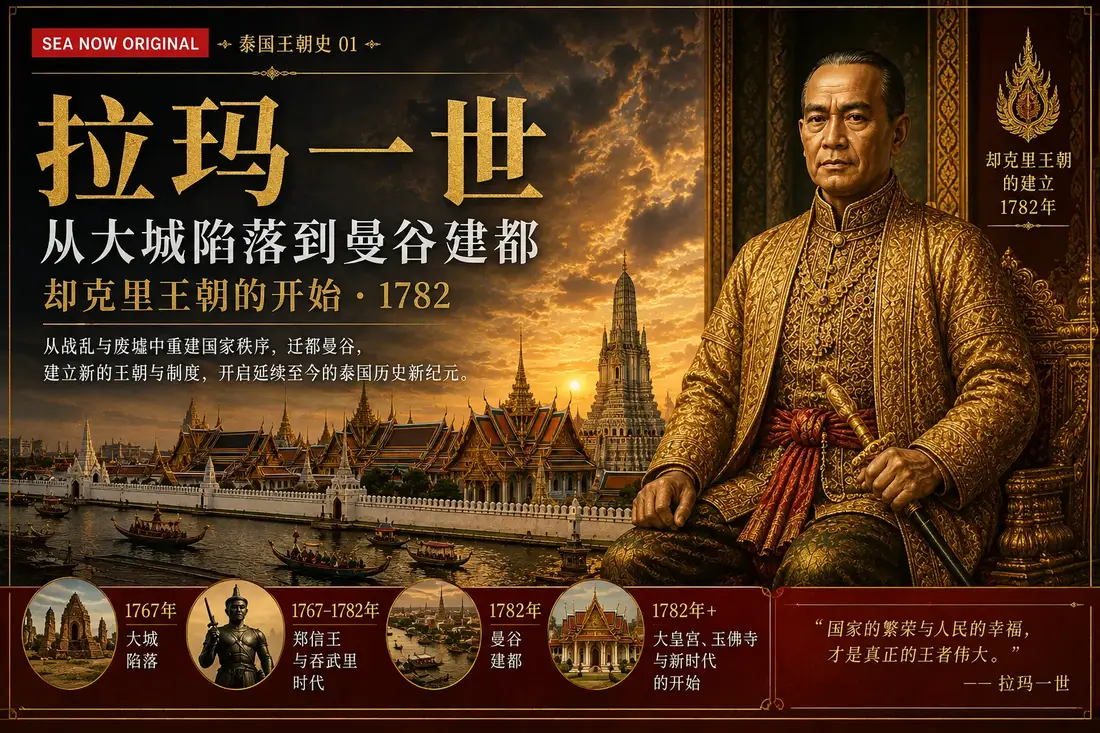
SEA NOW ORIGINAL · THAI ROYAL HISTORY 01 King Rama I: From the Fall of Ayutthaya to the Founding of Bangkok
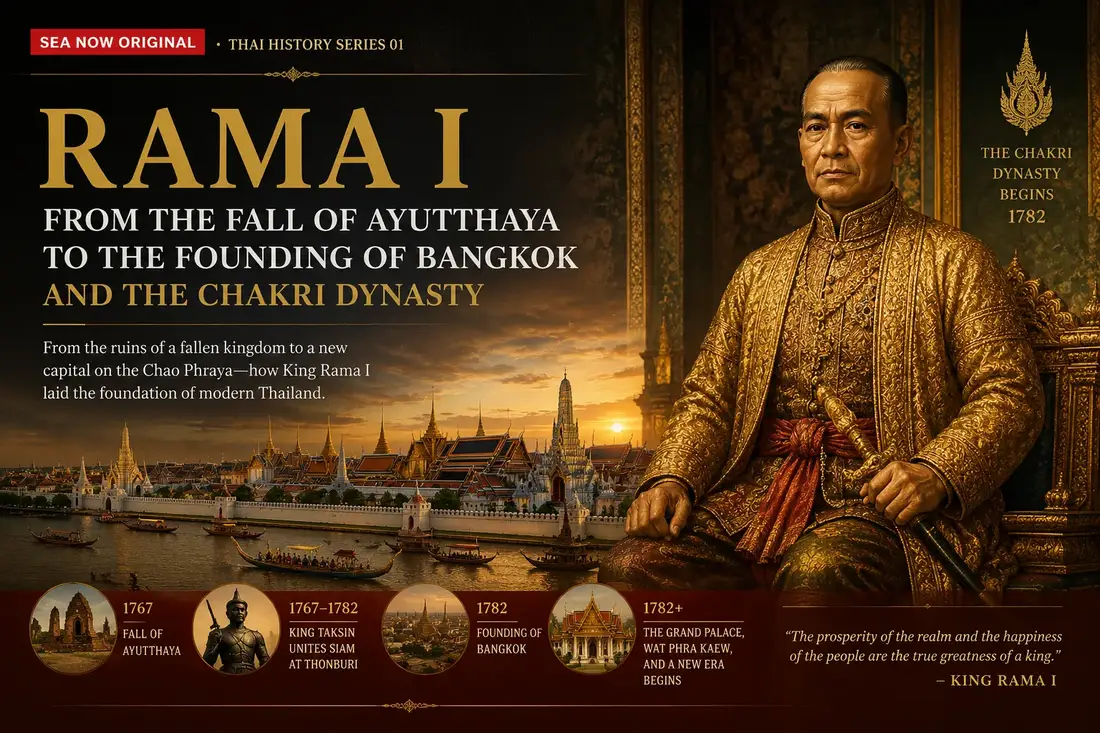
How King Rama I established the Chakri Dynasty, founded Bangkok as the new capital, and rebuilt Siam’s political, legal, religious, and cultural foundations
Reign: 1782–1809 Dynasty: Chakri Dynasty Historical Era: Early Rattanakosin Period
Introduction: To Understand Bangkok, We Have to Go Back to 1767
For most visitors today, Bangkok is a vast modern metropolis—a city of skyscrapers, shopping malls, expressways, BTS and MRT lines, luxury hotels, street markets, temples, and neighborhoods stretching far beyond the Chao Phraya River.
Yet at the historical heart of Bangkok, a very different city remains visible.
The Grand Palace, Wat Phra Kaew, Wat Pho, the old canals, the Chao Phraya River, and the streets of Rattanakosin all point back to one decisive period in Thai history.
That period began in 1782, when King Rama I established the Chakri Dynasty and moved the political center of Siam to the eastern bank of the Chao Phraya River.
But the story of Rama I does not begin in 1782.
To understand why Bangkok was founded, why a new dynasty emerged, and why Rama I became one of the most consequential monarchs in Thai history, we first have to go back fifteen years earlier—to the destruction of Ayutthaya in 1767.
1. 1767: The Fall of Ayutthaya and the Collapse of an Era
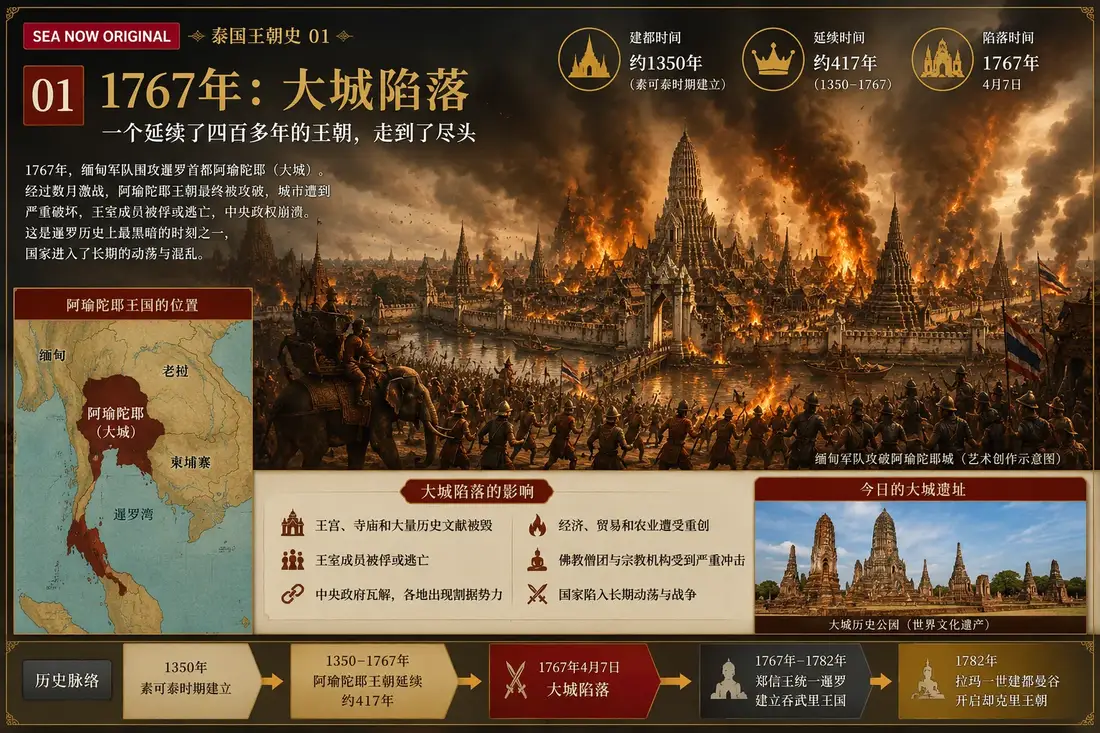
SEA NOW Thailand · Rama I · Illustration 01
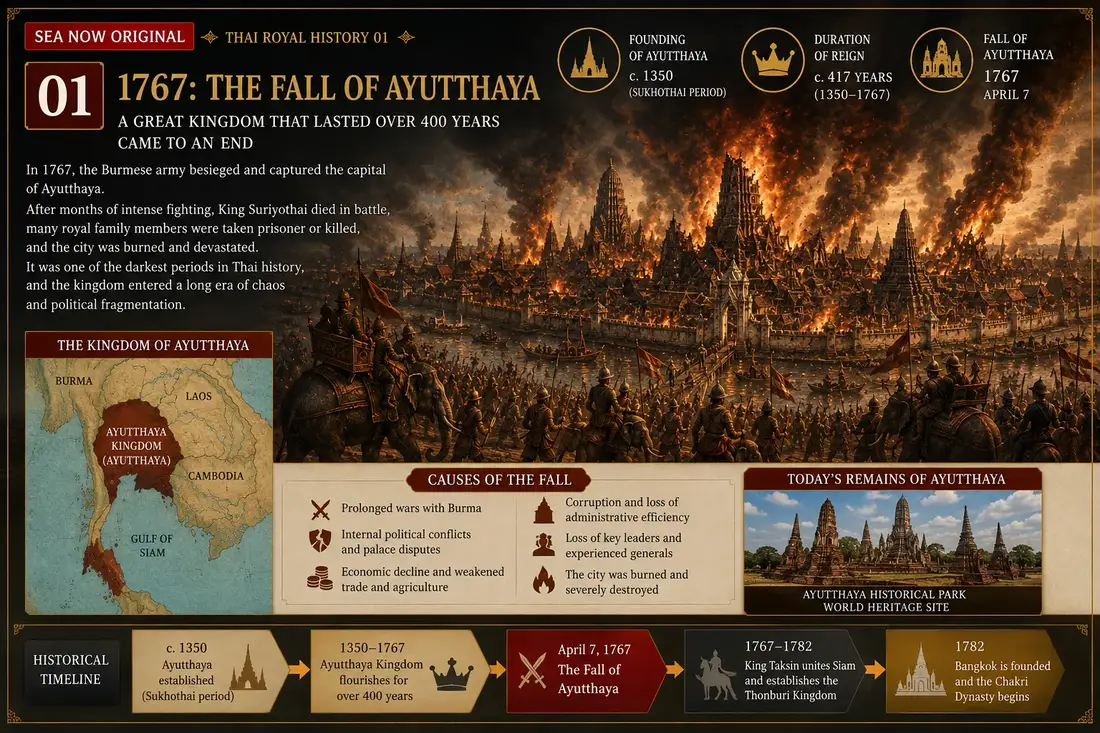
For more than four centuries, Ayutthaya had been one of the great political and commercial centers of mainland Southeast Asia.
Founded in 1351, the Ayutthaya Kingdom developed extensive diplomatic and trading connections with China, India, Persia, Japan and European powers.
Its location connected inland Southeast Asia with international maritime trade.
Foreign merchants arrived at the capital. Diplomats entered the royal court. Temples, palaces and settlements expanded across the island city.
For generations, Ayutthaya represented the political center of Siam.
Then came 1767.
After prolonged warfare, Burmese forces captured Ayutthaya.
The old capital was devastated, the royal government collapsed, and the kingdom's political order fragmented.
What disappeared was not simply a city.
A political system that had existed for centuries had broken apart.
Government institutions were disrupted. Communities were displaced. Religious and cultural institutions suffered severe damage. Regional leaders competed for authority.
Siam entered one of the most dangerous periods in its history.
Standing among the ruins of Ayutthaya today, it can be difficult to imagine the scale of that crisis.
The broken stupas and ruined temples now visited by travelers were once part of the center of a functioning kingdom.
In 1767, however, there was no guarantee that the kingdom would be reunited.
Before Bangkok could ever be founded, Siam first had to survive.
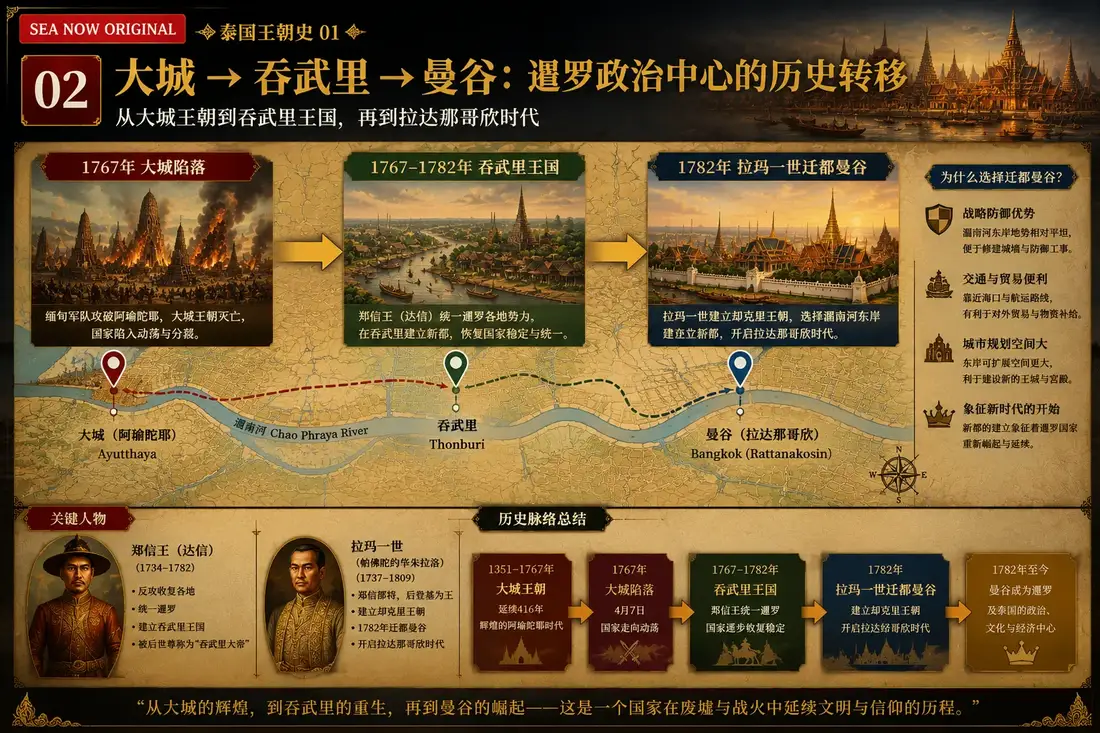
2. From Ayutthaya to Thonburi: The Kingdom Is Reunified
SEA NOW Thailand · Rama I · Illustration 02
The years immediately following the fall of Ayutthaya were chaotic.
One of the most important figures to emerge from this period was King Taksin.
Taksin gathered military forces, defeated rival regional powers and played the decisive role in reuniting much of the former Siamese territory.
Rather than attempting to restore devastated Ayutthaya as his capital, he established a new political center farther south along the Chao Phraya River.
That capital was Thonburi.
This decision changed the geographical direction of Siamese political history.
Thonburi was closer to the sea and international trade routes. Its location also offered strategic advantages during a period when renewed warfare remained a constant possibility.
The center of power had now moved away from Ayutthaya and toward the area that would eventually become metropolitan Bangkok.
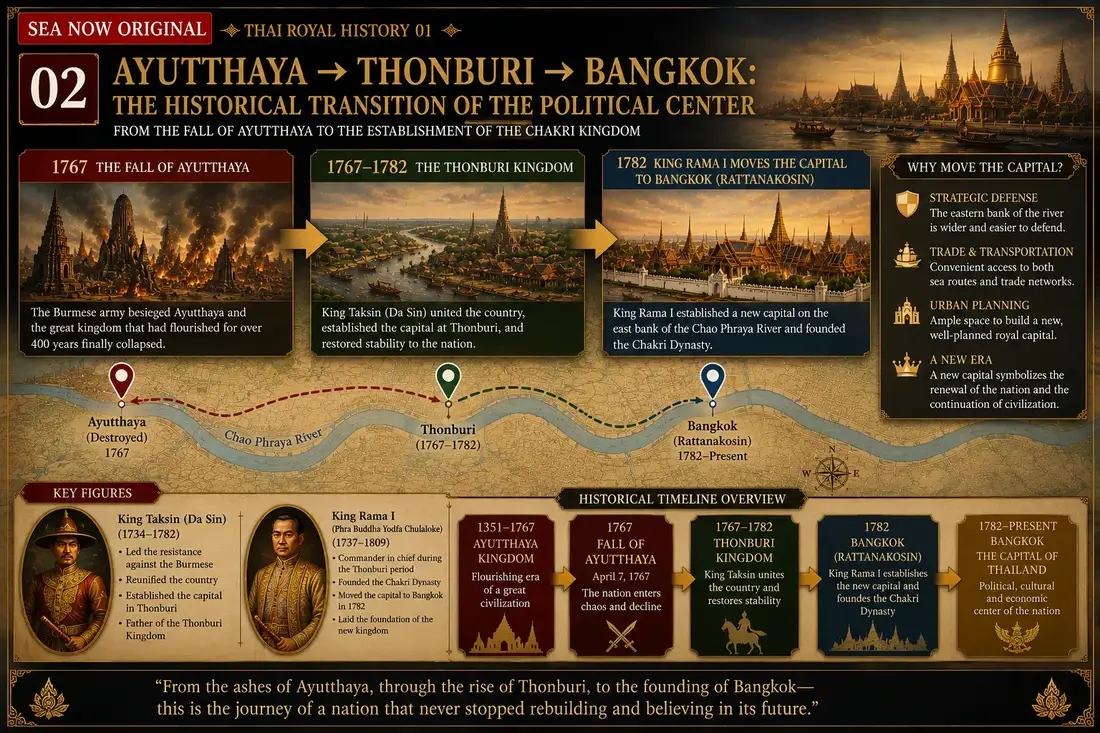
This is why the history of modern Bangkok cannot be understood simply as:
Ayutthaya → Bangkok.
The real transition was:
Ayutthaya → Thonburi → Bangkok.
King Taksin's reunification of Siam created the political foundation upon which the next era would be built.
And among the military leaders who rose during the Thonburi period was a man who would eventually become King Rama I.
3. Before He Was King: Rama I as a Military and Political Leader
SEA NOW Thailand · Rama I · Illustration 03
King Rama I was born in 1737, during the final decades of the Ayutthaya Kingdom.
He therefore belonged to a generation that experienced both the old Ayutthaya political world and the upheaval that followed its destruction.
Before becoming king, he built his reputation through military and political service.
During the Thonburi period, he became one of the kingdom's leading commanders and participated in campaigns that helped consolidate Siamese power.
This background is essential to understanding his later reign.
Rama I was not a monarch formed in an era of uninterrupted peace.
His political outlook developed during decades of war, fragmentation and reconstruction.
Security was not an abstract concept.
He had experienced what happened when a capital fell and central authority collapsed.
That experience helps explain many of the priorities that later defined his reign:
strong defense,
a secure capital,
effective administration,
clear laws,
religious legitimacy,
and political stability.
The first challenge facing his generation was survival.
The second was reunification.
The third would be rebuilding a state capable of enduring.
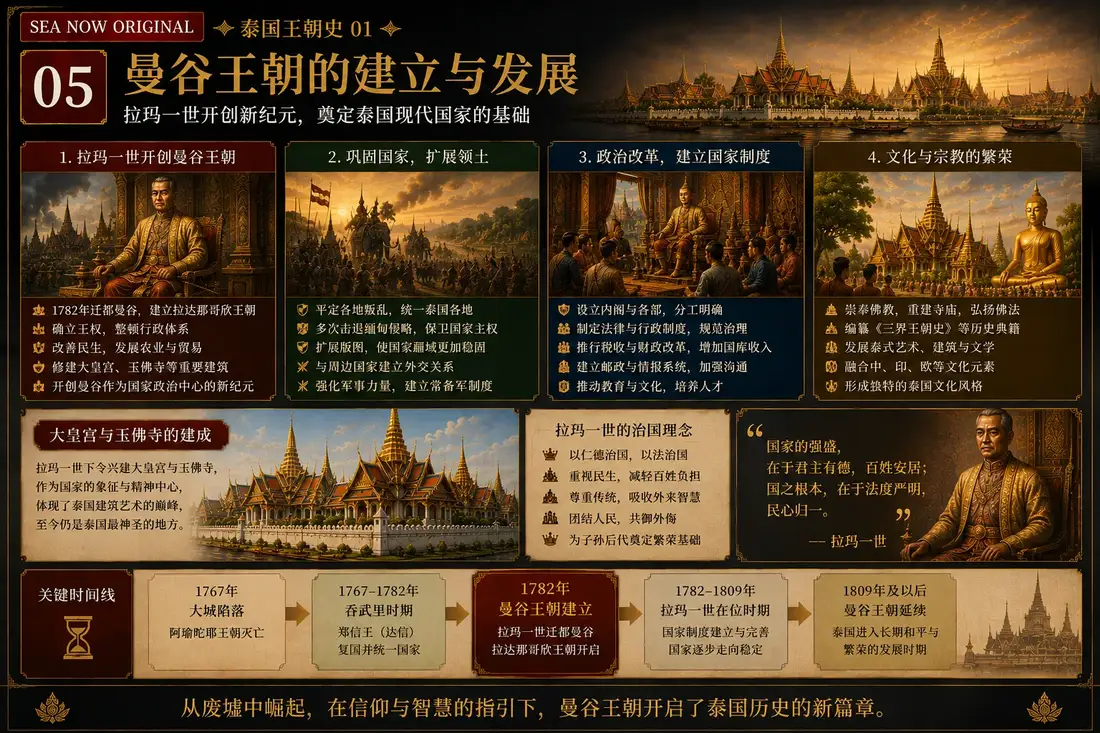
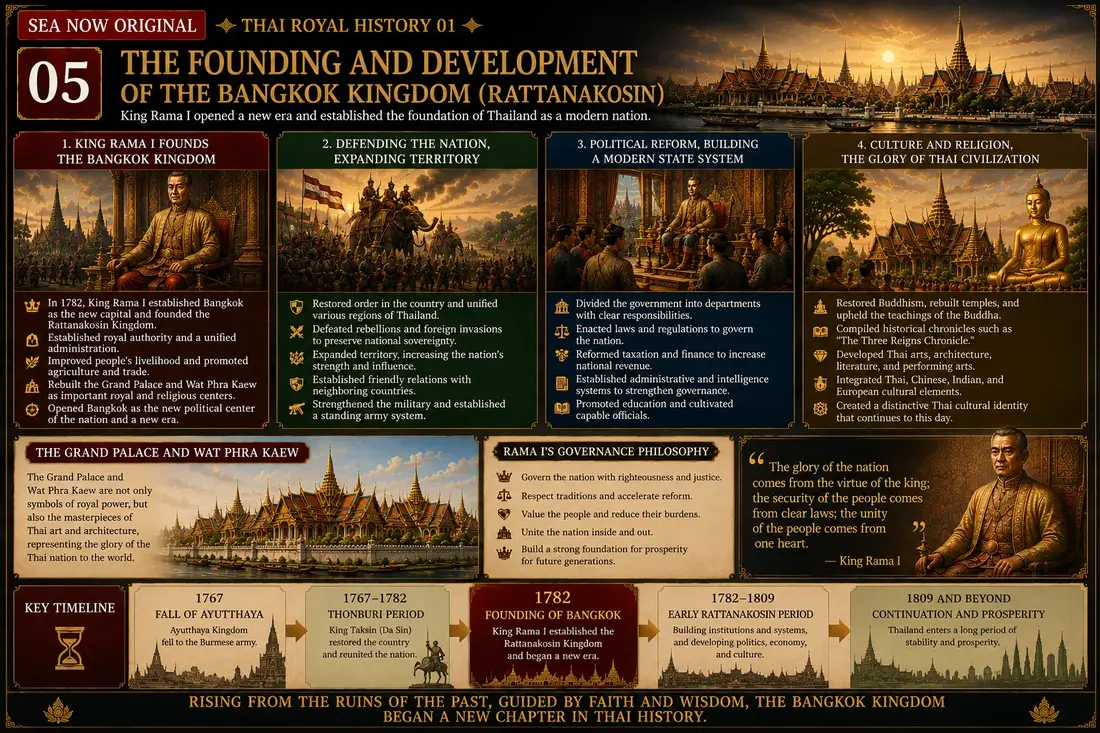
4. 1782: King Rama I Ascends the Throne
SEA NOW Thailand · Rama I · Illustration 04
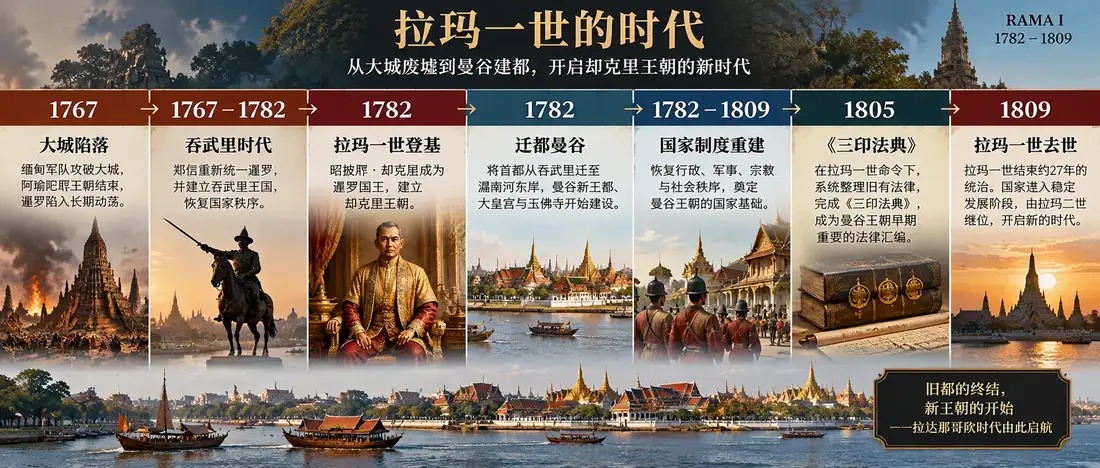
In 1782, the Thonburi period came to an end.
Rama I ascended the throne and established a new royal dynasty:
The Chakri Dynasty
This was the beginning of the dynasty that continues in Thailand today.
Rama I's accession therefore represents much more than the beginning of one king's reign.
It marks the beginning of an entirely new political era.
The period that followed became known as the Rattanakosin Era.
Rama I would reign from 1782 until his death in 1809.
During those twenty-seven years, he faced an enormous task.
The kingdom had survived the destruction of Ayutthaya.
It had been reunited during the Thonburi period.
Now it needed durable institutions.
It needed a secure political center.
It needed laws.
It needed religious and cultural restoration.
And it needed a capital capable of representing the authority of the new dynasty.
Rama I's answer was Bangkok.
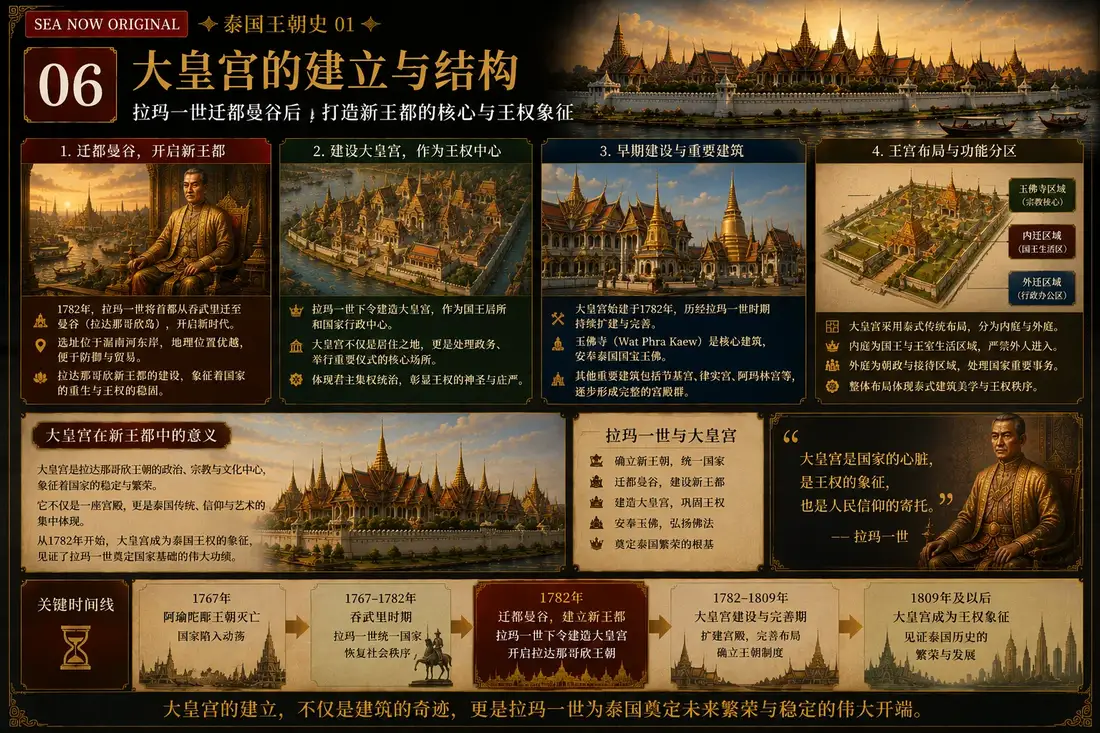
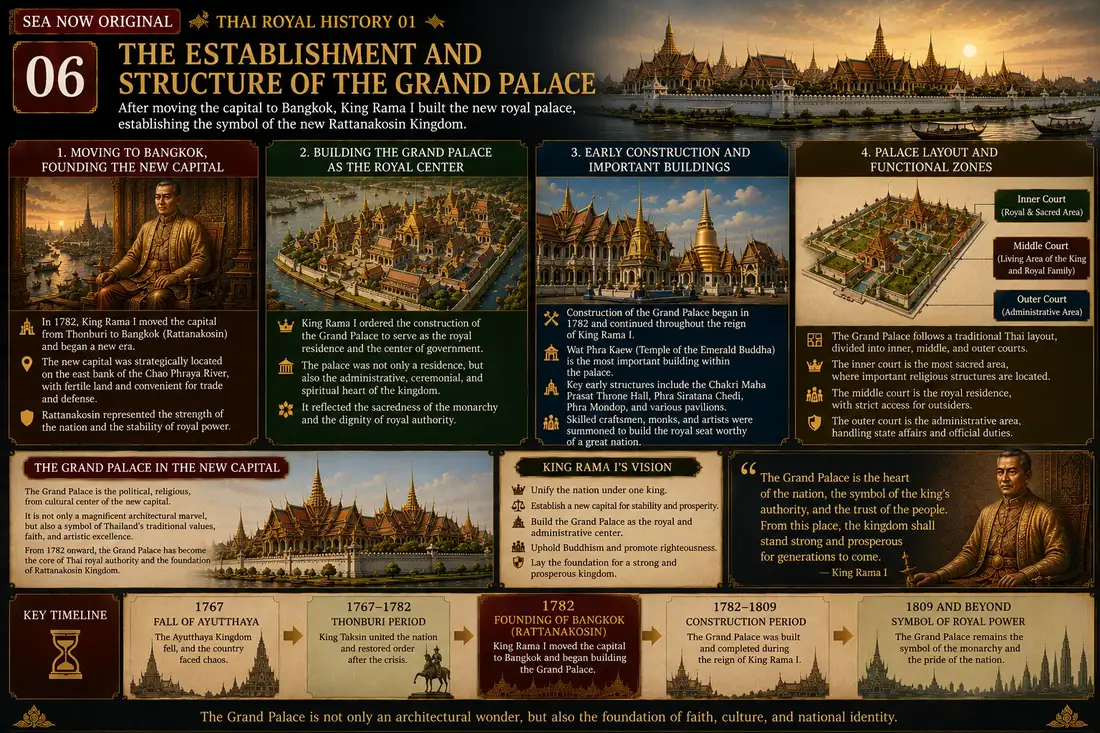
5. Why Rama I Moved the Capital to Bangkok
SEA NOW Thailand · Rama I · Illustration 05
One of Rama I's first and most important decisions was to move the capital from Thonburi on the western bank of the Chao Phraya River to the eastern bank.
This became the foundation of the historical center of modern Bangkok.
The decision was strategic as well as political.
The Chao Phraya River provided a major natural defensive barrier, while canals could be used to strengthen the protection of the new capital.
The eastern side also provided greater possibilities for the expansion and organization of a new royal city.
The result was Rattanakosin.
This was not simply the construction of another palace.
Rama I was establishing the physical center of a new political order.
Palaces, temples, government offices, defensive structures, walls, waterways and residential communities gradually formed around the new capital.
In this sense, Bangkok began not merely as a settlement but as a deliberate royal capital.
The geography of central Bangkok today still reflects this decision made in 1782.
More than two centuries later, the Grand Palace and Wat Phra Kaew remain at the symbolic center of the historic city.
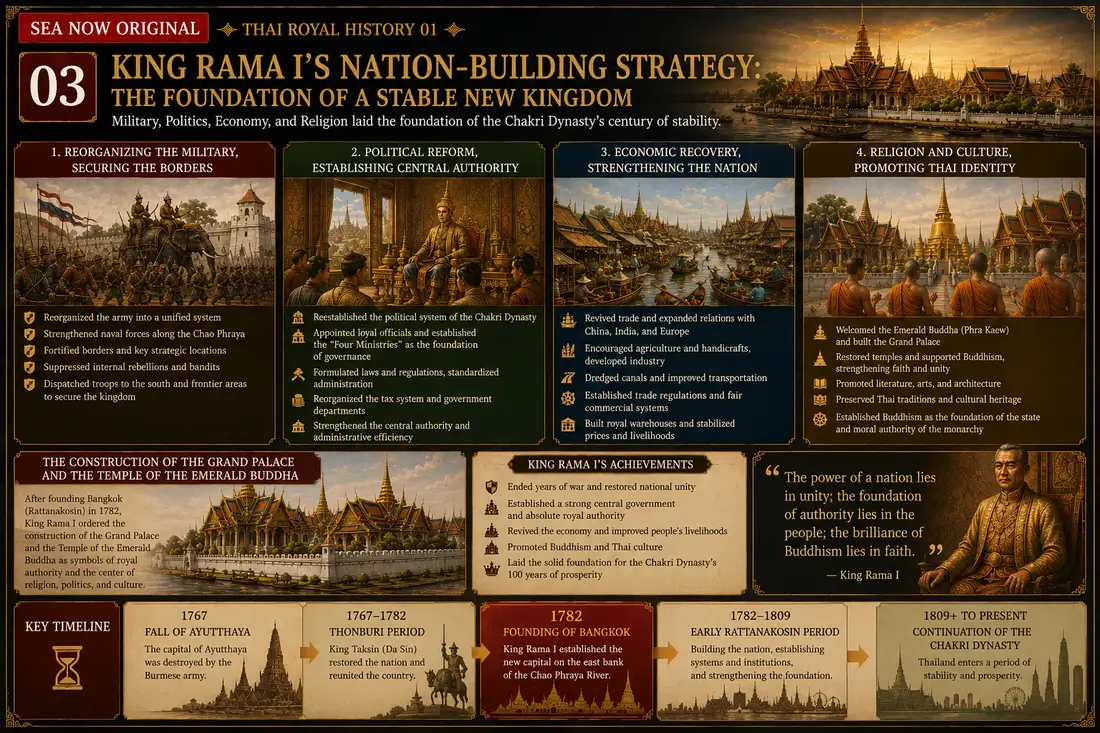
6. The Grand Palace: Building the Center of the New Kingdom
SEA NOW Thailand · Rama I · Illustration 06
Construction of the Grand Palace began in 1782.
Today it is one of Thailand's most famous landmarks, visited by travelers from around the world.
But to Rama I, it was not a tourist attraction or simply an impressive royal residence.
It was part of the machinery of the state.
The palace served as the king's residence while also functioning as a center of administration, royal ceremony and political authority.
Its design drew on traditions inherited from earlier Siamese capitals, especially Ayutthaya.
This was highly significant.
Rama I was creating a new dynasty, but he was not attempting to erase the civilization that had existed before him.
Instead, many elements of Ayutthaya's political, architectural, religious and cultural traditions were revived within the new capital.
Even construction materials symbolically connected the two eras.
Bricks from ruined structures in old Ayutthaya were transported down the Chao Phraya River and reused in construction associated with the new capital.
The image is historically powerful:
materials from a fallen capital became part of a rising one.
Rattanakosin was new.
But it also represented continuity.
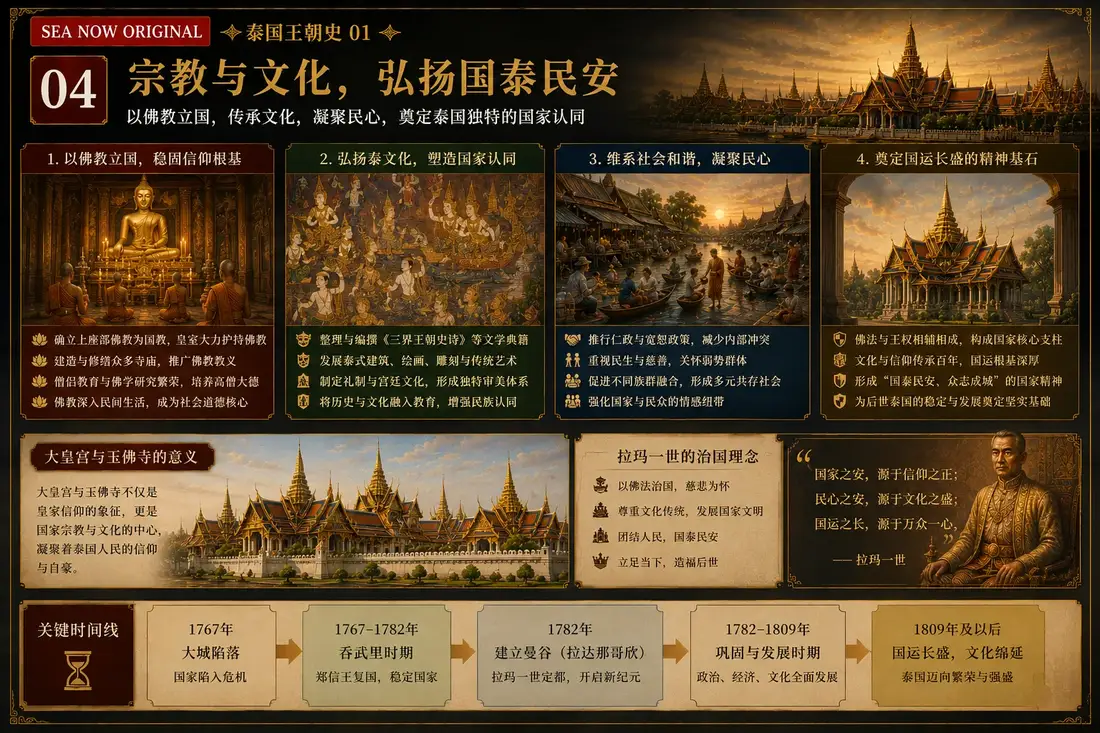
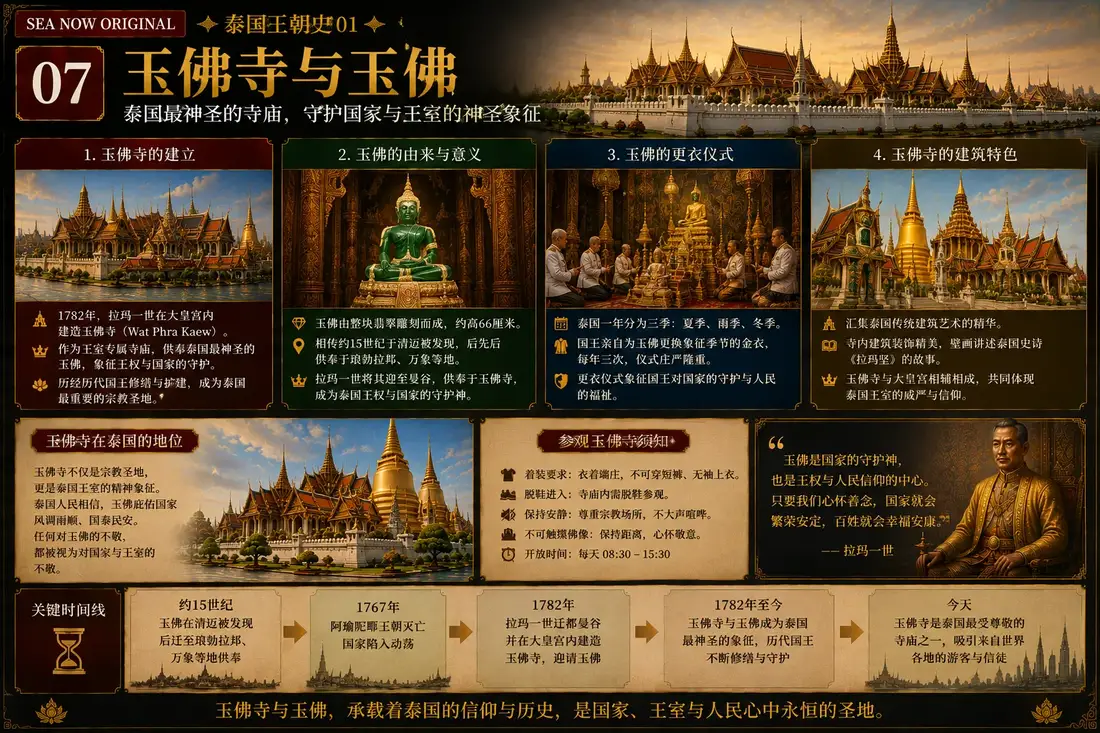
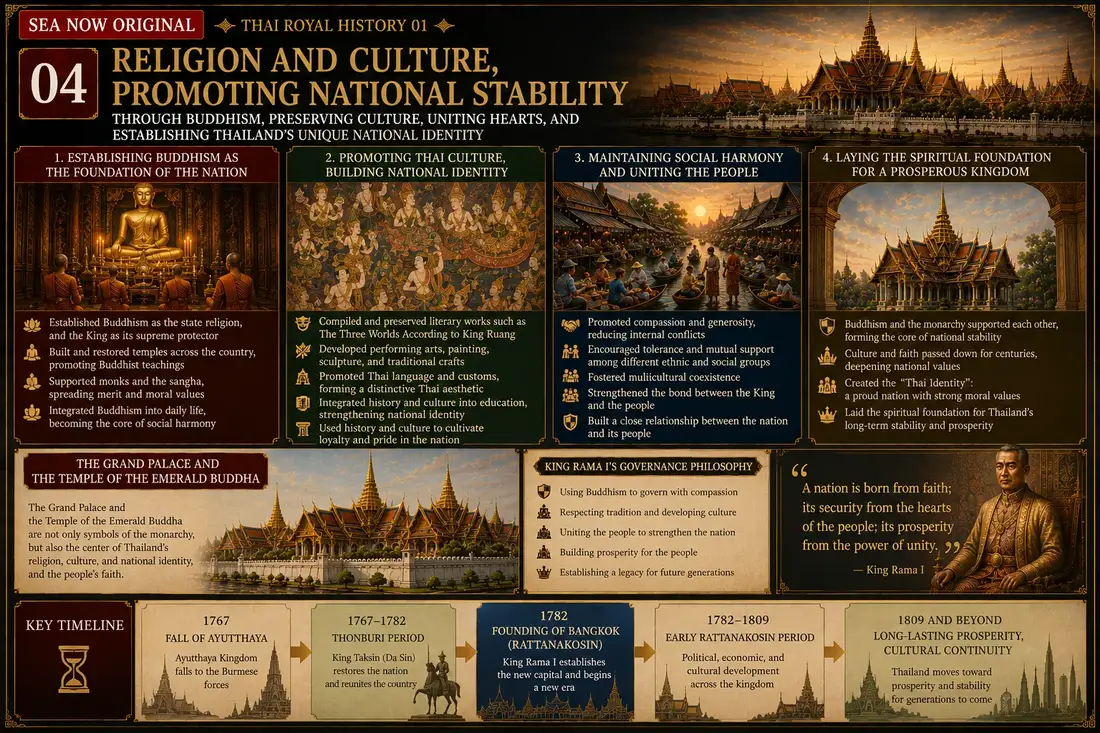
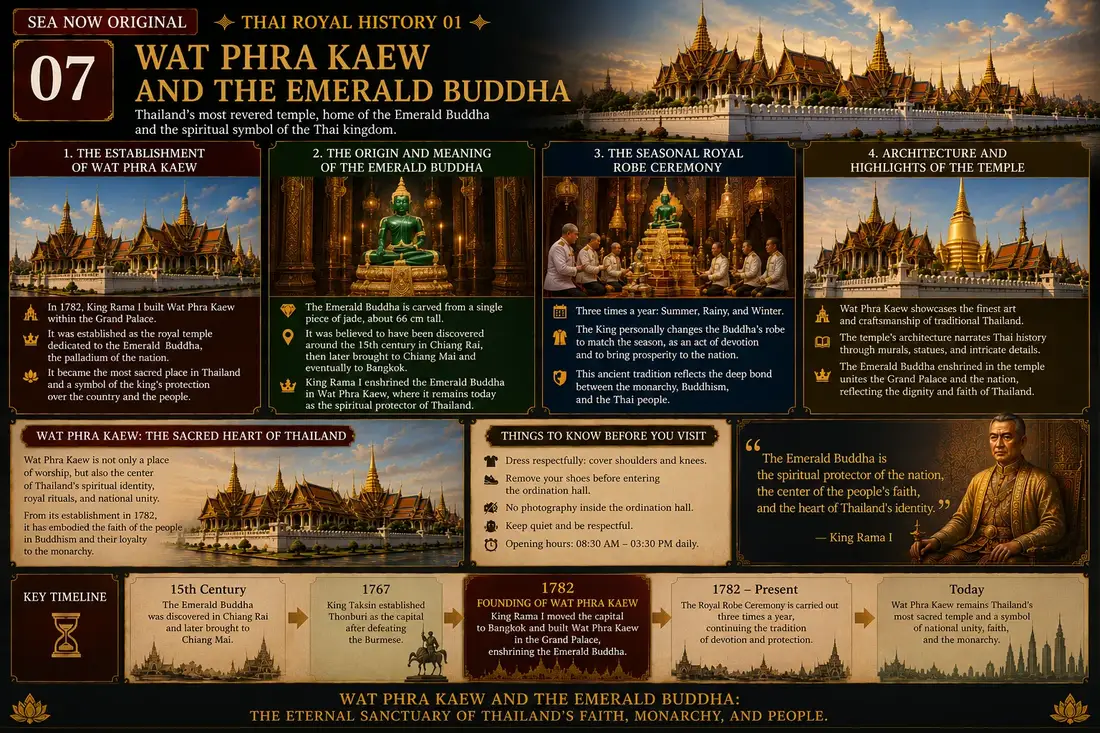
7. Wat Phra Kaew and the Emerald Buddha
SEA NOW Thailand · Rama I · Illustration 07
Within the Grand Palace complex, Rama I established one of the most important religious sites in Thailand:
Wat Phra Kaew The Temple of the Emerald Buddha
The temple was created as a royal temple and became the home of the Emerald Buddha, one of Thailand's most sacred religious images.
Unlike ordinary Buddhist monasteries, Wat Phra Kaew does not function as a residential monastery for monks.
Its role is closely connected to the monarchy, royal ceremonies and the symbolic relationship between Buddhism and the Thai state.
The placement of the Emerald Buddha within the new royal capital carried profound meaning.
A new dynasty needed more than military power.
It needed political legitimacy.
It needed institutions.
It needed cultural continuity.
And within the traditional Siamese political world, Buddhism was deeply connected to ideas of kingship, morality and social order.
By placing the Emerald Buddha at the heart of the new capital, Rama I linked the Chakri monarchy with one of the kingdom's most powerful religious symbols.
The Grand Palace represented royal authority.
Wat Phra Kaew represented sacred legitimacy.
Together, they became two pillars of the new Rattanakosin capital.
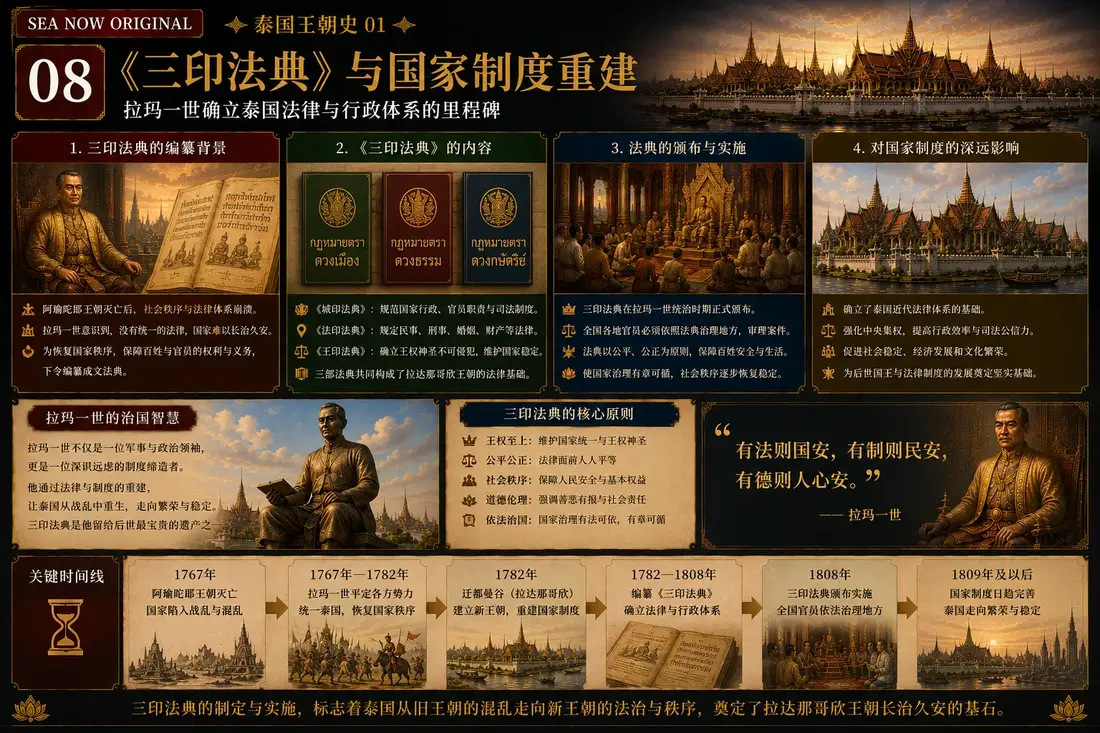
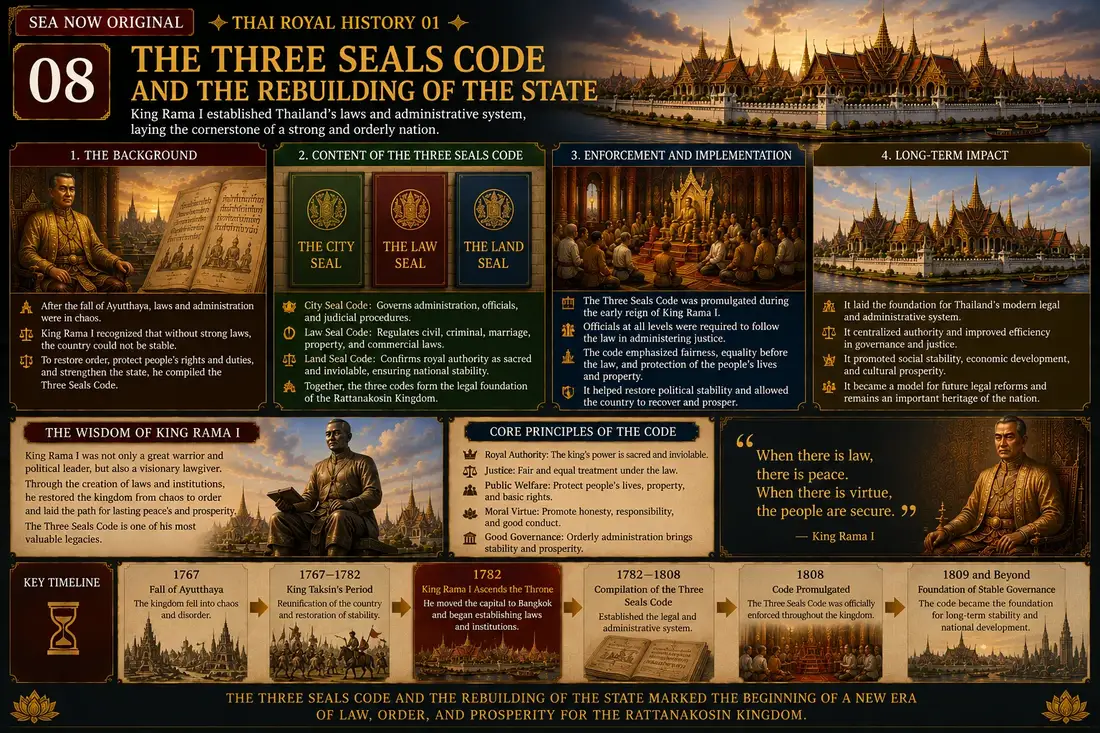
8. The Three Seals Code: Rebuilding the Legal Order
SEA NOW Thailand · Rama I · Illustration 08
Buildings alone cannot rebuild a state.
After decades of warfare and political disruption, Siam also needed a functioning legal and administrative system.
One of the most important institutional achievements associated with Rama I's reign was the systematic revision and compilation of existing Siamese laws.
In 1805, Rama I ordered a major review of the legal tradition.
The resulting collection became known as the:
Three Seals Code Kotmai Tra Sam Duang
The name refers to the three official seals associated with major branches of the traditional administration.
The importance of the code went far beyond the production of a legal manuscript.
The destruction of Ayutthaya had disrupted archives, institutions and the continuity of government.
Recompiling the law therefore represented a larger political project:
restoring order after institutional collapse.
The code addressed areas of governance, judicial procedure, family matters, property, social relations and other aspects of life within the kingdom.
For Rama I, rebuilding Siam required more than winning wars.
A stable kingdom needed rules that government officials and courts could apply.
The Three Seals Code became one of the most important symbols of that institutional reconstruction.
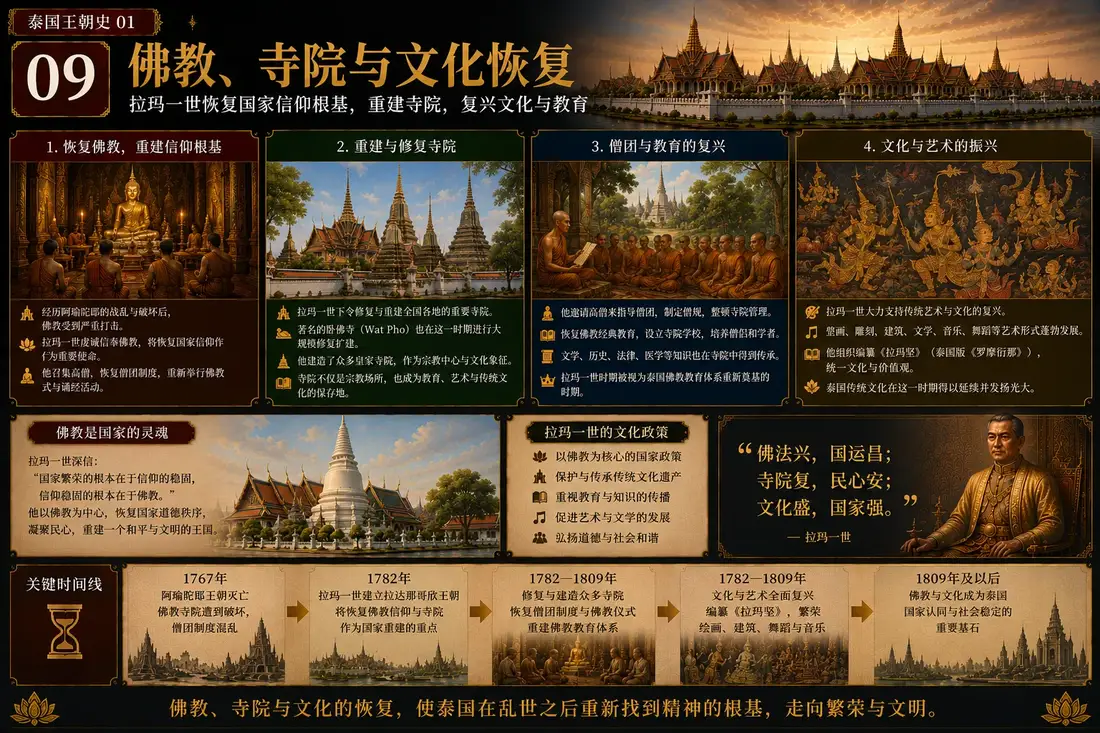
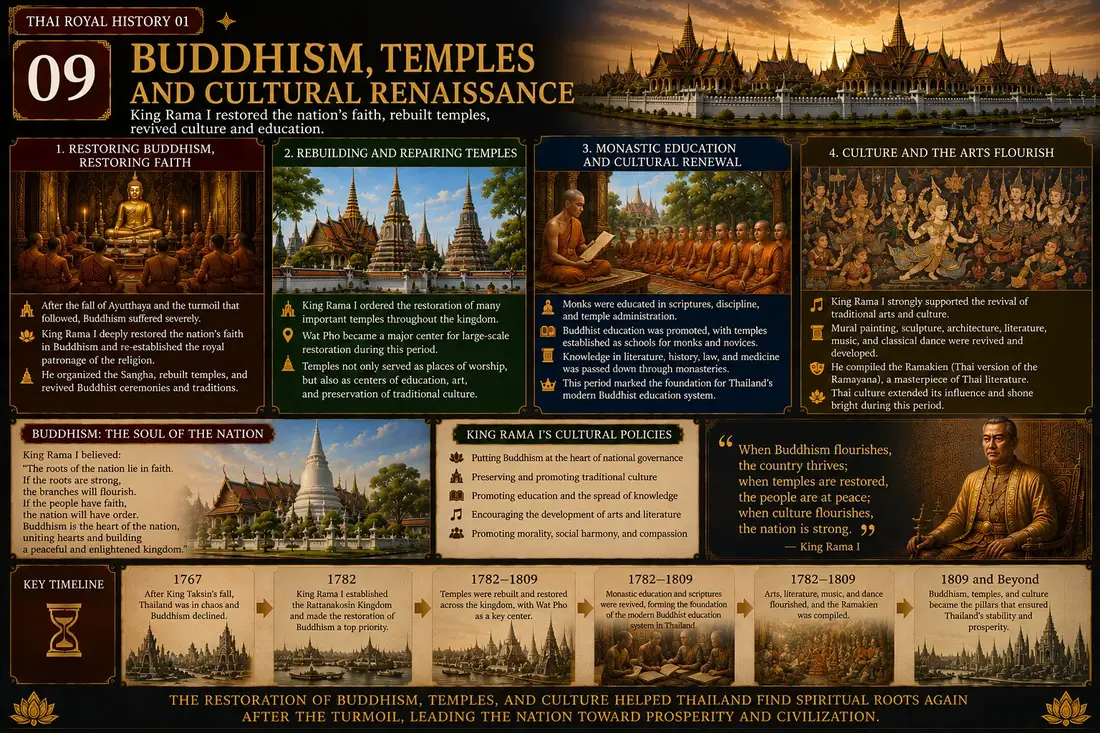
9. Restoring Buddhism, Temples and Cultural Life
SEA NOW Thailand · Rama I · Illustration 09
The fall of Ayutthaya damaged more than political institutions.
Religious institutions, temples, manuscripts and cultural traditions had also suffered.
For Rama I, restoring the kingdom therefore included restoring Buddhism.
Temples were rebuilt or renovated.
The Sangha—the Buddhist monastic community—received renewed royal attention.
Religious texts and practices were reviewed and preserved.
Important temples in and around Bangkok were restored and incorporated into the religious landscape of the new capital.
One important example was Wat Pho, whose restoration under Rama I helped transform it into one of Bangkok's major royal temples.
But temples in traditional Siamese society were more than places of worship.
They also served as centers of education, knowledge, community life and cultural transmission.
This meant that rebuilding temples contributed to the restoration of society itself.
Religion, education, morality and political legitimacy were deeply interconnected.
Rama I's religious policies therefore formed part of a much larger project:
rebuilding confidence in the kingdom after decades of instability.
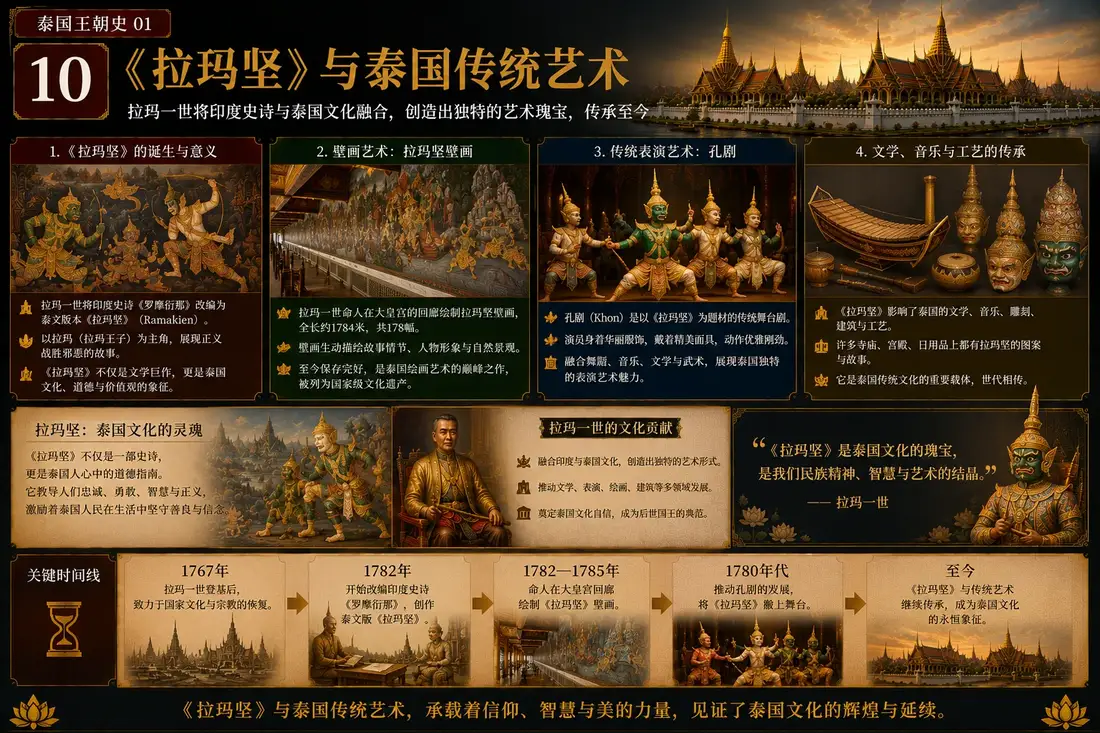
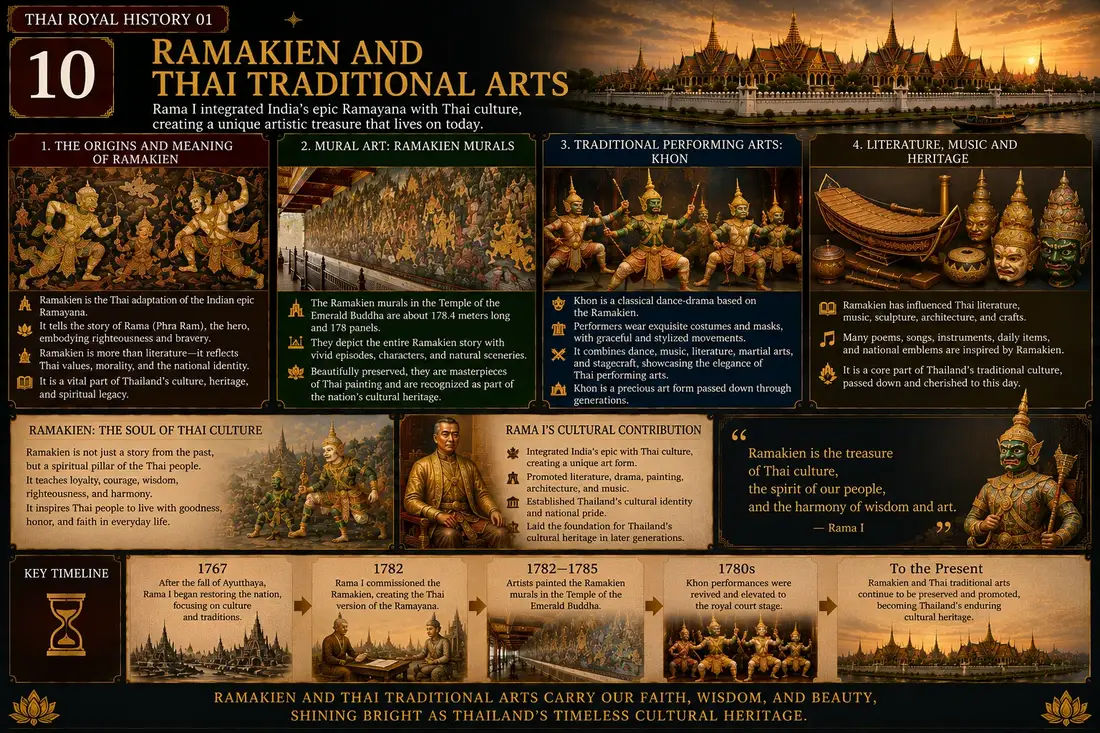
10. Ramakien and the Restoration of Thai Cultural Identity
SEA NOW Thailand · Rama I · Illustration 10
A kingdom also needs stories.
War can destroy buildings.
It can destroy manuscripts.
It can interrupt artistic traditions.
But cultural memory can be reconstructed.
One of the most famous examples from Rama I's reign is the Ramakien.
The Ramakien developed from the wider cultural tradition of the Indian Ramayana, but over centuries it became deeply adapted to Thai language, aesthetics, performance and ideas.
Under Rama I, a major Thai version of the epic was compiled.
The story became closely associated with Thai literature, dance, theatre, painting and royal culture.
Its characters appear throughout traditional Thai art.
Its stories became central to Khon, Thailand's classical masked dance-drama.
And perhaps its most visible expression for modern visitors can be found at Wat Phra Kaew.
The extensive Ramakien murals surrounding the temple complex transform the epic into a monumental visual narrative.
This tells us something important about Rama I's reconstruction of Siam.
He was not rebuilding only armies, walls and government offices.
He was rebuilding cultural memory.
The new Rattanakosin Kingdom needed to know not only how it would be governed, but also how it understood itself.
11. War, Defense and the Survival of the New Capital
The establishment of Bangkok did not mean that the military danger had disappeared.
Siam continued to face serious external threats during Rama I's reign.
One of the most important conflicts was the Nine Armies' War of 1785–1786, when Burmese forces launched a major invasion of Siam.
The new Chakri government was still young.
Bangkok had been established only a few years earlier.
A major defeat could have threatened the survival of the new political order.
Siamese forces resisted the invasion successfully.
The conflict reinforced the importance of military organization and national defense during Rama I's reign.
This is another reason why the location and defensive planning of Bangkok mattered so much.
Rama I had lived through the fall of one capital.
His new capital had to be capable of surviving another major war.
Security therefore remained one of the foundations upon which the Rattanakosin state was built.
12. Trade, Economy and the Return of Stability
National recovery required more than political stability.
It also required economic revival.
The wars of the eighteenth century had disrupted agriculture, population centers, transportation and trade.
As stability gradually returned, economic activity could recover.
Siam maintained important commercial connections with China and other regional trading networks.
Bangkok's location on the Chao Phraya River was particularly advantageous.
The river connected inland agricultural areas to maritime trade routes.
This helped the new capital develop simultaneously as a political center and a commercial hub.
The relationship between river, trade and state power would remain central to Bangkok's development for generations.
Long before modern highways, airports or railways existed, the Chao Phraya was one of the great arteries of the kingdom.
The decision to establish the capital here would have economic consequences far beyond Rama I's lifetime.
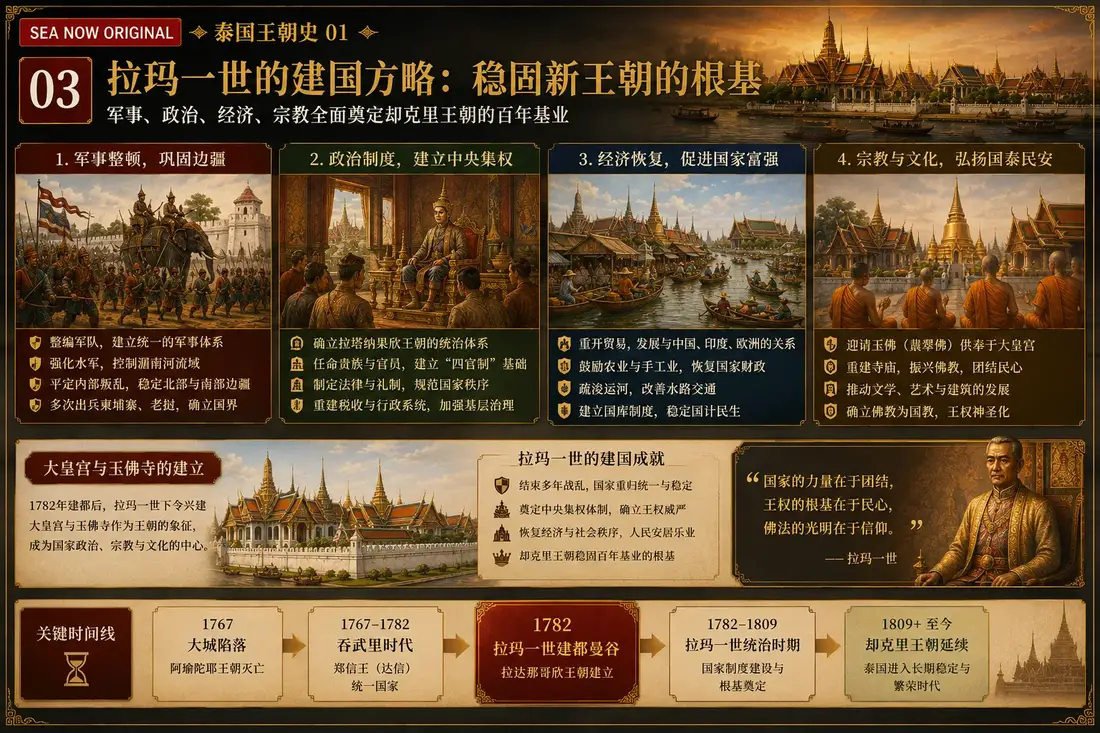
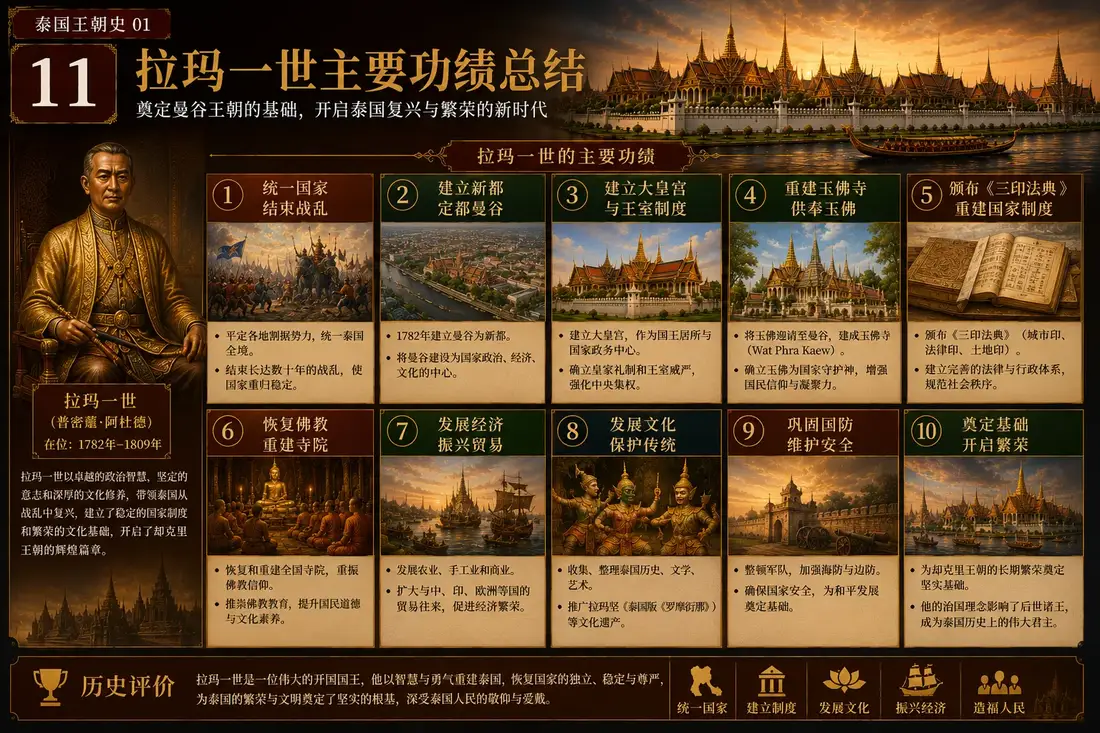
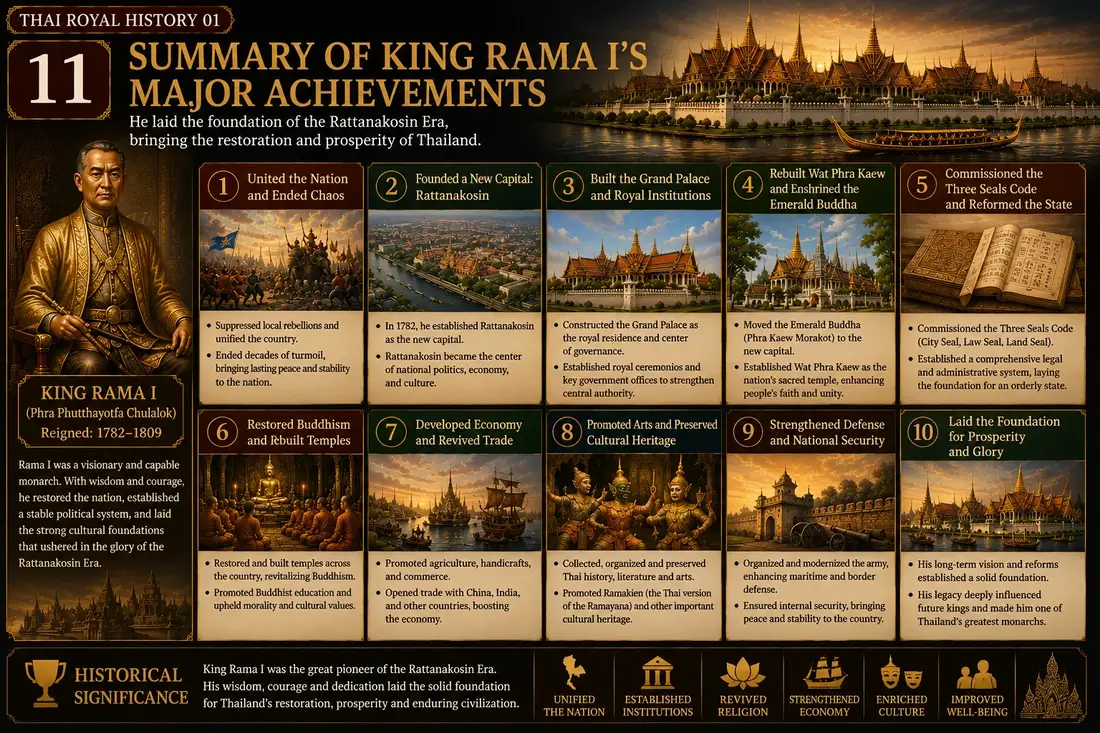
13. Rama I's Major Achievements
SEA NOW Thailand · Rama I · Illustration 11
When Rama I died in 1809, he left behind a kingdom dramatically different from the fragmented Siam that had emerged after the destruction of Ayutthaya.
His achievements can be understood across several major areas.
He helped consolidate the kingdom and strengthen national security.
He established the Chakri Dynasty.
He founded Bangkok as the new capital.
He created the political center of Rattanakosin.
He built the Grand Palace.
He established Wat Phra Kaew as the royal temple and enshrined the Emerald Buddha there.
He strengthened government and administrative institutions.
He ordered the compilation of the Three Seals Code.
He supported the restoration of Buddhism and important temples.
He encouraged the revival of literature, art and traditional culture.
He strengthened defense against external threats.
And he helped create the political stability necessary for economic recovery and future development.
None of these achievements existed in isolation.
Together they formed a larger project:
the reconstruction of Siam after one of the greatest crises in its history.
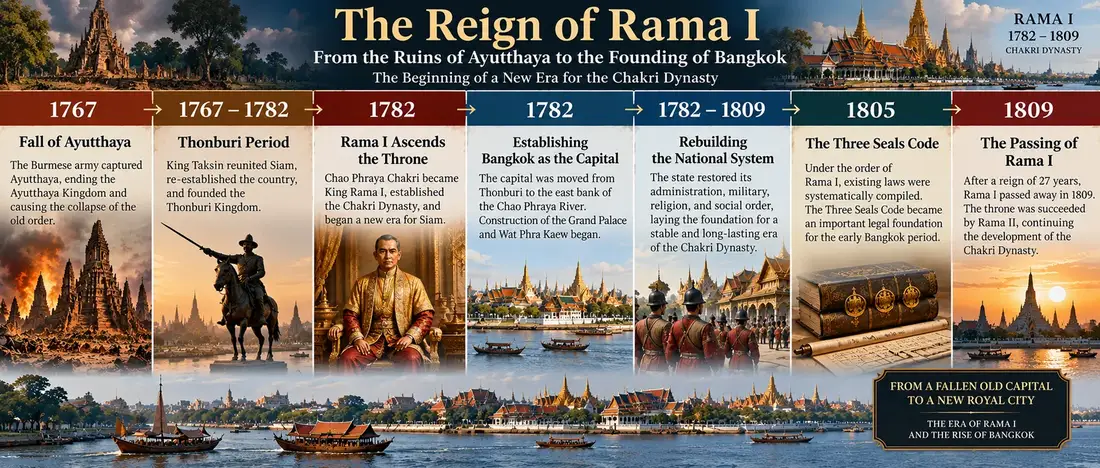
14. 1767 → 1782 → 1809: From Destruction to Reconstruction
SEA NOW Thailand · Rama I · Illustration 12
The significance of Rama I becomes clearest when we look at the three dates that define this story.
1767
Ayutthaya fell.
A kingdom that had existed for more than four centuries lost its capital.
Political authority fragmented.
Siam entered a period of war and uncertainty.
1782
Rama I ascended the throne.
The Chakri Dynasty began.
The political center moved to the eastern bank of the Chao Phraya River.
Bangkok became the new capital.
Construction began on the Grand Palace and Wat Phra Kaew.
The Rattanakosin Era had begun.
1809
Rama I died after twenty-seven years on the throne.
By then, the new capital was established.
The monarchy had been consolidated.
Government institutions had been reorganized.
The legal system had been reviewed and compiled.
Buddhism and major temples had been restored.
Literature and the arts were flourishing again.
The kingdom had survived major military threats.
A new political order had taken root.
The distance between 1767 and 1809 was only forty-two years.
Historically, however, the transformation was enormous.
15. Did Rama I “Found Thailand”?
This question requires an important distinction.
It would not be historically accurate to say that Rama I founded Thailand.
Thai history did not begin in 1782.
Long before Rama I, the region had seen major Thai kingdoms and political centers, including Sukhothai, Ayutthaya and Thonburi.
Nor did the country use the modern official name “Thailand” during Rama I's reign.
The state was historically known to foreigners as Siam, while political identity and terminology evolved over time.
A more accurate description is:
King Rama I founded the Chakri Dynasty, established Bangkok as the new capital, and reconstructed the political, legal, religious and cultural foundations of Siam after the destruction of Ayutthaya and the Thonburi period.
That distinction matters.
Rama I did not create Thai civilization from nothing.
Instead, he inherited older traditions, preserved many of them, reorganized others, and built a new political center capable of carrying them into a different era.
16. The Bangkok of Today Still Reflects the Decisions of 1782
More than two centuries later, Rama I's decisions remain visible in Bangkok.
Stand beside the Chao Phraya River and look toward the historic center.
The Grand Palace still dominates the old royal district.
Wat Phra Kaew remains one of Thailand's most sacred sites.
Rattanakosin remains the historical heart of Bangkok.
Wat Pho remains nearby.
Across the river lies Thonburi—the capital of the previous era.
Farther north along the river lies Ayutthaya—the capital that fell in 1767.
Seen geographically, these places form an extraordinary historical corridor:
Ayutthaya → Thonburi → Bangkok.
Three capitals.
Three political eras.
One river.
The Chao Phraya connects the destruction of the old kingdom, the reunification of Siam, and the birth of the Rattanakosin capital.
That is why understanding Rama I changes the way we see Bangkok.
The Grand Palace is no longer simply a beautiful landmark.
Wat Phra Kaew is no longer simply another famous temple.
Rattanakosin is no longer simply Bangkok's old town.
Together, they are physical evidence of how a kingdom rebuilt itself.
Conclusion: The King Who Built a New Era from the Ruins of the Old
King Rama I's historical importance lies not in a single achievement.
It lies in the scale of reconstruction that took place during his reign.
He inherited a kingdom shaped by the destruction of Ayutthaya, years of warfare and the extraordinary reunification achieved during the Thonburi period.
From that foundation, he established a new dynasty and a new capital.
He strengthened the government.
He reorganized the legal order.
He restored Buddhist institutions.
He rebuilt temples.
He revived literature and traditional culture.
He strengthened national defense.
And above all, he gave the new Rattanakosin Kingdom a political and cultural center that endured long after his death.
The story therefore should not be simplified into:
“Rama I founded Thailand.”
The deeper story is more interesting.
It is the story of how a kingdom that had suffered catastrophic destruction managed to preserve its past while constructing a new future.
In 1767, Ayutthaya fell.
In 1782, Bangkok rose as the new capital.
By 1809, the foundations of a new era had been firmly established.
And the dynasty founded by Rama I would continue to face challenges that he could never have imagined:
the expansion of European colonial empires,
the transformation of international trade,
industrial technology,
modern education,
constitutional government,
world wars,
and eventually the emergence of modern Thailand.
But before Siam could confront any of those challenges, it first had to recover.
That was the defining achievement of the age of King Rama I.