位于其出生地相关区域的King Rama II Memorial Park(拉玛二世纪念公园),就是后世纪念其文化贡献的重要地点之一。
他的名字也不断出现在:
泰国文学史、
传统艺术史、
文化教育、
古典表演
以及历史研究之中。
后世甚至将他的出生纪念日与泰国艺术文化纪念活动联系起来。
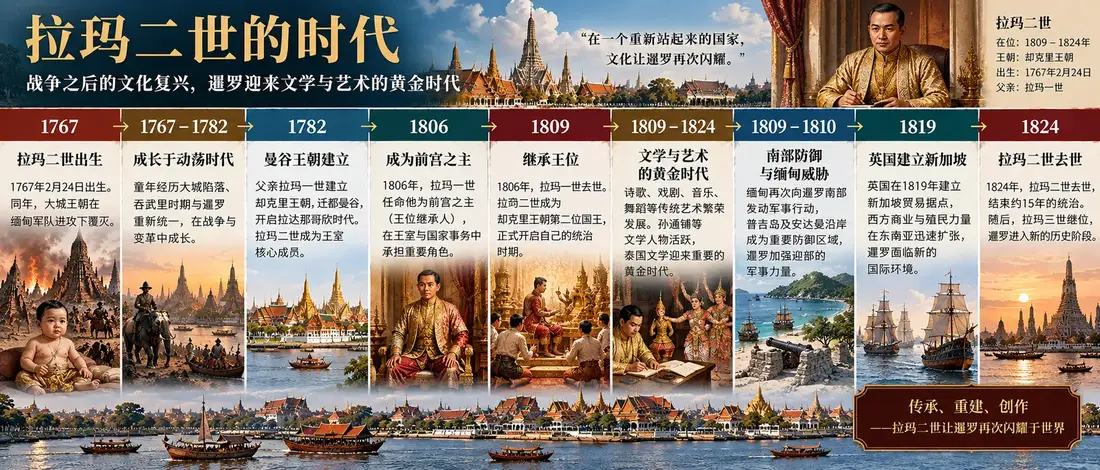
这说明拉玛二世留下的影响,并没有随着1824年的去世结束。
两百多年以后,人们记住他的方式依然非常特别:
不是因为一场决定性的征服。
而是因为:
文化。
结语|当一个国家重新开始写诗
如果说拉玛一世的故事,是从大城废墟中建立曼谷;
那么拉玛二世的故事,就是在这个新首都里重新听见音乐、诗歌和戏剧。
父亲留下的是:
城墙、宫殿、法律、政府和王朝。
儿子继续填入的是:
文学、舞蹈、音乐、艺术与文化。
这两种贡献并不是彼此分开的。
因为一个国家仅仅能够生存,并不代表它已经真正恢复。
当社会重新拥有创造文化的能力,
当诗人重新写作,
当演员重新登上舞台,
当寺院重新传授知识,
当音乐重新响起,
这个国家才真正开始从战争的阴影中走出来。
这就是拉玛二世时代的意义。
但是与此同时,暹罗外面的世界正在迅速变化。
英国势力进入马来半岛和新加坡。
国际海上贸易越来越重要。
中国贸易继续增长。
曼谷正在从一座新王都,逐渐成长为区域商业中心。
1824年拉玛二世去世之后,一个与父亲、兄长都非常不同的国王登上历史舞台。
他极其重视商业。
大量发展对华贸易。
修建寺院。
积累国家财富。
同时开始越来越频繁地面对西方国家。
SEA NOW ORIGINAL · THAI ROYAL HISTORY
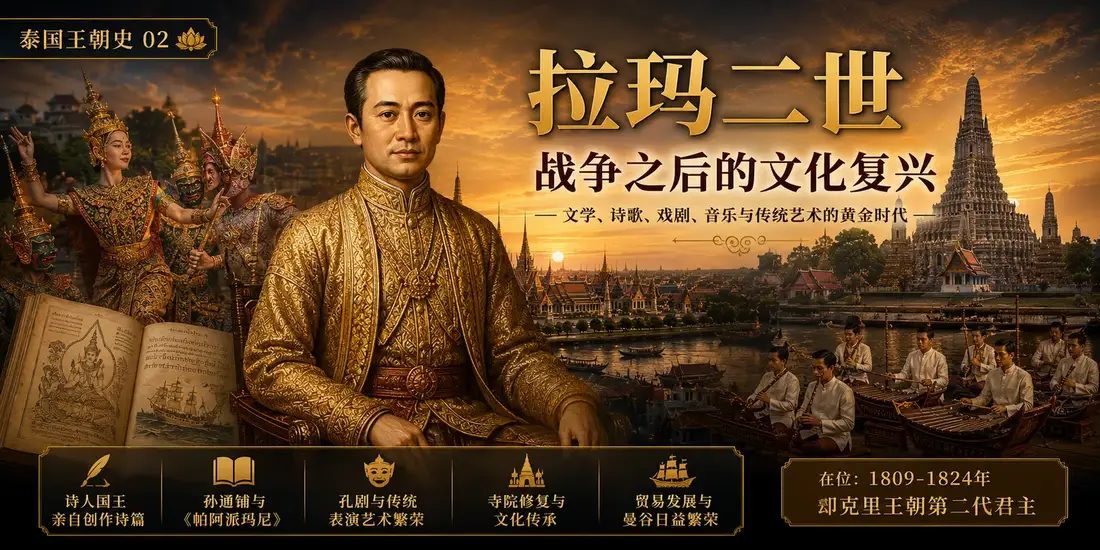
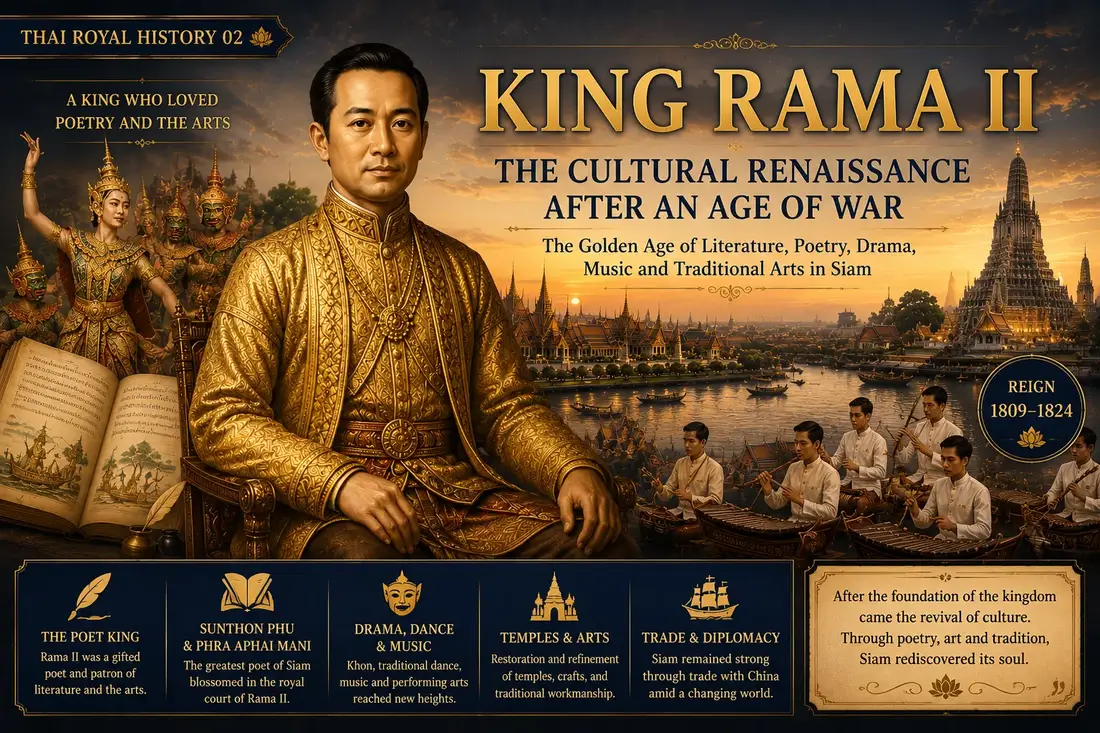
SEA NOW ORIGINAL · THAI ROYAL HISTORY 02 King Rama II: The Cultural Renaissance After an Age of War How the second king of the Chakri Dynasty helped transform early Rattanakosin Siam from an age of reconstruction into an era remembered for poetry, literature, music, theater, religion, and traditional arts
Reign: 1809–1824 Dynasty: Chakri Dynasty Historical Era: Early Rattanakosin Period Royal Name: Phra Phutthaloetla Naphalai
Introduction: What Happens After a Kingdom Survives?
The story of King Rama I was, above all, a story of reconstruction.
After the fall of Ayutthaya in 1767, Siam had endured war, political fragmentation, reunification under King Taksin, the Thonburi period, and finally the establishment of Bangkok and the Chakri Dynasty in 1782.
King Rama I had faced fundamental questions.
Where should the capital be located?
How could the kingdom defend itself?
How could government institutions be rebuilt?
How could laws be restored?
How could Buddhism and the monastic order recover?
And how could the cultural inheritance of Ayutthaya survive the destruction of the old capital?
By the time Rama I died in 1809, these problems had not disappeared entirely.
But Siam was no longer the fragmented kingdom that had emerged from the catastrophe of 1767.
Bangkok had become an established capital.
The Grand Palace and Wat Phra Kaew stood at the center of the new royal city.
Government institutions had been reorganized.
The legal system had been reviewed.
Buddhist institutions had been restored.
And the kingdom had successfully resisted major military threats.
When Rama II came to the throne, Siam therefore entered a different stage of its recovery.
The most urgent question was no longer simply:
How can the kingdom survive?
A new question was emerging:
Now that the kingdom has survived, what kind of culture will it preserve and pass on?
That question helps explain why the reign of Rama II occupies such a distinctive place in Thai history.
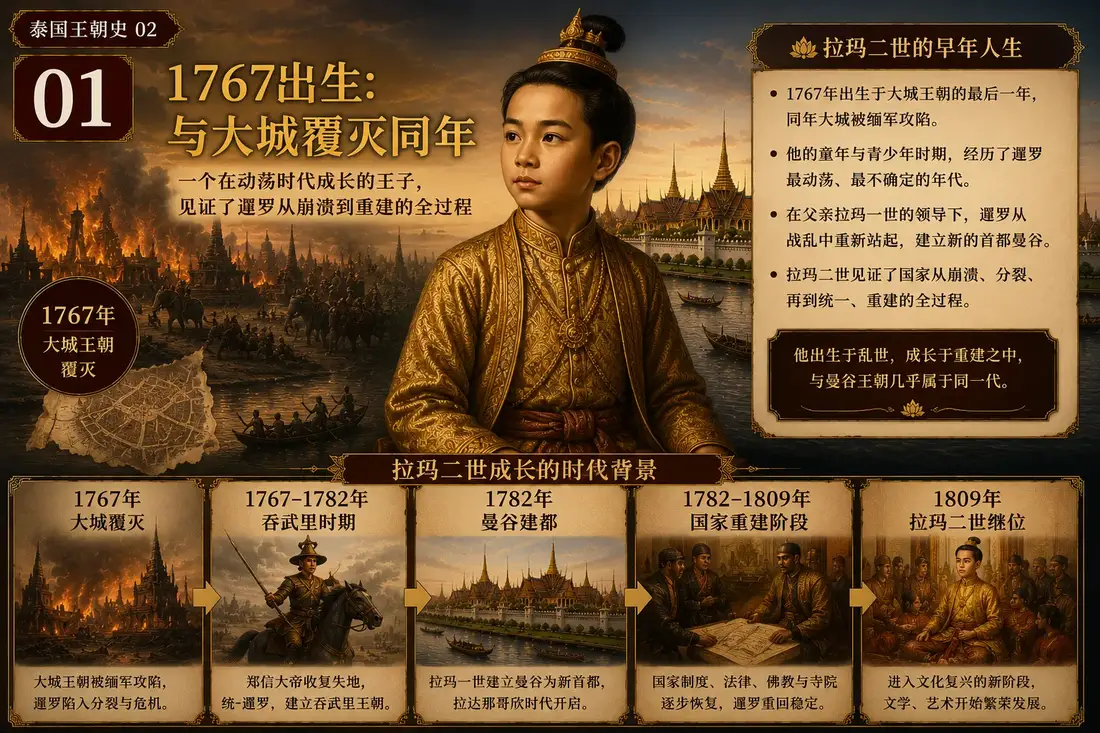
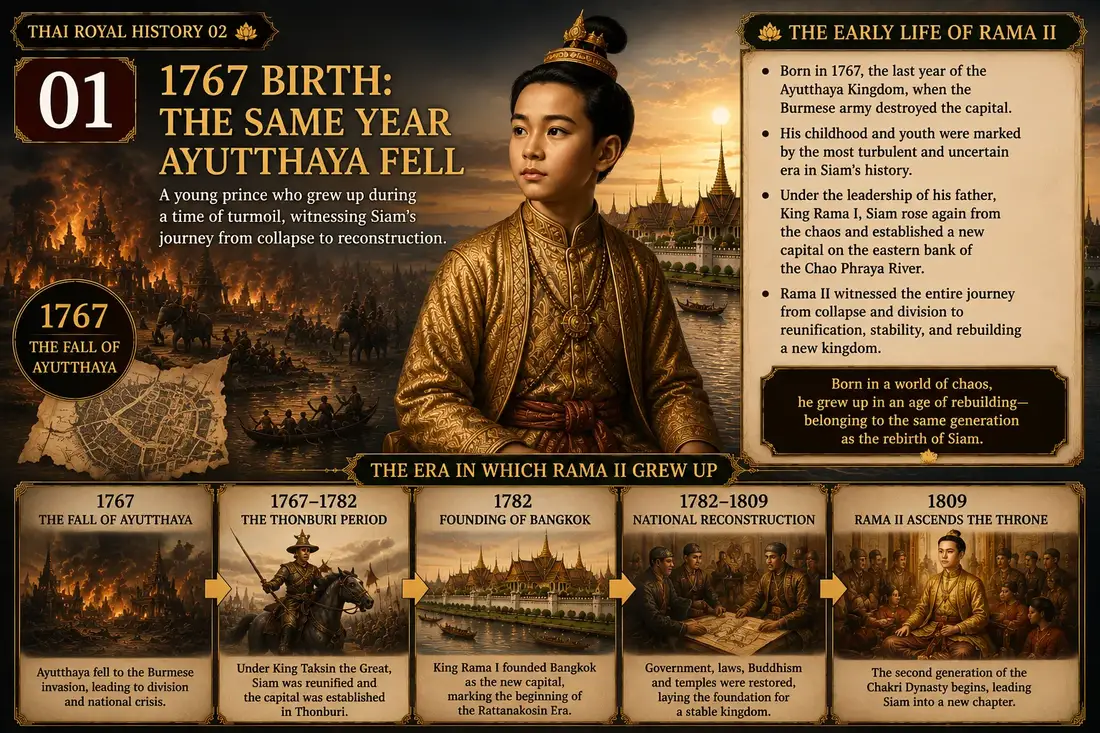
1. Born in 1767: A Prince Born in the Year Ayutthaya Fell
SEA NOW Thailand · Rama II · Illustration 01
King Rama II was born in 1767, one of the most dramatic years in Siamese history.
That was the same year in which Ayutthaya fell to Burmese forces.
The coincidence is historically striking.
Rama II belonged to a generation whose lives were shaped by the transition from the destroyed Ayutthaya world to the new political order centered on Bangkok.
His father would later become King Rama I, founder of the Chakri Dynasty.
His mother would later be known as Queen Amarindra.
But when Rama II was born, none of this future was certain.
The old capital had collapsed.
Communities had been displaced.
Regional political authority was fragmented.
War continued.
Siam's future remained uncertain.
Unlike later generations of Chakri princes, Rama II was therefore not born into a long-established Bangkok royal court.
His early life unfolded during a period when the kingdom itself was being reconstructed.
That experience is important.
Rama I belonged to the generation that remembered the old Ayutthaya political world directly and fought to rebuild Siam after its destruction.
Rama II belonged to the generation that grew up during the transition.
In that sense, Rama II and the early Rattanakosin era matured together.
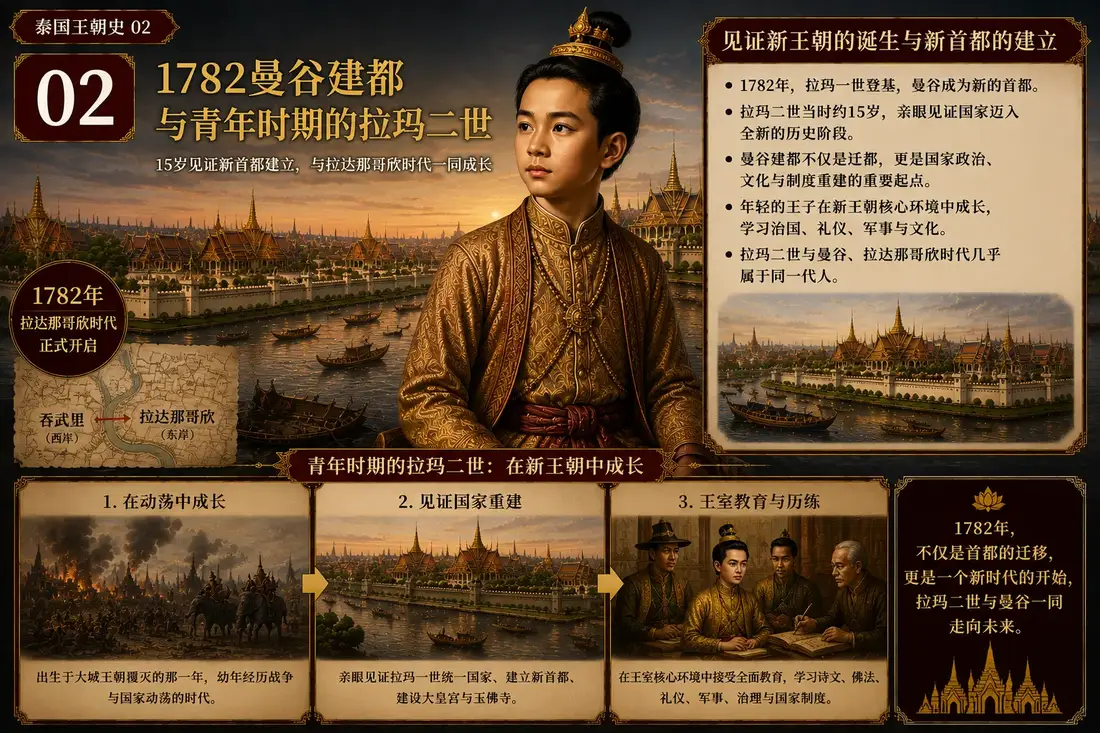
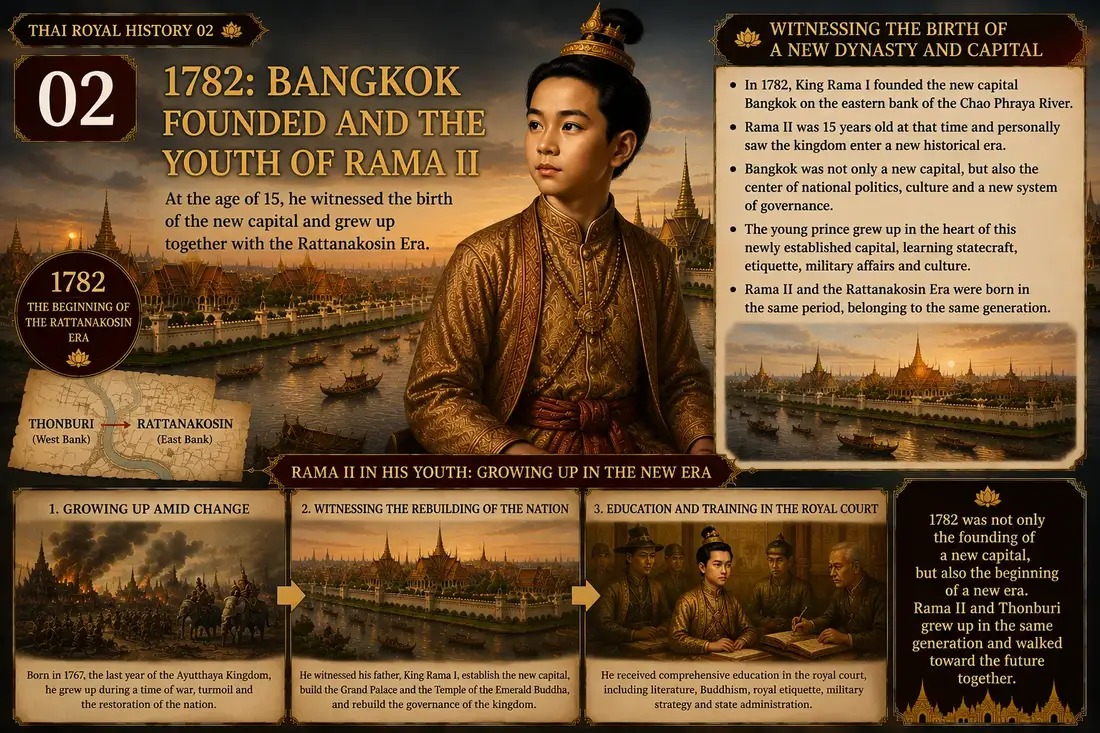
2. 1782: Growing Up as Bangkok Became the New Capital
SEA NOW Thailand · Rama II · Illustration 02
In 1782, Rama I ascended the throne.
The Chakri Dynasty was established, and the political center of Siam moved to the eastern bank of the Chao Phraya River.
Bangkok became the new capital.
Rama II was still a young man.
He therefore witnessed firsthand the construction of the new Rattanakosin political order.
The Grand Palace rose beside the river.
Wat Phra Kaew became the royal temple.
Canals, fortifications, government buildings, temples and communities gradually transformed the new capital.
For the young prince, this was not ancient history.
It was the world in which he came of age.
He received an education appropriate to his position and became familiar with religion, literature, court traditions and government.
Like many elite men of the period, Buddhist learning formed an important part of education.
But Rama II developed an especially strong interest in literature and the arts.
This would eventually distinguish him from many other rulers in Thai history.
Before becoming king, he was already part of a court that was attempting to recover the cultural traditions damaged or dispersed after the fall of Ayutthaya.
The future monarch was therefore shaped by two powerful historical forces:
the memory of destruction and the experience of cultural reconstruction.
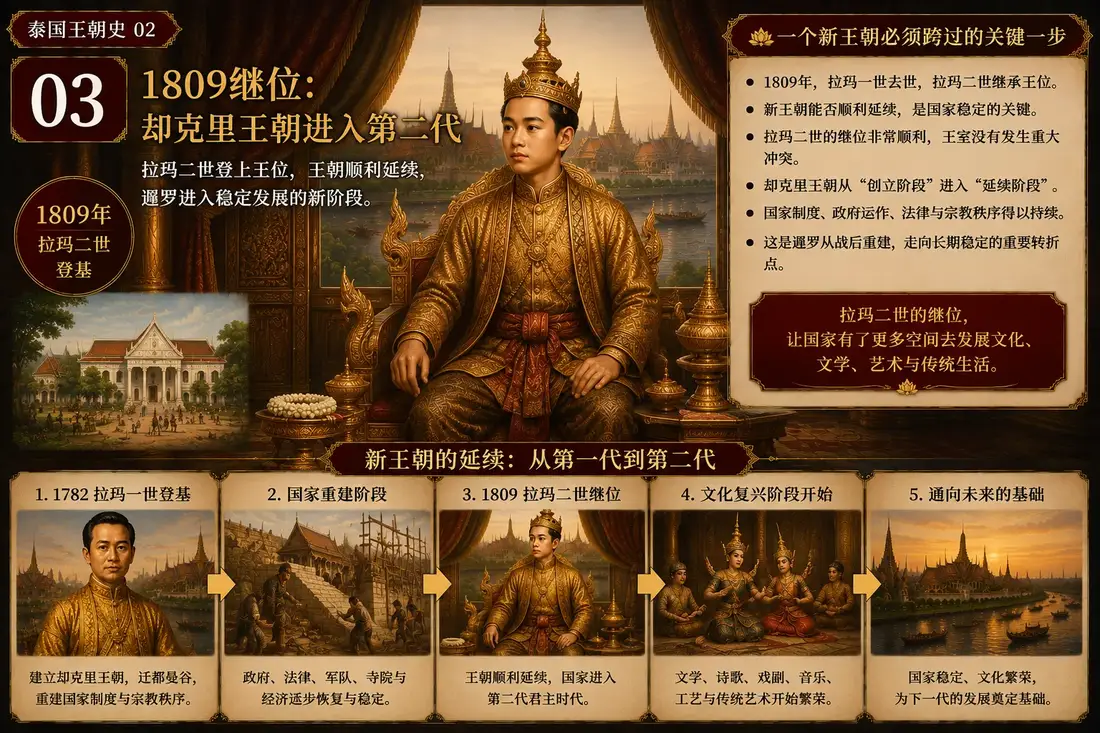
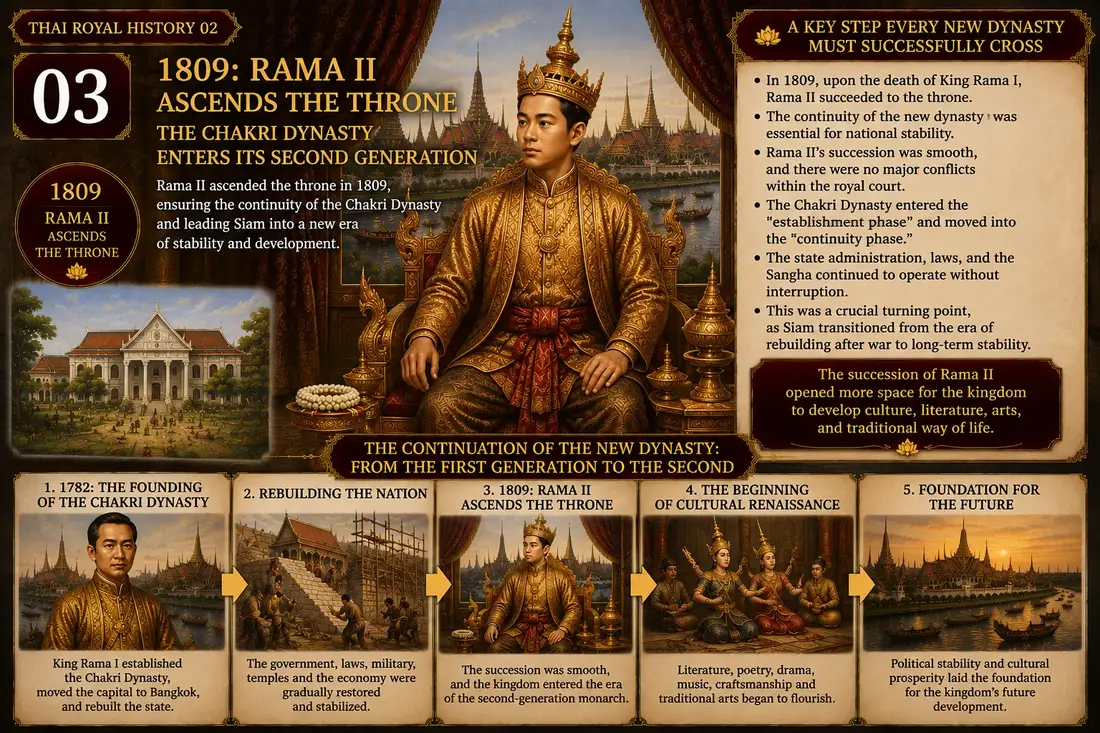
3. 1809: The Chakri Dynasty Enters Its Second Generation
SEA NOW Thailand · Rama II · Illustration 03
King Rama I died in 1809 after twenty-seven years on the throne.
Rama II succeeded him.
This transition had significance beyond the personal succession of one monarch by another.
The Chakri Dynasty was still relatively young.
One of the most important tests facing any newly established dynasty is whether political stability can survive the death of its founder.
A kingdom built around one powerful monarch can become vulnerable when that ruler dies.
The accession of Rama II therefore represented an important transition.
Rama I had founded the dynasty.
Rama II demonstrated that the dynasty could continue into a second generation.
The political center remained in Bangkok.
The institutions created and restored under Rama I continued to function.
The new Rattanakosin order was becoming more permanent.
Rama II would reign for approximately fifteen years, from 1809 until 1824.
His reign did not involve another dramatic relocation of the capital or the creation of a new dynasty.
Instead, his historical importance emerged in another area:
the consolidation and cultural development of the kingdom his father had rebuilt.
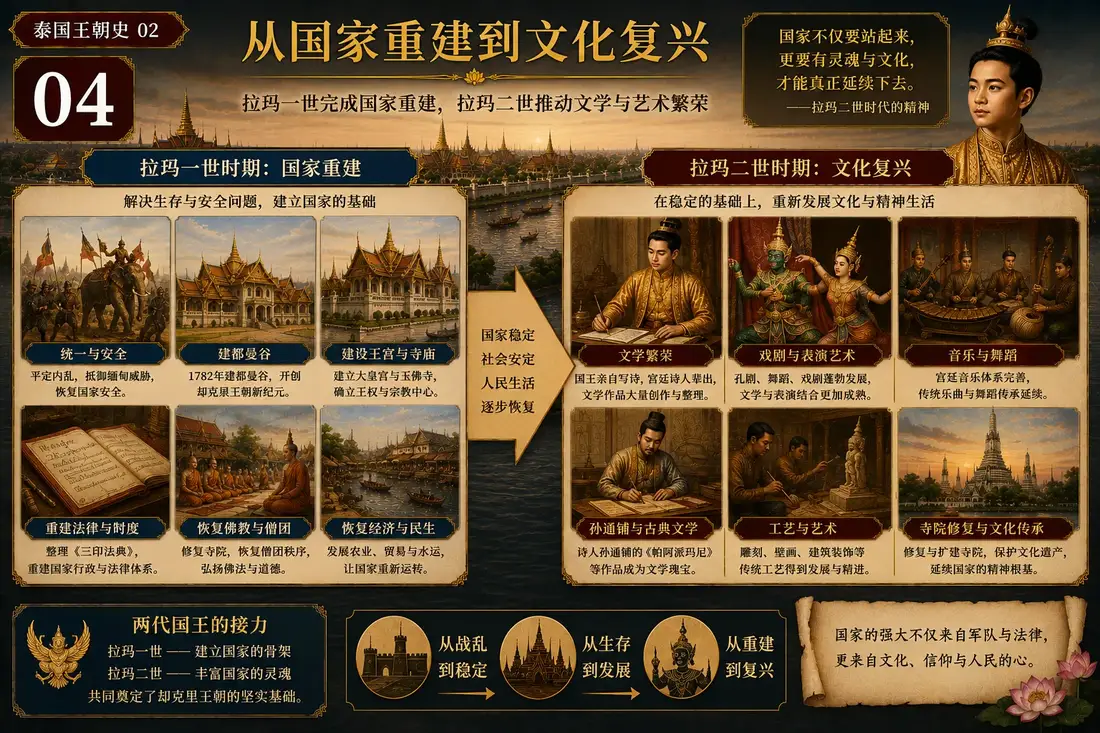
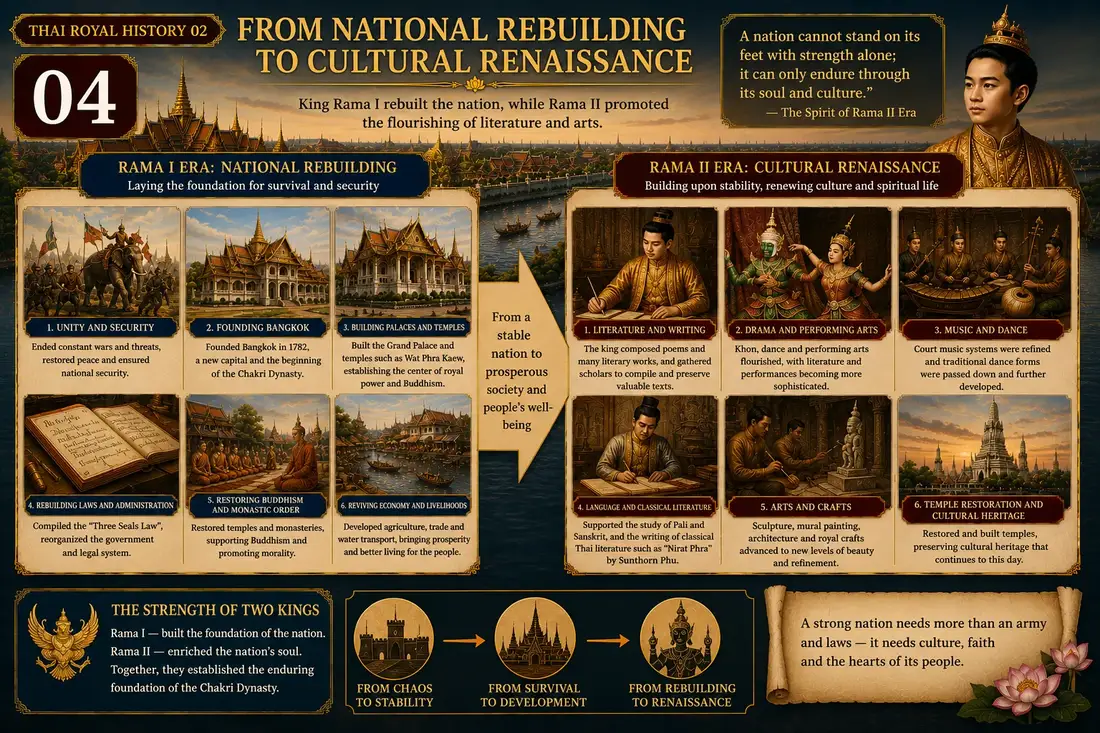
4. From National Reconstruction to Cultural Renaissance
SEA NOW Thailand · Rama II · Illustration 04
Why is Rama II's reign so closely associated with cultural revival?
The answer begins again with 1767.
The destruction of Ayutthaya affected far more than palaces and defensive walls.
Manuscripts were lost.
Libraries and archives were disrupted.
Religious institutions suffered.
Court artists and performers were dispersed.
Literary traditions were interrupted.
Craft knowledge and artistic communities were affected by decades of warfare.
During the reign of Rama I, a major effort began to recover this inheritance.
Important literary works were reconstructed or compiled.
Buddhist texts were reviewed.
Temples were restored.
Court ceremonies were reorganized.
The Ramakien tradition received major royal attention.
By the time Rama II came to power, this first stage of reconstruction had created conditions in which culture could flourish more fully again.
The royal court once more became an important center for:
poets,
writers,
musicians,
dancers,
dramatic performers,
craftsmen,
religious scholars,
and artists.
For this reason, the cultural achievements of Rama II's reign should not be understood as something that suddenly appeared in 1809.
They were part of a longer historical process:
Ayutthaya cultural inheritance → post-1767 disruption → Rama I's restoration → Rama II's cultural flourishing.
Rama II inherited the results of reconstruction and helped take them into a new stage.
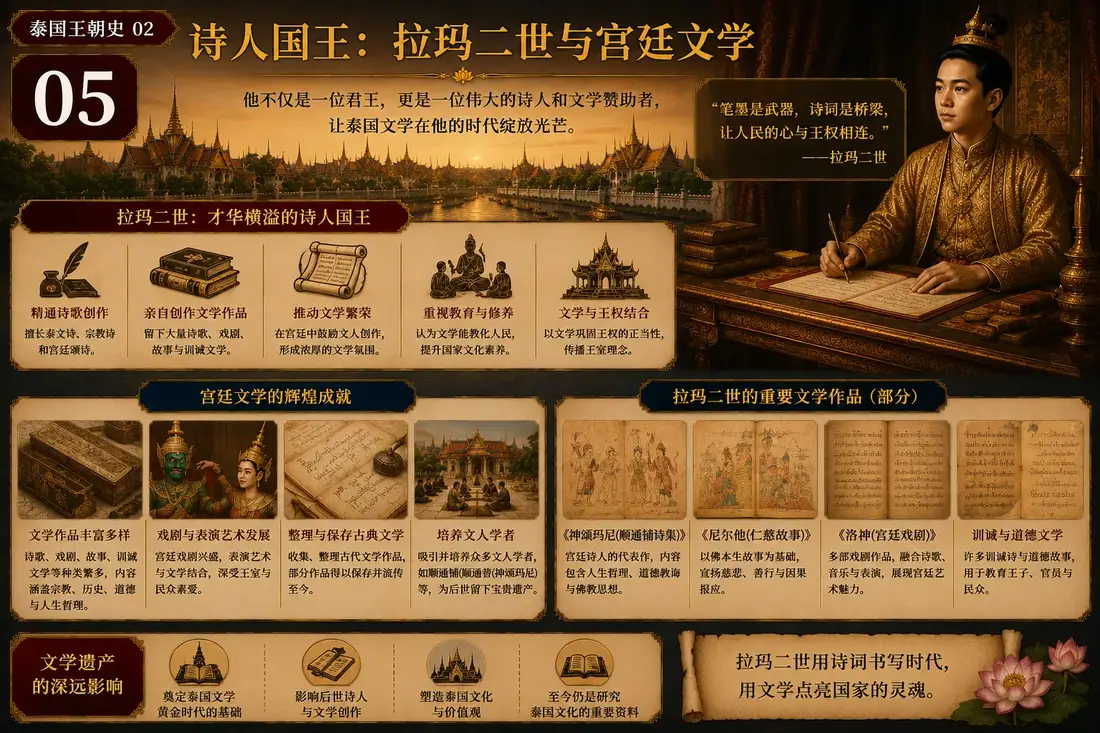
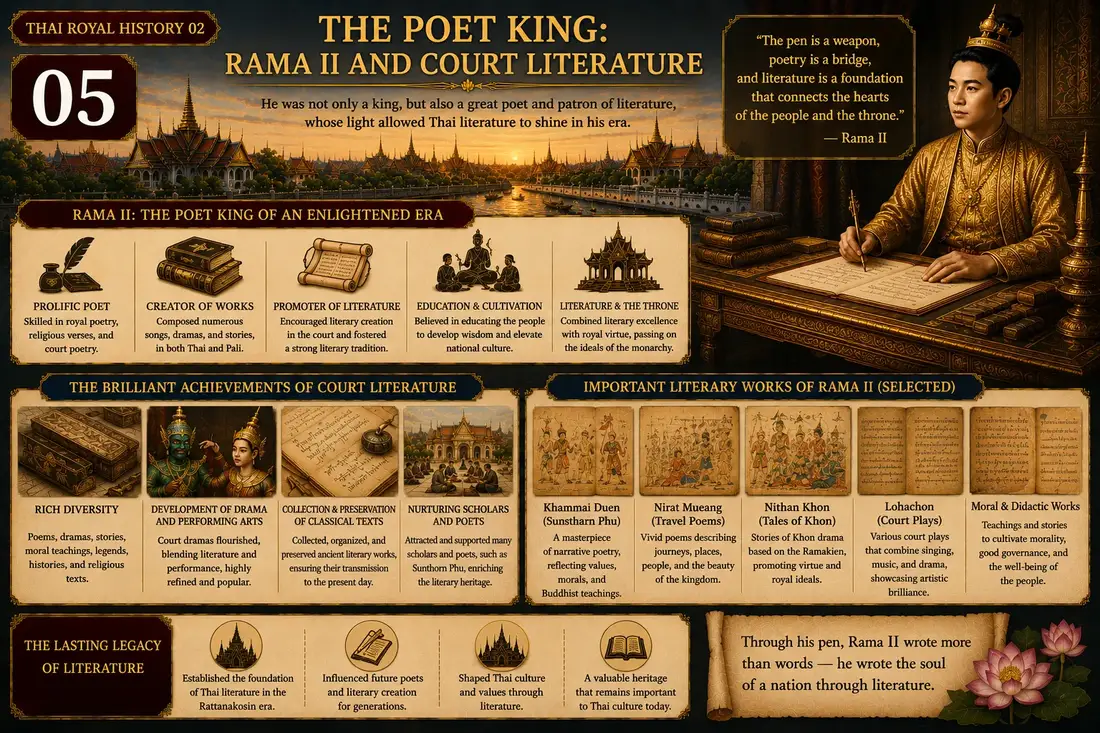
5. The Poet King: Rama II and Court Literature
SEA NOW Thailand · Rama II · Illustration 05
One of the most remarkable aspects of Rama II's historical reputation is that he was not merely a royal patron of literature.
He was himself associated with literary creation.
Rama II had a deep interest in poetry, drama and performance.
Literature occupied an important position within his court.
This matters because royal patronage could provide writers and artists with the institutional environment needed to create, revise, perform and preserve their work.
Thai classical literature was also not always separated from performance in the way modern readers might imagine.
Poetry could become song.
Literary narratives could become drama.
Drama could become dance.
Dance required music.
Music required specialized performers and instruments.
Costumes required skilled craftsmen.
Masks and stage objects required artists.
A thriving literary court could therefore support an entire network of cultural activity.
Rama II's literary interests were especially important to the development of dramatic literature.
Works associated with the Ramakien tradition and other classical stories continued to be adapted for performance.
It is important, however, to distinguish Rama II's role from that of Rama I.
Rama I had already sponsored a major reconstruction of the Ramakien literary tradition.
Rama II's era continued this cultural development, particularly through the close relationship between literature and performance.
This distinction helps us understand why Rama II is remembered not simply as a king who “preserved old texts,” but as a monarch associated with a living artistic culture.
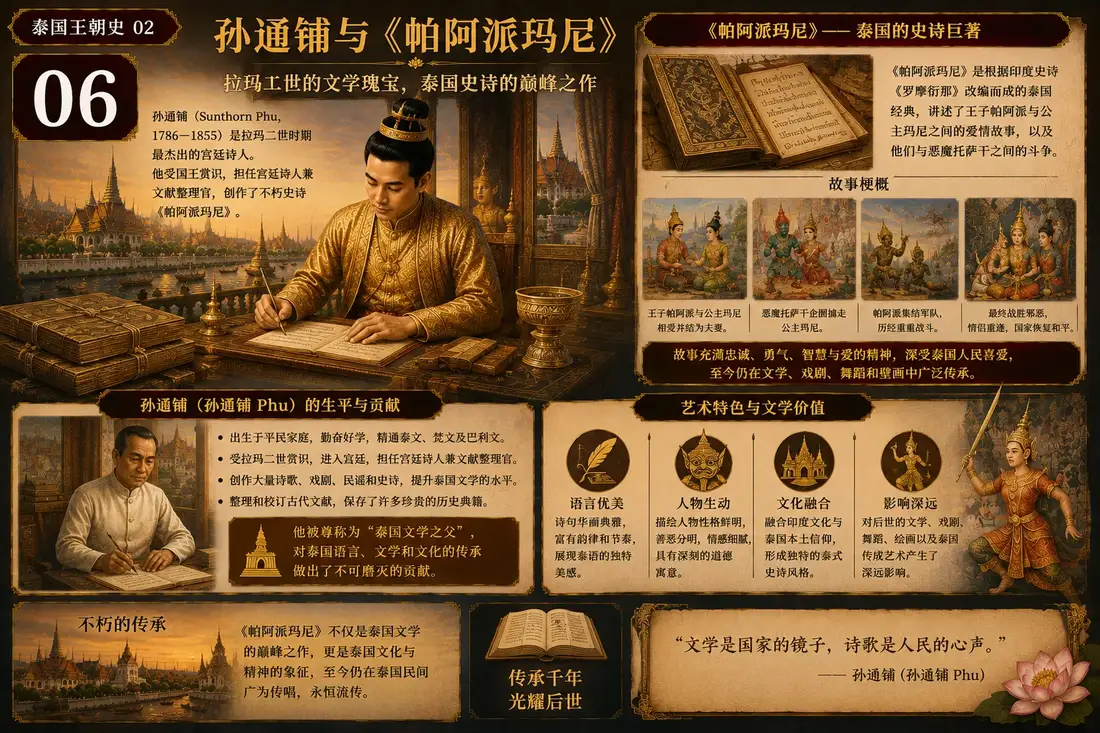
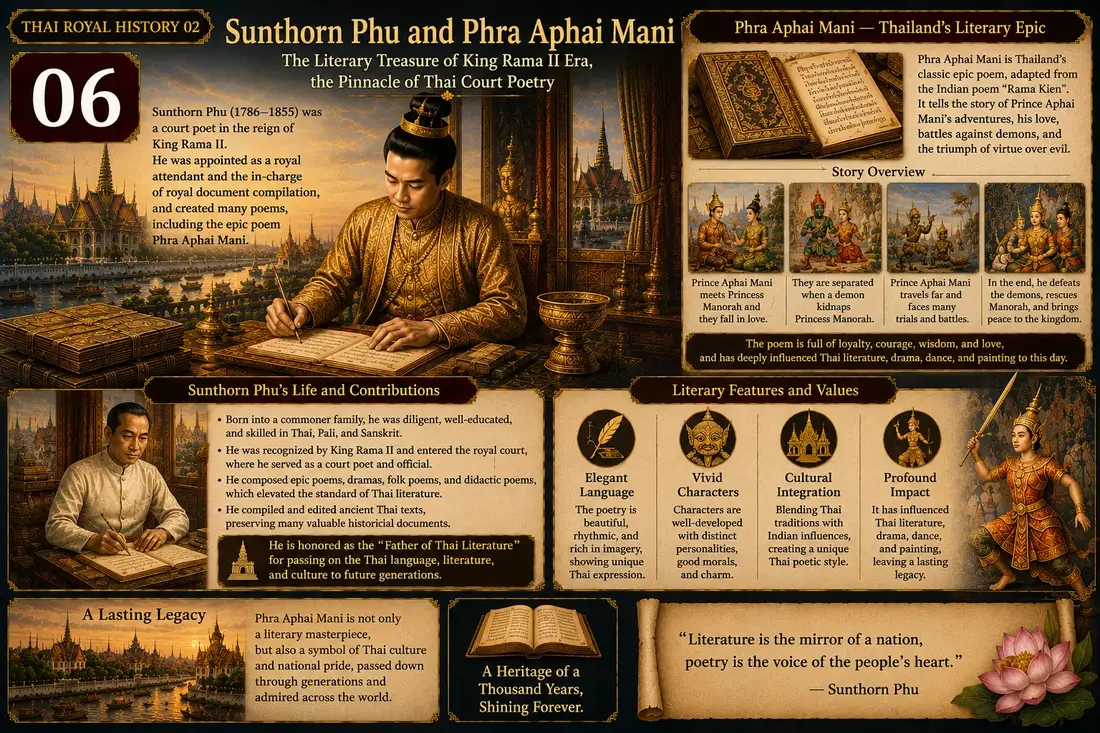
6. Sunthorn Phu and Phra Aphai Mani
SEA NOW Thailand · Rama II · Illustration 06
No discussion of Thai literature in the early Rattanakosin era would be complete without Sunthorn Phu.
Born in 1786, Sunthorn Phu became one of the most celebrated poets in Thai literary history.
His career extended beyond the reign of Rama II, but the cultural environment of Rama II's court played an important role in his development.
Sunthorn Phu became associated with royal literary circles and gained recognition for his poetic ability.
Today his name is connected with numerous works, but none is more famous internationally than:
Phra Aphai Mani
This long narrative poem occupies an extraordinary place in Thai literature.
Its world is filled with journeys, kingdoms, conflict, romance, supernatural beings, islands, oceans and adventure.
One of its most memorable elements is its maritime imagination.
Princes travel across seas.
Characters encounter unfamiliar peoples and places.
Magic and politics coexist.
Human beings encounter giants and mermaids.
The story moves far beyond the walls of a royal palace.
This gives Phra Aphai Mani a remarkably expansive fictional world.
The work continued to develop over a long period and should not be reduced to a single moment in Rama II's reign. Nevertheless, Sunthorn Phu's rise within the literary world of early Rattanakosin demonstrates the extraordinary creative environment associated with this era.
His influence survived far beyond the royal court.
Characters and scenes from his literature entered popular culture, education, visual art and tourism.
More than two centuries later, Sunthorn Phu remains one of the most recognizable names in Thai literature.
The cultural revival of the early Chakri period had produced something more enduring than court entertainment.
It had produced literature capable of surviving generations.
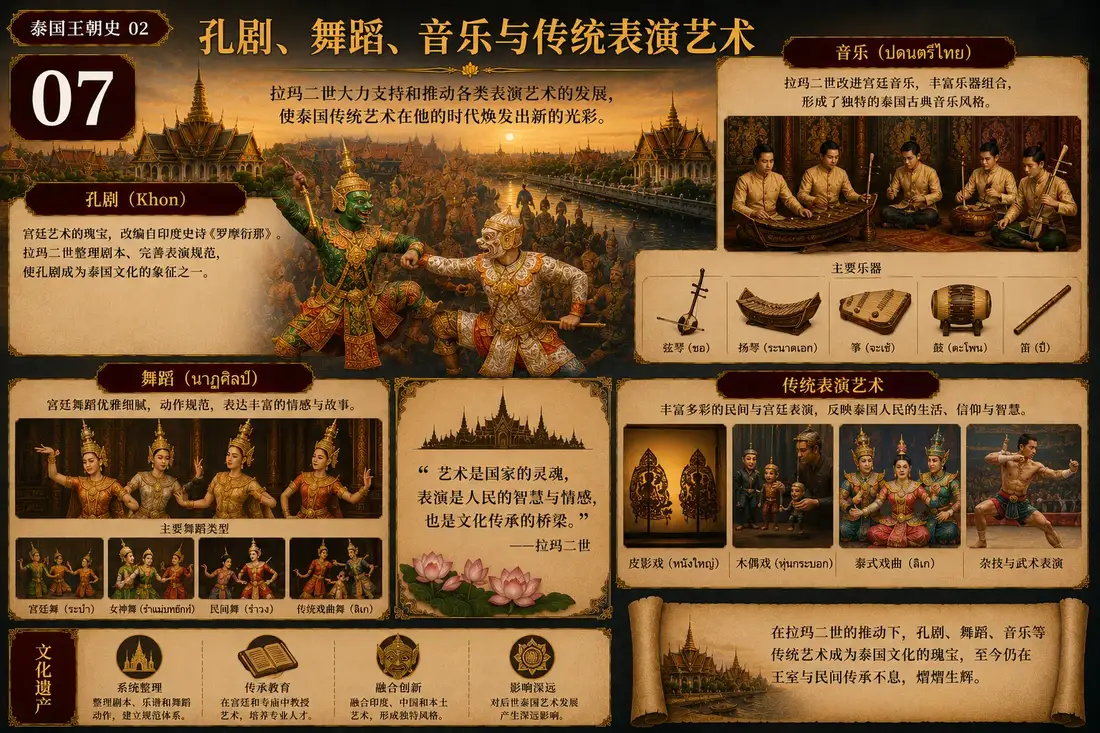
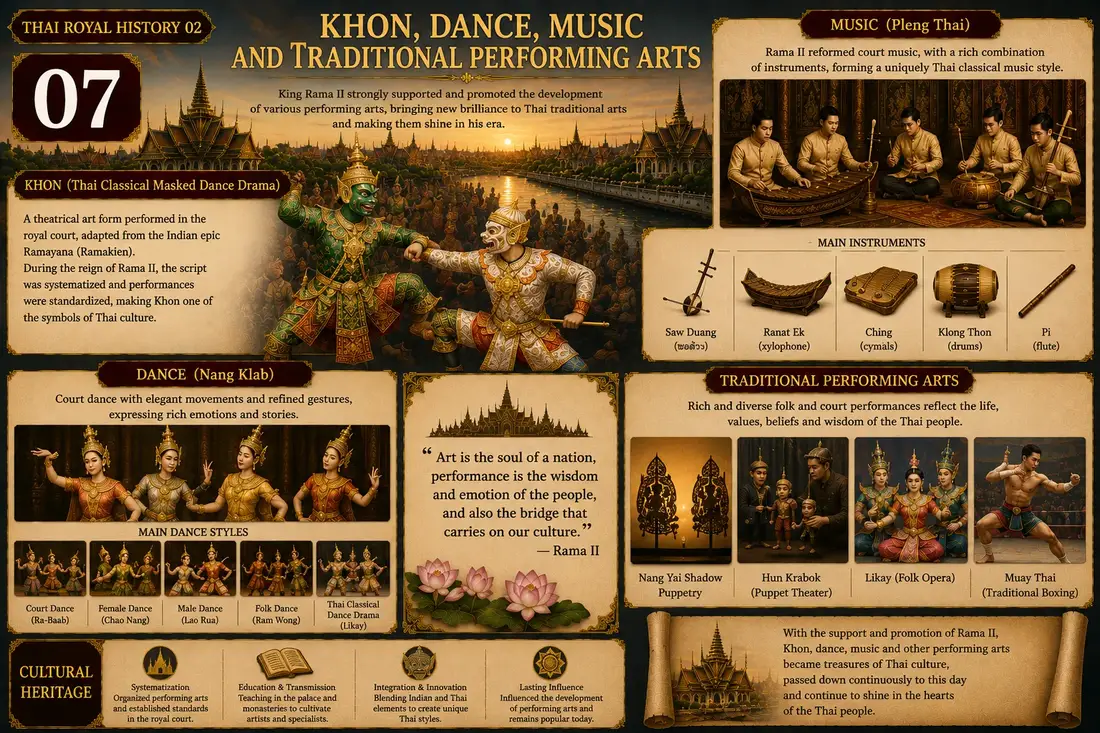
7. Khon, Dance, Music and Traditional Performing Arts
SEA NOW Thailand · Rama II · Illustration 07
To understand Rama II's cultural world, we cannot look at literature alone.
Thai traditional performing arts developed through the interaction of many disciplines.
One of the most famous examples is:
Khon
Khon is Thailand's classical masked dance-drama, traditionally associated with episodes from the Ramakien.
A Khon performance brings together multiple artistic traditions.
There is literature.
There is narration.
There is classical music.
There is choreography.
There are elaborate costumes.
There are masks.
There is embroidery.
There are highly disciplined physical movements.
There are musicians and singers.
There are craftsmen who create the visual world of the performance.
This means that supporting Khon and related court arts helped preserve much more than a single form of theater.
It helped sustain an entire cultural ecosystem.
During Rama II's reign, literature, drama, dance and music enjoyed strong royal interest.
Court performance traditions became closely associated with the cultural reputation of his reign.
The king's own interest in dramatic literature also strengthened the relationship between written texts and performance.
This is one of the most important characteristics of the period.
Culture was not divided neatly into separate categories.
Poetry could become theater.
Theater could become dance.
Dance could preserve literature.
Music could preserve stories.
Craftsmanship could give those stories a physical form.
Together, they helped transmit cultural memory from one generation to another.
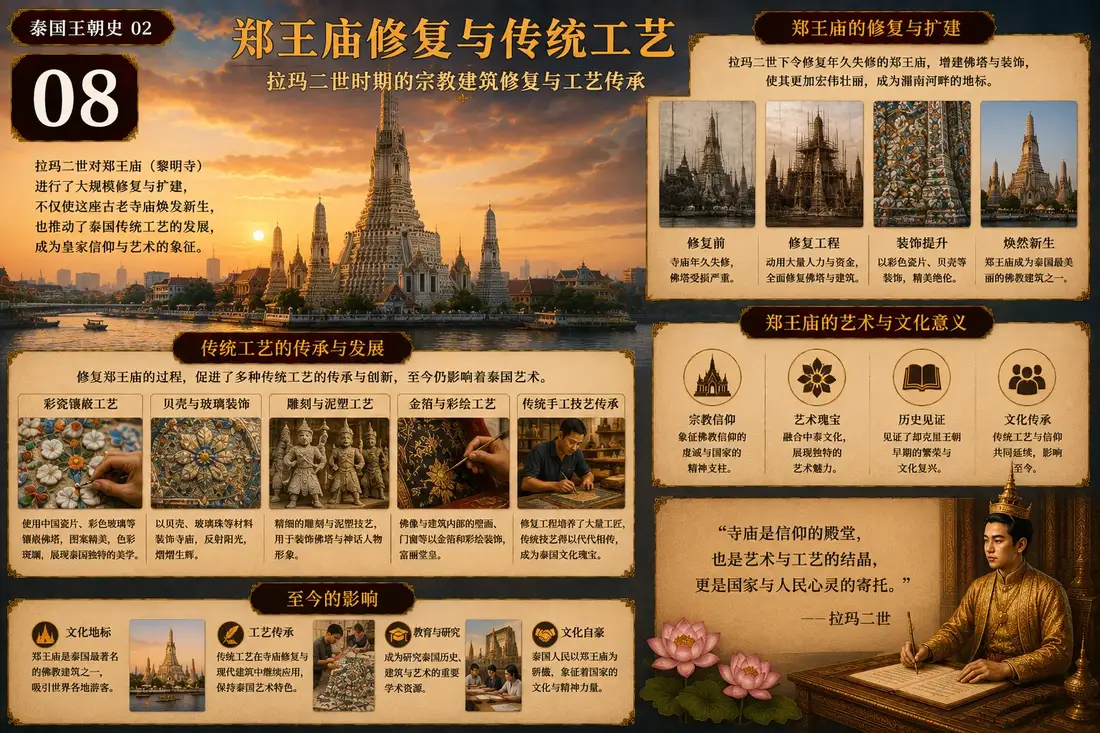
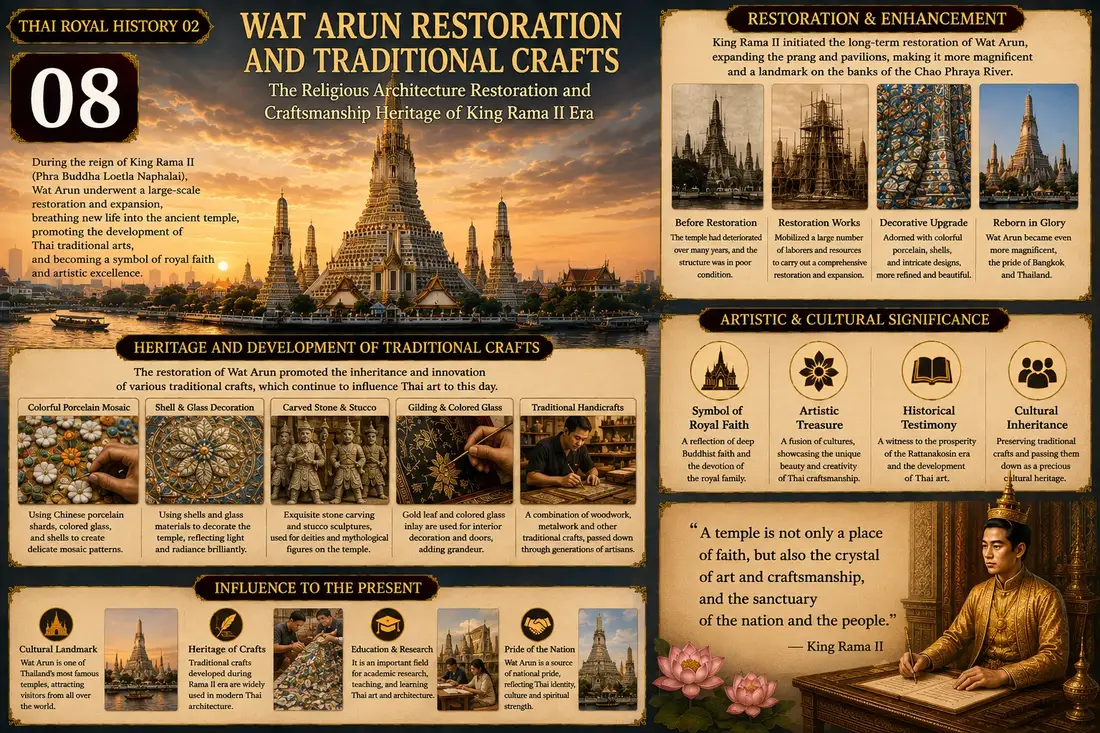
8. Wat Arun: Restoration, Royal Patronage and Traditional Craftsmanship
SEA NOW Thailand · Rama II · Illustration 08
One of Bangkok's most recognizable landmarks is Wat Arun, the Temple of Dawn.
Its history extends far earlier than the reign of Rama II.
The temple was already important during the Thonburi period, when the political center of Siam stood on the western bank of the Chao Phraya River.
Therefore, it would be inaccurate to say that Rama II “founded” Wat Arun.
His role belongs to another stage of its history.
During Rama II's reign, important restoration and development of the temple were undertaken.
The project reflected the continuing importance of Buddhist institutions to the early Chakri monarchy.
It also created opportunities for architecture, sculpture, decoration and traditional craftsmanship.
However, another historical distinction is essential.
The monumental central prang that defines the modern skyline of Wat Arun was developed across more than one reign, with major work continuing under Rama III.
What visitors see today is therefore the result of a historical process rather than the work of one king alone.
That makes Wat Arun especially useful for understanding early Rattanakosin history.
Its architecture embodies continuity.
Thonburi.
Rama II.
Rama III.
Later restorations.
Different periods accumulated within the same sacred landscape.
Temple restoration also supported skilled craftsmen.
Woodwork, gilding and other crafts depended on generations of accumulated knowledge.
Royal temple projects therefore played an important role in preserving artistic skills as well as religious institutions.
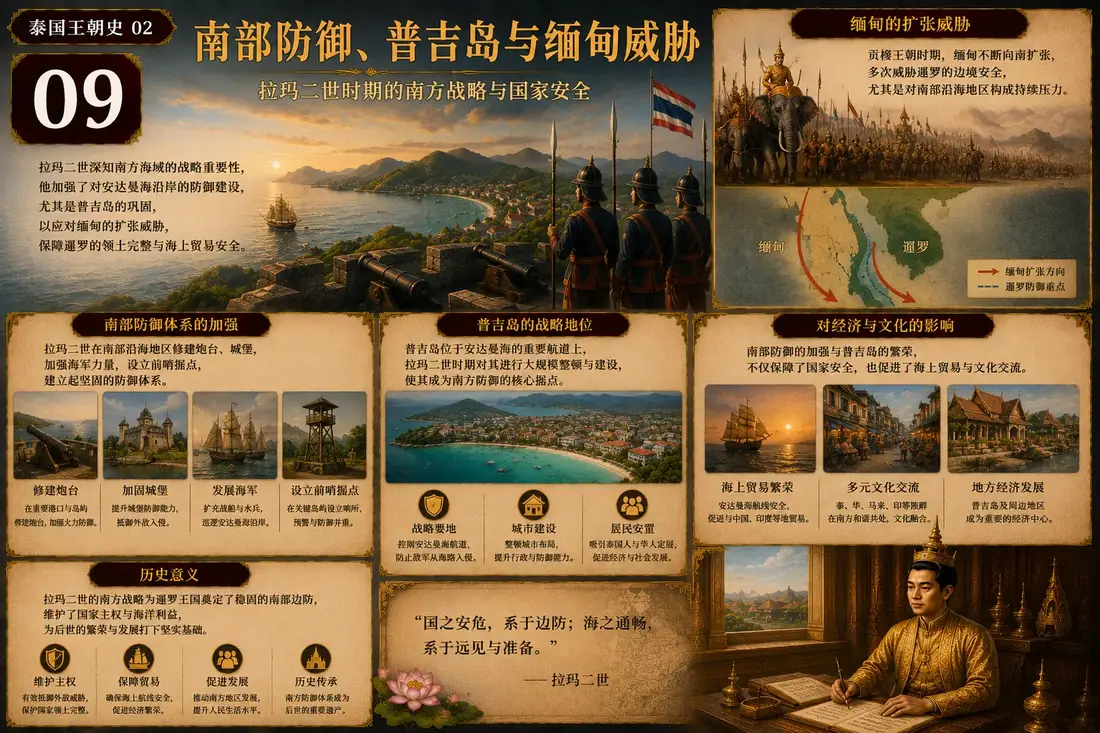
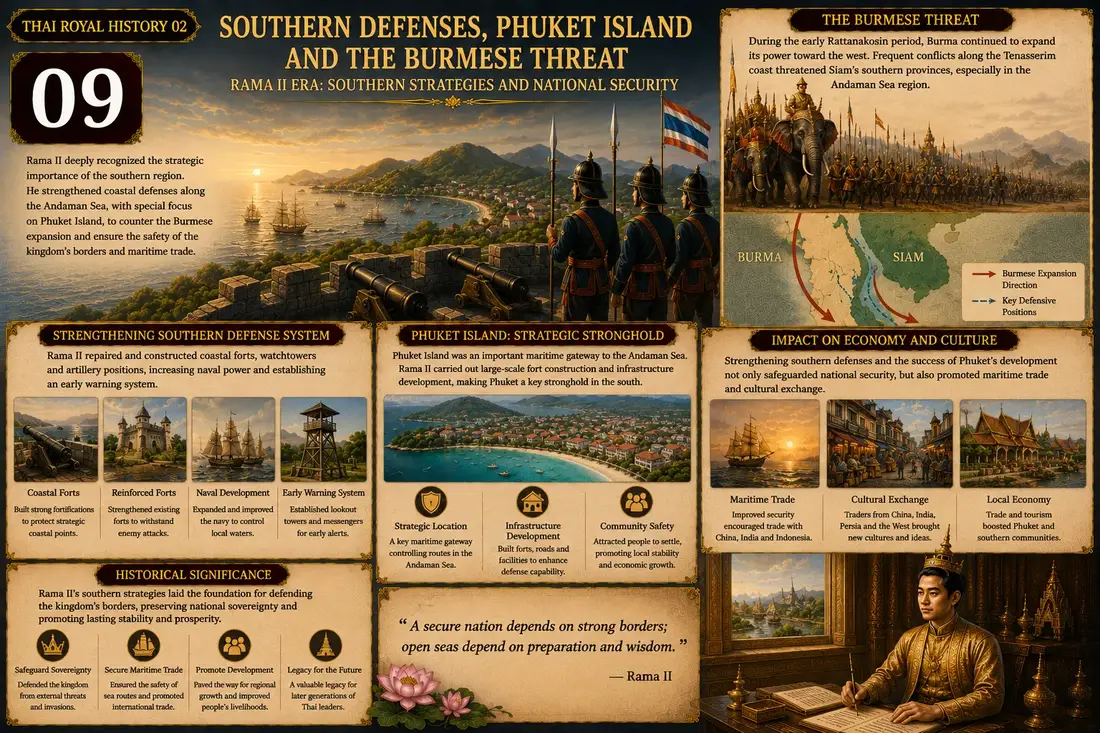
9. Southern Defense, Phuket and the Continuing Burmese Threat
SEA NOW Thailand · Rama II · Illustration 09
The phrase “cultural renaissance” can create the misleading impression that Rama II ruled during an entirely peaceful period.
He did not.
The military rivalry between Siam and Burma had not disappeared.
During the early years of Rama II's reign, the southern territories of Siam remained vulnerable to attack.
The Andaman coast was particularly important.
Among the strategic areas was Phuket.
Today Phuket is internationally associated with beaches, resorts and tourism.
In the early nineteenth century, its importance was very different.
Its position on the Andaman Sea gave it strategic value, while the region's tin resources contributed to its economic importance.
Burmese military pressure in the south therefore represented both a security and economic challenge.
Siam had to maintain defensive capabilities even while Bangkok's cultural life flourished.
This gives us a more balanced understanding of Rama II's reign.
The kingdom had become stable enough to support literature and the arts.
But it was not so secure that military defense could be ignored.
The government still needed to protect strategic territories, maintain military forces and respond to regional threats.
Cultural prosperity existed alongside geopolitical uncertainty.
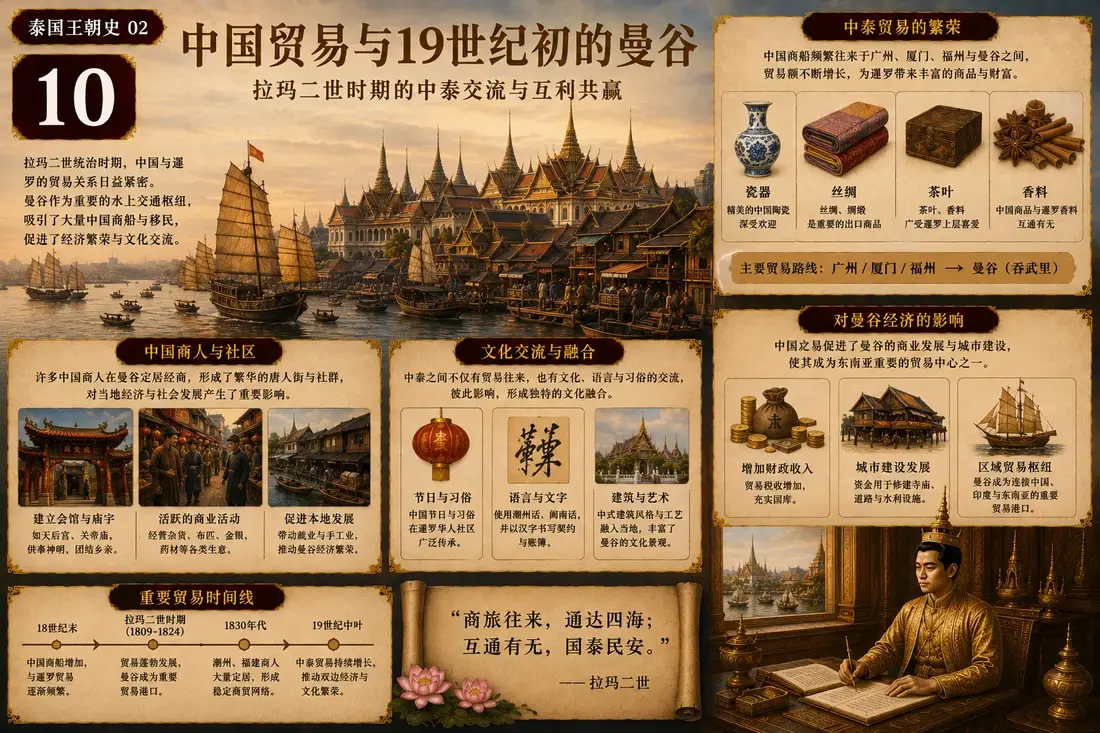
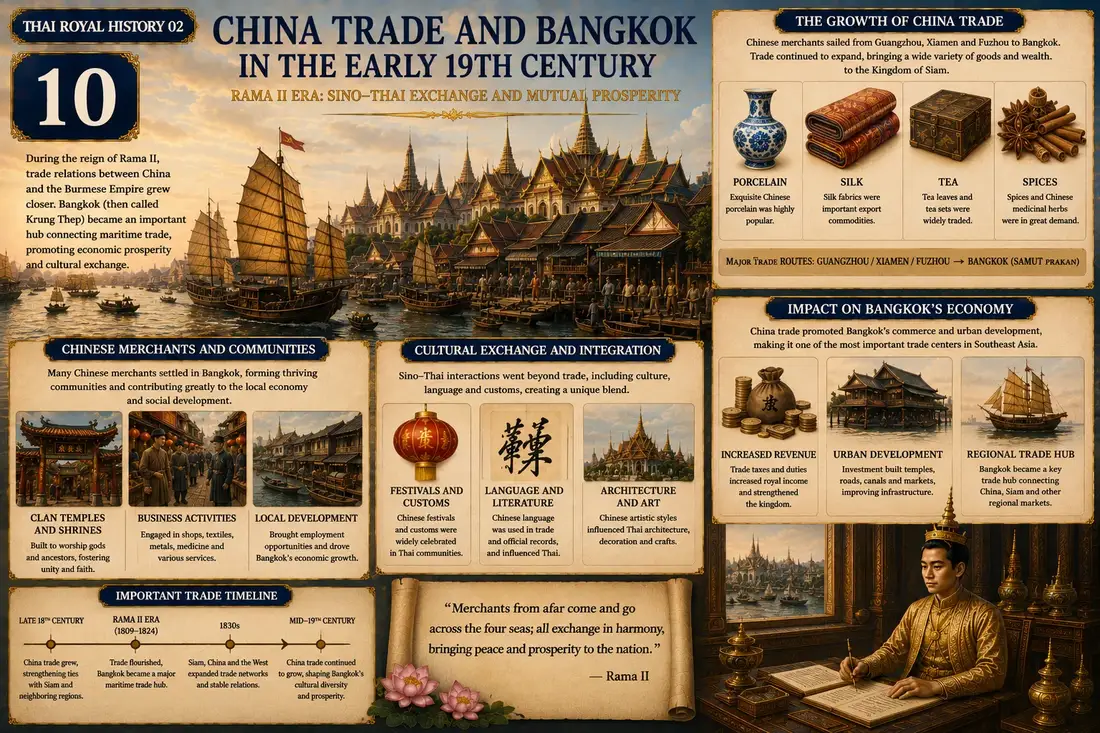
10. China Trade and Bangkok in the Early Nineteenth Century
SEA NOW Thailand · Rama II · Illustration 10
While Siam continued to face regional military threats, another force was reshaping Bangkok:
trade.
Commercial relations with China were particularly important.
Chinese merchants and migrants had long played significant roles in Siamese economic life, and these connections continued to expand during the early Rattanakosin period.
Bangkok's geography made it an ideal commercial center.
The Chao Phraya River connected the agricultural interior of Siam with the Gulf of Thailand and maritime trading networks.
Goods could move downriver toward Bangkok.
Ships could then connect the capital with ports across Asia.
Chinese junks became a familiar part of this commercial world.
Trade brought goods, revenue, merchants, labor and cultural exchange.
Chinese communities became increasingly important to Bangkok's economic development.
Their influence could be seen in commerce, neighborhoods, religious sites, food, language and material culture.
This interaction did not begin under Rama II and did not end with him.
But his reign formed part of a period in which Bangkok was becoming more than a royal capital.
It was increasingly becoming a commercial city.
This development would become even more significant under Rama III, whose reign would be closely associated with expanding foreign trade, particularly with China.
11. A Changing World: European Power Moves Closer to Siam
Beyond Siam's borders, the international environment was changing rapidly.
European imperial power was expanding across Asia.
Britain's position in India had grown enormously.
British commercial and strategic interests were moving deeper into Southeast Asia.
Then, in 1819, Stamford Raffles established a British trading settlement at Singapore.
For Siam, this development was significant.
Singapore was geographically close to the Malay Peninsula and rapidly became an important commercial center.
The political world surrounding Siam was beginning to change.
For centuries, Siamese rulers had primarily understood security through relationships with neighboring kingdoms, regional powers and tributary networks.
But the nineteenth century would increasingly bring Siam into contact with a different kind of power:
European states supported by global maritime networks, industrial production, modern military technology and colonial empires.
During Rama II's reign, this challenge had not yet reached the intensity it would under later monarchs.
But the direction of change was already visible.
The world of Rama I had been dominated by the aftermath of Ayutthaya's fall and conflict with Burma.
The world inherited by later Chakri kings would increasingly be shaped by:
Britain, France, global trade and Western imperial expansion.
Rama II stood near the beginning of that transition.
12. Buddhism and the Social Foundations of the Kingdom
Cultural revival under Rama II was inseparable from religion.
Buddhism remained central to the political and social order of Siam.
Royal support for temples and religious institutions therefore served multiple purposes.
Temples were places of worship.
But historically they could also function as centers of learning, manuscript preservation, artistic production and community activity.
In a society without a modern nationwide public-school system, Buddhist institutions played an important educational role.
Supporting temples could therefore contribute to the preservation of:
religion,
literacy,
art,
architecture,
knowledge,
and community life.
Rama II continued the early Chakri tradition of royal support for Buddhism.
This continuity was politically important as well.
The monarchy presented itself not only as a source of government authority but also as a protector of Buddhism and social order.
Religion, culture and kingship were deeply interconnected.
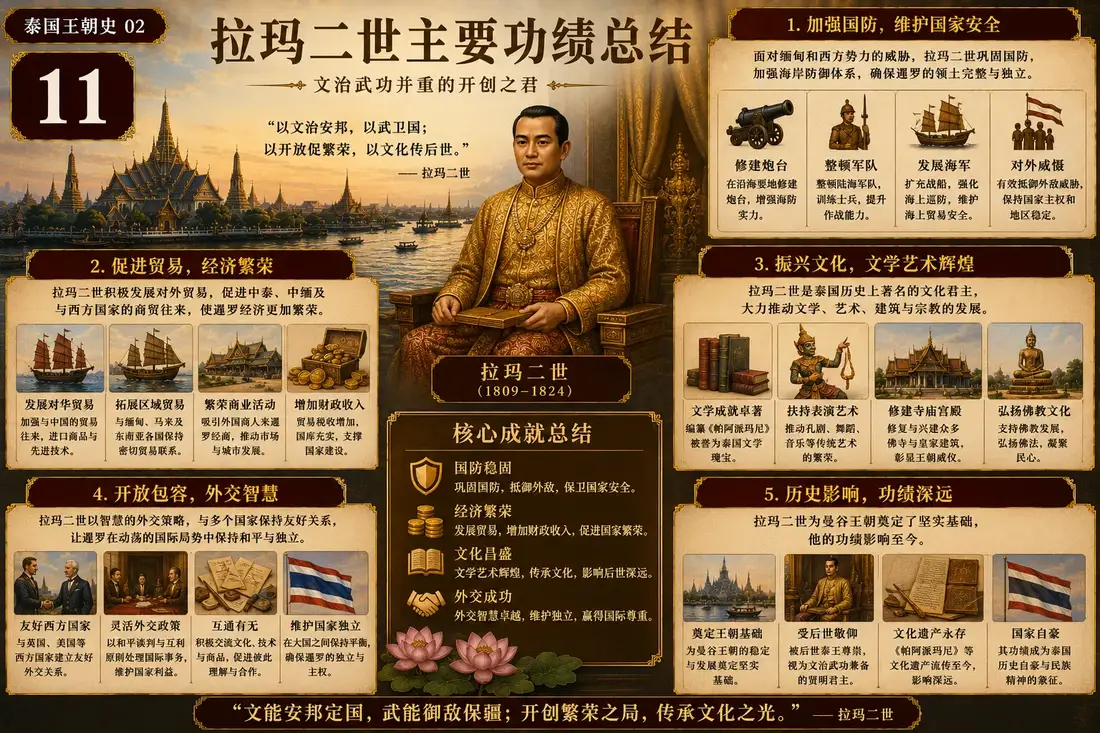
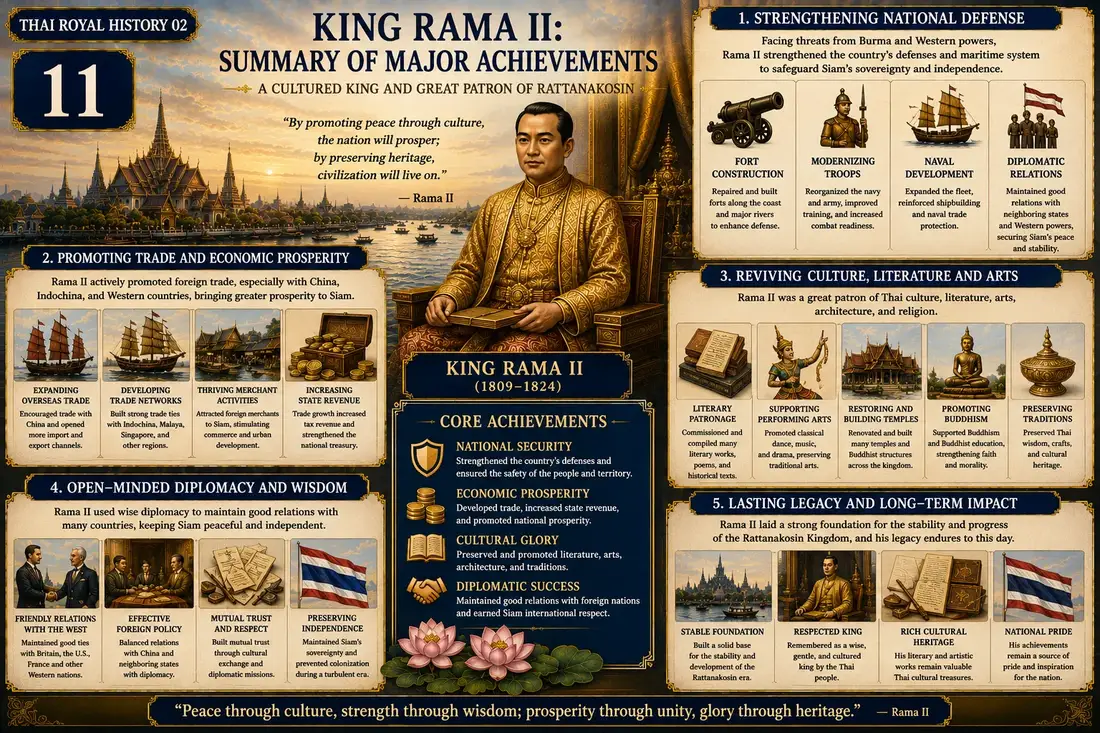
13. The Major Achievements of King Rama II
SEA NOW Thailand · Rama II · Illustration 11
Rama II died in 1824, after approximately fifteen years on the throne.
His reign was shorter than that of his father, and it did not involve an event comparable to the founding of Bangkok in 1782.
Yet its historical importance is substantial.
His major legacy can be understood through several interconnected areas.
He helped preserve political continuity after the death of the founder of the Chakri Dynasty.
He maintained the stability of the early Rattanakosin Kingdom.
He supported the defense of Siam during a period when Burmese military pressure had not completely disappeared.
Foreign commerce continued to develop.
Bangkok continued its transformation into a major political and commercial center.
Buddhist temples and institutions received royal support.
Traditional craftsmanship continued through major religious and court projects.
Most famously, literature and performing arts flourished.
Rama II himself became remembered for his literary interests.
Writers such as Sunthorn Phu emerged within the extraordinary literary world of early Rattanakosin.
Poetry, drama, music, dance and court performance developed in an environment of strong royal patronage.
Taken together, these achievements explain why Rama II's reign is remembered differently from that of Rama I.
Rama I built the foundations of a new political era.
Rama II helped give that era a cultural voice.
14. 1767 → 1809 → 1824: The Complete Historical Arc
SEA NOW Thailand · Rama II · Illustration 12
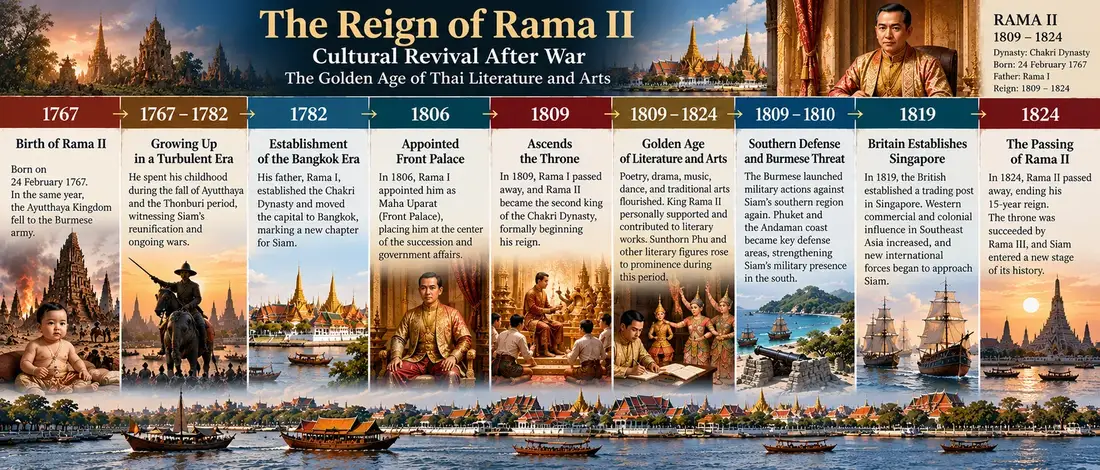
Three dates provide a simple way to understand Rama II's life.
1767 — Birth
Rama II was born during the year Ayutthaya fell.
The kingdom was entering one of the most unstable periods in its history.
He grew up during war, reunification and political reconstruction.
1809 — Accession
Rama I died.
Rama II became the second monarch of the Chakri Dynasty.
The new dynasty successfully entered its second generation.
Bangkok was no longer simply a newly founded capital.
It was becoming an established political and cultural center.
1824 — Death
Rama II died after roughly fifteen years on the throne.
By this time, early Rattanakosin culture had entered a period remembered for remarkable literary and artistic activity.
The political system founded by Rama I had endured.
Bangkok continued to grow.
Trade was expanding.
Traditional arts were flourishing.
And the international environment around Siam was beginning to change.
The distance between 1767 and 1824 was only fifty-seven years.
But Rama II's lifetime had witnessed an extraordinary transformation:
the fall of one capital, the rise of another, the founding of a dynasty, the stabilization of a kingdom, and the revival of a cultural world.
15. Rama I and Rama II: Two Different Stages of the Same Recovery
The first two kings of the Chakri Dynasty are easier to understand when their reigns are viewed together.
Rama I
War and reunification ↓ Foundation of the Chakri Dynasty ↓ Establishment of Bangkok ↓ Construction of the royal capital ↓ Legal reconstruction ↓ Religious restoration ↓ Political consolidation
Then came Rama II.
Rama II
Political continuity ↓ Literary development ↓ Poetry and dramatic writing ↓ Music and dance ↓ Traditional performing arts ↓ Temple restoration ↓ Cultural transmission
These were not two unrelated historical projects.
They were two stages of the same recovery.
A kingdom recovering from catastrophe first needs security.
It needs government.
It needs laws.
It needs institutions.
But survival alone is not the same as complete recovery.
Eventually people must begin creating again.
They must write.
Perform.
Compose music.
Build.
Teach.
Preserve stories.
And pass cultural knowledge to another generation.
This is why Rama II's reign matters.
It represents a moment when early Rattanakosin Siam was increasingly able to do more than defend what had survived.
It could create again.
16. Why Rama II Is Still Remembered for Culture
More than two centuries after his reign, Rama II remains closely associated with Thai literature and traditional arts.
His historical reputation is unusual among monarchs.
Many kings are remembered primarily through:
wars,
territorial expansion,
political reforms,
or major construction projects.
Rama II is remembered strongly through culture.
His connection with poetry, dramatic literature and artistic patronage gave him a distinctive place in Thai cultural memory.
The King Rama II Memorial Park in Amphawa, Samut Songkhram, reflects this continuing interest in his life and cultural legacy.
His era is studied in discussions of Thai literature, classical performance and early Rattanakosin culture.
The continued prominence of figures such as Sunthorn Phu further demonstrates how powerful the literary legacy of the period became.
That may ultimately be one of the most important measures of Rama II's cultural impact.
The works and traditions associated with his age did not remain inside the nineteenth-century royal court.
They entered the cultural memory of Thailand.
Conclusion: When a Kingdom Began to Write Poetry Again
If the story of Rama I is the story of building Bangkok from the ruins of an earlier political world, then the story of Rama II is about what happened inside that new world once stability began to return.
Rama I left behind a dynasty, a capital, institutions, laws and a reconstructed political order.
Rama II inherited those foundations.
His era became associated with something different:
literature,
poetry,
music,
dance,
drama,
religion,
craftsmanship,
and cultural expression.
That distinction tells us something important about how societies recover from catastrophe.
Recovery is not complete simply when armies can defend the border.
It is not complete when government offices reopen.
It is not complete when tax revenue returns.
A society has entered another stage of recovery when poets begin writing again.
When musicians perform again.
When actors return to the stage.
When craftsmen pass their knowledge to apprentices.
When temples again become centers of learning and artistic production.
When stories interrupted by war are told to a new generation.
That is the deeper significance of Rama II's reign.
He inherited a kingdom that had learned how to survive.
He helped preside over an era in which it could increasingly remember, perform and create.
But beyond Bangkok, another transformation was already underway.
British power was expanding across Asia.
Singapore was becoming a major new trading center.
Maritime commerce was growing.
Chinese trade remained increasingly important to Siam.
The nineteenth-century world was moving closer to Bangkok.
When Rama II died in 1824, the next monarch would inherit not only the cultural achievements of the early Chakri period, but also a rapidly changing economic and international environment.