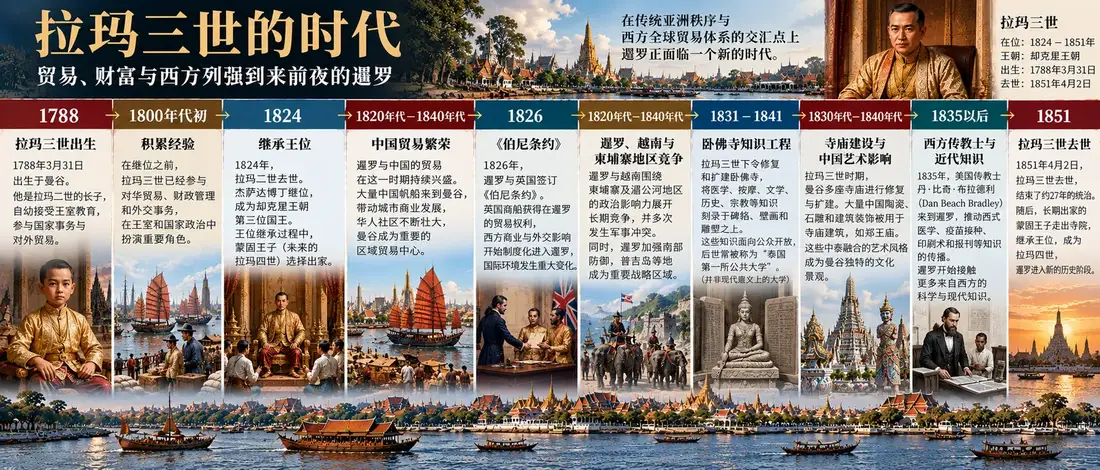
King Rama III: Trade, Wealth and the West on the Eve of Colonial Expansion Thailand’s Royal History 03 | Rama III (1824–1851)
When King Rama III ascended the throne in 1824, Siam was entering a period of profound change.
Bangkok had already become the political center of the Rattanakosin Kingdom, but the world surrounding Siam was changing rapidly. Maritime trade was expanding, Chinese merchants were becoming increasingly important to the regional economy, and European powers—especially Britain—were extending their commercial and political influence across Southeast Asia.
Rama III ruled at this crucial moment.
His reign was shaped not only by royal authority and Buddhist tradition, but also by commerce, taxation, diplomacy, international competition and the growing exchange of knowledge between Asia and the West.
From the busy trading ports of China to the temples of Bangkok, from the 1826 Burney Treaty to the regional struggle involving Siam, Vietnam and Cambodia, the reign of Rama III helped prepare Siam for the much greater challenges that would arrive later in the nineteenth century.
01 | Born in 1788: Growing Up with Bangkok’s New Dynasty
SEA NOW Thailand · Rama III · Illustration 01
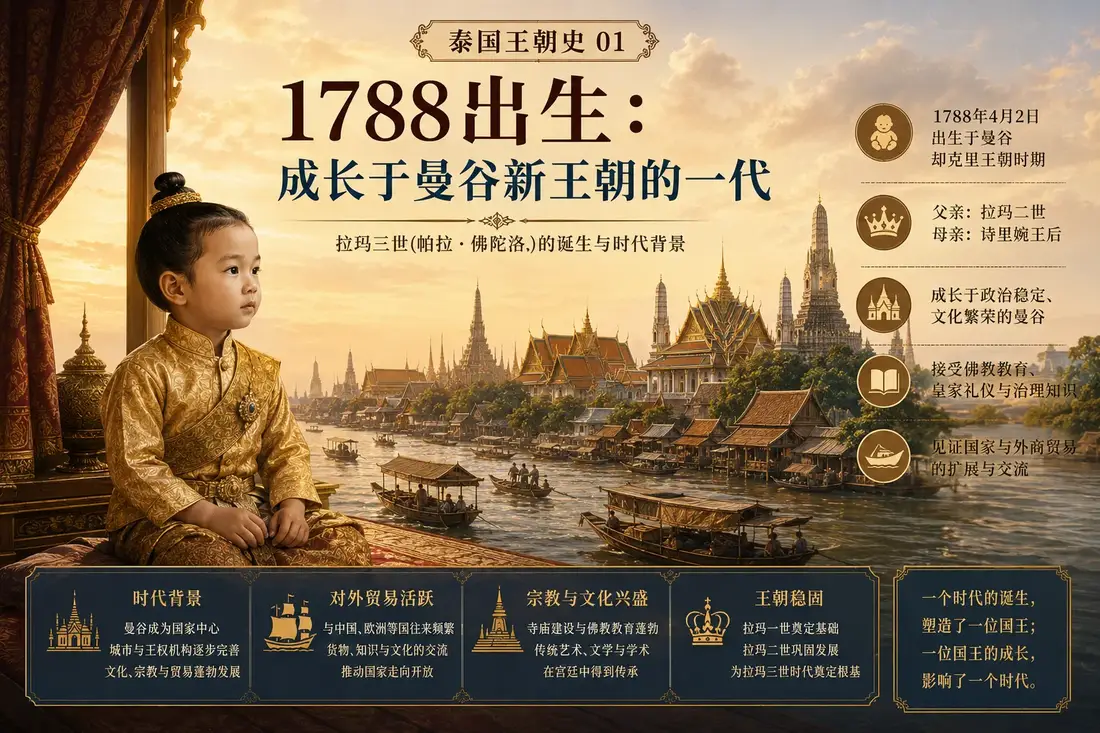
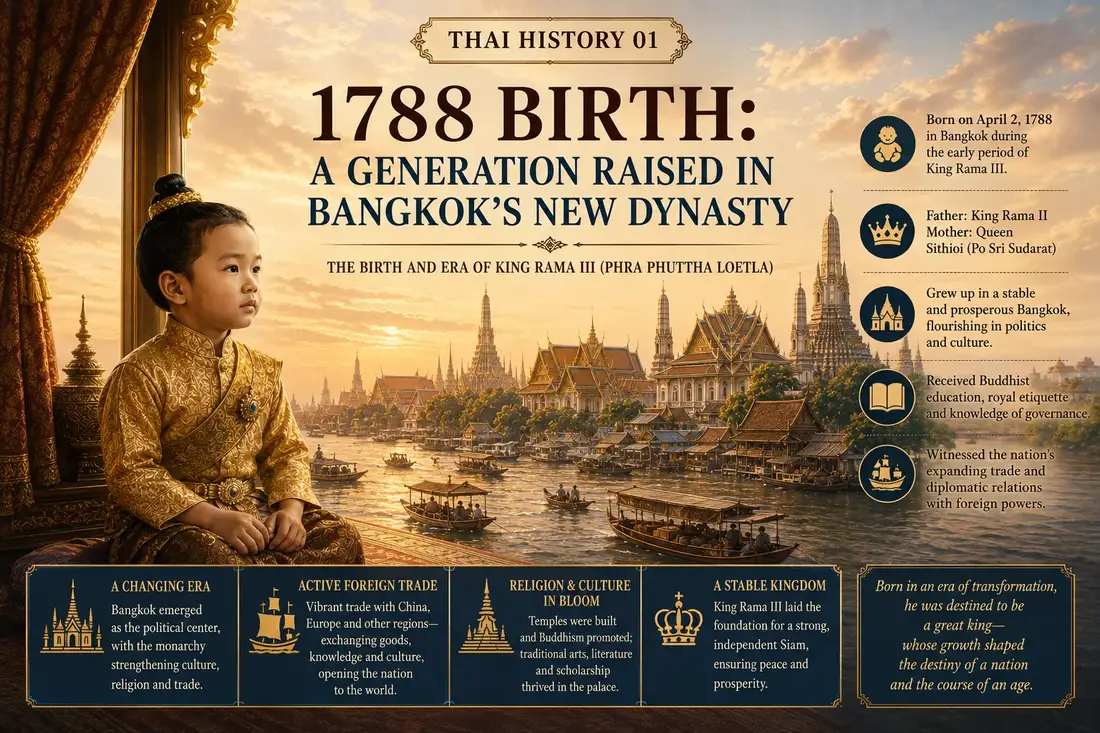
Prince Nangklao, later King Rama III, was born in Bangkok in 1788, only a few years after Bangkok became the capital of the newly established Rattanakosin Kingdom.
He therefore belonged to the first generation to grow up entirely within Bangkok’s new royal order.
The city around him was still developing. The Grand Palace, temples, canals, markets, defensive structures and royal institutions were being expanded as the Chakri dynasty consolidated its authority.
At the same time, Bangkok was becoming increasingly connected to maritime trade.
Chinese merchants, sailors, craftsmen and migrant communities played an important role in the commercial life of the capital. Goods, people and ideas moved through the Chao Phraya River, gradually transforming Bangkok from a royal capital into an increasingly important regional trading city.
This environment had a lasting influence on the future Rama III.
Unlike a ruler whose experience was limited mainly to court ceremony, he developed a strong understanding of trade, taxation, finance and administration before becoming king.
02 | Before Becoming King: Experience in Trade, Finance and Politics
SEA NOW Thailand · Rama III · Illustration 02
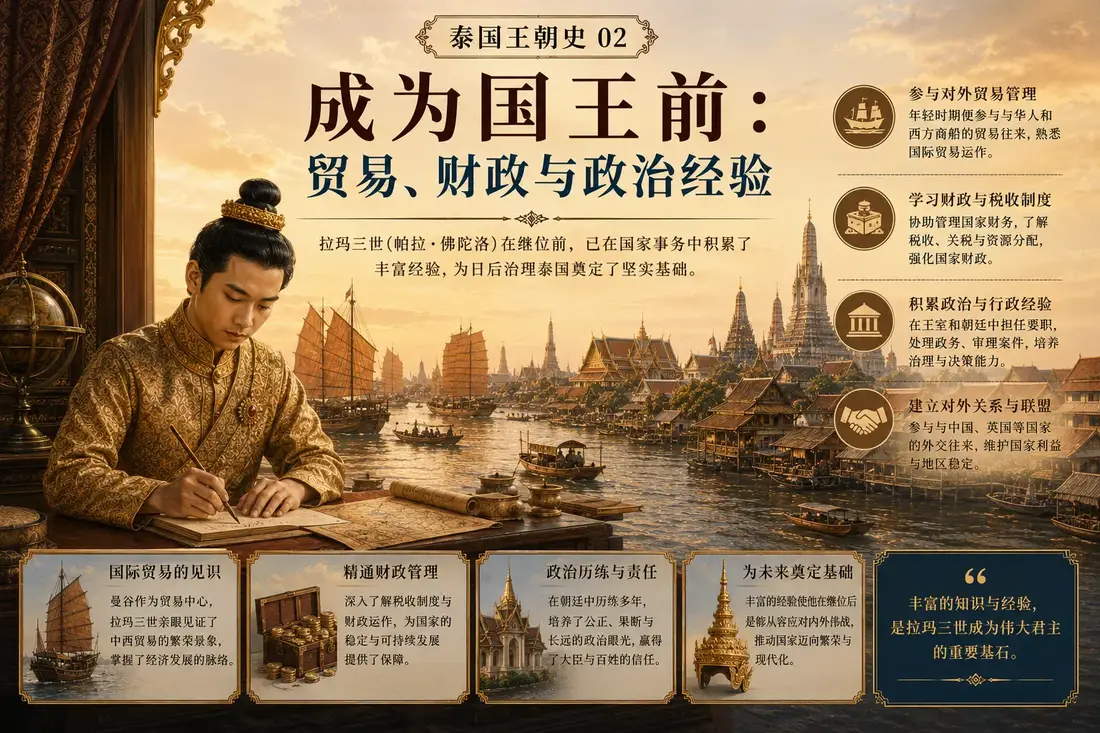
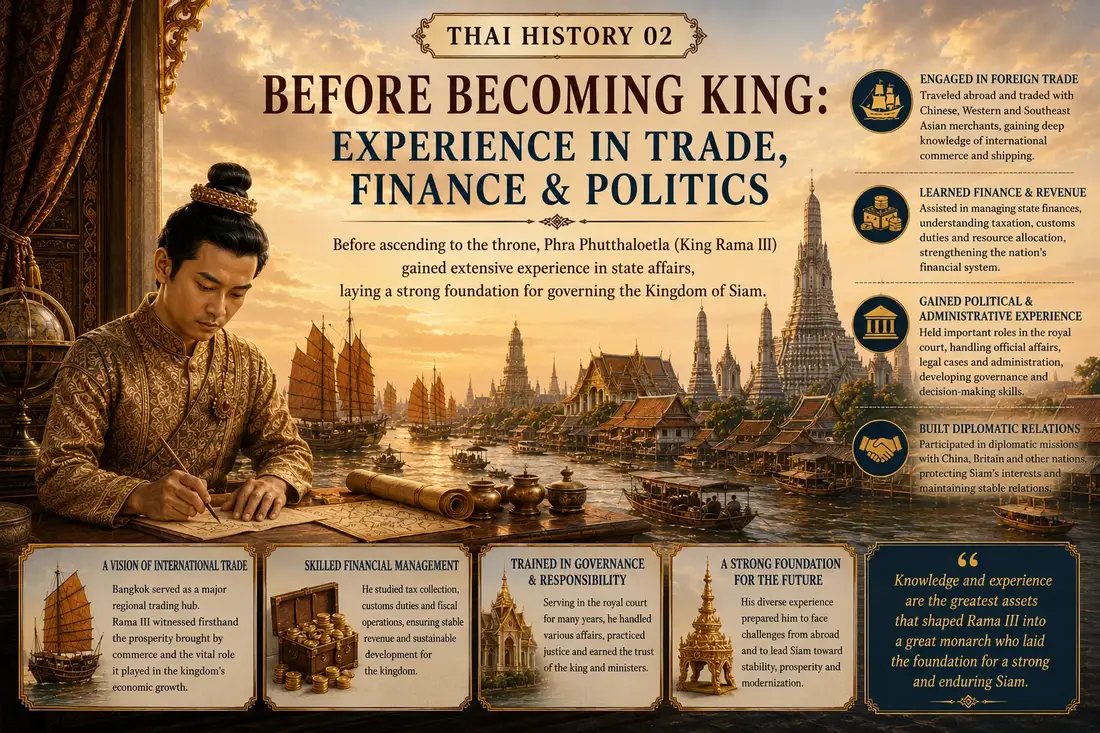
Long before ascending the throne, Prince Nangklao was deeply involved in government affairs.
He gained practical experience in areas related to commerce, taxation, state revenue and foreign trade. This gave him an unusually strong understanding of how economic activity could strengthen royal power and national stability.
China was particularly important.
Siam exported agricultural and forest products while importing Chinese manufactured goods, ceramics, silk, tea and other commodities. Chinese merchant networks connected Bangkok with ports across southern China and the wider maritime world.
For the Siamese state, trade was not simply private business.
Customs duties, taxes, royal monopolies and commercial activity were major sources of government revenue.
By the time Rama III became king, he already understood a fundamental principle of nineteenth-century statecraft:
Economic strength was becoming inseparable from political strength.
03 | 1824: The Beginning of the Rama III Era
SEA NOW Thailand · Rama III · Illustration 03
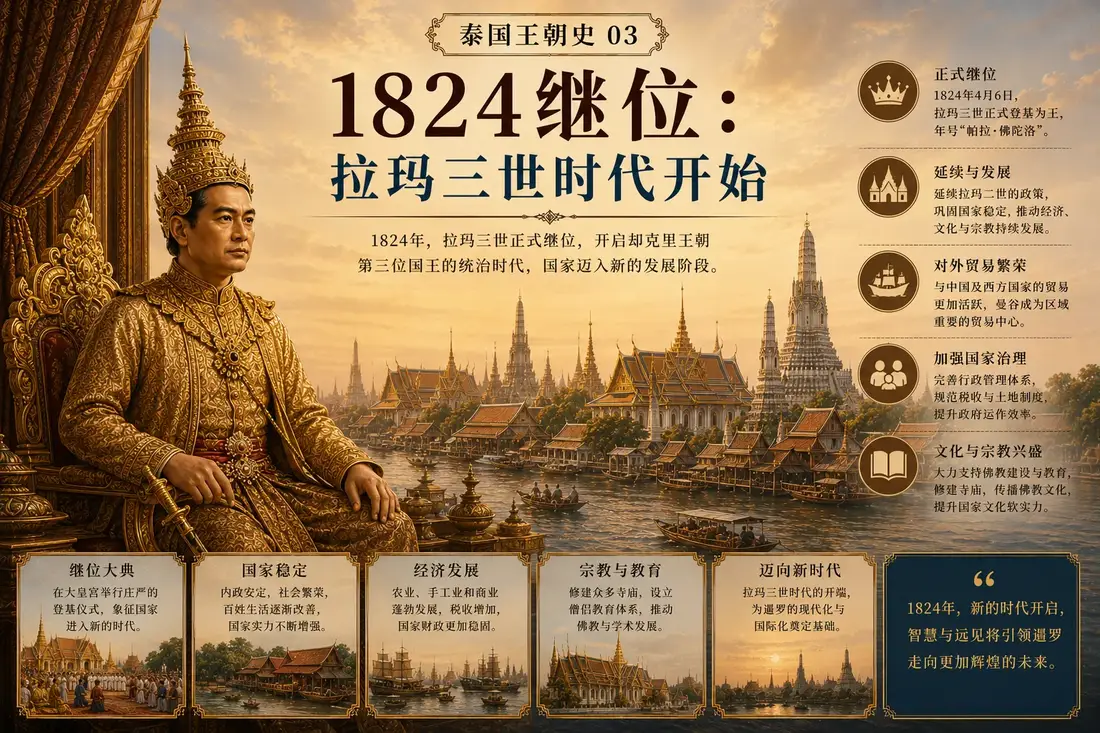
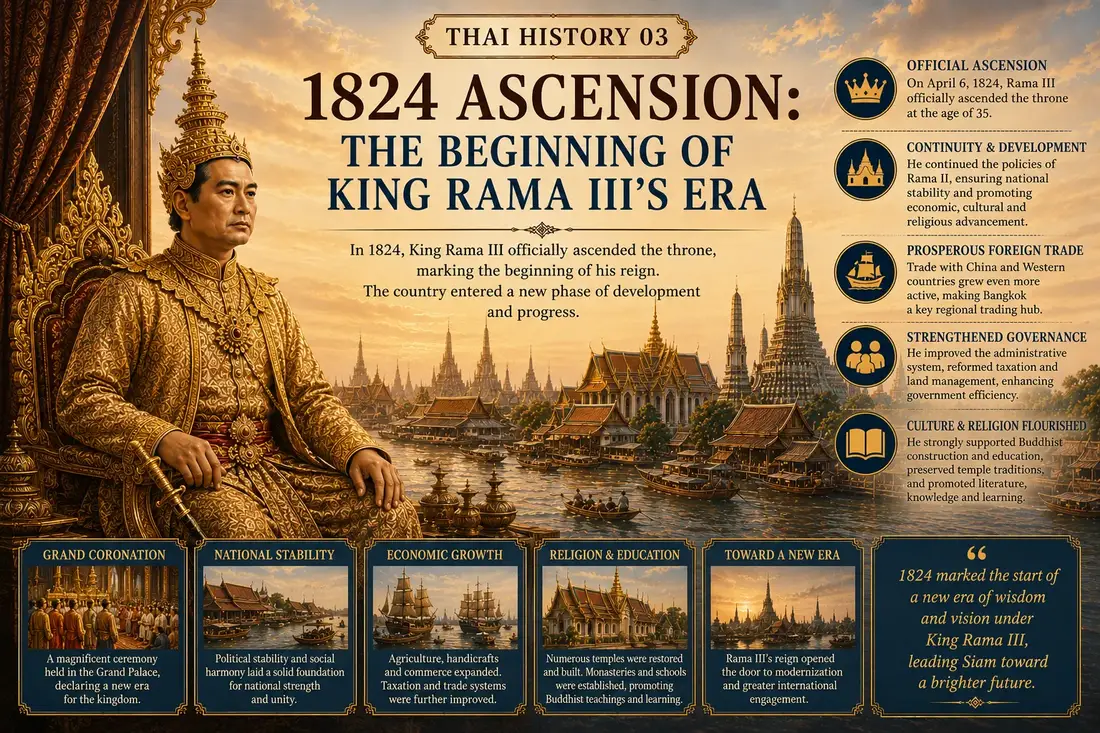
In 1824, Prince Nangklao ascended the throne as King Rama III.
His accession marked the beginning of a reign that would last until 1851.
Siam during this period faced two very different worlds.
To the east and within mainland Southeast Asia, traditional regional rivalries continued. Siam, Vietnam, Cambodia and neighboring territories competed for influence, security and political advantage.
To the west, however, a new force was appearing.
European colonial powers possessed increasingly powerful navies, expanding commercial networks and growing diplomatic influence.
Rama III therefore had to strengthen Siam internally while carefully managing external pressure.
His reign became a period of commercial expansion, temple construction, cultural development and cautious engagement with Western powers.
04 | Chinese Trade and Bangkok’s Commercial Prosperity
SEA NOW Thailand · Rama III · Illustration 04
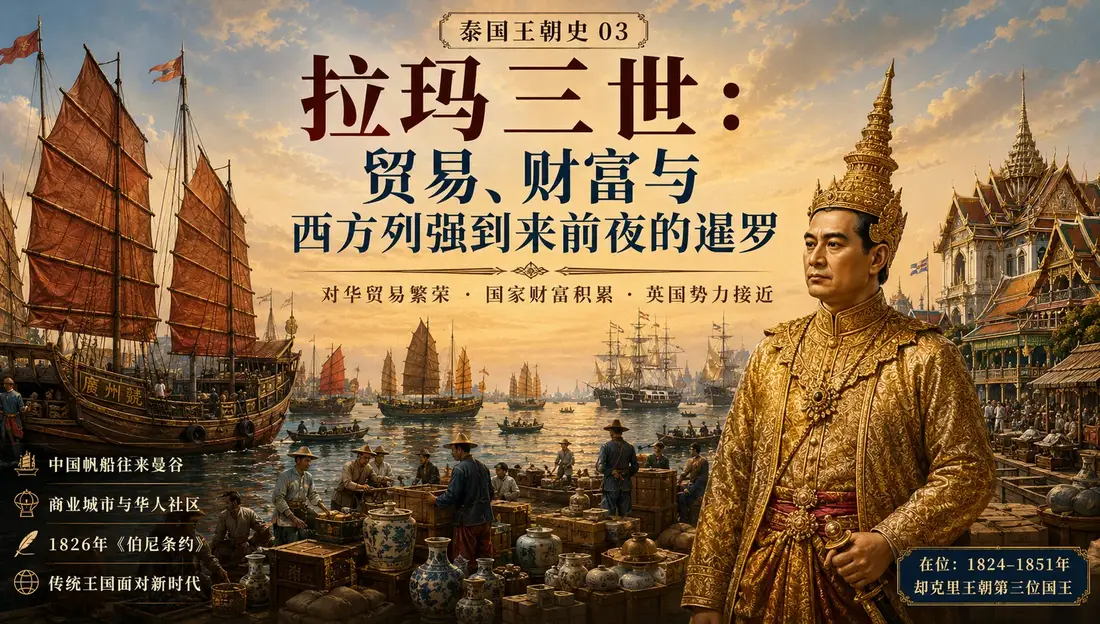
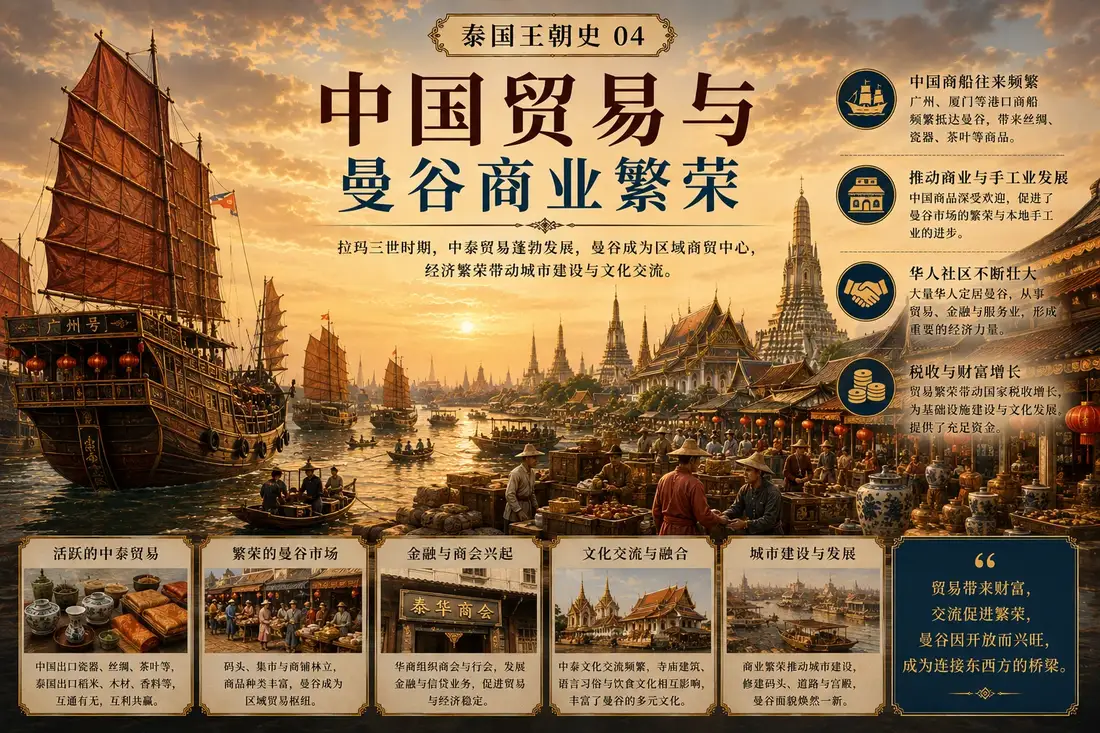
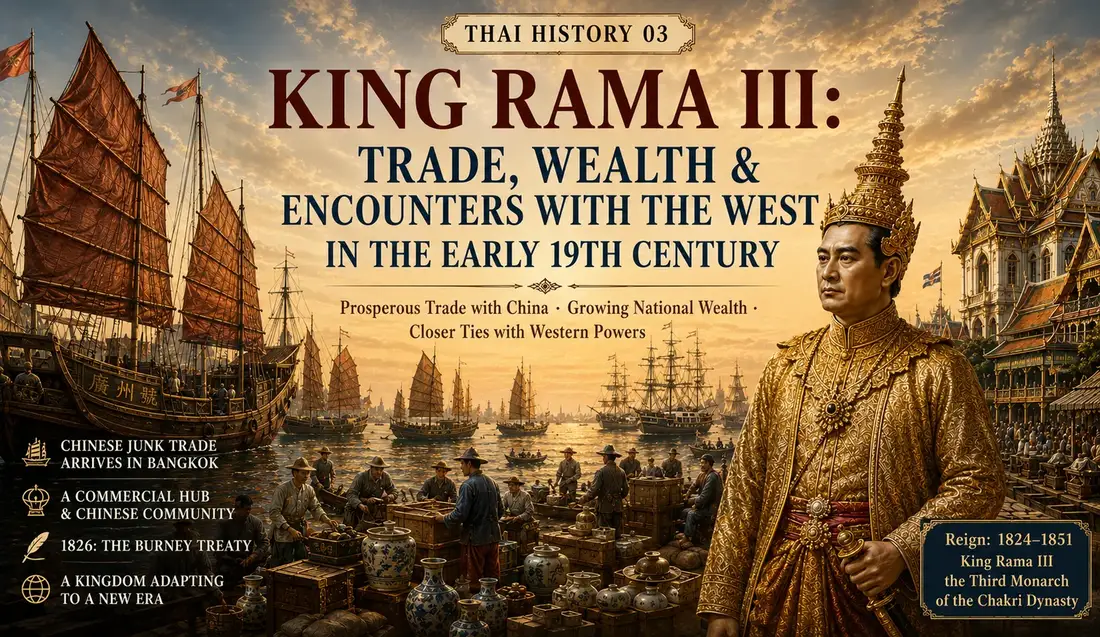
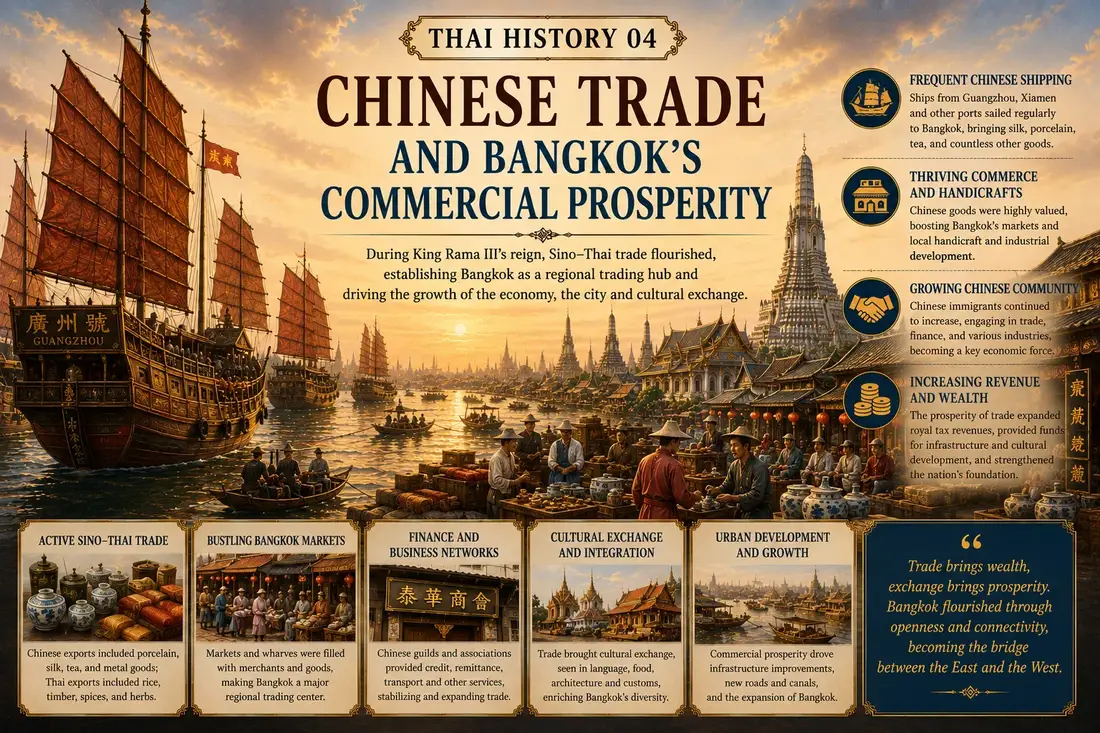
One of the defining features of Rama III’s reign was the extraordinary importance of trade with China.
Chinese junks regularly sailed between Bangkok and ports such as Guangzhou and other commercial centers along the Chinese coast.
They carried porcelain, silk, tea, metal goods and manufactured products to Siam, while Siam exported rice, timber, forest products, spices and other regional commodities.
Bangkok’s wharves and markets became increasingly busy.
Merchants, laborers, shipowners, craftsmen and financial intermediaries created new commercial networks around the capital. The Chinese community expanded and became deeply involved in trade, taxation, transport, manufacturing and urban development.
The prosperity generated by commerce also strengthened the state.
Trade revenue and taxation helped finance temples, canals, public works and other royal projects.
Bangkok was no longer simply the political capital of Siam.
It was becoming one of mainland Southeast Asia’s most important commercial centers.
05 | “Red Bag Money” and the National Wealth Reserve
SEA NOW Thailand · Rama III · Illustration 05
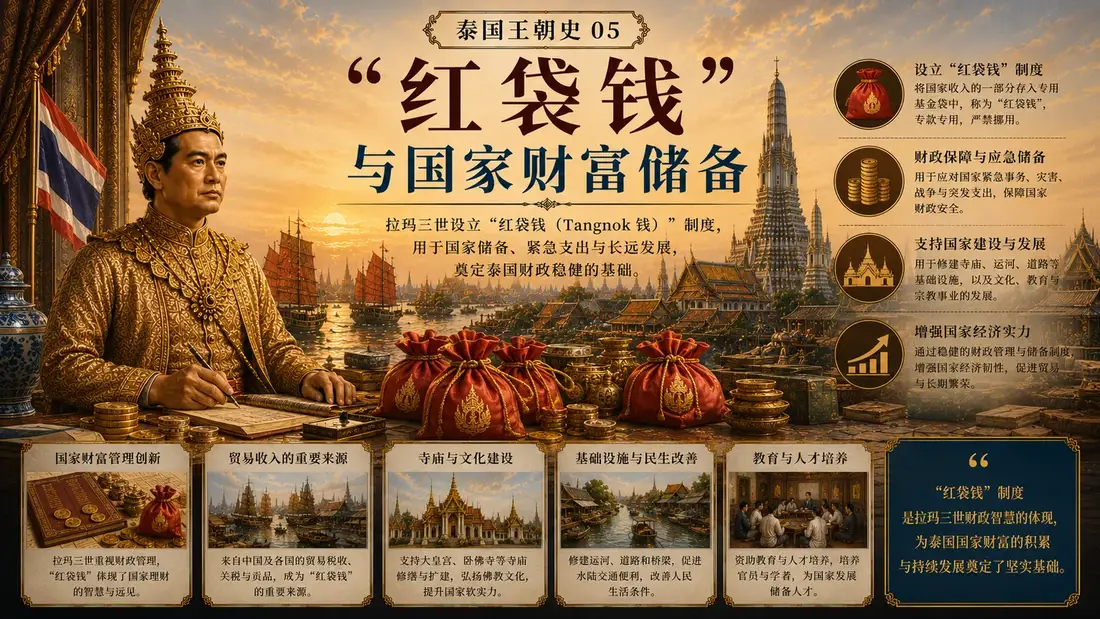
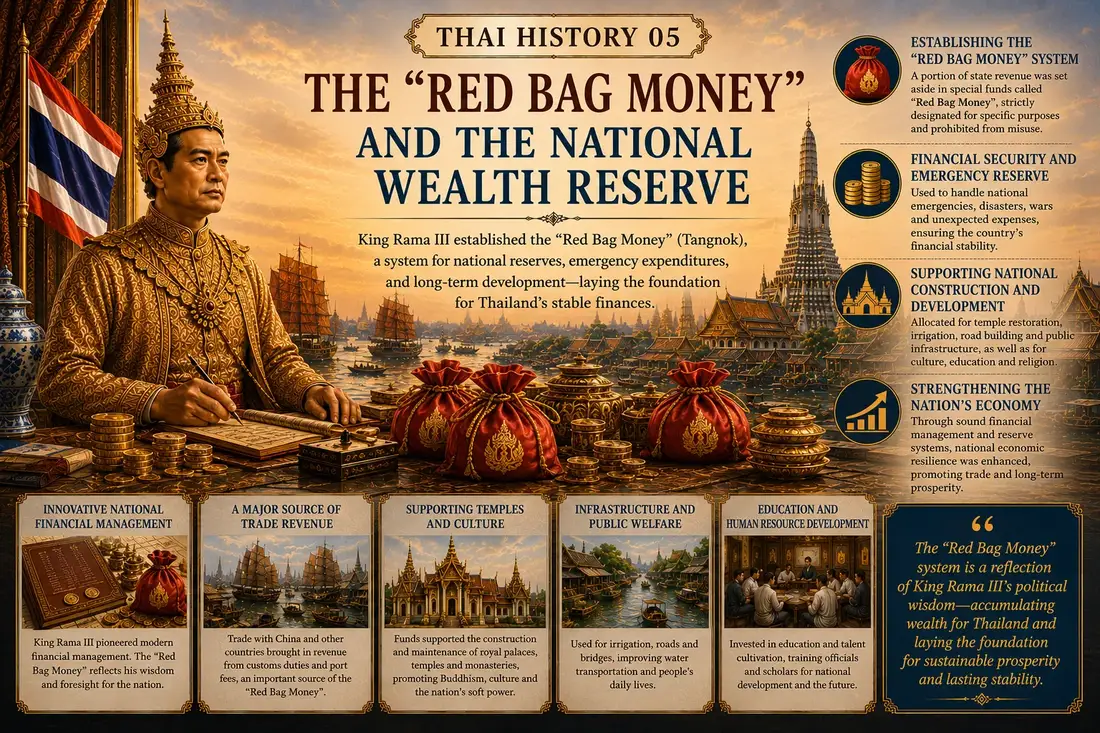
Rama III is also remembered in Thai historical tradition for the accumulation of royal reserves commonly associated with “Red Bag Money.”
The idea reflected Rama III’s strong concern for financial security.
Revenue generated through commerce, taxation and royal economic activities contributed to reserves that could strengthen the kingdom during periods of uncertainty.
This was important because nineteenth-century Siam faced both regional conflict and increasing pressure from foreign powers.
A strong treasury gave the state greater flexibility.
Resources could support defense, administration, temple construction, infrastructure and emergency expenditures.
The broader significance of the “Red Bag Money” tradition therefore goes beyond the image of money stored in bags.
It represents a political philosophy based on preparation:
A kingdom with financial reserves has greater freedom to respond to crisis.
06 | The 1826 Burney Treaty and Britain’s Entry into Siamese Diplomacy
SEA NOW Thailand · Rama III · Illustration 06
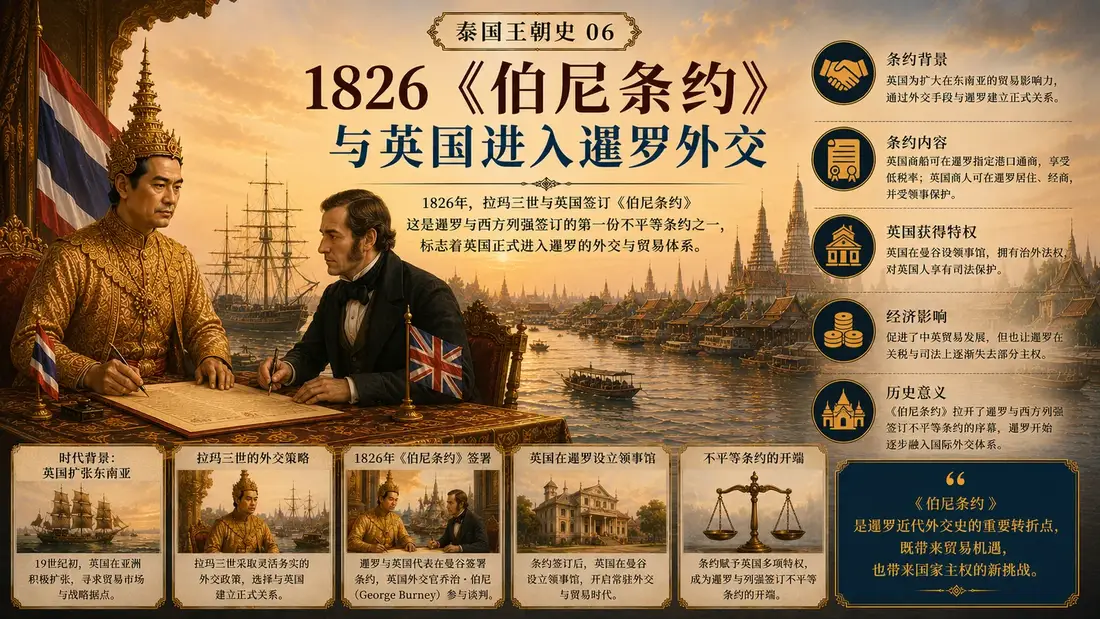
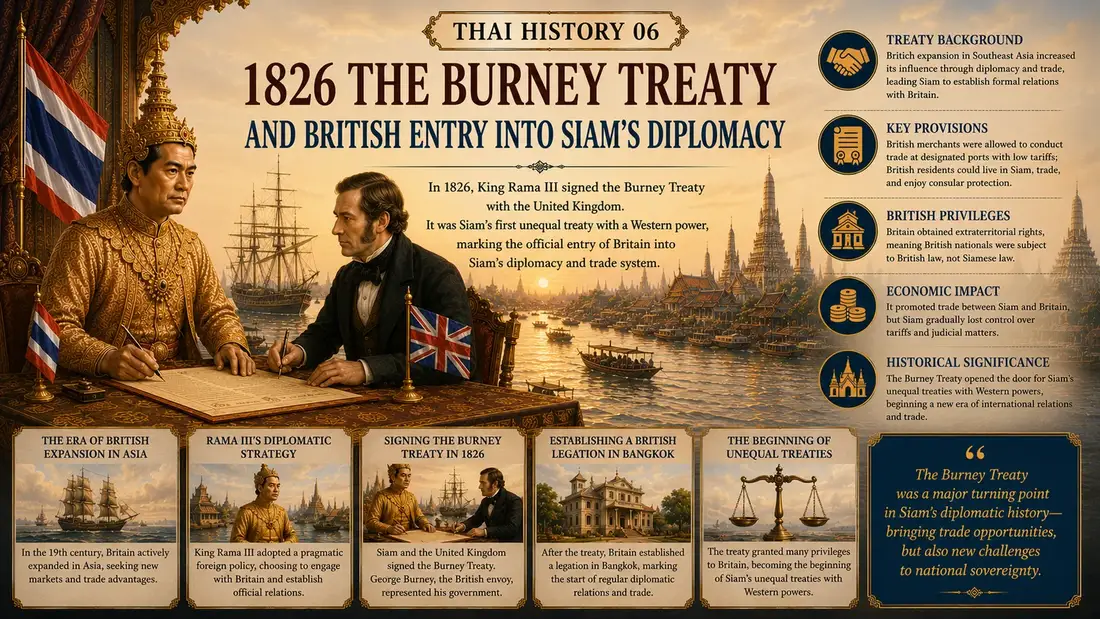
One of the most important diplomatic events of Rama III’s reign occurred in 1826, when Siam concluded the Burney Treaty with Britain.
The agreement was negotiated by British representative Henry Burney.
Britain’s influence in Southeast Asia was expanding rapidly at the time, particularly following its growing presence in British India and the Malay Peninsula.
For Siam, Britain represented both an opportunity and a warning.
British merchants wanted greater access to regional markets, while the Siamese court wanted to preserve political independence and maintain control over trade.
The Burney Treaty established a framework for relations between Siam and Britain and facilitated commercial interaction.
More importantly, it demonstrated that Siam could no longer conduct foreign affairs solely through the traditional diplomatic system of mainland Southeast Asia.
A new international order was emerging.
European powers increasingly expected treaties, formal negotiations and commercial privileges.
Rama III’s government responded cautiously—engaging with Britain while attempting to protect Siamese interests.
This diplomatic balancing strategy would become increasingly important under later Thai kings.
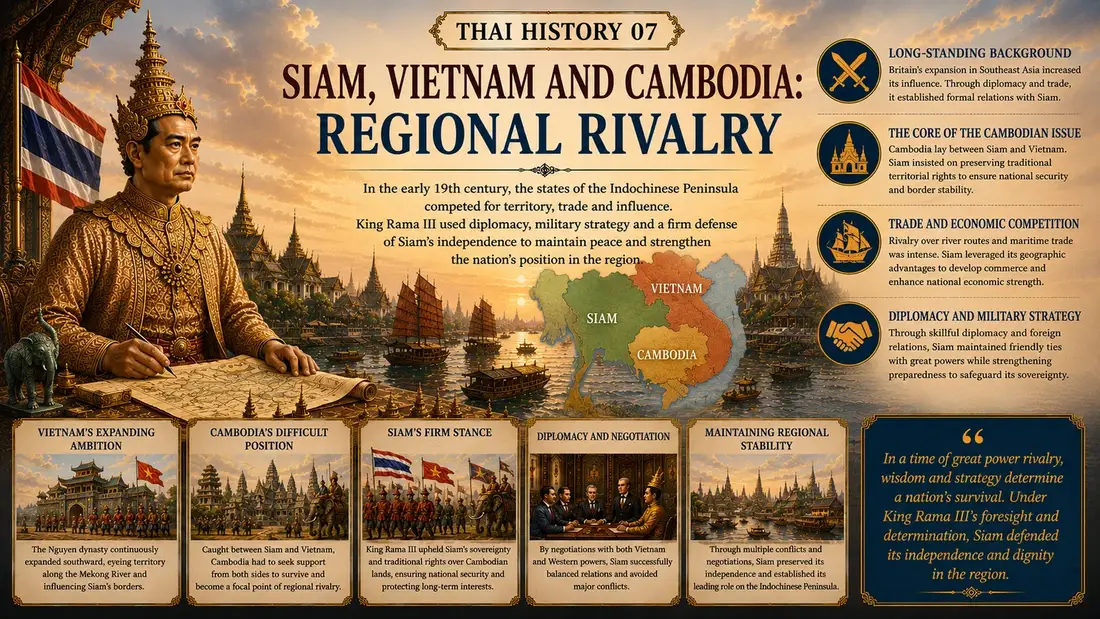
07 | Siam, Vietnam and Cambodia: Regional Rivalry
SEA NOW Thailand · Rama III · Illustration 07
European expansion was not the only challenge confronting Rama III.
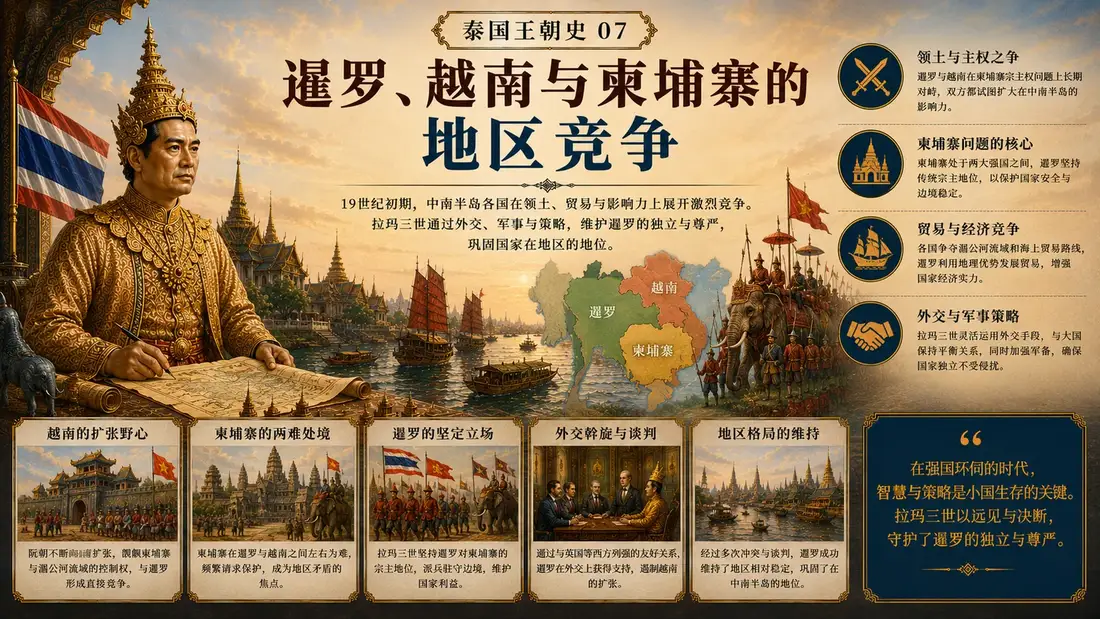
Siam was also involved in a long-running regional competition with Vietnam, with Cambodia often caught between the two powers.
Both Siam and Vietnam sought influence over territories and political networks across mainland Southeast Asia.
Cambodia occupied an especially sensitive position.
Its rulers frequently had to navigate between the competing influence of Bangkok and the Vietnamese court.
These tensions contributed to military campaigns, political intervention and prolonged instability.
For Rama III, regional policy therefore required a combination of military readiness and diplomacy.
Siam needed to defend its traditional sphere of influence without exhausting the kingdom through continuous warfare.
The conflicts of this period reveal an important reality:
Before European colonial domination fully transformed Southeast Asia, the region already possessed its own complex system of rival states, alliances and competing centers of power.
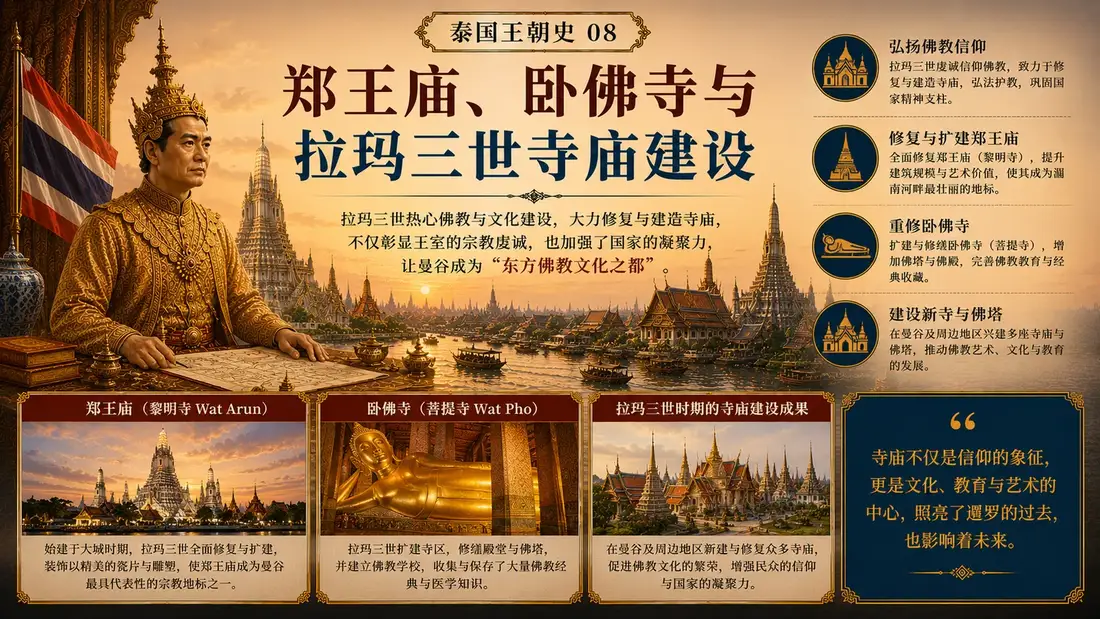
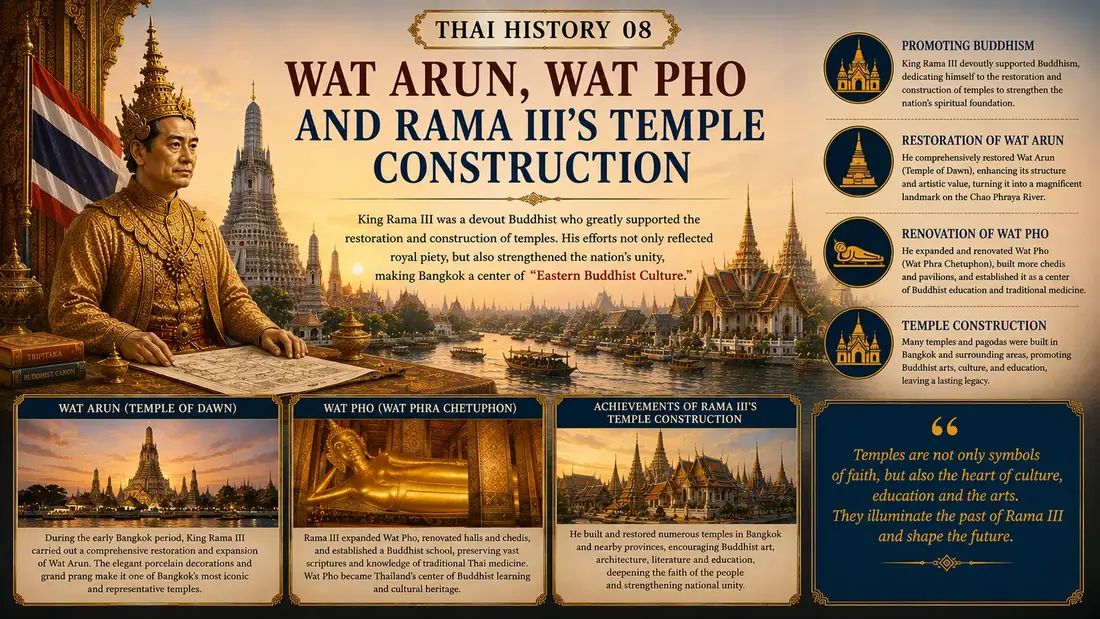
08 | Wat Arun, Wat Pho and Rama III’s Temple-Building Era
SEA NOW Thailand · Rama III · Illustration 08
Rama III’s legacy is visible not only in diplomacy and commerce, but throughout Bangkok’s religious landscape.
He was a major patron of Buddhism and supported extensive temple construction and restoration.
Among the temples associated with this era are Wat Arun and Wat Pho, together with numerous other monasteries renovated or constructed during his reign.
Temple building served several purposes.
It expressed royal devotion to Buddhism, strengthened the legitimacy of the monarchy and created centers for education, religious practice and community life.
Temples were also major cultural institutions.
They preserved manuscripts, supported monks and scholars, transmitted artistic traditions and provided spaces where knowledge could be shared.
Rama III’s Bangkok was therefore shaped by a close relationship between economic prosperity and religious patronage.
The wealth generated through trade helped finance a remarkable period of architectural and artistic activity.
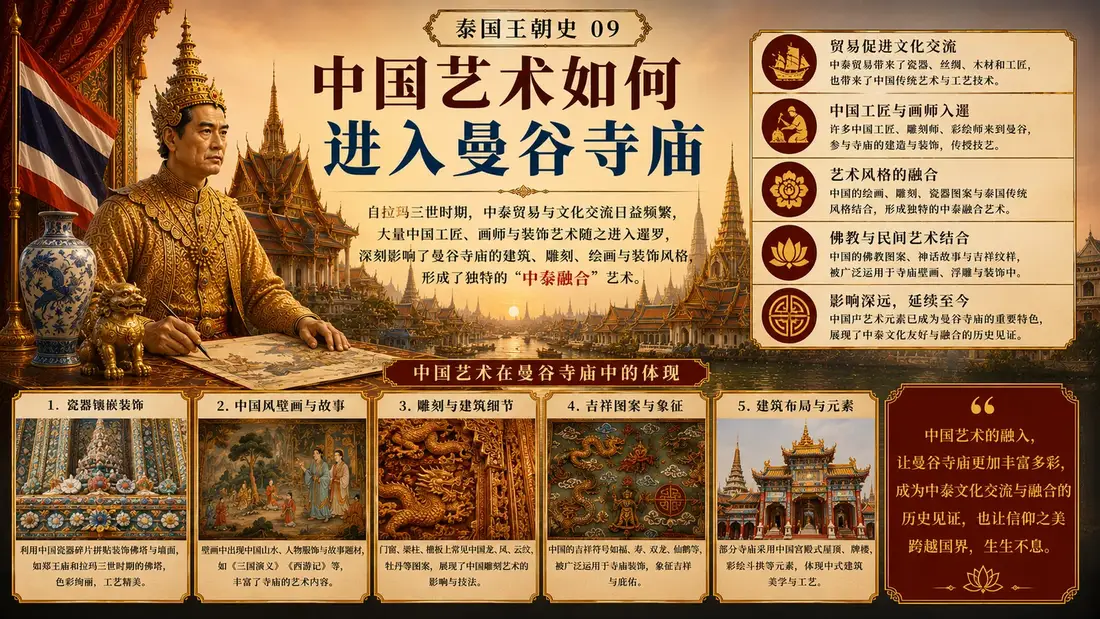
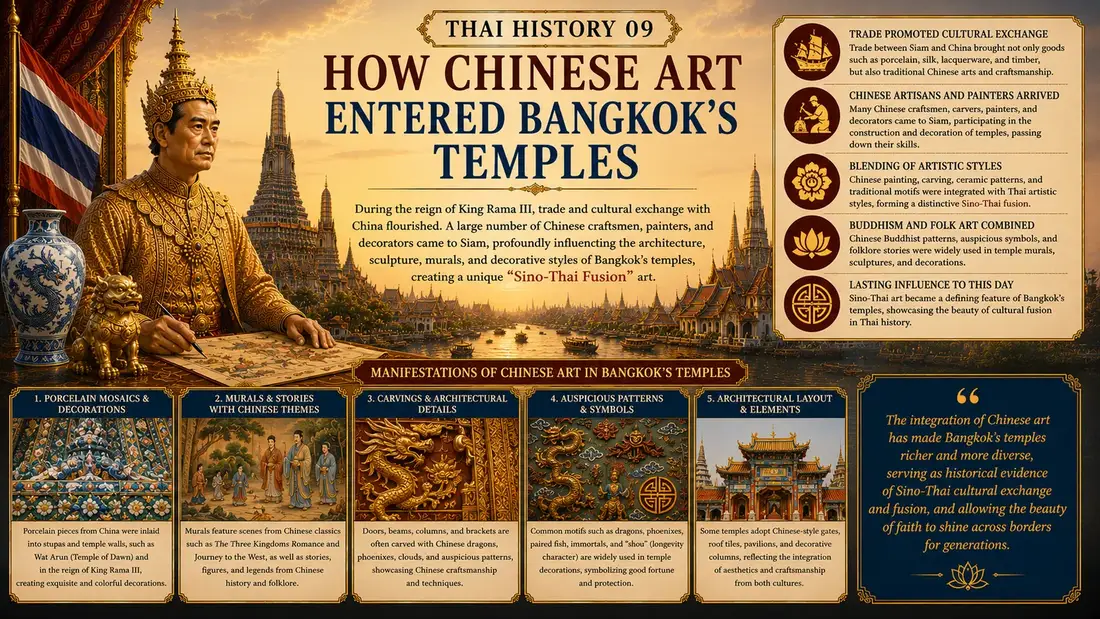
09 | How Chinese Art Entered Bangkok’s Temples
SEA NOW Thailand · Rama III · Illustration 09
The commercial relationship between Siam and China also transformed Bangkok’s visual culture.
Ships did not carry only goods.
They carried artistic styles, craftsmen, decorative materials and cultural ideas.
During Rama III’s reign, Chinese artistic influences became especially visible in temple architecture and decoration.
Chinese ceramics and porcelain fragments were incorporated into decorative surfaces. Chinese-style stone sculptures appeared around temple compounds. Floral patterns, mythical animals and auspicious symbols were combined with traditional Thai Buddhist architecture.
Chinese craftsmen and artists also contributed skills and techniques.
The result was not simply the imitation of Chinese architecture.
Instead, Bangkok developed a distinctive Sino-Thai artistic language.
Thai religious structures incorporated Chinese materials and decorative vocabulary while remaining part of Siam’s Buddhist architectural tradition.
Many of these features can still be seen in Bangkok today.
They are physical evidence of centuries of interaction between Siam and China.
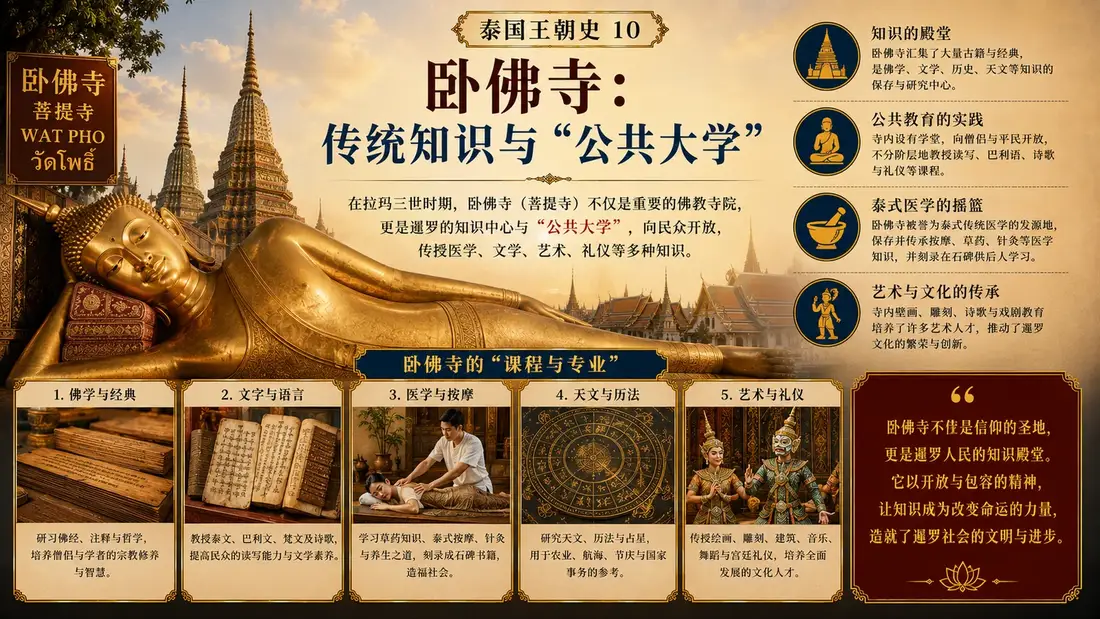
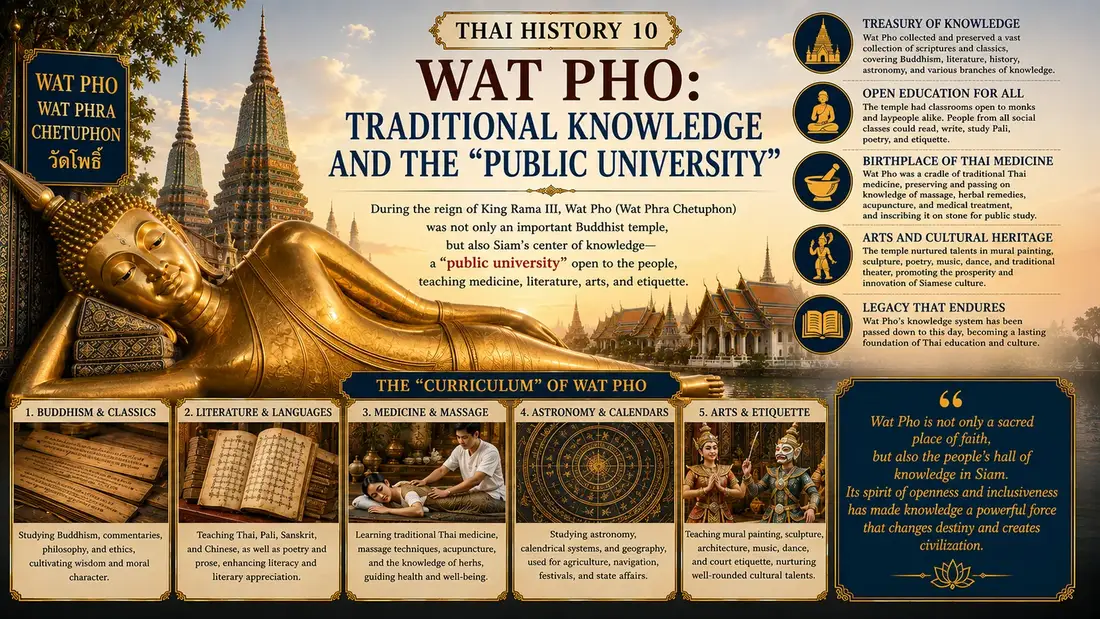
10 | Wat Pho: Traditional Knowledge and the “Public University”
SEA NOW Thailand · Rama III · Illustration 10
Wat Pho represents another important dimension of Rama III’s cultural policy.
During his reign, the temple became an extraordinary center for preserving and disseminating knowledge.
Religious teachings, literature, medicine, massage, language, history and other forms of traditional knowledge were recorded and displayed within the temple complex.
Knowledge that might otherwise have remained restricted to specialists or court circles became more accessible.
For this reason, Wat Pho is sometimes described as Thailand’s early “public university.”
Its famous inscriptions preserved knowledge of traditional Thai medicine, including therapeutic practices and massage.
But medicine was only part of a much broader intellectual project.
The temple functioned as a repository of Siamese knowledge at a moment when the kingdom was becoming increasingly exposed to new ideas from abroad.
This made Wat Pho both conservative and innovative:
It preserved traditional knowledge precisely because Siam was entering a period of accelerating change.
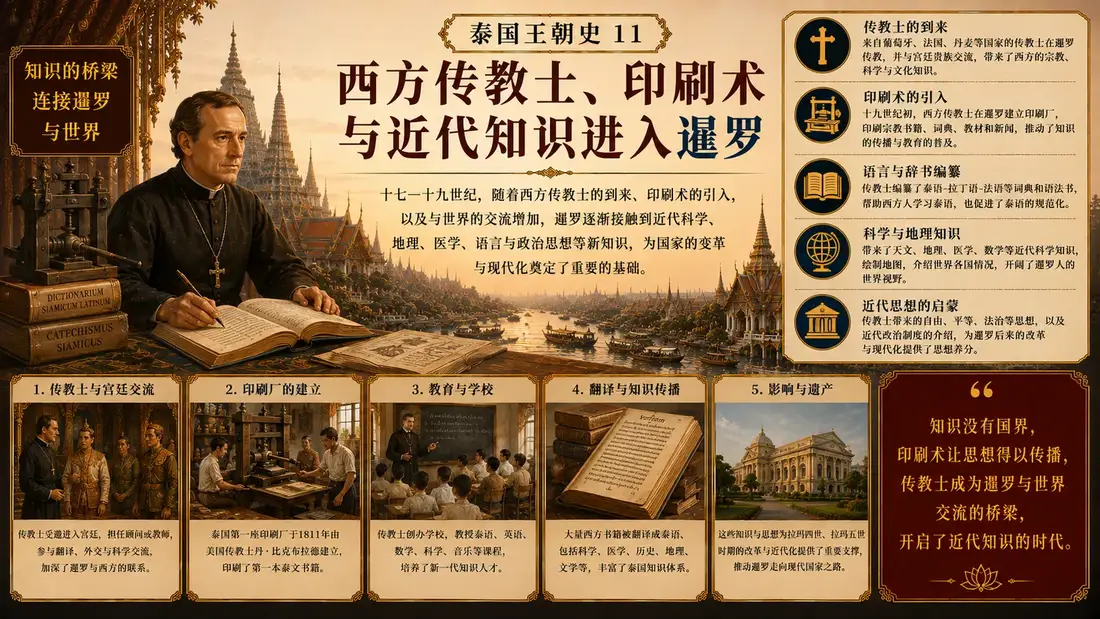
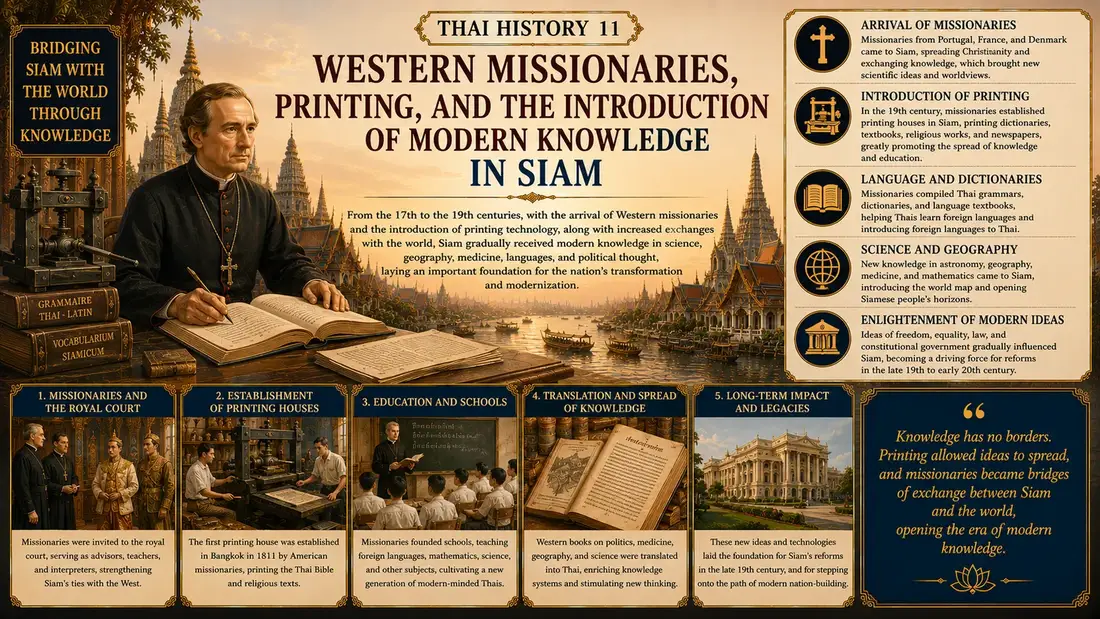
11 | Western Missionaries, Printing and the Arrival of Modern Knowledge
SEA NOW Thailand · Rama III · Illustration 11
Western contact during the nineteenth century brought more than diplomatic pressure and commercial competition.
It also introduced new technologies and forms of knowledge.
Western missionaries played an important role in this process.
Missionaries studied local languages, produced dictionaries and religious texts, established schools and introduced new approaches to printing.
Printing technology dramatically changed the way information could circulate.
Texts that once had to be copied manually could increasingly be reproduced and distributed more efficiently.
Western knowledge of medicine, astronomy, geography, mathematics and other subjects also entered Siam through missionaries, merchants, diplomats and foreign publications.
The Siamese elite did not simply accept everything that arrived from abroad.
Foreign knowledge was observed, translated, debated and selectively adopted.
This process would become even more important during the reign of Rama IV.
The intellectual opening that began before and during Rama III’s reign therefore helped prepare Siam for the reforms of the second half of the nineteenth century.
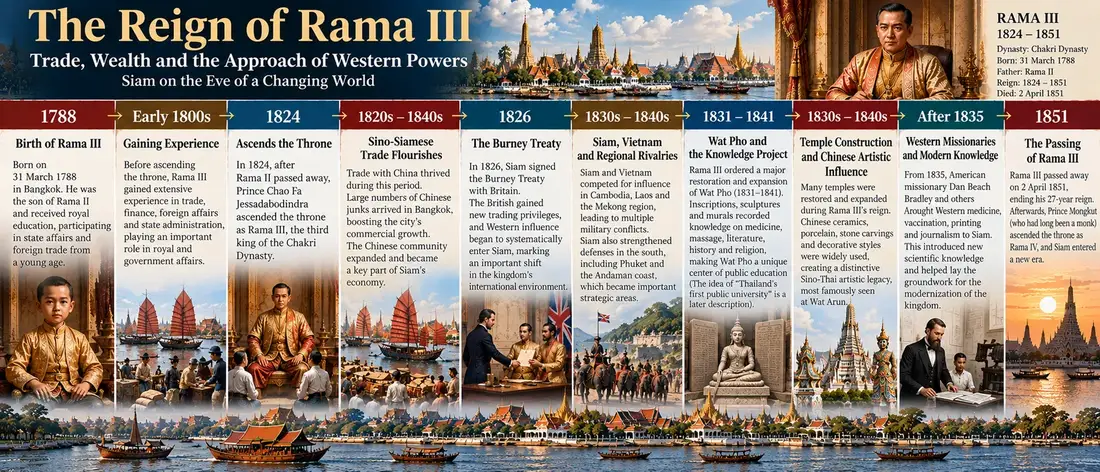
12 | 1788 → 1824 → 1851: A Complete Timeline
SEA NOW Thailand · Rama III · Illustration 12
Three dates help explain Rama III’s place in Thai history.
1788 — Prince Nangklao was born into the early Rattanakosin era, only a few years after Bangkok became the capital.
He grew up in a kingdom that was rebuilding political stability while developing new commercial connections.
1824 — He ascended the throne as King Rama III.
During his reign, trade expanded, Bangkok prospered, Chinese cultural influence became increasingly visible, temples were restored and constructed, and Siam cautiously developed formal relations with Western powers.
1851 — Rama III died, and Rama IV—King Mongkut—ascended the throne.
The new king would accelerate Siam’s engagement with Western science, diplomacy and international institutions.
Seen together, these three dates tell a larger story:
1788 was the age of consolidation. 1824 was the age of prosperity and opening. 1851 marked the beginning of a new phase of modernization.
Rama III’s Historical Legacy
King Rama III ruled before the most dramatic phase of European colonial expansion in mainland Southeast Asia.
Yet many of the forces that would define that later era were already visible during his reign.
International trade was expanding.
China remained economically and culturally important.
Britain was becoming increasingly influential.
Western missionaries and technologies were introducing new knowledge.
Regional competition remained intense.
Bangkok itself was transforming into a larger, wealthier and more cosmopolitan capital.
Rama III responded to these changes through a combination of commercial pragmatism, financial discipline, Buddhist patronage, military preparedness and cautious diplomacy.
His reign therefore forms an important bridge between two periods of Thai history.
On one side stood the early Rattanakosin kingdom—a state still consolidating itself after the upheavals of the eighteenth century.
On the other stood the nineteenth-century world of steamships, colonial empires, modern diplomacy, printing, science and international commerce.
Rama III stood between these two worlds.
The wealth accumulated through trade strengthened the kingdom. The temples built and restored during his reign reshaped Bangkok’s cultural landscape. Contact with China produced a distinctive artistic legacy, while growing interaction with Britain and other Western powers forced Siam to reconsider its position in a rapidly changing international system.
When Rama IV came to the throne in 1851, Siam’s modernization did not begin from nothing.
The foundations had already been laid.
And much of that foundation was built during the reign of King Rama III.
Between 1788, 1824 and 1851, Siam moved from the consolidation of a new capital toward a far more connected and complicated world.
King Rama III’s reign was one of the crucial chapters in that transformation—a period when Bangkok became wealthier, more international and more culturally diverse, while Siam began learning how to survive in an age increasingly dominated by global trade and Western imperial power.