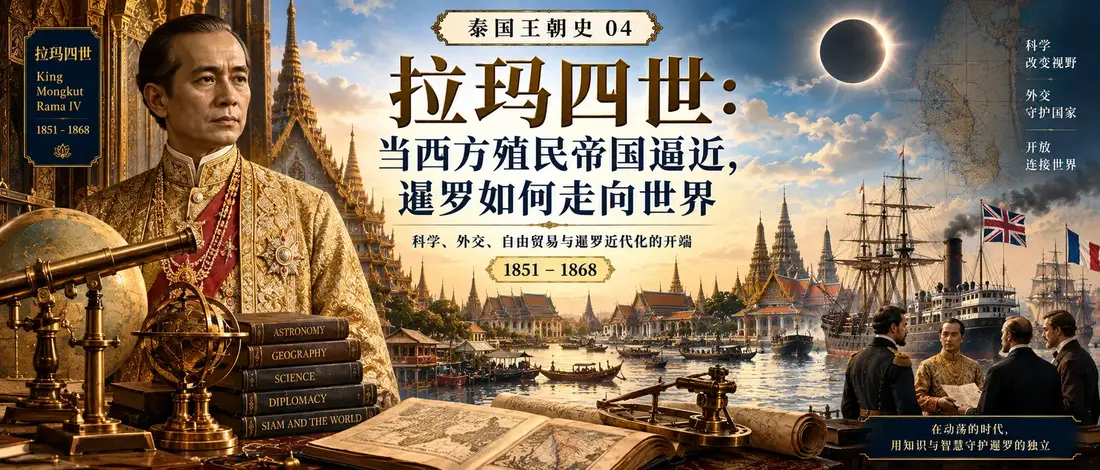
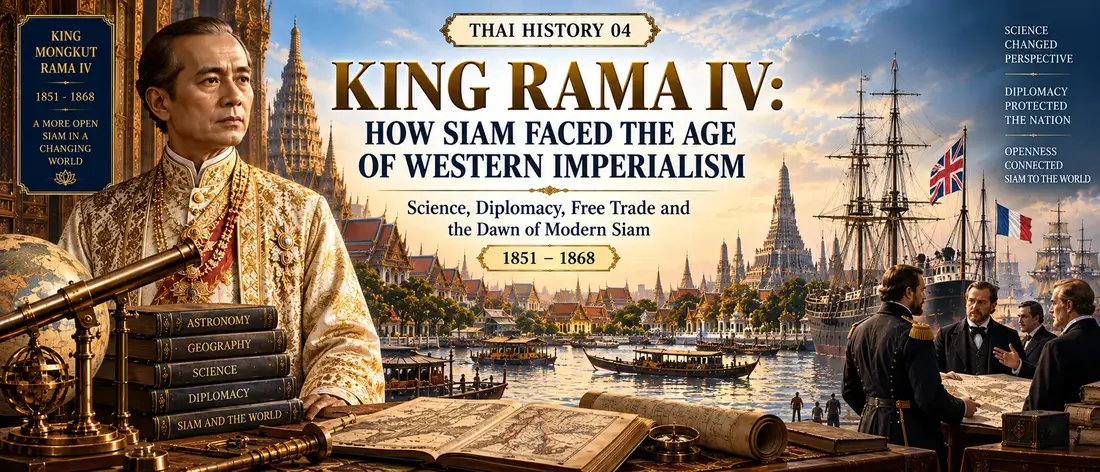
King Rama IV: How Siam Faced the Age of Western Imperialism Thai Royal History 04 | King Rama IV (Mongkut), 1851–1868
By the middle of the nineteenth century, Siam stood at one of the most dangerous crossroads in its history.
To the west, Britain had consolidated its power in India and was expanding its influence over Burma. British power was also deeply established in the Malay Peninsula.
To the east, France was beginning its expansion into Vietnam and, eventually, other parts of mainland Southeast Asia.
The traditional political order of the region was being transformed by European imperialism.
Siam was running out of room.
At this critical moment, a prince who had spent roughly twenty-seven years as a Buddhist monk ascended the throne.
He had studied English, engaged with Western missionaries, developed a deep interest in science and geography, and became particularly fascinated by astronomy.
His name was King Mongkut—Rama IV.
Instead of completely rejecting the West, Mongkut attempted to understand it.
Through diplomacy, trade, science and education, he sought a place for Siam within the emerging international order while preserving the kingdom’s sovereignty.
His reign became one of the great turning points in Siam’s transition toward a modern state.
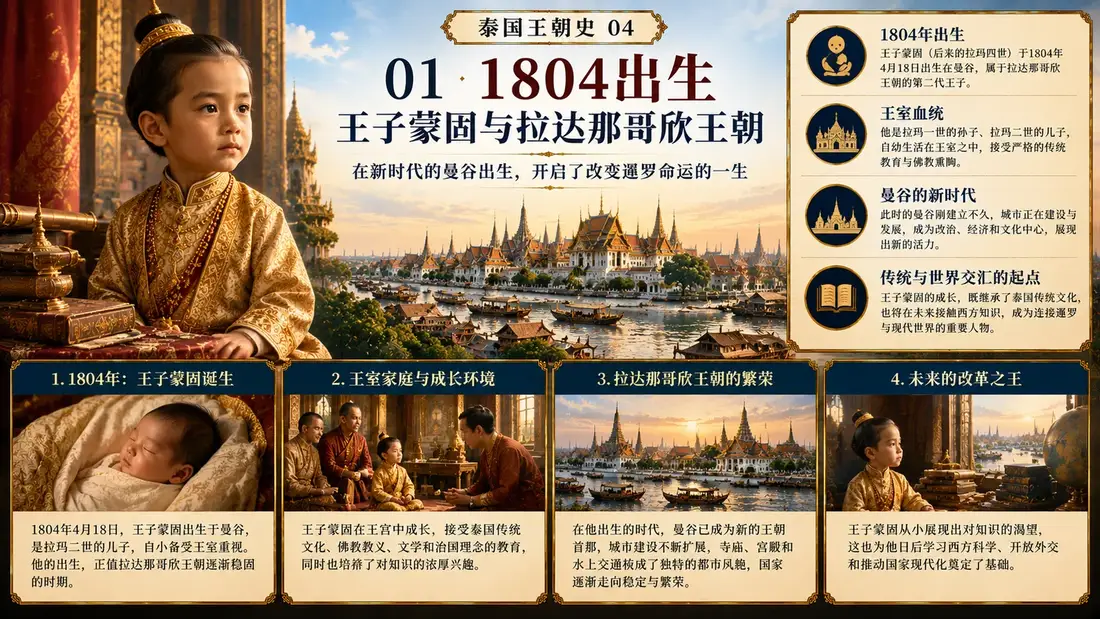
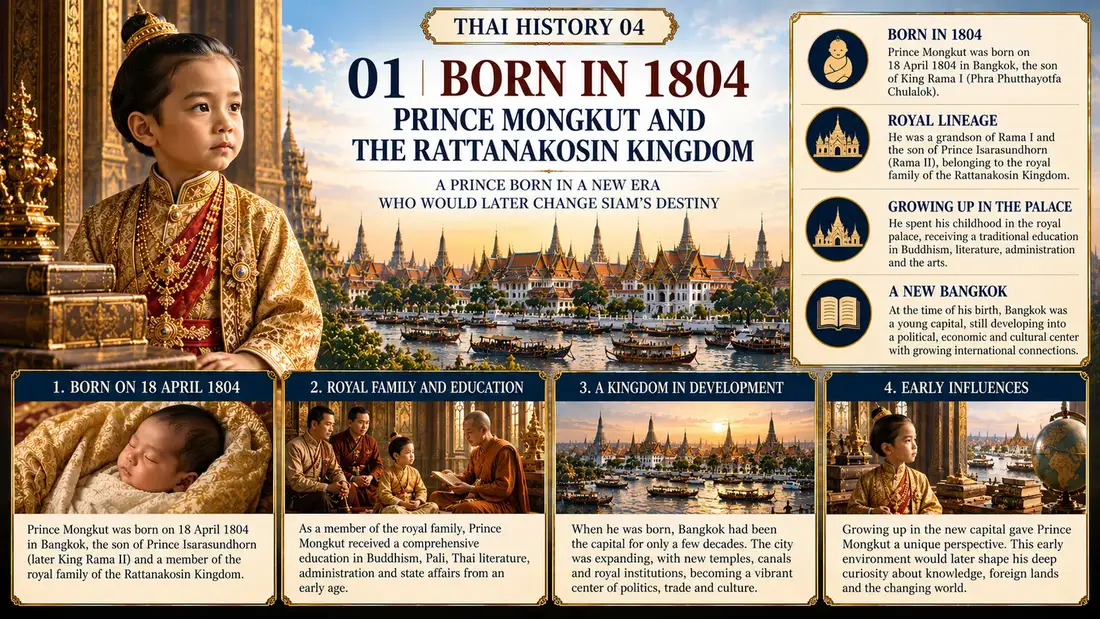
01 | Born in 1804: Prince Mongkut and the Rattanakosin Dynasty
SEA NOW Thailand · Rama IV · Illustration 01
Prince Mongkut was born in Bangkok on October 18, 1804.
His father later became King Rama II.
At the time, Bangkok had been the capital of Siam for only a little more than two decades, and the Rattanakosin Kingdom was still consolidating itself.
Growing up within the royal court, Mongkut received a traditional education centered on Buddhism, language, literature and royal culture.
But his intellectual interests eventually reached far beyond conventional court learning.
He became fascinated by languages, geography, astronomy and the wider world.
This curiosity would later become one of the defining characteristics of his reign.
The world around Siam was also changing.
Industrialization was transforming Europe, oceanic trade was expanding, and European ships were appearing with increasing frequency across Asian waters.
The West was no longer distant.
It was moving closer to Siam.
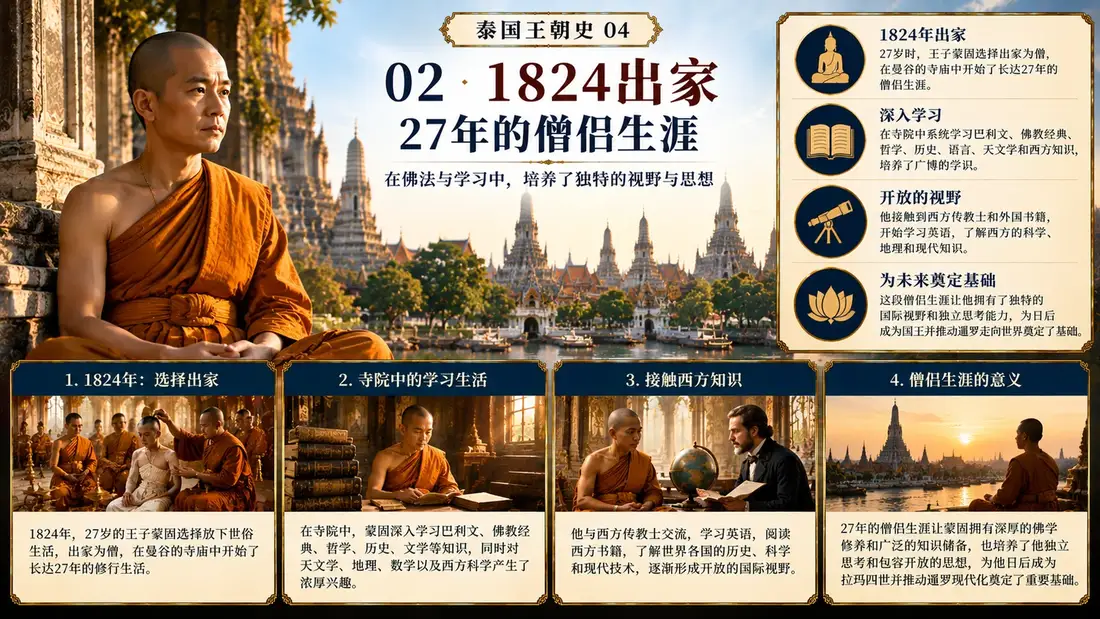
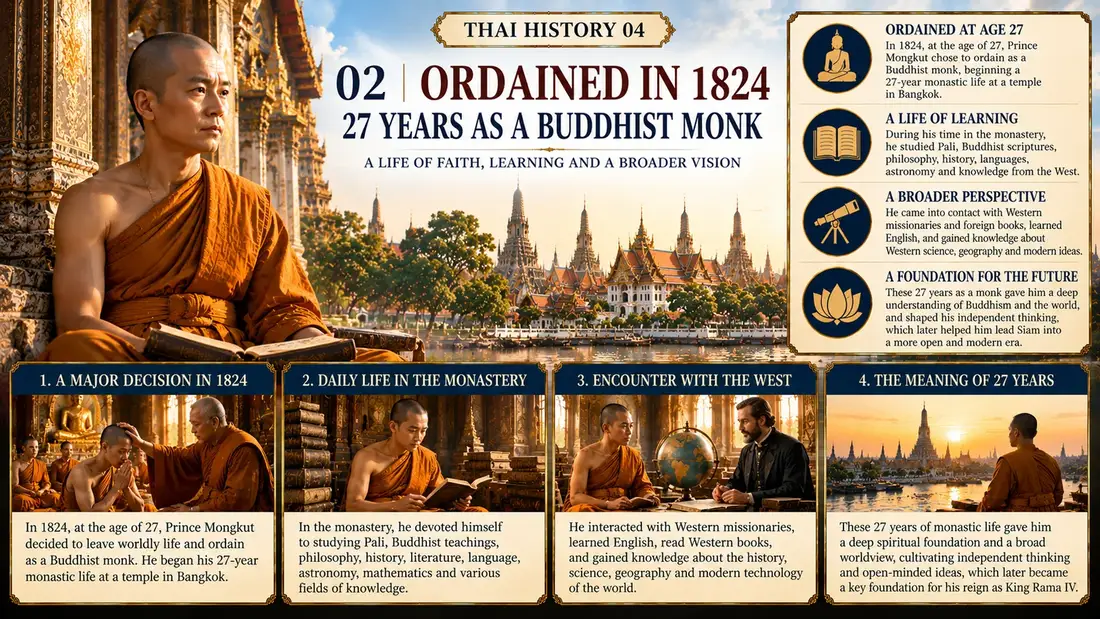
02 | 1824: Twenty-Seven Years as a Buddhist Monk
SEA NOW Thailand · Rama IV · Illustration 02
In 1824, King Rama II died.
Mongkut, then around twenty years old, had already entered the Buddhist monkhood.
The throne eventually passed to his elder half-brother, who became King Rama III.
Mongkut remained a monk.
He would continue his monastic life for approximately twenty-seven years, from 1824 until his accession in 1851.
Those years profoundly shaped his worldview.
Monastic life allowed him to travel, encounter people outside the royal court and study Buddhist teachings in depth.
It also brought him into contact with Western missionaries and foreigners living in Siam.
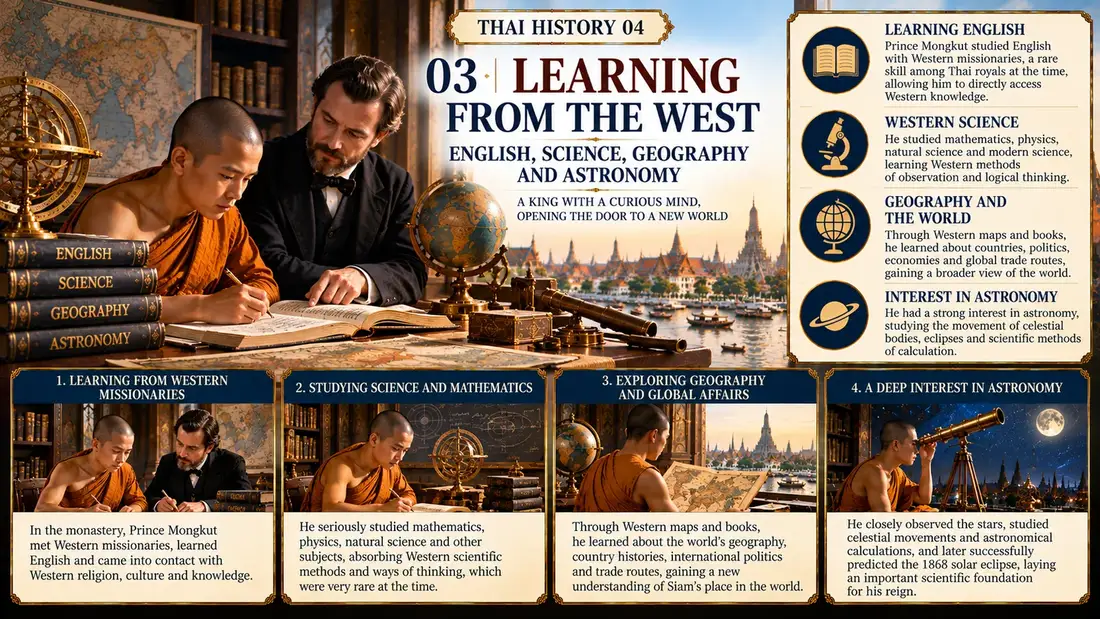
He studied English and became increasingly interested in mathematics, geography, science and astronomy.
Rather than being a pause in his political life, Mongkut’s long period in the monkhood became preparation for the challenges he would later face as king.
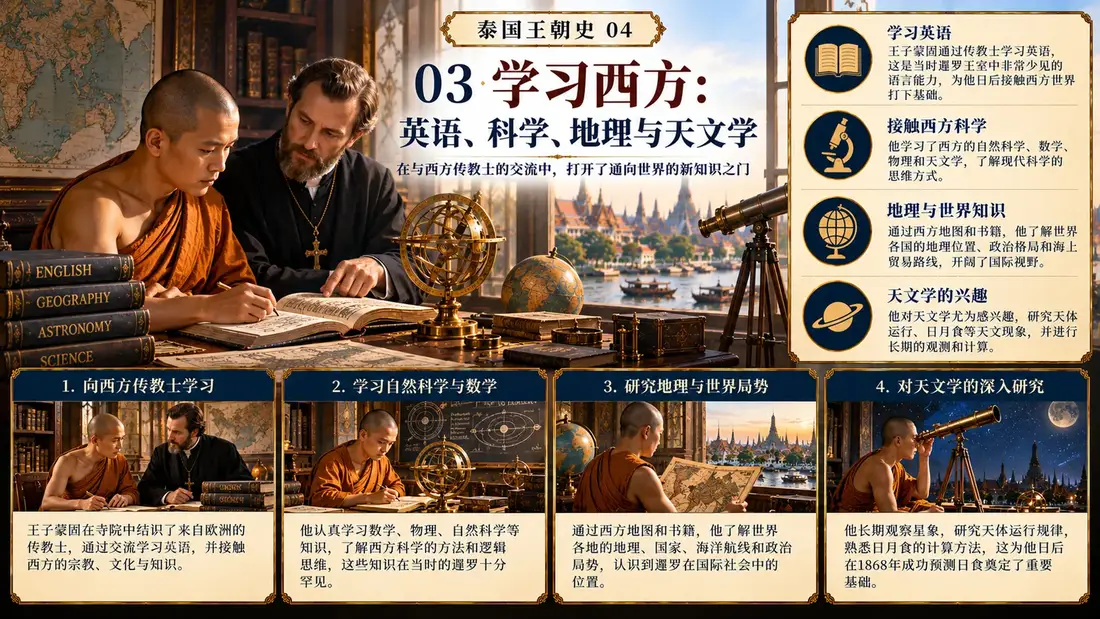
03 | Learning from the West: English, Science, Geography and Astronomy
SEA NOW Thailand · Rama IV · Illustration 03
One of Mongkut’s most remarkable qualities was his willingness to study Western knowledge.
Through his contact with missionaries and foreigners, he learned English and gained greater access to information from outside Siam.
Language opened a new intellectual world.
Mongkut studied geography, international affairs, mathematics, natural science and astronomy.
Astronomy became one of his greatest personal interests.
He observed celestial bodies, studied calendars and eclipses, and became familiar with Western methods of astronomical calculation.
At the same time, he developed a clearer understanding of the political transformation taking place across Asia.
Why were Britain and France becoming so powerful?
Why could European states send fleets across the world?
Why was international commerce changing the balance of power between Asian kingdoms?
Mongkut increasingly understood a crucial reality:
Simply rejecting the West would not protect Siam.
To survive, Siam first had to understand the world that was emerging around it.
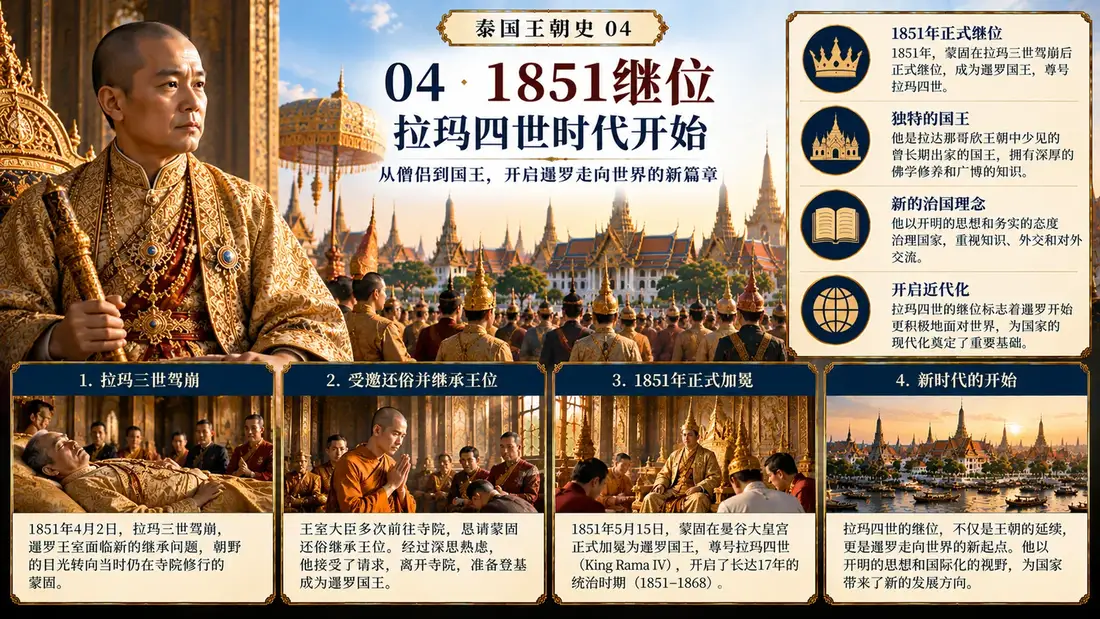
04 | Accession in 1851: The Beginning of King Rama IV’s Reign
SEA NOW Thailand · Rama IV · Illustration 04
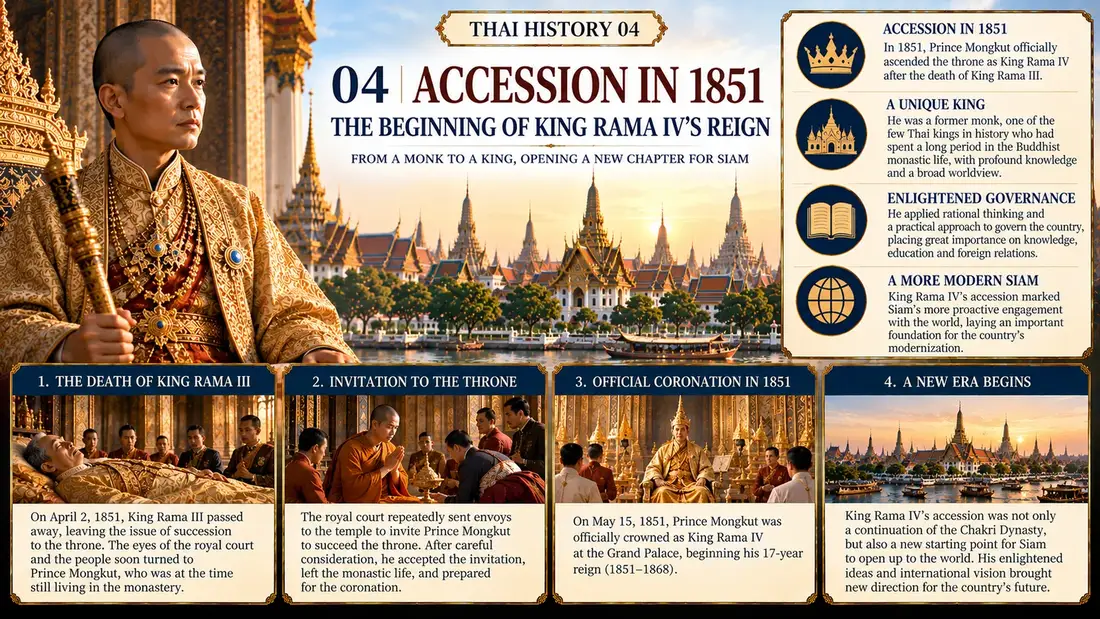
On April 2, 1851, King Rama III died.
The question of succession once again confronted the royal court.
Mongkut, after approximately twenty-seven years in the monkhood, emerged as the leading candidate for the throne.
He left monastic life and became king.
On May 15, 1851, Mongkut was formally crowned as King Rama IV.
Siam now had a ruler unlike most of his predecessors.
He possessed deep Buddhist learning, but he was also familiar with Western knowledge and increasingly aware of international politics.
Rama IV continued to respect Siamese traditions and Buddhism.
Yet he understood that the kingdom could no longer remain relatively isolated from global affairs.
The question was no longer whether Siam should engage with Western powers.
The real question was:
How could Siam engage with them without losing its sovereignty?
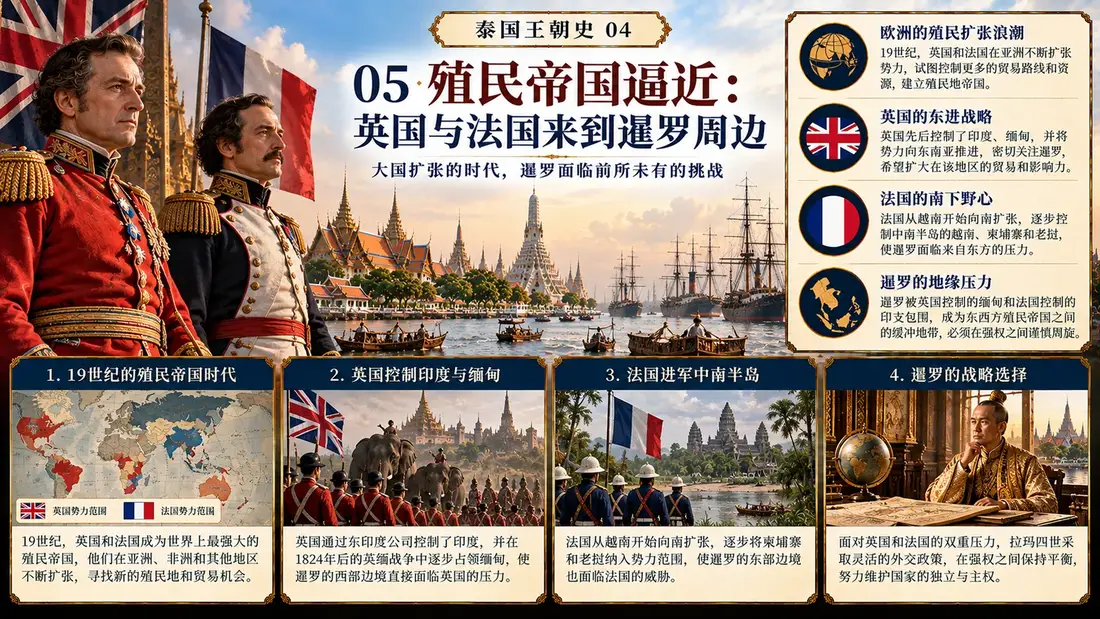
05 | Colonial Empires Approach: Britain and France Surround Siam
SEA NOW Thailand · Rama IV · Illustration 05
When Rama IV became king, the geopolitical environment of Southeast Asia had already changed dramatically.
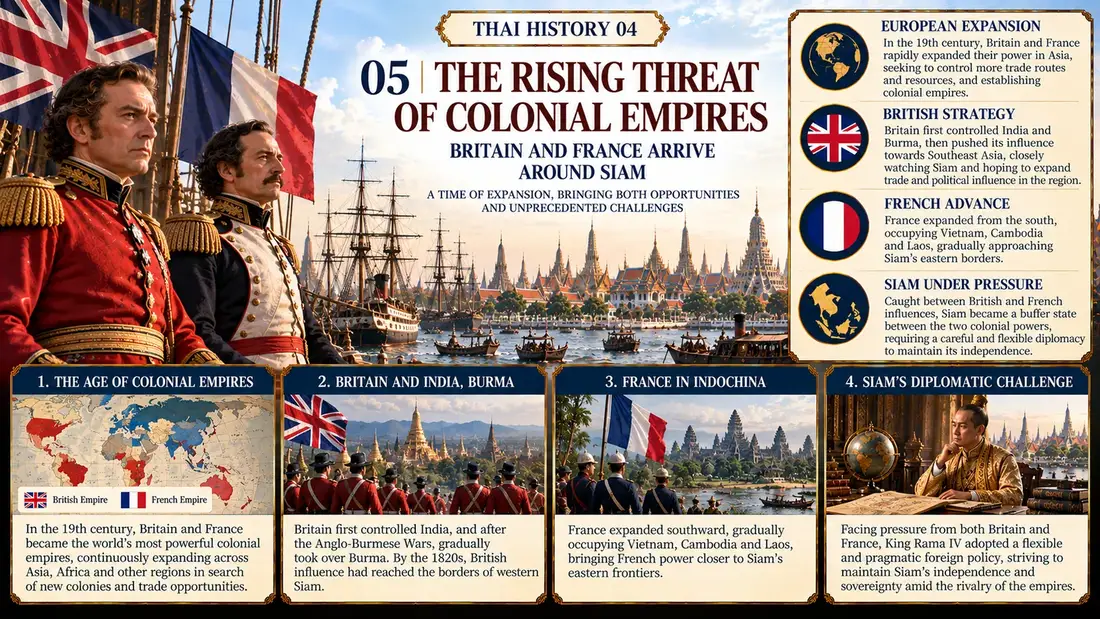
Britain possessed one of the largest empires in the world.
India had become the center of British power in Asia, while a series of Anglo-Burmese wars brought growing areas of Burma under British control.
British influence was therefore moving closer to Siam from the west and south.
France, meanwhile, was expanding its ambitions in mainland Southeast Asia.
Vietnam became a major target of French intervention, followed by increasing French involvement in Cambodia and, later, Laos.
Siam was gradually finding itself positioned between two European imperial powers.
Britain to the west.
France to the east.
A serious diplomatic mistake could threaten Siam’s autonomy and potentially its very survival.
Rama IV therefore adopted a pragmatic strategy.
Instead of direct military confrontation, he emphasized diplomacy, treaties and commercial engagement.
Siam began learning how to balance between competing empires.
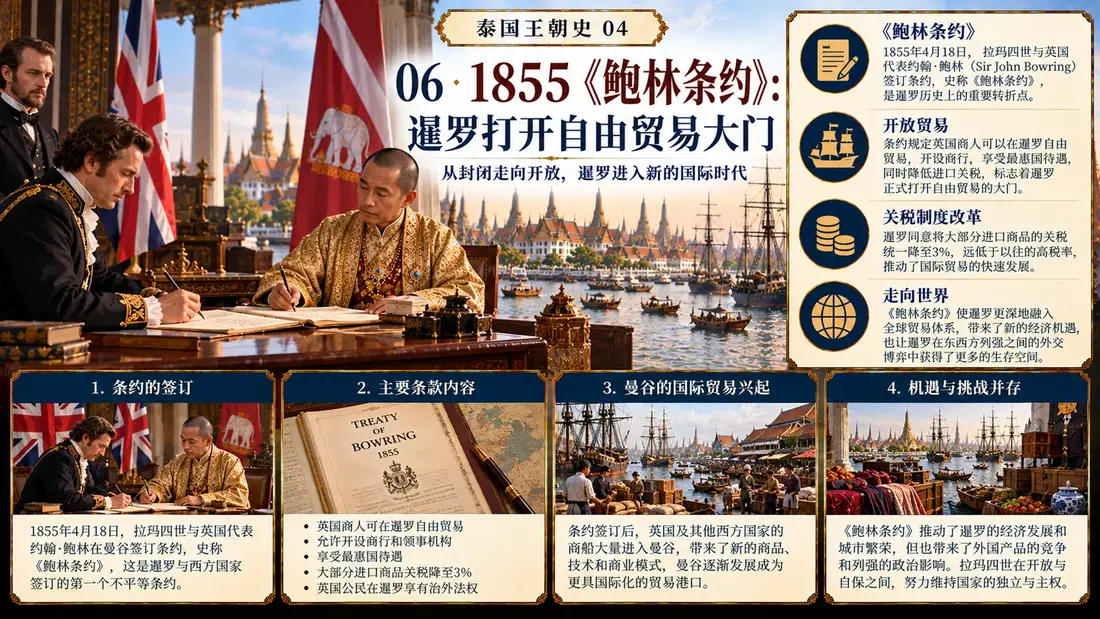
06 | The Bowring Treaty of 1855: Siam Opens to Free Trade
SEA NOW Thailand · Rama IV · Illustration 06
One of the defining diplomatic events of Rama IV’s reign occurred in 1855.
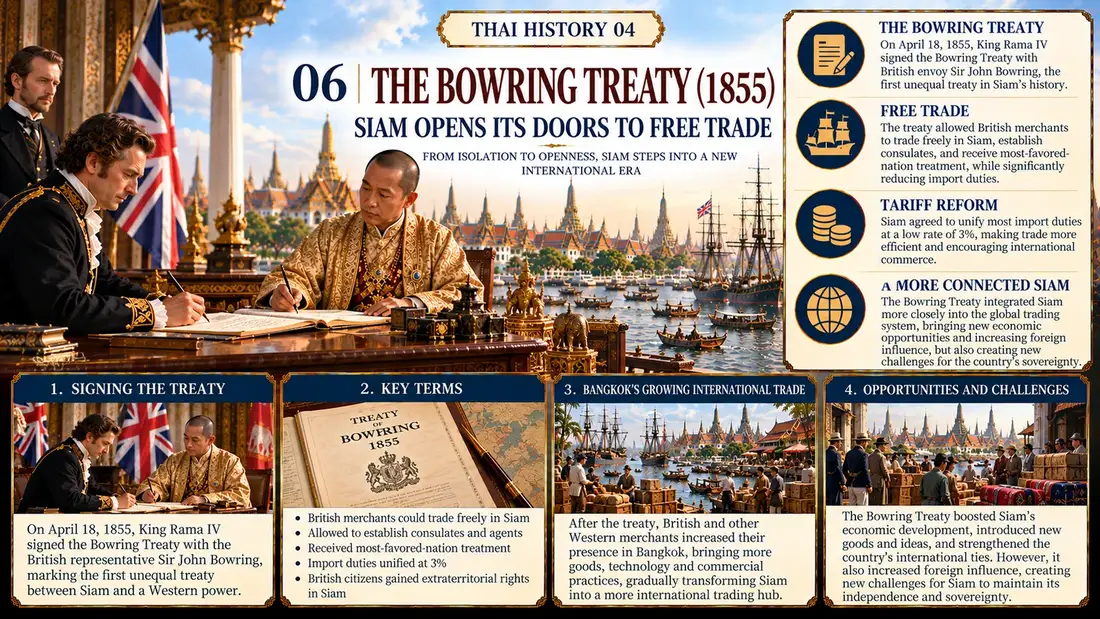
British diplomat Sir John Bowring arrived in Siam to negotiate a new agreement.
The negotiations resulted in the famous Bowring Treaty.
The treaty fundamentally altered commercial relations between Britain and Siam.
British merchants gained much greater freedom to trade, the tariff system was restricted and reorganized, and British subjects received extraterritorial privileges under consular jurisdiction.
From a modern historical perspective, the agreement clearly contained features associated with the unequal treaty system imposed by Western powers across nineteenth-century Asia.
Siam surrendered part of its economic and judicial autonomy.
Yet the treaty also accelerated the kingdom’s integration into international commerce.
Siam subsequently concluded agreements with other Western powers.
Foreign trade expanded rapidly.
Rama IV’s decision reflected a difficult form of political realism:
Accept limited concessions in order to gain diplomatic space and time.
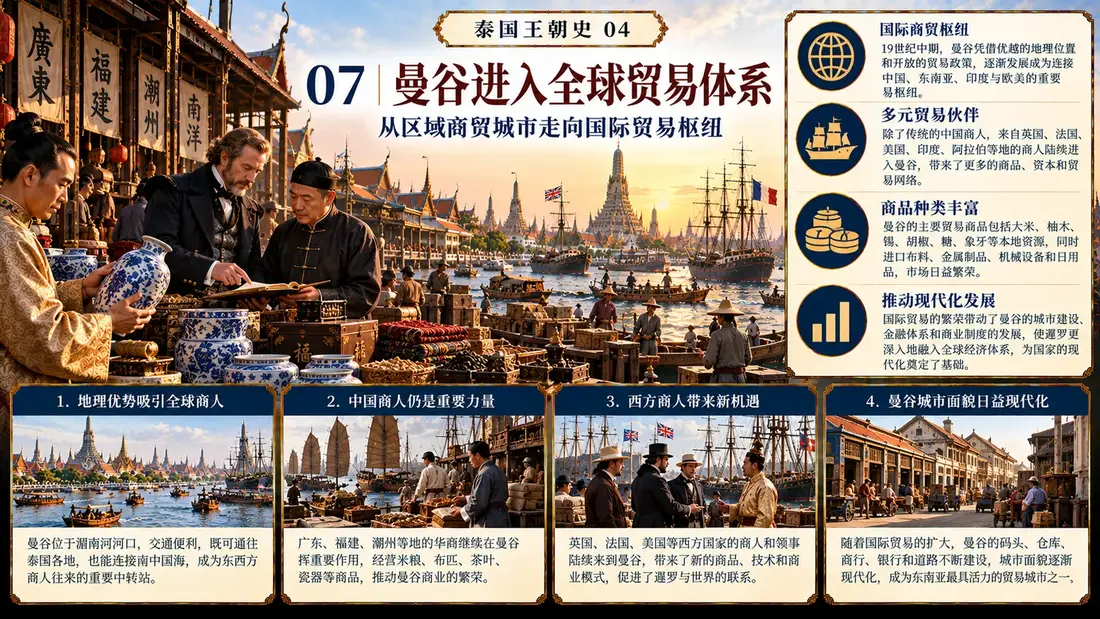
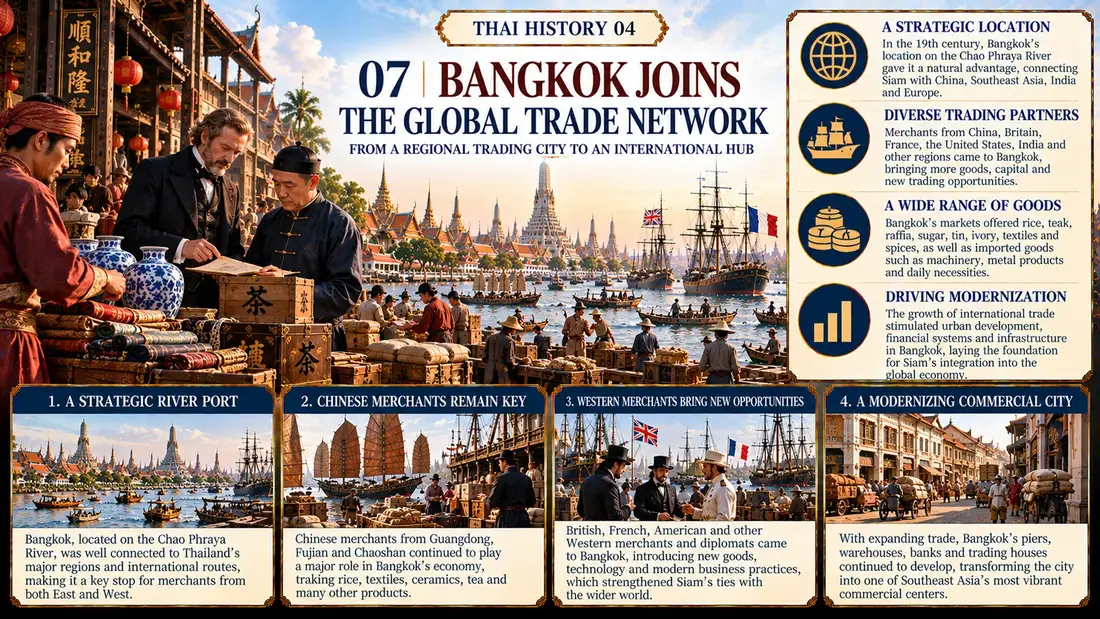
07 | Bangkok Joins the Global Trade Network
SEA NOW Thailand · Rama IV · Illustration 07
After the Bowring Treaty, Bangkok’s connection to the global economy expanded rapidly.
The Chao Phraya River became an increasingly important international trade corridor.
Ships and merchants arrived from China, Britain, Europe, India and other parts of Asia.
Chinese merchants remained essential to Siam’s economy, while Western trading houses, diplomats and commercial representatives became increasingly visible in Bangkok.
Among Siam’s exports, rice became especially important, alongside teak, sugar and other agricultural and forest products.
Manufactured goods, machinery and new commercial practices flowed into the kingdom.
Bangkok itself began to change.
Wharves, warehouses, trading houses and other commercial facilities expanded along the river.
The capital was gradually transforming from primarily a royal and political center into a major international trading city.
Siam was becoming part of the global economy.
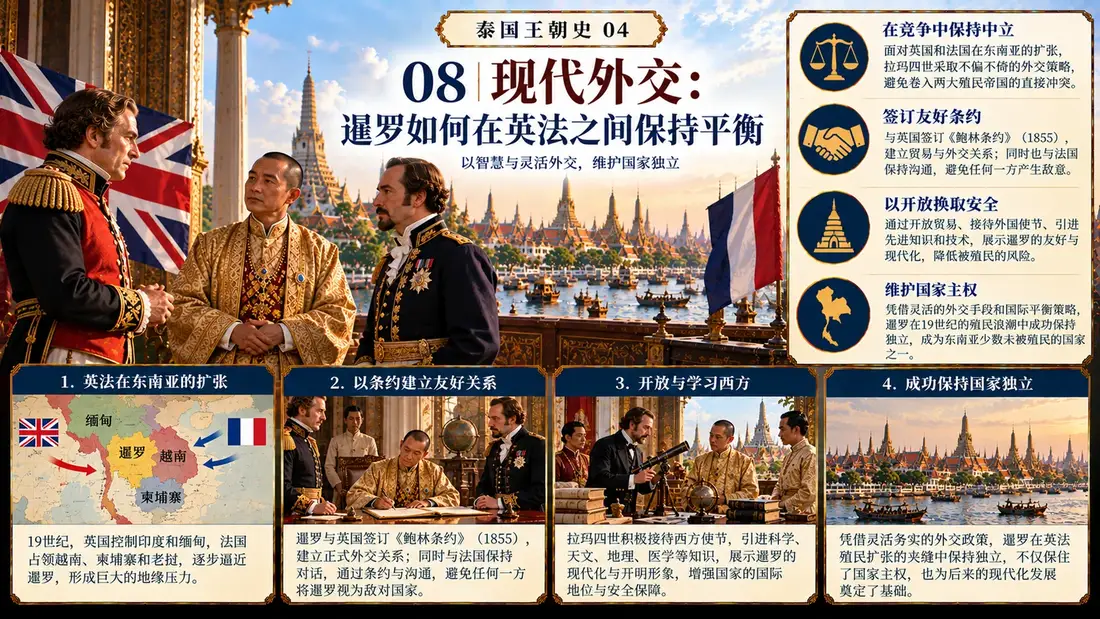
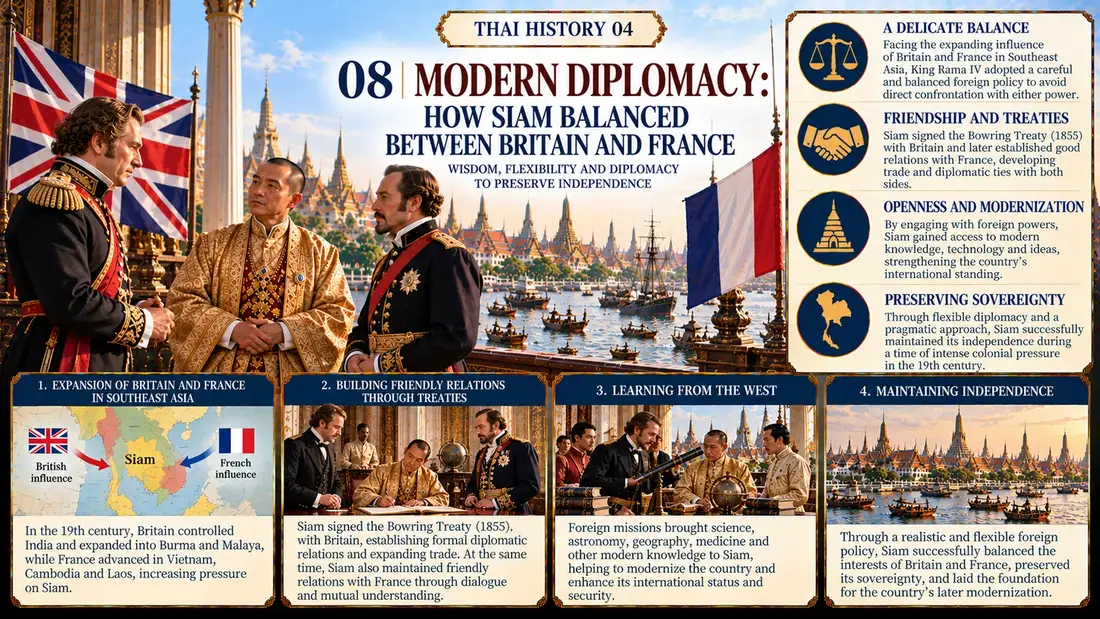
08 | Modern Diplomacy: How Siam Balanced Britain and France
SEA NOW Thailand · Rama IV · Illustration 08
Rama IV did not place Siam completely on the side of either Britain or France.
That principle would become one of the most important characteristics of Siamese foreign policy.
Closer relations with Britain did not mean complete hostility toward France.
Siam also maintained dialogue with France and other Western countries.
The objective was to avoid becoming the direct enemy—or exclusive dependency—of any single imperial power.
Rama IV also understood the importance of international perception.
He communicated with foreign representatives, encouraged engagement with Western knowledge and presented Siam as an organized sovereign kingdom capable of diplomacy and international negotiation.
Openness therefore became more than an economic policy.
It was also a diplomatic strategy.
By demonstrating that Siam could participate in international trade and formal diplomacy, Rama IV hoped to reduce the risk of direct colonial intervention.
The strategy could not eliminate imperial pressure.
But it bought Siam something extremely valuable:
time.
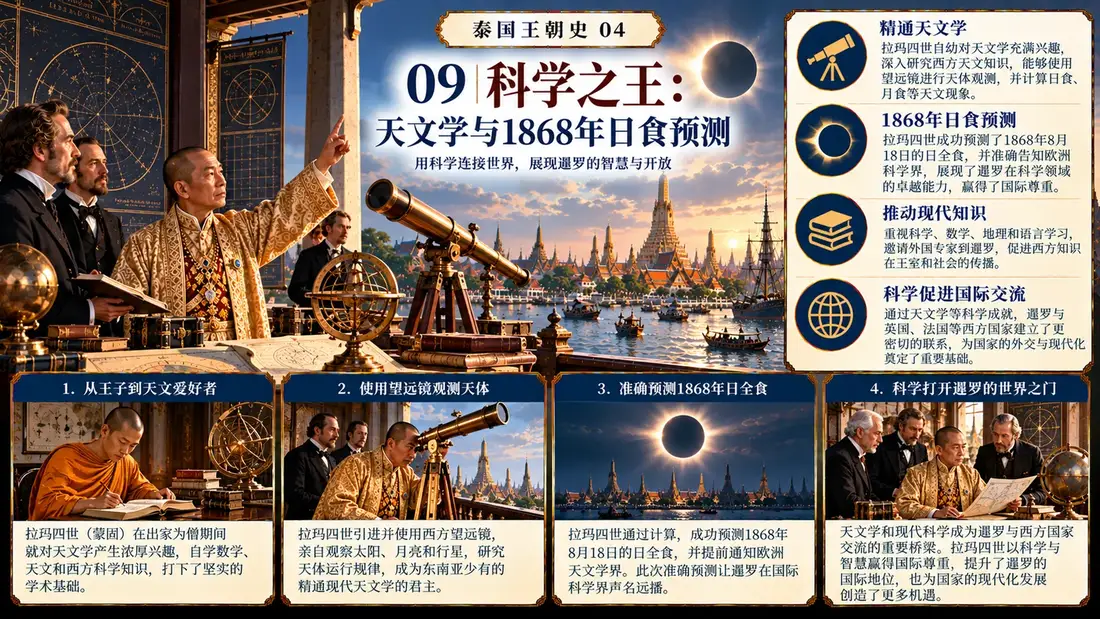
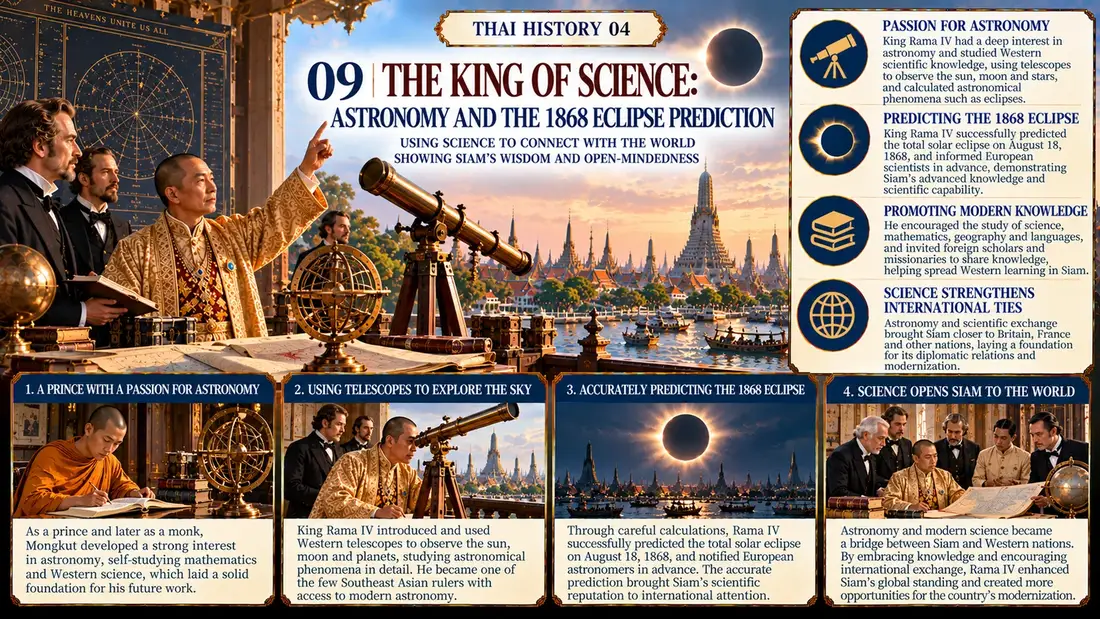
09 | The King of Science: Astronomy and the 1868 Eclipse Prediction
SEA NOW Thailand · Rama IV · Illustration 09
Rama IV’s interest in science was far more than an intellectual hobby.
The most famous example was his prediction of the 1868 total solar eclipse.
After years of astronomical study and calculation, Rama IV predicted that a total solar eclipse would be visible in southern Siam on August 18, 1868.
Foreign diplomats and observers were invited to witness the event.
The eclipse occurred as predicted.
It became one of the most celebrated scientific episodes of Rama IV’s reign.
To foreign observers, it demonstrated that Siam’s king was not only deeply familiar with Buddhist tradition but also capable of understanding modern scientific knowledge.
Science therefore became another bridge between Siam and the outside world.
Tragically, Rama IV contracted malaria following the eclipse expedition.
He died later that year.
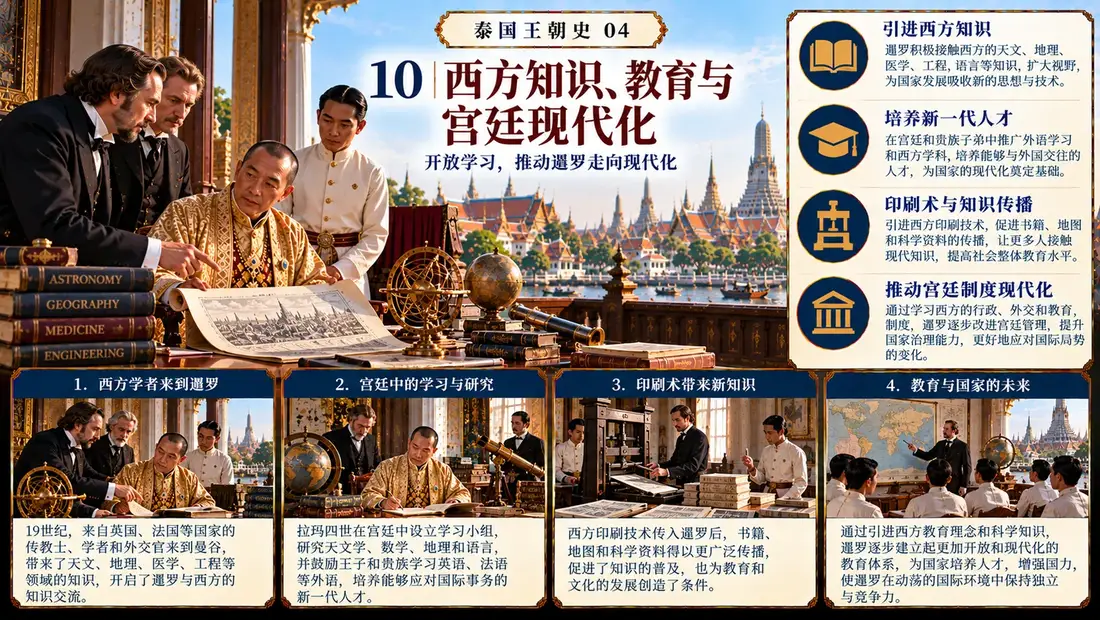
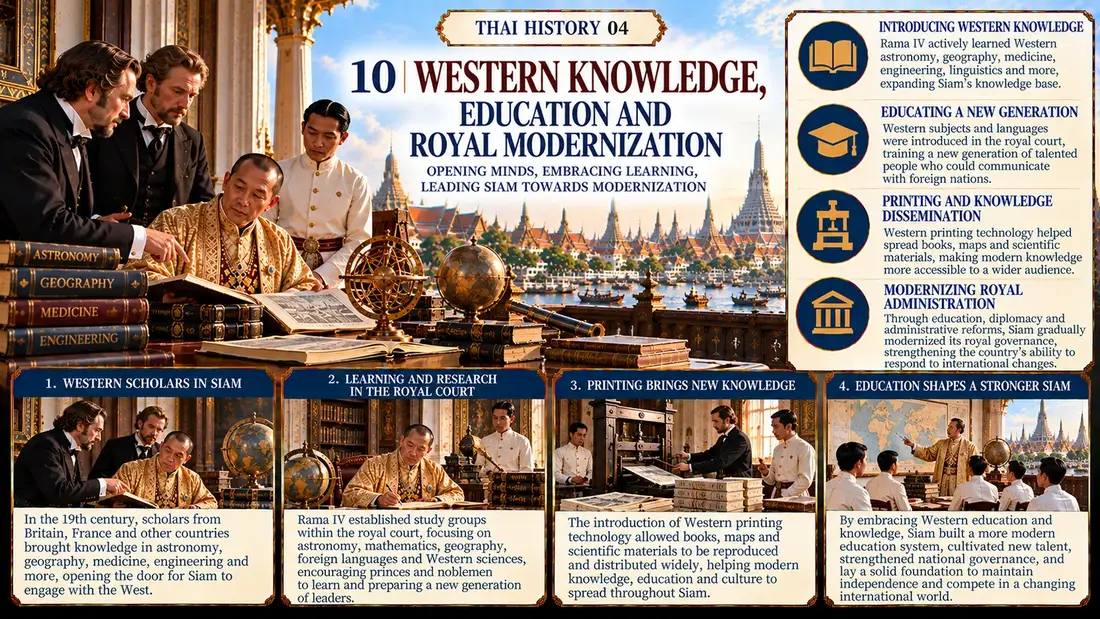
10 | Western Knowledge, Education and Royal Modernization
SEA NOW Thailand · Rama IV · Illustration 10
During Rama IV’s reign, Western knowledge became increasingly visible in Siam.
Astronomy, mathematics, geography, medicine, languages, engineering and international affairs attracted greater attention.
Missionaries, scholars, diplomats and foreign specialists served as important channels for the transmission of knowledge.
Printing technology also helped books, maps, newspapers and scientific materials circulate more widely.
Within the royal court, greater attention was given to foreign languages and modern subjects.
This produced an important long-term effect.
Siam gradually developed a generation of princes and officials who could understand international affairs, communicate with foreigners and study foreign political and economic systems.
A nationwide modern education system had not yet emerged.
But the intellectual foundations were being created.
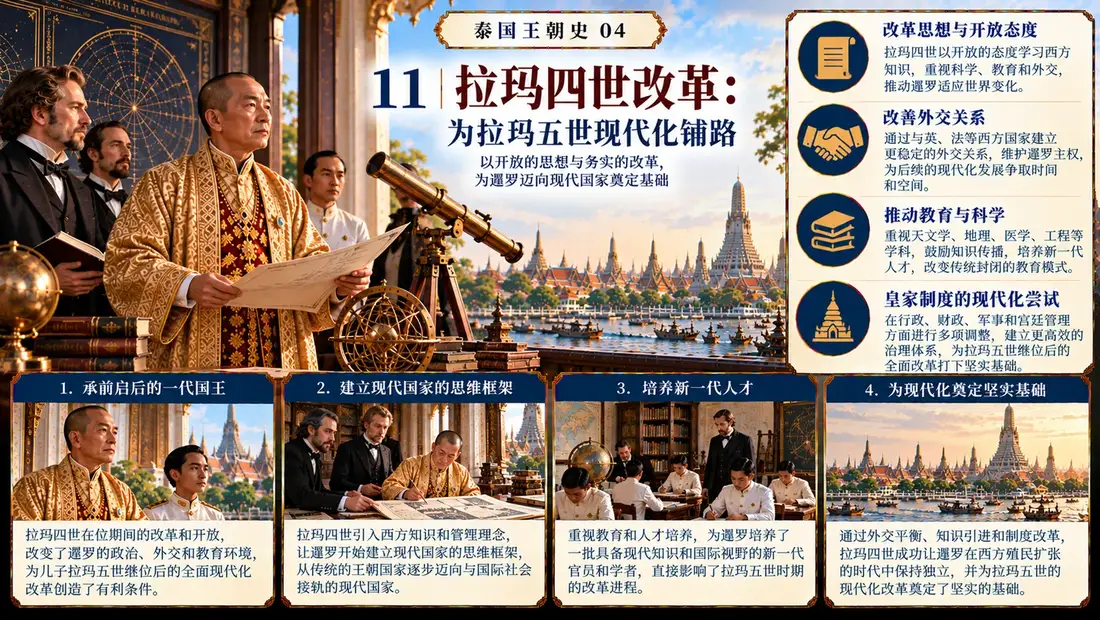
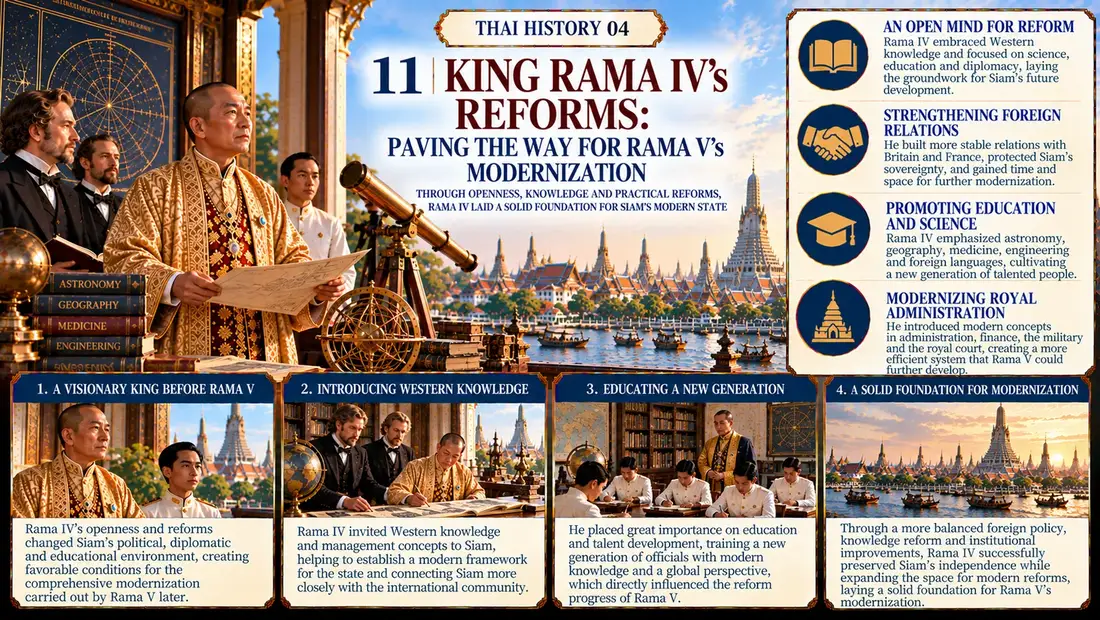
11 | Rama IV’s Reforms: Paving the Way for Rama V
SEA NOW Thailand · Rama IV · Illustration 11
When people think of Siam’s modernization, they often associate it with the railways, administrative reforms, abolition of slavery and state-building programs of King Rama V.
Yet those reforms did not emerge from nothing.
Rama IV had already transformed the intellectual and diplomatic environment in which modernization could occur.
He expanded international trade.
He strengthened diplomatic relations with foreign powers.
He encouraged science and foreign-language learning.
He helped cultivate a new generation with greater awareness of the outside world.
Most importantly, his reign helped convince Siam’s ruling elite of a difficult truth:
A state that refused to adapt might not survive the colonial age.
Rama IV did not complete Siam’s modernization.
His historical importance lies partly in the fact that he changed the conditions under which modernization became possible.
He opened the door.
His son, King Chulalongkorn—Rama V, would walk through it.
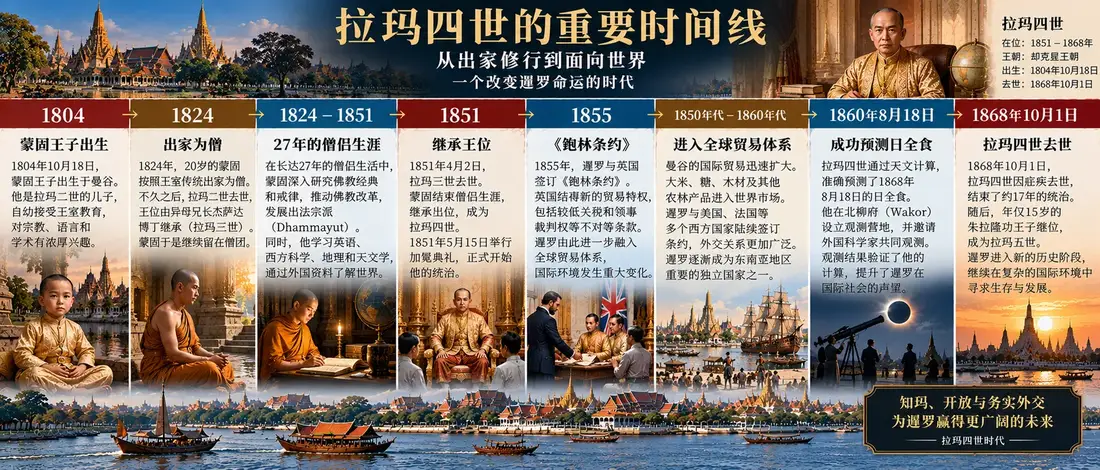
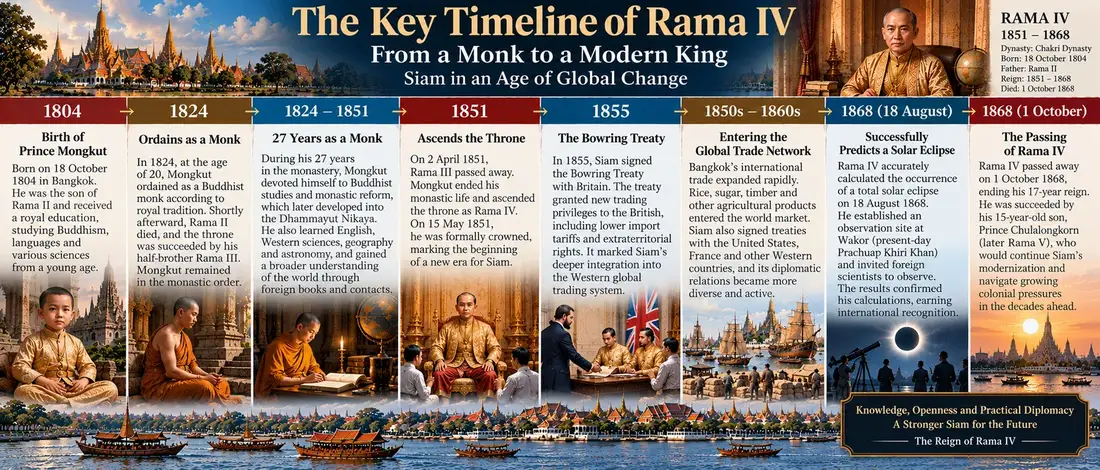
12 | 1804 → 1851 → 1855 → 1868: A Complete Timeline 1804 | Birth of Prince Mongkut
SEA NOW Thailand · Rama IV · Illustration 12
On October 18, 1804, Prince Mongkut was born in Bangkok.
He would develop a deep interest in Buddhism, languages, geography, science, astronomy and foreign cultures.
1851 | Mongkut Becomes King Rama IV
After approximately twenty-seven years as a Buddhist monk, Mongkut left monastic life and ascended the throne.
Siam began engaging more actively with the Western world.
1855 | The Bowring Treaty
Siam signed the Bowring Treaty with Britain.
Although the agreement contained unequal provisions, it accelerated international trade and helped integrate Bangkok more deeply into the global economy.
1868 | Rama IV Dies and Rama V Succeeds
On October 1, 1868, King Rama IV died at the age of 63.
His fifteen-year-old son Chulalongkorn succeeded him as King Rama V.
A far more extensive era of modernization was about to begin.
The Legacy of King Rama IV
King Rama IV did not complete Siam’s transformation into a modern state.
But he changed the way Siam faced the modern world.
He understood that in the nineteenth-century imperial age, national strength no longer came only from armies and territory.
It also came from:
knowledge, commerce, science, diplomacy and the ability to understand the world.
Siam could not compete militarily with the great European empires.
Rama IV therefore pursued another strategy.
Learn from them.
Negotiate with them.
Trade with them.
Use competition among the great powers to create diplomatic space for Siam.
At the same time, preserve as much sovereignty, royal authority and cultural identity as possible.
This strategy was not without cost.
Siam accepted unequal treaties and limitations on parts of its sovereignty.
Nevertheless, while European colonial empires eventually dominated almost all of mainland Southeast Asia, Siam remained formally independent.
Rama IV helped establish some of the diplomatic and intellectual foundations that made this possible.
In 1868, his reign came to an end.
The throne passed to his fifteen-year-old son, Chulalongkorn.
He would become one of the most consequential reforming monarchs in Thai history.
If Rama IV opened Siam’s doors and taught the kingdom to understand the changing world, then the task facing Rama V was even greater: