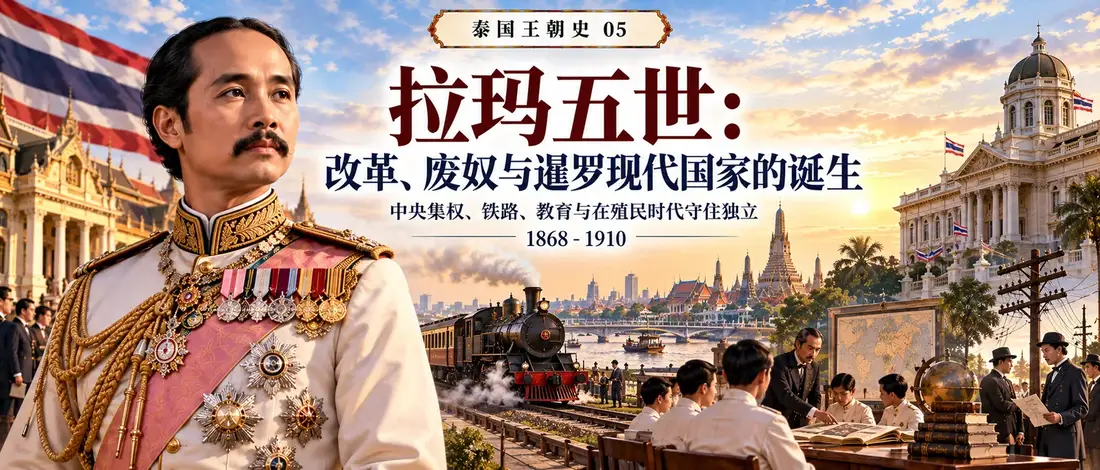
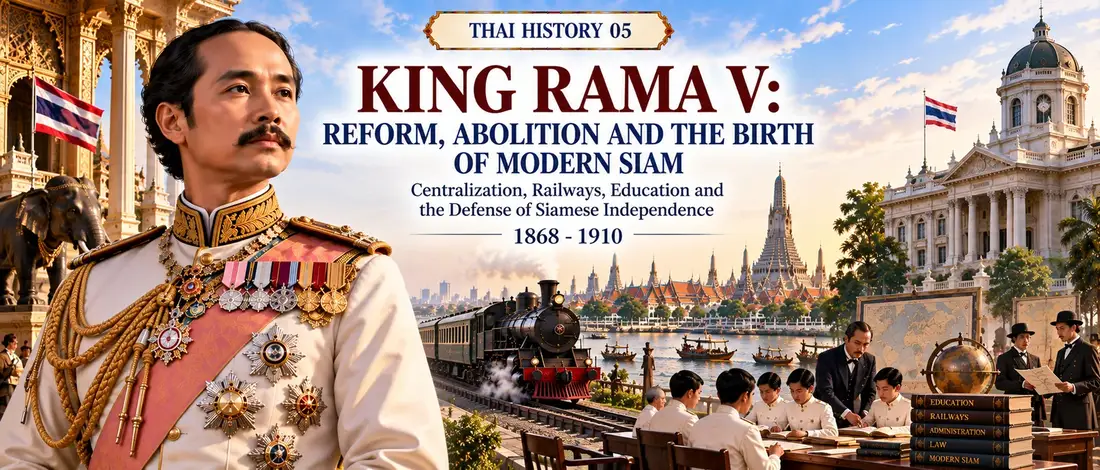
King Rama V: Reform, Abolition and the Birth of Modern Siam Thai Royal History 05 | King Rama V (Chulalongkorn), 1868–1910
In 1868, King Mongkut—Rama IV—died.
His successor was his fifteen-year-old son:
Prince Chulalongkorn.
He would become known as King Rama V.
If Rama IV had opened Siam’s doors to the wider world, Rama V faced an even greater challenge:
How could Siam transform itself into a state capable of surviving that world?
Southeast Asia was being divided by European colonial empires.
Britain controlled India, expanded across Burma and dominated much of the Malay Peninsula.
France expanded from Vietnam into Cambodia and Laos.
Siam increasingly found itself trapped between two imperial powers.
At home, meanwhile, traditional systems of administration, labor obligations, slavery and local authority remained deeply embedded.
Without reform, Siam risked falling behind the colonial states surrounding it.
During Rama V’s forty-two-year reign, a profound transformation began.
Government, provincial administration, law, education, transportation, communications, urban development and social institutions were gradually reorganized.
This was one of the decisive periods in Siam’s transformation into a modern state.
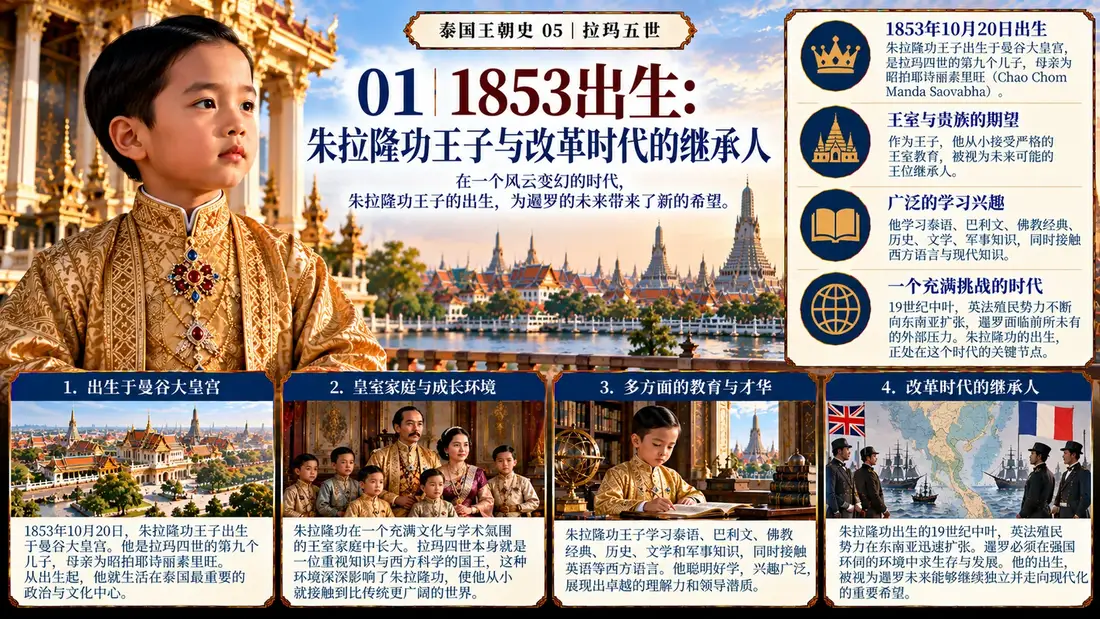
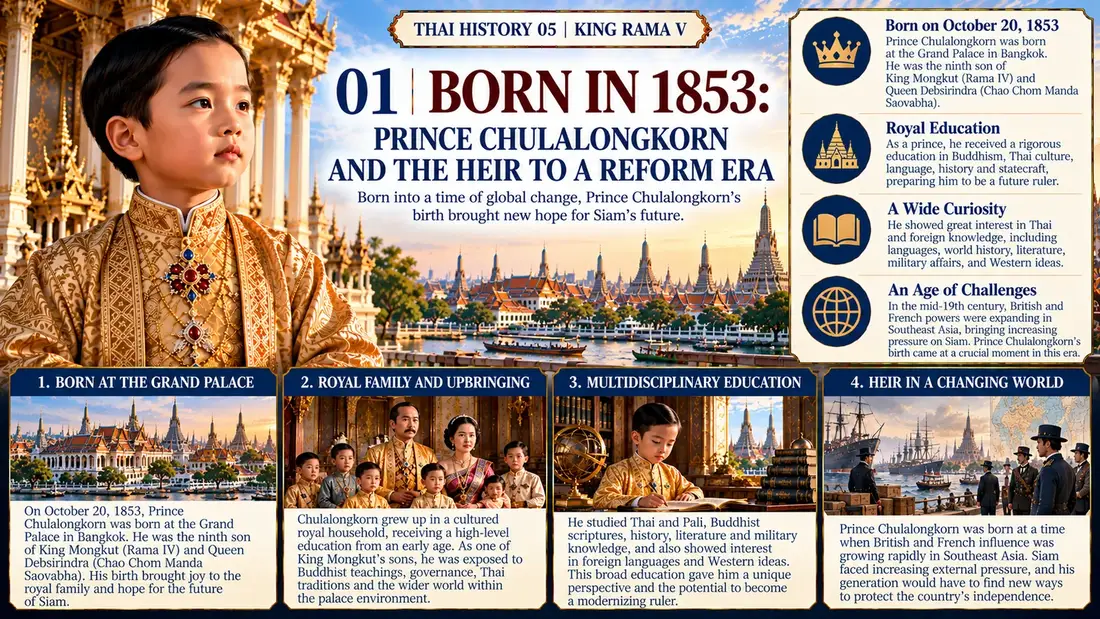
01 | Born in 1853: Prince Chulalongkorn, Heir to an Age of Reform
SEA NOW Thailand · Rama V · Illustration 01
Prince Chulalongkorn was born in Bangkok’s Grand Palace on September 20, 1853.
His father was King Mongkut, Rama IV.
Chulalongkorn therefore grew up in a royal court that was already becoming more engaged with the outside world.
English, science, geography, astronomy and international diplomacy were becoming increasingly important at court.
Alongside traditional royal education, the young prince encountered ideas and knowledge coming from the West.
He was also growing up during a period of accelerating European imperial expansion.
Britain and France were moving steadily closer to Siam’s borders.
The future king gradually learned that ruling Siam would require more than preserving an old political order.
A ruler would have to understand how to protect the kingdom within an entirely new international system.
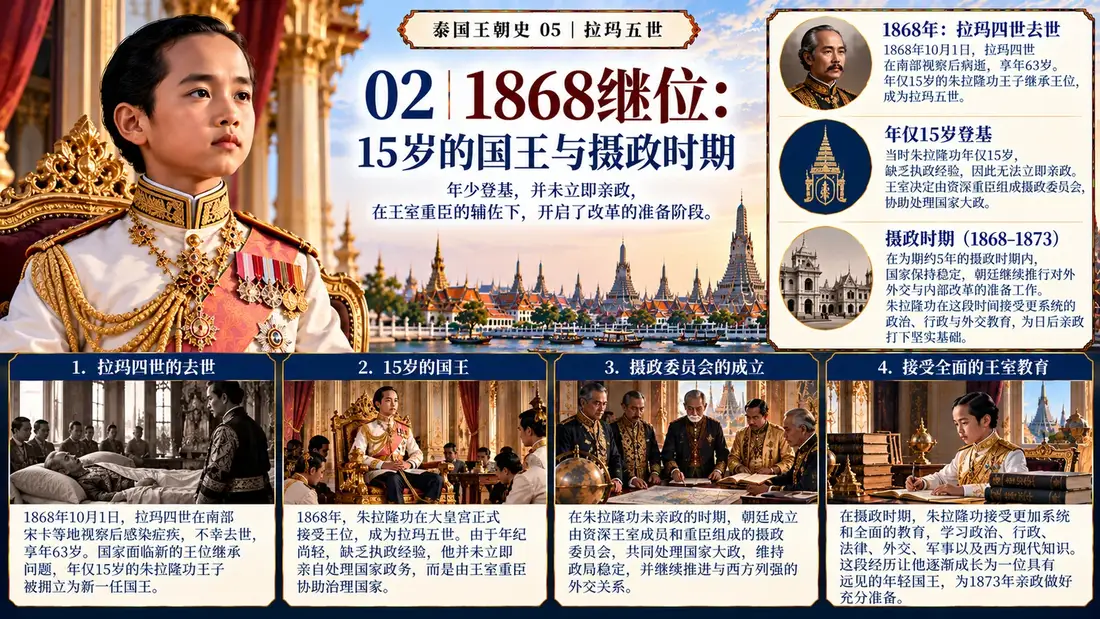
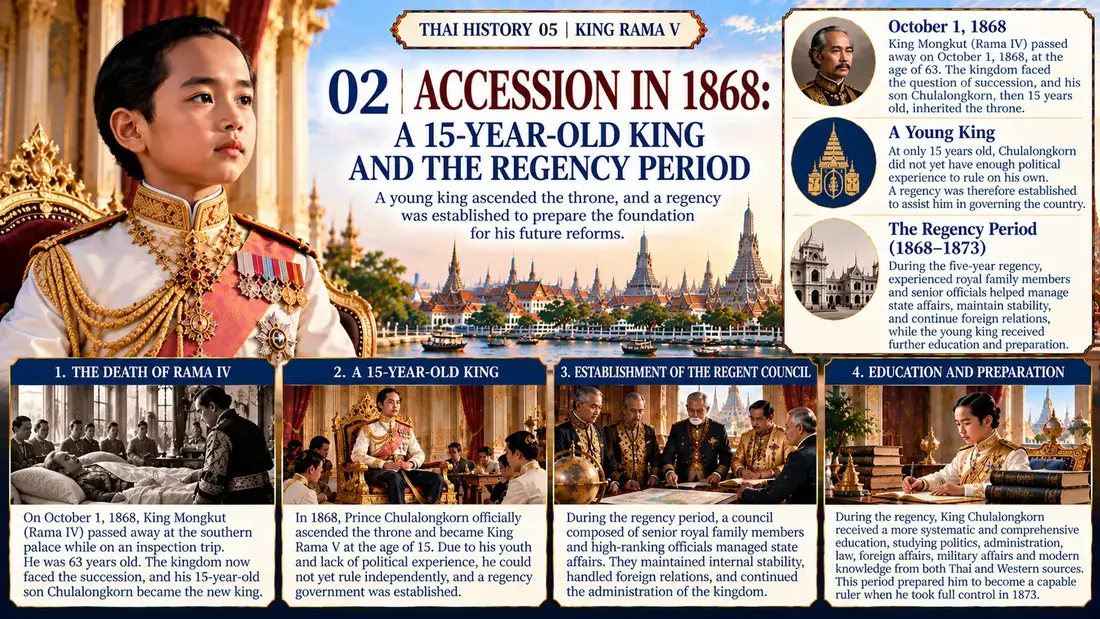
02 | Accession in 1868: A Fifteen-Year-Old King and the Regency
SEA NOW Thailand · Rama V · Illustration 02
King Mongkut died on October 1, 1868.
Chulalongkorn, only fifteen years old, succeeded him as King Rama V.
Because of his youth, Siam initially operated under a regency.
The young king inherited a difficult political environment.
Powerful aristocratic families controlled important administrative and economic institutions.
The central government’s authority over some regions remained limited.
Taxation, finance, justice and the military had not yet been fully modernized.
At the same time, pressure from Britain and France continued to grow.
Rama V increasingly recognized a fundamental problem:
A politically fragmented Siam would struggle to withstand external imperial pressure.
He therefore studied foreign institutions and prepared for a wider program of reform.
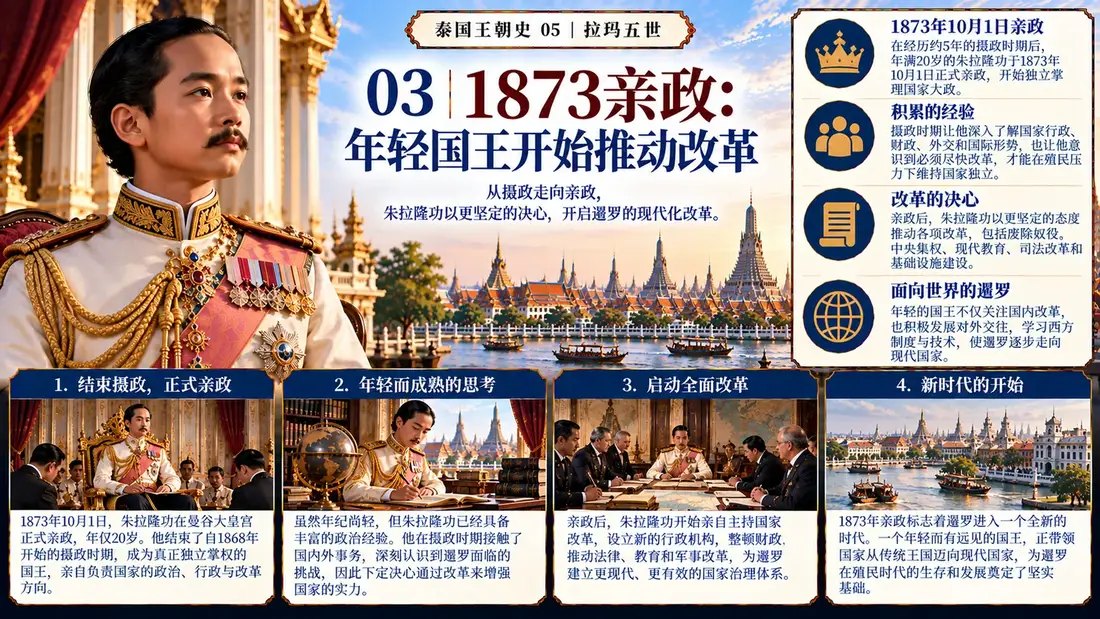
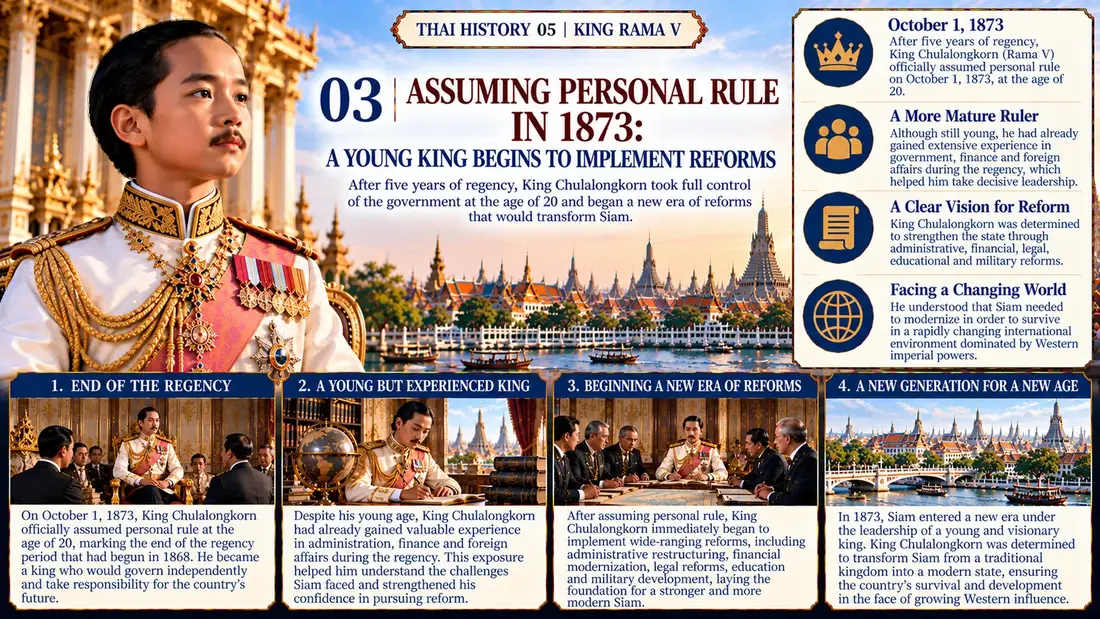
03 | 1873: The Young King Takes Power and Begins Reform
SEA NOW Thailand · Rama V · Illustration 03
In 1873, Chulalongkorn reached the age of twenty and underwent his second coronation.
As the regency period came to an end, he began exercising royal authority more directly.
Reform accelerated.
The government sought greater control over taxation and state revenues while attempting to reorganize traditional administrative structures.
New advisory institutions were also introduced as Rama V experimented with more systematic forms of government.
But reform was politically difficult.
Powerful aristocratic families and established interests remained influential.
Rama V therefore did not attempt to destroy the old system overnight.
Many reforms were introduced gradually.
This became one of the defining characteristics of his reign:
change the state step by step while avoiding destabilizing internal conflict.
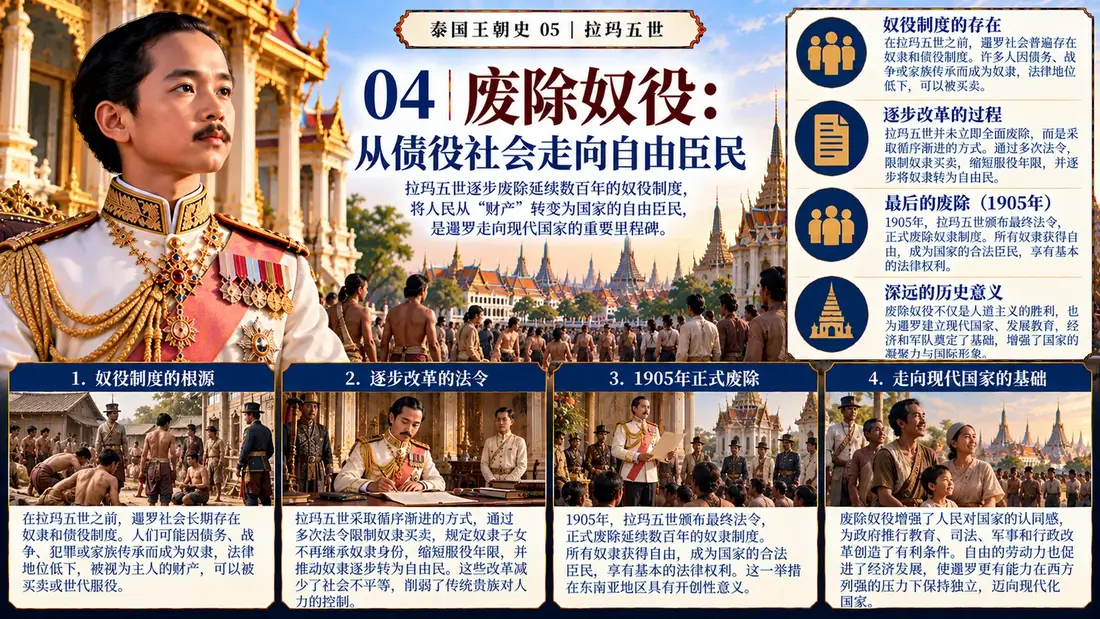
04 | Abolition of Slavery: From Personal Dependency to Free Subjects
SEA NOW Thailand · Rama V · Illustration 04
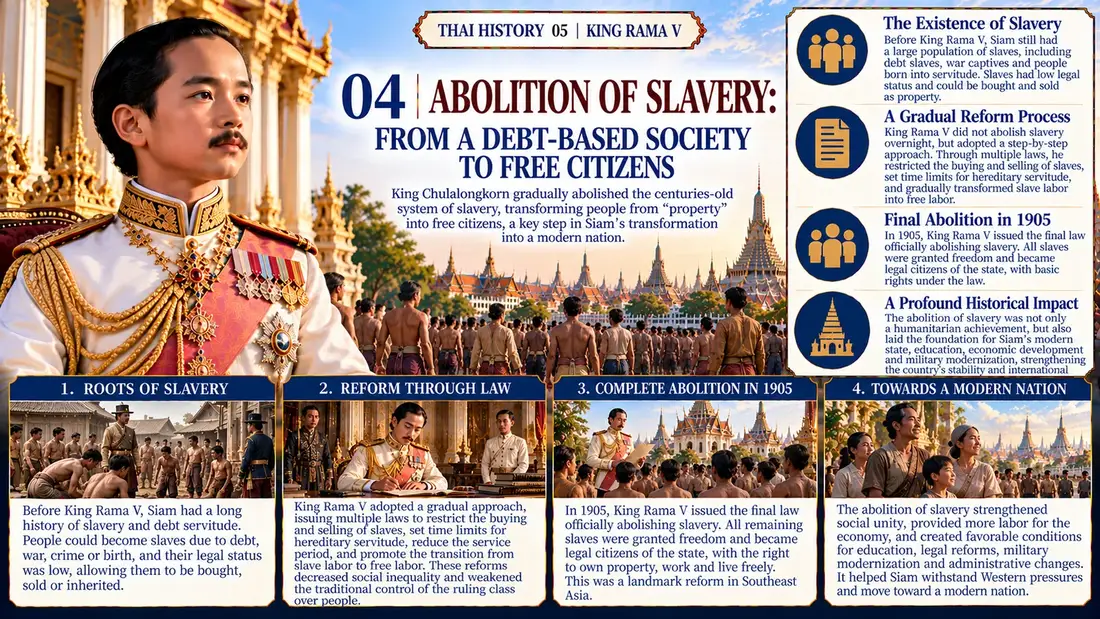
One of Rama V’s most famous social reforms was the gradual abolition of slavery.
Nineteenth-century Siam had a complicated system of slavery and debt bondage.
People could lose varying degrees of personal freedom through debt, war, family status and other circumstances.
Rama V did not simply declare every enslaved person free overnight.
Such a sudden transformation could have produced severe economic and social disruption.
Instead, he adopted a gradual strategy.
In 1874, an important law began improving the status of children born into slavery and created mechanisms through which they could eventually become free.
Further reforms followed over the next several decades.
By around 1905, the legal process of abolishing slavery had essentially been completed.
The significance went beyond emancipation itself.
Siamese society was gradually moving away from traditional relationships of personal dependency and toward a modern state composed increasingly of legally freer subjects.
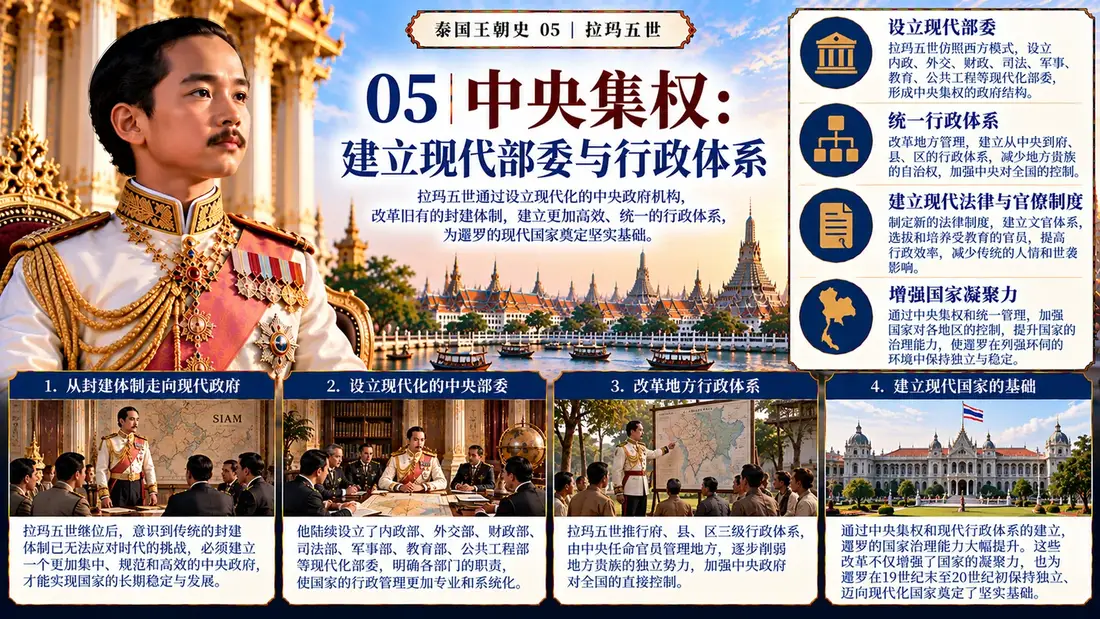
05 | Centralization: Building Modern Ministries and Administration
SEA NOW Thailand · Rama V · Illustration 05
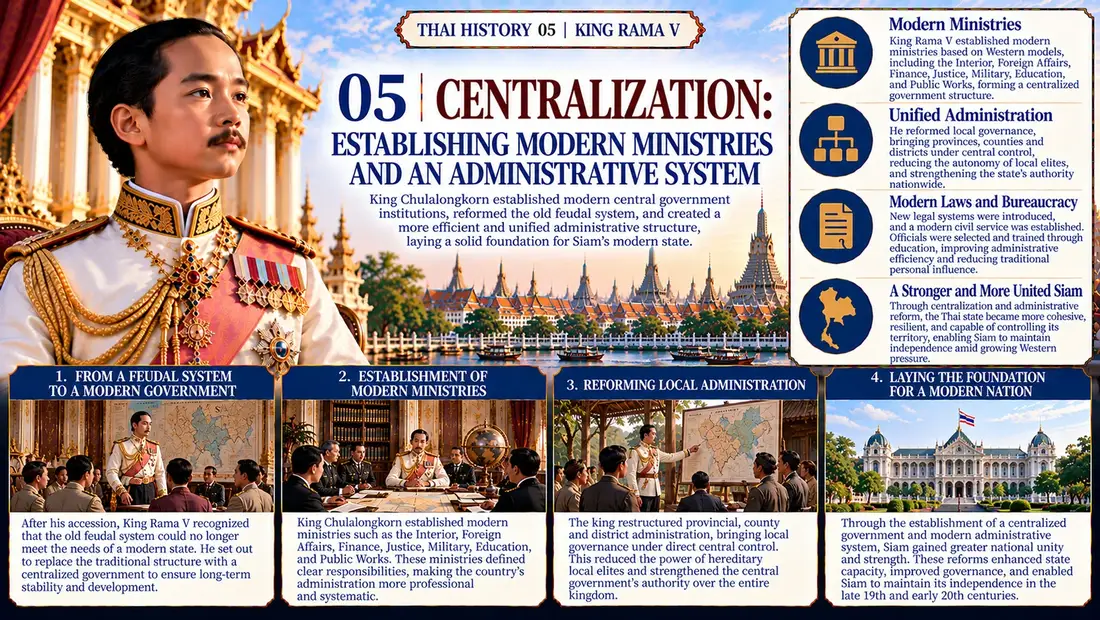
One of Rama V’s most important objectives was to create a central government capable of governing the entire kingdom.
Traditional Siamese administration had distributed authority among powerful officials, aristocratic families and regional rulers.
Such a system had functioned in an earlier political environment.
But it was increasingly inadequate in the age of European imperialism.
In 1892, Rama V carried out a major reorganization of the central government.
Modern ministries gradually took shape, with clearer responsibilities for areas such as interior administration, foreign affairs, finance, justice, the military, education and public works.
Provincial administration was also reorganized.
Under the leadership of figures such as Prince Damrong Rajanubhab, the Ministry of the Interior strengthened Bangkok’s control over the provinces, eventually developing the Monthon administrative system.
Local authority was increasingly incorporated into the central state.
Siam was changing from a traditional kingdom based on layered regional relationships into a more centralized territorial state.
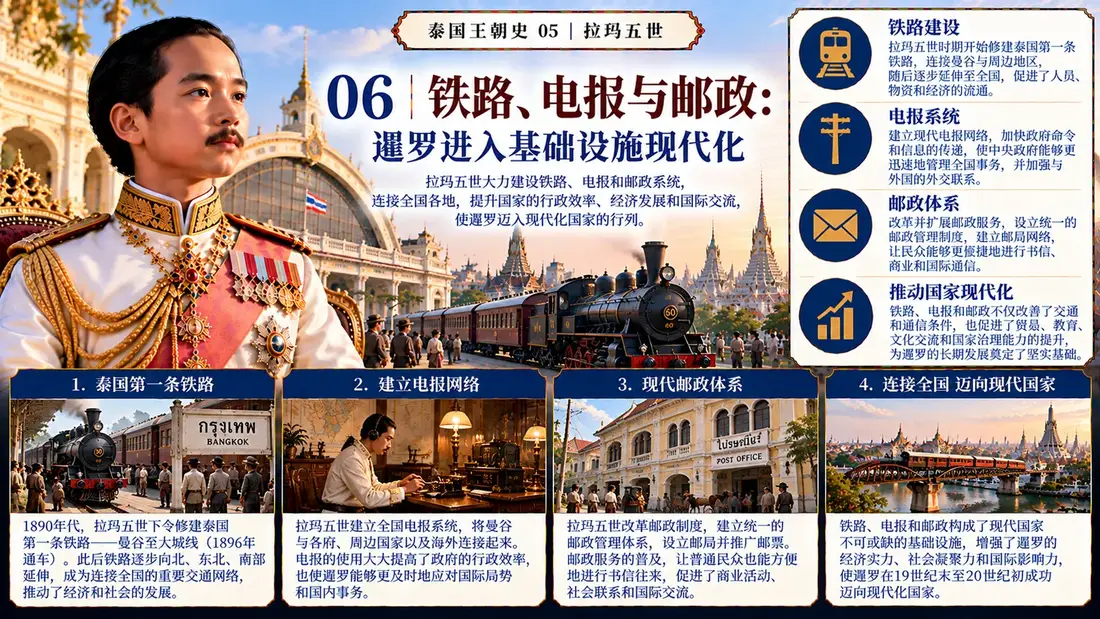
06 | Railways, Telegraphs and Postal Services: Infrastructure Modernizes Siam
SEA NOW Thailand · Rama V · Illustration 06
A modern state needed more than ministries and laws.
It needed physical and communications networks that could connect the country.
Under Rama V, Siam began developing modern transportation and communications infrastructure.
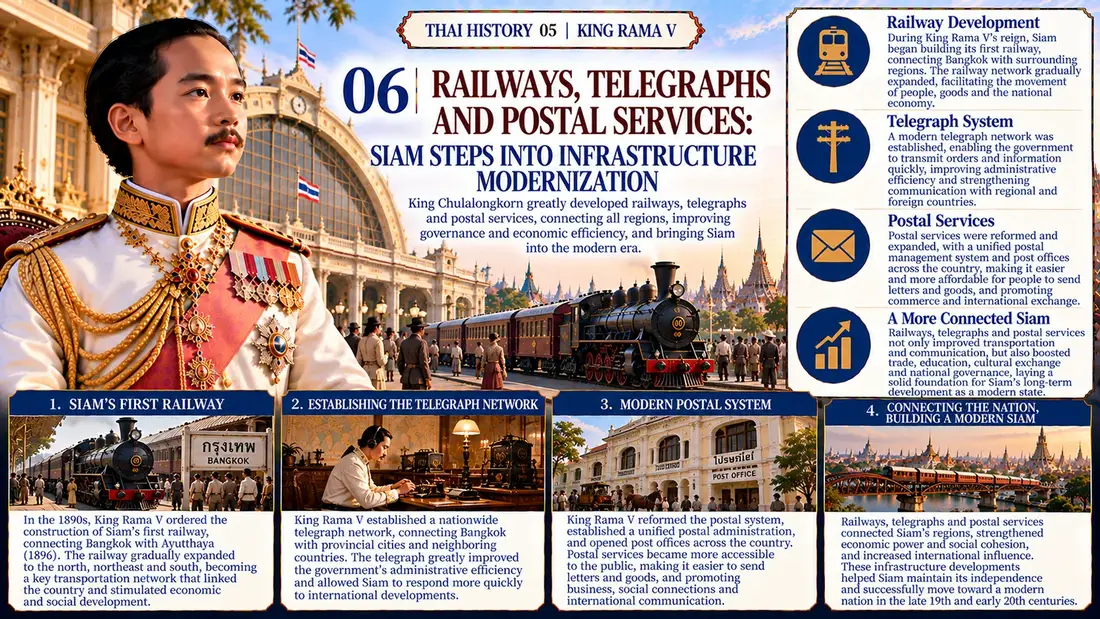
In 1883, Siam established a modern postal service.
Postal networks expanded, allowing government agencies, businesses and residents to communicate more efficiently.
Telegraph lines also spread across the kingdom.
Information that had once taken days or weeks to travel could increasingly be transmitted rapidly between Bangkok and the provinces.
Railways became the most visible symbol of this transformation.
In 1893, the Bangkok–Paknam railway opened.
Government railway construction then expanded.
In 1897, the Bangkok–Ayutthaya section of the state railway began operation.
Railways later extended toward the north, northeast and south.
Trains, telegraphs and postal services did more than make life convenient.
They also strengthened Bangkok’s ability to govern the country.
Infrastructure became an instrument of state-building.
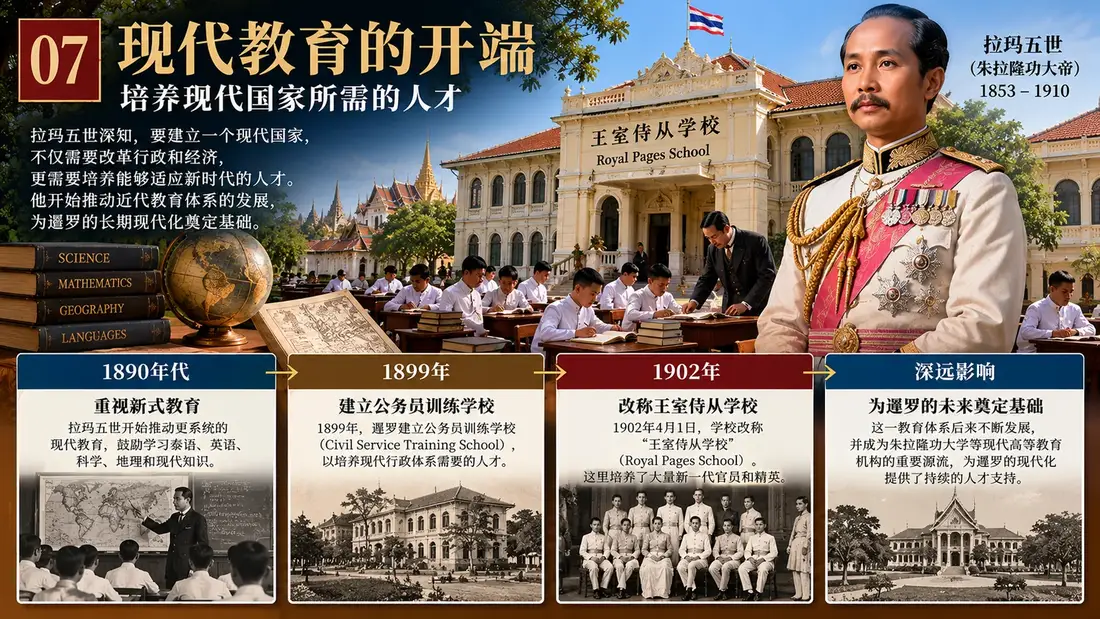
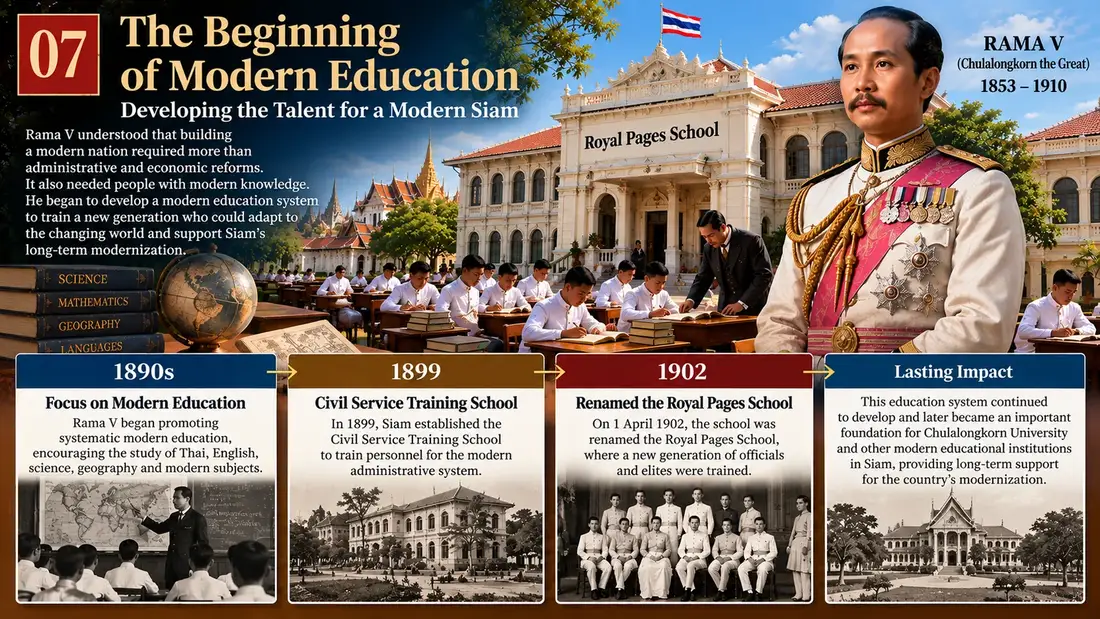
07 | Modern Education: Schools, Overseas Study and a New Generation of Officials
SEA NOW Thailand · Rama V · Illustration 07
Modernization required people capable of running a modern state.
Education therefore became a major part of Rama V’s reform program.
Traditional Siamese education had long been closely connected to Buddhist temples.
Temples played a vital role in literacy and cultural education.
But the modern government increasingly needed new forms of knowledge.
Mathematics, science, foreign languages, law, administration, engineering and modern military training became more important.
New schools were established during Rama V’s reign.
In 1899, the Royal Pages School was founded.
Its educational legacy later contributed to the institutional development that eventually led to Chulalongkorn University.
Members of the royal family and promising young officials were also sent abroad, particularly to Britain and other European countries.
When they returned, many entered government ministries, diplomacy, the military and the judiciary.
A new generation of professionally trained officials began to emerge.
Modern education became the human foundation of state reform.
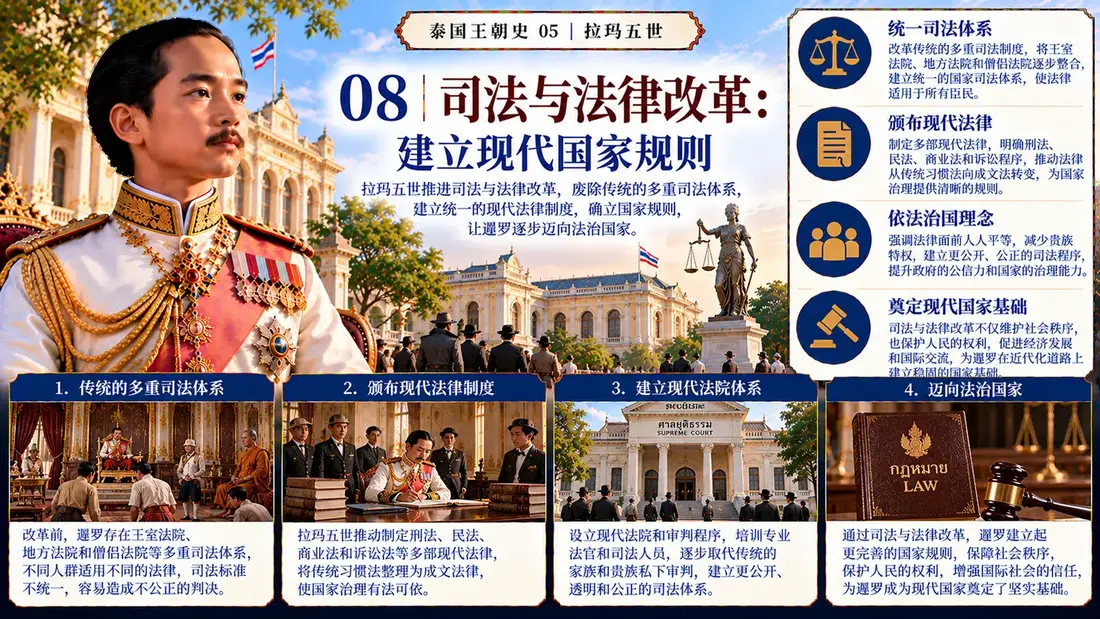
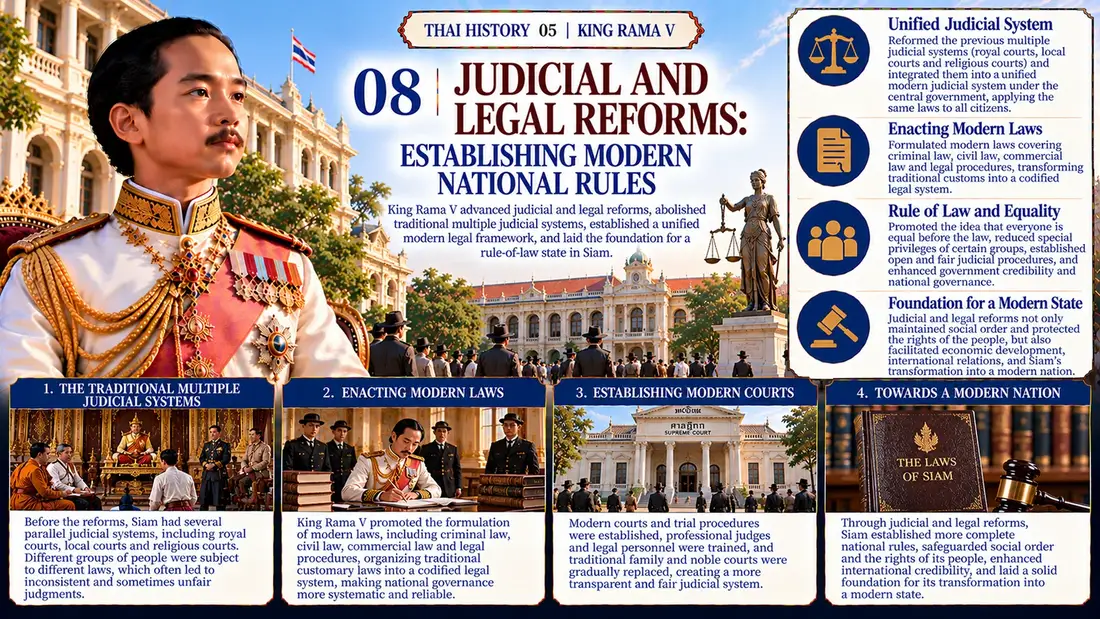
08 | Judicial and Legal Reform: Creating the Rules of a Modern State
SEA NOW Thailand · Rama V · Illustration 08
Nineteenth-century Siam still possessed a complex mixture of traditional laws and judicial jurisdictions.
Western powers used what they considered weaknesses in Siam’s legal system to demand extraterritorial rights for their citizens.
This became an important question of sovereignty.
Judicial reform was therefore not merely a domestic matter.
It was also part of Siam’s struggle for international independence.
During Rama V’s reign, modern courts and judicial administration gradually developed.
In 1891, a Ministry of Justice was established.
Siam subsequently worked toward modern criminal, civil and commercial laws and more standardized judicial procedures.
Professional judges and legal specialists became increasingly important.
Siam wanted to demonstrate to Western governments that it possessed a functioning modern legal system.
Only then could the kingdom hope eventually to remove the extraterritorial privileges enjoyed by foreign nationals.
Legal modernization was therefore also a form of national defense.
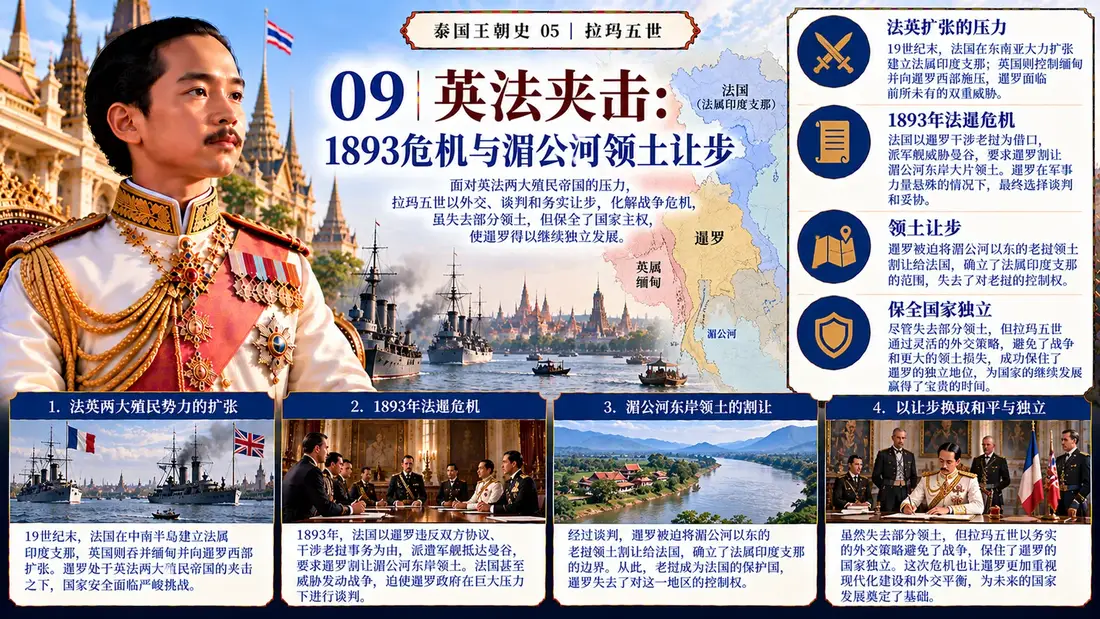
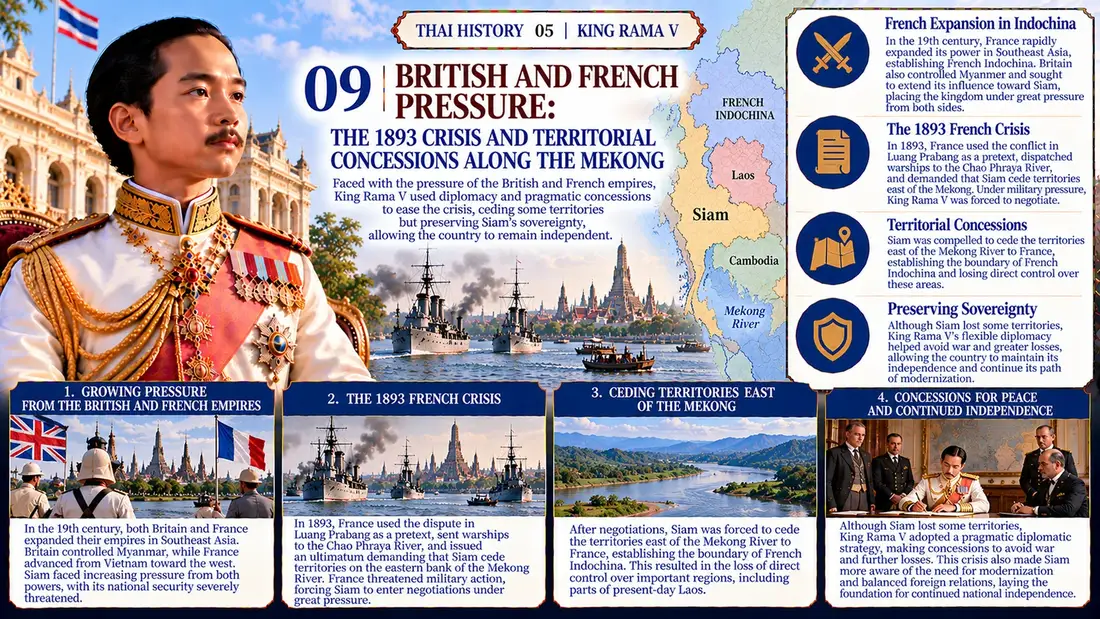
09 | Between Britain and France: The 1893 Crisis and Mekong Concessions
SEA NOW Thailand · Rama V · Illustration 09
One of the most dangerous international crises of Rama V’s reign came in 1893.
France had established itself in Vietnam and was expanding its influence across Indochina.
French authorities increasingly challenged Siamese claims and control in territories east of the Mekong.
Tensions escalated.
French warships eventually forced their way toward Bangkok, placing enormous military pressure on Siam.
The possibility of war became very real.
Rama V ultimately chose negotiation and concession.
Under the settlement of 1893, Siam relinquished its claims and control over extensive Lao territories east of the Mekong River.
French influence moved significantly closer to Siam itself.
For Rama V, the crisis was deeply painful.
But he faced a harsh reality:
Siam did not possess the military power required for a full-scale war against France.
If war began, Siam might lose far more than border territories.
It might lose the kingdom itself.
Rama V therefore accepted territorial sacrifice in order to preserve the survival of the state.
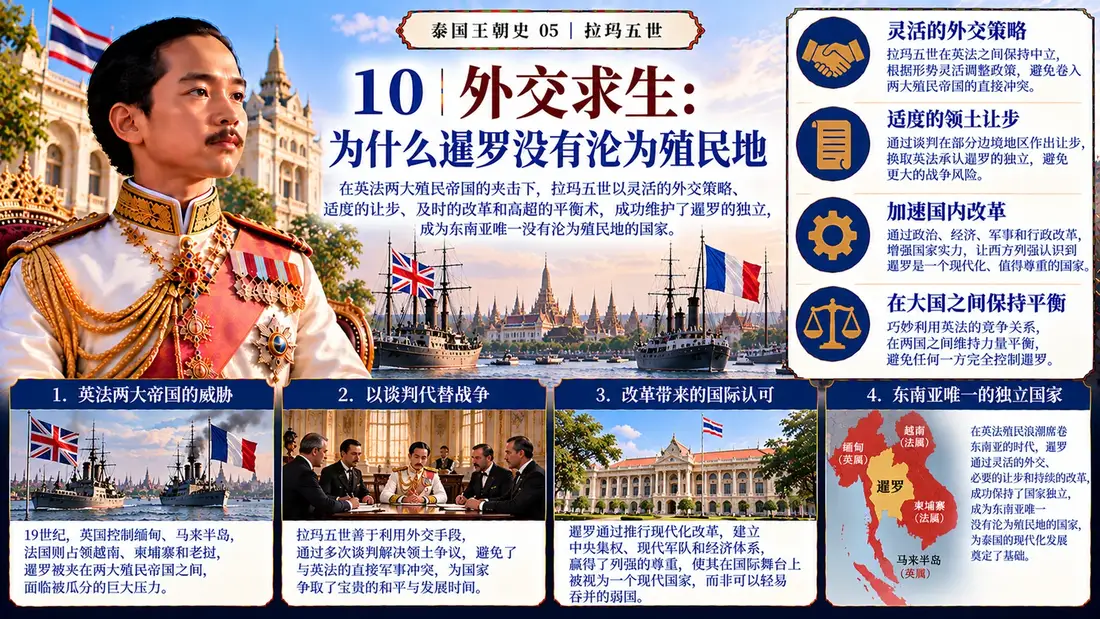
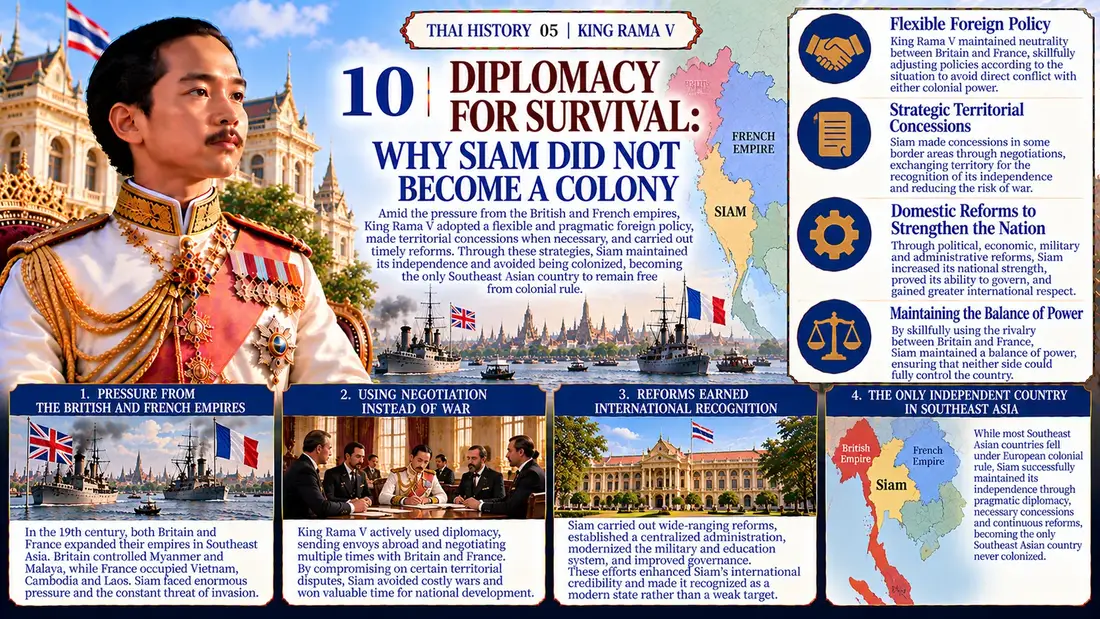
10 | Diplomacy for Survival: Why Siam Was Not Colonized
SEA NOW Thailand · Rama V · Illustration 10
By the end of the nineteenth century, most of Southeast Asia had fallen under European colonial rule.
Britain controlled Burma and Malaya.
France controlled Vietnam, Cambodia and Laos.
Siam remained between them.
Why did Siam avoid formal colonization?
There was no single reason.
The first was diplomatic balancing.
Siam tried to avoid becoming completely dependent on either Britain or France.
The second was strategic territorial concession.
After 1893, further compromises in border regions were sometimes made in exchange for greater recognition of Siam’s core territory and sovereignty.
The third was domestic modernization.
Rama V sought to demonstrate that Siam possessed a functioning government, legal system, diplomatic service, schools, railways and modern institutions.
The fourth factor was the strategic rivalry between Britain and France.
For periods of time, neither power wanted the other to gain complete control over Siam.
Siam consequently served, in part, as a buffer state between their colonial possessions.
Diplomacy, reform, geopolitical rivalry and painful territorial compromises together helped preserve Siam’s core independence.
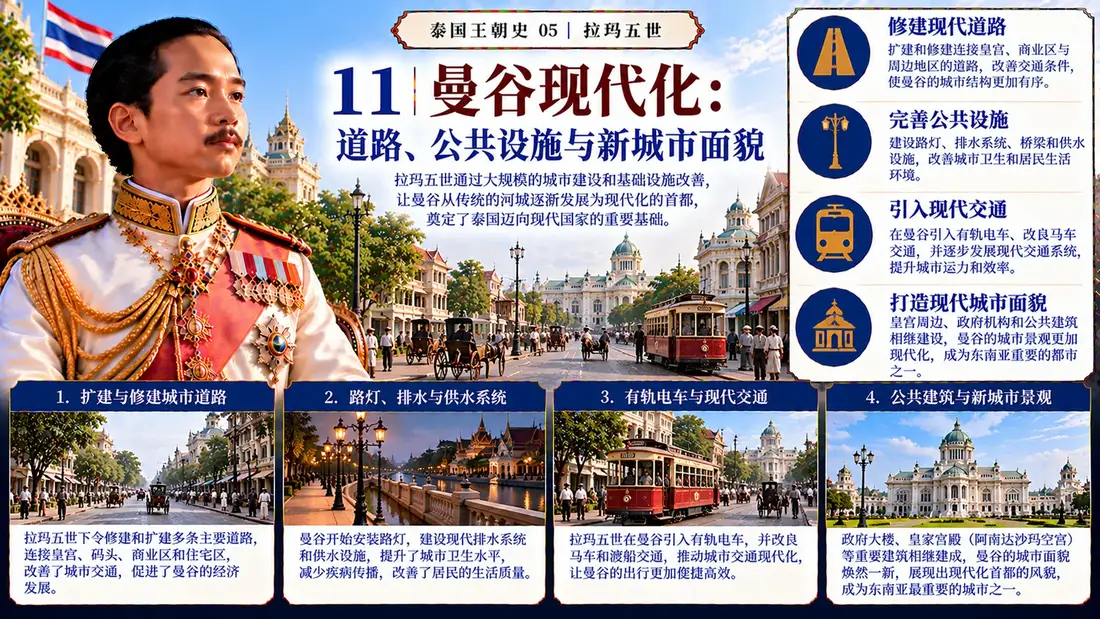
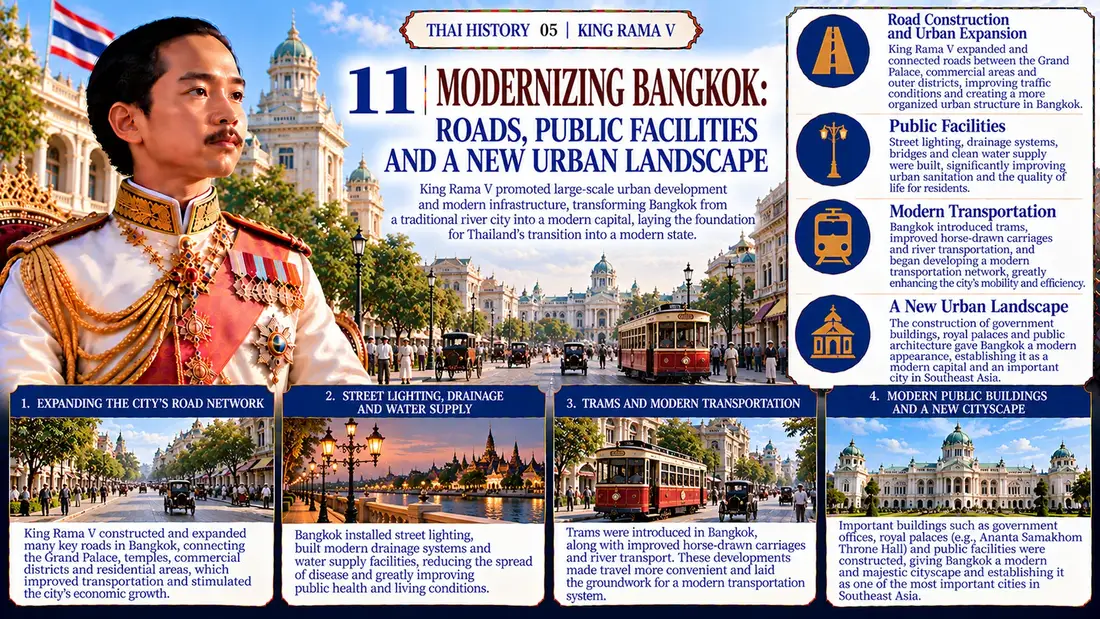
11 | Modernizing Bangkok: Roads, Public Facilities and a New Urban Landscape
SEA NOW Thailand · Rama V · Illustration 11
Rama V’s reforms also transformed Bangkok itself.
Earlier Bangkok had been overwhelmingly a river-and-canal city.
Transportation, markets and daily life depended heavily on waterways.
During the late nineteenth century, however, the road network expanded.
New streets connected royal areas, commercial districts, government institutions and residential neighborhoods.
Bridges, street lighting, drainage and other public facilities gradually improved.
Bangkok also entered the age of modern public transportation.
By 1893, electric tram services were operating in the capital.
New ministries, palaces, civic buildings and European-influenced architecture also reshaped the city.
Bangkok’s appearance began to change dramatically.
Temples, palaces and canals remained central to its identity.
But they now existed alongside roads, trams, modern government buildings and new commercial districts.
A modern capital was beginning to emerge.
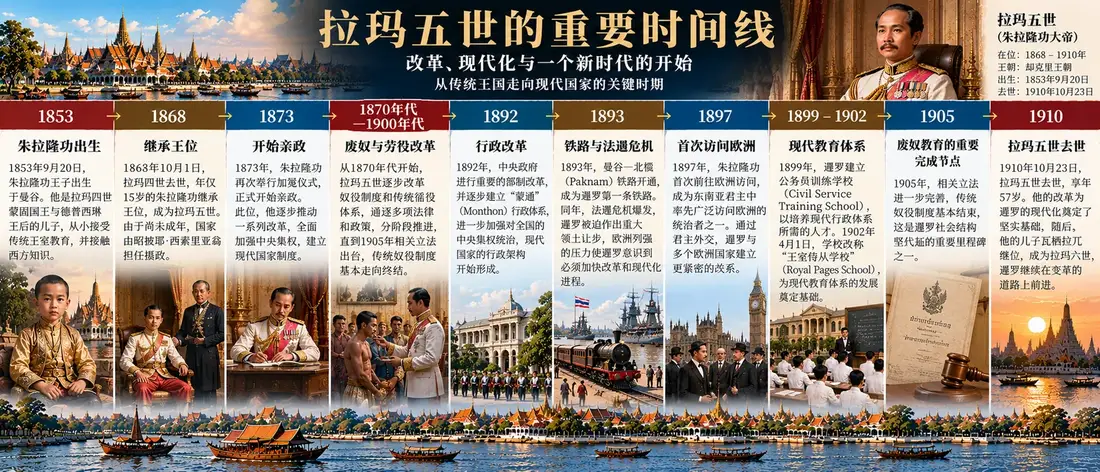
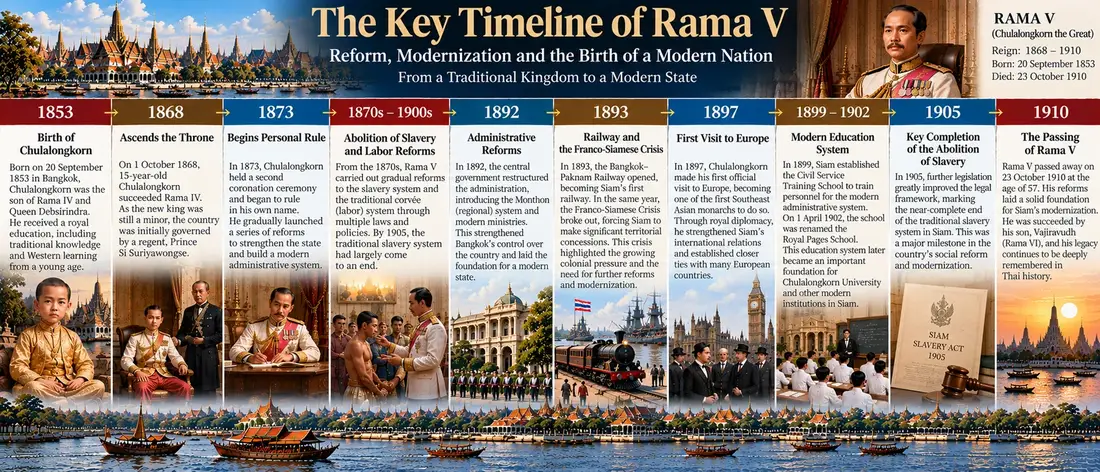
12 | 1853 → 1868 → 1873 → 1893 → 1910: Complete Timeline 1853 | Prince Chulalongkorn Is Born
SEA NOW Thailand · Rama V · Illustration 12
On September 20, 1853, Prince Chulalongkorn was born in Bangkok’s Grand Palace.
He grew up during Rama IV’s era of increasing engagement with Western knowledge and international diplomacy.
1868 | A Fifteen-Year-Old King
On October 1, 1868, King Mongkut died.
Chulalongkorn succeeded him as King Rama V.
Because of his youth, the early years of his reign were conducted under a regency.
1873 | Personal Rule and Early Reform
At the age of twenty, Rama V underwent his second coronation and began exercising royal power more directly.
Administrative, fiscal and social reforms gradually accelerated.
The long process that would ultimately abolish slavery also began during this period.
1893 | The Franco-Siamese Crisis
French military pressure reached Bangkok.
Siam was forced to relinquish its position in extensive territories east of the Mekong.
It was one of the most serious international crises of Rama V’s reign.
Yet Siam avoided a full-scale colonial war and retained its independence.
1910 | The End of Rama V’s Era
On October 23, 1910, King Rama V died at the age of 57.
He had ruled Siam for forty-two years.
During those decades, Siam’s administration, law, education, transportation, communications and social institutions underwent profound transformation.
A traditional kingdom was becoming a modern state.
The Legacy of King Rama V
The historical importance of King Rama V cannot be reduced to any single reform.
His reign changed the structure of the state itself.
Under Rama V, Siam gradually:
abolished slavery;
created a modern central government;
strengthened provincial administration;
reformed law and the judiciary;
expanded modern education;
sent students overseas;
built railways, telegraph lines and postal networks;
and transformed Bangkok into a more modern capital.
Behind these reforms stood a larger objective:
to give Siam the institutional strength required to survive the colonial age.
That survival came at a price.
Siam surrendered territories during negotiations with Britain and France rather than risk wars it was unlikely to win.
Yet the political core of the kingdom, the monarchy and Siamese sovereignty survived.
This is why Rama V occupies such an important place in Thai history.
He was not simply a reforming monarch.
He was one of the central figures in Siam’s transformation from a traditional kingdom into a modern state.
King Rama V died in 1910.
The throne passed to his son:
King Vajiravudh—Rama VI.
By then, the central question facing Siam was beginning to change.
For decades, the challenge had been:
How can Siam avoid becoming a colony?
In the twentieth century, a new question would become increasingly important:
What does it mean to belong to the Siamese nation?
And that brings us directly to the sixth chapter of our series:
King Rama VI — nationalism, a changing society, and Siam’s entry into the First World War.