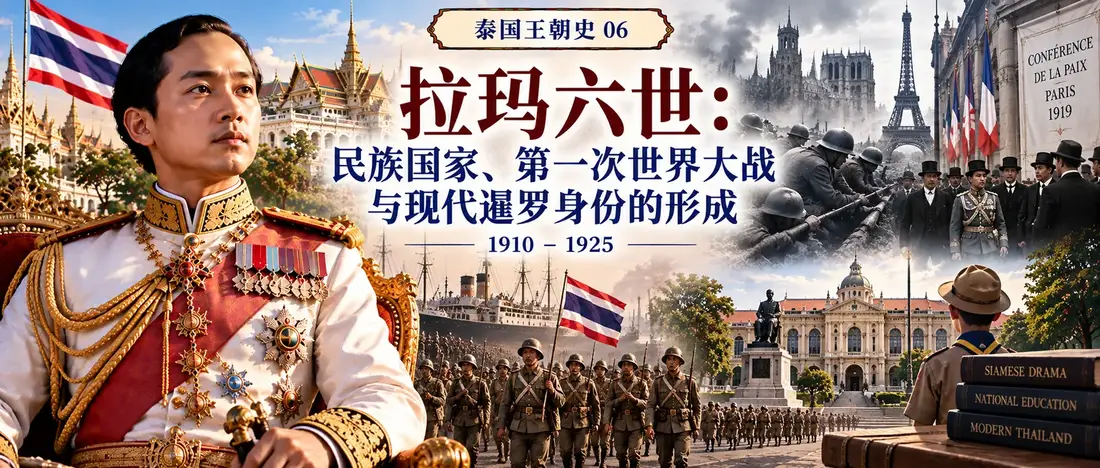
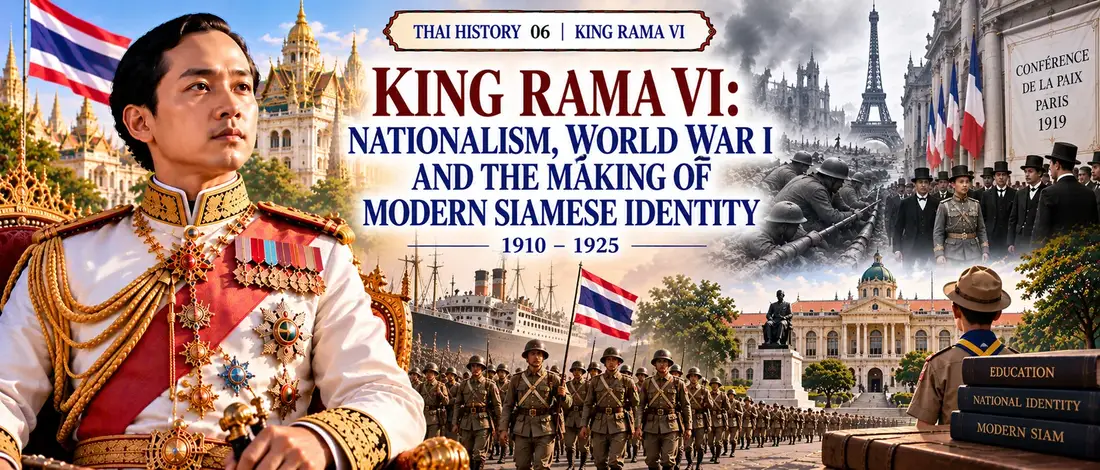
King Rama VI: Nationalism, World War I and the Making of Modern Siamese Identity Thai Royal History 06 | King Rama VI (Vajiravudh), 1910–1925
On October 23, 1910, King Chulalongkorn—Rama V—passed away.
After more than four decades of reform, Siam was a very different country from the kingdom he had inherited.
Railways were expanding across the country. Modern ministries had replaced much of the old administrative structure. Slavery had been abolished, while schools, postal services, telegraph networks, courts and modern legal institutions continued to develop.
Most importantly:
Siam had survived the age of European colonial expansion without becoming a formal colony.
But this success created a new question.
Once a traditional kingdom had begun transforming itself into a modern state:
How should the people living within that state understand their shared identity?
The man who inherited the throne was Chulalongkorn's son:
Prince Vajiravudh.
He became the sixth monarch of the Chakri Dynasty:
King Rama VI.
The world Rama VI inherited was already changing again.
Colonialism remained powerful, but nationalism was spreading across the world. Newspapers, mass education, modern armies and new political ideas were transforming societies.
And in Europe, an unprecedented global conflict was approaching.
Rama VI's reign was therefore not simply a continuation of modernization.
It was also an era in which Siam increasingly confronted three fundamental questions:
What is a nation?
What creates a national identity?
And what position should Siam occupy in the modern international order?
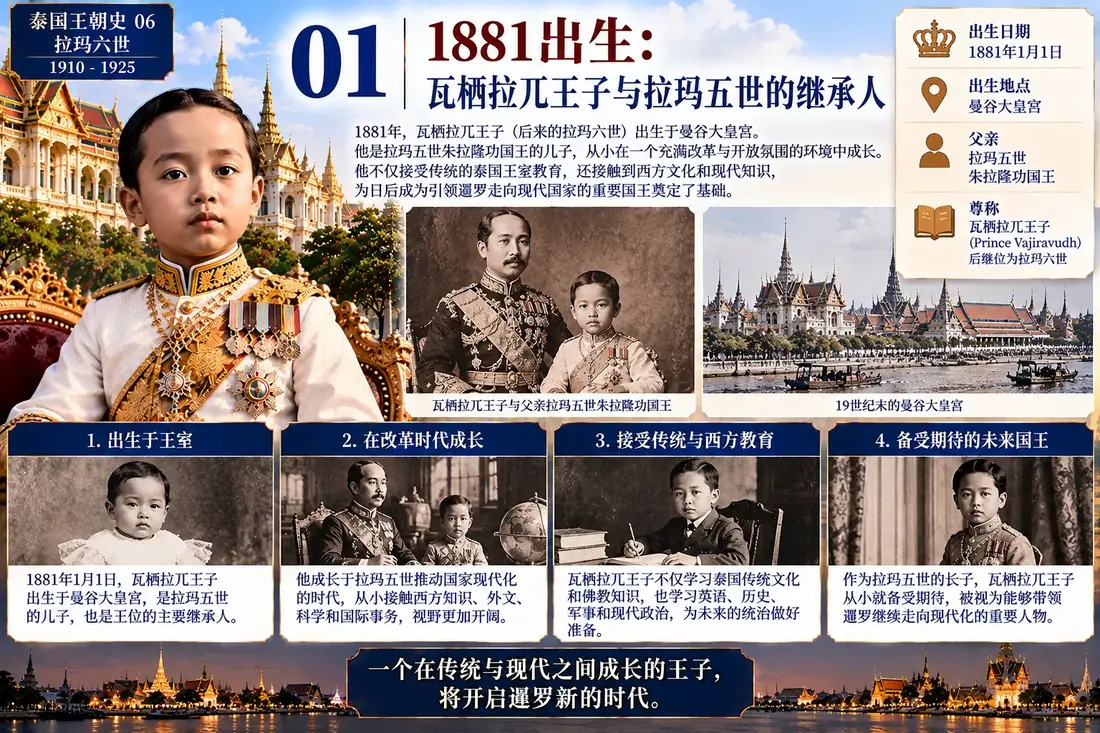
01 | Born in 1881: Prince Vajiravudh, Heir to King Chulalongkorn
SEA NOW Thailand · Rama VI · Illustration 01
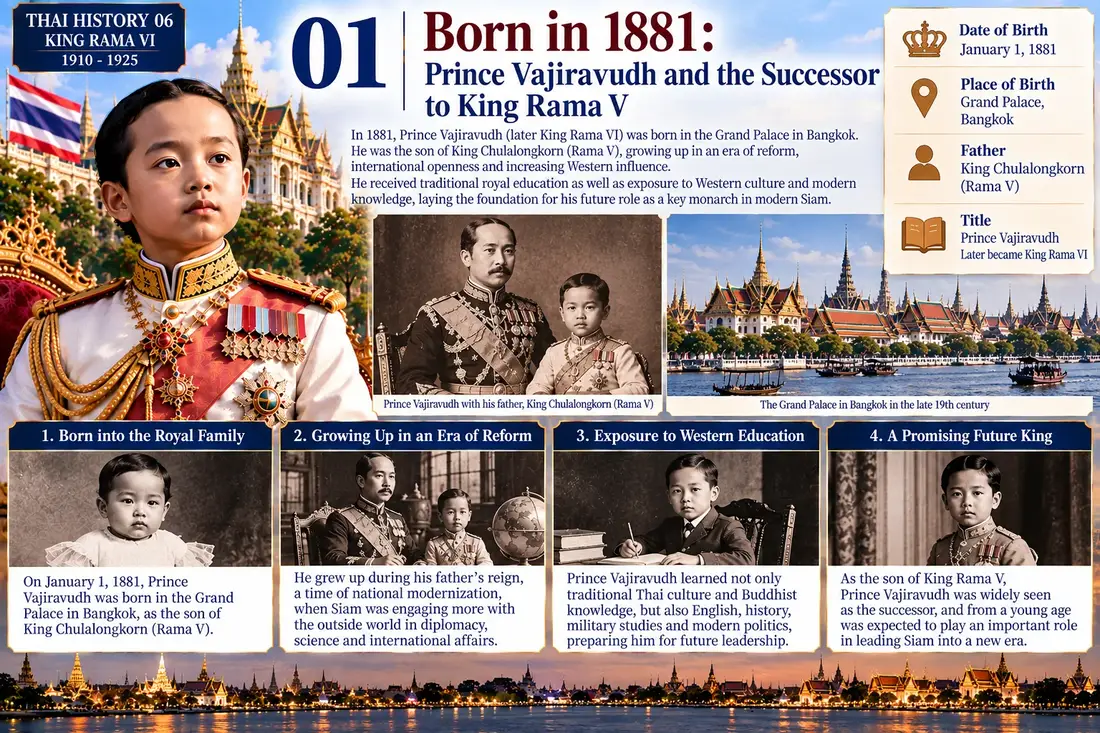
Prince Vajiravudh was born in Bangkok's Grand Palace on January 1, 1881.
His father was King Chulalongkorn, Rama V.
Vajiravudh therefore grew up during one of the most important periods of modernization in Siamese history.
Railways were being constructed.
Modern government ministries were taking shape.
Education, law, diplomacy and the military were undergoing major reforms.
The young prince did not grow up within an isolated traditional court.
Instead, he belonged to a royal family that increasingly understood that Siam's future depended on its ability to understand the outside world.
King Chulalongkorn believed that the next generation of royal leaders needed direct knowledge of Western institutions and ideas.
As Vajiravudh grew older and became an important heir to the throne, this principle shaped his education.
It would eventually make him one of the most extensively Western-educated monarchs in Thai history.
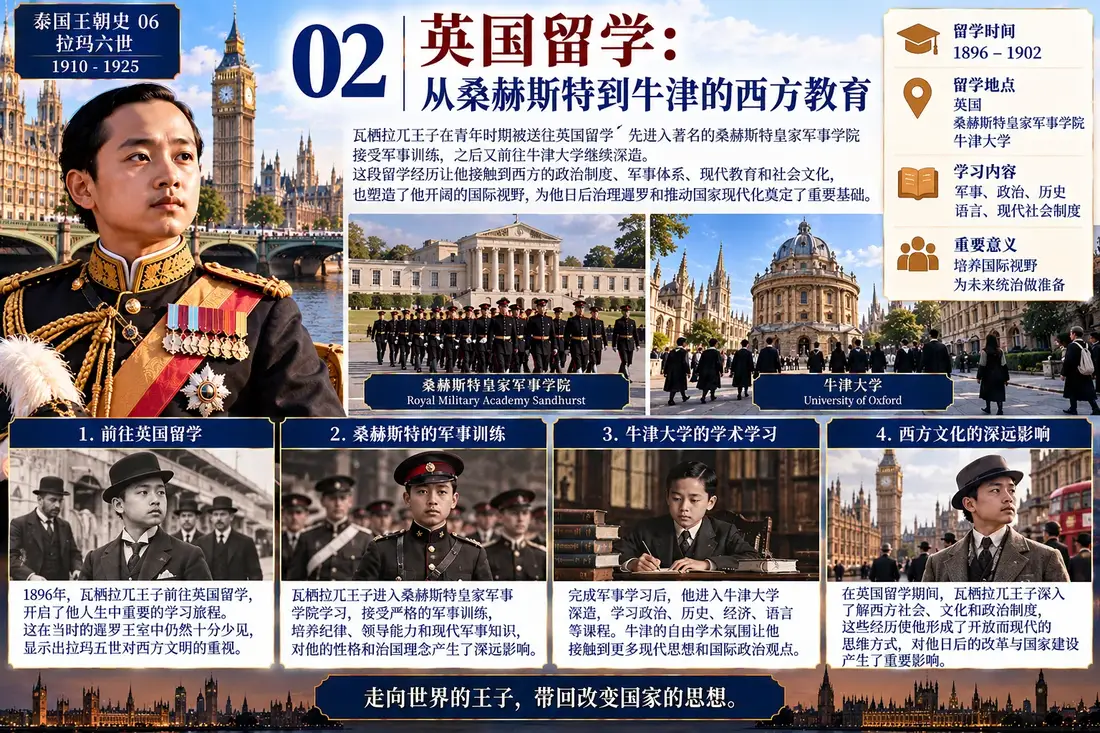
02 | Education in Britain: From Sandhurst to Oxford
SEA NOW Thailand · Rama VI · Illustration 02
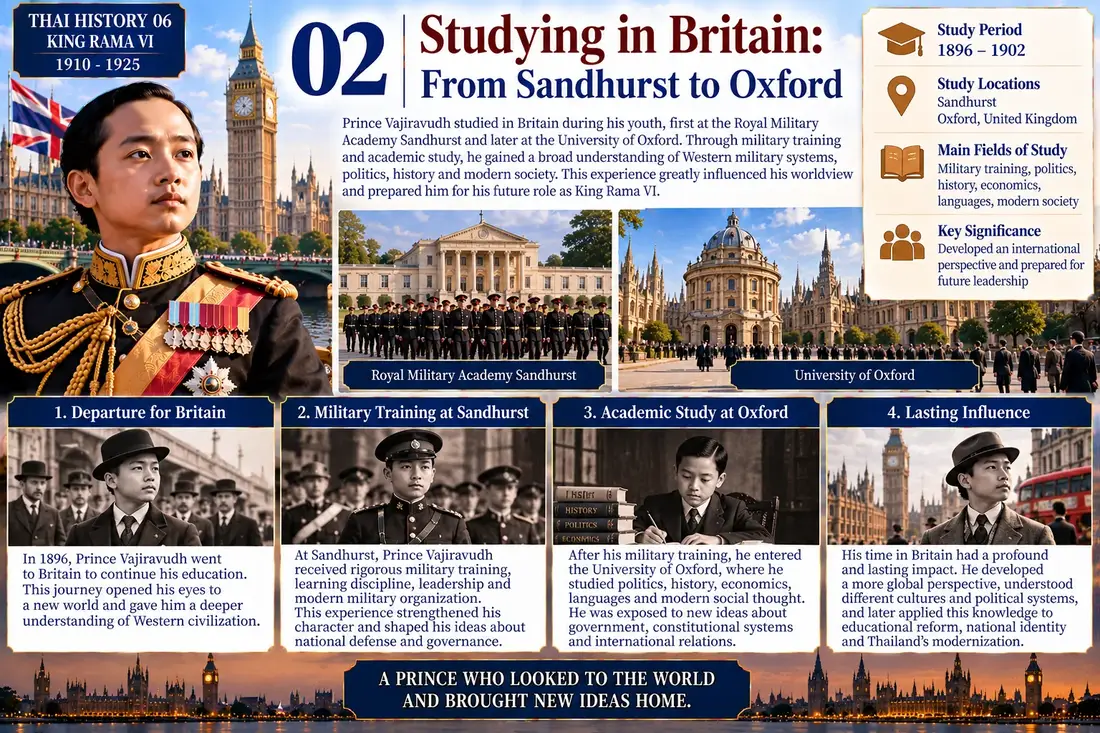
As a young man, Prince Vajiravudh was sent to Britain for his education.
His years abroad profoundly influenced his political thinking, cultural interests and understanding of nationalism.
He received military training at the Royal Military College, Sandhurst.
He later studied at Christ Church, Oxford.
But his British experience went far beyond formal education.
Vajiravudh was exposed to European political institutions, nationalism, public education, literature, theater, journalism and modern military organization.
He observed how ideas of nationhood, citizenship and public duty were used to create a sense of unity in a modern state.
These experiences would later influence his policies in Siam.
On October 23, 1910, King Chulalongkorn died.
Prince Vajiravudh succeeded his father and became:
King Rama VI.
For the first time, a Siamese monarch who had spent many formative years studying in Europe now ruled a rapidly modernizing kingdom.
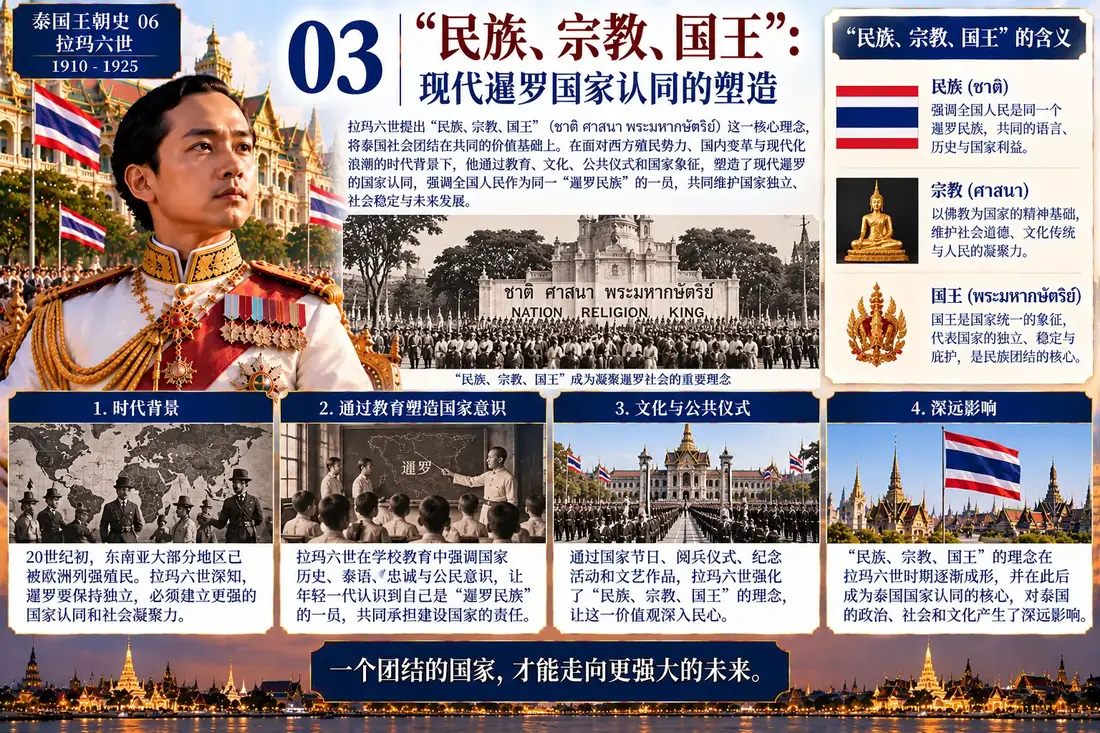
03 | “Nation, Religion, King”: Creating a Modern Siamese National Identity
SEA NOW Thailand · Rama VI · Illustration 03
The central challenge of Rama V's reign had been:
How could Siam build a modern state?
Under Rama VI, another question became increasingly important:
How could the people of that state develop a shared national identity?
Rama VI strongly promoted an idea that would become deeply influential in modern Thailand:
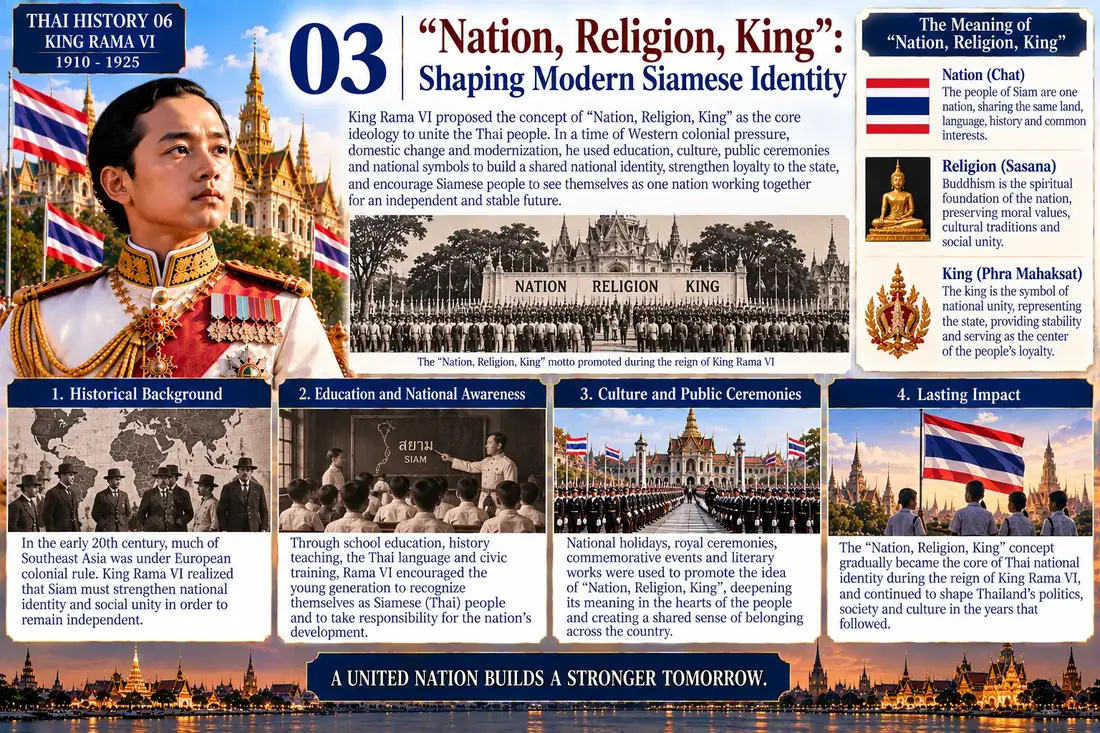
Chat – Satsana – Phra Maha Kasat
Usually expressed in English as:
Nation – Religion – King.
In this conception, the nation represented a shared political and cultural identity.
Religion—especially Buddhism—served as an important moral and cultural foundation.
The monarchy represented unity, political order and continuity.
Schools, the military, the Scout movement, public ceremonies, literature and journalism all became important channels through which national consciousness could be promoted.
National symbols also became increasingly important.
In 1917, Siam adopted the red, white and blue striped national flag known as the Thong Trairong, the basic design of Thailand's national flag today.
The kingdom was gradually moving beyond an older political world based heavily on dynastic and local relationships.
People were increasingly encouraged to imagine themselves as members of a common nation.
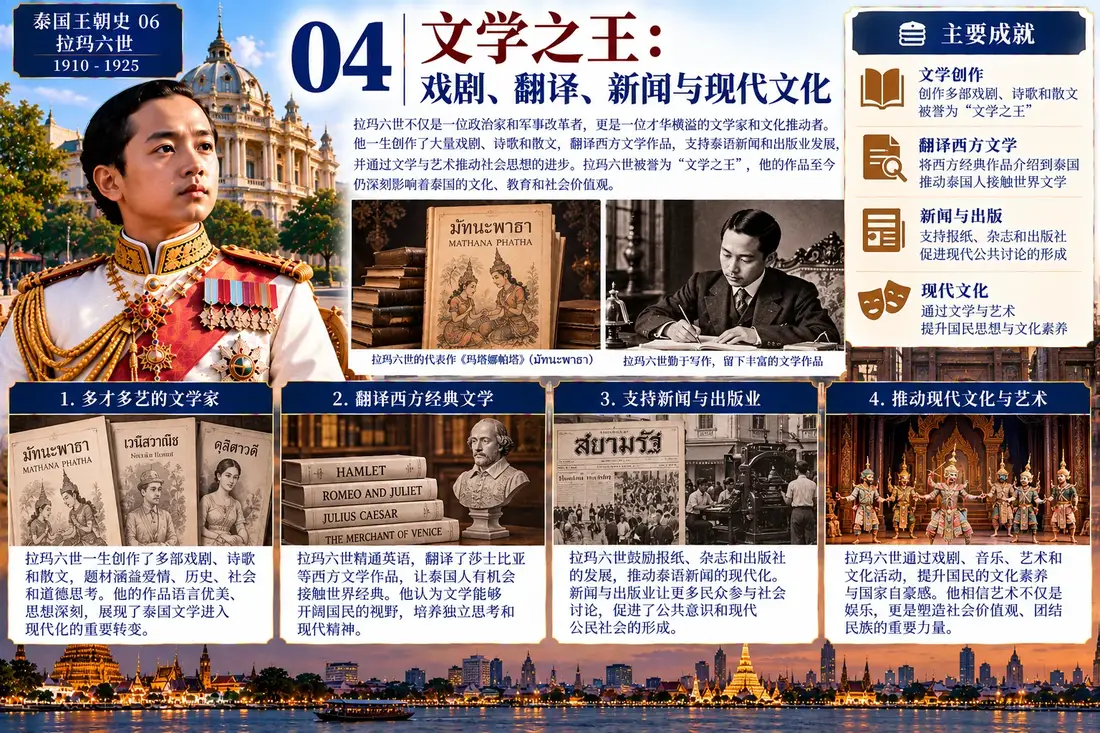
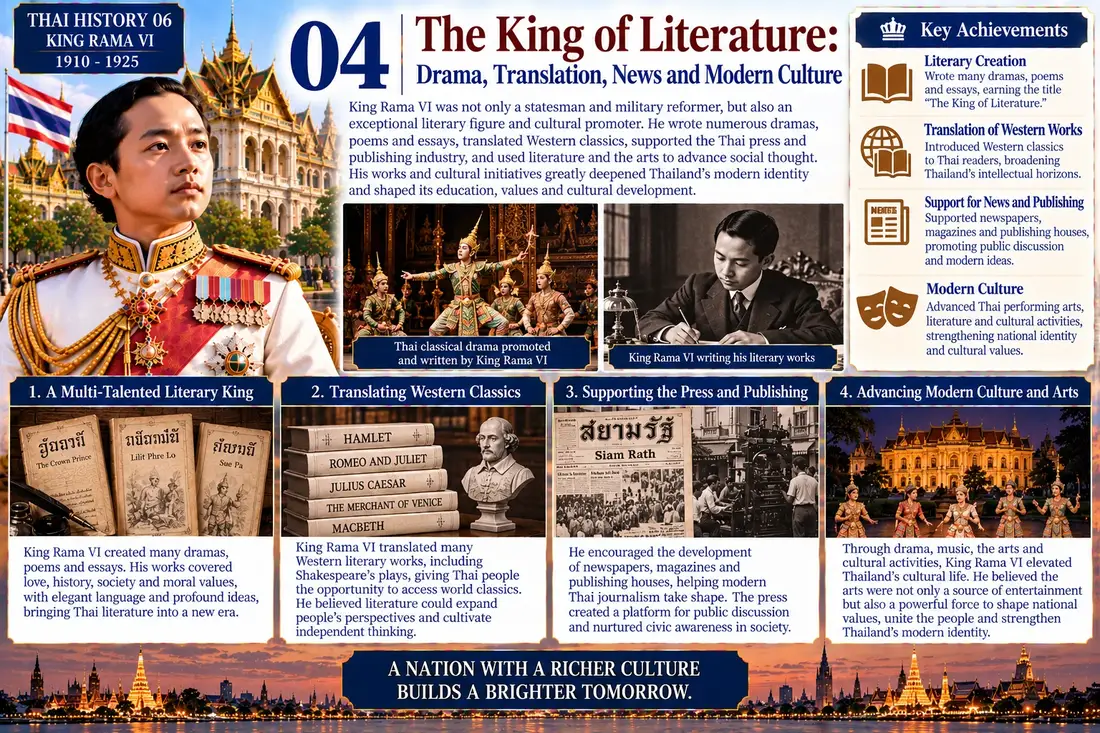
04 | The Literary King: Drama, Translation, Journalism and Modern Culture
SEA NOW Thailand · Rama VI · Illustration 04
Rama VI possessed one characteristic that distinguished him from many other monarchs:
He was an extraordinarily active writer.
He wrote and participated in the production of plays, essays, political commentary, poetry and other literary works.
He also translated and adapted works from Western literature.
European drama—particularly works associated with writers such as Shakespeare—became an important part of his cultural interests.
For Rama VI, however, literature was not simply entertainment.
It could also be an instrument for communicating ideas.
Through plays, essays, newspapers and other publications, he explored themes including patriotism, social responsibility, modern civilization, politics and national identity.
At the same time, the expansion of printing and journalism contributed to the development of a wider public sphere.
An increasing number of educated Siamese could read, write and participate in discussions about society and government.
Cultural modernization and political modernization were therefore closely connected.
A modern nation required more than railways, ministries and laws.
It also required:
shared stories, shared symbols and a shared imagination of the nation.
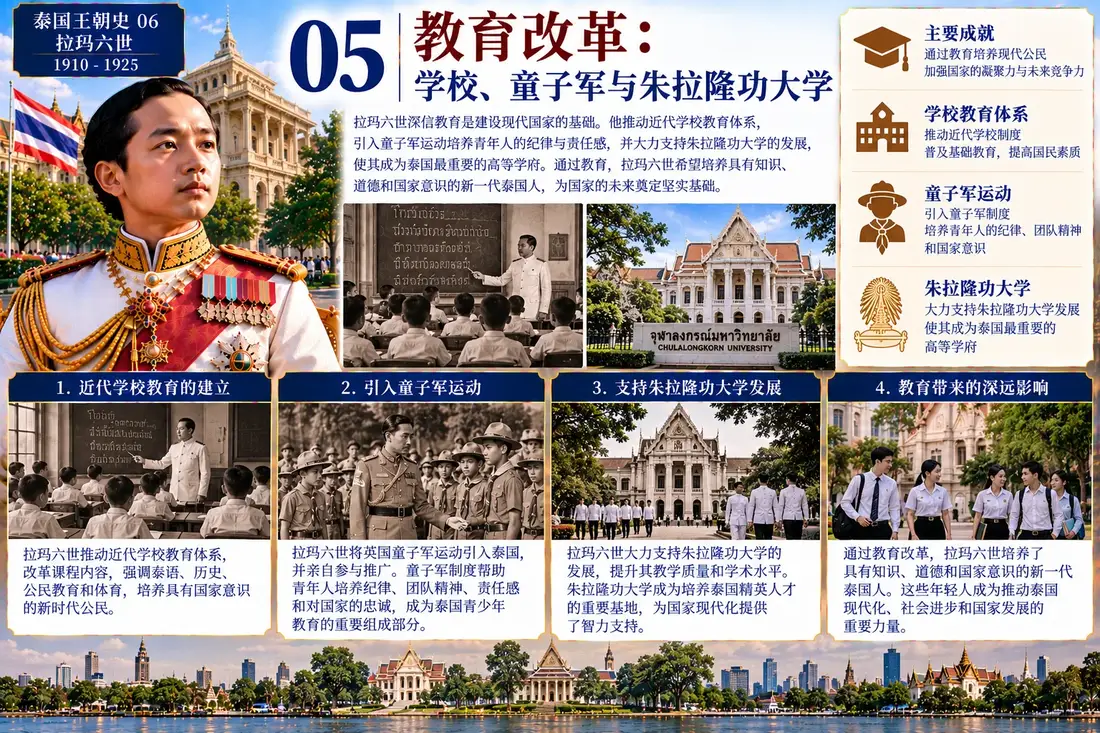
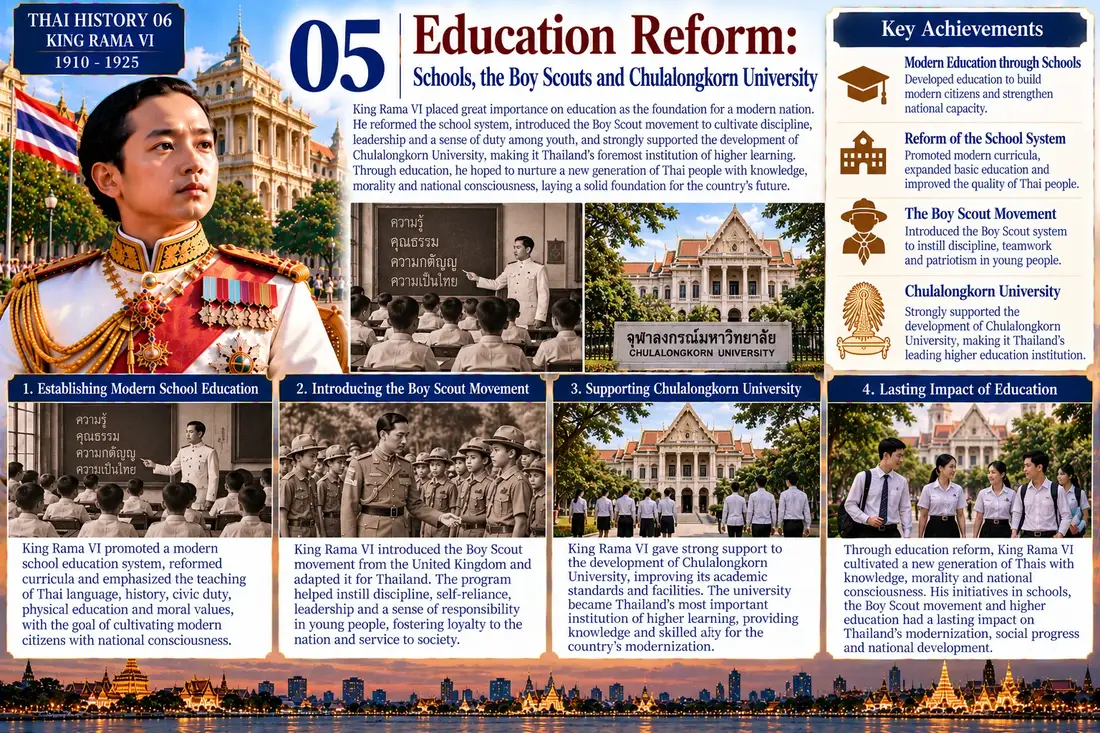
05 | Education Reform: Schools, the Boy Scouts and Chulalongkorn University
SEA NOW Thailand · Rama VI · Illustration 05
Rama VI placed great importance on education.
In his view, a modern country required more than trained government officials.
It also needed a new generation equipped with knowledge, discipline, responsibility and national consciousness.
Modern schooling continued to expand during his reign.
At the same time, Rama VI introduced another institution strongly influenced by his experiences in Britain.
In 1911, the Boy Scout movement was established in Siam.
The movement emphasized discipline, teamwork, responsibility, service and patriotism.
Education was therefore increasingly connected to the formation of modern citizens.
Higher education also reached an important milestone.
Institutions originally developed during Rama V's reign continued to expand and evolve.
In 1917, Chulalongkorn University was formally established.
Named in honor of King Chulalongkorn, it became a landmark in the development of modern higher education in Siam.
The kingdom was beginning to develop its own university system.
This meant that future doctors, engineers, teachers, civil servants and other professionals could increasingly receive advanced education within Siam itself.
Education became one of the most important long-term foundations of modernization.
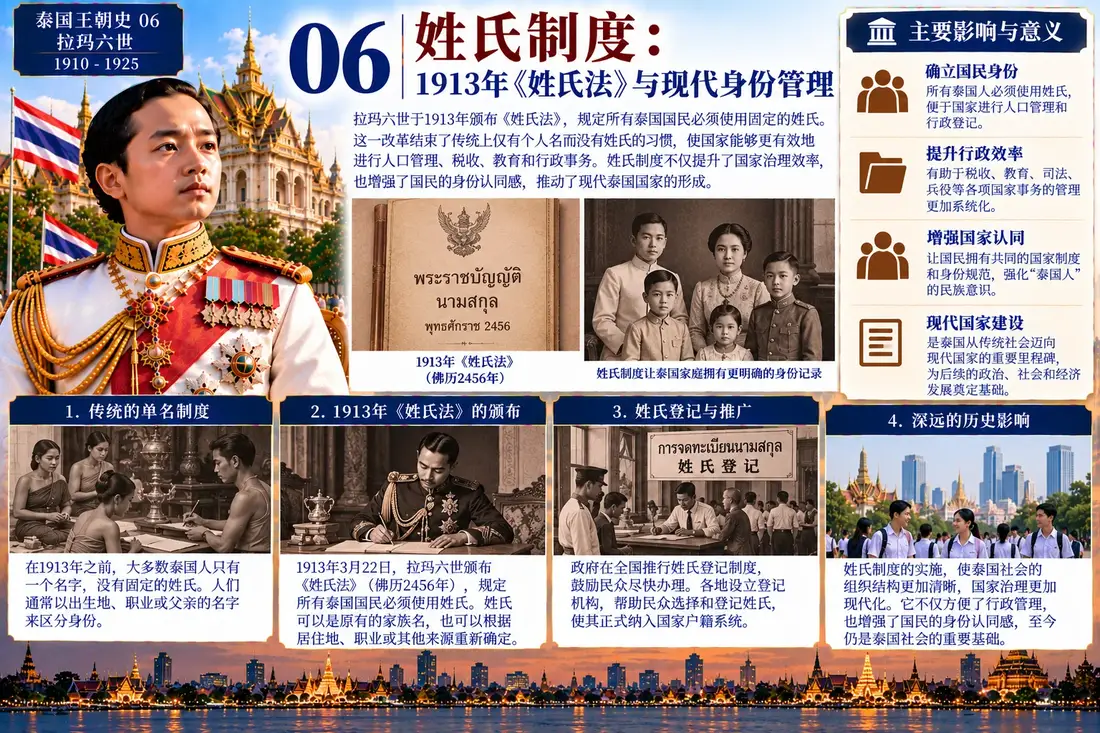
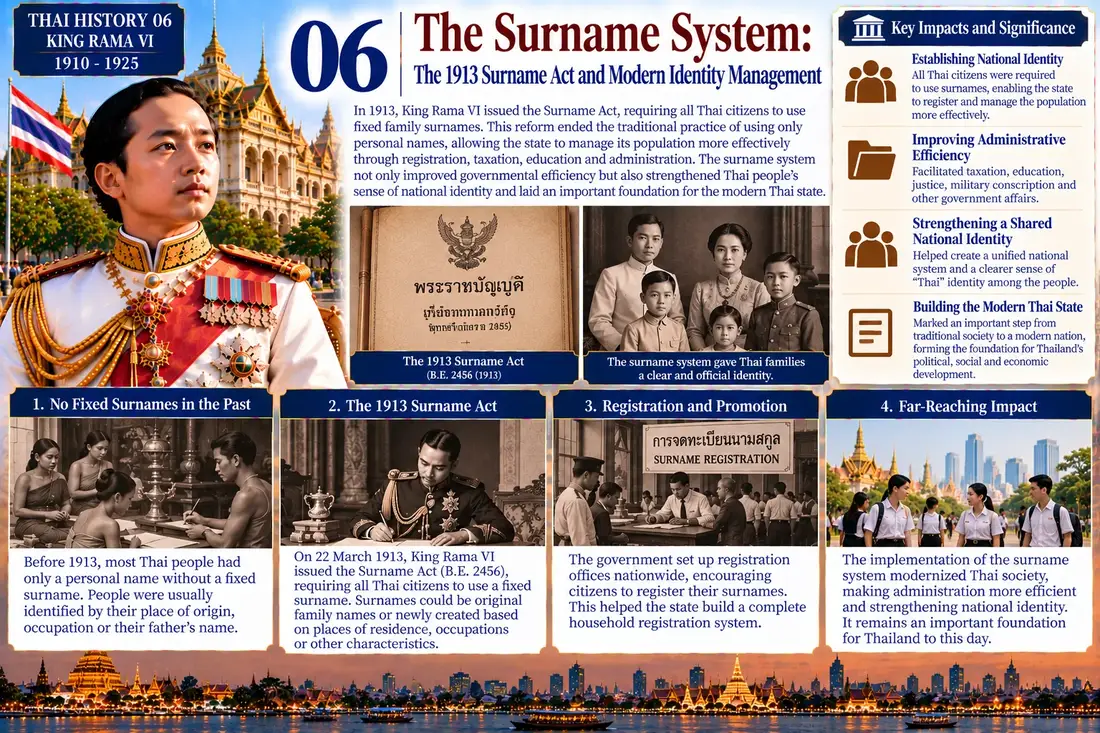
06 | The Surname System: The 1913 Surname Act and Modern Identity Management
SEA NOW Thailand · Rama VI · Illustration 06
It can be difficult from a modern perspective to imagine a society in which fixed family surnames were not universally used.
Traditionally, many Siamese people primarily used personal names and could be distinguished through family relationships, occupations, places of origin and other social connections.
But a modern administrative state required more standardized methods of identification.
The government increasingly needed to know:
Who is this person?
To which family do they belong?
Where do they live?
How should they be recorded for education, taxation, legal administration and other government purposes?
In 1913, Rama VI promulgated the Surname Act.
The adoption of fixed surnames gradually became an important element of modern identity administration.
Members of families could now be identified through a common surname within an increasingly standardized system.
On the surface, the reform might appear to have simply given people family names.
Its significance was much greater.
A modern state was developing increasingly systematic ways to identify and administer its population.
Individuals were no longer understood only through their village, occupation or local relationships.
They were increasingly identifiable as:
individual subjects within a national administrative system.
The surname system therefore became another symbol of Siam's transition from a traditional kingdom toward a modern bureaucratic state.
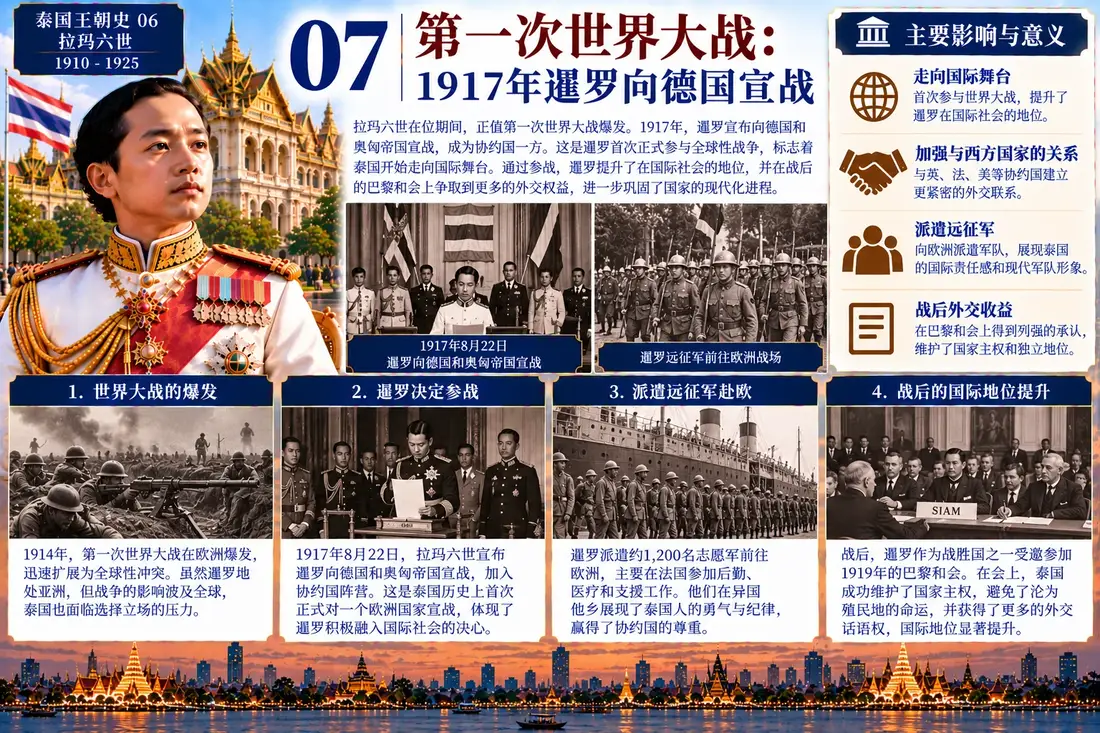
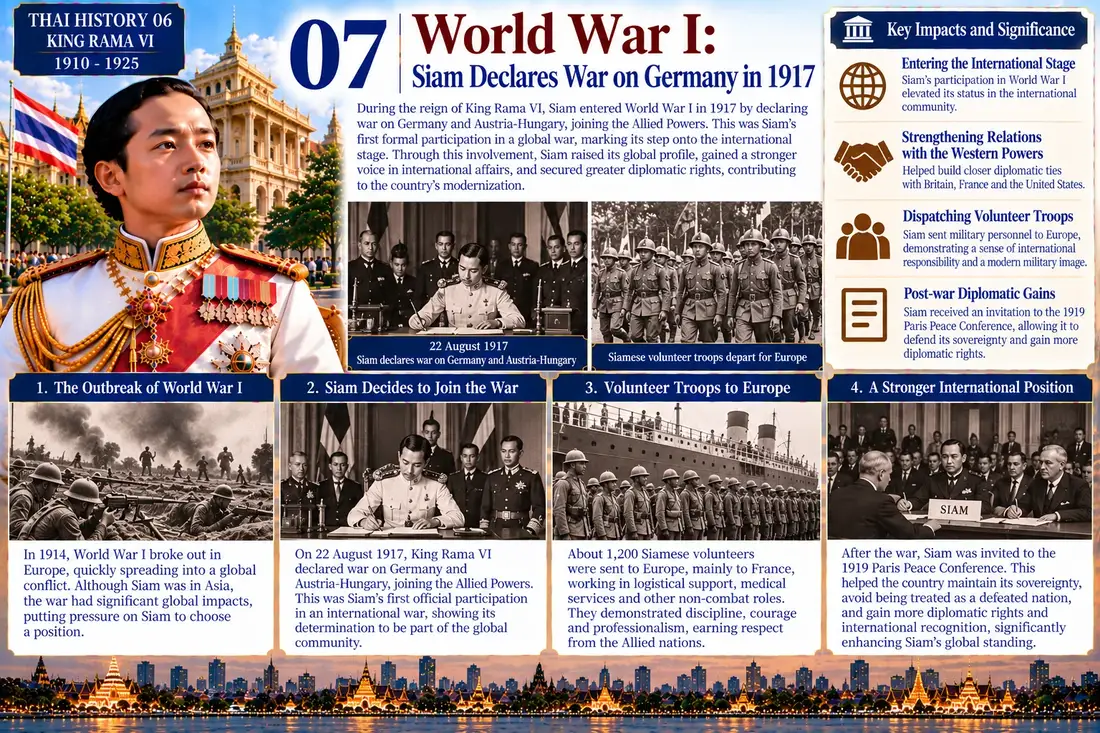
07 | World War I: Siam Declares War on Germany in 1917
SEA NOW Thailand · Rama VI · Illustration 07
In 1914, World War I broke out in Europe.
Siam initially remained neutral.
As the conflict continued, however, the international situation changed.
By 1917, the United States had entered the war on the Allied side, and the strategic balance increasingly favored the Allies.
Rama VI recognized an important diplomatic opportunity.
If Siam joined what eventually became the victorious side, the kingdom might be able to strengthen its international position.
There was another important consideration.
For decades, Siam had been constrained by unequal treaties and foreign extraterritorial privileges.
Participation in the war could give Siam greater diplomatic leverage in future negotiations.
On July 22, 1917, Siam formally declared war on Germany and Austria-Hungary.
It was a major turning point.
For the first time, Siam formally participated in a global war.
The conflict also provided an opportunity for the kingdom to present itself internationally as a modern sovereign state.
That same year, Siam adopted its red, white and blue tricolor flag.
A new visual symbol accompanied the country's increasingly international identity.
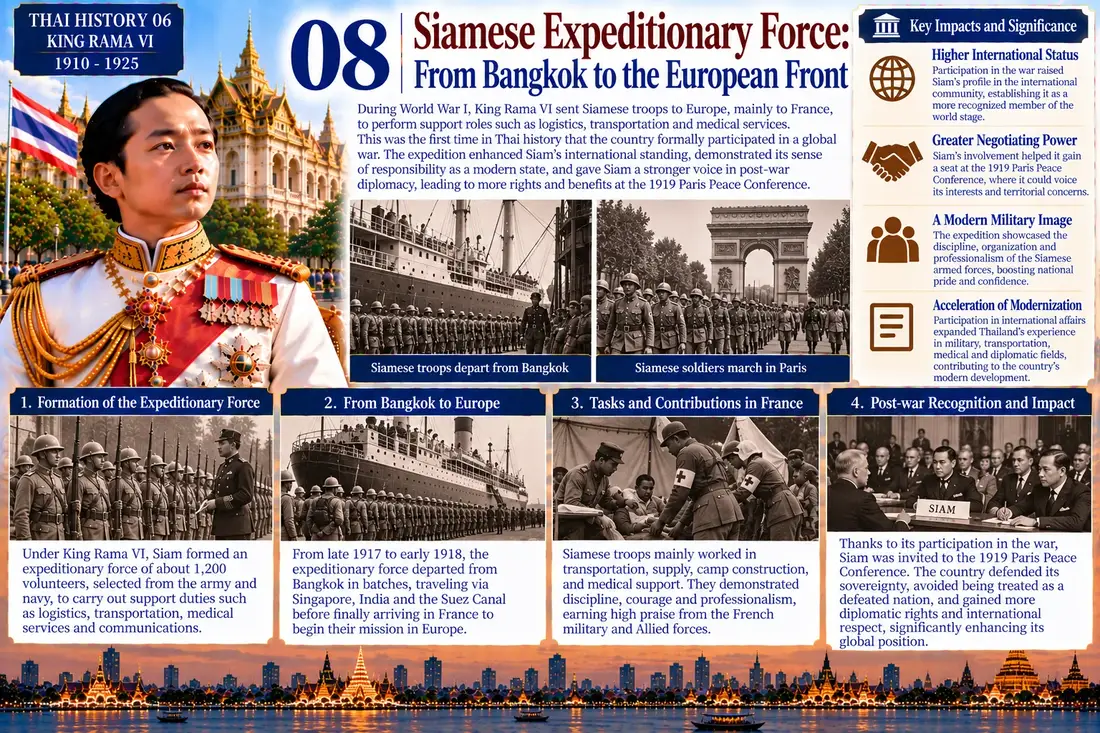
08 | The Siamese Expeditionary Force: From Bangkok to the European Front
SEA NOW Thailand · Rama VI · Illustration 08
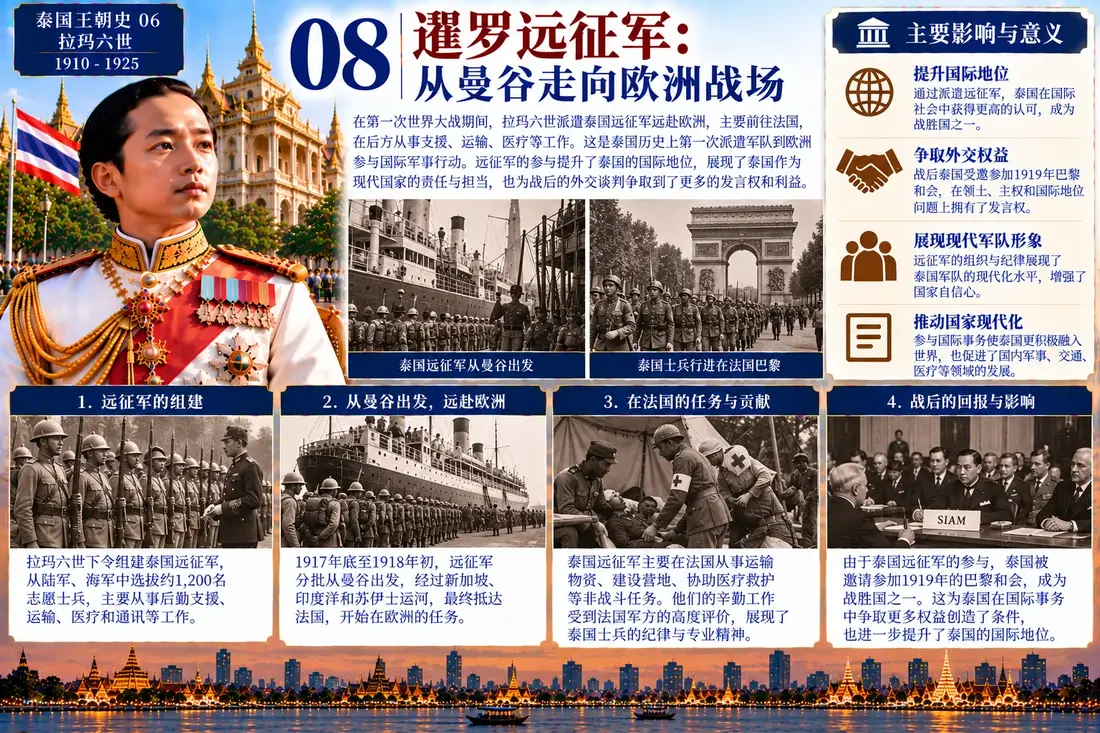
After declaring war, Siam decided to send personnel to Europe.
A Siamese Expeditionary Force of more than 1,200 men was organized.
It included aviation personnel, motor transport units, drivers, mechanics and medical and support personnel.
In 1918, the expeditionary force arrived in France.
Because the Siamese contingent reached Europe during the final phase of the war, its members did not experience years of large-scale trench warfare comparable to the major European armies.
Nevertheless, Siamese personnel received modern military training and carried out transportation and logistical duties.
After the Armistice, elements of the Siamese force also participated in the Allied occupation of Germany.
Siamese troops subsequently took part in victory celebrations in Europe.
The symbolic significance was enormous.
Only decades earlier, Siam had been struggling to avoid European colonization.
Now:
Siamese soldiers appeared in Europe as representatives of one of the victorious Allied nations.
This became one of the most visible results of Rama VI's wartime strategy.
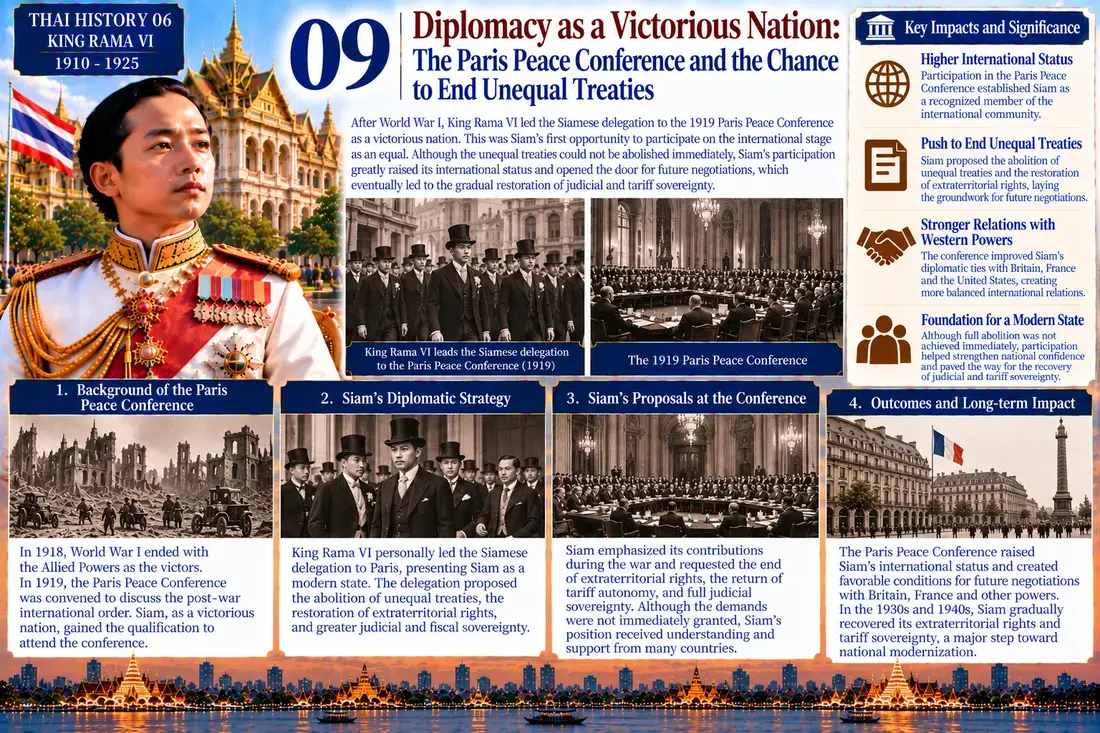
09 | Diplomacy as a Victorious Nation: The Paris Peace Conference and the Opportunity to End Unequal Treaties
SEA NOW Thailand · Rama VI · Illustration 09
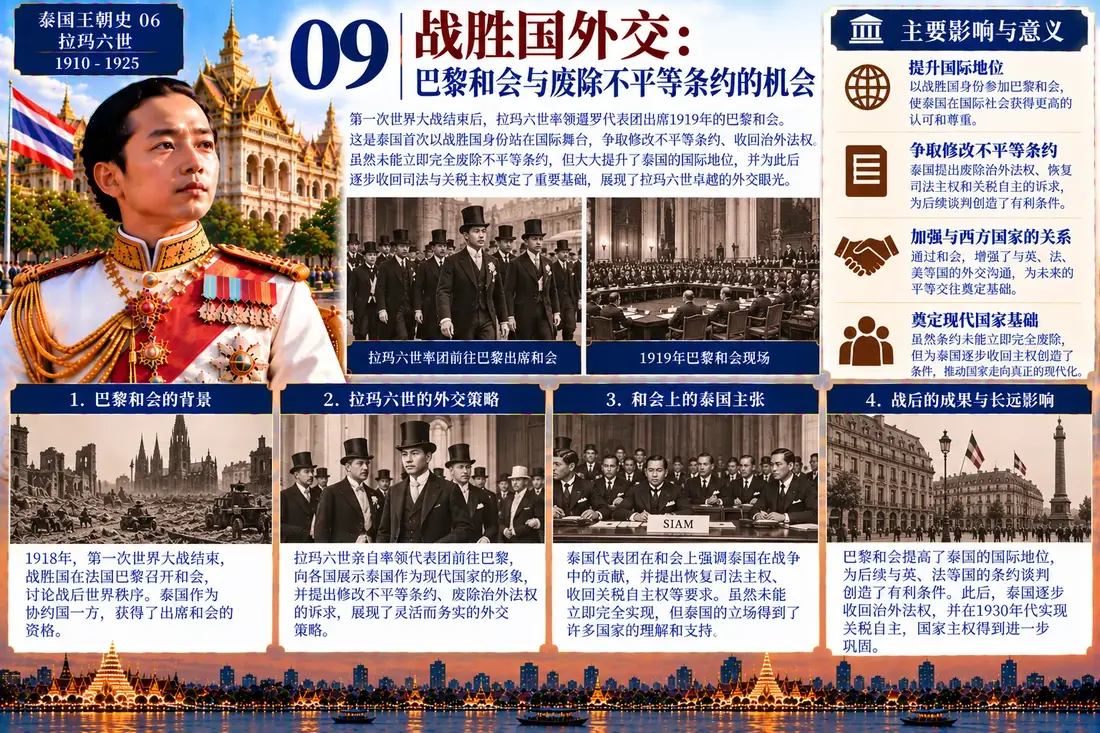
In November 1918, World War I ended.
The Allied Powers emerged victorious.
Because Siam had joined the Allied side, it entered the postwar settlement among the victorious nations.
In 1919, Siam participated in the Paris Peace Conference.
This gave the kingdom an important diplomatic opportunity:
to challenge the unequal treaty system that had constrained Siamese sovereignty since the nineteenth century.
One of the most important issues was:
extraterritoriality.
Under earlier treaties, citizens of several foreign powers in Siam were subject to special legal arrangements rather than being fully governed by Siamese courts.
Siam's freedom to determine its own customs tariffs had also been restricted.
For a state seeking recognition as a modern sovereign nation, these limitations were increasingly unacceptable.
Siam's enhanced international position after World War I created more favorable conditions for treaty revision.
An important distinction, however, is necessary:
The Paris Peace Conference did not immediately abolish all of Siam's unequal treaties.
The restoration of full judicial and tariff sovereignty required further negotiations over subsequent years.
Nevertheless, Rama VI's decision to enter World War I significantly strengthened Siam's diplomatic position and helped open the door to later treaty revisions.
Siam was increasingly able to negotiate with Western powers not simply as a vulnerable Asian kingdom, but as a recognized participant in the international system.
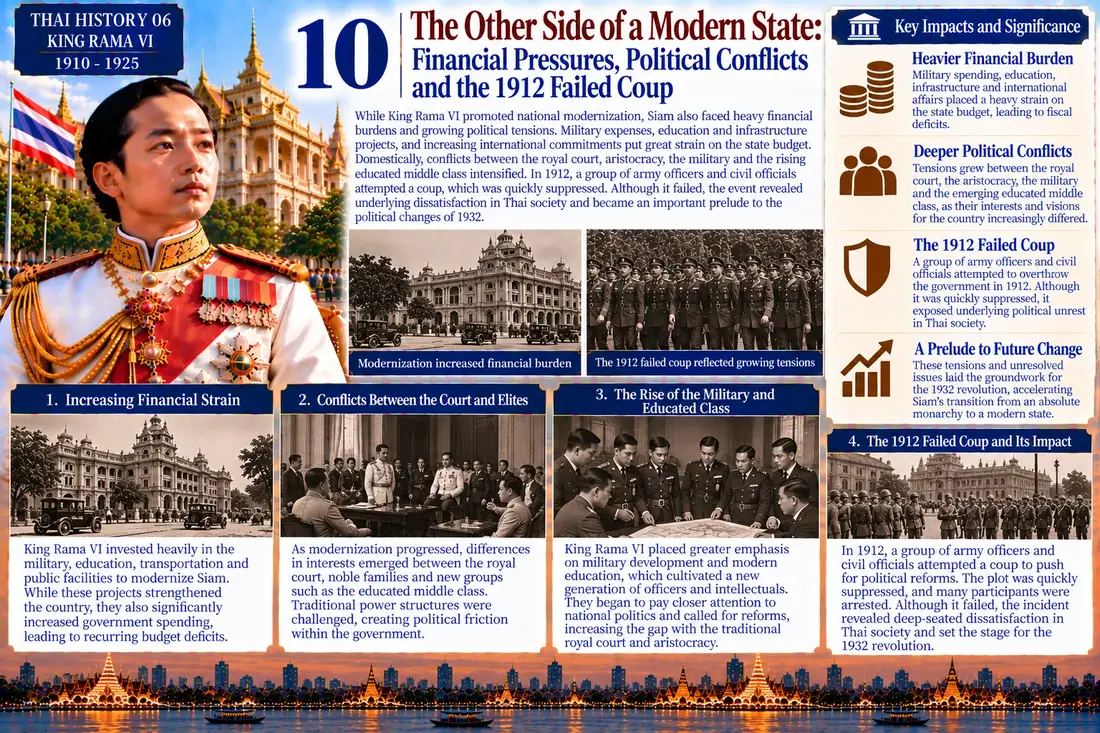
10 | The Other Side of the Modern State: Financial Pressure, Political Conflict and the Failed Coup of 1912
SEA NOW Thailand · Rama VI · Illustration 10
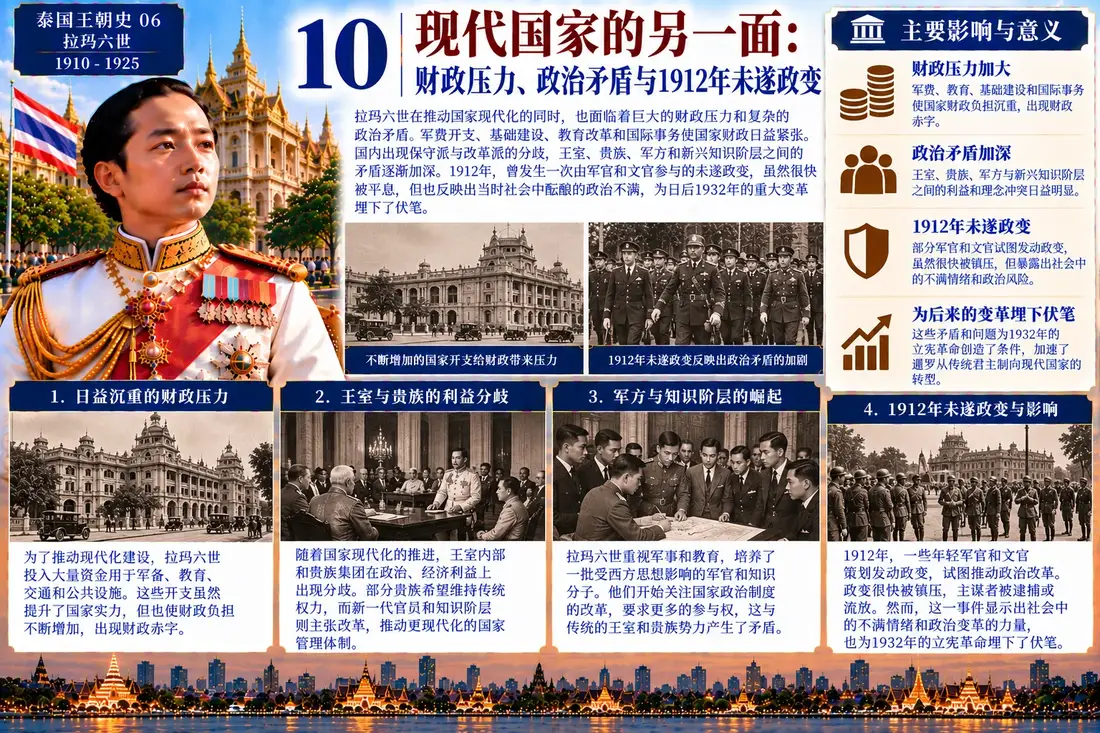
Rama VI's reign was not defined only by nationalism, education and diplomatic success.
Modernization also created new pressures.
The government required substantial resources for the military, education, transportation, administration and public projects.
At the same time, royal expenditure and aspects of government spending attracted criticism amid broader fiscal pressures.
New political groups were also emerging within Siamese society.
Modern education had produced growing numbers of military officers, civil servants and intellectuals.
Many were familiar with political ideas circulating elsewhere in Asia and Europe.
Some began to ask a difficult question:
If the country was becoming modern, should its political system also change?
These tensions became visible very early in Rama VI's reign.
In 1912, a group of young military officers planned a coup.
The conspirators did not all share exactly the same political objectives. Some favored constitutional government, while others held more radical ideas about political change.
The conspiracy was discovered before it could be carried out.
Participants were arrested, and the attempted coup failed.
Yet the event was historically significant.
It demonstrated that modernization itself was creating new political tensions.
Modern schools produced a new educated class.
The modern military produced a new generation of officers.
Foreign political ideas entered Siam more rapidly than before.
And some members of these emerging groups began demanding changes not only to administration, but to the political system itself.
The 1912 plot failed.
But the question it revealed did not disappear.
Twenty years later, in 1932, Siam's absolute monarchy would come to an end.
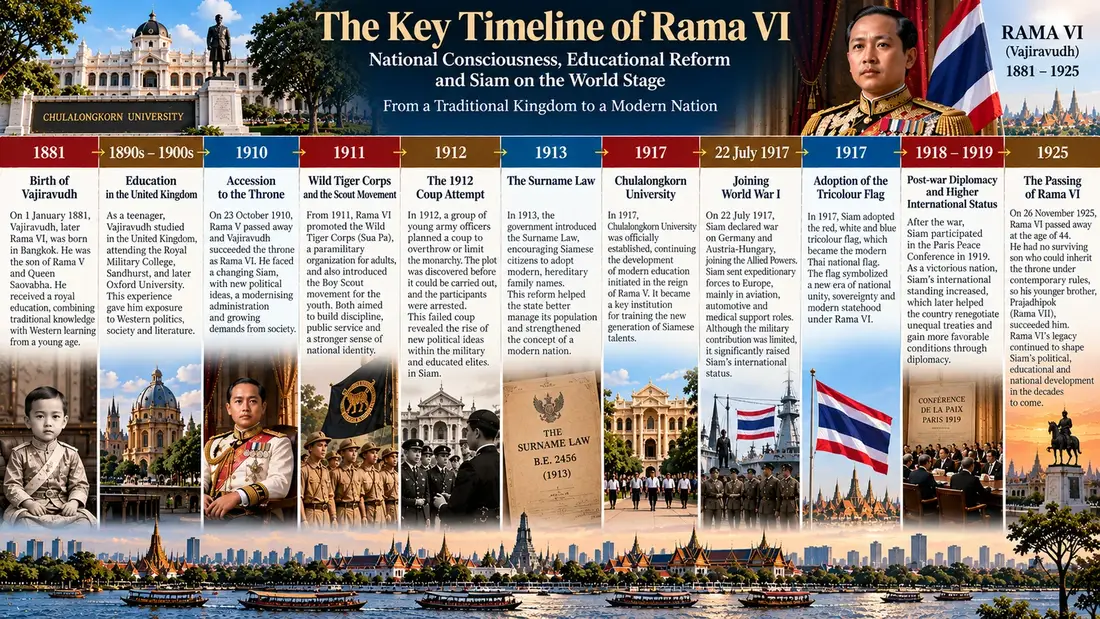
11 | 1881 → 1910 → 1912 → 1917 → 1925: A Complete Timeline 1881 | Prince Vajiravudh Is Born
SEA NOW Thailand · Rama VI · Illustration 11
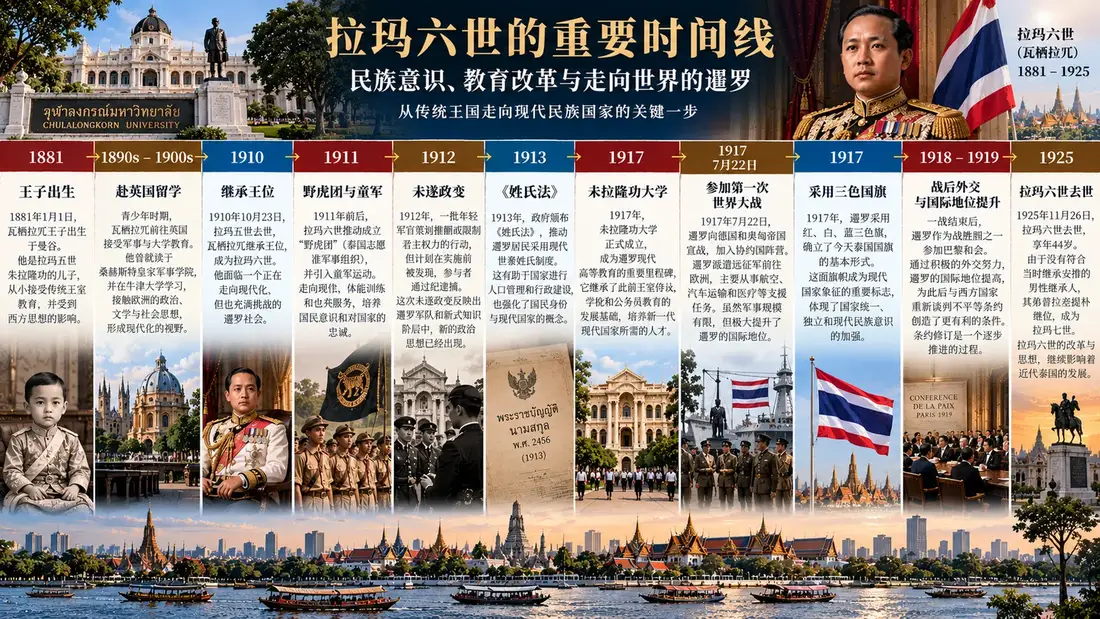
On January 1, 1881, Prince Vajiravudh was born in Bangkok's Grand Palace.
He was a son of King Chulalongkorn, Rama V.
He would later spend important years studying in Britain, an experience that strongly influenced his ideas about education, the military, literature and nationalism.
1910 | Accession to the Throne
On October 23, 1910, King Chulalongkorn died.
Vajiravudh succeeded his father as:
King Rama VI.
His reign placed increasing emphasis on national identity, education, culture and patriotism.
1912 | The Failed Coup
A group of young military officers planned an attempt to change the existing political order.
The conspiracy was discovered and suppressed before it could be carried out.
Although unsuccessful, it revealed emerging political tensions within modernizing Siam.
1917 | Siam Enters World War I
On July 22, 1917, Siam declared war on Germany and Austria-Hungary.
A Siamese expeditionary force was subsequently sent to Europe.
The same year also saw the adoption of Siam's red, white and blue tricolor national flag.
1925 | The Death of King Rama VI
On November 26, 1925, King Rama VI died in Bangkok at the age of 44.
He left no surviving son to inherit the throne.
The crown therefore passed to his younger brother:
Prince Prajadhipok.
He became:
King Rama VII.
What Did King Rama VI Leave Behind?
If Rama V's great historical task had been:
building the institutions of a modern state,
then one of the defining challenges of Rama VI's reign was:
giving that modern state a stronger sense of national identity.
During his reign, Siam further developed modern education, higher education, the Boy Scout movement, the surname system, journalism, literature, national symbolism and ideas of patriotism.
Rama VI was also deeply involved in writing and cultural life.
His reign helped strengthen the idea that a modern nation required more than territory and government institutions.
It also required people to imagine themselves as belonging to a shared national community.
At the same time, Siam entered World War I.
The decision to join the Allied Powers gave the kingdom an opportunity to raise its international status and later negotiate more effectively against the unequal treaty system inherited from the nineteenth century.
But Rama VI's reign also revealed another side of modernization.
Financial pressures increased.
New military officers, officials and intellectuals emerged.
Political expectations began to change.
The failed coup of 1912 demonstrated that some Siamese were already questioning the structure of absolute monarchy.
These tensions would not disappear.
King Rama VI died in 1925, and his younger brother Prajadhipok inherited the throne as King Rama VII.
The new king would soon face problems even more serious than those of his predecessor:
economic difficulties,
growing demands for political reform,
a new generation of Western-educated officials and military officers,
and eventually the worldwide shock of the Great Depression.
Then, in 1932, an event would fundamentally transform the country's political system.
After approximately a century and a half under the Chakri kings as an absolute monarchy,
Siam would undergo a revolution that ended absolute royal rule and established a constitutional system.