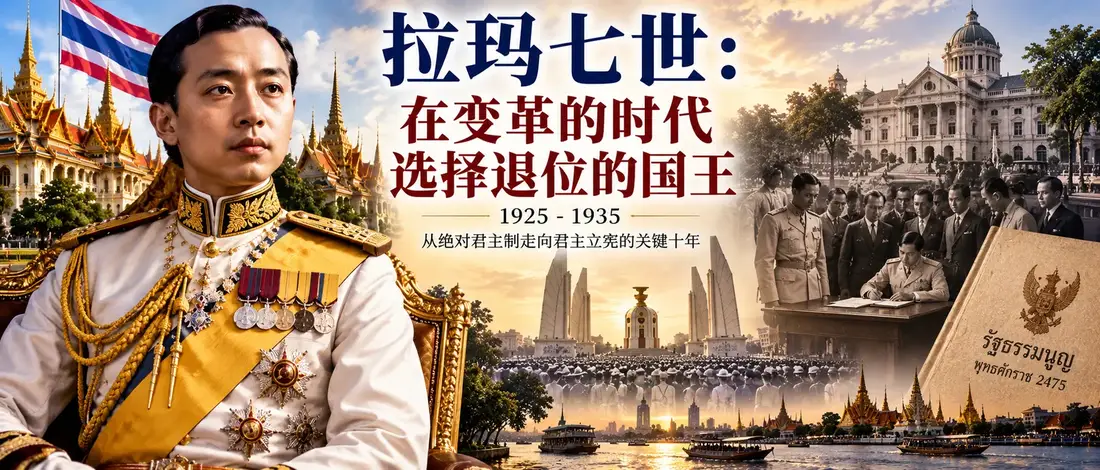
King Rama VII: The End of Absolute Monarchy and Siam’s Constitutional Turning Point
King Prajadhipok (Rama VII) | Reign: 1925–1935
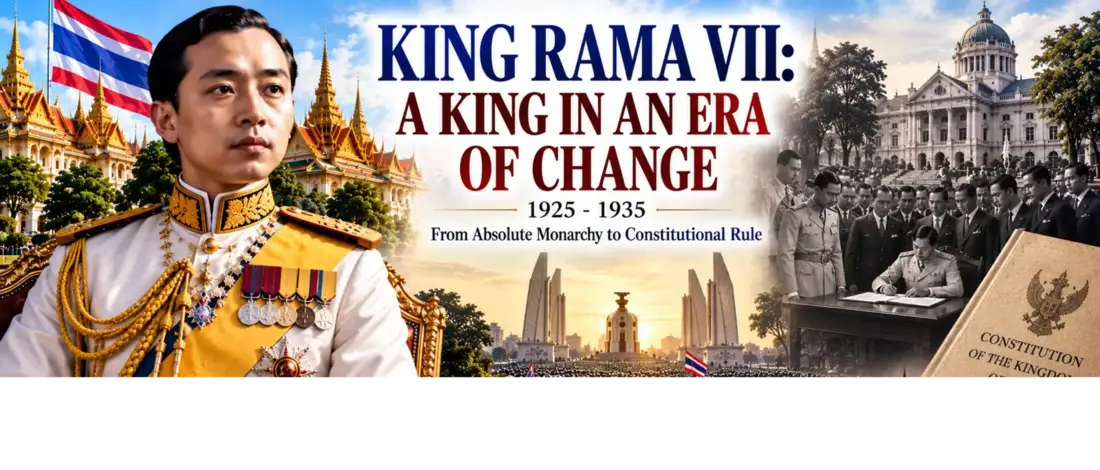
King Rama VII’s reign was relatively short, but it became one of the most decisive periods in modern Thai history.
When Prajadhipok ascended the throne in 1925, Siam was still an absolute monarchy. By the time he abdicated in 1935, the country had undergone a fundamental political transformation: absolute monarchy had ended, a constitution had been introduced, parliament had emerged, and the relationship between the monarchy, military, bureaucracy, and political elites had been permanently reshaped.
His reign coincided with the Great Depression, severe fiscal pressure, the rise of a new generation of Western-educated Siamese reformers, the Revolution of 1932, and the Boworadet Rebellion of 1933.
Rama VII therefore stands at the dividing line between two eras—the final king of Siam’s absolute monarchy and the first monarch to reign under its new constitutional order.
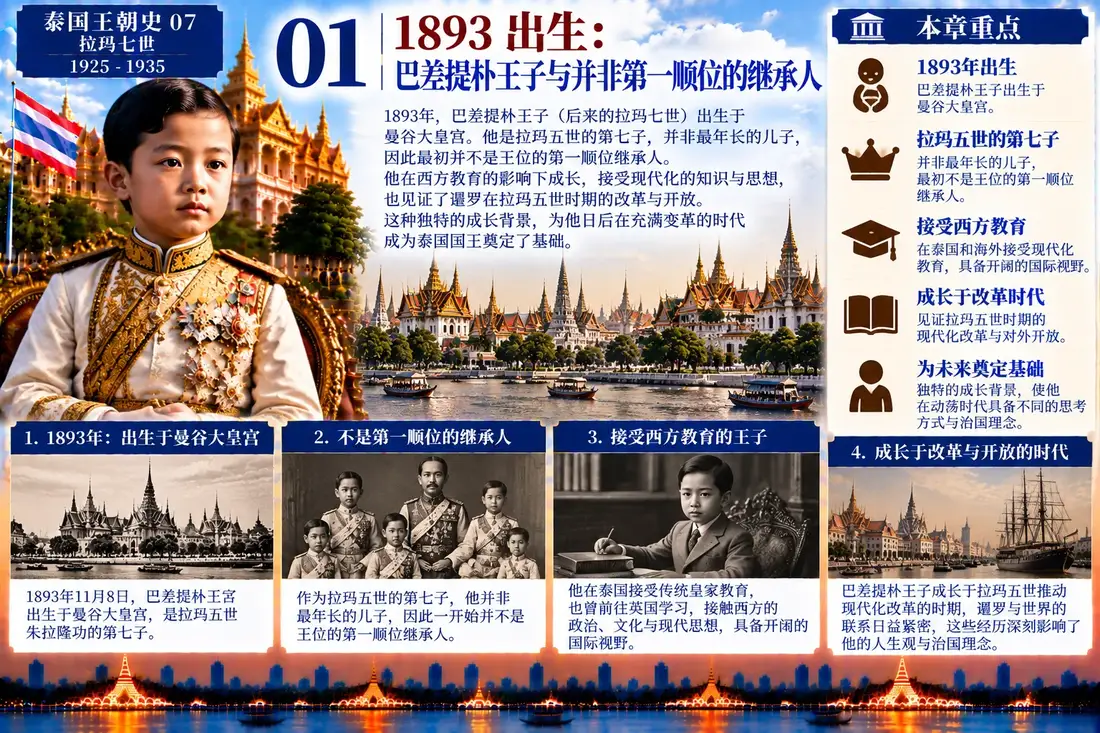
01 | Born in 1893: Prince Prajadhipok and an Unlikely Heir to the Throne
SEA NOW Thailand · Rama VII · Illustration 01
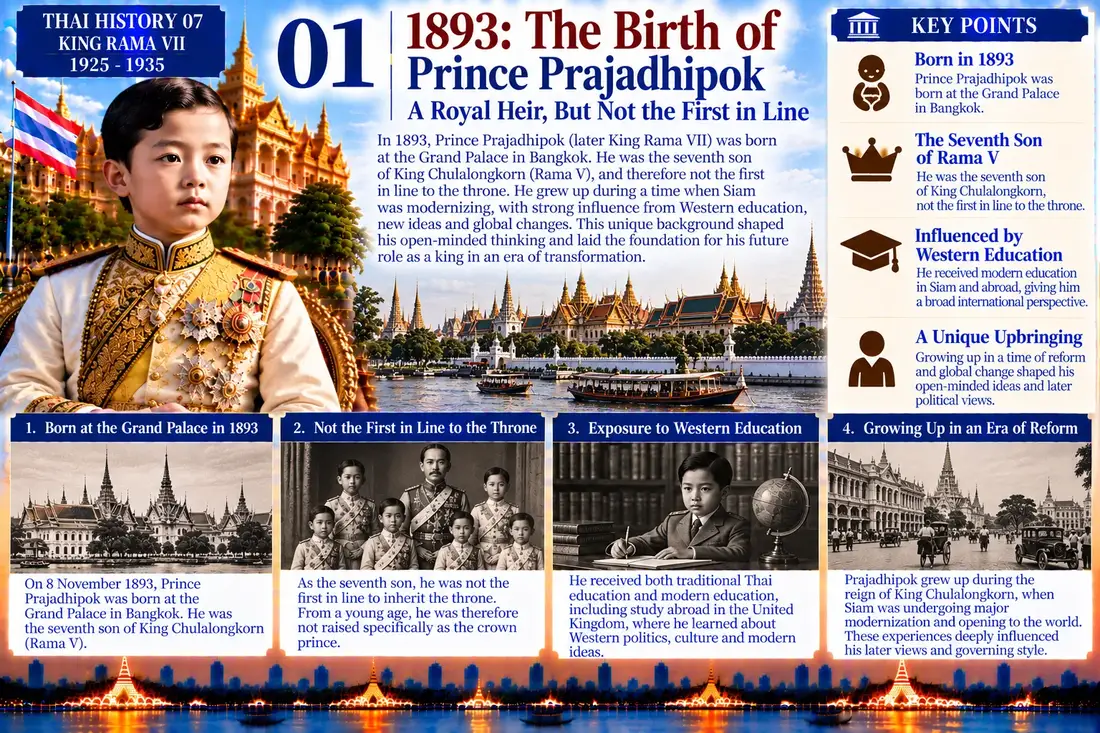
Prince Prajadhipok Sakdidej was born on November 8, 1893, during the reign of his father, King Chulalongkorn, Rama V.
He was the youngest son born to Queen Saovabha Phongsri and was not originally expected to become king. Several older princes stood ahead of him in the line of succession.
Like other members of the new generation of the Siamese royal family, Prajadhipok received an education that reflected the modernization program begun under Rama V.
He was sent to Britain, where he studied at Eton College and later received military training at the Royal Military Academy, Woolwich. He subsequently served in the British Army before returning to Siam.
This overseas experience exposed him to European institutions, military organization, administration, and constitutional politics.
Yet at this stage, there was little reason to believe that Prajadhipok would one day inherit the throne.
That changed as several senior princes died before him, gradually moving Prajadhipok closer to the succession.
His unexpected rise would eventually place him at the center of the greatest political transformation the Chakri monarchy had experienced since Bangkok became the capital in 1782.
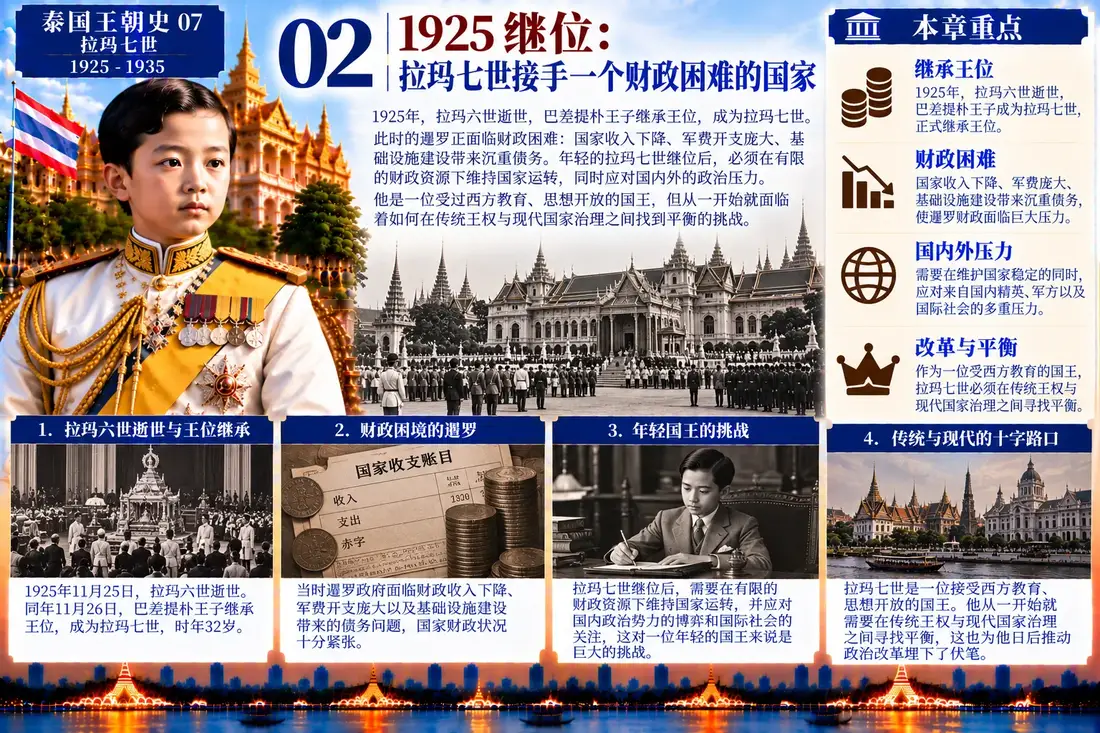
02 | 1925: Rama VII Inherits a Country in Financial Trouble
SEA NOW Thailand · Rama VII · Illustration 02
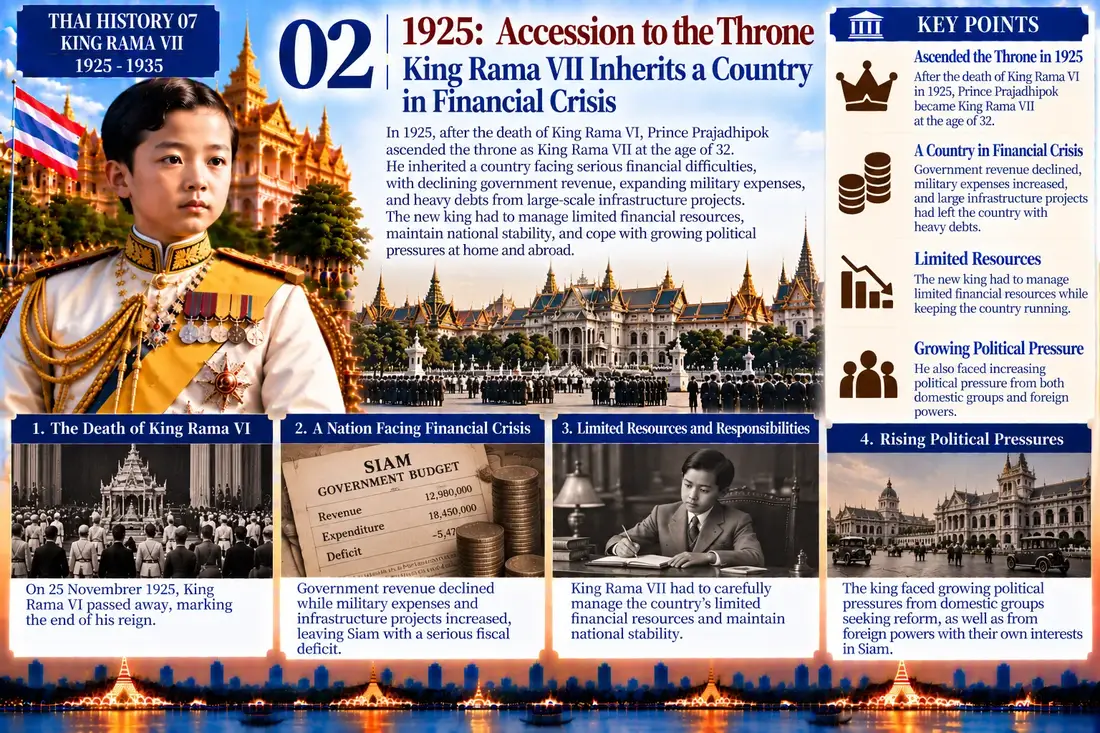
On November 26, 1925, King Vajiravudh, Rama VI, died.
Prajadhipok succeeded him as King Rama VII.
He inherited a monarchy that remained politically powerful but faced serious economic and administrative problems.
Government expenditure had expanded during the previous reign, while state revenue was under pressure. Rama VII therefore made financial stabilization one of his first priorities.
Government spending was reduced, administrative departments were reorganized, and efforts were made to balance the national budget.
These measures, however, had political consequences.
Cuts in government employment and expenditure affected officials, soldiers, and members of the bureaucracy. At the same time, a growing number of educated Siamese believed that modernization should no longer be limited to infrastructure and administration.
They increasingly asked a more fundamental question:
Should Siam’s political system also be modernized?
Rama VII himself recognized that political change would eventually be necessary and discussed constitutional reform with senior advisers.
But the monarchy and the political elite disagreed over how quickly such reforms should proceed.
That hesitation became increasingly important as economic and political pressures intensified.
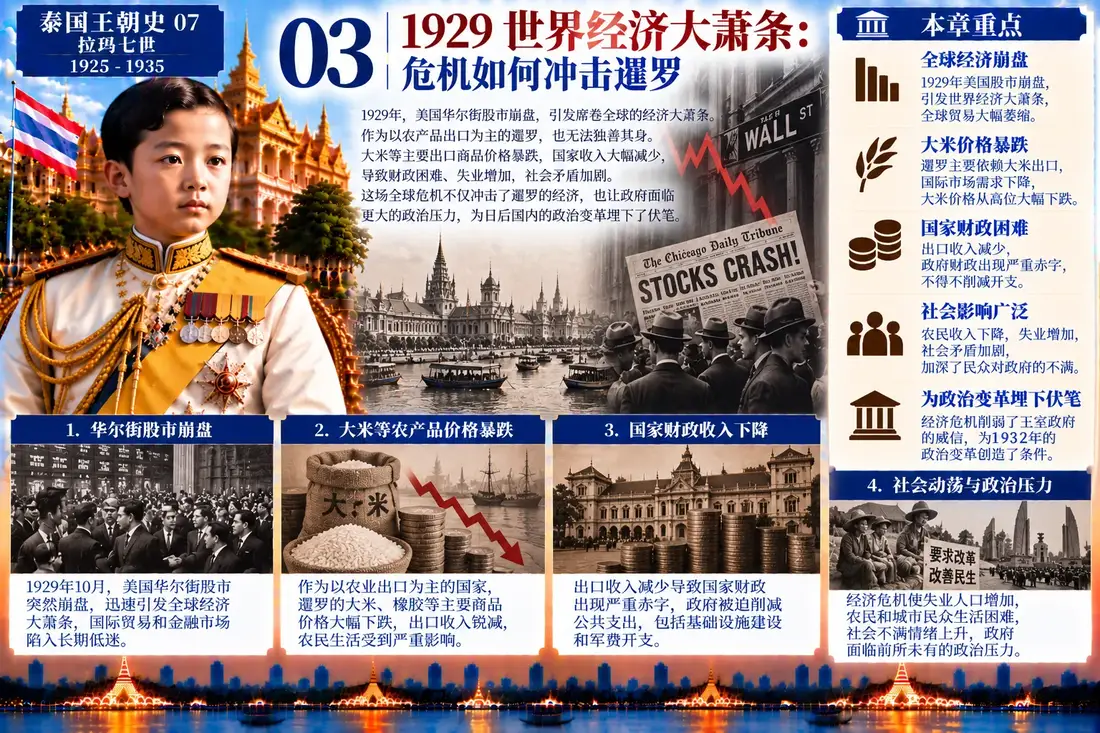
03 | The Great Depression: How the Global Crisis Hit Siam
SEA NOW Thailand · Rama VII · Illustration 03
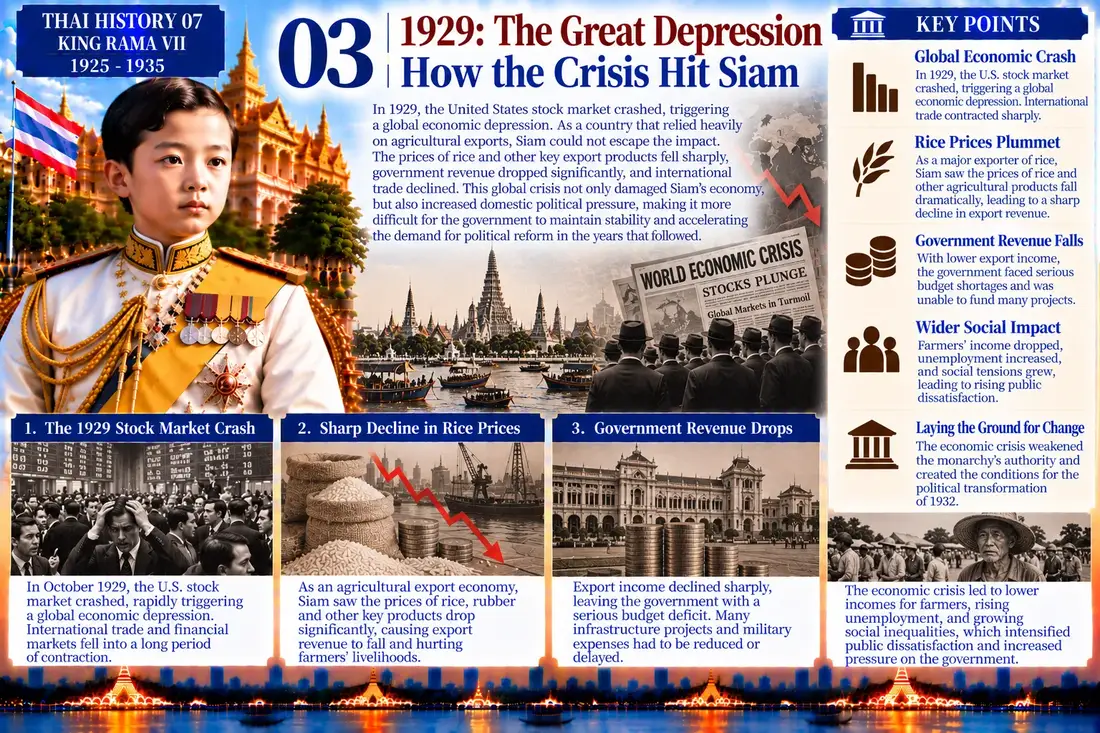
The Great Depression, which began in 1929, dramatically worsened Siam’s problems.
Siam’s economy depended heavily on agricultural exports, especially rice. When international commodity prices collapsed, the effects spread rapidly through the country.
Rice prices fell.
Export earnings declined.
Farm incomes suffered.
Government tax revenues weakened.
The monarchy responded with additional spending cuts and austerity measures in an attempt to preserve financial stability.
But economic hardship affected both rural and urban society.
Farmers earned less for their crops, while government officials faced salary reductions, job insecurity, and tighter budgets.
The crisis also exposed a deeper weakness in the existing political system.
A new generation of officials, military officers, students, and intellectuals increasingly believed that Siam needed not only economic reforms but also a new political structure capable of responding to modern challenges.
Economic crisis therefore became closely connected with demands for political change.
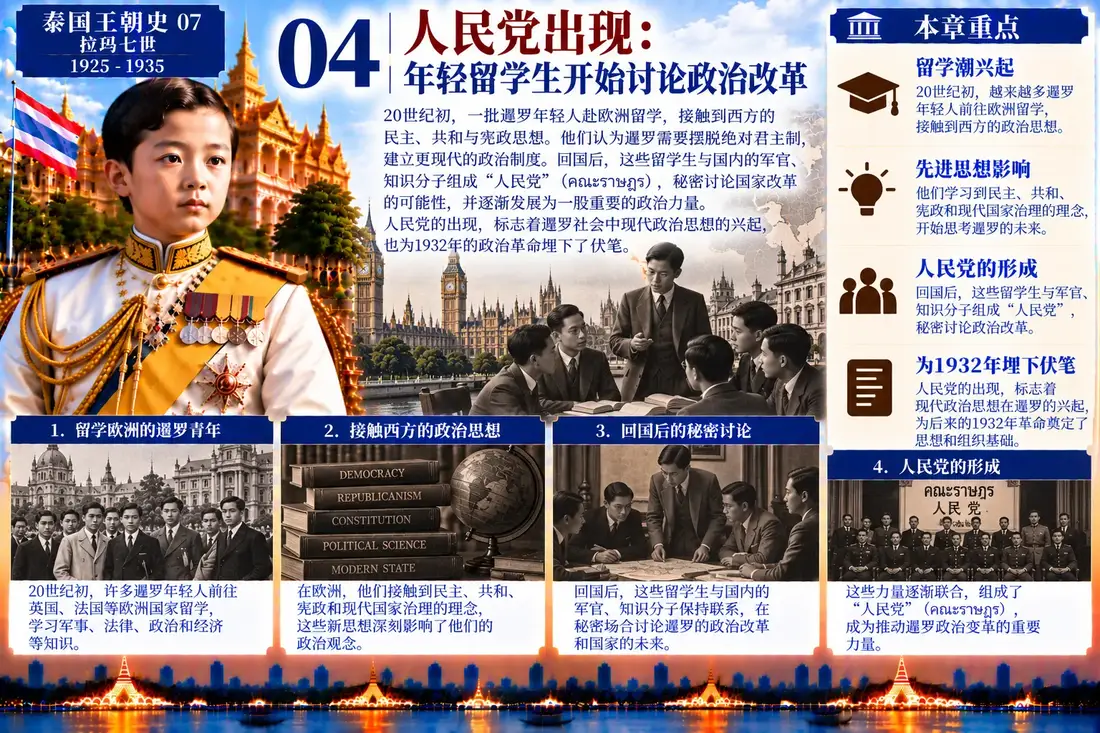
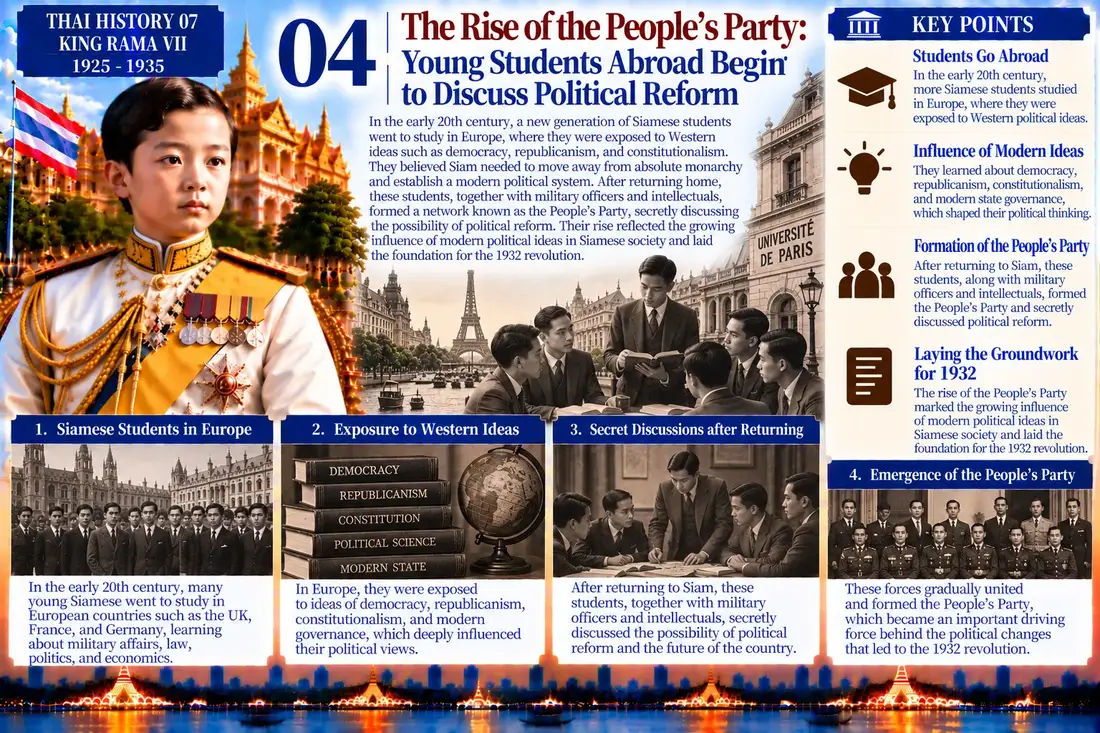
04 | The Rise of the People’s Party: Young Siamese Begin Discussing Political Reform
SEA NOW Thailand · Rama VII · Illustration 04
During the early twentieth century, increasing numbers of Siamese students traveled abroad to study in Europe.
There they encountered political ideas that differed sharply from Siam’s absolute monarchy.
They studied constitutional government, parliamentary systems, republicanism, modern law, economics, military organization, and nationalism.
In Paris in 1927, a small group of Siamese students and officers met and began discussing how their country could be transformed.
Their movement eventually became known as the People’s Party — Khana Ratsadon.
Among its important figures were Pridi Banomyong and Plaek Phibunsongkhram, alongside civilian and military allies.
The movement was not simply opposed to one particular king. Its objective was broader: to replace absolute monarchy with a constitutional political system.
As its network expanded inside Siam, the People’s Party gained supporters among both civilian officials and military officers.
By the beginning of the 1930s, the conditions for major political change were taking shape.
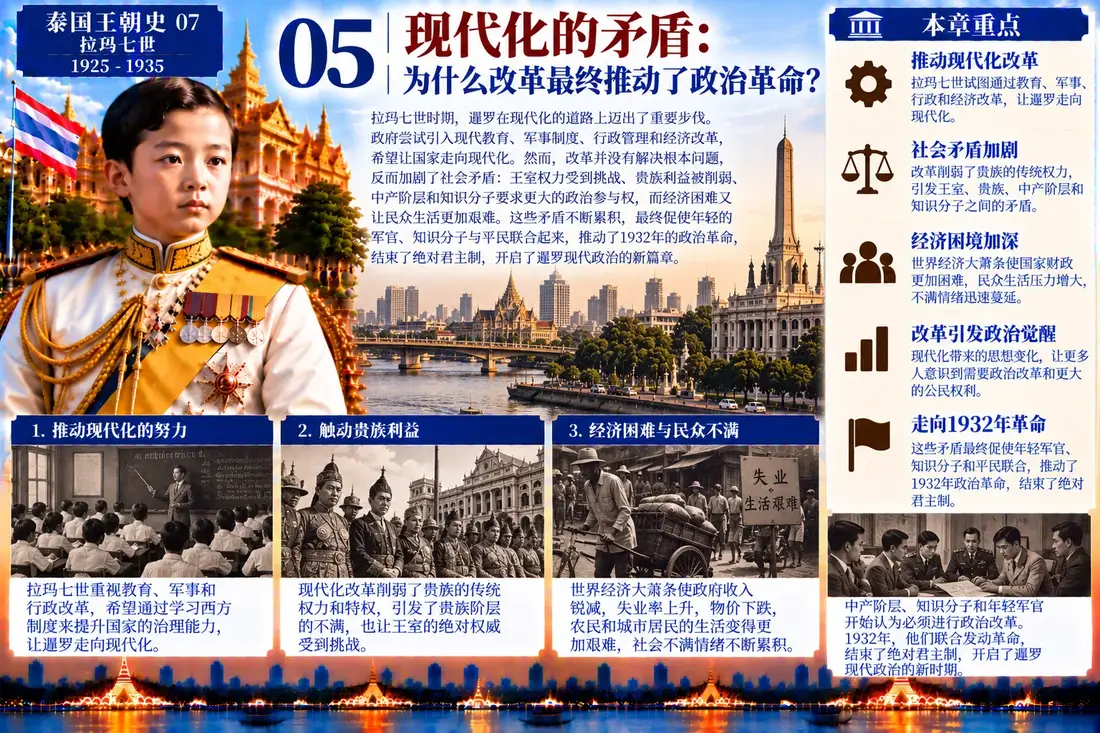
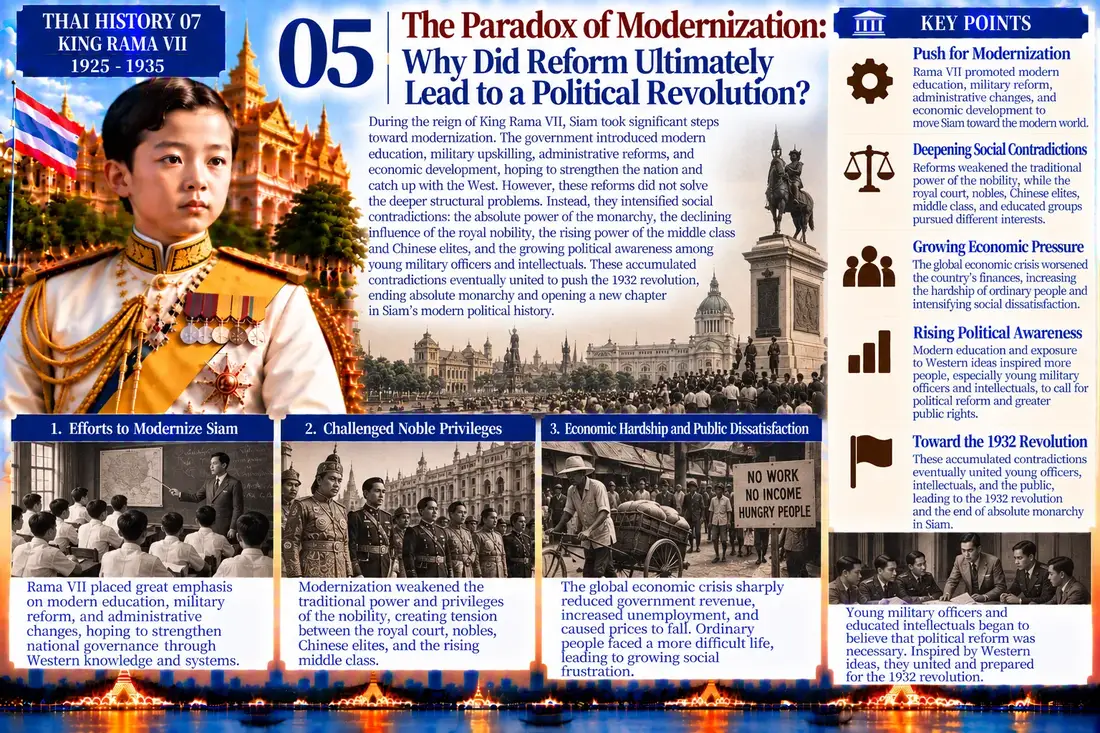
05 | The Paradox of Modernization: Why Reform Helped Produce Revolution
SEA NOW Thailand · Rama VII · Illustration 05
The political transformation of 1932 did not emerge from nowhere.
Ironically, many of the reforms introduced by Rama V, Rama VI, and Rama VII helped create the social groups that eventually challenged absolute monarchy.
Modern schools produced educated officials.
Military academies created professional officers.
Overseas scholarships exposed Siamese students to European political ideas.
A modern bureaucracy created a new class of civil servants.
Improved transportation and communications connected different parts of the kingdom more closely to Bangkok.
These reforms strengthened the Siamese state—but they also created people who expected a greater role in governing it.
At the same time, political authority remained concentrated around the monarchy and senior aristocratic circles.
The contradiction became increasingly obvious:
Siam was becoming a modern state, but its political system remained based on absolute monarchy.
The Great Depression intensified these tensions.
For younger officers and intellectuals, political reform increasingly appeared necessary rather than optional.
By 1932, modernization itself had helped create the forces capable of demanding a new political order.
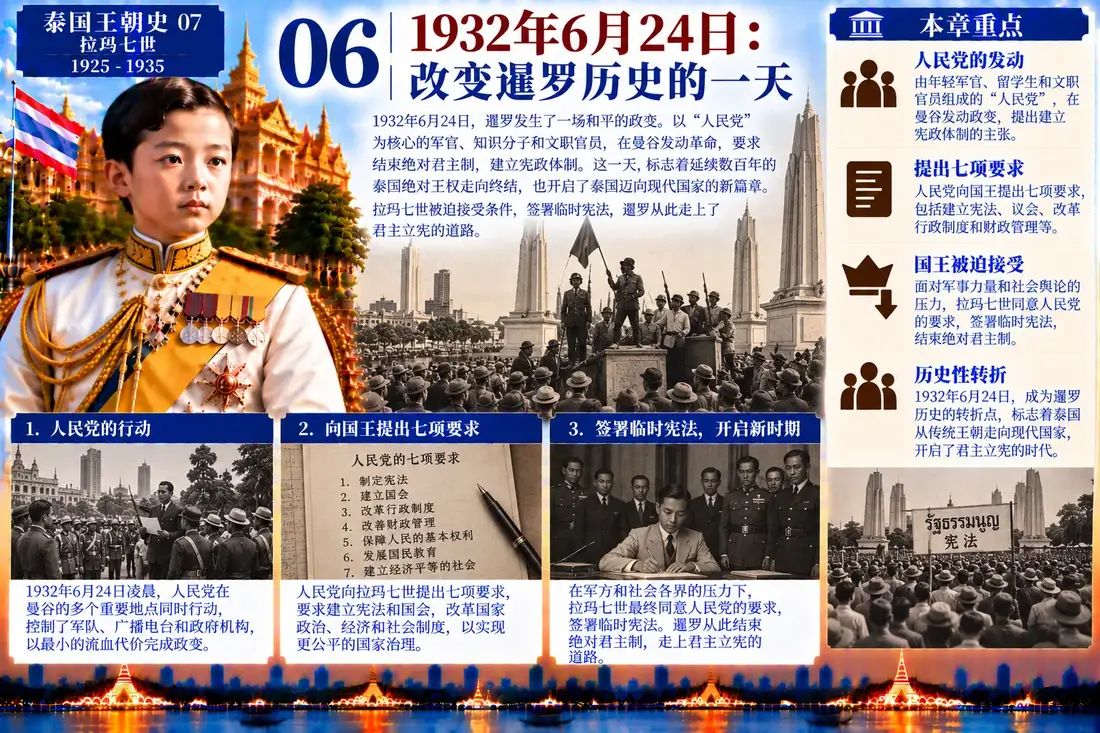
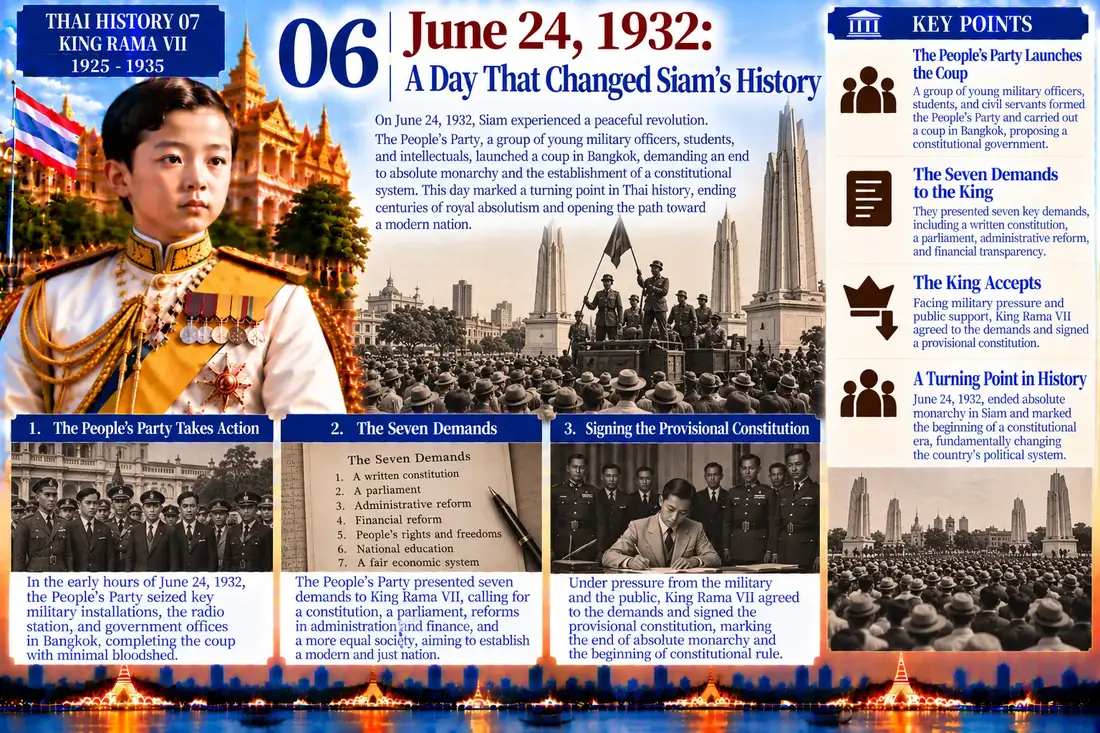
06 | June 24, 1932: The Day That Changed Siamese History
SEA NOW Thailand · Rama VII · Illustration 06
Before dawn on June 24, 1932, the People’s Party launched a carefully coordinated political takeover in Bangkok.
Military and civilian members occupied strategic locations, secured key officials, and announced that absolute monarchy would be replaced by constitutional government.
The operation involved relatively little bloodshed.
King Rama VII was outside Bangkok at Klai Kangwon Palace in Hua Hin when the revolution began.
He now faced an extraordinary decision.
He could attempt to mobilize loyal forces and resist the revolution—or accept the political transformation.
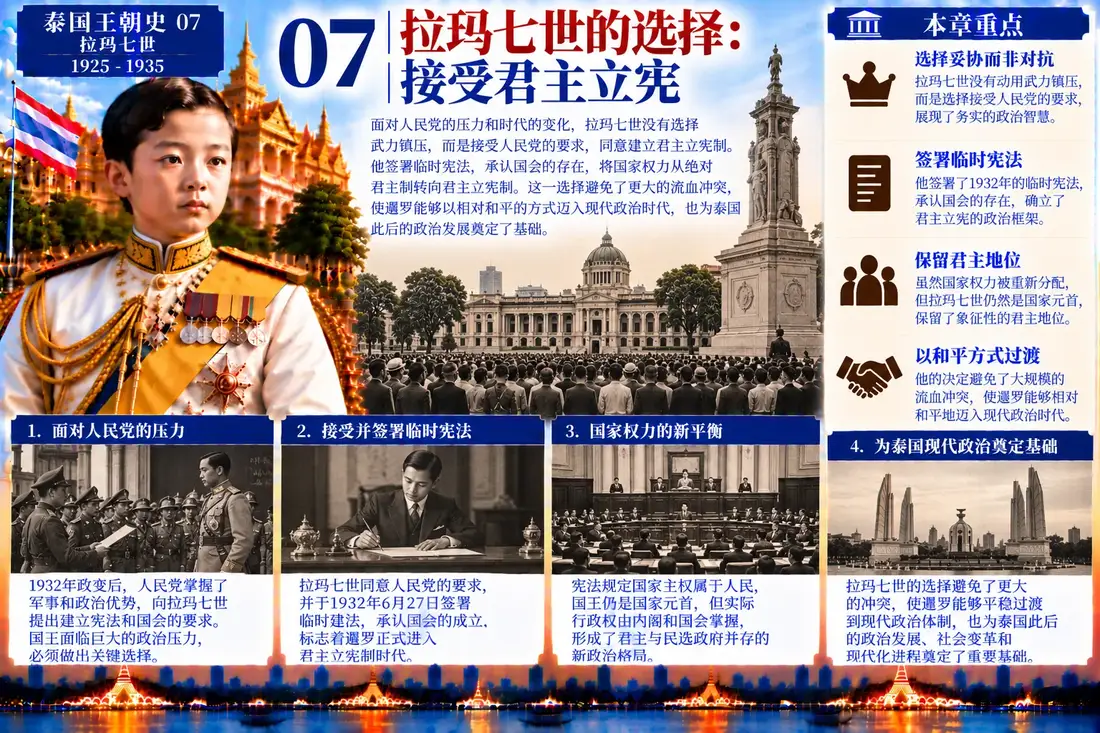
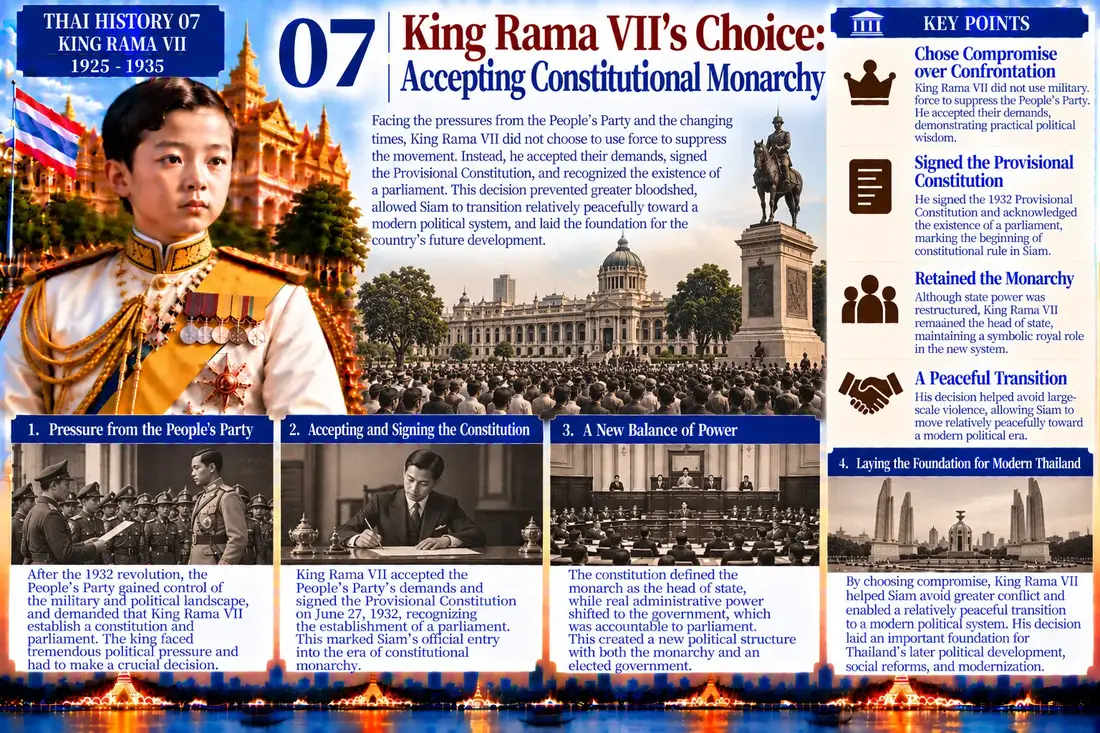
Rama VII chose not to plunge the country into a civil conflict.
He accepted the new political reality.
On June 27, 1932, he signed Siam’s provisional constitution.
Later that year, on December 10, 1932, a permanent constitution was promulgated.
The consequences were enormous.
After roughly a century and a half of Chakri rule under an absolute monarchy, sovereign political authority was now formally reorganized under a constitutional system.
June 24, 1932 became one of the most important turning points in Thai history.
Rama VII’s response to the revolution was crucial.
The king possessed supporters within the royal family, bureaucracy, and military, and armed resistance could potentially have produced a much bloodier confrontation.
Instead, he accepted constitutional government.
The monarchy was not abolished.
Rama VII remained king and head of state, but the nature of royal authority fundamentally changed.
Government would increasingly operate through constitutional institutions, ministers, and a legislature rather than through the king’s absolute authority.
For the first time, Siam had entered the era of constitutional monarchy.
Rama VII hoped that the new political system would eventually provide meaningful constitutional government and a balance between royal authority, parliament, and the public.
But agreement over the end of absolute monarchy did not mean agreement over how the new system should function.
Almost immediately, new conflicts emerged.
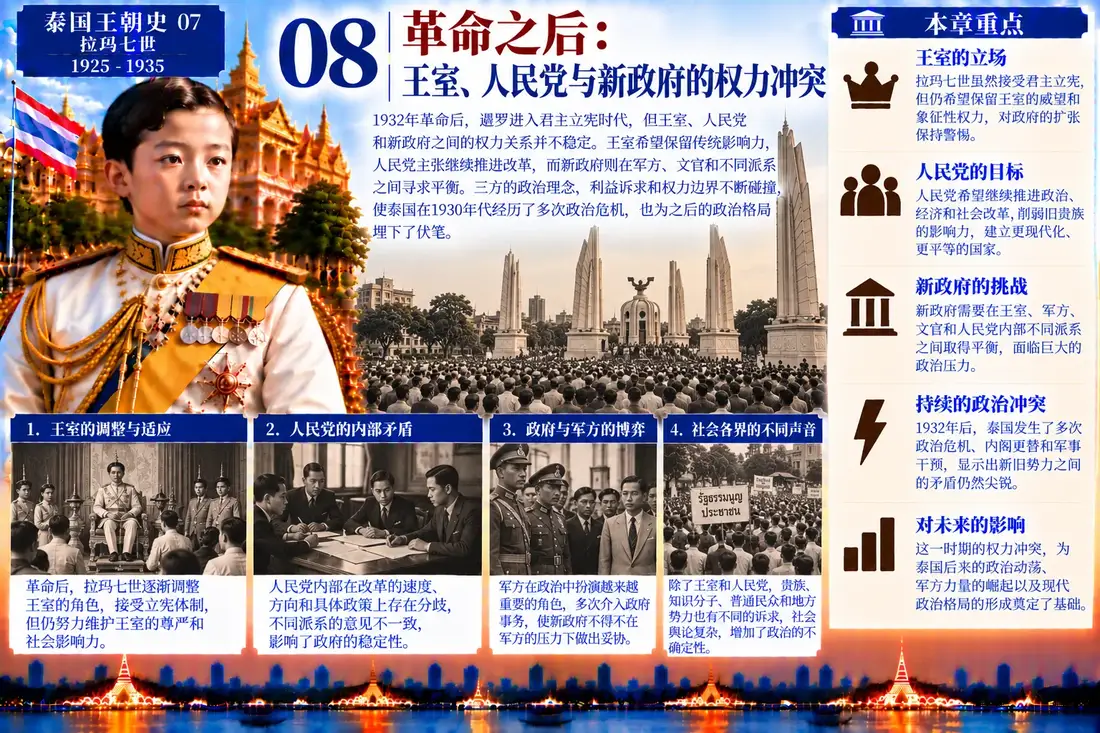
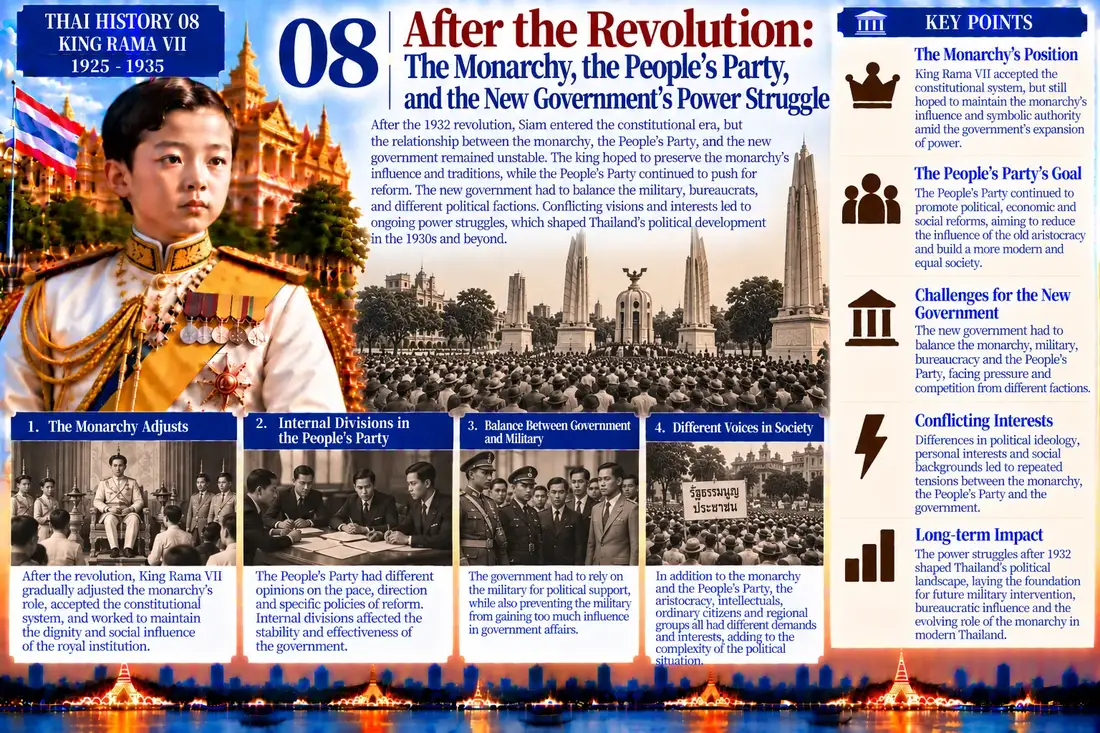
08 | After the Revolution: The Monarchy, People’s Party and New Government Struggle for Power
SEA NOW Thailand · Rama VII · Illustration 08
The Revolution of 1932 solved one question—whether absolute monarchy would continue—but created many others.
How powerful should the king remain?
How much authority should parliament possess?
What role should the military play?
How quickly should political and economic reforms proceed?
And who would ultimately control the new state?
The People’s Party itself contained different factions, including civilian reformers and military officers.
The monarchy remained an important institution with significant prestige and supporters.
Meanwhile, conservative aristocrats and officials feared that political change was moving too quickly.
Disagreements became particularly intense over economic policy and the distribution of political authority.
The result was not immediate democratic stability.
Instead, Siam entered a prolonged period of competition among the monarchy, military, bureaucracy, civilian politicians, and competing factions within the People’s Party.
This struggle would become one of the defining characteristics of modern Thai politics.
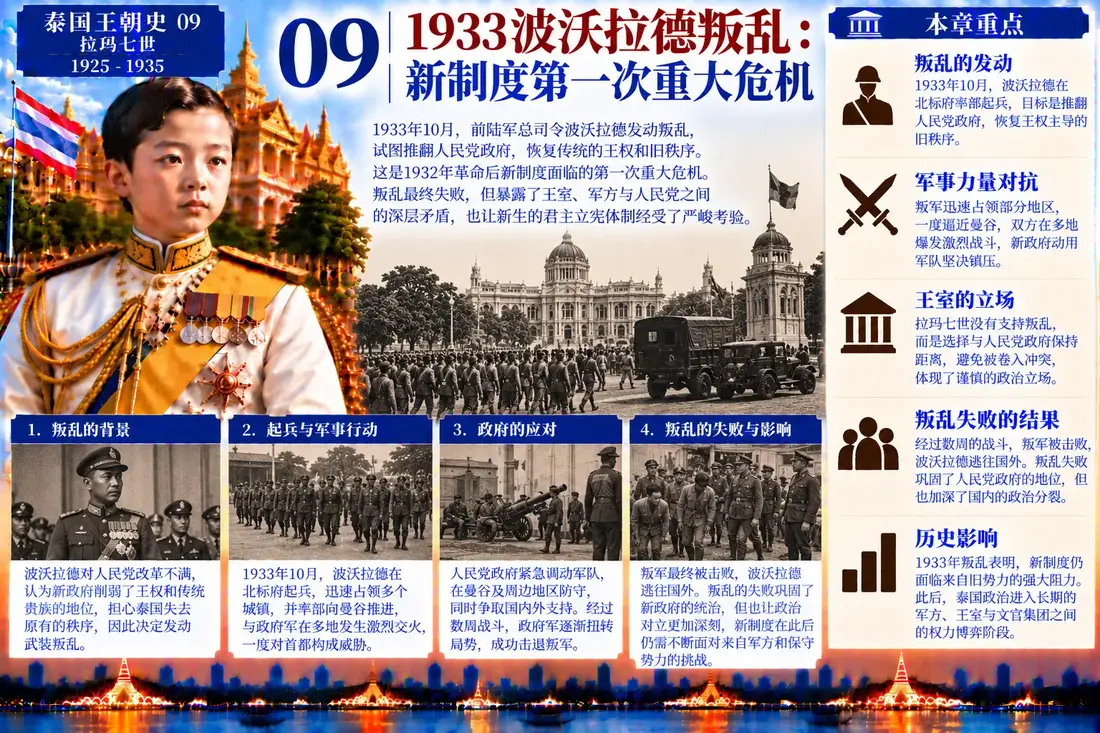
09 | The 1933 Boworadet Rebellion: The New System’s First Major Crisis
SEA NOW Thailand · Rama VII · Illustration 09
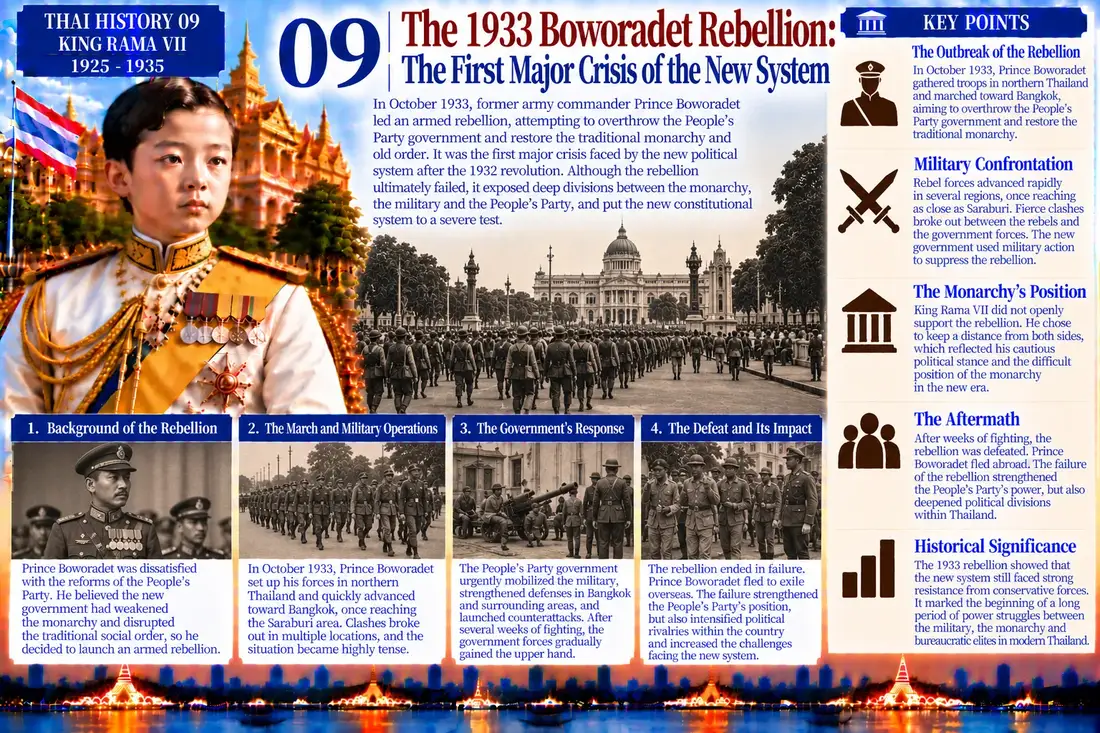
In October 1933, Siam’s fragile new political order faced its first major armed challenge.
Prince Boworadet, a former senior military figure and member of the royal family, led rebel forces against the government.
The rebels accused the People’s Party government of moving in a dangerous political direction and demanded changes in the new system.
Forces associated with the rebellion advanced toward Bangkok, and fighting broke out between rebel and government troops.
The government mobilized military forces and successfully defeated the uprising.
Prince Boworadet eventually fled abroad.
Rama VII did not openly join the rebellion, but the crisis deepened mistrust between the government and conservative and royalist forces.
The rebellion had important long-term consequences.
It strengthened the position of the People’s Party and increased the political importance of the military.
At the same time, relations between Rama VII and the new political leadership continued to deteriorate.
The constitutional system had survived its first major armed crisis—but the conflict over what constitutional government actually meant remained unresolved.
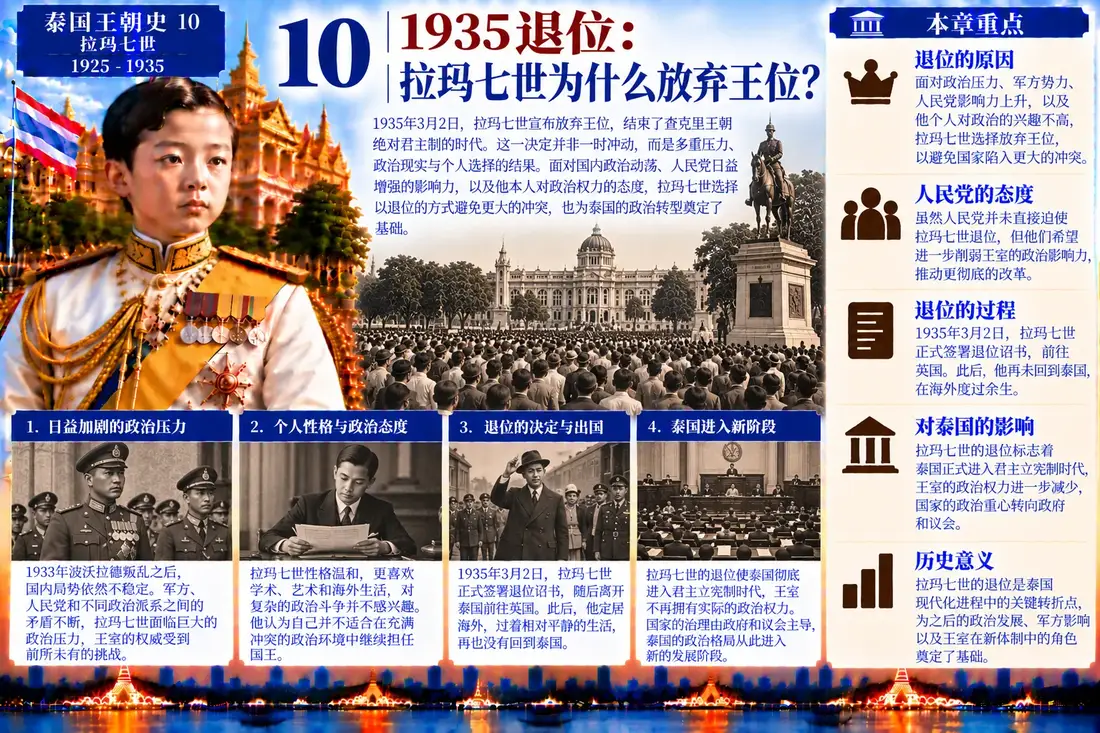
10 | 1935 Abdication: Why Did Rama VII Give Up the Throne?
SEA NOW Thailand · Rama VII · Illustration 10
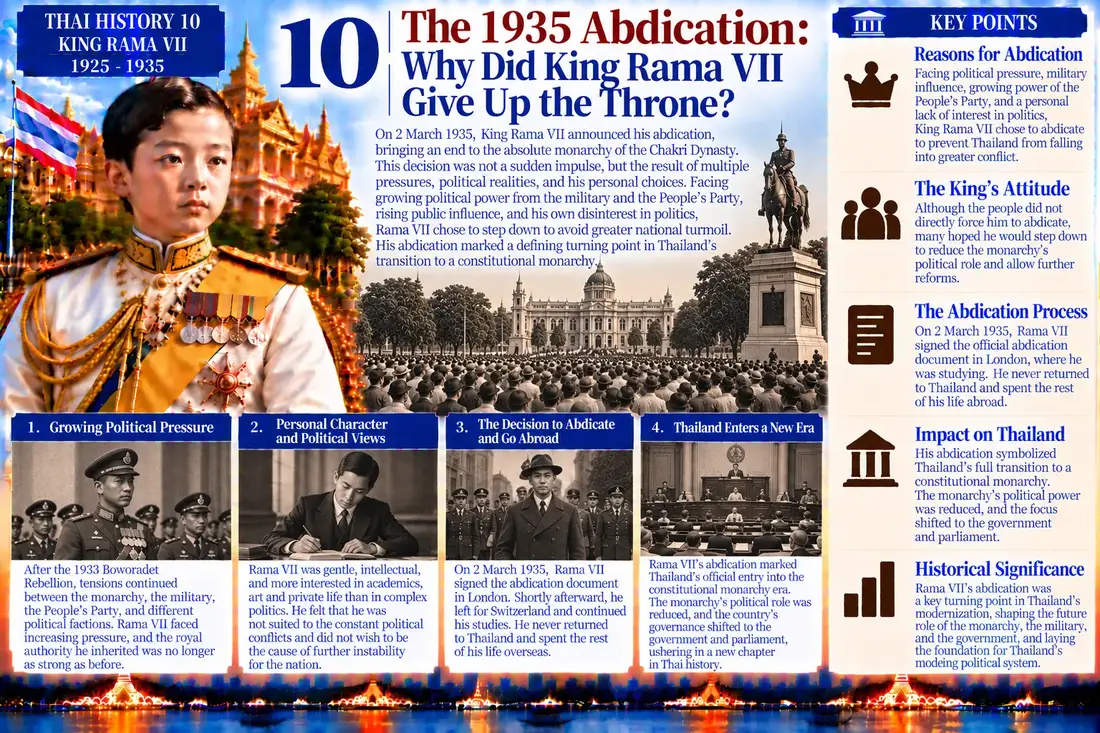
By 1934, disagreements between Rama VII and the government had become increasingly difficult to resolve.
The king believed that constitutional government should contain meaningful checks on political power and expressed concerns about how authority was being exercised under the new system.
While receiving medical treatment in Britain, he continued negotiations with the Siamese government.
No satisfactory compromise emerged.
Finally, on March 2, 1935, Rama VII abdicated.
His abdication statement became one of the most famous political documents in modern Thai history. In it, he emphasized that he was willing to surrender his former absolute powers to the people as a whole, but did not wish those powers to be concentrated in the hands of any particular individual or group.
Rama VII did not return to the throne.
He remained in Britain and died there in 1941.
Because he had no children, the throne passed to his young nephew, Ananda Mahidol, who became King Rama VIII.
Rama VII’s abdication therefore closed an extraordinary chapter in Thai history.
The king who had inherited an absolute monarchy in 1925 left behind a country whose political system had been permanently transformed.
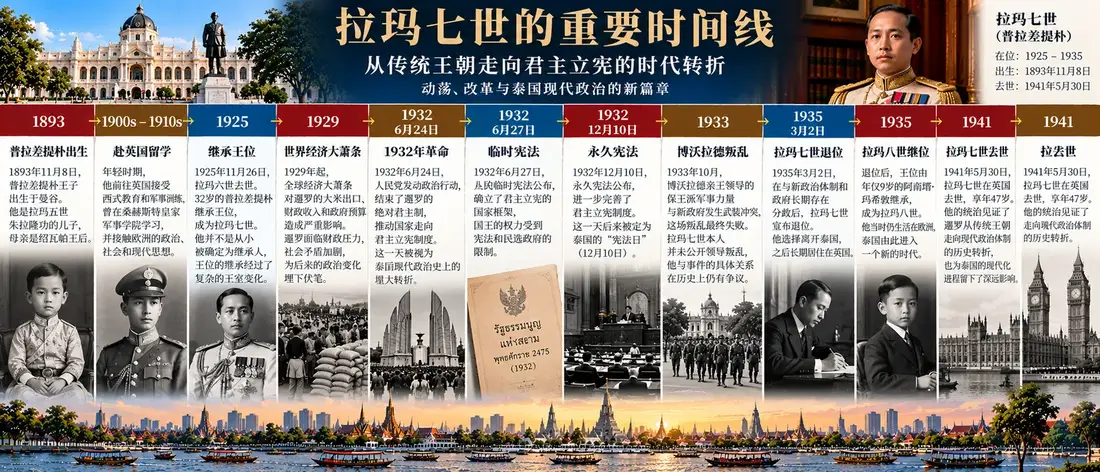
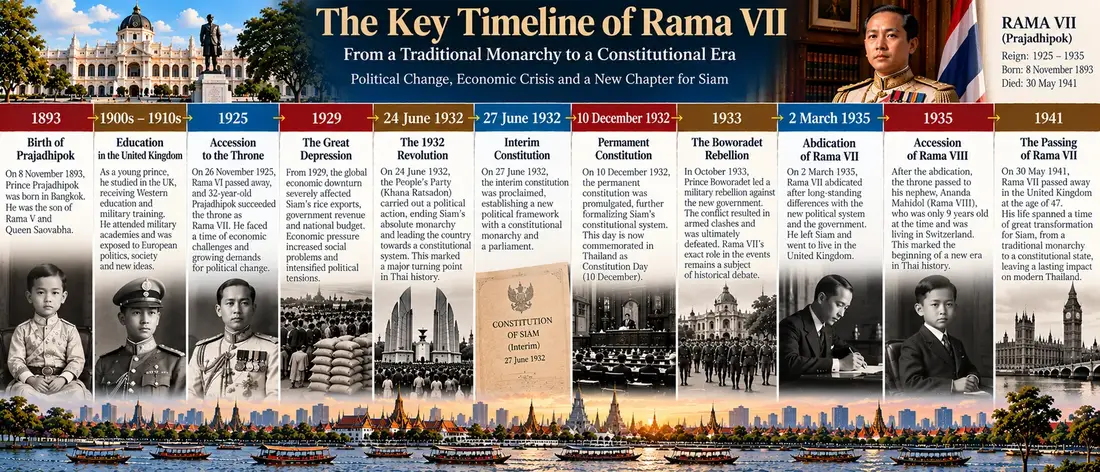
1893 — Birth of Prince Prajadhipok Prince Prajadhipok was born into the royal family during the reign of Rama V. As one of the younger royal sons, he was never originally expected to become king.
1925 — Rama VII Ascends the Throne Following the death of Rama VI, Prajadhipok became King Rama VII and inherited a country facing serious fiscal and administrative challenges.
1929 — The Great Depression The worldwide economic crisis caused agricultural prices and export earnings to fall, placing enormous pressure on Siam’s government, farmers, officials, and wider economy.
1932 — The Siamese Revolution On June 24, the People’s Party carried out a political takeover that ended absolute monarchy. Rama VII accepted constitutional government, and Siam entered a new political era.
1935 — Rama VII Abdicates After continuing disputes with the new government over political authority and constitutional principles, Rama VII abdicated on March 2, 1935.
Conclusion: The King Between Two Eras
Rama VII did not build an empire, lead Siam through a major foreign war, or reign for decades.
His historical importance comes from something different.
He ruled at the precise moment when the political system created and strengthened by generations of Chakri kings could no longer remain unchanged.
The modernization begun under Rama IV and accelerated dramatically under Rama V had transformed Siam’s administration, military, education, infrastructure, economy, and relationship with the outside world. But modernization also produced new social groups, new expectations, and new political ideas.
The Great Depression accelerated those pressures.
The Revolution of 1932 finally ended absolute monarchy.
Rama VII’s decision to accept the constitutional transformation rather than immediately launch an armed struggle helped Siam pass through the initial revolution with comparatively limited bloodshed. Yet the years that followed demonstrated that writing a constitution was only the beginning.
The deeper question—who should hold political power in modern Thailand?—would continue to shape the country for generations.
That is why Rama VII occupies such a distinctive place in Thai history:
He was the last king of Siam to rule under absolute monarchy—and the first to remain on the throne after constitutional monarchy began.