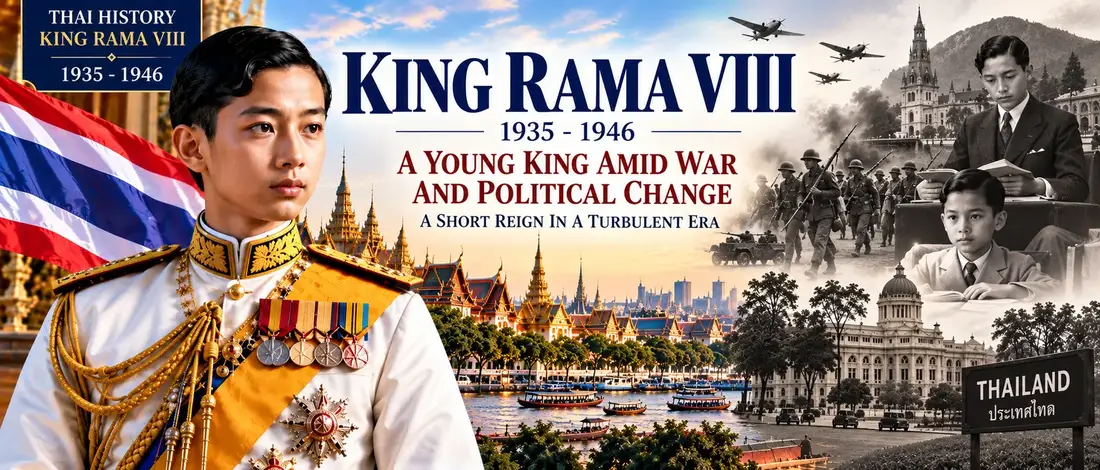
King Rama VIII: War, the Free Thai Movement, and the Sudden Death of a Young King
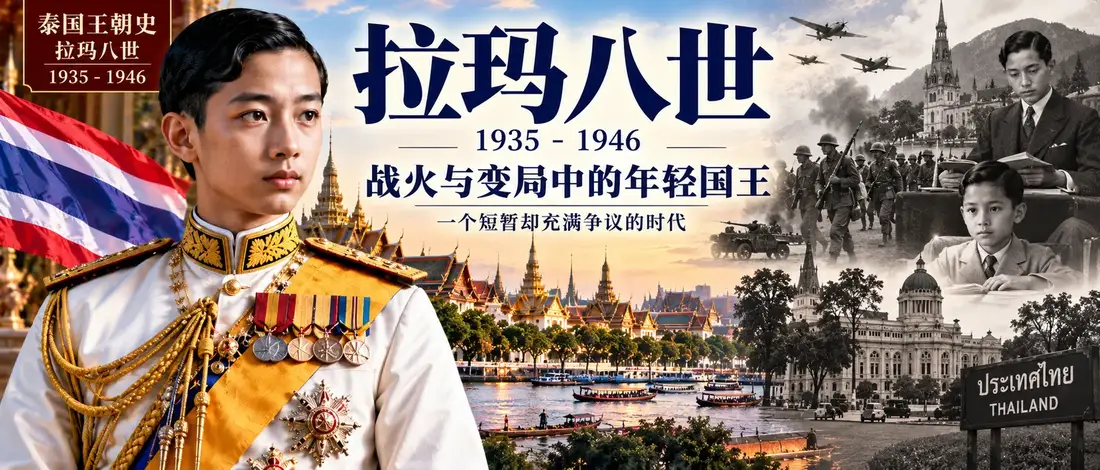
King Rama VIII | Ananda Mahidol Reign: 1935–1946 Eighth King of the Chakri Dynasty
If the reign of Rama VII witnessed Siam’s transition from absolute monarchy to constitutional monarchy, the reign of Rama VIII unfolded in an even more turbulent world.
He ascended the throne at only nine years old and spent much of his youth in Switzerland.
During his reign, Siam officially changed its name to Thailand, World War II swept across Southeast Asia, Japanese forces entered the country, the Free Thai Movement secretly cooperated with the Allies, and after the war Thailand had to redefine its place in the international order.
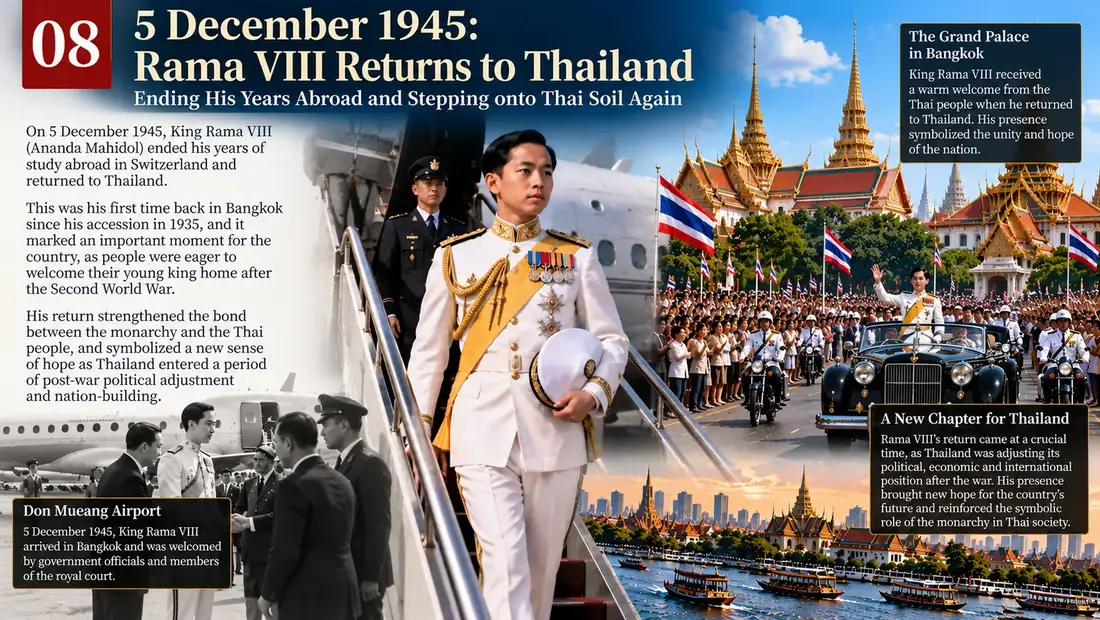
In late 1945, the young king returned to Bangkok.
For many, it appeared that a new chapter in his reign was finally about to begin.
But only months later—
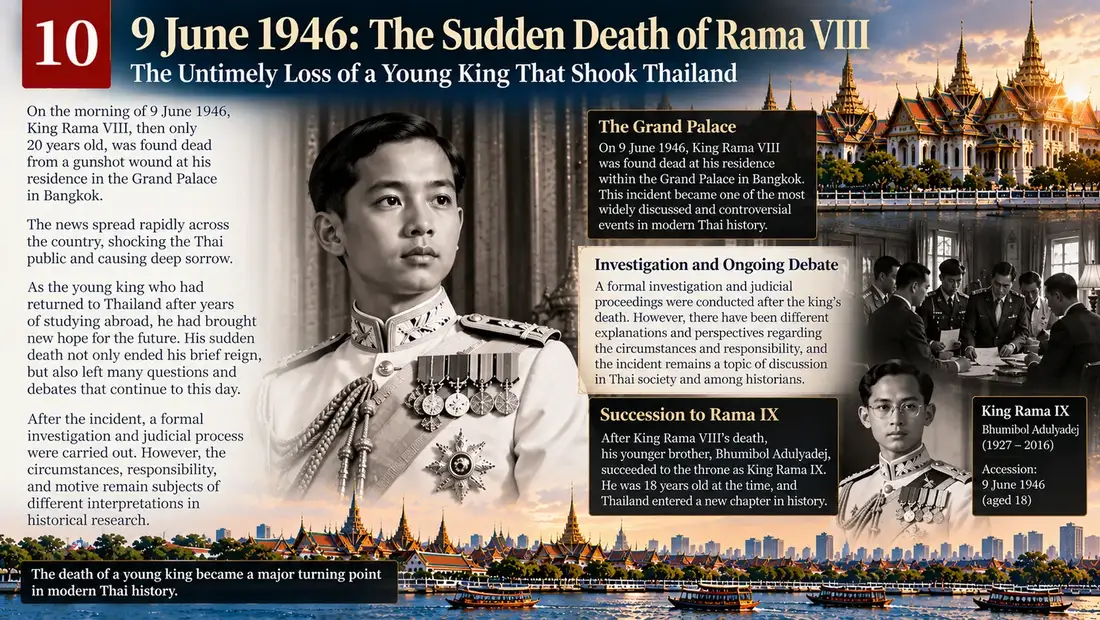
On June 9, 1946, the 20-year-old King Rama VIII was found dead from a gunshot wound inside Bangkok’s Grand Palace.
His sudden death became one of the most famous and controversial episodes in modern Thai history.
Rama VIII lived a remarkably short life.
Yet his reign coincided with one of the most dramatic periods in Thailand’s transformation from old Siam into a modern nation-state.
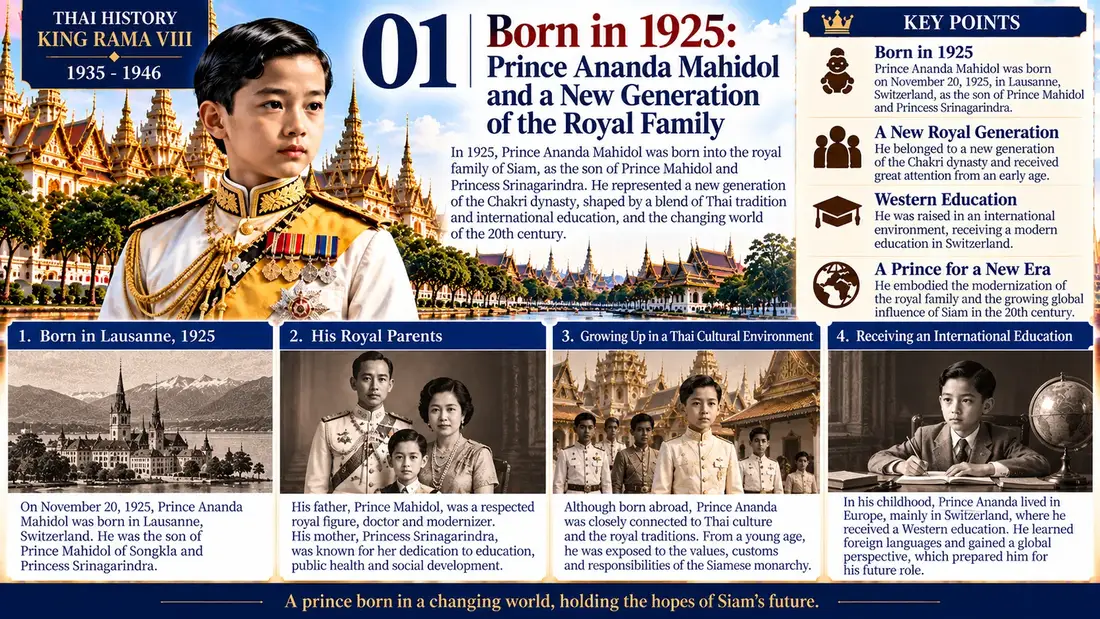
01 | Born in 1925: Prince Ananda Mahidol and a New Generation of the Royal Family
SEA NOW Thailand · Rama VIII · Illustration 01
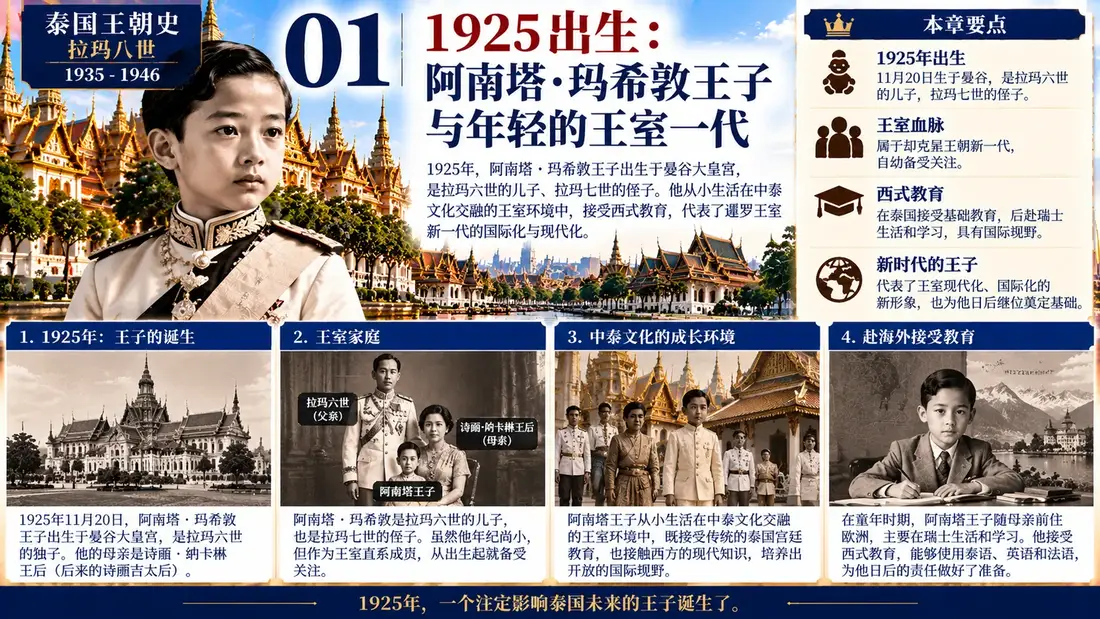
Prince Ananda Mahidol was born on September 20, 1925, in Heidelberg, Germany.
His father was Prince Mahidol Adulyadej, a son of King Chulalongkorn, Rama V. His mother was Princess Srinagarindra, who would later become one of the most respected members of the Thai royal family.
This made Ananda Mahidol a grandson of Rama V.
At the time of his birth, however, few could have imagined that he would one day become king.
His father, Prince Mahidol, had studied extensively abroad and became closely associated with the development of modern medicine, public health, and medical education in Siam.
In 1929, Prince Mahidol died.
Ananda was only four years old.
His mother then took primary responsibility for raising her three children: Princess Galyani Vadhana, Prince Ananda Mahidol, and his younger brother Prince Bhumibol Adulyadej.
All three would later occupy important places in modern Thai royal history.
Ananda’s childhood was therefore quite different from that of princes raised entirely within the traditional royal court.
From an early age, his life was connected with international education, European society, and the rapidly changing world of the twentieth century.
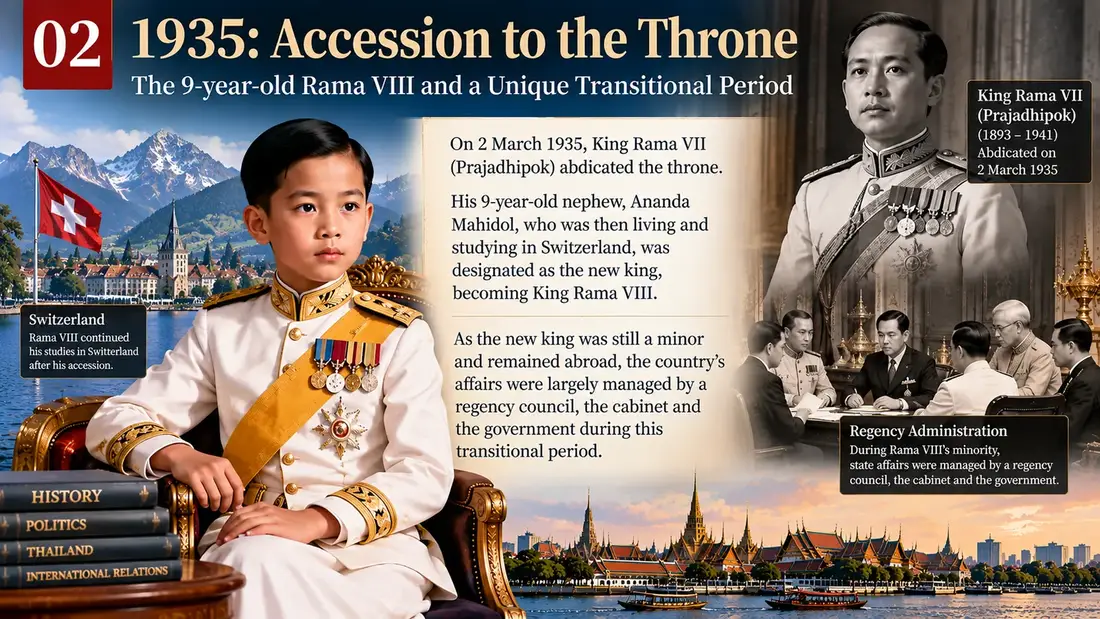
02 | 1935: The Nine-Year-Old Rama VIII Ascends the Throne
SEA NOW Thailand · Rama VIII · Illustration 02
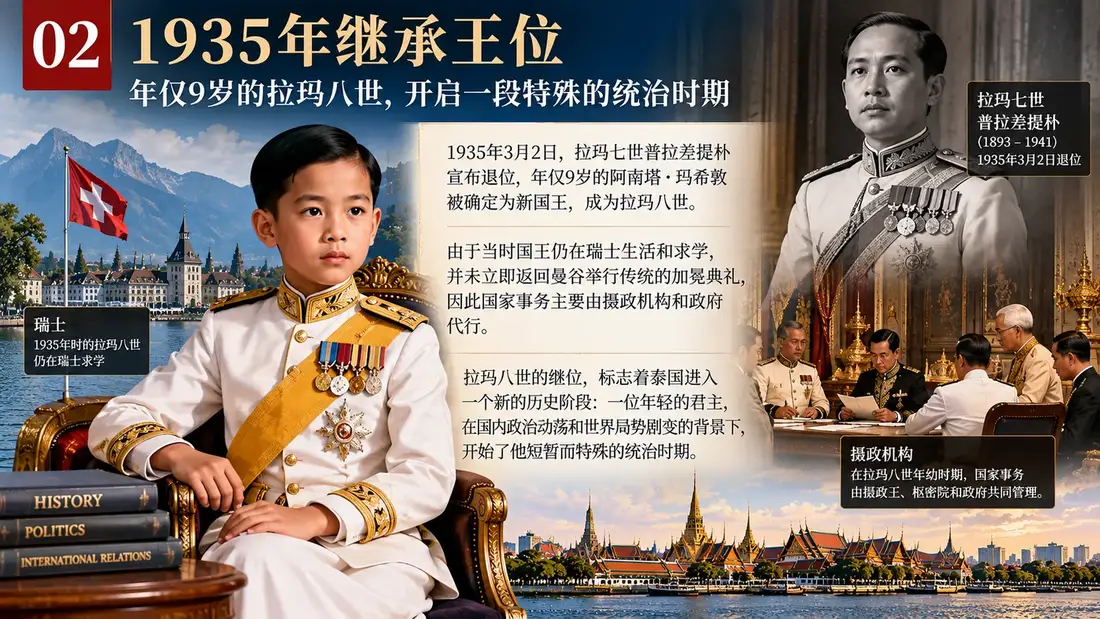
On March 2, 1935, King Prajadhipok, Rama VII, abdicated while living in Britain.
Rama VII had no children.
The succession therefore passed to another branch of the Chakri royal family.
The nine-year-old Prince Ananda Mahidol was selected as the new king.
He became:
King Rama VIII.
The timing was extraordinary.
Less than three years had passed since the Revolution of 1932.
Siam was no longer an absolute monarchy.
The king’s political authority was now defined by a constitution, while the government, legislature, military, bureaucracy, and emerging political groups competed for influence.
There was another unusual factor:
The new king was only nine years old and was still living in Switzerland.
Rama VIII therefore did not immediately return to Siam to personally carry out all royal duties.
A Council of Regency acted on behalf of the young monarch.
Thailand thus entered an unusual period in its history:
The king lived in Europe while his kingdom underwent enormous political change in Asia.
Rama VIII remained the symbolic head of state, but everyday political power increasingly rested with the constitutional government and the country’s competing political forces.
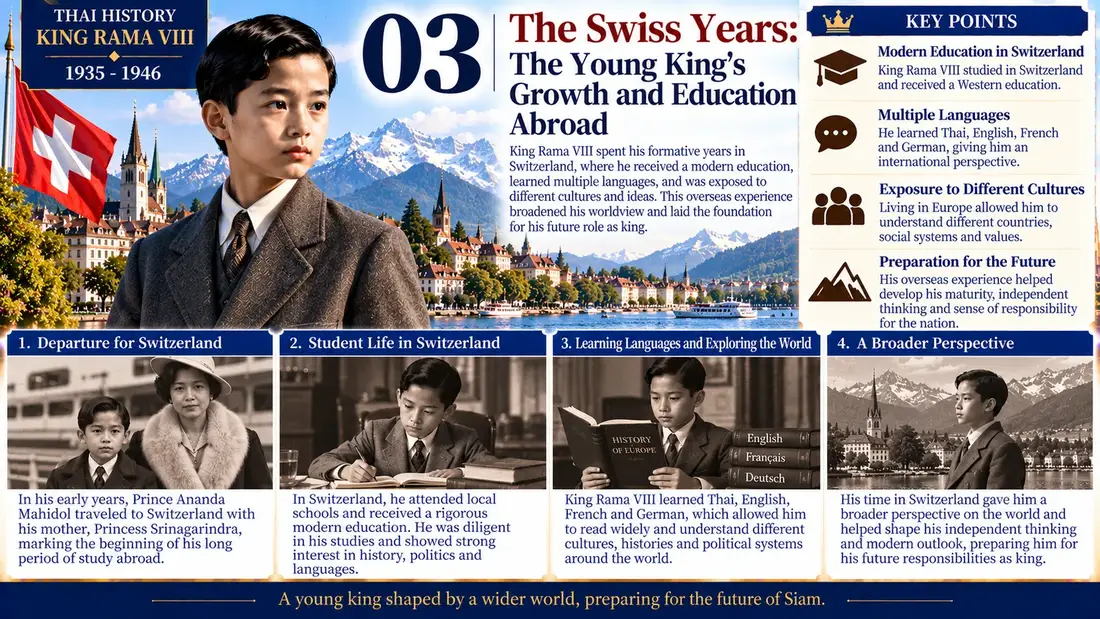
03 | The Swiss Years: The Young King’s Education Abroad
SEA NOW Thailand · Rama VIII · Illustration 03
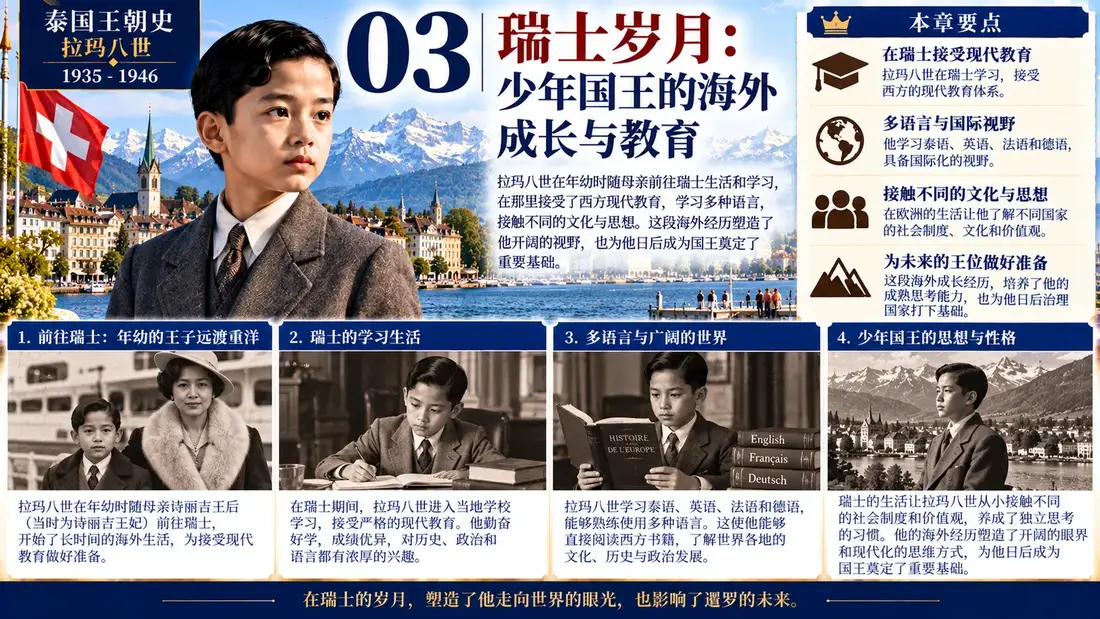
Although he had become king, Rama VIII continued living and studying in Switzerland.
His upbringing was very different from that of many earlier Siamese monarchs.
He received a modern European education and grew up surrounded by languages, science, history, and contemporary European society.
In 1938, Rama VIII returned to Siam for a visit.
It was his first return to the country after becoming king.
But he later went back to Switzerland to continue his education.
As a result, for most of his reign Rama VIII did not reside permanently in Bangkok.
Meanwhile, political developments inside Thailand accelerated.
Military influence grew.
Nationalism became increasingly powerful.
War was approaching Europe.
Japan was simultaneously expanding its military and political influence throughout East and Southeast Asia.
The contrast was striking:
A young Thai king was being educated in peaceful Switzerland while his country in Asia was entering one of the most turbulent periods in its modern history.
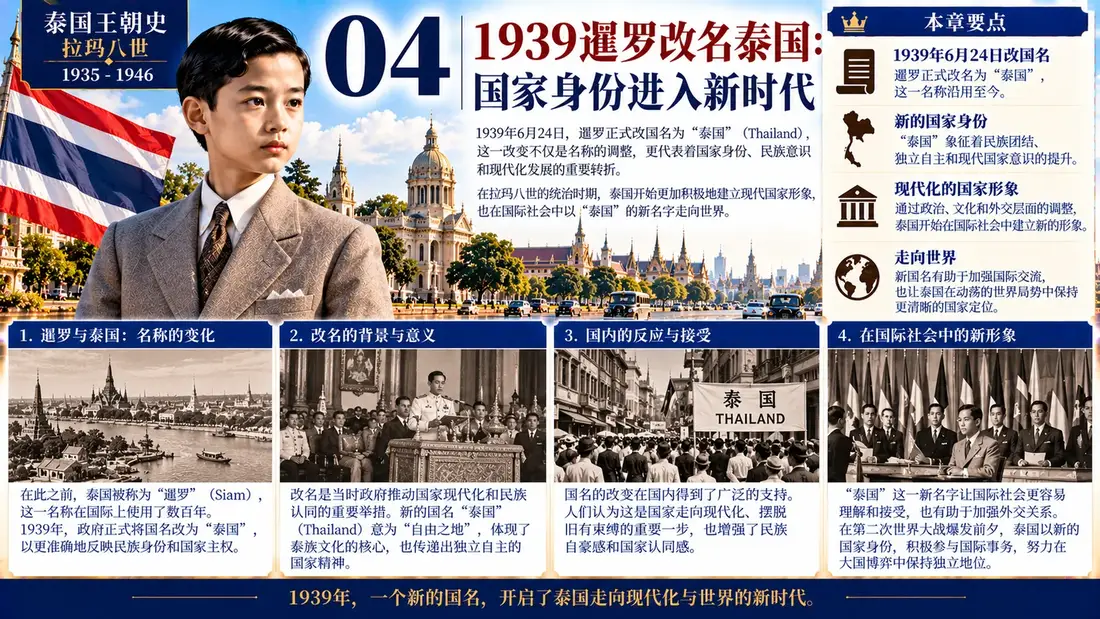
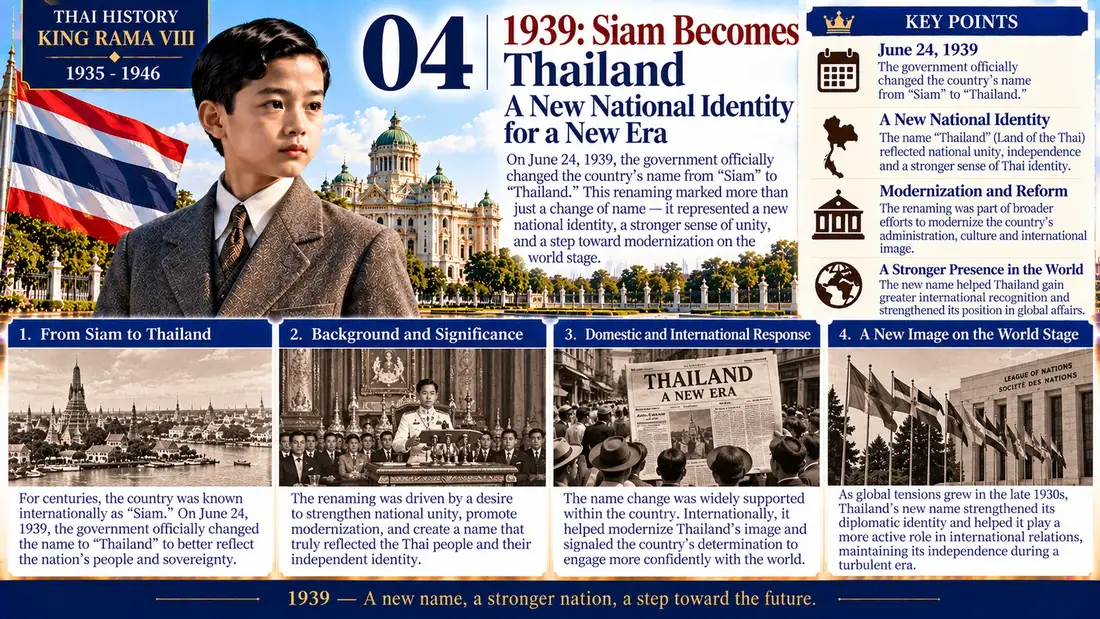
04 | 1939: Siam Becomes Thailand
SEA NOW Thailand · Rama VIII · Illustration 04
On June 24, 1939, the government announced a historic change:
“Siam” would officially become “Thailand.”
One of the principal figures behind this transformation was Prime Minister Plaek Phibunsongkhram.
This was much more than a simple change of name.
During the late 1930s, the government was actively promoting a stronger concept of the modern Thai nation.
A series of cultural policies sought to reshape national identity through language, clothing, public behavior, social customs, and nationalist symbolism.
The name “Thailand” became one of the most visible symbols of this new national identity.
An important distinction must be made, however.
Rama VIII was still a teenager living mainly in Switzerland.
The policies transforming the country were therefore not personally directed by the young king.
They were primarily driven by Thailand’s government and increasingly influential military leadership.
This reflected a fundamental political reality after 1932:
The center of political power had shifted away from the traditional royal court toward constitutional government, the military, and the modern bureaucracy.
Rama VIII was king.
But Thailand was increasingly being shaped by new political forces.
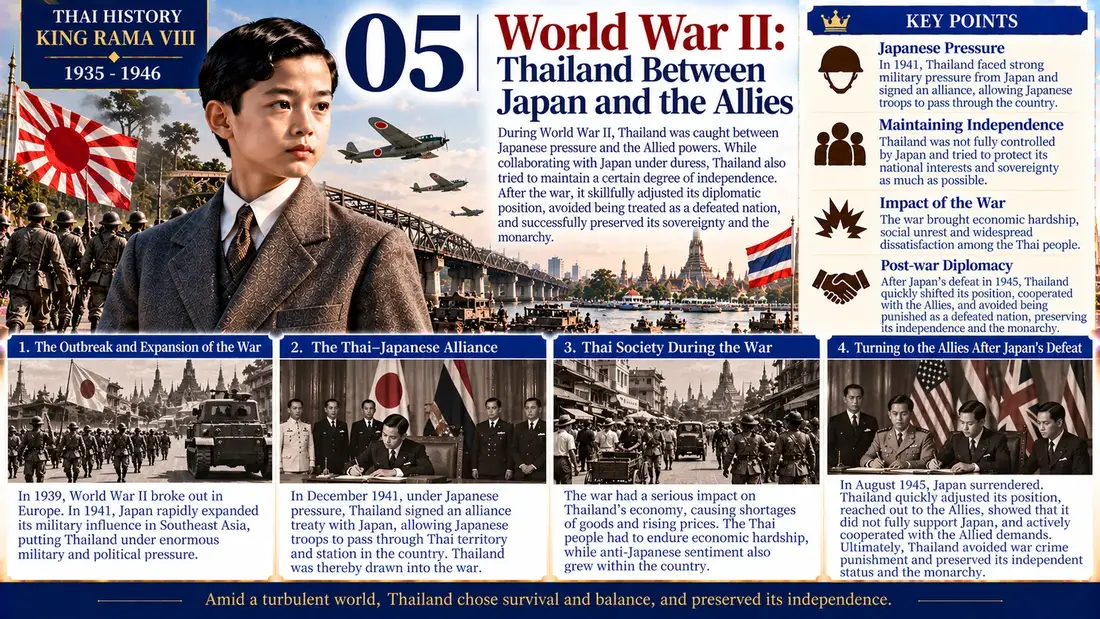
05 | World War II: Thailand Between Japan and the Allies
SEA NOW Thailand · Rama VIII · Illustration 05
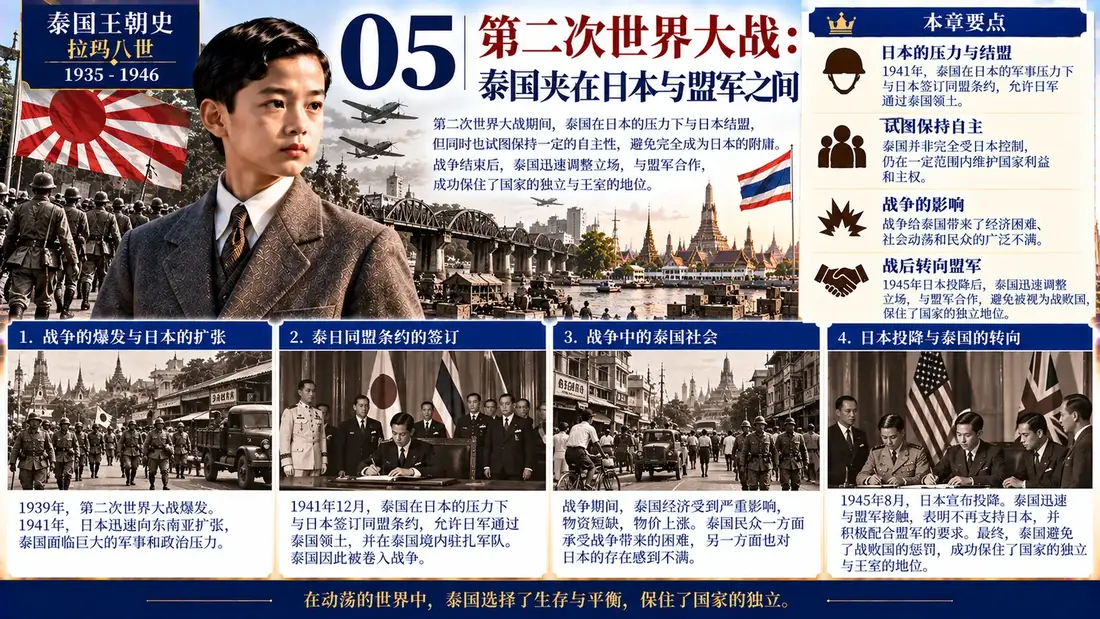
World War II began in Europe in 1939.
At first, the conflict seemed geographically distant from Thailand.
That changed rapidly as Japan expanded into Southeast Asia.
On December 8, 1941, Japanese forces landed at several locations in Thailand and demanded passage through Thai territory for operations toward British Malaya and Burma.
Thai forces resisted at several locations.
After a brief period of fighting, however, the Thai government ordered a ceasefire.
Thailand subsequently allowed Japanese forces to move through its territory and eventually entered into an alliance with Japan.
In January 1942, the Thai government declared war on Britain and the United States.
But the situation was more complicated than a simple alliance suggested.
Thailand’s ambassador to Washington, Seni Pramoj, refused to formally deliver the declaration of war to the U.S. government.
Meanwhile, many Thai politicians, diplomats, officials, students, and intellectuals opposed Japanese domination.
Thailand therefore found itself in an unusual wartime position.
Its government formally cooperated with Japan.
At the same time, other Thai groups secretly established connections with the Allies.
This alternative path would eventually become crucial to Thailand’s postwar survival.
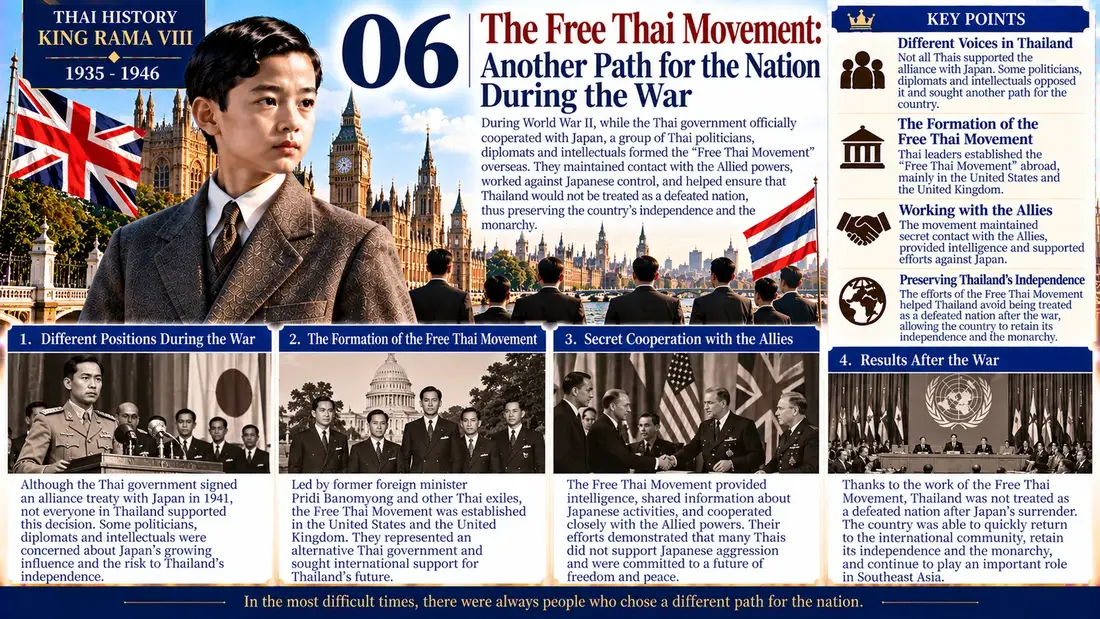
06 | The Free Thai Movement: Another Path for the Nation During the War
SEA NOW Thailand · Rama VIII · Illustration 06
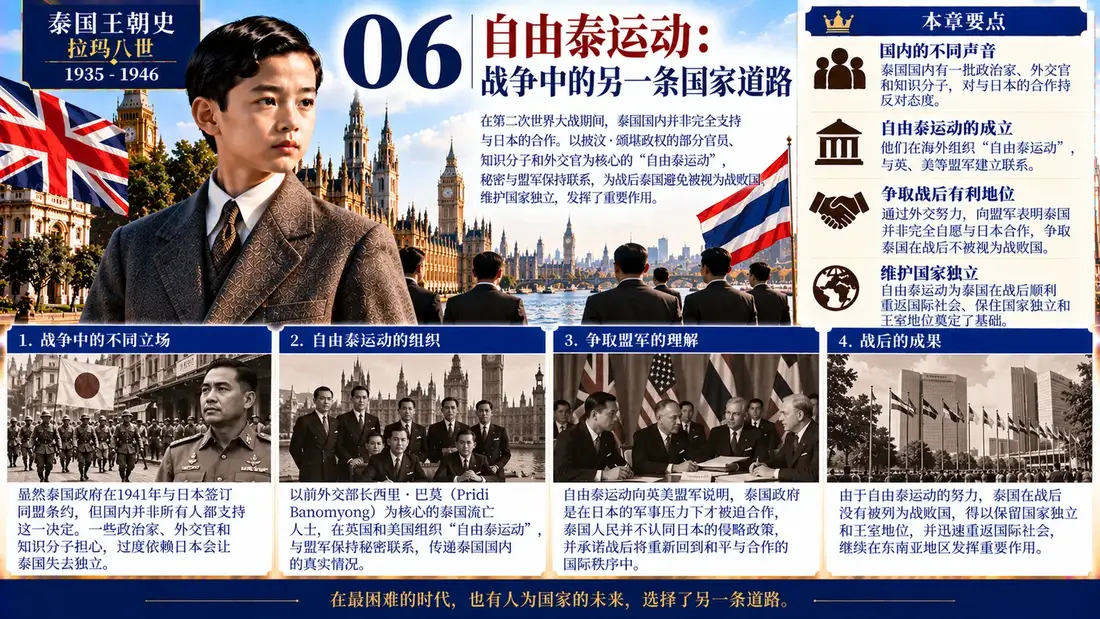
This resistance network became known as the:
Free Thai Movement — Seri Thai.
The movement developed both inside Thailand and overseas.
Within Thailand, one of its most important leaders was Pridi Banomyong, who served as regent during part of Rama VIII’s reign.
In the United States, Seni Pramoj and other Thai nationals worked with American authorities.
Free Thai networks also operated in Britain.
Members of the movement established clandestine communications, supplied intelligence, assisted Allied operations, and prepared for possible resistance against Japanese forces.
But the historical importance of the Free Thai Movement went beyond military activity.
It communicated a crucial political message to the Allied powers:
Not all Thai political forces supported the alliance with Japan.
That distinction became enormously important when the war ended.
Had Thailand been regarded simply as a committed Japanese ally, it could have faced much harsher treatment as a defeated enemy state.
The Free Thai Movement therefore became one of Thailand’s most valuable diplomatic assets in the transition from war to peace.
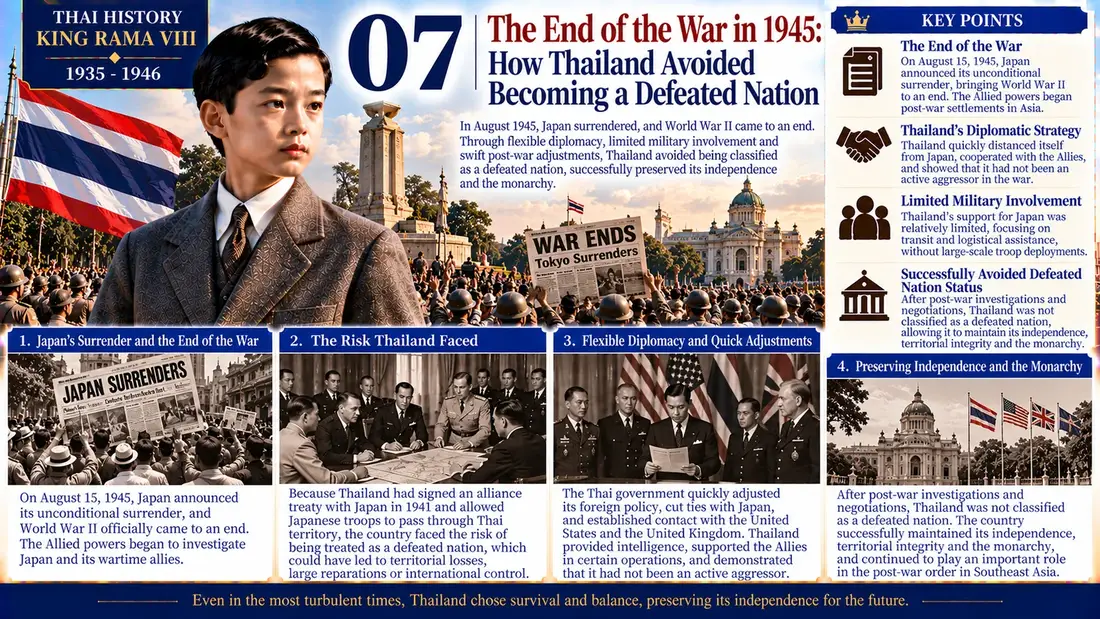
07 | The War Ends in 1945: How Thailand Avoided Defeated-Nation Status
SEA NOW Thailand · Rama VIII · Illustration 07
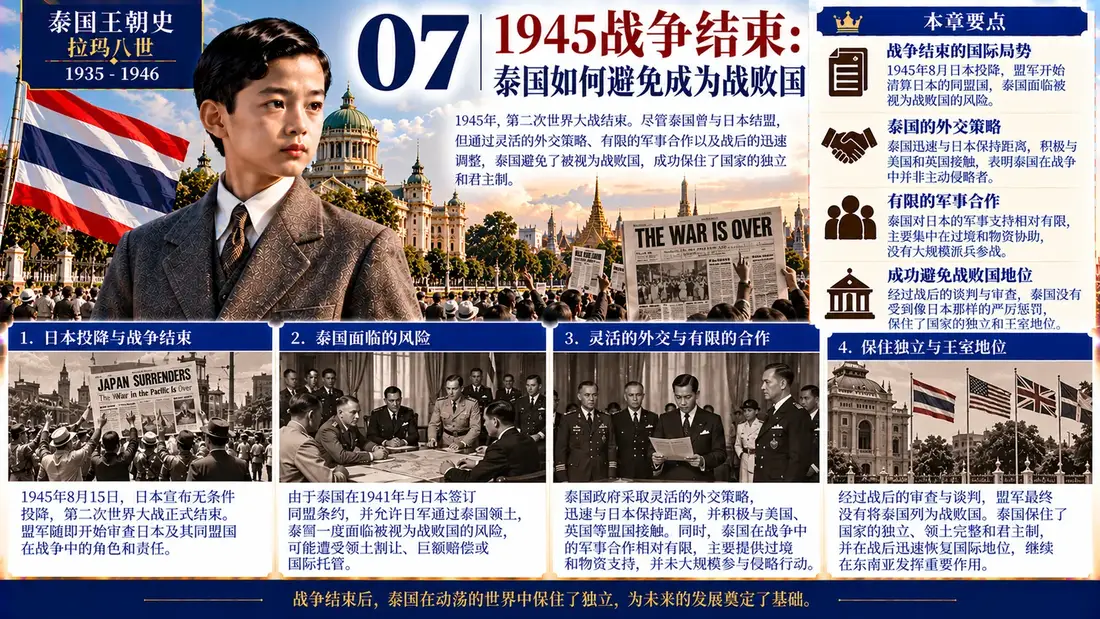
Japan surrendered in August 1945.
World War II was over.
Thailand now faced an urgent question:
How would the victorious Allies treat the country?
Thailand had formally allied itself with Japan and had declared war on Britain and the United States.
That created a serious diplomatic problem.
However, Thailand possessed several important advantages.
The Free Thai Movement had cooperated with the Allies throughout the war.
The United States did not treat Thailand in the same manner as the principal defeated Axis powers.
And Thailand’s postwar leadership moved quickly to distance the country from its wartime alliance with Japan.
On August 16, 1945, Regent Pridi Banomyong issued a proclamation declaring Thailand’s wartime declaration of war against Britain and the United States null and void.
The postwar settlement was not cost-free.
Britain took a harder position than the United States, and Thailand had to negotiate settlements concerning wartime obligations and return territories acquired during the conflict.
Nevertheless, the most important outcome remained:
Thailand was not occupied and fundamentally reconstructed as a major defeated Axis power in the manner of Japan.
Thai sovereignty survived.
The monarchy survived.
And Thailand was able to begin rebuilding its international relationships.
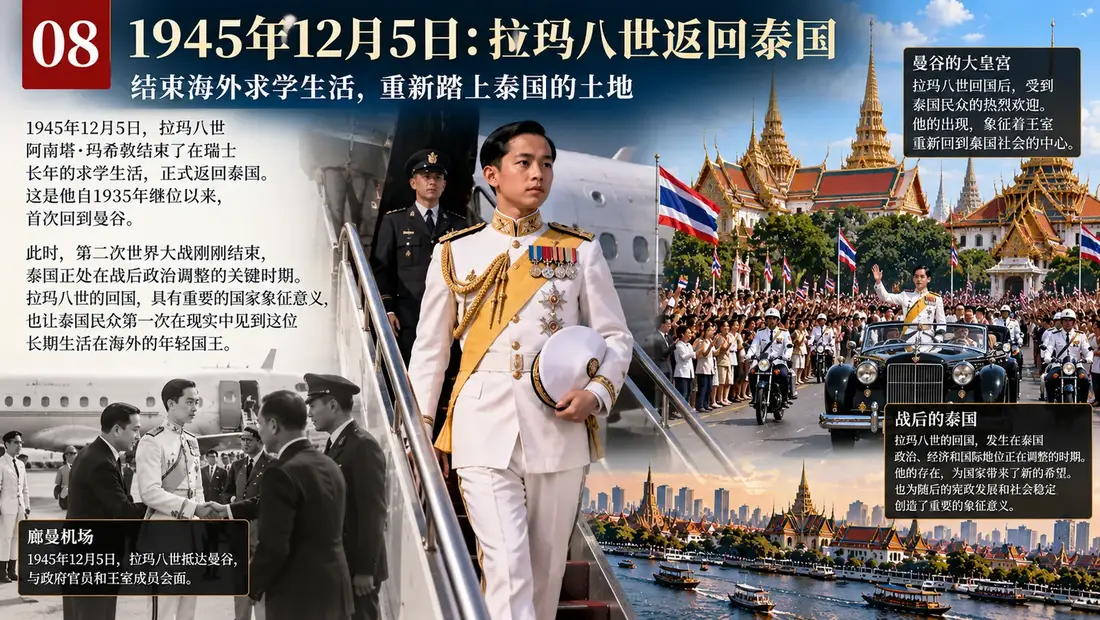
08 | Returning to Bangkok in 1945: A Young King Comes Home to Post-War Thailand
SEA NOW Thailand · Rama VIII · Illustration 08
In December 1945, several months after the end of World War II, Rama VIII returned to Thailand.
This return was very different from his earlier visit in 1938.
He was now 20 years old.
And the country he returned to had been profoundly transformed.
The Revolution of 1932 had changed the political system.
Siam had become Thailand.
World War II had transformed Southeast Asia.
Japan had been defeated.
Military officers, civilian politicians, democratic reformers, royalists, and other political groups were now competing to shape the postwar order.
After returning to Bangkok, Rama VIII participated in public ceremonies and increasingly engaged directly with Thai society.
One particularly symbolic event occurred in June 1946, when Rama VIII and his younger brother Bhumibol visited Bangkok’s Chinese community.
The visit came at a time of social and political tension and became an important symbol of reconciliation and national unity.
For many Thais, this period offered their first real opportunity to become familiar with the young monarch who had spent so much of his reign overseas.
Rama VIII appeared to be moving from being a distant constitutional symbol toward becoming a monarch with a direct public presence in Thailand.
But this period lasted only a few months.
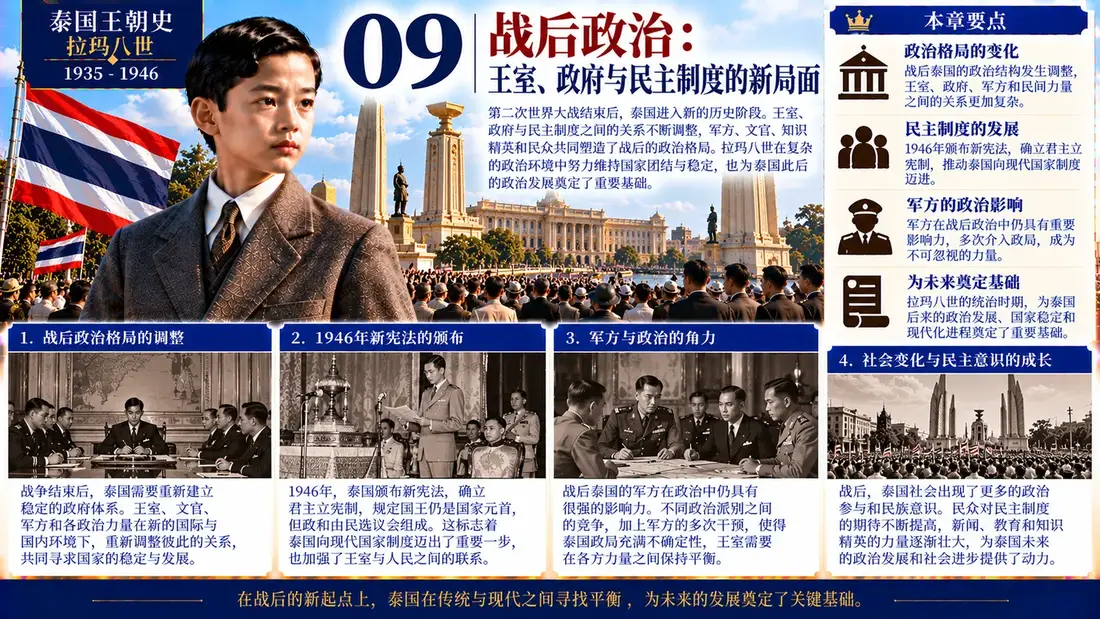
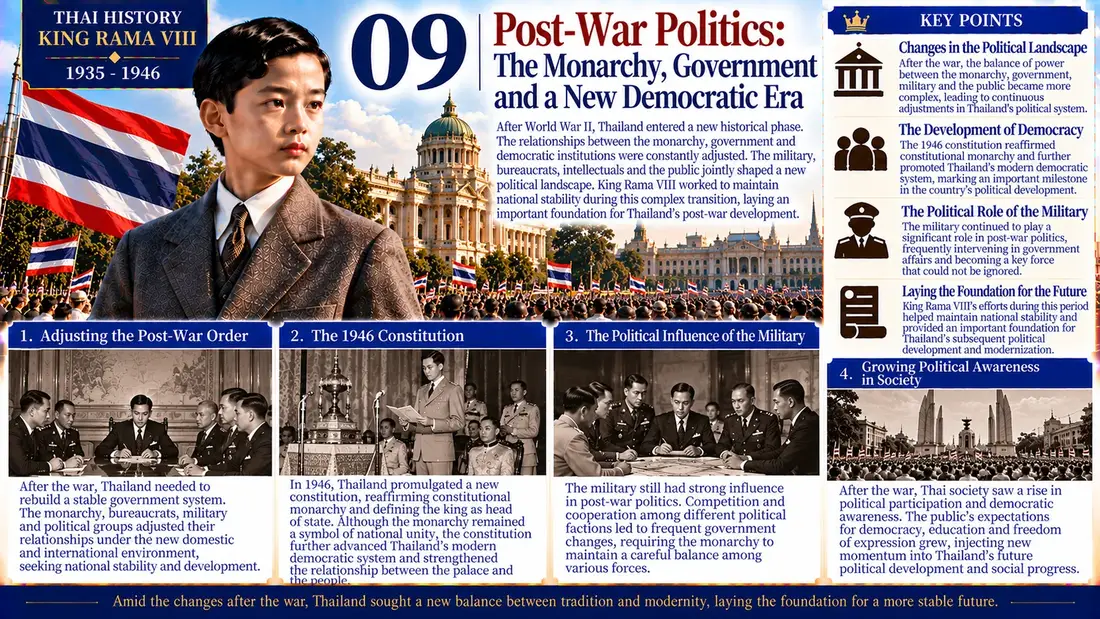
09 | Post-War Politics: The Monarchy, Government, and a New Democratic Landscape
SEA NOW Thailand · Rama VIII · Illustration 09
The end of World War II did not immediately bring political stability to Thailand.
Instead, a new period of political competition began.
Civilian political forces associated with Pridi Banomyong gained considerable influence.
The wartime achievements of the Free Thai Movement strengthened the prestige of civilian and democratic groups.
The military, however, remained a powerful institution.
The monarchy was also searching for its place within the relatively young constitutional system.
In 1946, Thailand promulgated a new constitution.
For a time, the political atmosphere encouraged hopes that Thailand might develop a more parliamentary and democratic political system.
Yet serious tensions remained.
Military political power had not disappeared.
Royal influence was beginning to recover.
Civilian political factions were themselves divided.
Economic hardship and social disruption caused by the war also remained unresolved.
Rama VIII stood at the center of this complicated environment.
He was simultaneously a symbol of the Chakri monarchy and the constitutional king of a changing modern state.
Had he lived longer, what relationship might have developed between the young king, parliament, the government, the military, and Thai society?
History never provided an answer.
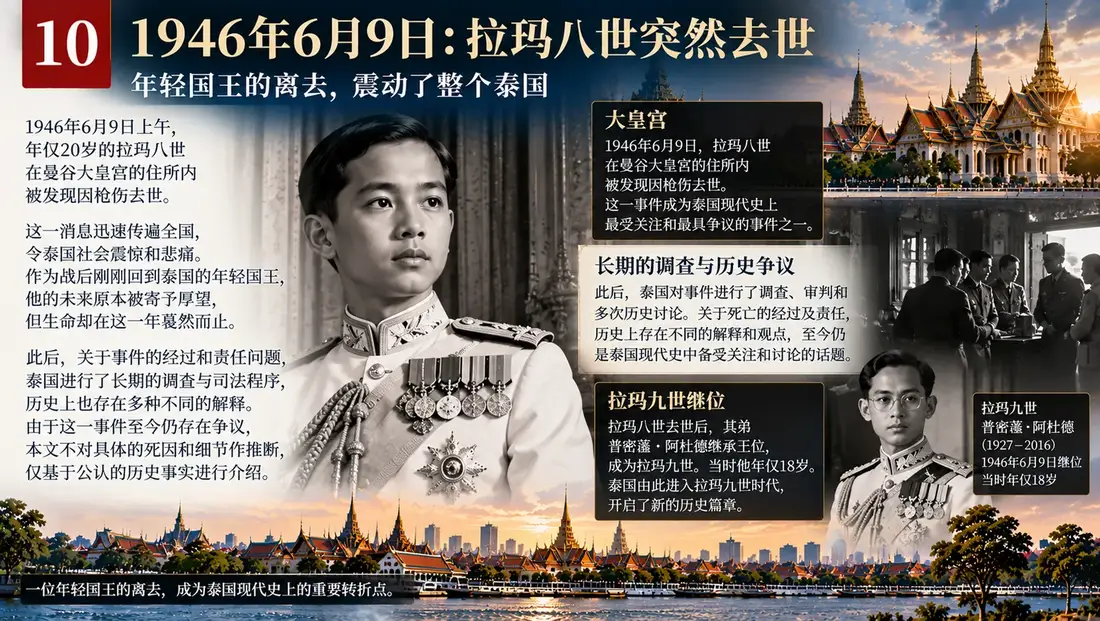
10 | June 9, 1946: The Sudden Death of King Rama VIII
SEA NOW Thailand · Rama VIII · Illustration 10
On the morning of June 9, 1946, an event inside Bangkok’s Grand Palace shocked the nation.
King Rama VIII was found dead from a gunshot wound in his bedroom in the Boromphiman Throne Hall.
He was only 20 years old.
News of his death spread rapidly across Thailand.
From the beginning, competing explanations emerged concerning whether the shooting had been accidental, suicidal, or homicidal.
A lengthy investigation and judicial process followed.
Eventually, three royal household employees were convicted in connection with the case and executed in 1955.
Yet the precise circumstances surrounding Rama VIII’s death have remained the subject of historical debate and controversy.
Different writers and researchers have proposed different interpretations, and questions have persisted over the evidence, investigations, legal proceedings, and highly charged political environment of the period.
The most careful historical description is therefore:
On June 9, 1946, King Rama VIII died from a gunshot wound inside the Grand Palace; the precise circumstances surrounding the shooting have remained controversial.
His death was not only a royal tragedy.
It immediately changed the political and dynastic future of Thailand.
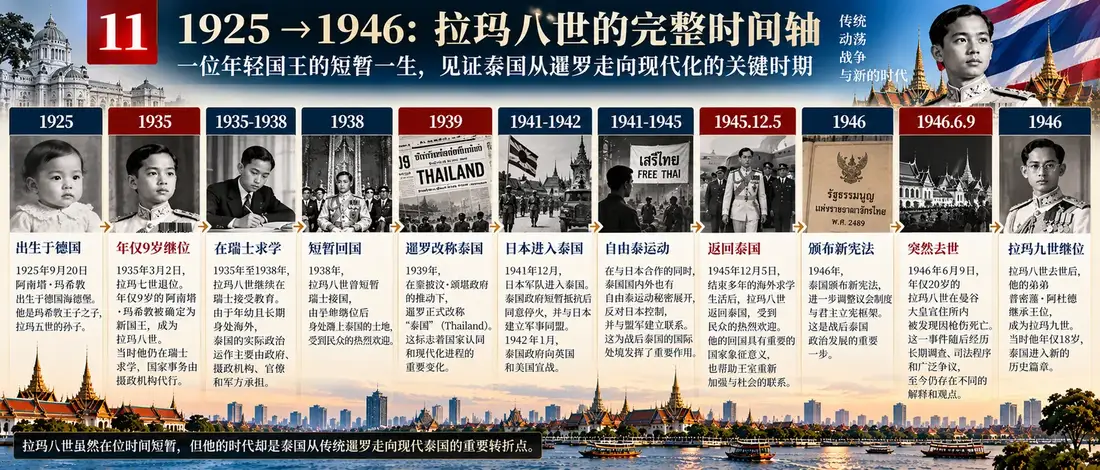
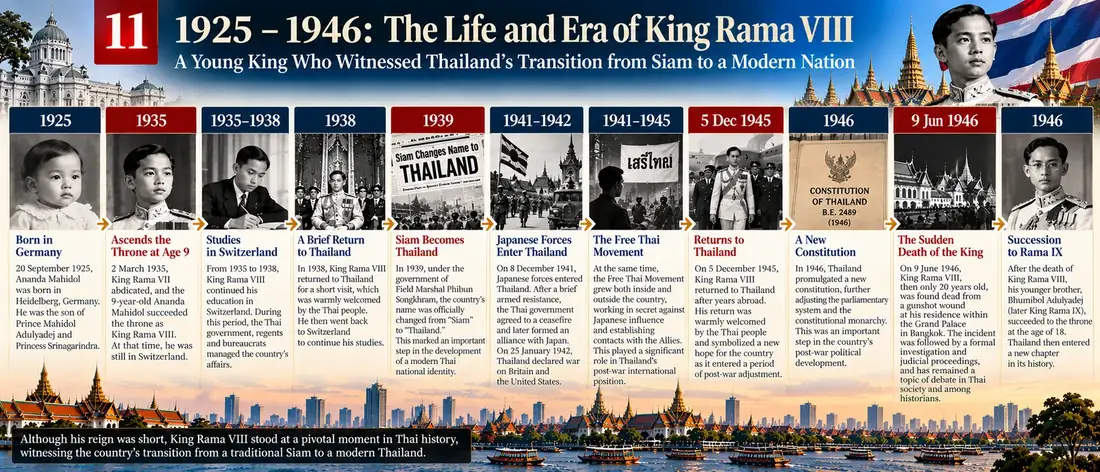
On September 20, Ananda Mahidol was born in Heidelberg, Germany.
He was the son of Prince Mahidol Adulyadej and Princess Srinagarindra and a grandson of King Rama V.
↓
1935 | Rama VIII Ascends the Throne
Following Rama VII’s abdication, nine-year-old Ananda Mahidol became King Rama VIII.
Because of his young age and residence abroad, a regency represented the monarch in Thailand.
↓
1939 | Siam Becomes Thailand
On June 24, the government of Plaek Phibunsongkhram officially changed the country’s international name from Siam to Thailand, symbolizing the growing importance of modern nationalism and a new national identity.
↓
1941 | Japanese Forces Enter Thailand
On December 8, Japanese troops entered Thailand.
After brief resistance, the Thai government permitted Japanese military passage and subsequently entered into an alliance with Japan.
↓
1945 | World War II Ends
Japan surrendered.
The activities of the Free Thai Movement and Thailand’s postwar diplomacy helped the country avoid the same treatment imposed on the principal defeated Axis powers.
In December, Rama VIII returned to Thailand.
↓
1946 | The Young King Dies Suddenly
On June 9, the 20-year-old King Rama VIII died from a gunshot wound inside Bangkok’s Grand Palace.
His younger brother, Bhumibol Adulyadej, succeeded him.
Thailand entered another extraordinary period of its modern history:
The Era of King Rama IX.
Conclusion | A Short Reign in One of Thailand’s Most Turbulent Eras
Rama VIII was very different from the Chakri kings who preceded him.
Rama V personally drove enormous programs of national modernization.
Rama VI helped shape modern Thai nationalism.
Rama VII witnessed the Revolution of 1932 and the end of absolute monarchy.
Rama VIII’s reign, by contrast, can almost be seen as a mirror reflecting the enormous forces transforming Thailand around him.
During his lifetime:
Constitutional monarchy was still taking shape.
Siam became Thailand.
Military power grew.
World War II engulfed Southeast Asia.
Japanese forces entered Thailand.
The Free Thai Movement secretly cooperated with the Allies.
And after the war, Thailand began rebuilding its position in the international community.
Then, just as the country was entering the postwar era, its young king suddenly died.
Rama VIII reigned for more than eleven years, but spent most of that period abroad.
His time in Thailand as an adult monarch lasted only months.
We therefore cannot know what kind of constitutional monarch he might eventually have become.
How would he have understood the balance between monarchy and parliamentary government?
How would his relationship with Thailand’s political leaders and military have developed?
And what influence might he have had on the country’s postwar political evolution?
History left those questions unanswered.
But after June 9, 1946, a new and much longer chapter began.
Rama VIII’s younger brother, Bhumibol Adulyadej, succeeded to the throne at the age of 18.