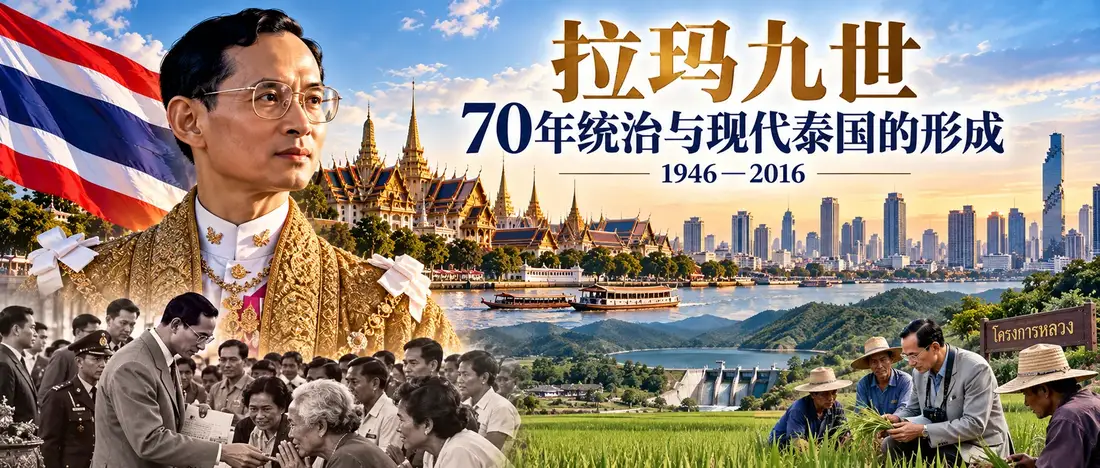
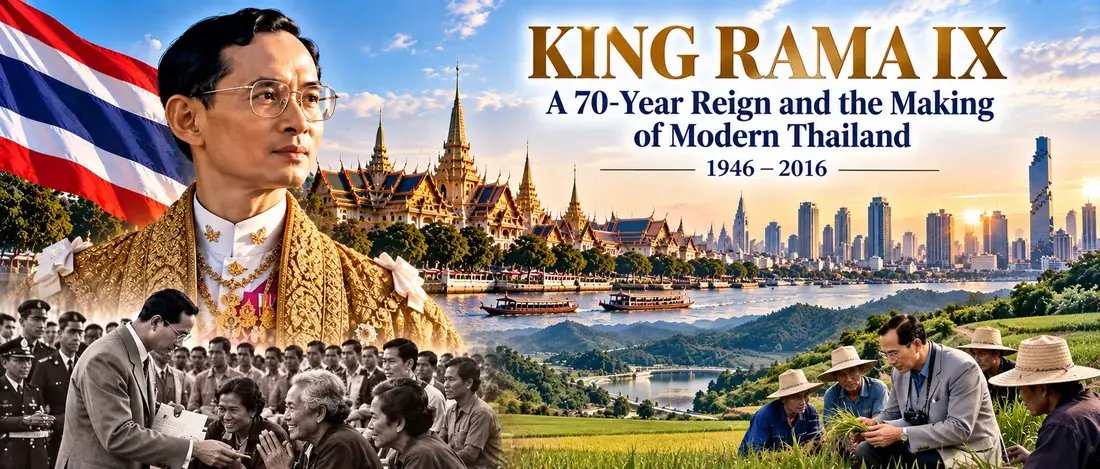
King Rama IX: A 70-Year Reign and the Making of Modern Thailand
King Rama IX | Bhumibol Adulyadej Reign: 1946–2016 Ninth King of the Chakri Dynasty
June 9, 1946.
An event inside Bangkok’s Grand Palace shocked the entire nation.
The 20-year-old King Ananda Mahidol, Rama VIII, suddenly died.
His younger brother—
18-year-old Prince Bhumibol Adulyadej—ascended the throne.
At the time, few could have imagined that this young king would reign over Thailand for the next 70 years.
Nor could anyone have predicted the enormous changes the country would experience during his lifetime.
World War II had just ended.
The Cold War was beginning to reshape Asia.
Military governments rose to power.
A succession of coups repeatedly transformed Thai politics.
Millions of people moved from the countryside into growing cities.
Roads, dams, electricity networks, irrigation systems and modern infrastructure expanded across the country.
Bangkok evolved from a relatively low-rise city of canals into a global metropolis filled with expressways, mass transit systems, skyscrapers and international capital.
The Black May crisis of 1992 shook the nation.
Then the Asian Financial Crisis of 1997 devastated Thailand’s economy.
Throughout these decades of extraordinary change, one name remained a constant presence in Thailand’s postwar history:
Bhumibol Adulyadej—King Rama IX.
He would eventually become the longest-reigning monarch in Thai history.
To understand modern Thailand, it is almost impossible to avoid understanding the era of Rama IX.
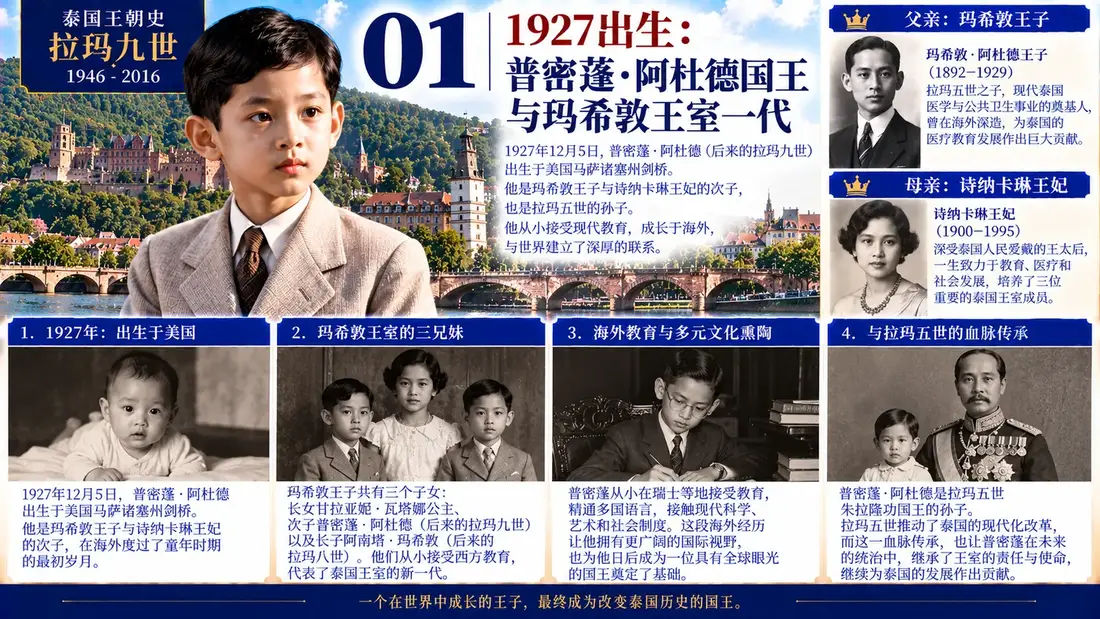
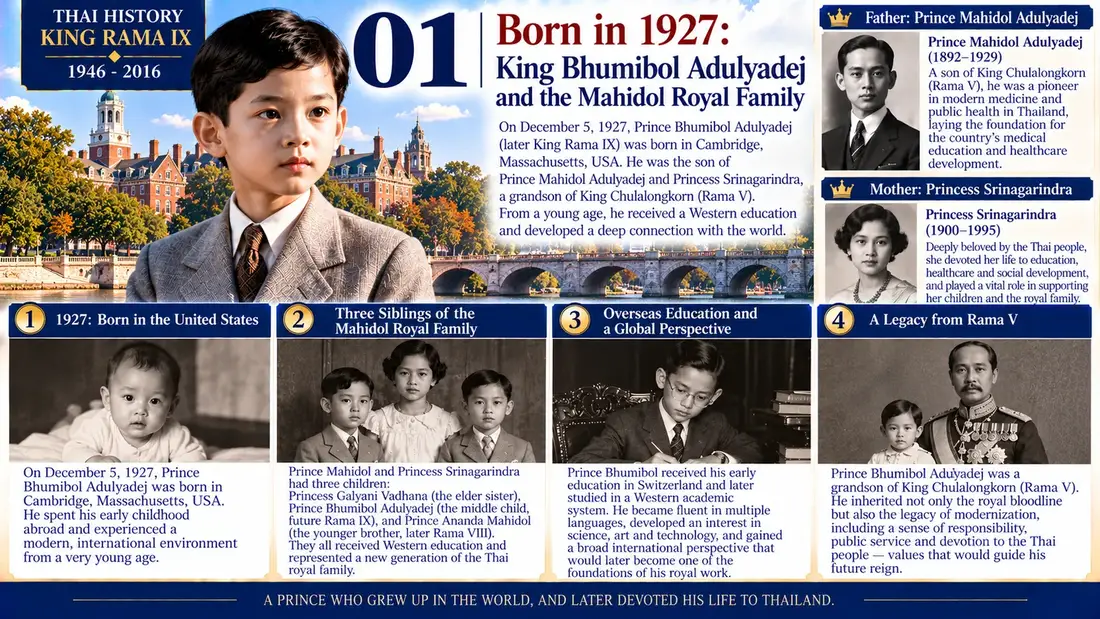
01 | Born in 1927: Bhumibol Adulyadej and the Mahidol Generation
SEA NOW Thailand · Rama IX · Illustration 01
Bhumibol Adulyadej was born on December 5, 1927, in Cambridge, Massachusetts, United States.
His father was Prince Mahidol Adulyadej, a son of King Chulalongkorn, Rama V.
His mother was Princess Srinagarindra, who would later become widely known and respected in Thailand as the Princess Mother.
Bhumibol was therefore a grandson of Rama V.
His elder brother was Prince Ananda Mahidol, the future King Rama VIII.
The childhood of this generation of the royal family was very different from that of Siamese princes in the nineteenth century.
They grew up with modern education and spent much of their youth abroad.
Their father, Prince Mahidol, had a particularly strong interest in medicine, science and public health.
But in 1929, Prince Mahidol died.
Bhumibol was not yet two years old.
Princess Srinagarindra was left with the responsibility of raising her three children.
In 1933, the family moved to Switzerland.
There, Bhumibol received his education and developed interests in languages, science, photography, music and engineering.
At the time, he was not expected to become king.
Even after his elder brother Ananda became Rama VIII in 1935, Bhumibol remained simply the younger brother of the young monarch.
History, however, would soon transform his life.
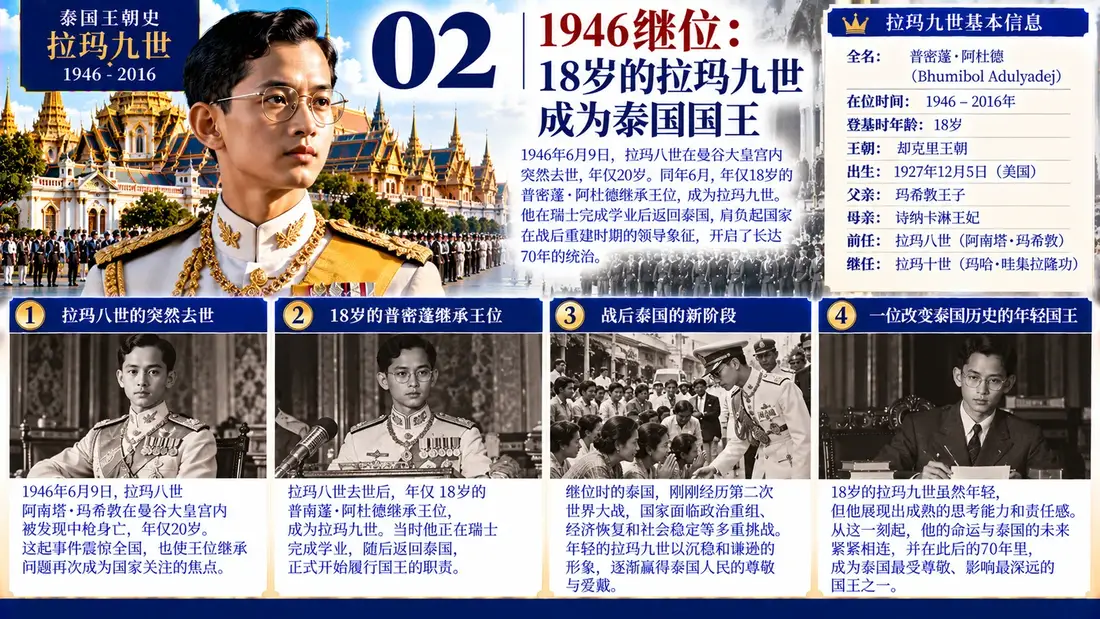
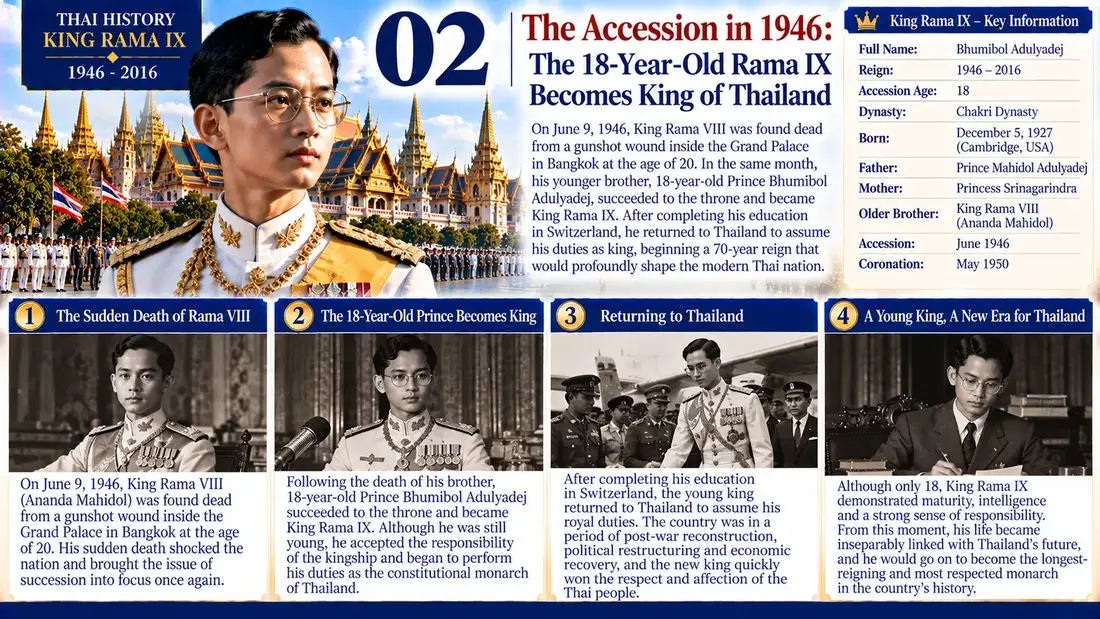
02 | 1946: The 18-Year-Old Rama IX Ascends the Throne
SEA NOW Thailand · Rama IX · Illustration 02
On June 9, 1946, King Rama VIII died from a gunshot wound inside Bangkok’s Grand Palace.
Thailand was stunned.
That same day, Bhumibol Adulyadej succeeded his brother.
He became:
King Rama IX.
He was only 18 years old.
The Thailand inherited by this young monarch was fundamentally different from the Siam ruled by Rama V.
The Revolution of 1932 had already ended absolute monarchy.
The king was now head of state within a constitutional system.
World War II had just ended.
Thailand was rebuilding its relationships with the United States, Britain and the wider international community.
Domestic politics were equally uncertain.
The military, civilian political groups, royalists and other competing forces were struggling to define the country’s postwar future.
Soon after his accession, Bhumibol returned to Switzerland to continue his education.
But the direction of his life had changed forever.
A young man interested in science, engineering, photography and music now had to prepare himself for the responsibilities of constitutional kingship.
A reign that would eventually last seven decades had begun.
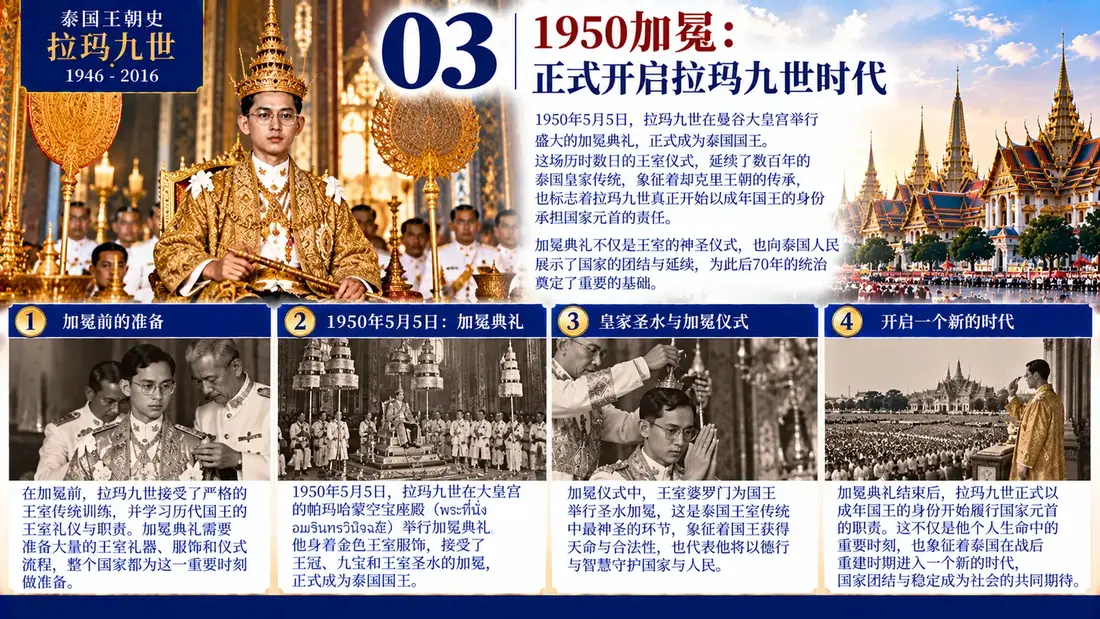
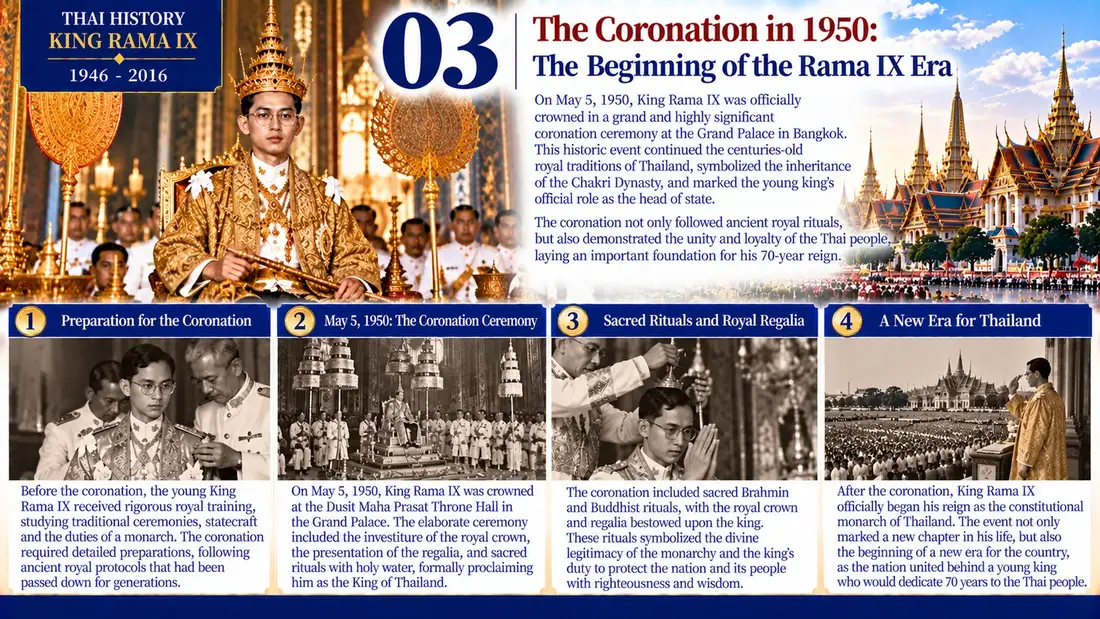
03 | The 1950 Coronation: The Rama IX Era Formally Begins
SEA NOW Thailand · Rama IX · Illustration 03
The year 1950 was one of the most important of Rama IX’s life.
On April 28, he married Sirikit Kitiyakara, who became Queen Sirikit.
Then, on May 5, 1950, Rama IX was formally crowned at Bangkok’s Grand Palace.
The coronation continued centuries-old royal traditions.
Sacred water, royal regalia, the Great Crown of Victory, Buddhist ceremonies and Brahmanical rituals all formed part of the occasion.
But the coronation represented more than tradition.
It marked the formal beginning of a new royal era.
Rama IX faced a fundamental question:
What role should a king play in a modern Thailand that had already become a constitutional monarchy?
The answer did not emerge immediately in 1950.
It developed gradually over the following decades.
And that evolving role would eventually become one of the defining features of modern Thai history.
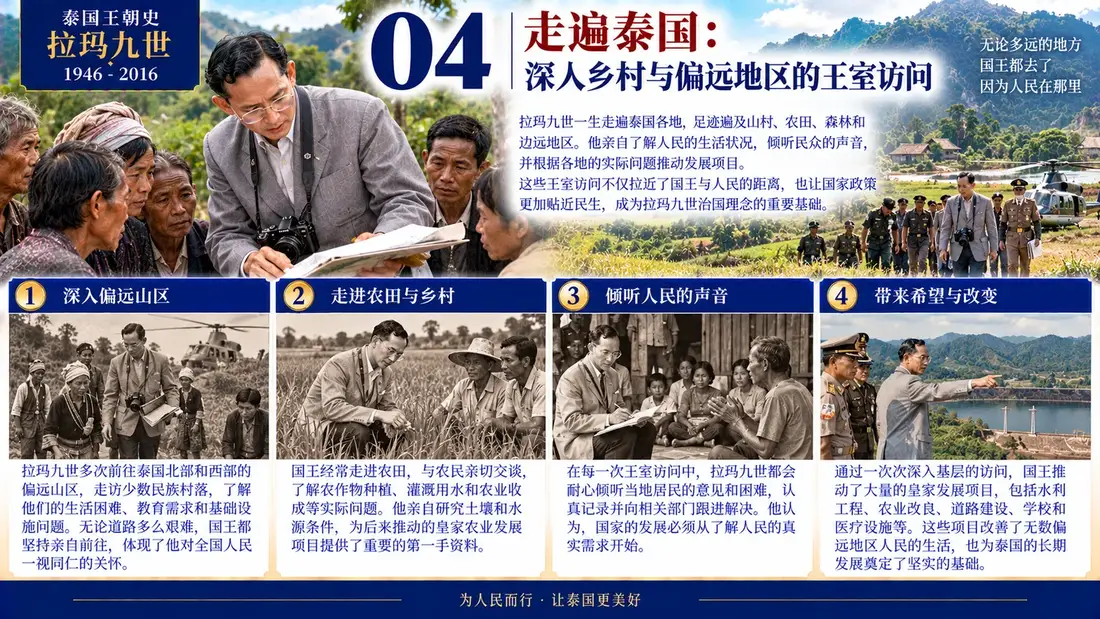
04 | Across Thailand: Royal Visits to Rural and Remote Communities
SEA NOW Thailand · Rama IX · Illustration 04
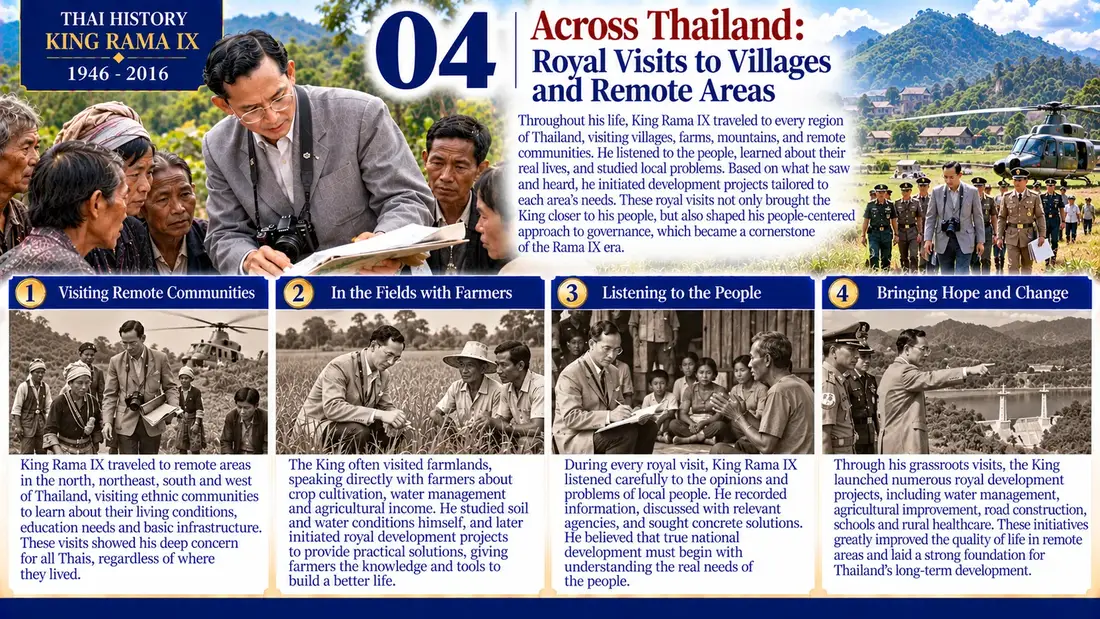
Beginning in the 1950s, Rama IX and Queen Sirikit increasingly traveled throughout Thailand.
They visited the northern mountains.
The drought-prone Northeast.
The Central Plains.
Southern provinces.
And remote rural communities that were difficult to reach at the time.
Many villages still lacked reliable roads, electricity, irrigation and clean water.
During these journeys, the King spoke with farmers, villagers and local officials.
The visits produced images that later became familiar to generations of Thai people:
The King standing in a field with a map.
Discussing water supplies with farmers.
Examining soil conditions.
Studying the terrain of mountain communities.
Taking notes about problems raised by local residents.
These journeys gradually helped create one of the most recognizable images of Rama IX’s reign:
A king who did not remain only inside Bangkok’s palaces, but regularly traveled into rural and remote Thailand.
These extensive field visits would also provide the foundation for many royal development initiatives.
05 | Royal Development Projects: Water, Agriculture and Rural Development
SEA NOW Thailand · Rama IX · Illustration 05
To understand the Rama IX era, one subject cannot be ignored:
Royal development projects.
Thailand was still predominantly agricultural during the early decades of his reign.
For millions of rural families, water could determine whether a harvest succeeded or failed.
But different regions faced different problems.
Some suffered from chronic drought.
Others experienced flooding.
Some struggled with poor soil.
Mountain communities faced deforestation, environmental degradation and limited economic opportunities.
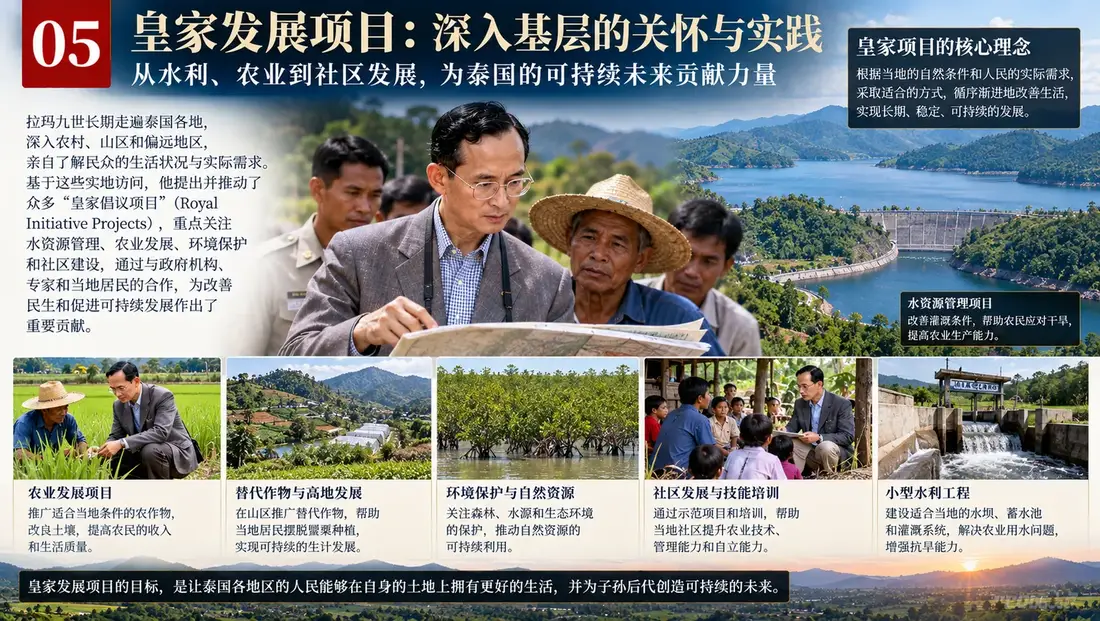
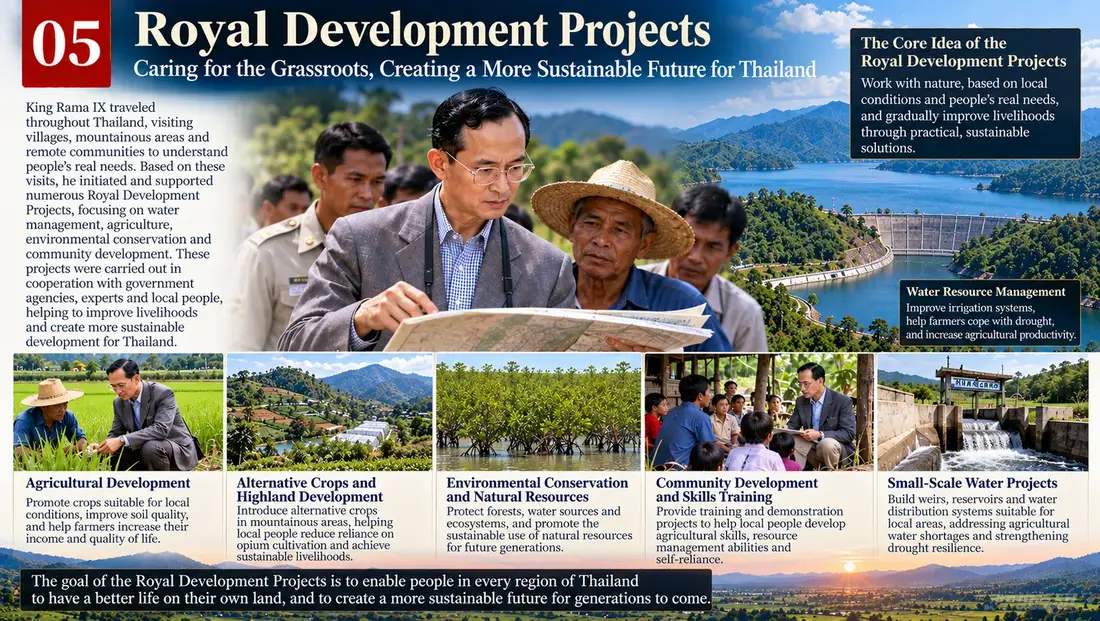
Rama IX therefore developed a long-standing interest in water management, soil, agriculture and rural livelihoods.
Over the decades, royal initiatives and royal development projects addressed areas including:
reservoirs, irrigation, water storage, artificial rainmaking, agricultural experimentation, soil improvement, forest conservation and rural development.
One of the best-known initiatives became the Royal Rainmaking Project, designed to help address drought and water shortages.
Royal Development Study Centres were also established in different parts of Thailand to experiment with solutions appropriate to local environmental and economic conditions.
A central idea behind many of these projects was relatively simple:
Understand the local problem first, then develop a solution suited to local conditions.
This helps explain why Rama IX became so closely associated with maps, cameras, notebooks, agricultural fields and water-management projects.
06 | The “Sufficiency Economy”: Development, Moderation and Resilience
SEA NOW Thailand · Rama IX · Illustration 06
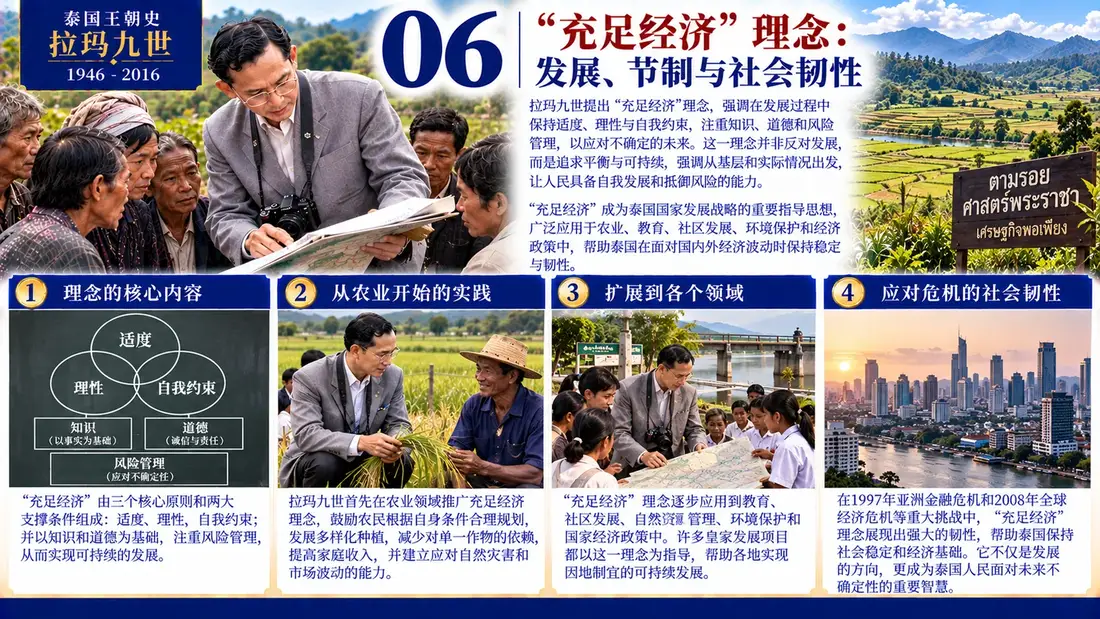
Another concept closely associated with Rama IX is the:
Sufficiency Economy Philosophy.
The idea does not simply mean rejecting wealth or abandoning economic development.
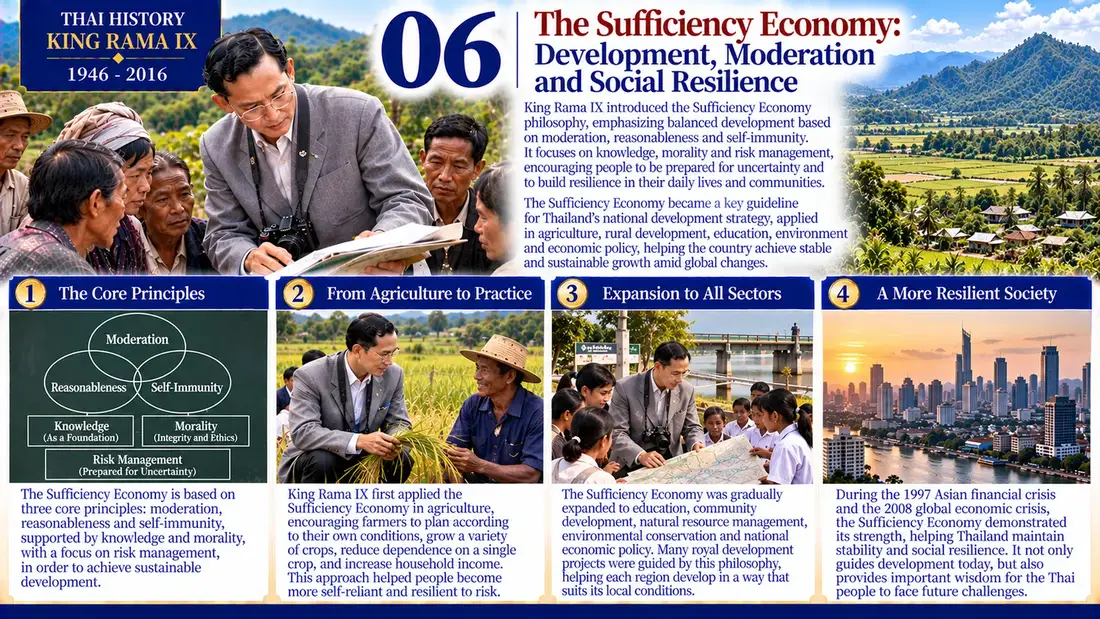
Rather, it emphasizes:
moderation, reasonableness and resilience against risk.
In simple terms, development should not focus only on speed.
Families, communities, businesses and even governments should consider how much risk they can realistically absorb.
The philosophy is commonly described through three central principles:
Moderation.
Reasonableness.
Self-immunity, or resilience against shocks.
Knowledge and ethical considerations are also treated as important underlying conditions.
For farmers, this could mean avoiding complete dependence on a single crop or source of income.
For households, it could mean managing debt and financial risk carefully.
For society and government, it emphasizes stability and long-term sustainability.
Over time, the philosophy influenced discussions about agriculture, community development, education and public policy.
But it attracted particularly widespread attention after Thailand suffered one of the greatest economic shocks in its modern history.
07 | The Cold War Era: Monarchy, Military and the Reshaping of Modern Thailand
SEA NOW Thailand · Rama IX · Illustration 07
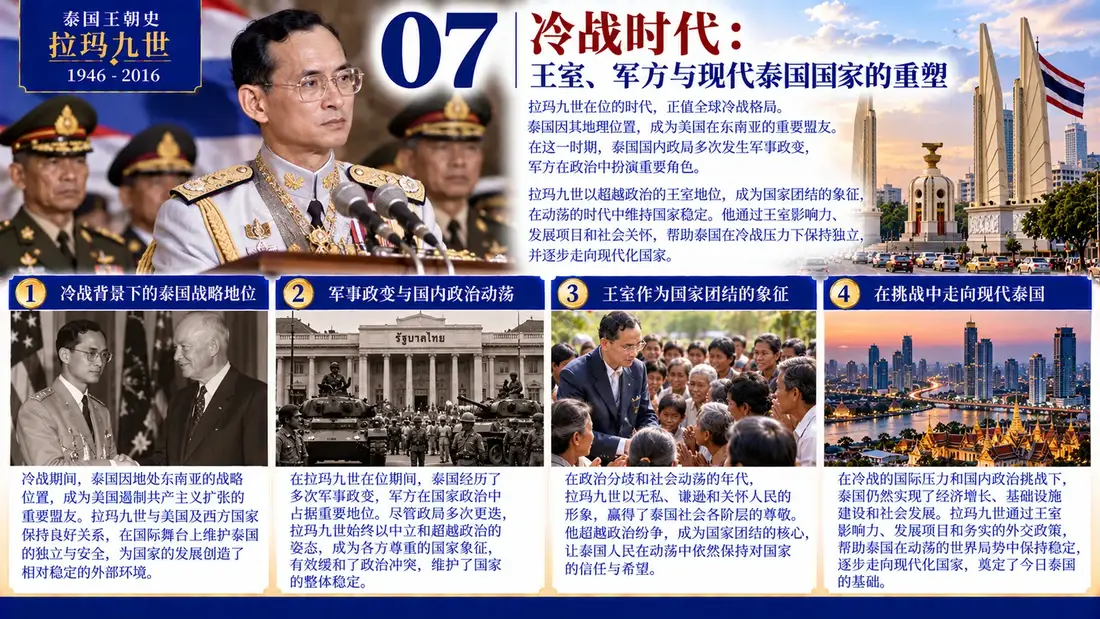
Rama IX’s long reign overlapped with almost the entire Cold War.
After World War II, the United States and Soviet Union emerged as rival superpowers.
Asia quickly became one of the principal arenas of that global confrontation.
The Chinese Revolution.
The Korean War.
The Vietnam War.
Conflict in Laos and Cambodia.
Communist movements spread throughout Southeast Asia.
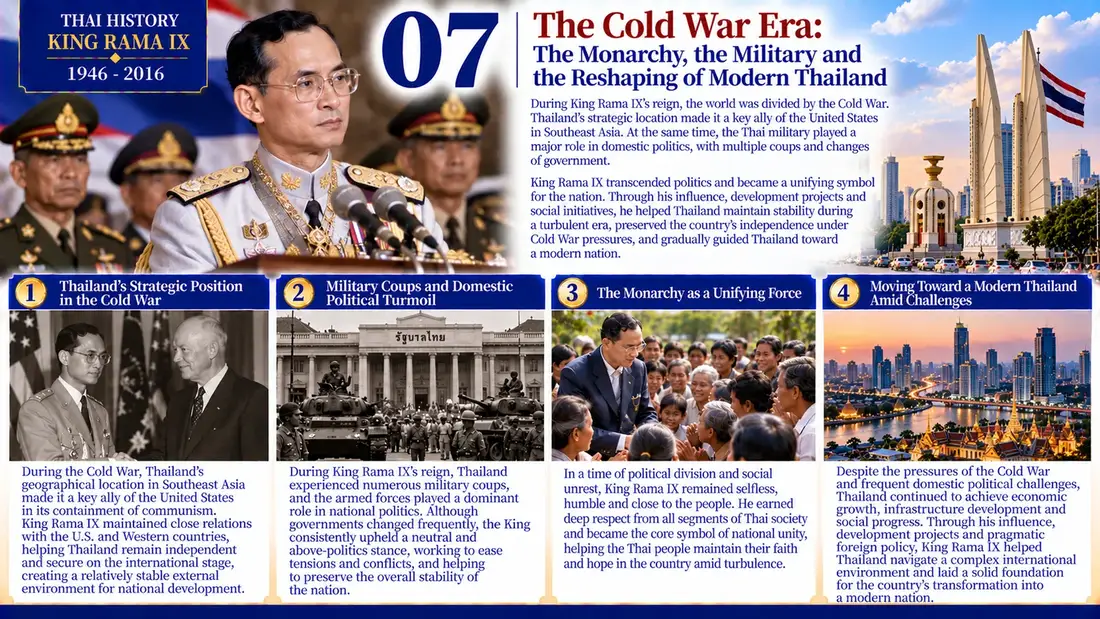
Because of its strategic position, Thailand became an important American partner in the region.
The United States provided military, economic and infrastructure assistance.
At the same time, Thailand’s armed forces became increasingly powerful in domestic politics.
Beginning in the late 1940s, Thailand experienced repeated military coups, authoritarian governments and political transitions.
Rama IX was not simply the initiator or controller of these coups; relations among the monarchy, military, civilian governments and broader society changed considerably across different periods.
Yet as the Cold War developed, the monarchy’s public presence and institutional influence expanded.
The King traveled throughout the country.
Royal development programs increased.
Royal ceremonies and activities became increasingly visible in everyday national life.
In a country where governments changed repeatedly and constitutions were frequently rewritten, the monarchy came to represent continuity and stability for many Thais.
This became one of the most important—and most complex—features of modern Thai political life.
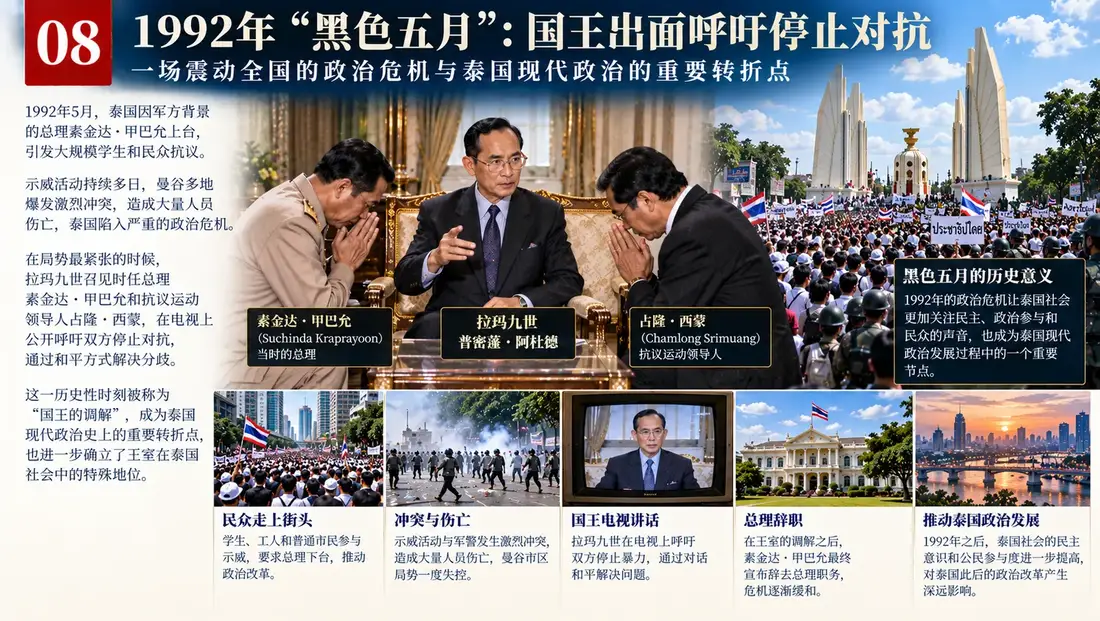
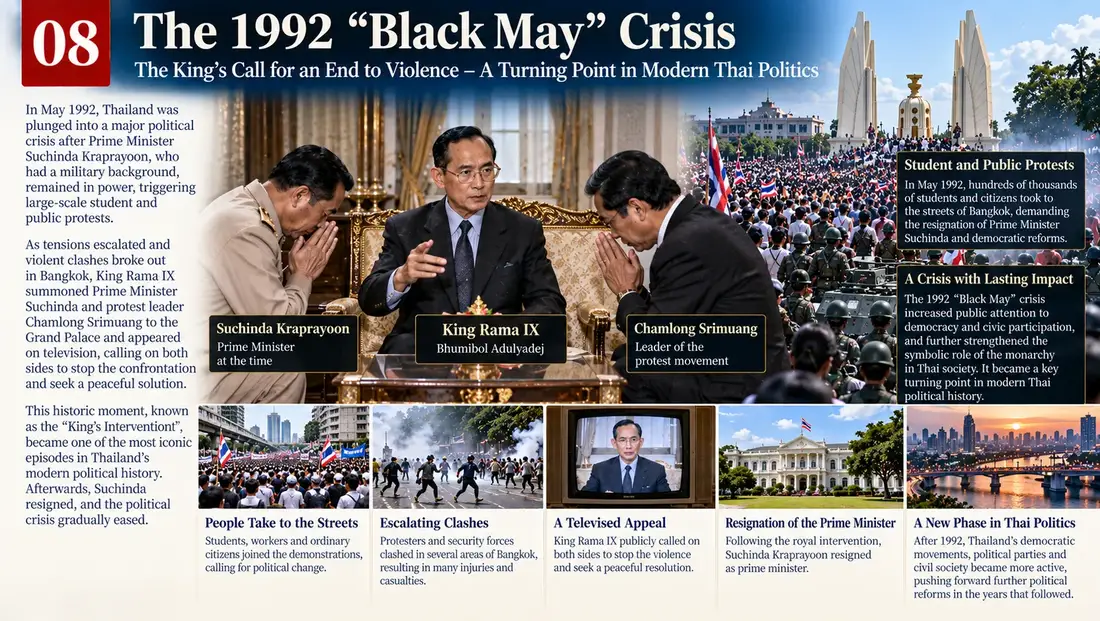
08 | Black May 1992: The King Intervenes in a Political Crisis
SEA NOW Thailand · Rama IX · Illustration 08
In 1992, Thailand entered another serious political crisis.
A military coup had previously overthrown the government.
General Suchinda Kraprayoon later became prime minister, provoking widespread opposition.
In May 1992, large demonstrations filled the streets of Bangkok.
Protesters demanded an end to military domination of politics and a return to more democratic government.
The confrontation escalated dramatically.
Security forces opened fire and violently suppressed demonstrators.
People were killed, injured and reported missing.
The episode became known as:
Black May.
As the crisis deepened, Rama IX intervened publicly.
On May 20, 1992, the King summoned Suchinda and leading opposition figure Chamlong Srimuang to an audience that was televised nationwide.
He urged both sides to end the confrontation and prevent further violence.
The televised images became among the most famous scenes in modern Thai political history.
The immediate crisis subsequently eased.
Suchinda eventually resigned as prime minister.
For many Thais, the episode reinforced Rama IX’s image as an important mediator during moments of national political crisis.
But it also raised a question that would continue to shape debates about Thai politics:
Within a constitutional monarchy, what role should the monarchy play when elected institutions and political systems enter a severe crisis?
That question did not disappear after 1992.
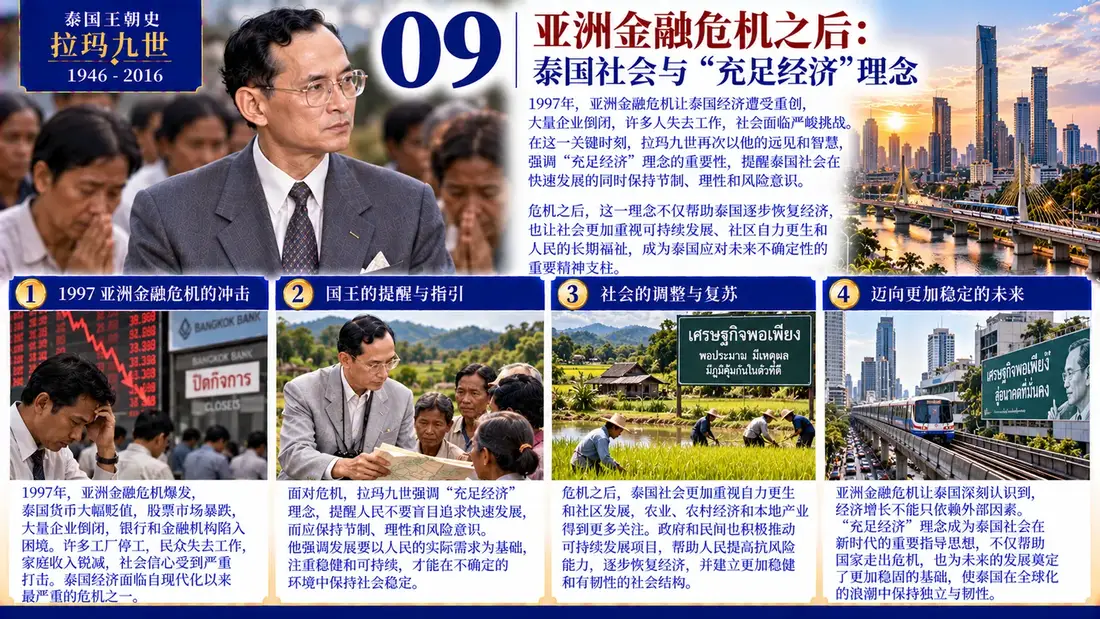
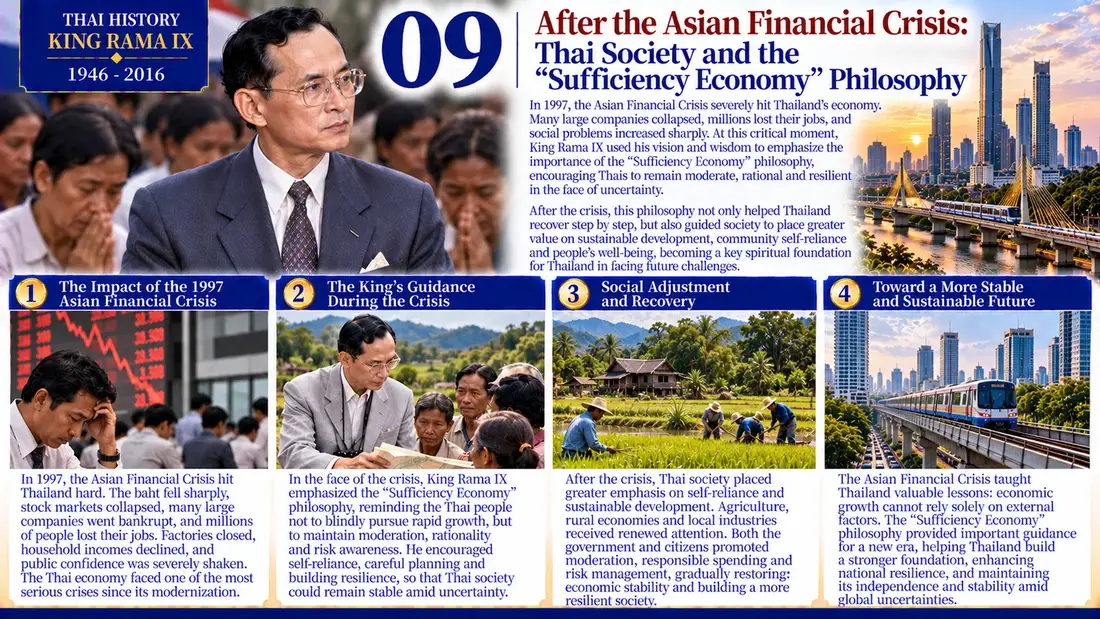
09 | After the Asian Financial Crisis: Thai Society and the “Sufficiency Economy”
SEA NOW Thailand · Rama IX · Illustration 09
In 1997, an economic crisis that began in Thailand shook much of Asia.
On July 2, the Thai government abandoned its long-standing defense of the baht’s exchange rate.
The currency fell sharply.
Corporate debt became increasingly difficult to repay.
Financial institutions collapsed.
Businesses failed.
Unemployment increased.
The property sector was devastated.
The crisis subsequently spread to Indonesia, South Korea and other Asian economies.
It became known as the:
1997 Asian Financial Crisis.
For Thailand, which had enjoyed years of rapid economic expansion, the crisis was an enormous psychological and economic shock.
It forced society to reconsider a fundamental question:
If growth depends heavily on foreign capital, debt and rapid expansion, how resilient is that growth when external conditions suddenly change?
Against this background, Rama IX’s ideas about the Sufficiency Economy received much greater public attention.
The philosophy emphasized that development should not simply mean “more” and “faster.”
Risk, stability and the ability to withstand unexpected shocks also mattered.
In subsequent years, the Sufficiency Economy Philosophy increasingly entered discussions of Thai development and public policy.
In 2006, the United Nations Development Programme presented Rama IX with its first Human Development Lifetime Achievement Award, recognizing his long involvement in grassroots development and human development initiatives.
His influence therefore extended beyond the ceremonial role traditionally associated with monarchy.
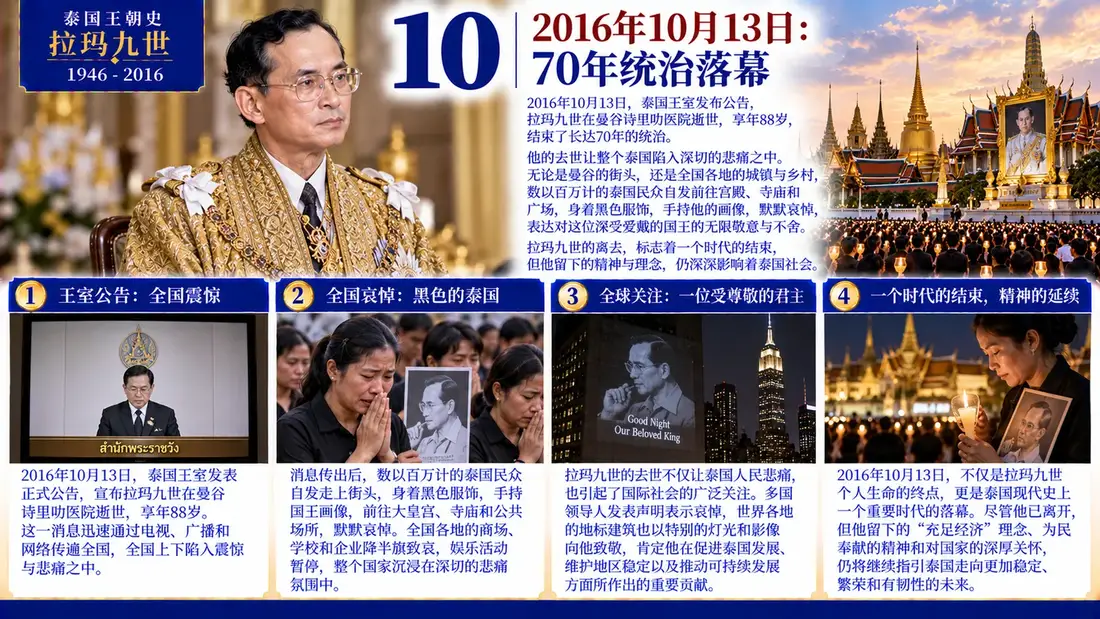
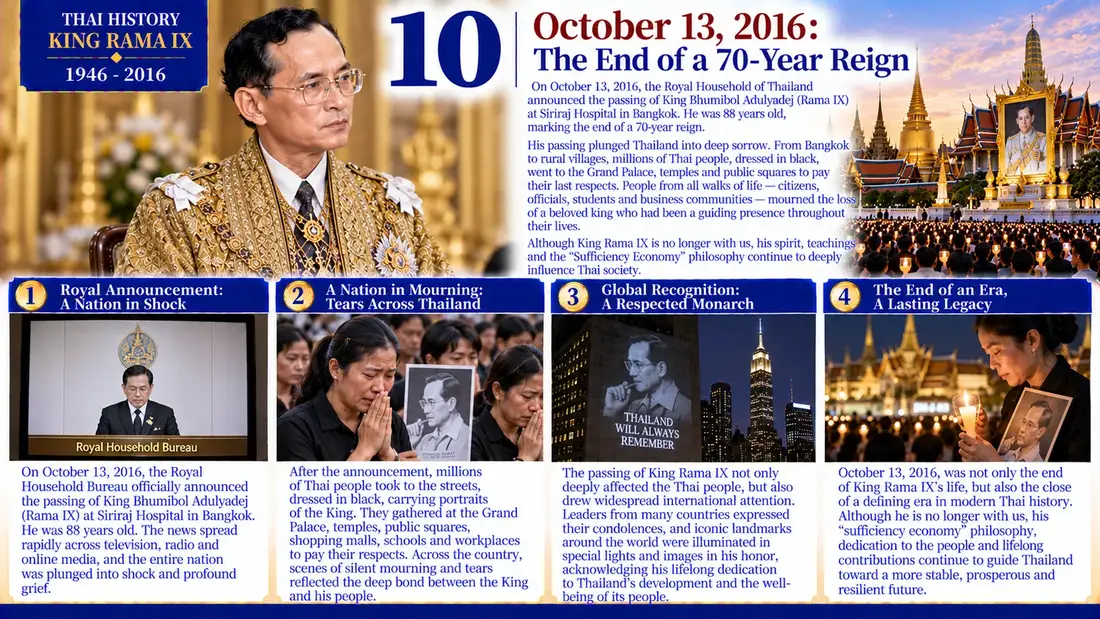
10 | October 13, 2016: The End of a 70-Year Reign
SEA NOW Thailand · Rama IX · Illustration 10
By the early twenty-first century, Rama IX was growing increasingly elderly.
His health became a major subject of public attention, and he spent extended periods receiving medical treatment.
On October 13, 2016, Thailand’s Royal Household Bureau announced that:
King Bhumibol Adulyadej had died at Siriraj Hospital in Bangkok.
He was 88 years old.
From his accession in 1946 until his death in 2016, he had reigned for approximately 70 years.
It was the longest reign of any Thai monarch.
The announcement was followed by nationwide mourning.
Millions of people wore black.
Large crowds gathered near Bangkok’s Grand Palace.
Portraits of the King appeared throughout the country.
For many Thais, this was the first time in their lives that they had experienced a Thailand without Rama IX.
For much of the population born during the second half of the twentieth century, Bhumibol had always been king.
Governments had changed.
Constitutions had changed.
Coups had taken place.
Economic crises had come and gone.
Bangkok itself had been transformed almost beyond recognition.
But Rama IX had remained on the throne.
His death therefore represented more than the passing of one monarch.
It marked:
The end of an era that had lasted seven decades.
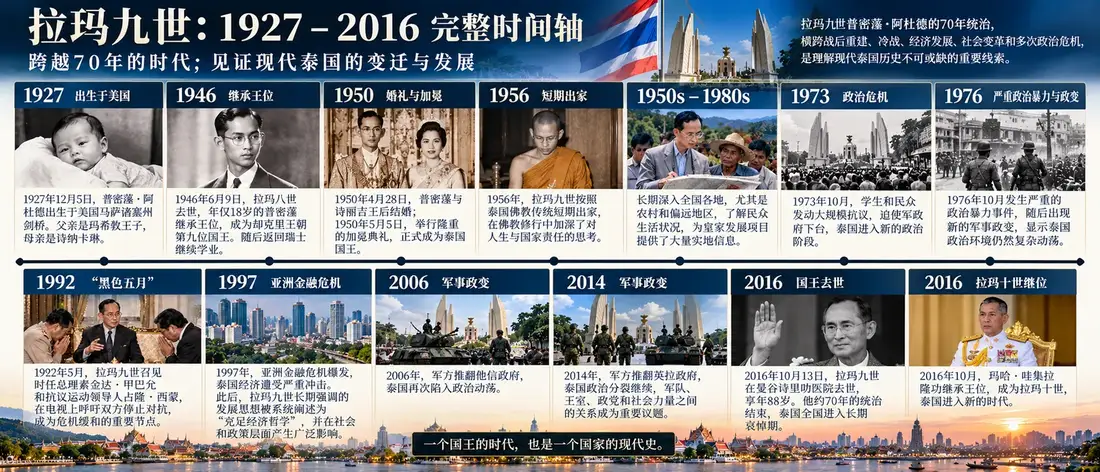
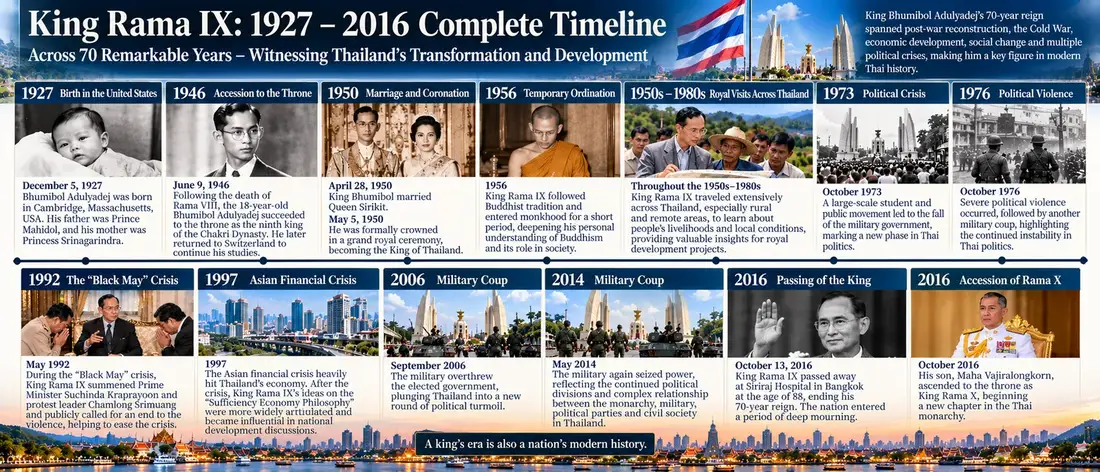
11 | Complete Timeline: 1927 → 1946 → 1950 → 1970s → 1992 → 1997 → 2016 1927 | Birth of a Prince
SEA NOW Thailand · Rama IX · Illustration 11
On December 5, Bhumibol Adulyadej was born in Cambridge, Massachusetts, United States.
He was the son of Prince Mahidol Adulyadej and a grandson of King Rama V.
↓
1946 | Accession to the Throne
On June 9, Rama VIII suddenly died.
The 18-year-old Bhumibol Adulyadej succeeded his brother as King Rama IX.
↓
1950 | The Coronation
On May 5, Rama IX was formally crowned at Bangkok’s Grand Palace.
The Rama IX era had formally begun.
↓
1970s | Development Work Across Thailand
Rama IX traveled extensively through rural, mountainous and remote regions.
Water management, agriculture, soil improvement, forests and rural development became major areas of royal development activity.
↓
1992 | Black May
A severe political confrontation erupted in Bangkok.
Rama IX summoned key leaders from both sides and publicly called for an end to the violence.
The episode became one of the best-known examples of royal intervention in a modern Thai political crisis.
↓
1997 | Asian Financial Crisis
The collapse of the baht triggered a severe economic crisis.
The King’s Sufficiency Economy Philosophy subsequently attracted much greater attention in Thai society.
↓
2016 | The End of a 70-Year Reign
On October 13, Rama IX died in Bangkok at the age of 88.
A reign that had spanned Thailand’s postwar reconstruction, the Cold War, industrialization, urbanization and globalization came to an end.
Conclusion | Why Understanding Rama IX Is Essential to Understanding Modern Thailand
From 1946 to 2016.
What does 70 years really mean?
When Rama IX became king, World War II had only just ended.
Bangkok did not yet have today’s dense network of expressways.
There was no BTS Skytrain.
No MRT subway.
No skyline of high-rise towers lining the Chao Phraya River.
Thailand remained overwhelmingly agricultural, with most of its population living in rural communities.
By the time Rama IX died in 2016, the country had changed dramatically.
Bangkok had become one of Southeast Asia’s major global cities.
Tens of millions of international visitors were arriving in Thailand.
Automobile manufacturing, electronics, tourism and modern service industries had transformed the national economy.
Thailand had become deeply integrated into the globalized world.
Of course, this transformation was not the work of one individual.
It was built by generations of Thai farmers, workers, entrepreneurs, civil servants, governments, businesses, communities and institutions.
Nor was the Rama IX era a period of uninterrupted stability.
Thailand experienced military dictatorship.
Student uprisings.
Political violence.
Repeated coups.
Financial crisis.
And a long, complicated process of democratization.
Describing the Rama IX era only as a story of “development and prosperity” would therefore fail to capture the complexity of modern Thai history.
But one fact remains impossible to ignore.
During those seven decades, Rama IX became an extraordinarily influential symbol within Thai national life.
His journeys throughout the country.
His rural development initiatives.
His interest in water management and agriculture.
His Sufficiency Economy Philosophy.
And his role during several moments of political crisis.
Together, these shaped how generations of Thais understood the monarchy.
The life of Rama IX overlapped with almost the entire history of postwar modern Thailand.
And after 2016, Thailand entered another period of change.
Globalization itself was changing.
Smartphones and social media were transforming political communication.
Younger generations increasingly expressed more diverse views about the nation, politics, society and the monarchy.
A new chapter had begun.
Following the death of King Bhumibol Adulyadej, his son Maha Vajiralongkorn succeeded to the throne.