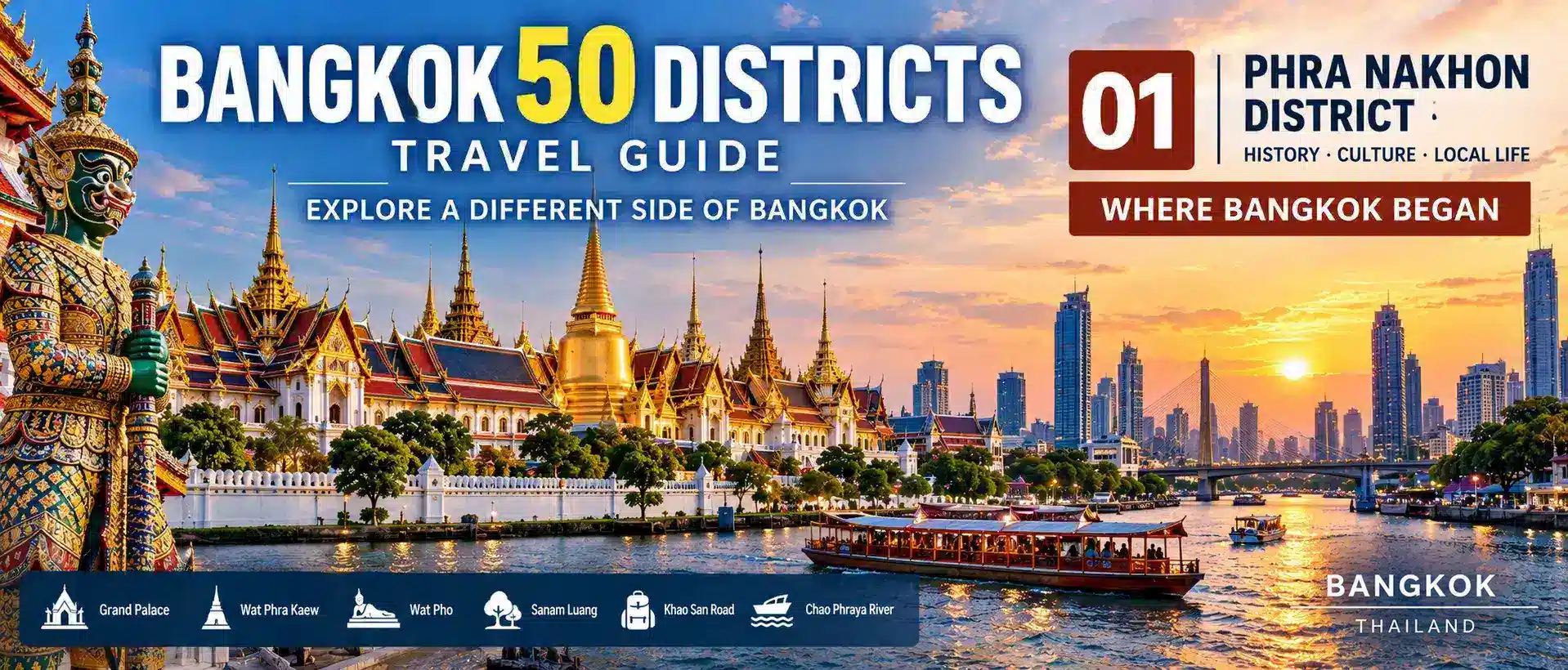
Bangkok is much more than shopping malls, rooftop bars, street food and nightlife.
Behind the modern skyline is a city made up of 50 districts, each with its own history, communities, streets, food and rhythm of life.
So instead of looking at Bangkok only through a list of famous attractions, SEA NOW THAILAND is starting a new journey:
Bangkok 50 Districts Travel Guide.
One district at a time, we will explore the city more deeply.
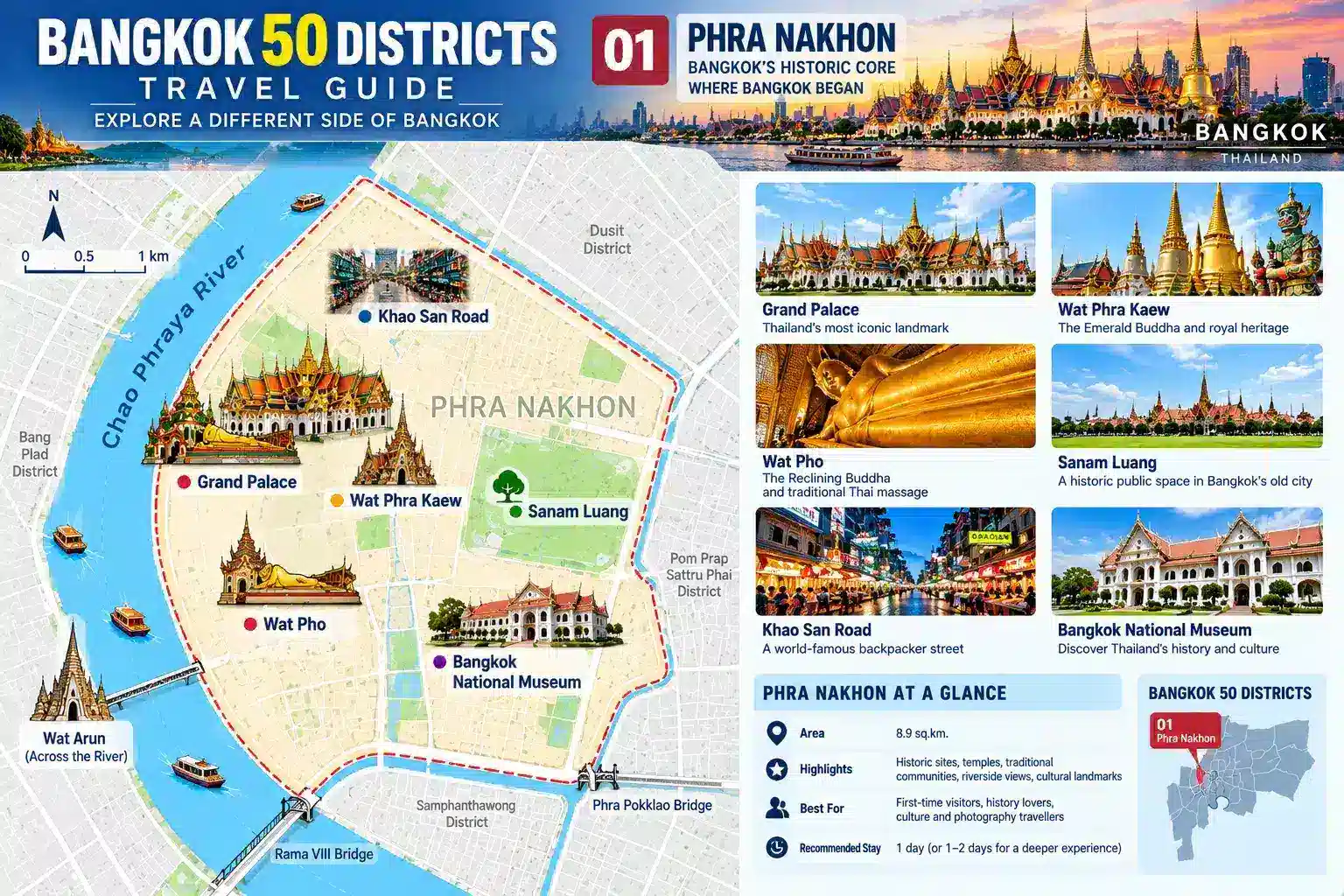
And for our first stop, there could hardly be a better place to begin:
Phra Nakhon — the historic heart of Bangkok.
01|Why Start with Phra Nakhon?
If you want to understand Bangkok, Phra Nakhon is one of the best places to start.
This is where some of the most recognizable images of Thailand come together: royal palaces, Buddhist temples, old streets, museums, traditional neighborhoods and the Chao Phraya River.
When Bangkok became the capital of Siam in 1782, the new royal and administrative center developed around this part of the city.
More than two centuries later, that history remains visible everywhere.
Walk through Phra Nakhon today and you are not simply moving between tourist attractions.
You are walking through layers of Bangkok's history.
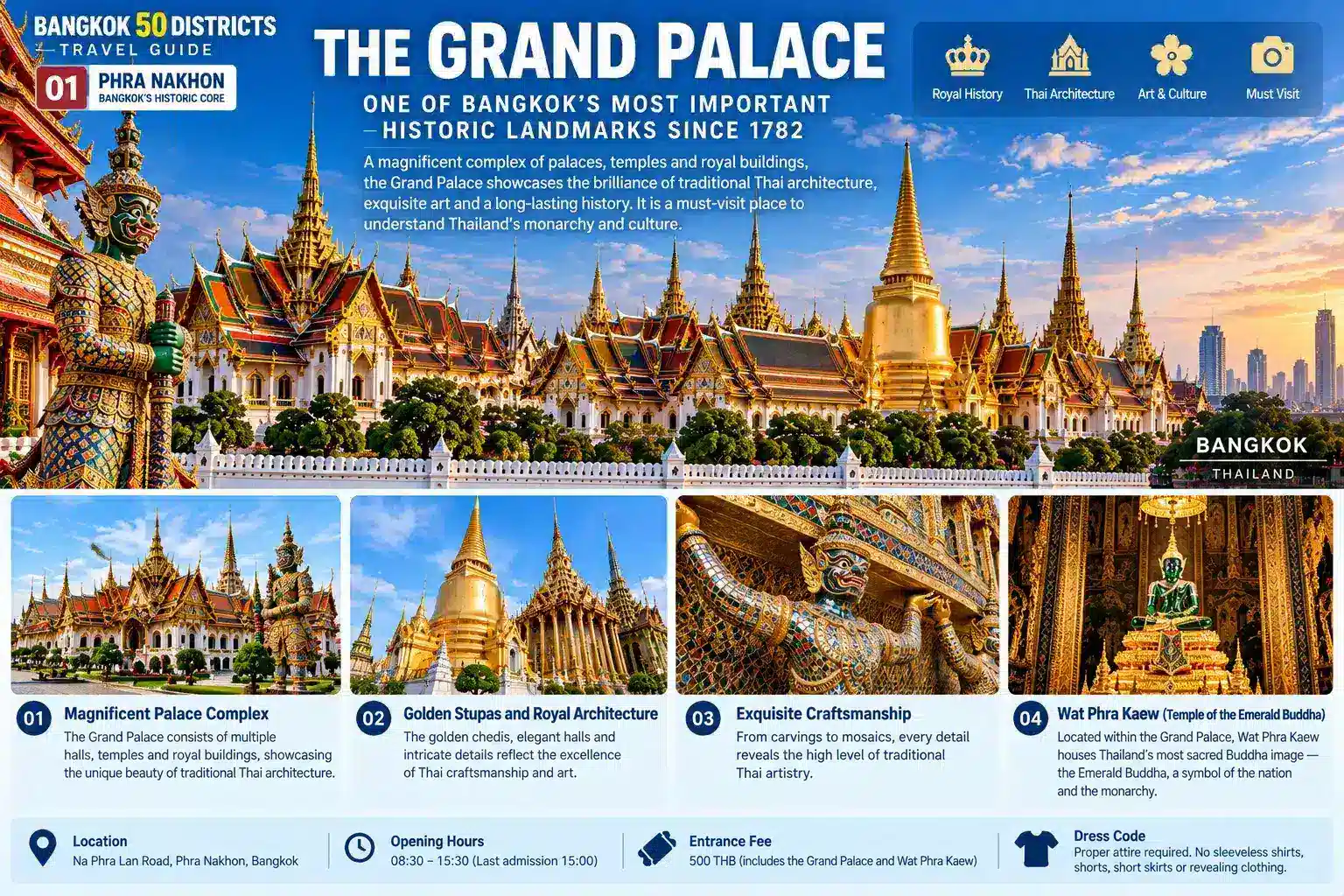
02|The Grand Palace: One of Bangkok’s Most Important Historic Landmarks Since 1782
For many first-time visitors, the Grand Palace is the natural starting point.
Construction began in 1782, when King Rama I established Bangkok as the new capital of the Rattanakosin Kingdom.
The palace became closely connected with royal administration, ceremonies and the political center of the new capital.
Even today, its architecture immediately communicates the scale and importance of the early Rattanakosin period.
Golden spires rise above white walls.
Traditional Thai roofs overlap in layers of red, green and gold.
Courtyards, ceremonial halls and religious structures form one of Bangkok's most recognizable architectural complexes.
But the Grand Palace is more than a beautiful place to photograph.
It is one of the key places for understanding how modern Bangkok began.
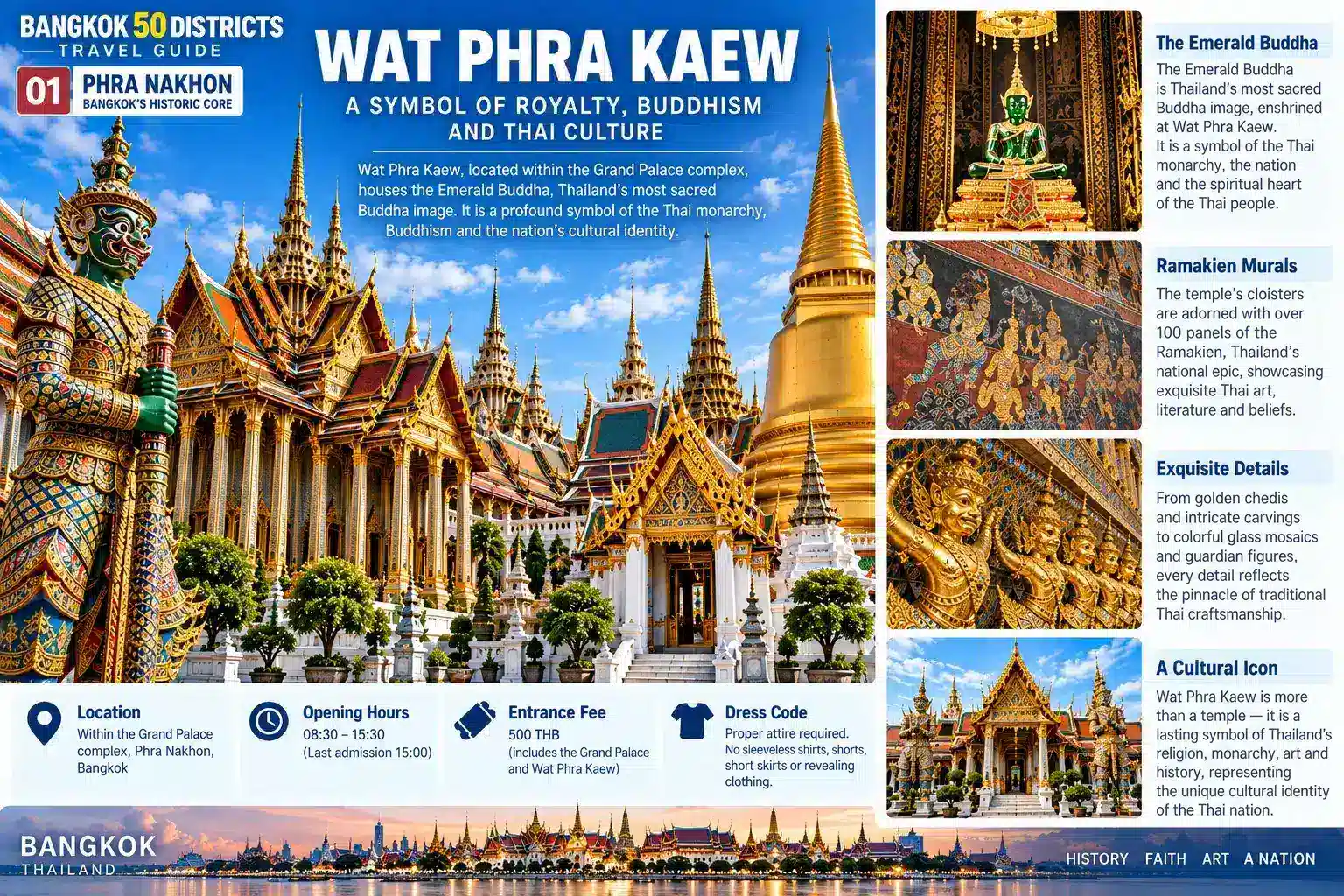
03|Wat Phra Kaew: Royalty, Buddhism and Thai Culture
Located within the Grand Palace complex, Wat Phra Kaew — the Temple of the Emerald Buddha — is one of Thailand's most important Buddhist sites.
At its center is the Emerald Buddha, one of the country's most revered religious images.
The temple also offers visitors an extraordinary introduction to Thai religious art and architecture.
Golden chedis, elaborate murals, guardian figures and richly decorated buildings fill the complex.
This is not simply another sightseeing stop.
It is a place where Buddhism, kingship, history, architecture and national culture intersect.
Visitors should therefore remember that this is an active sacred space.
Dress appropriately, behave respectfully and take the time to observe the details rather than rushing through for photographs.
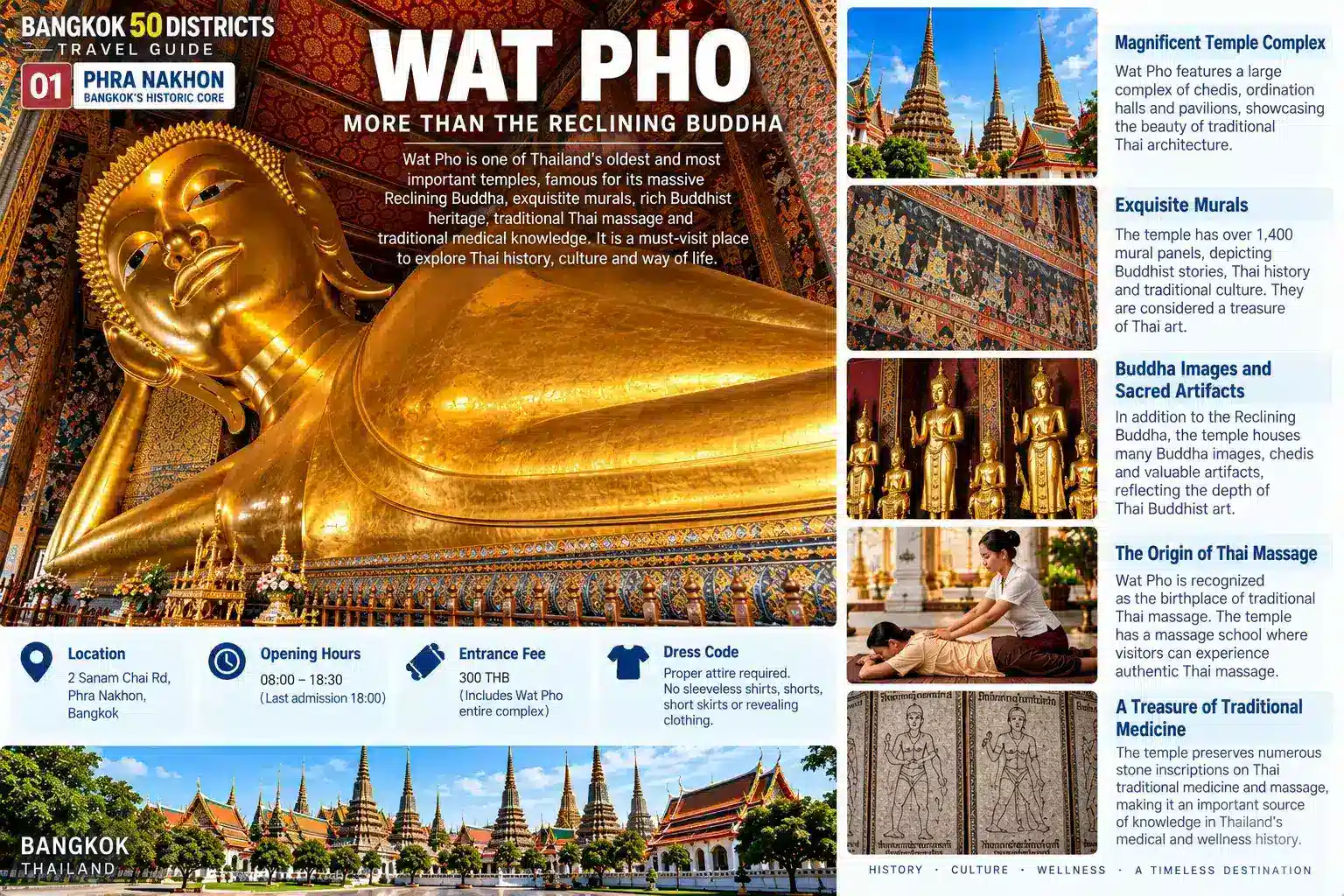
04|Wat Pho: Much More Than a Reclining Buddha
A short walk from the Grand Palace brings you to Wat Pho, officially known as Wat Phra Chetuphon.
Most travelers know it because of its enormous Reclining Buddha.
And yes, the statue is spectacular.
But stopping there means missing much of what makes Wat Pho special.
The temple complex contains courtyards, stupas, inscriptions, sculptures and traditional knowledge accumulated over generations.
Wat Pho is also closely associated with traditional Thai massage and historical education.
Spend some extra time walking through the quieter parts of the temple grounds.
You may discover that the famous Reclining Buddha is only the beginning of the story.
05|Sanam Luang: The Great Open Space of Bangkok’s Old City
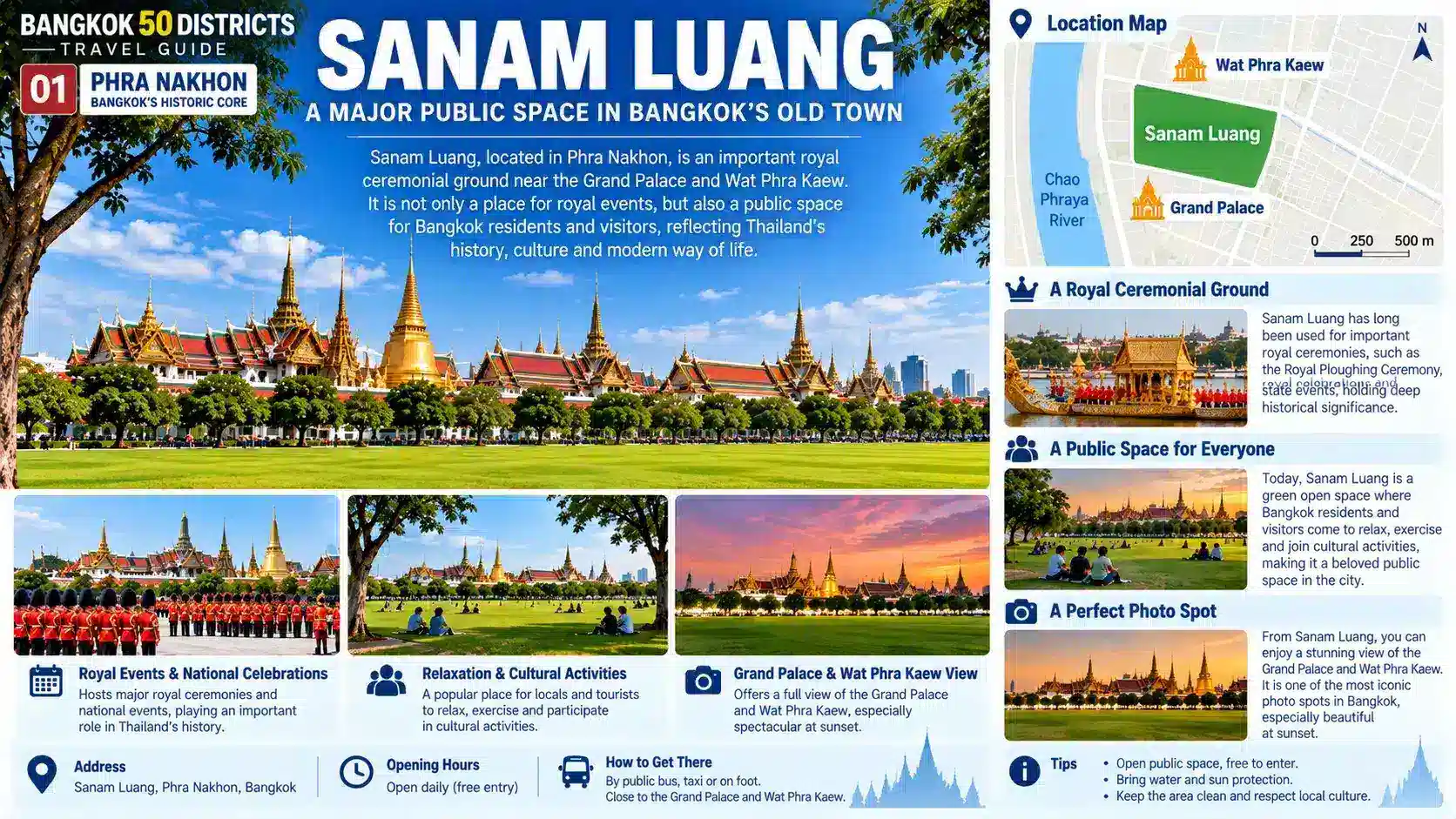
Next to the Grand Palace is a huge open field that can look surprisingly simple compared with the surrounding temples and palaces.
This is Sanam Luang.
Its importance comes not from elaborate architecture but from its role as one of Bangkok's major ceremonial and public spaces.
For generations, this area has been connected with royal ceremonies, national events and public gatherings.
It also changes the visual rhythm of the old city.
After walking through narrow streets, temple compounds and crowded tourist areas, Sanam Luang suddenly opens the landscape.
From here, the scale of historic Bangkok becomes much easier to appreciate.
06|Bangkok National Museum: Start with the Objects to Understand Thai History
If temples tell one part of Thailand's story, museums help connect the pieces.
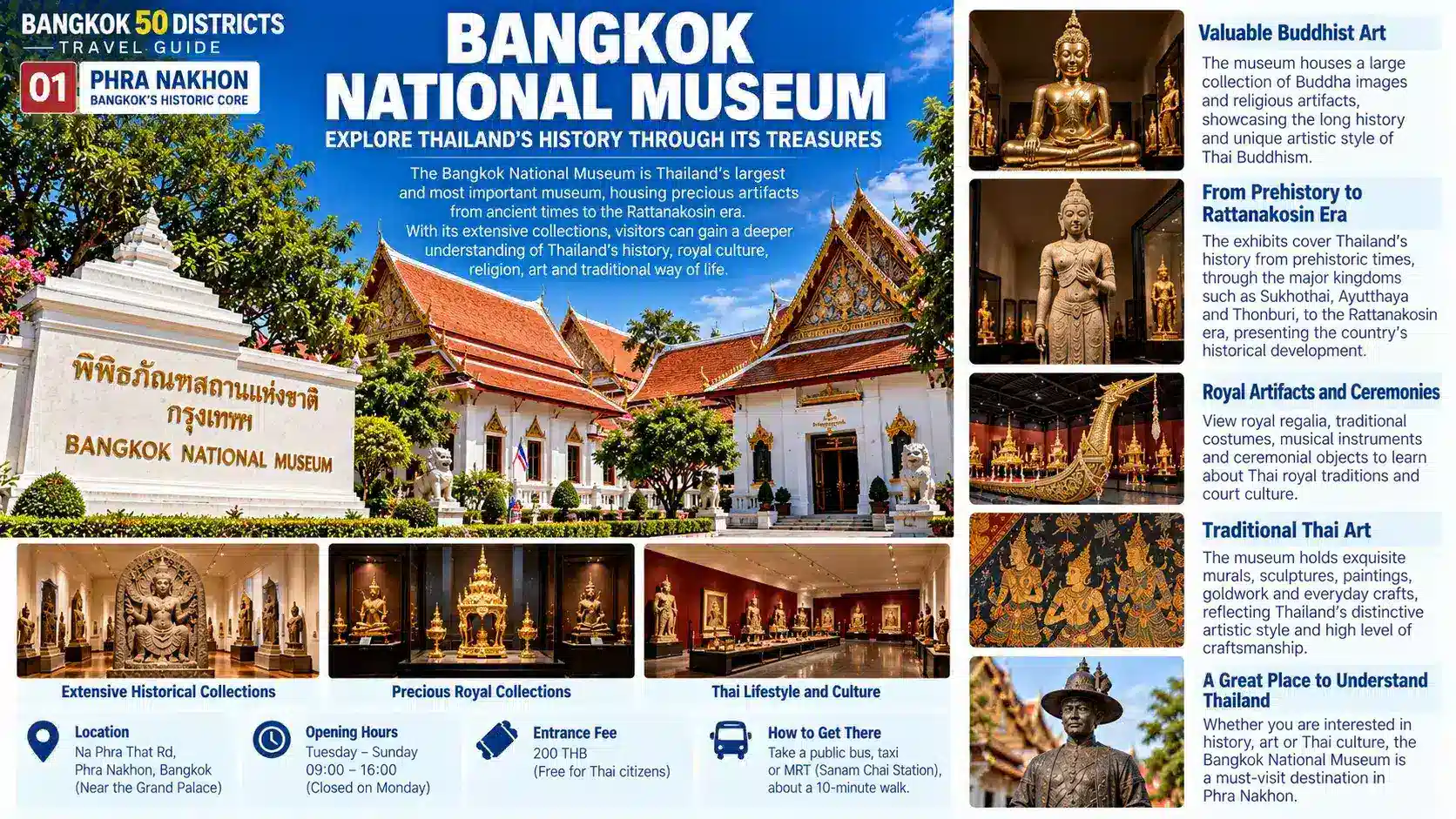
The Bangkok National Museum is one of the most useful stops for travelers who want more historical context.
Its collections introduce visitors to Thai art, religious objects, royal artifacts, sculpture and material culture from different historical periods.
Visiting the museum can completely change the way you see the temples and historic buildings outside.
Objects that might otherwise look simply “old” or “beautiful” begin to make more sense once you understand their cultural and historical background.
For history lovers, this deserves more than a quick visit.
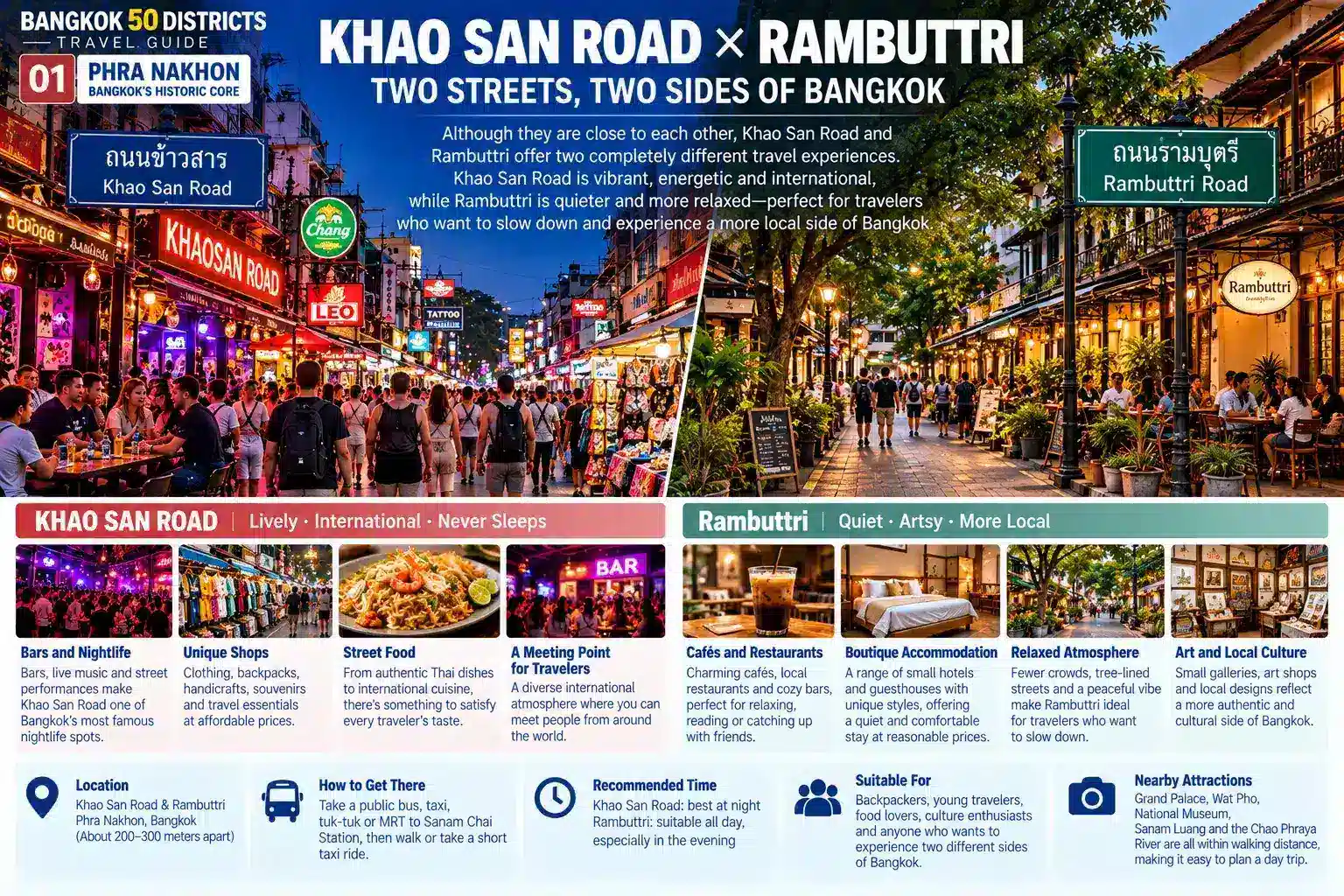
07|Khao San Road: One Street, Two Bangkoks
Then comes a completely different side of Phra Nakhon.
Khao San Road.
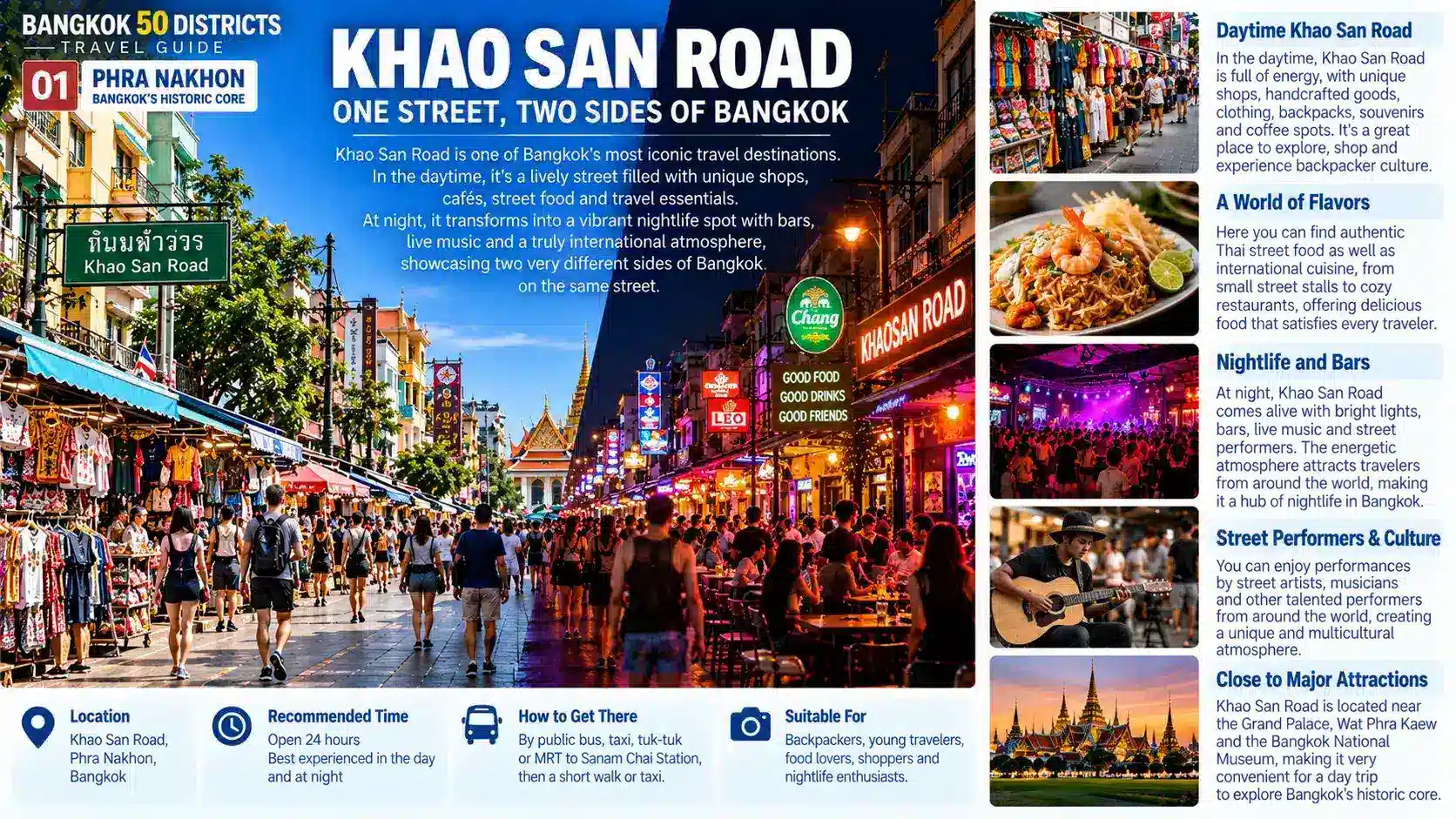
During the day, the street can feel relatively relaxed.
Travelers eat breakfast, book transportation, shop, exchange money or simply walk around the neighborhood.
After sunset, everything changes.
Lights come on.
Music gets louder.
Bars fill up.
Street vendors appear.
Travelers from around the world gather along a street that has been part of Bangkok's backpacker culture for decades.
Whether you love it or avoid it, Khao San Road is undeniably part of modern Bangkok's travel history.
08|Khao San Road × Rambuttri: Energy vs. Slow Travel
If Khao San feels too intense, don't leave the neighborhood immediately.
Walk toward Soi Rambuttri.
The atmosphere changes surprisingly quickly.
Khao San is loud, energetic and packed with activity.
Rambuttri tends to feel slower, greener and more relaxed.
You can sit at a café, eat dinner, have a drink or simply watch people pass by without feeling that you need to keep moving.
The two streets are close together, but they offer very different experiences.
That contrast is exactly what makes this part of Phra Nakhon interesting.
Khao San gives you energy.
Rambuttri gives you time.
09|The Chao Phraya River: See Bangkok from Another Angle
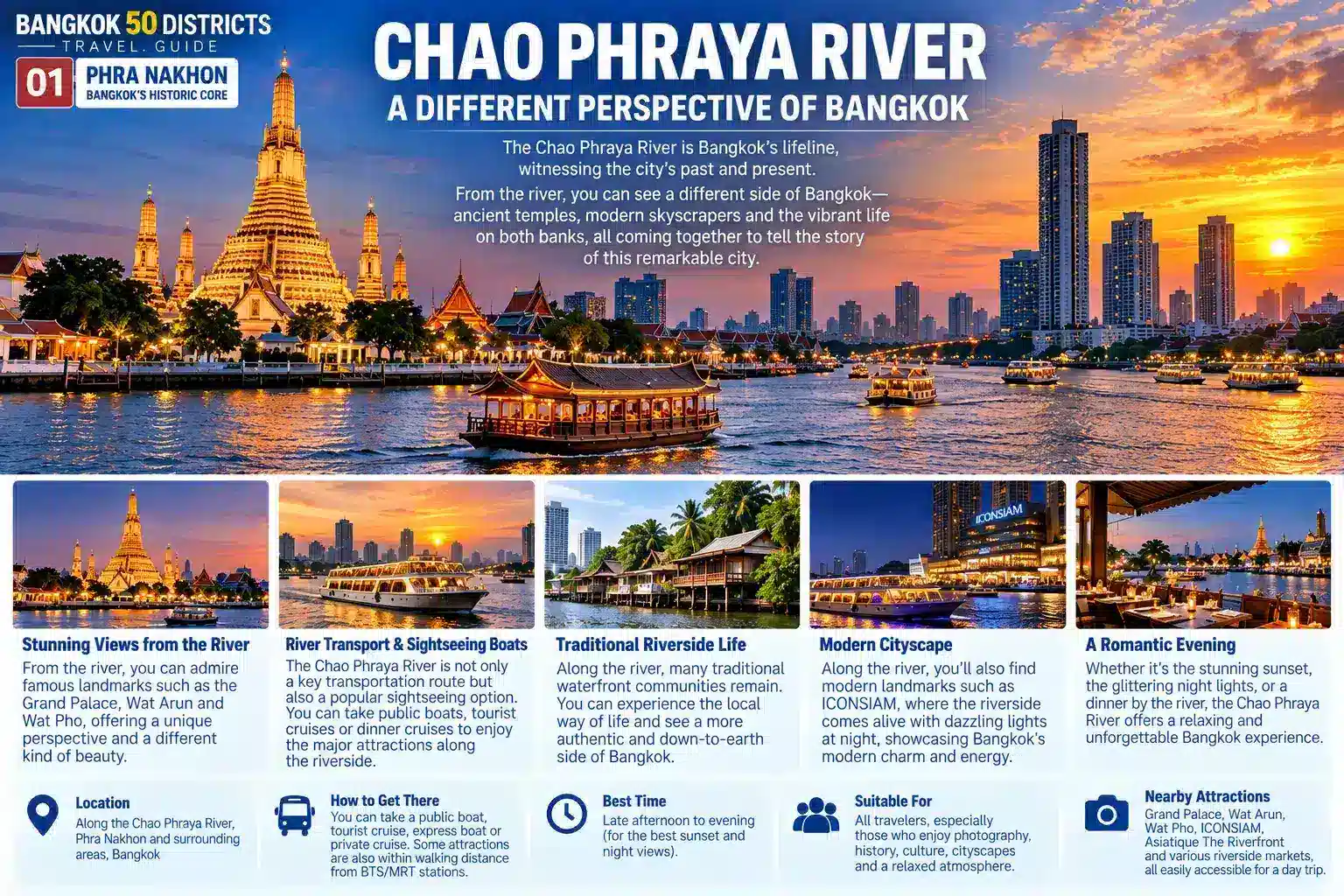
One of the best ways to understand Bangkok is to stop looking at it only from the road.
Look at it from the river.
The Chao Phraya River has shaped Bangkok's development for centuries.
Long before modern roads, highways and rail systems transformed the city, waterways were essential transportation routes.
Even today, taking a boat through the historic center offers a completely different perspective.
Temples appear between modern buildings.
Old neighborhoods sit beside hotels and condominiums.
Ferries cross between riverbanks.
Long-tail boats move past commuter boats and tourist vessels.
And across the water stands one of Bangkok's great landmarks:
Wat Arun.
From Phra Nakhon, the river does not feel like the edge of the district.
It feels like part of the city's main street.
10|The Streets of Old Bangkok: The Phra Nakhon That Guidebooks Often Miss
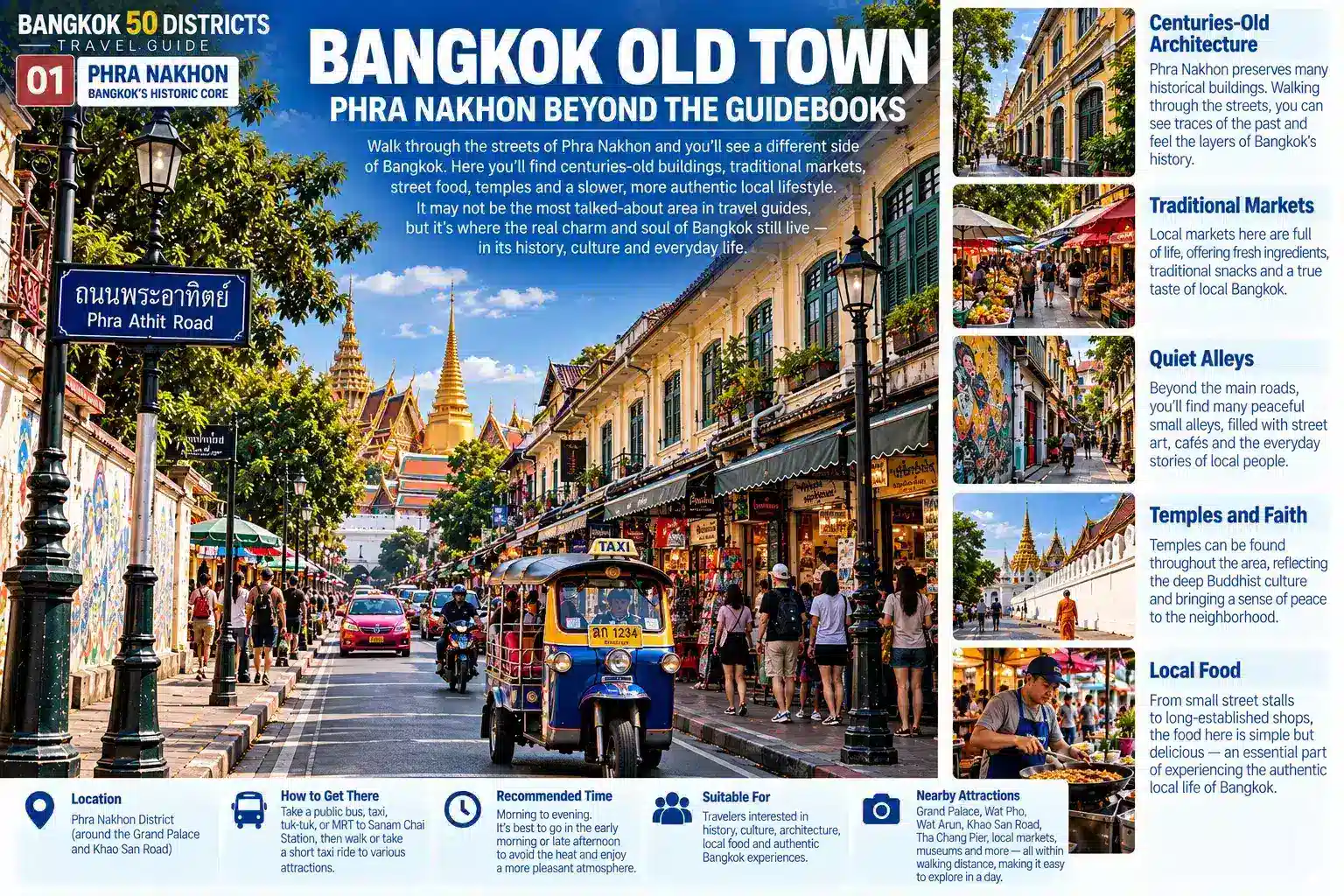
The famous attractions are important.
But some of the best moments in Phra Nakhon happen between them.
Walk away from the main tourist routes and pay attention to the streets.
Old shophouses.
Small family restaurants.
Temple walls.
Traditional signs.
Street vendors preparing food.
Motorcycles passing through narrow lanes.
Local residents sitting outside their homes.
Monks walking through the neighborhood in the morning.
These scenes may never appear on a “Top 10 Bangkok Attractions” list.
But they are part of what makes the old city feel alive.
Phra Nakhon is not an open-air museum.
People still live, work, eat, pray and commute here every day.
11|Phra Nakhon Food Map: Eat While You Explore
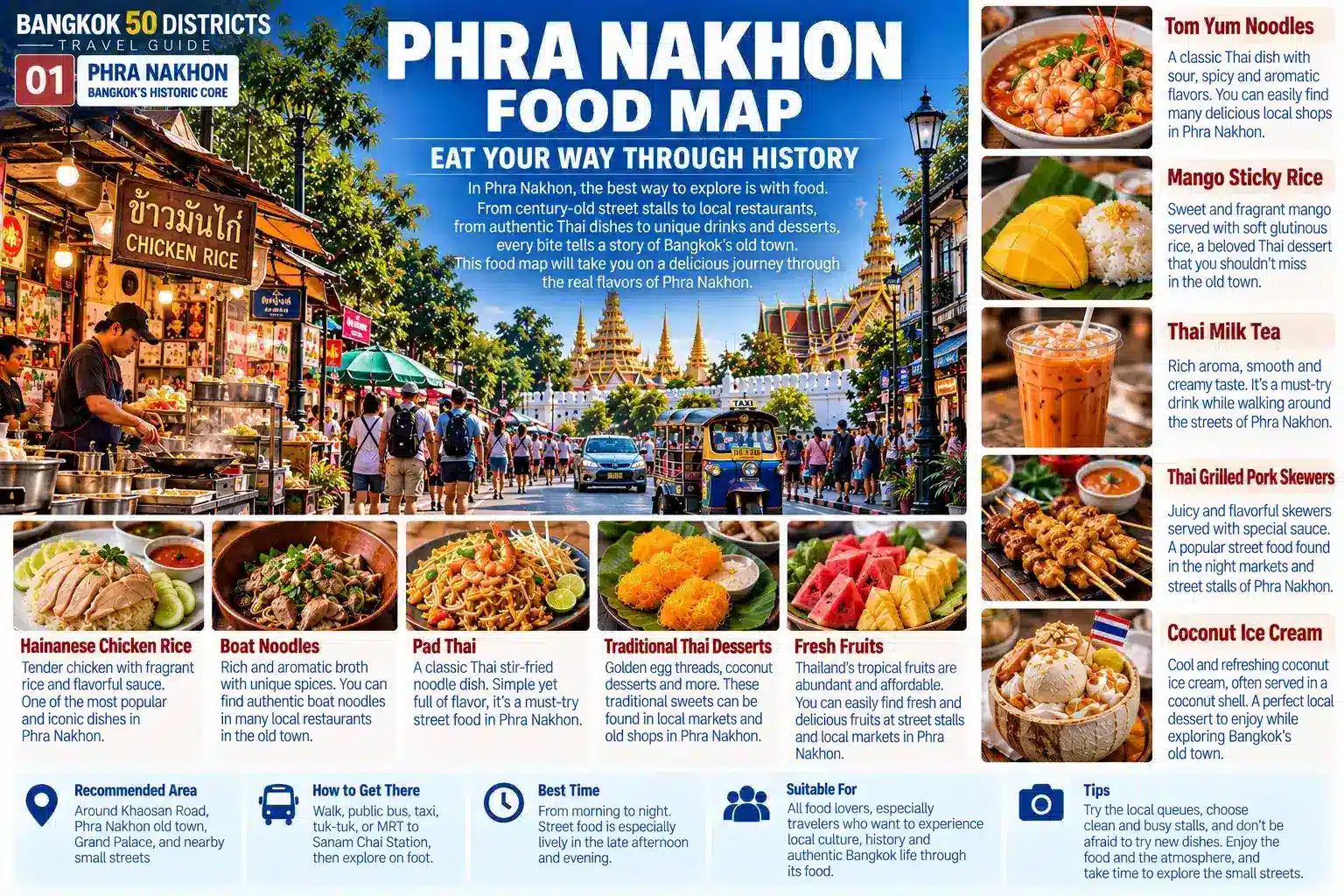
Do not visit Phra Nakhon on a full stomach.
Food is part of the experience.
Around the old city, you can find traditional Thai dishes, noodles, grilled meats, curries, desserts, coffee shops and decades-old local restaurants.
Instead of planning one famous restaurant as the center of the day, try something different:
walk first, eat along the way.
Have breakfast near the old town.
Stop for a drink after visiting a temple.
Try a small local restaurant for lunch.
Grab a snack in the afternoon.
Finish with dinner around Khao San, Rambuttri or another nearby neighborhood.
In Phra Nakhon, food can become part of the route rather than a separate destination.
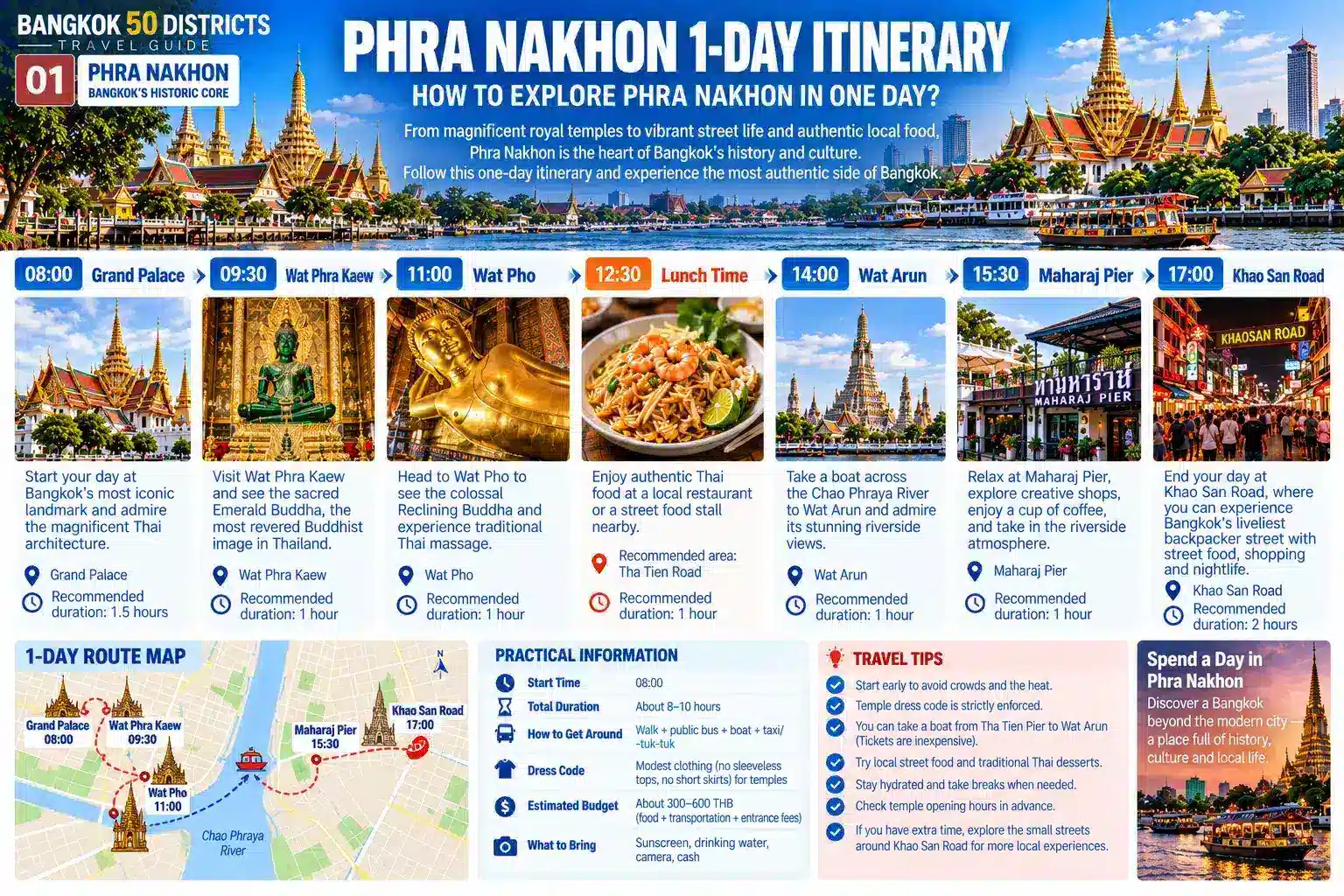
12|One-Day Phra Nakhon Itinerary
If you only have one day, don't try to see everything.
A comfortable route could look like this:
08:30 — Grand Palace & Wat Phra Kaew
Start early before the strongest afternoon heat.
10:30 — Wat Pho
Walk south and explore the temple complex.
12:00 — Lunch in the Old City
Find a local restaurant and take a proper break.
13:30 — Bangkok National Museum / Old Town Walk
Choose the museum if you enjoy history, or spend more time exploring the streets.
15:30 — Chao Phraya River
Take a ferry or river boat and see the historic center from the water.
17:30 — Return to the Old City
Slow down, find coffee or take a short rest.
18:30 — Rambuttri
Have dinner and enjoy the more relaxed evening atmosphere.
20:00 — Khao San Road
Finish the day with the completely different nighttime side of Phra Nakhon.
The point is not to collect as many attractions as possible.
The point is to experience how the district changes from morning to night.
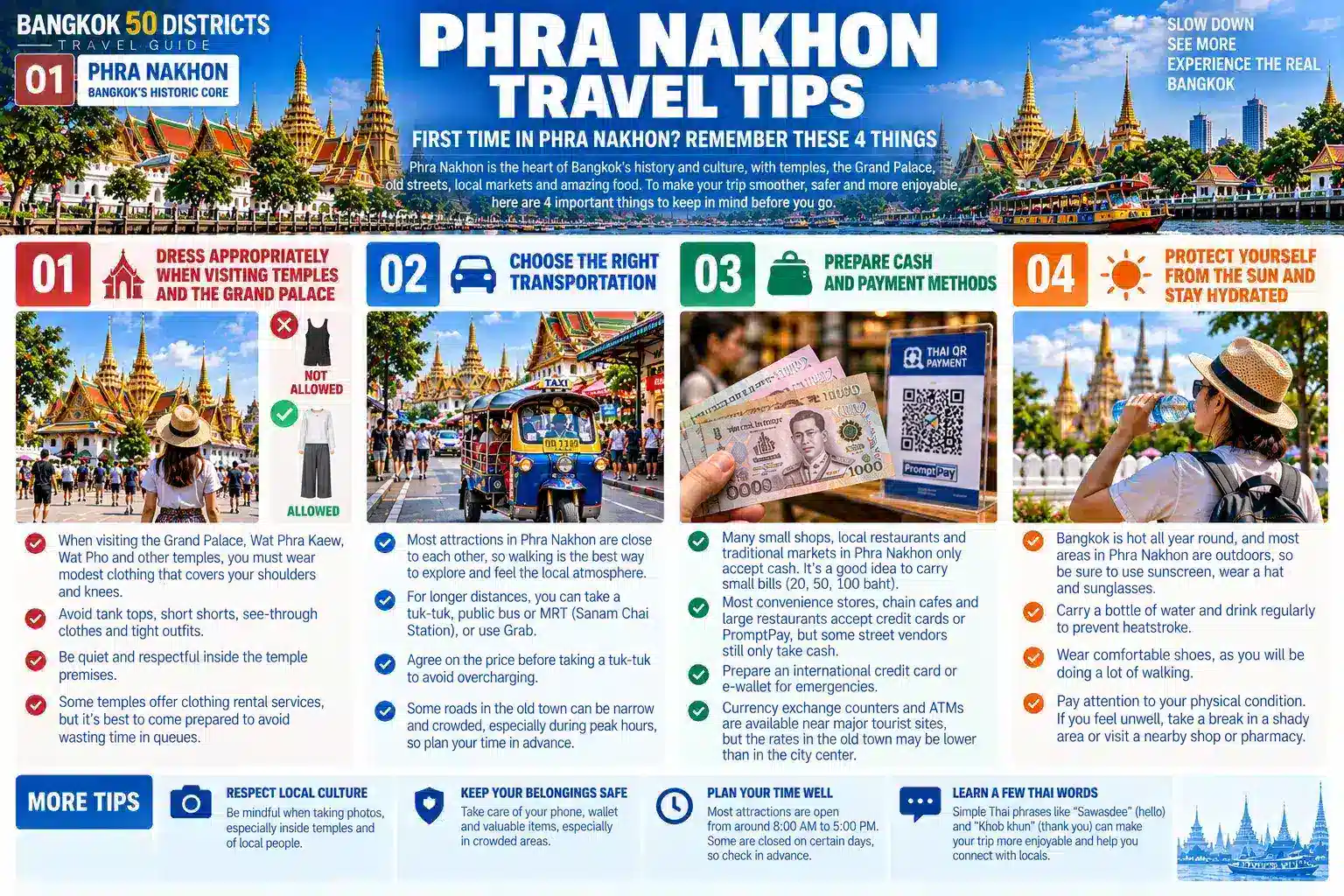
13|First Time in Phra Nakhon? Remember These 4 Things
① Dress appropriately for temples
When visiting the Grand Palace, Wat Phra Kaew and other religious sites, wear clothing suitable for sacred places.
Avoid arriving in clothing that may prevent entry.
② Don't rely on cars for every journey
Many attractions in Phra Nakhon are relatively close together.
Walking, ferries, river boats and short local transport connections can sometimes make more sense than repeatedly calling a car.
③ Carry some cash
Digital payments are widespread in Thailand, but small shops, street vendors and some traditional businesses may still be easier to use with cash.
④ Prepare for Bangkok's heat
The old city involves a lot of outdoor walking.
Bring water, use sunscreen, wear comfortable shoes and take breaks when necessary.
Trying to rush through every attraction in the midday heat can quickly turn a good itinerary into an exhausting one.
14|Why Phra Nakhon Is More Than a Tourist District
It is easy to describe Phra Nakhon as simply “Bangkok Old Town.”
But that description is incomplete.
This district contains several versions of Bangkok at the same time.
There is the Bangkok of kings and royal ceremonies.
The Bangkok of temples and Buddhist traditions.
The Bangkok of museums and historical memory.
The Bangkok of river transportation.
The Bangkok of old neighborhoods and local restaurants.
And the Bangkok of international backpackers on Khao San Road.
They exist only minutes apart.
That is why Phra Nakhon deserves to be the beginning of this series.
If you want to understand where Bangkok came from, this is one of the places where the story becomes visible.
Bangkok 50 Districts
01 / 50 UNLOCKED
PHRA NAKHON ✓
Historic temples.
Royal heritage.
Old streets.
Local food.
River life.
Backpacker culture.
This is only the beginning.
There are still 49 districts waiting for us.
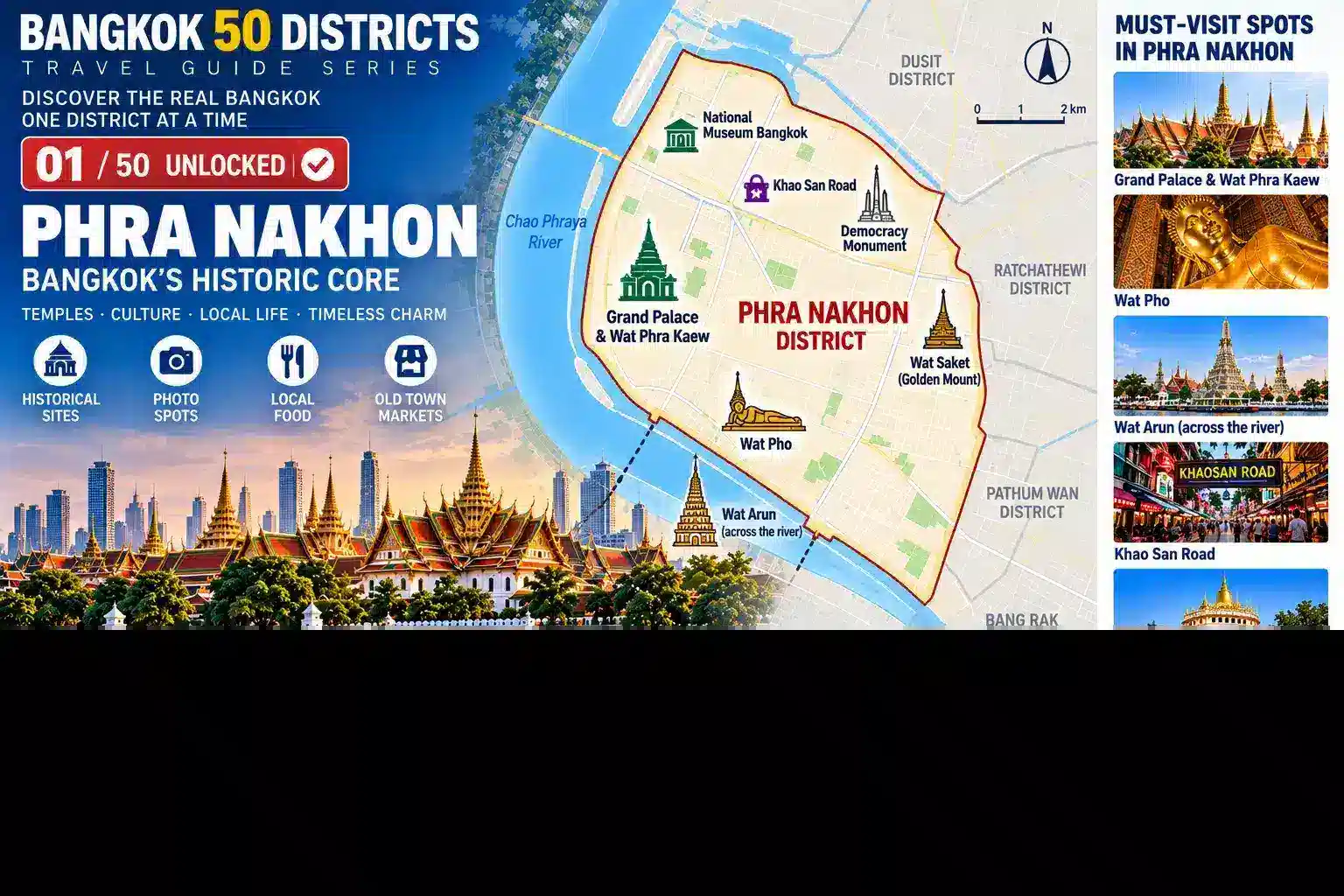
NEXT STOP → 02 DUSIT