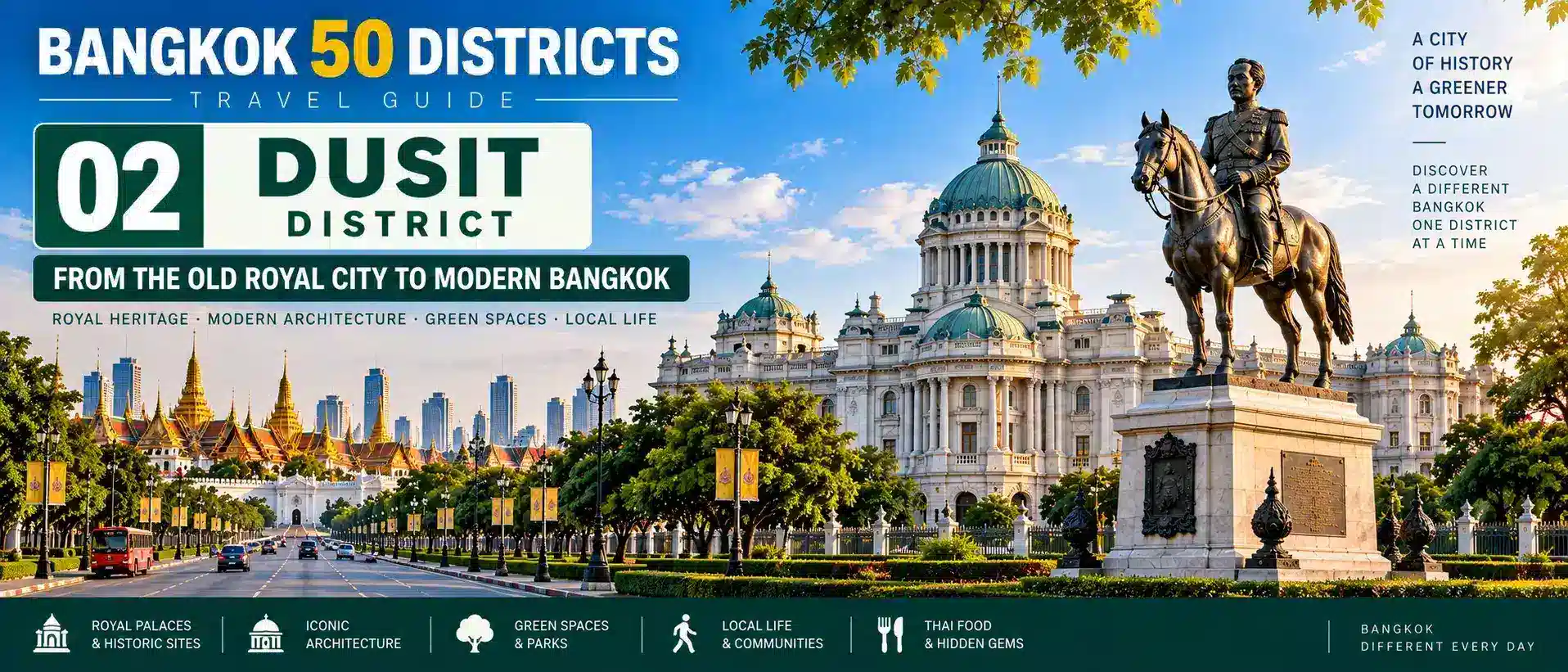
For our second stop, we travel north.
Not very far on the map, but into a very different side of Bangkok:
Dusit District.
Here, the streets become wider. Green spaces appear between grand buildings. Royal residences, government institutions and European-influenced architecture begin to reshape the cityscape.
If Phra Nakhon represents the historical starting point of Bangkok, Dusit shows us how the capital began moving toward the modern era.
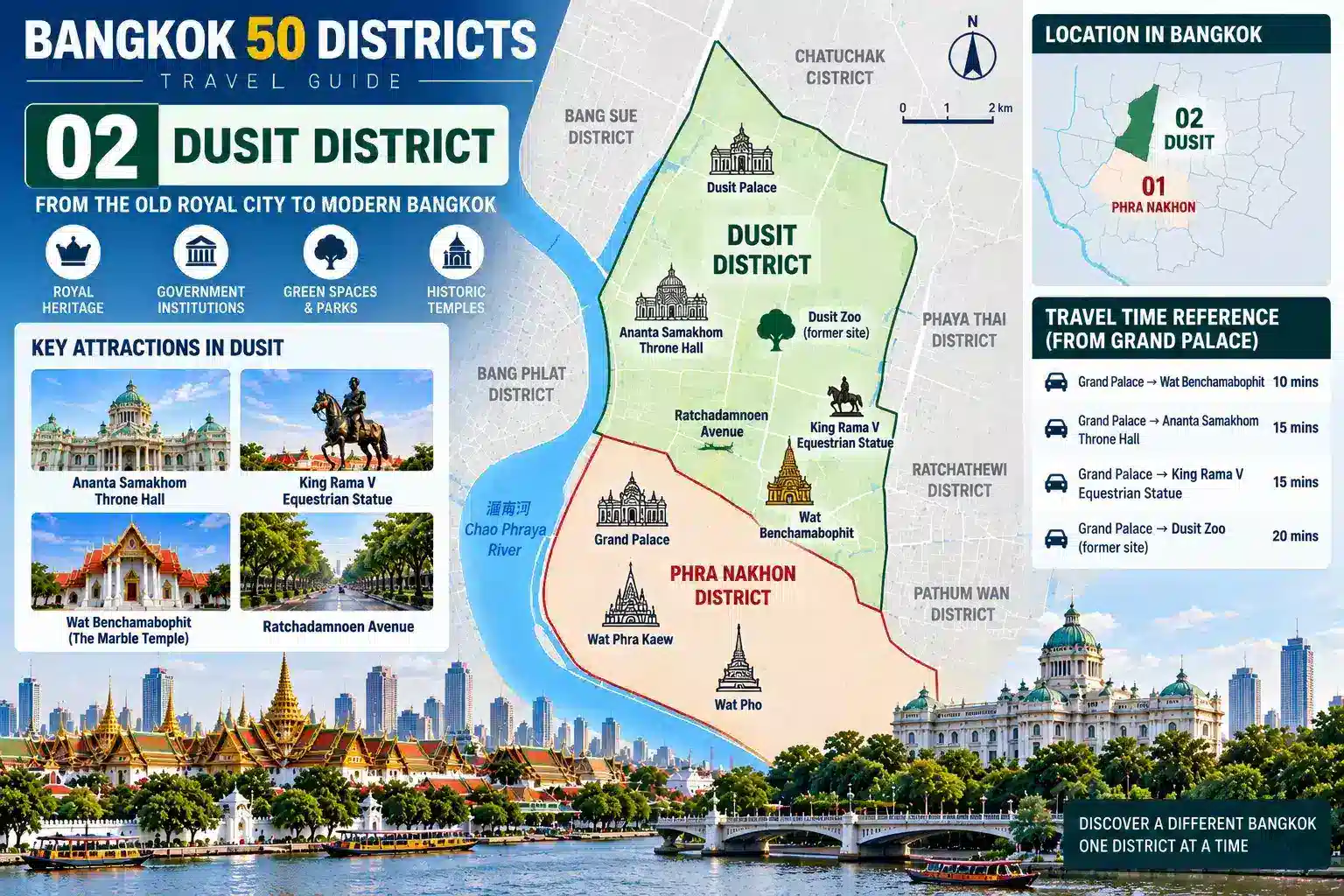
01|Where Is Dusit?
Dusit lies directly north of Bangkok's historic old city.
On a map, Phra Nakhon and Dusit almost seem to flow into one another.
But once you move north, the atmosphere begins to change.
The dense network of temples, markets and narrow streets gradually gives way to broader avenues, landscaped grounds, government buildings and royal architecture.
This transformation became especially important during the reign of King Rama V (Chulalongkorn).
Bangkok was expanding beyond its traditional royal center, and Dusit became one of the most visible symbols of that expansion.
For travelers interested in more than individual attractions, this is what makes Dusit fascinating:
the district itself is part of Bangkok's modern history.
02|Dusit Palace and the Expansion of Bangkok
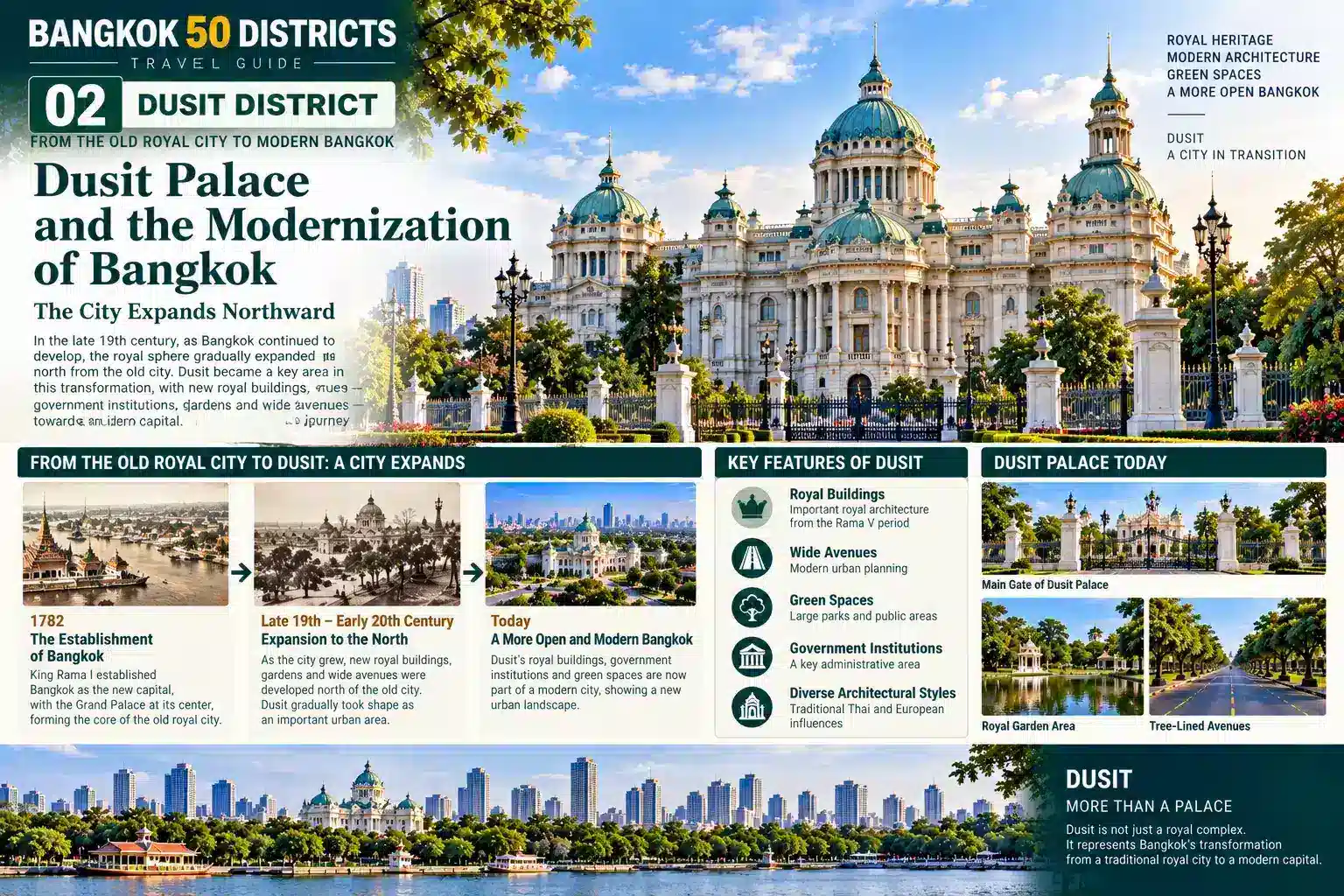
One of the best places to begin understanding the district is the wider Dusit Palace area.
By the late 19th century, Bangkok was no longer developing only around the Grand Palace.
New royal residences, gardens, avenues and administrative spaces began appearing farther north.
The difference is easy to notice.
Buildings are more widely spaced.
Roads become broader.
Green areas play a larger role in the urban landscape.
Compared with the compact fabric of the old city, Dusit feels deliberately more open.
Rather than looking only at individual buildings, look at the scale of the entire district.
It reveals how Bangkok was gradually transforming from a traditional royal capital into a more modern city.
03|Ananta Samakhom Throne Hall: A Different Bangkok Appears
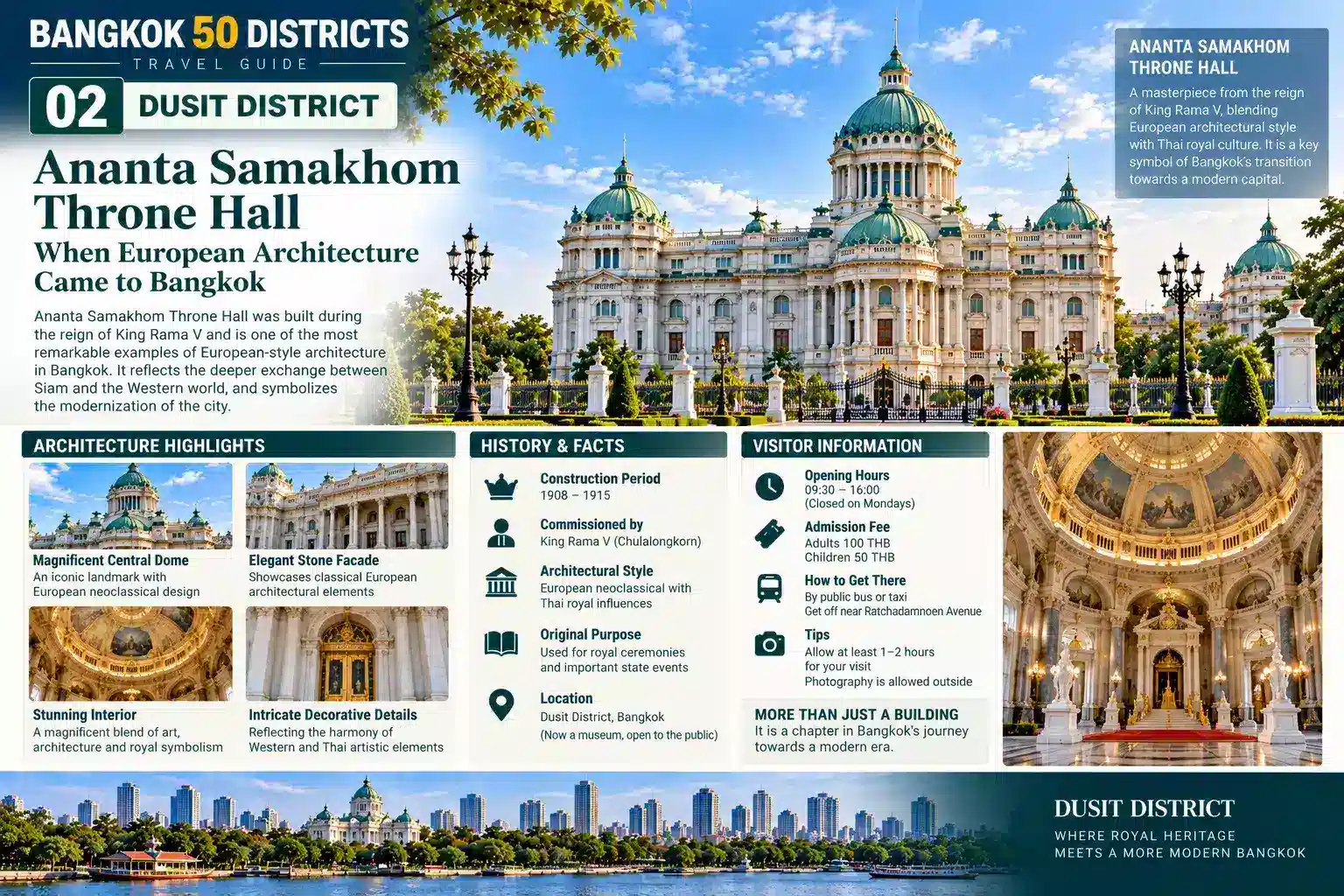
One of the most striking landmarks in Dusit is the Ananta Samakhom Throne Hall.
Its monumental dome, stone façade and European architectural language create a dramatic contrast with the traditional Thai roofs and temple complexes of Phra Nakhon.
And that contrast tells an important story.
During the late 19th and early 20th centuries, Siam's relationship with Europe was becoming increasingly important.
Those connections influenced diplomacy, education, infrastructure, technology and architecture.
Bangkok began to absorb new ideas while maintaining its own cultural identity.
Dusit is one of the clearest places to see that transition physically written into the city.
Traditional Thailand had not disappeared.
Instead, a new architectural layer had been added to Bangkok.
04|King Rama V and Ratchadamnoen Avenue
The development of Dusit is closely connected with the reign of King Rama V.
His era was one of major transformation for Siam.
Administrative reforms, railways, postal services, education, infrastructure and new forms of urban planning gradually changed the country.
Bangkok changed with it.
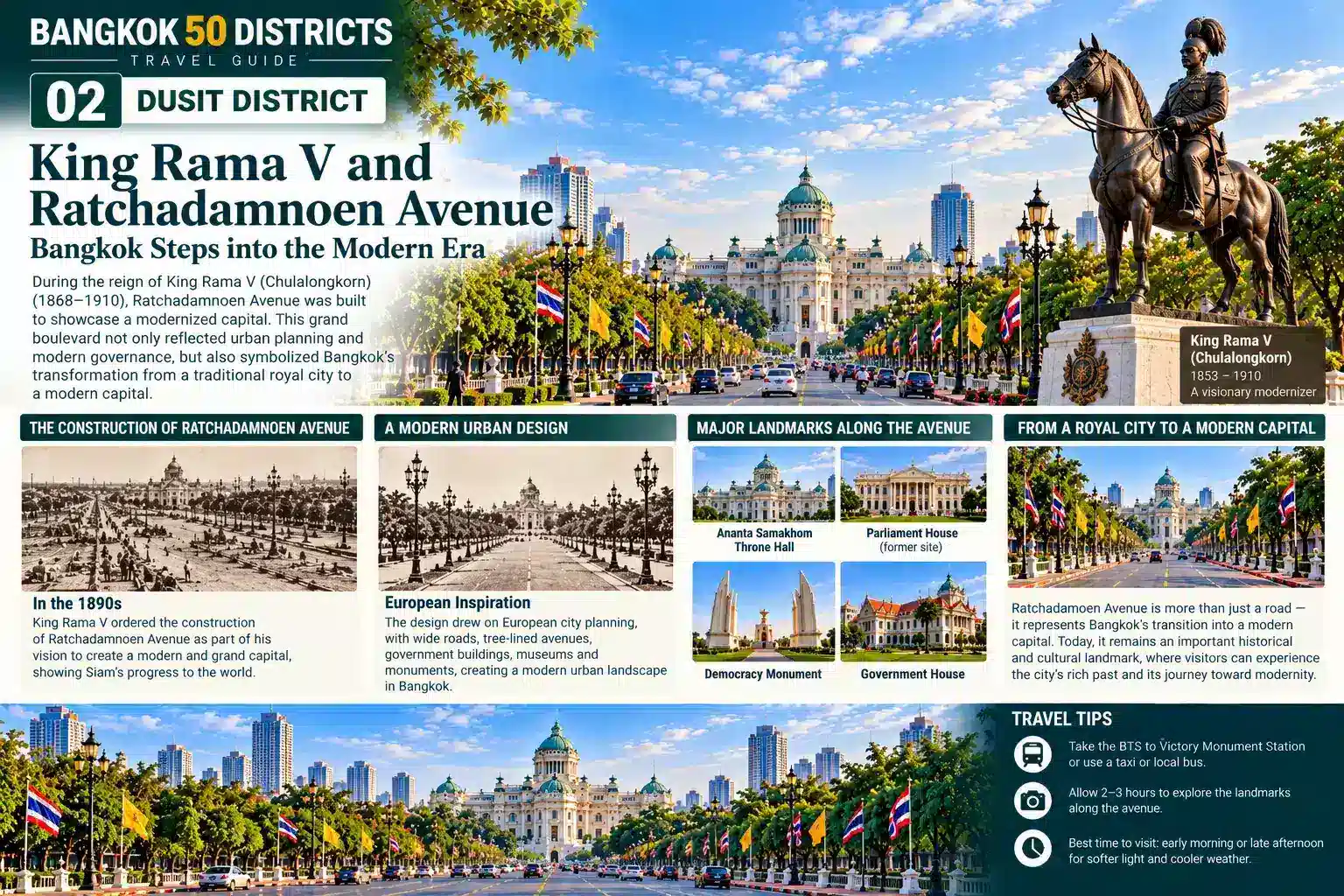
One of the most visible examples is Ratchadamnoen Avenue, the grand urban axis connecting important parts of the old royal city with the expanding capital.
If you have just come from the narrow streets of Phra Nakhon, the difference is immediate.
Bangkok suddenly feels wider.
More formal.
More planned.
The road itself becomes part of the historical experience.
It does not simply connect two places.
It connects two stages in Bangkok's development.
05|Wat Benchamabophit: The Marble Temple
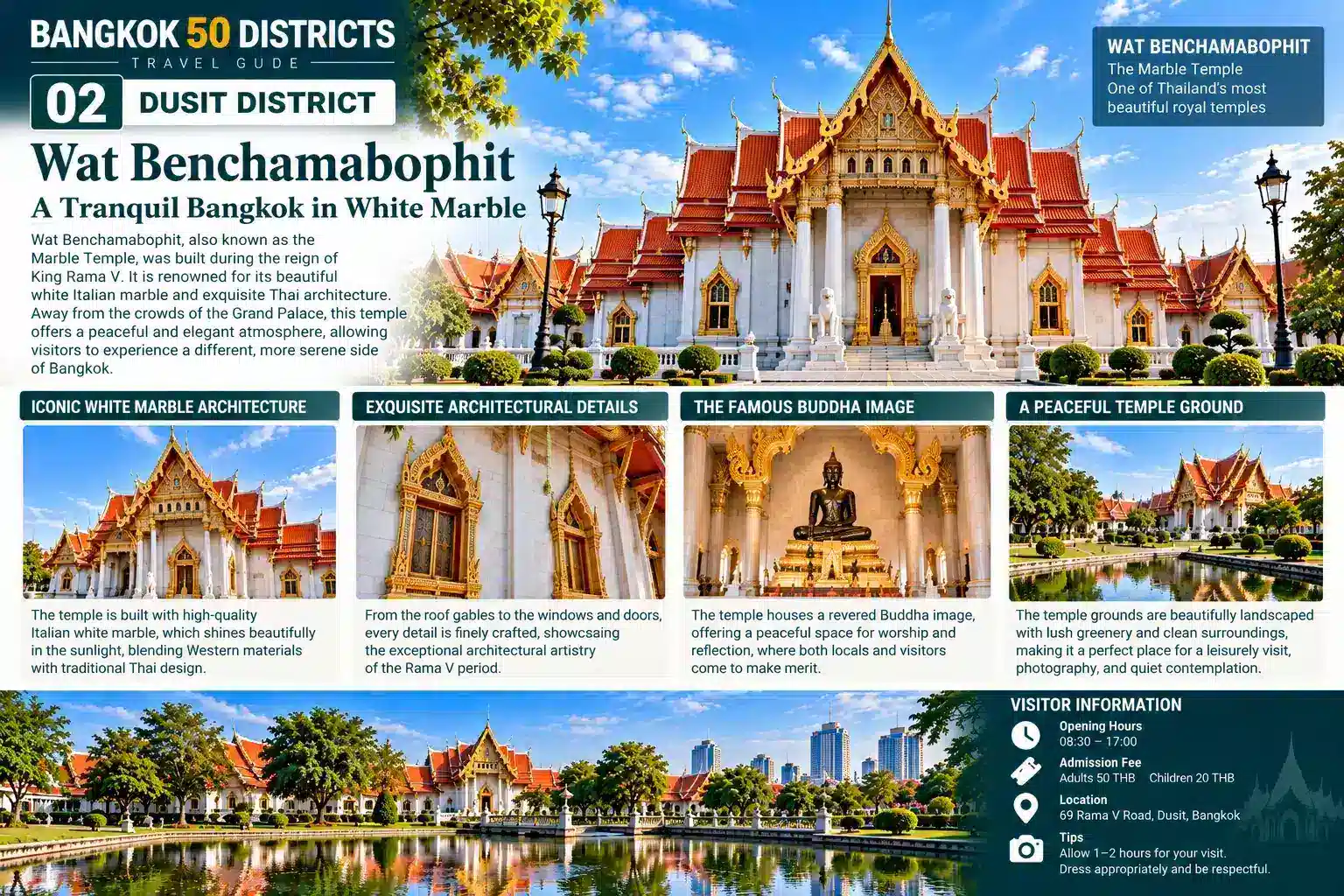
Among Dusit's religious landmarks, Wat Benchamabophit, commonly known as the Marble Temple, is one of the most memorable.
White marble, orange-red roofs and elegant Thai architectural details create a distinctive visual identity.
Compared with the busiest attractions around the Grand Palace, the atmosphere here can feel noticeably calmer.
It is a place worth experiencing slowly.
Walk through the temple grounds.
Look at the reflections on the marble.
Notice how traditional Thai design interacts with materials and influences associated with a changing era.
Early morning is particularly pleasant, especially for photography and a quieter visit.
But remember that this is first and foremost an active Buddhist temple.
Dress respectfully and observe the same etiquette you would at other religious sites in Thailand.
06|The Bangkok Beyond the Famous Attractions
Dusit does not have the same concentration of famous tourist attractions as Phra Nakhon.
That is actually part of its appeal.
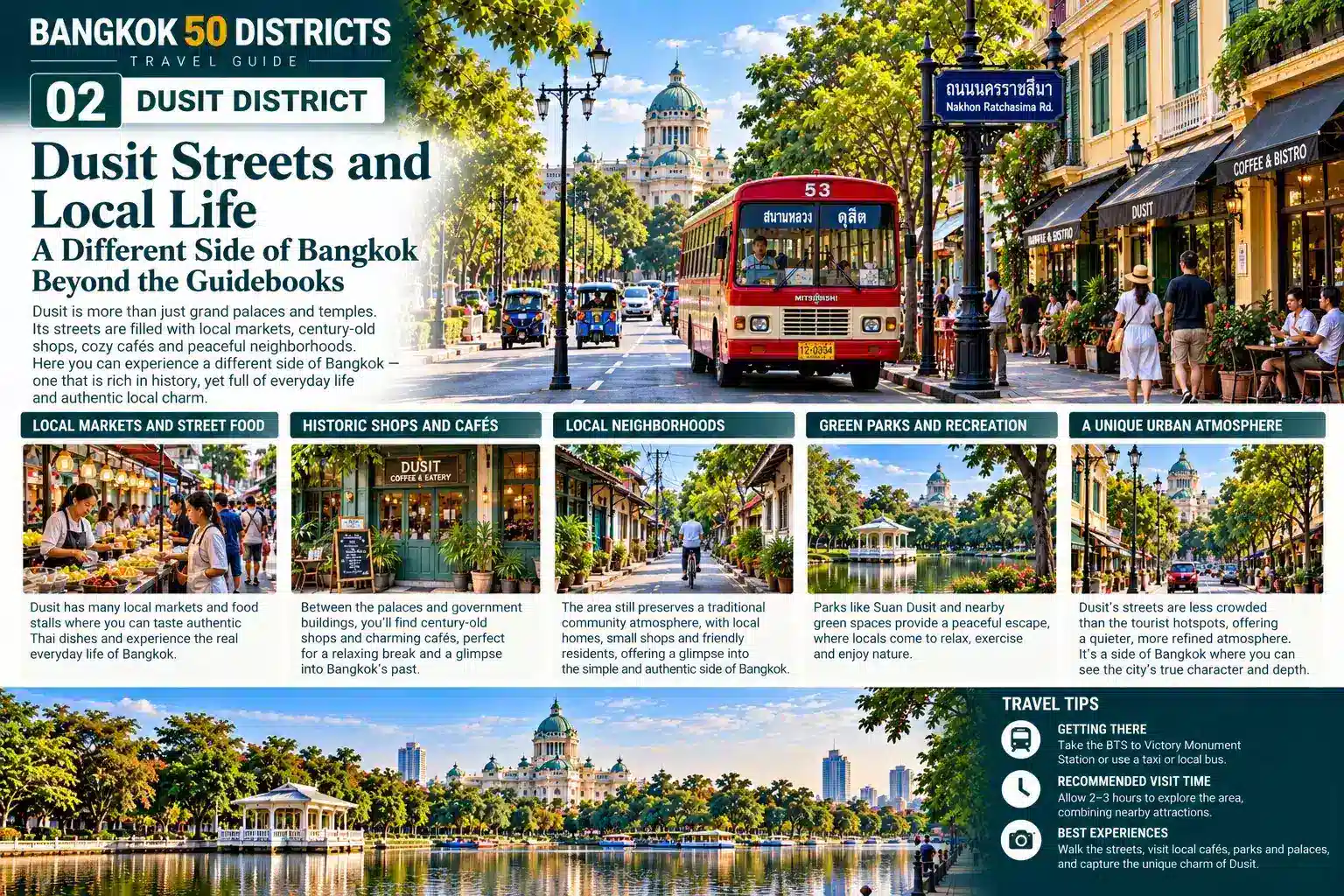
Between the major landmarks, you pass government buildings, schools, temples, residential streets, local restaurants, cafés and shaded neighborhoods.
This is where the pace of the trip should slow down.
Instead of constantly asking:
“What is the next attraction?”
try asking:
“How do people actually use this neighborhood?”
Stop at a local restaurant.
Walk along a quiet street.
Sit down for coffee.
Watch buses, students, office workers and neighborhood residents move through the district.
The Bangkok 50 Districts project is not simply about collecting fifty lists of tourist attractions.
It is about discovering how fifty different parts of Bangkok combine to create one enormous city.
07|How to Spend One Day in Dusit
You do not need to fill every minute of your day.
Dusit works better at a slower pace.
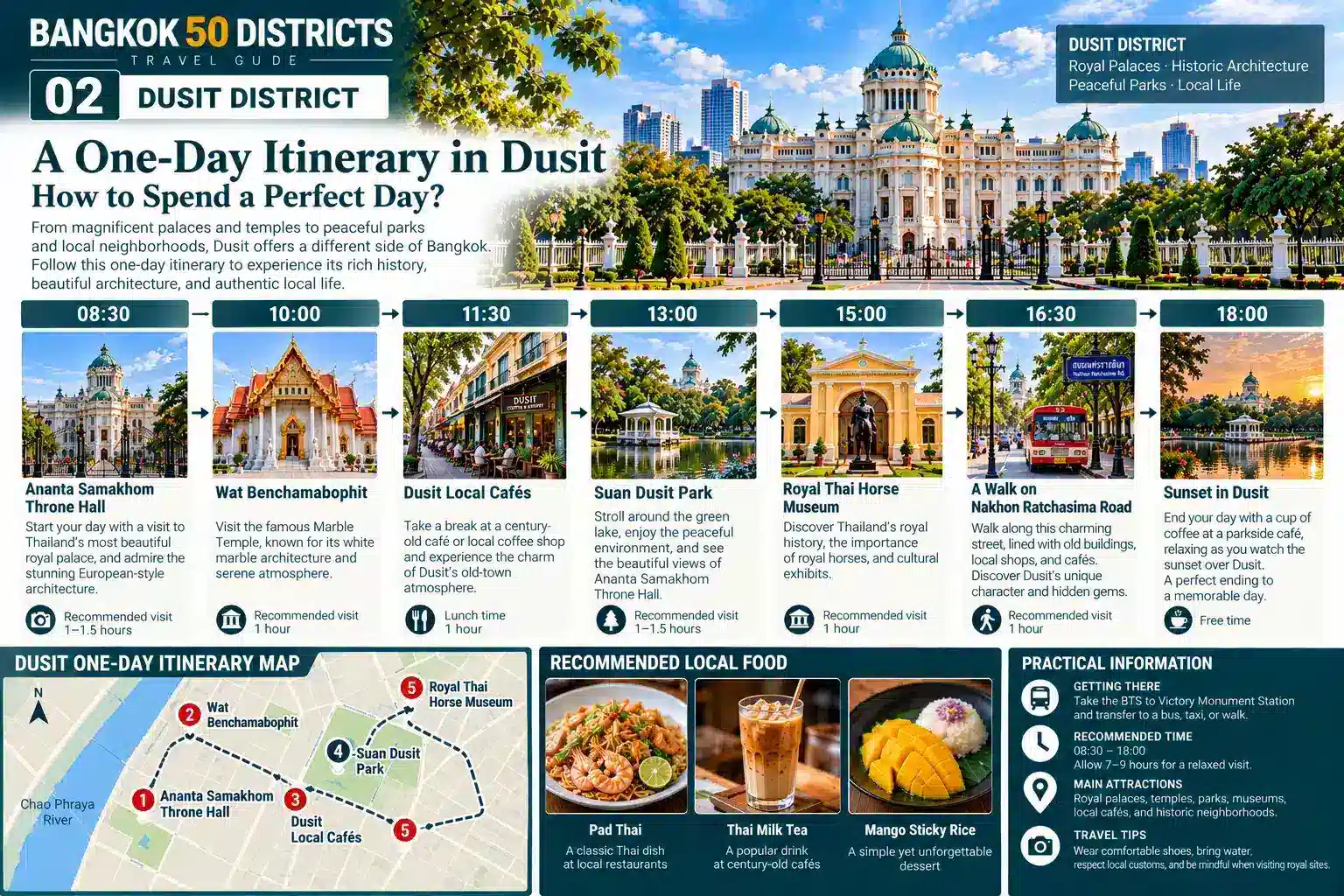
A simple itinerary could look like this:
08:30|Wat Benchamabophit
Start the morning at the Marble Temple while the temperature is still comfortable.
↓
10:00|Explore the Dusit Historic Area
Walk through the wider district and observe how the urban landscape differs from Phra Nakhon.
↓
11:00|Ananta Samakhom Area
See one of the district's most recognizable architectural landmarks from the surrounding accessible areas.
↓
12:30|Local Lunch
Skip the pressure to find a famous restaurant. Try a neighborhood Thai restaurant instead.
↓
14:00|King Rama V Monument & Surroundings
Continue exploring the historical and civic landscape of Dusit.
↓
15:30|Ratchadamnoen Avenue
Follow one of the important urban links between Bangkok's old royal center and its later expansion.
↓
17:00|Coffee & Slow Bangkok
Find a café, take a break and enjoy the quieter rhythm of the district.
Some royal, government or historically sensitive sites in Dusit may have access restrictions or changing opening conditions.
Always check current official information before visiting.
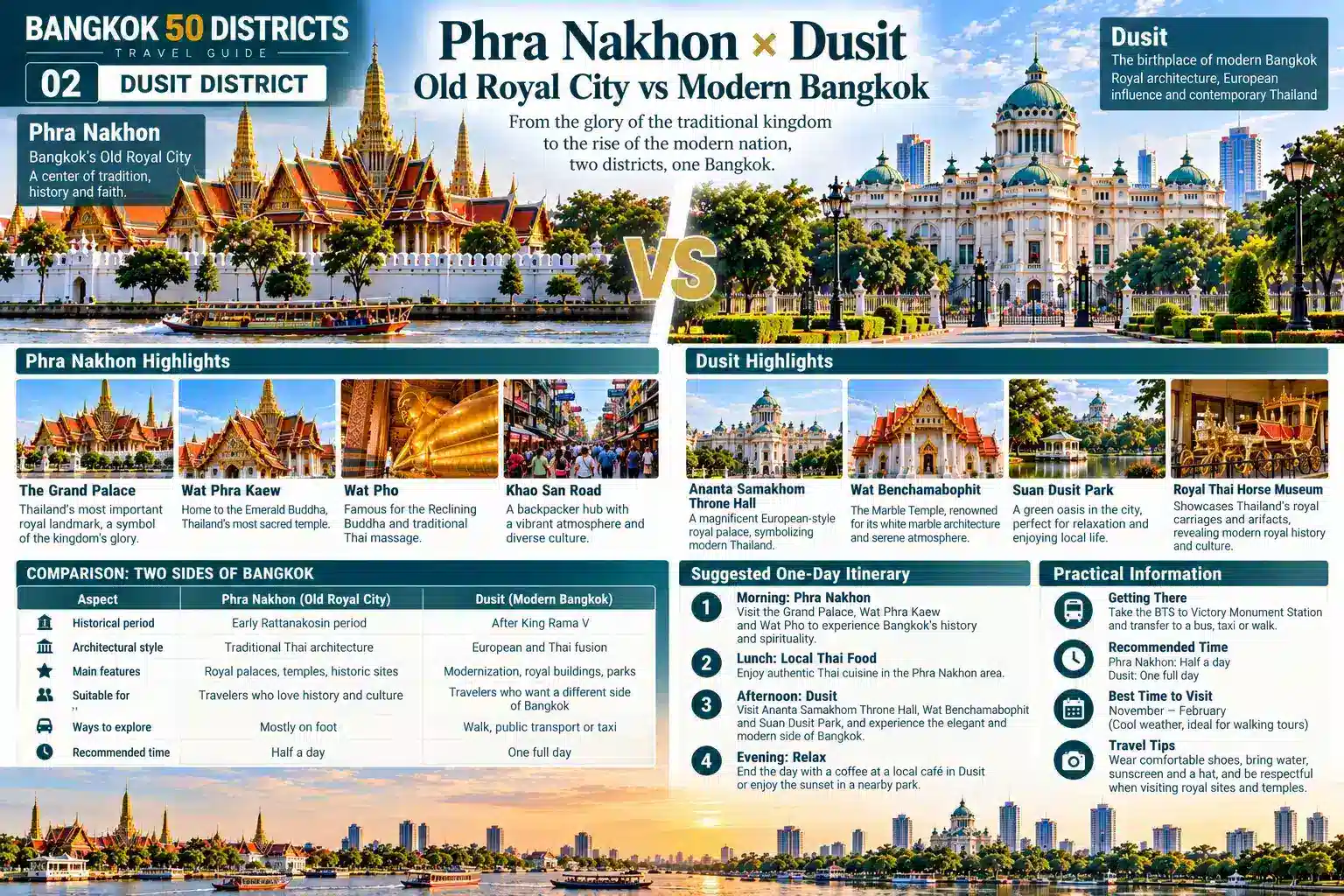
08|Phra Nakhon × Dusit: Two Districts, Two Eras
After visiting the first two districts in this series, an interesting picture begins to emerge.
PHRA NAKHON
This is the historic core of Bangkok.
The Grand Palace, Wat Phra Kaew, Wat Pho, old neighborhoods and traditional streets represent the early Rattanakosin capital.
Then travel north to:
DUSIT
The streets widen.
Urban space becomes more open.
Royal residences, administrative buildings, parks and European-influenced architecture become more visible.
The two districts are geographically close.
Historically, however, they allow us to experience different chapters of Bangkok's development.
Phra Nakhon helps us understand how the capital began.
Dusit helps us understand how it started changing.
This is exactly why we are exploring Bangkok district by district.
Not to create another list of the “Top 50 Places in Bangkok.”
But to put fifty pieces together and eventually see a much bigger picture of the city.
BANGKOK 50 DISTRICTS
02 / 50 UNLOCKED
DUSIT ✓
Royal Heritage · Historic Architecture · Green Spaces · Local Life
Our journey so far:
01|PHRA NAKHON ✓
Bangkok's historic royal core.
02|DUSIT ✓
From the old royal city toward modern Bangkok.
48 districts remain.
And the character of the city is about to change again.
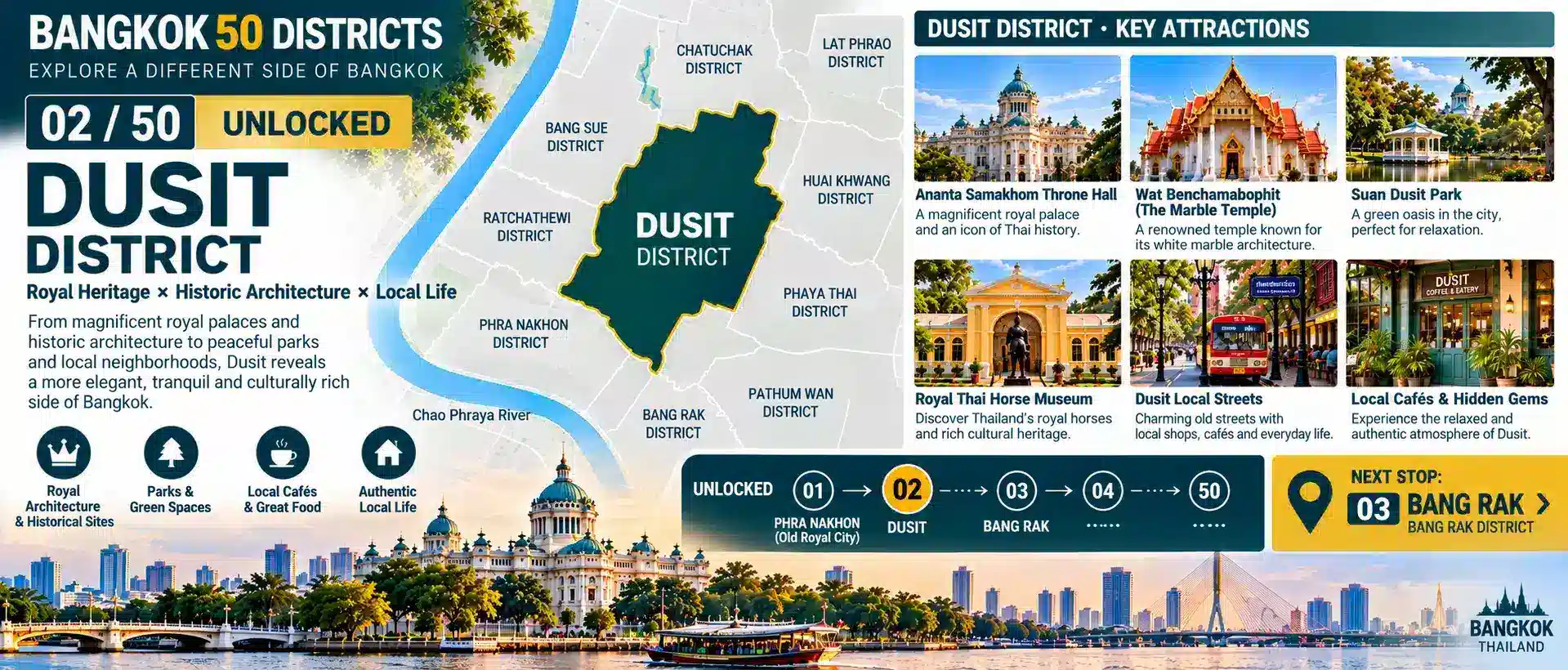
NEXT STOP → 03 BANG RAK
For our third district, we leave Bangkok's royal and administrative landscape and move toward the Chao Phraya River.
Historic trading communities, old piers, churches, mosques, colonial-era architecture, creative spaces, luxury hotels and some of Bangkok's most interesting streets will begin to appear together.
It is another Bangkok entirely.
BANGKOK 50 DISTRICTS · 03 / 50
BANG RAK
River · Trade · Communities · Architecture · Food · Creative Bangkok
To be continued.