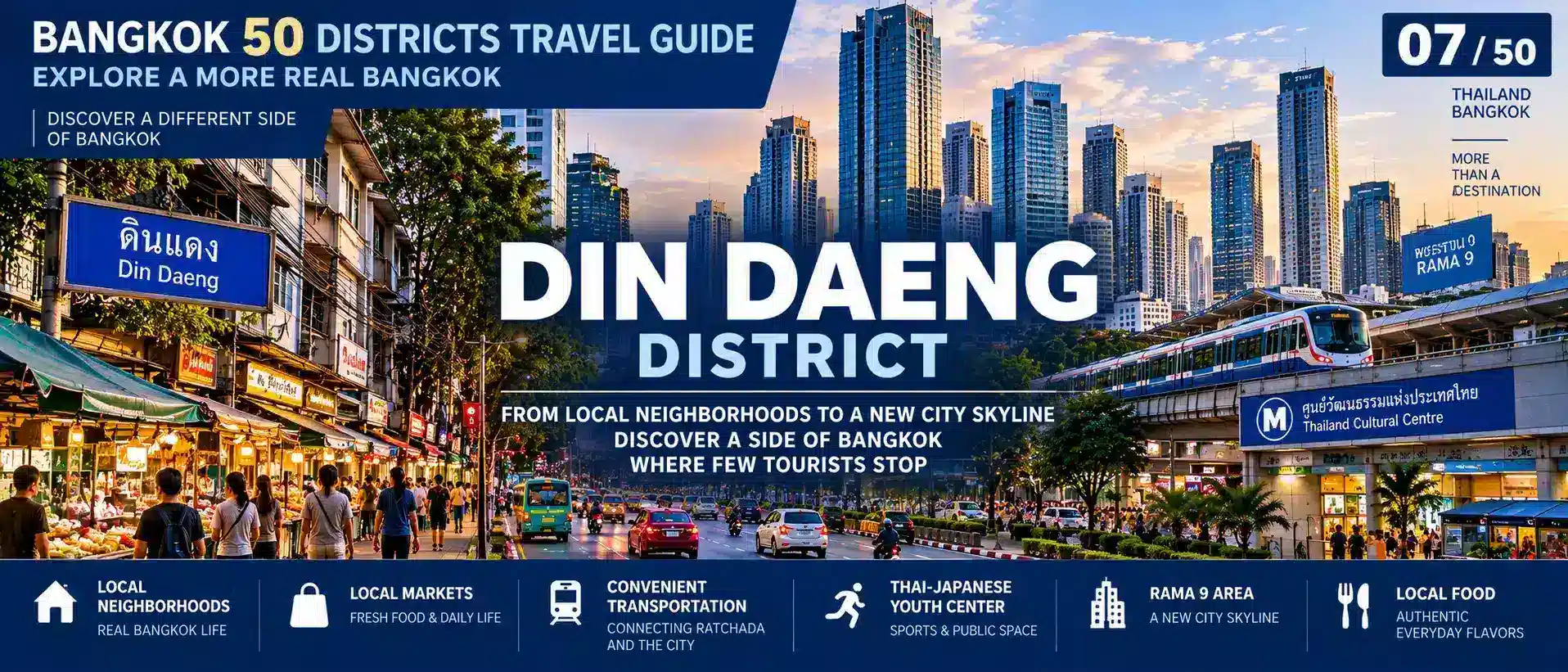
Theme: Local Communities · Markets · Everyday Life · Urban Development · Transportation · Modern Bangkok
Most visitors to Bangkok quickly become familiar with places like the Grand Palace, Siam, Chinatown, and Sukhumvit.
But Bangkok is much larger than its famous attractions.
Between the historic center and the rapidly expanding modern districts lies another Bangkok — one shaped by apartment blocks, neighborhood markets, roadside restaurants, public facilities, commuters, students, office workers, and families going about their everyday lives.
Din Daeng is one of the best districts for seeing this side of the city.
It may not have the monumental temples of Phra Nakhon or the giant shopping malls of Pathum Wan, but that is exactly what makes it interesting.
Here, the story is not simply about sightseeing.
It is about how ordinary Bangkok lives, works, eats, travels, and changes.
01|Where Is Din Daeng?
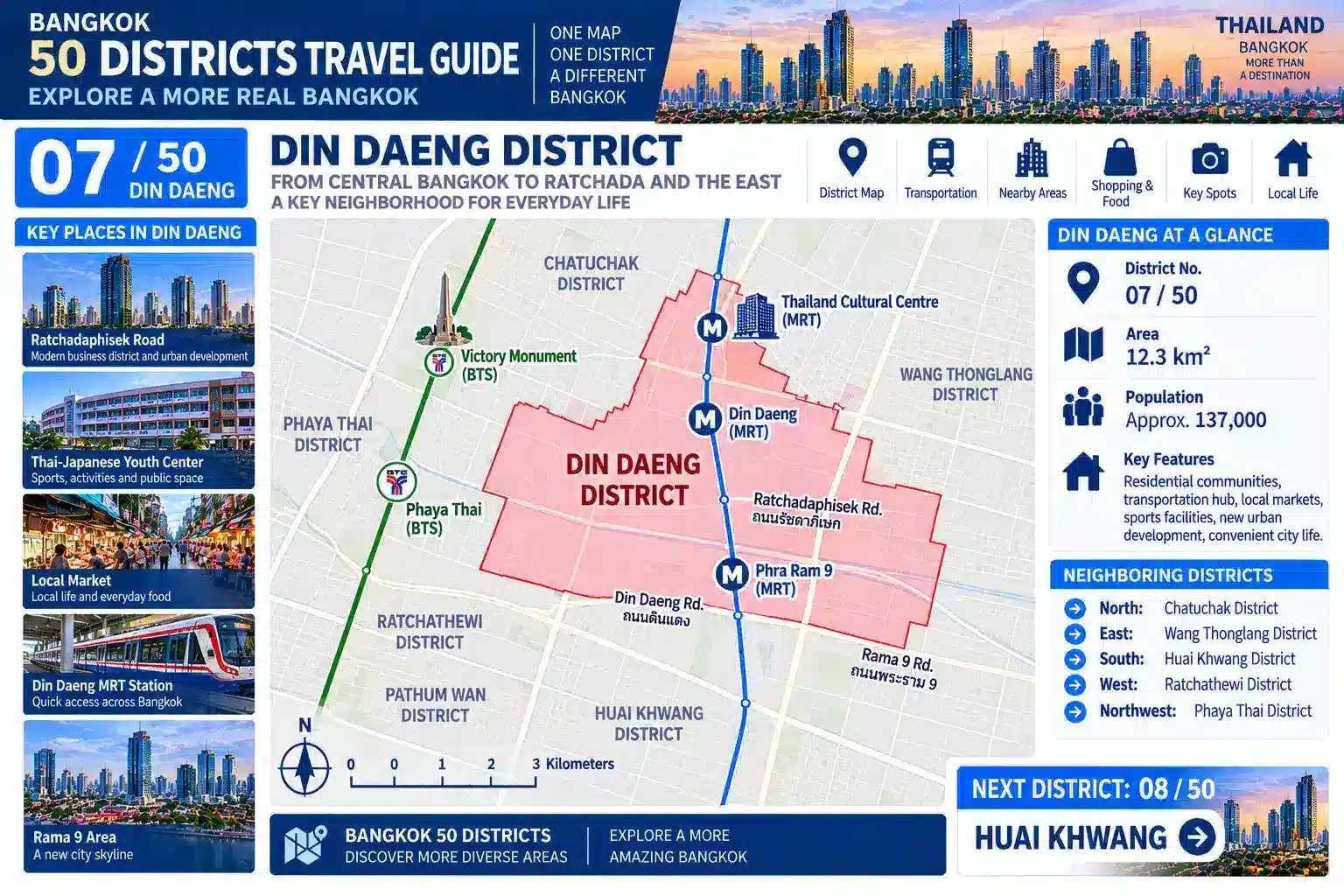
Din Daeng sits just north and northeast of Bangkok's central commercial districts.
From Ratchathewi, the city gradually changes as you move toward Din Daeng and the broader Ratchadaphisek–Rama 9 area.
The district occupies an interesting position between several different versions of Bangkok.
To the west are older central-city neighborhoods and major transportation corridors.
To the east and southeast, the landscape increasingly connects with Ratchadaphisek and Rama 9, where office towers, condominiums, hotels, shopping centers, and new commercial developments have transformed the skyline.
Din Daeng therefore feels like a transition zone.
Old residential communities and traditional street life remain visible, while a newer, denser and more vertical Bangkok continues to grow nearby.
That contrast is one of the district's defining characteristics.
02|Din Daeng's Local Communities: Everyday Bangkok Begins Here
The best way to understand Din Daeng is not to search for one famous landmark.
Instead, walk through its neighborhoods.
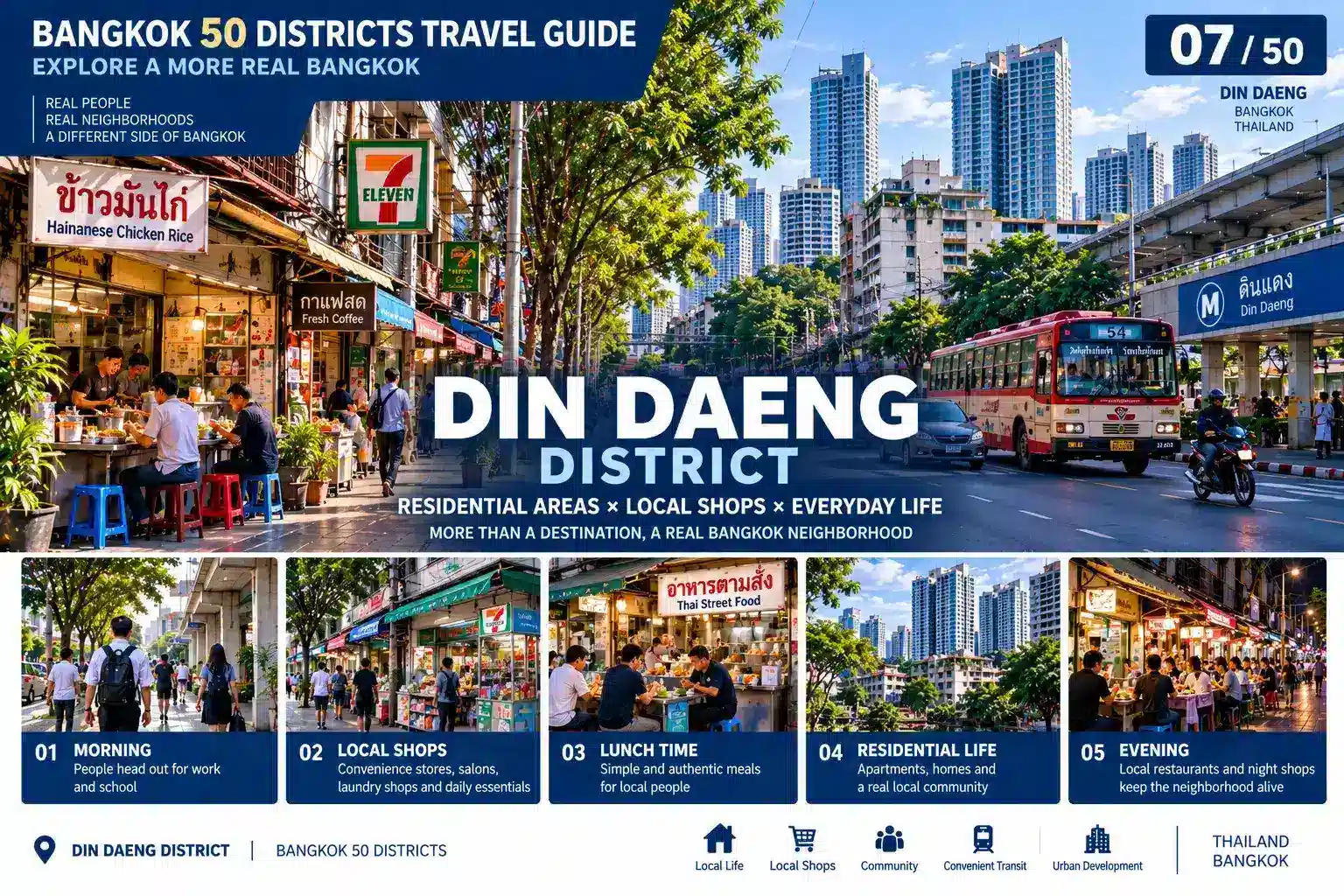
Residential buildings, apartment blocks, small convenience stores, food stalls, motorcycle taxis, laundries, cafés and family-run businesses form the everyday landscape.
In the morning, people leave home for work and school.
Around lunchtime, small restaurants fill with local customers.
In the evening, commuters return, street-food stalls become busier, and neighborhood life moves from workplaces back into residential streets.
None of this is designed specifically for tourists.
And that is precisely why Din Daeng offers something valuable.
You are not simply looking at Bangkok as a visitor.
You are observing Bangkok as a living city.
03|Local Markets: Understanding Bangkok Through Everyday Food
If you want to understand how a neighborhood really works, visit its market.
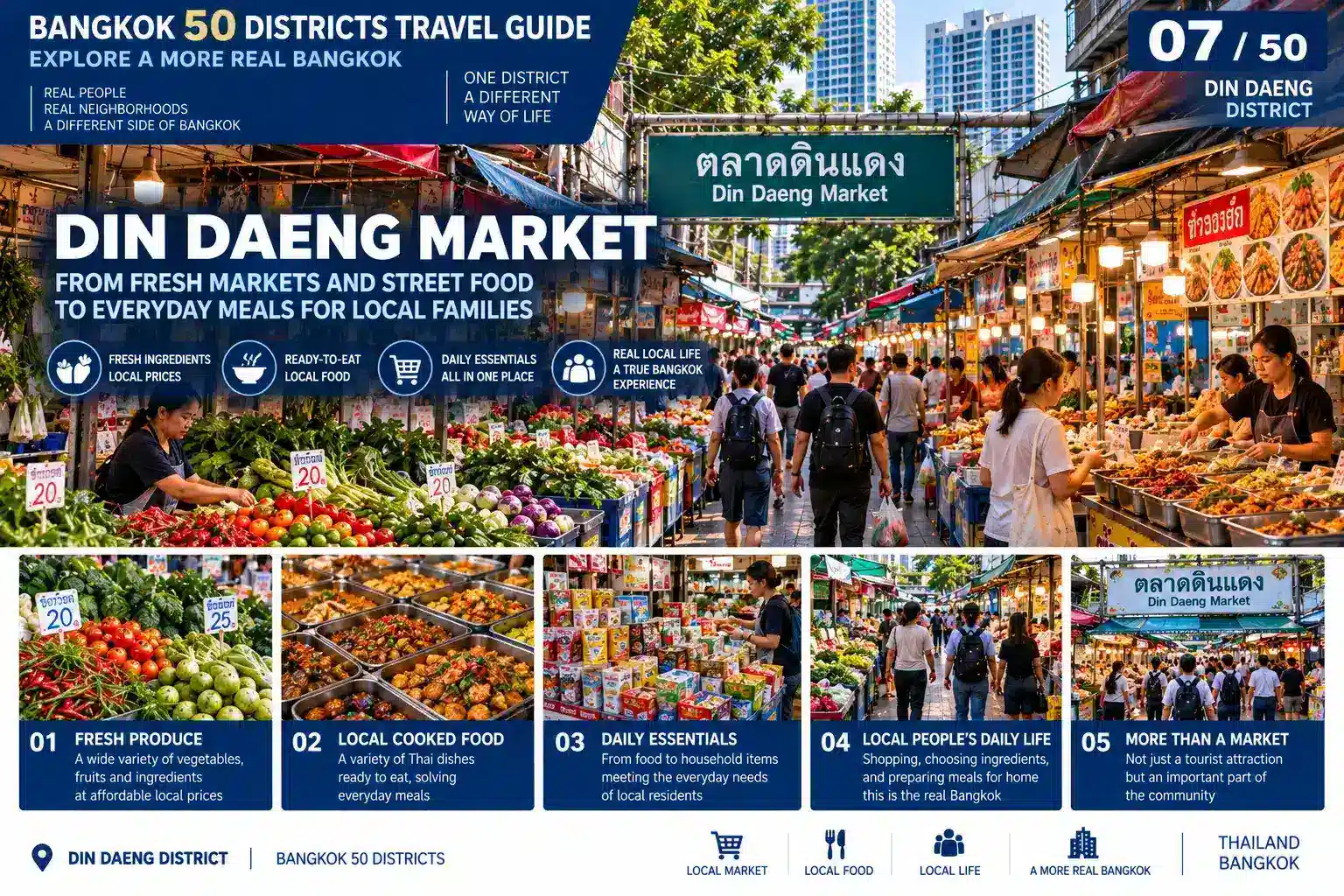
Din Daeng's local markets and food stalls are closely connected to the daily routines of nearby residents.
Fresh vegetables, fruit, meat, seafood, cooked dishes, noodles, grilled food, desserts and takeaway meals form part of the rhythm of ordinary life.
These places are very different from food destinations designed mainly for tourists.
Prices, portions and menus are shaped largely by people who live and work nearby.
Morning markets serve families buying ingredients.
At lunchtime, workers look for quick meals.
By evening, prepared-food stalls become especially convenient for residents returning home.
A neighborhood market therefore tells you much more than what people eat.
It shows you how Bangkok organizes everyday life around food.
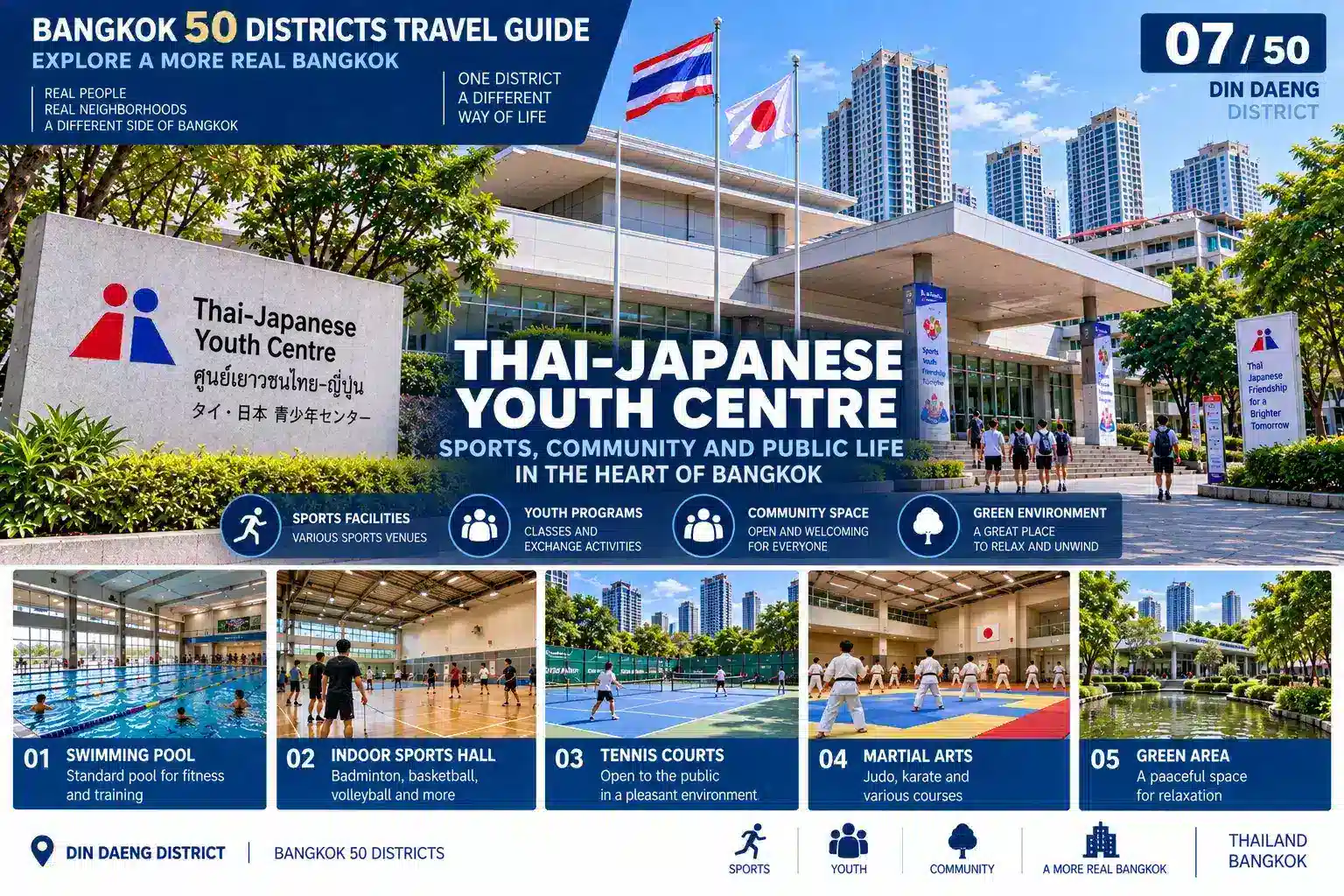
04|Thai-Japanese Youth Center: Sports and Public Life in Central Bangkok
Another side of Din Daeng can be found around the Thai-Japanese Youth Center Bangkok.
Rather than being a conventional tourist attraction, the complex represents an important part of Bangkok's public and recreational life.
Sports facilities, exercise areas, events and community activities bring together students, young people, athletes and local residents.
Places like this are easy to overlook when visiting a major city.
Yet they reveal something important.
Bangkok is not made only of temples, malls, hotels and nightlife districts.
It also depends on public spaces where people exercise, meet, participate in activities and spend time outside work and home.
For travelers interested in everyday urban culture, this is another window into how Bangkok functions beyond tourism.
05|Din Daeng × Ratchadaphisek: Where Old Communities Meet a New Bangkok
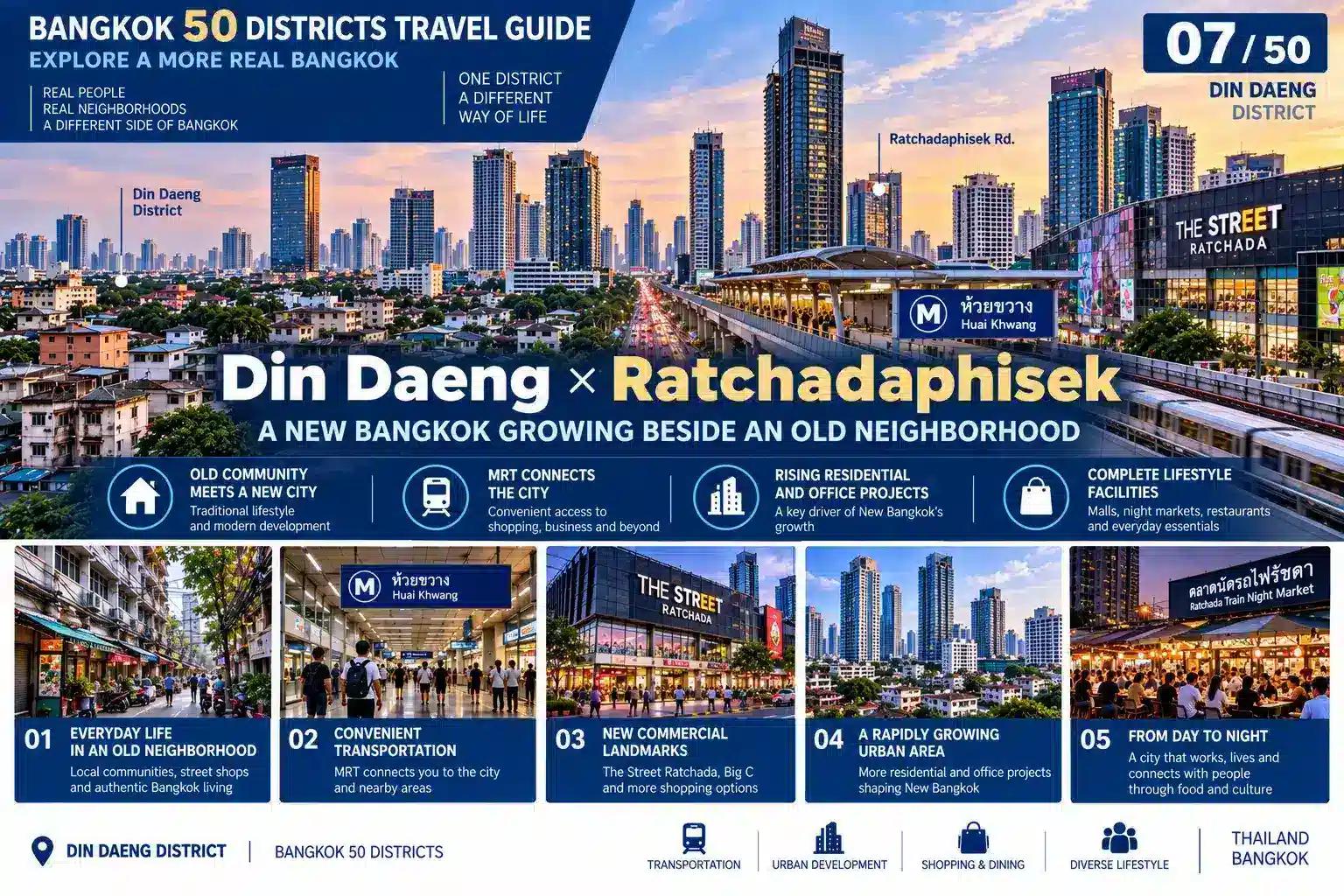
Continue east and the atmosphere begins to change.
The broader Ratchadaphisek corridor has become one of Bangkok's important modern urban zones.
Office buildings, condominiums, hotels, shopping complexes and entertainment venues have gradually created a very different cityscape from the low-rise communities nearby.
This makes the Din Daeng–Ratchada area especially interesting.
Within a relatively short distance, you can move from traditional neighborhood streets to large-scale commercial developments.
The contrast is not simply visual.
It reflects a larger transformation taking place across Bangkok: land values are changing, transportation networks are expanding, residential patterns are evolving, and new commercial centers are appearing outside the city's older core.
Din Daeng stands close to the middle of that transformation.
06|Din Daeng × Rama 9 Skyline: Watching Bangkok Grow Upward
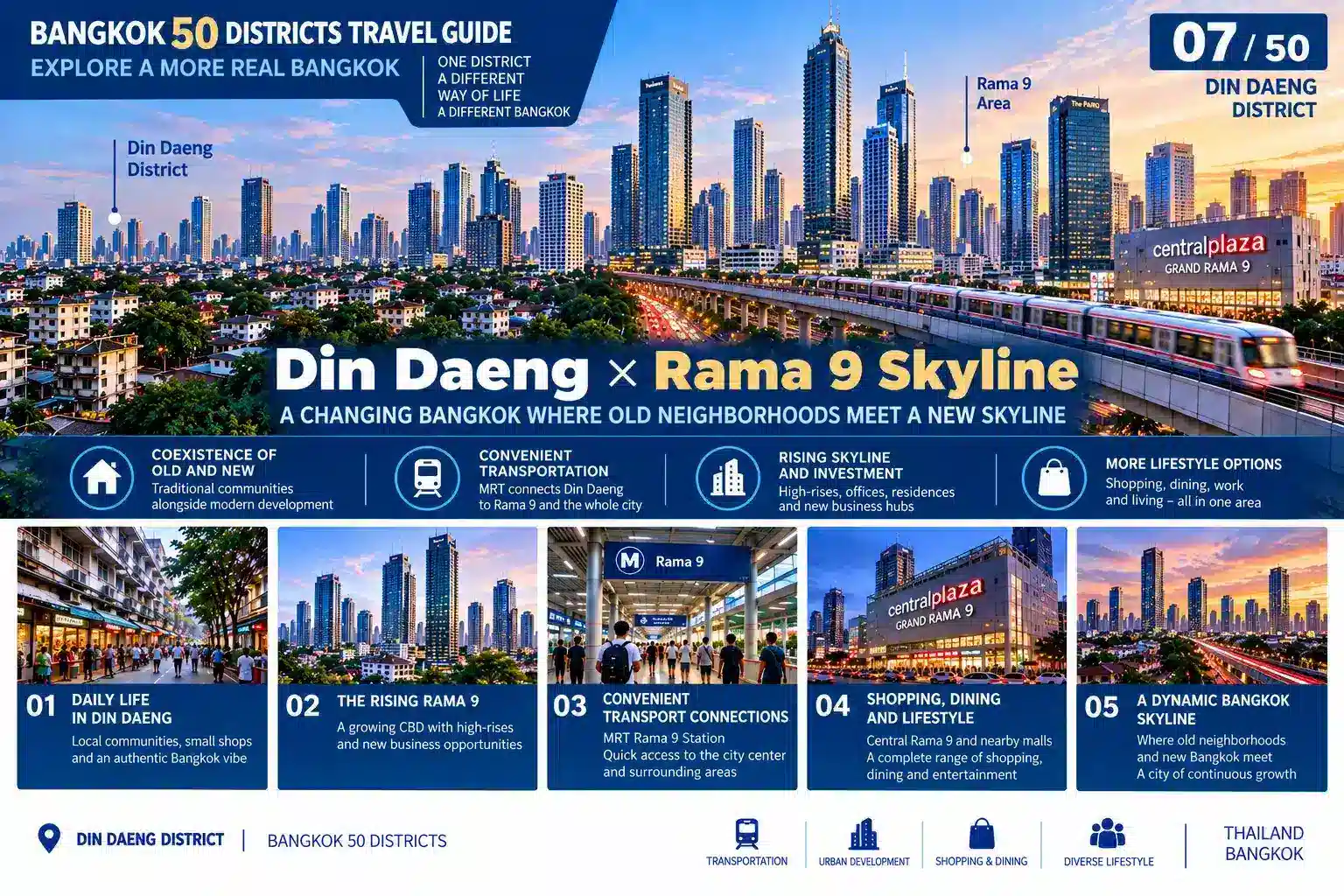
One of the clearest ways to understand modern Bangkok is simply to look at its skyline.
Around Rama 9 and neighboring areas, high-rise buildings increasingly dominate the horizon.
Condominiums, offices, shopping centers and mixed-use developments have created a modern business and residential landscape that feels very different from Bangkok's historic districts.
From parts of Din Daeng, these towers appear almost directly behind older residential communities.
The result is a striking urban contrast:
low-rise local Bangkok in the foreground, high-rise metropolitan Bangkok in the background.
It is a visual summary of the district itself.
Din Daeng has not stopped being a local residential area.
But the city around it is changing rapidly.
07|Street Food: The Flavors of an Ordinary Bangkok Neighborhood
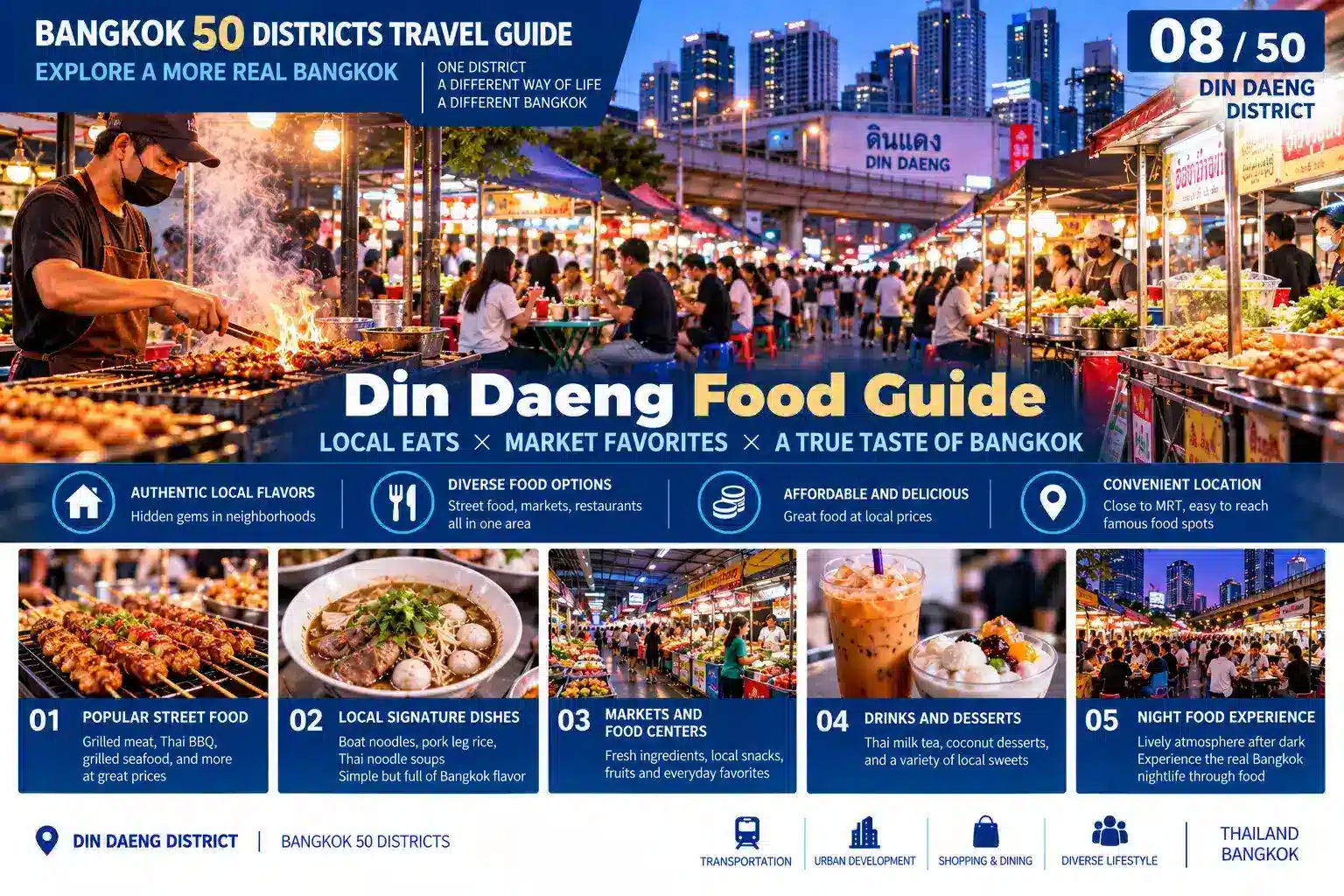
Din Daeng is also a good place to eat without turning every meal into a destination.
Small restaurants and street stalls are scattered throughout residential streets, markets and transportation corridors.
You may find rice dishes, noodles, grilled meats, soups, made-to-order Thai dishes, fresh fruit, desserts, coffee and inexpensive takeaway meals.
The important thing is not necessarily finding one "must-eat" restaurant.
The experience is about following the rhythm of the neighborhood.
Look for places busy with office workers at lunchtime.
Notice stalls surrounded by residents in the evening.
Walk into small restaurants where the menu is simple and customers clearly come back regularly.
This is where food becomes part of the district rather than a separate tourist attraction.
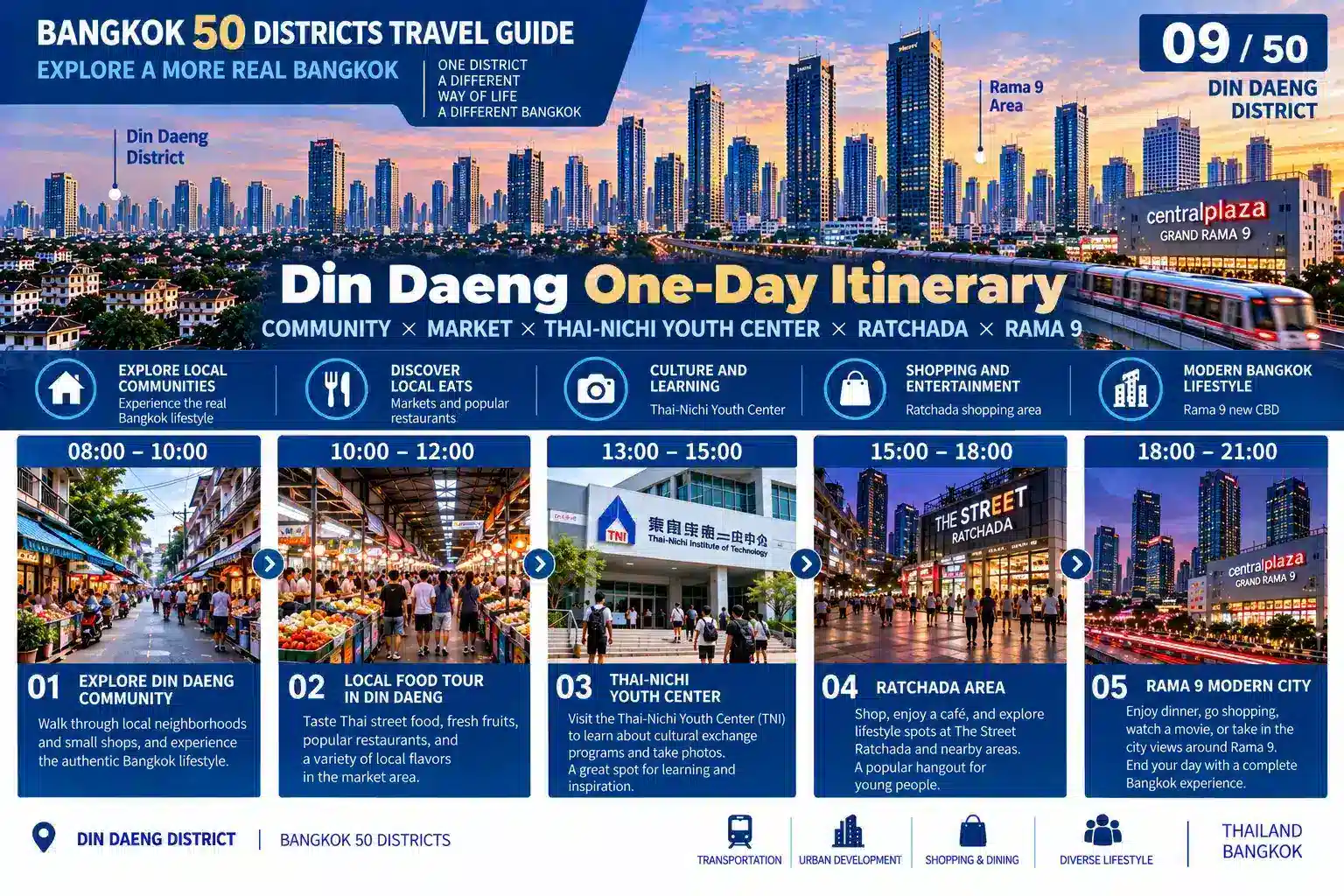
08|One Day in Din Daeng
Din Daeng works best as a slow urban exploration rather than a checklist of attractions.
A possible route could look like this:
08:00–10:00|Explore a Din Daeng neighborhood
Walk through residential streets, observe morning activity and stop at a local café or breakfast shop.
10:00–12:00|Visit a local market
Explore fresh-food stalls, prepared dishes and neighborhood businesses.
12:00–13:00|Local lunch
Choose a restaurant or food stall popular with nearby residents.
13:00–15:00|Thai-Japanese Youth Center
See another side of Bangkok through sports, recreation and community life.
15:00–18:00|Head toward the Ratchada area
Watch the urban landscape gradually shift from local neighborhoods toward larger commercial developments.
18:00–21:00|Rama 9 and the modern skyline
Finish the day with dinner, shopping or an evening walk while seeing the lights of Bangkok's newer urban center.
In one day, you can experience several layers of the city without traveling very far.
09|Why Din Daeng Deserves a Place in the Bangkok 50 Districts Travel Guide
Din Daeng is not the district most first-time visitors would place at the top of their Bangkok itinerary.
There is no Grand Palace here.
There is no Chinatown-scale tourist street.
And there is no Siam-style concentration of luxury shopping centers.
But the purpose of exploring Bangkok's 50 districts is not to repeat the same famous attractions.
It is to understand how different parts of Bangkok create different ways of life.
Din Daeng offers exactly that.
Here you can see local communities, neighborhood markets, public facilities, street food and ordinary residential life.
At the same time, Ratchadaphisek and Rama 9 reveal another Bangkok rising beside them — taller, denser, more commercial and increasingly connected.
Few districts show these two sides of the city so naturally within the same journey.
If Phra Nakhon helps us understand Bangkok's historical roots, and Pathum Wan shows us its modern commercial center, Din Daeng reveals something equally important:
the everyday Bangkok living between the old city and the city of the future.
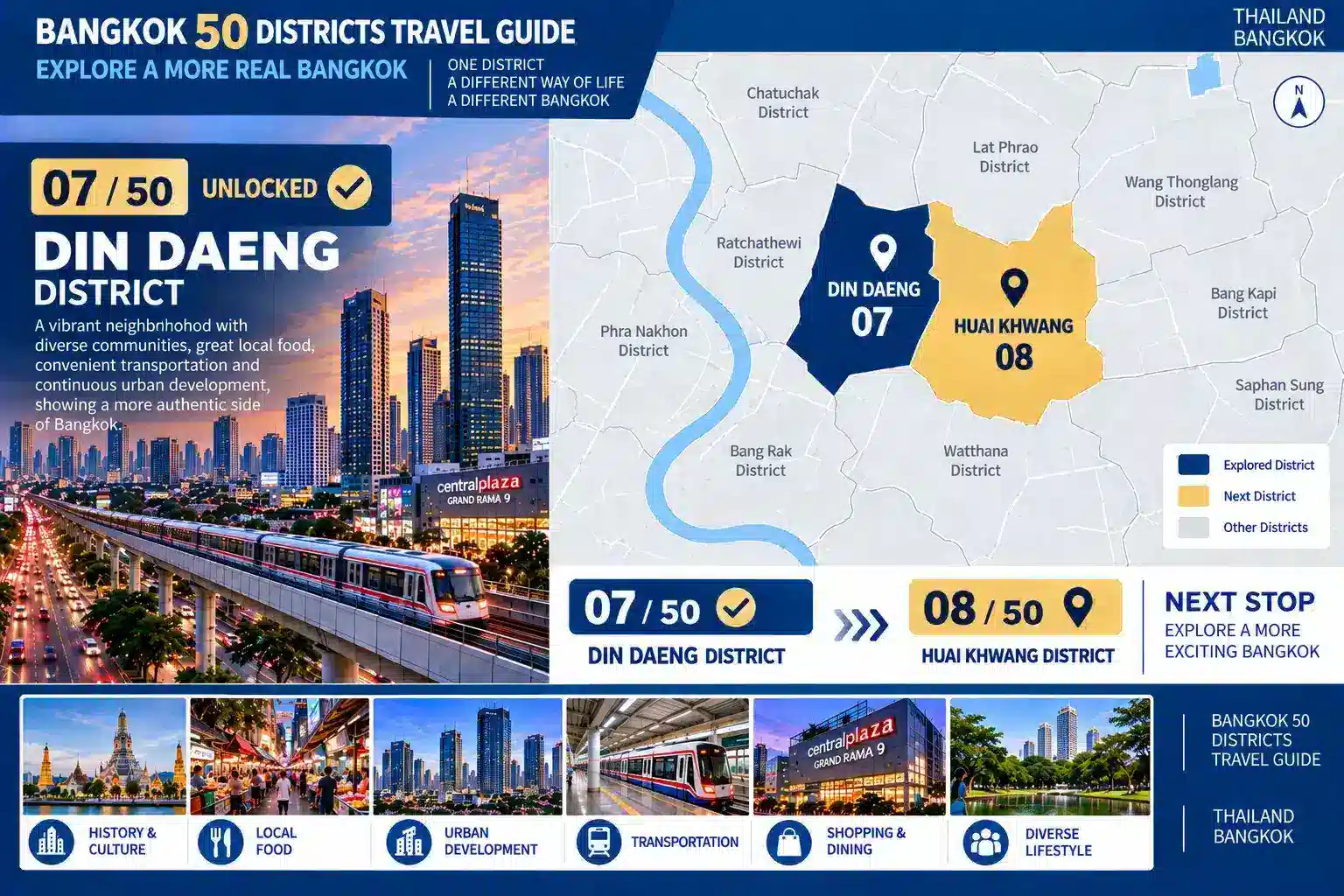
07 / 50 UNLOCKED
DIN DAENG ✓
Keywords:
Local Communities · Markets · Street Food · Public Life · Ratchada · Rama 9 · Urban Development · Everyday Bangkok
43 districts remaining.
NEXT STOP — 08 / 50
HUAI KHWANG
From Ratchada's nightlife and local neighborhoods to one of Bangkok's most rapidly changing international urban areas, the next journey continues deeper into the city's modern east-central districts.