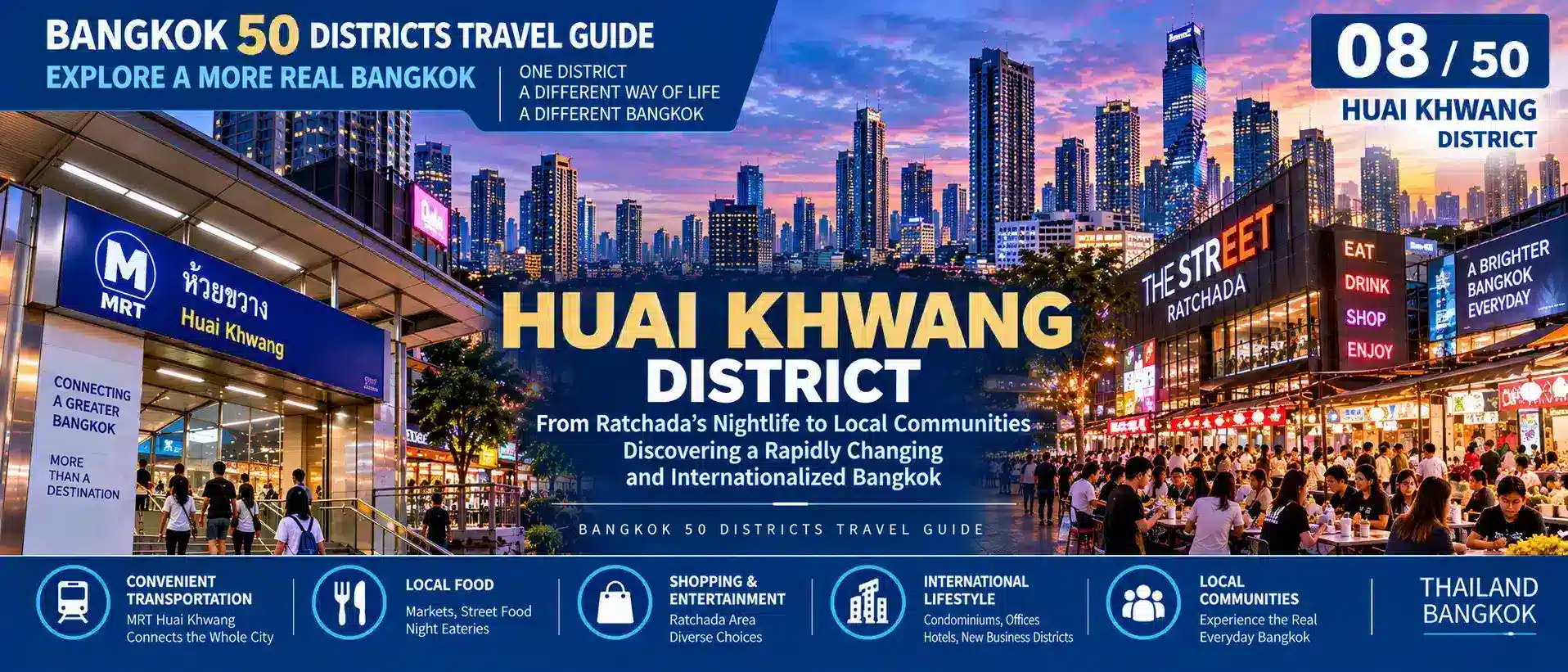
If our previous stop, Din Daeng, showed us the everyday life of Bangkok’s local communities and the new skyline rising beside older neighborhoods, then moving east into Huai Khwang reveals another side of the city’s transformation.
Here, streets stay busy long after sunset. Local markets serve nearby residents, the MRT carries commuters across the city, and apartments, hotels, restaurants, offices and entertainment venues create an increasingly international urban environment.
By day, Huai Khwang feels like a genuine residential and working district.
By night, it can feel like an entirely different city.
Together, these two sides tell the story of modern Huai Khwang.
01|Where Is Huai Khwang?
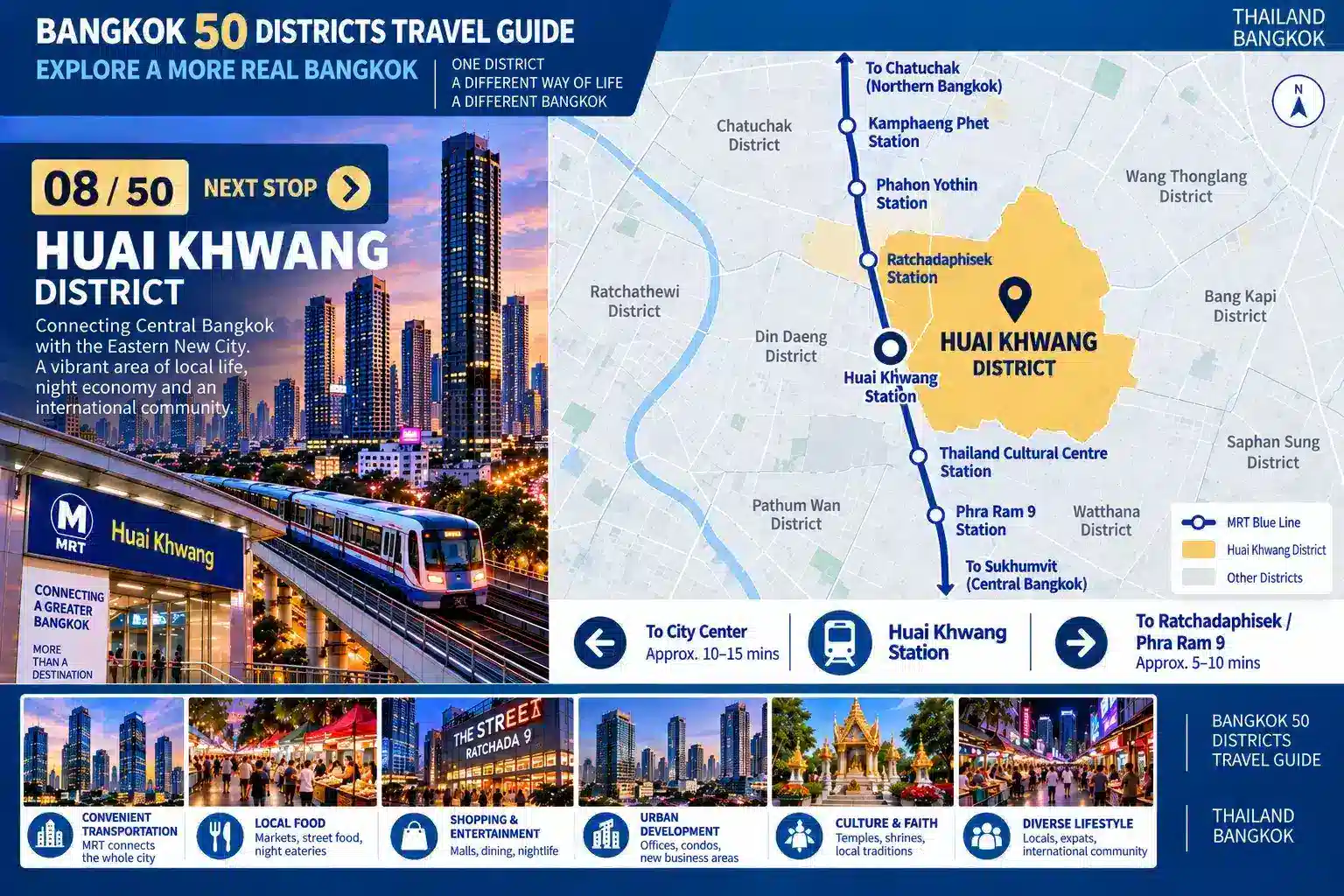
Huai Khwang lies east of central Bangkok and forms part of the broader urban area surrounding Ratchadaphisek.
For visitors, one of the easiest ways to understand this part of Bangkok is through the MRT Blue Line.
As you travel from central Bangkok toward the Ratchada–Huai Khwang area, the urban landscape gradually changes.
Office buildings, condominiums, hotels, commercial developments and entertainment venues line major roads, while behind them are residential neighborhoods, markets, small restaurants and local businesses.
This means Huai Khwang does not have just one identity.
It is a transportation hub and a residential district.
It is both local and increasingly international.
It combines everyday community life with a strong nighttime economy.
That mixture makes Huai Khwang an ideal eighth stop in our journey through Bangkok’s 50 districts.
02|Huai Khwang MRT: The Easiest Place to Begin
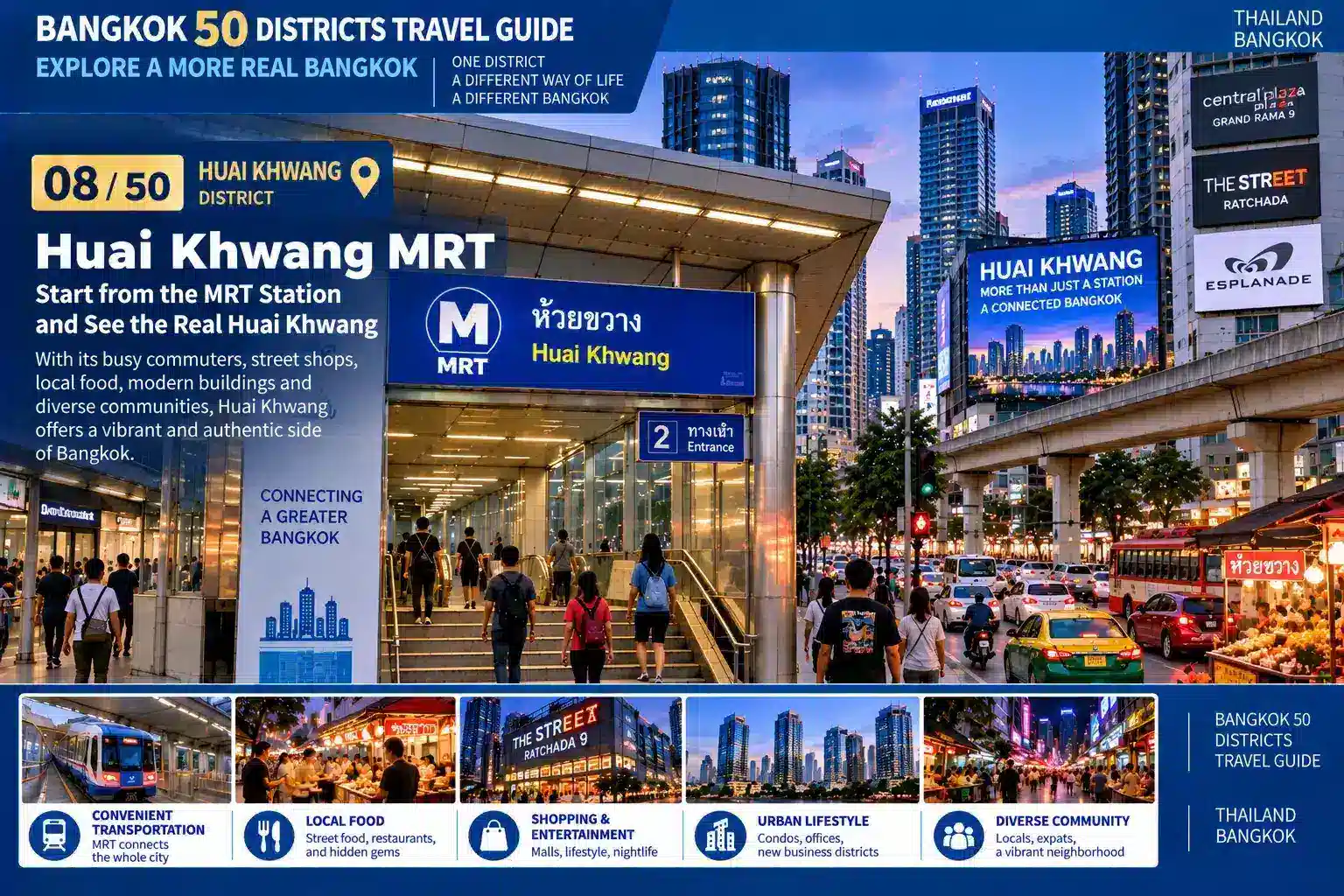
For a first visit to the district, Huai Khwang MRT Station is a natural starting point.
Step outside and you will not immediately encounter a monumental temple or famous tourist landmark.
Instead, you enter one of Bangkok’s most recognizable everyday urban scenes.
Commuters move between the station and surrounding streets. Motorcycles, buses and taxis pass by. Convenience stores, restaurants, apartments and street stalls fill the surrounding neighborhood.
This is exactly what makes Huai Khwang interesting.
The district was not created primarily for tourists.
It works because thousands of residents, office workers, students, shopkeepers and visitors use it every day.
The MRT has strengthened that role by connecting Huai Khwang directly with many other parts of Bangkok, making the area increasingly convenient for living, working and doing business.
So when you arrive, don’t rush to find the first “attraction.”
Spend a few minutes outside the station.
You are already seeing the real Huai Khwang.
03|Local Markets: Everyday Life Behind the Main Roads
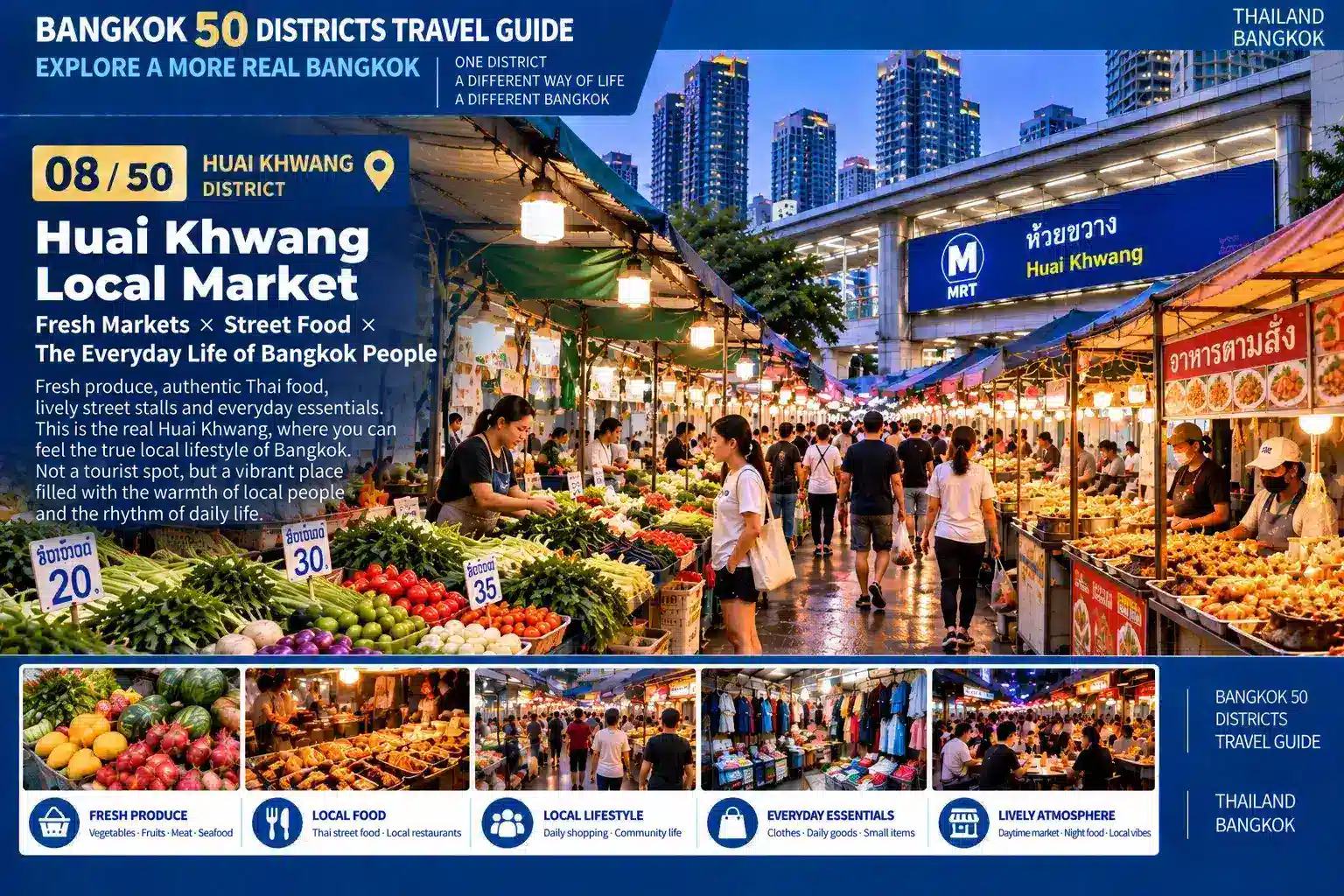
To understand Huai Khwang more deeply, explore its local markets and surrounding streets.
What makes these places interesting is not a collection of products designed for tourists.
Instead, you find the things ordinary residents actually use every day.
Fresh vegetables, fruit, meat, seafood, prepared meals, desserts, clothing, household goods and street snacks all form part of the neighborhood economy.
In the morning, residents shop for ingredients.
Around lunchtime, workers look for quick and affordable meals.
In the evening, cooked-food stalls and small restaurants become busier as people return home.
This is what separates a neighborhood market from a major shopping mall.
It reveals the rhythms, prices, tastes and habits of everyday life.
The real Bangkok does not exist only inside luxury malls and famous attractions.
Sometimes it can be found in a bag of vegetables, a takeaway meal and the familiar sounds of a neighborhood market.
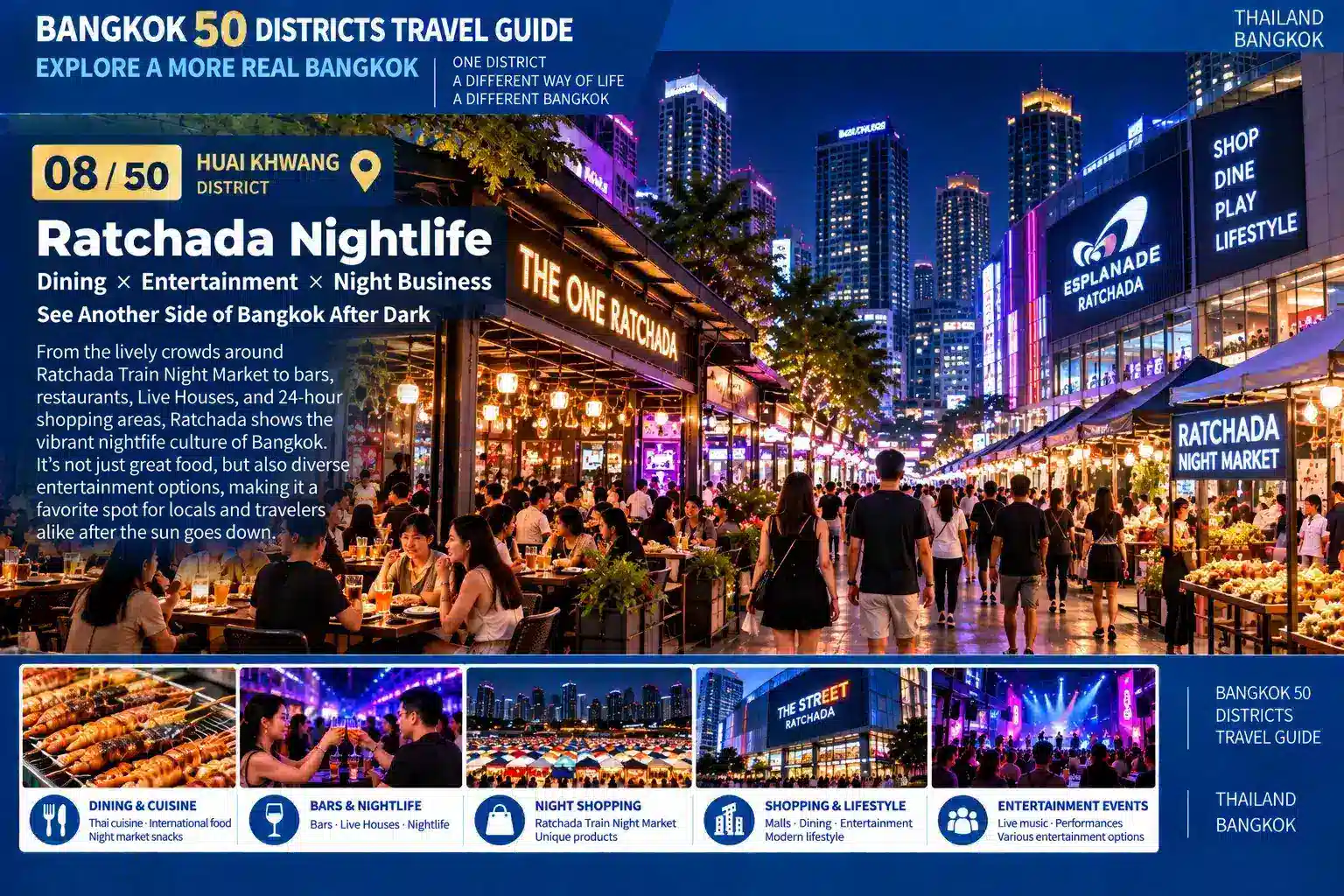
04|Ratchada: A District That Changes After Dark
One of the best-known sides of the wider Huai Khwang area is connected to Ratchadaphisek, usually shortened to Ratchada.
During the day, it functions as a busy urban corridor filled with traffic, offices, residences and commercial activity.
But after sunset, the rhythm changes.
Restaurants become busier. Bars and entertainment venues begin filling up. Nighttime dining comes alive, while office workers, local residents and visitors arrive from other parts of the city.
Bangkok gradually switches from “work mode” to “night mode.”
That is what makes Ratchada different from many traditional sightseeing districts.
It is not simply a street created for visitors to walk through.
It forms part of Bangkok’s broader nighttime economy and urban lifestyle.
Spend an evening here and you begin to understand why Bangkok remains active long after many conventional attractions have closed.
05|Community Faith in a Modern City
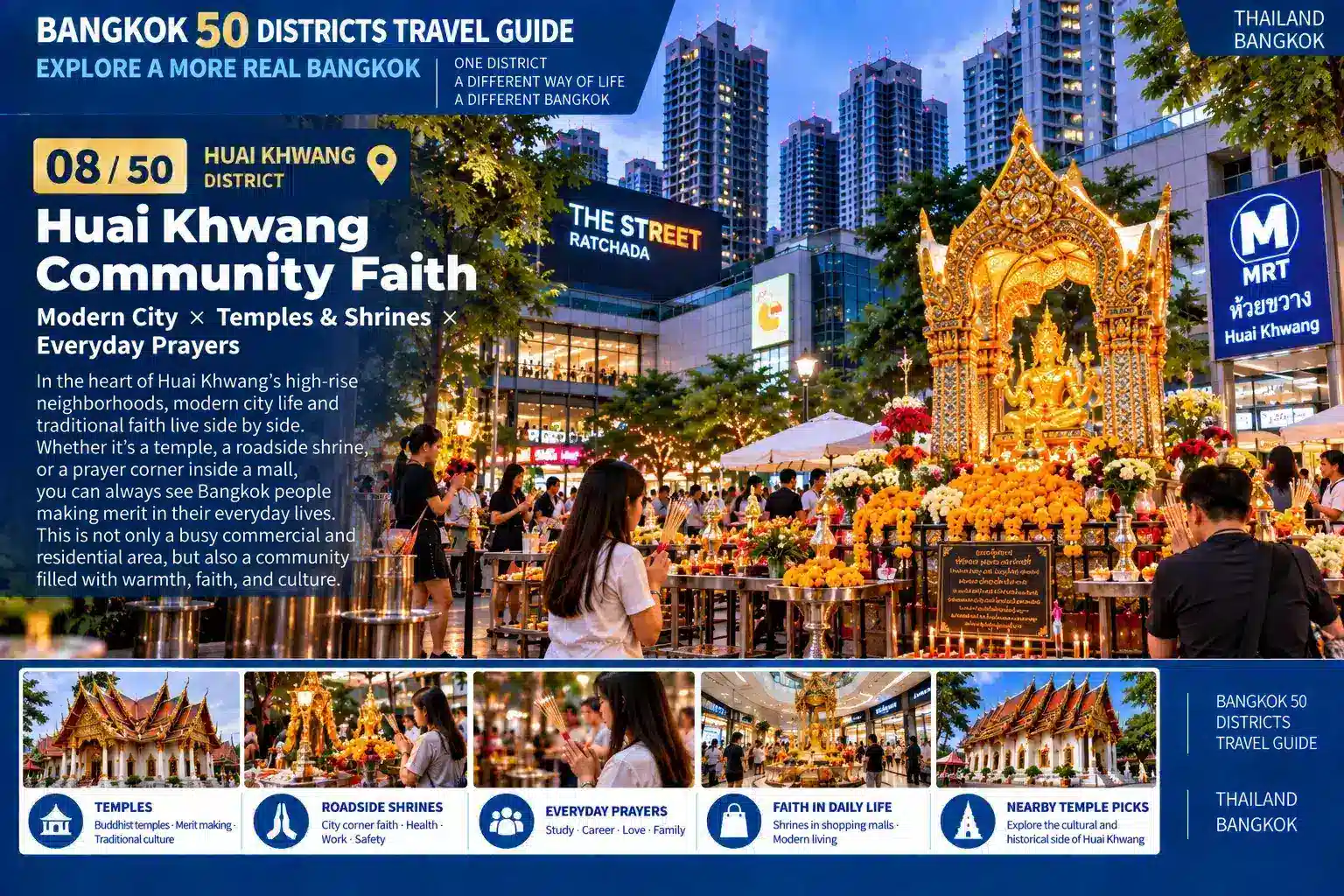
Huai Khwang is not only about modern buildings, transportation and nightlife.
Between busy roads, residential areas and commercial spaces, you can still find temples, shrines and other places connected to everyday spiritual life.
They remind us that even as Bangkok modernizes, traditional beliefs remain part of the city’s daily rhythm.
Some people stop to pray before work.
Others visit temples or shrines on important occasions.
For travelers, this experience can feel very different from visiting Bangkok’s monumental historic temples.
Here, religion is not simply something preserved as history.
It remains part of contemporary urban life.
That coexistence is one of Huai Khwang’s most interesting characteristics:
modern apartments, MRT stations, commercial districts and traditional faith can all exist within the same neighborhood.
06|Huai Khwang × Ratchada: An Increasingly International Urban Community
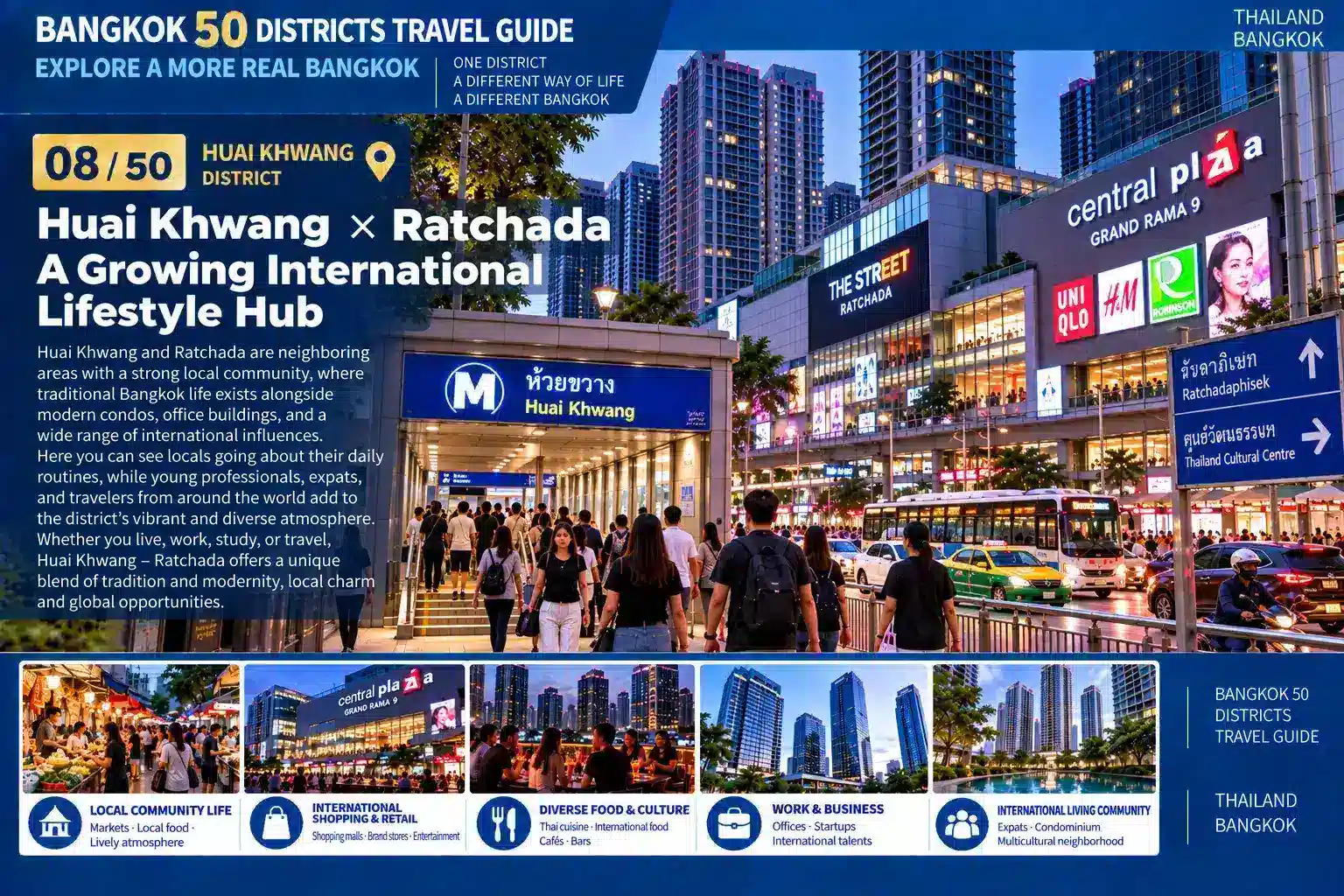
Walk around Huai Khwang and Ratchada today and another change quickly becomes noticeable.
The area feels increasingly international.
Different languages appear in commercial spaces, while restaurants and services cater to a wider range of residents and visitors. Hotels, condominiums and new businesses have also contributed to a more diverse urban environment.
But this does not mean Huai Khwang has simply stopped being a Thai neighborhood.
The interesting part is the coexistence.
A modern international restaurant may stand beside a long-running Thai eatery.
A street-food vendor may operate beneath a new condominium tower.
Behind a major commercial development, a quiet residential lane can still preserve the atmosphere of an ordinary Bangkok neighborhood.
The old and new are not simply replacing one another.
They are overlapping.
And that overlap is becoming part of Huai Khwang’s modern identity.
07|Huai Khwang Food: The Real Attraction Is Variety
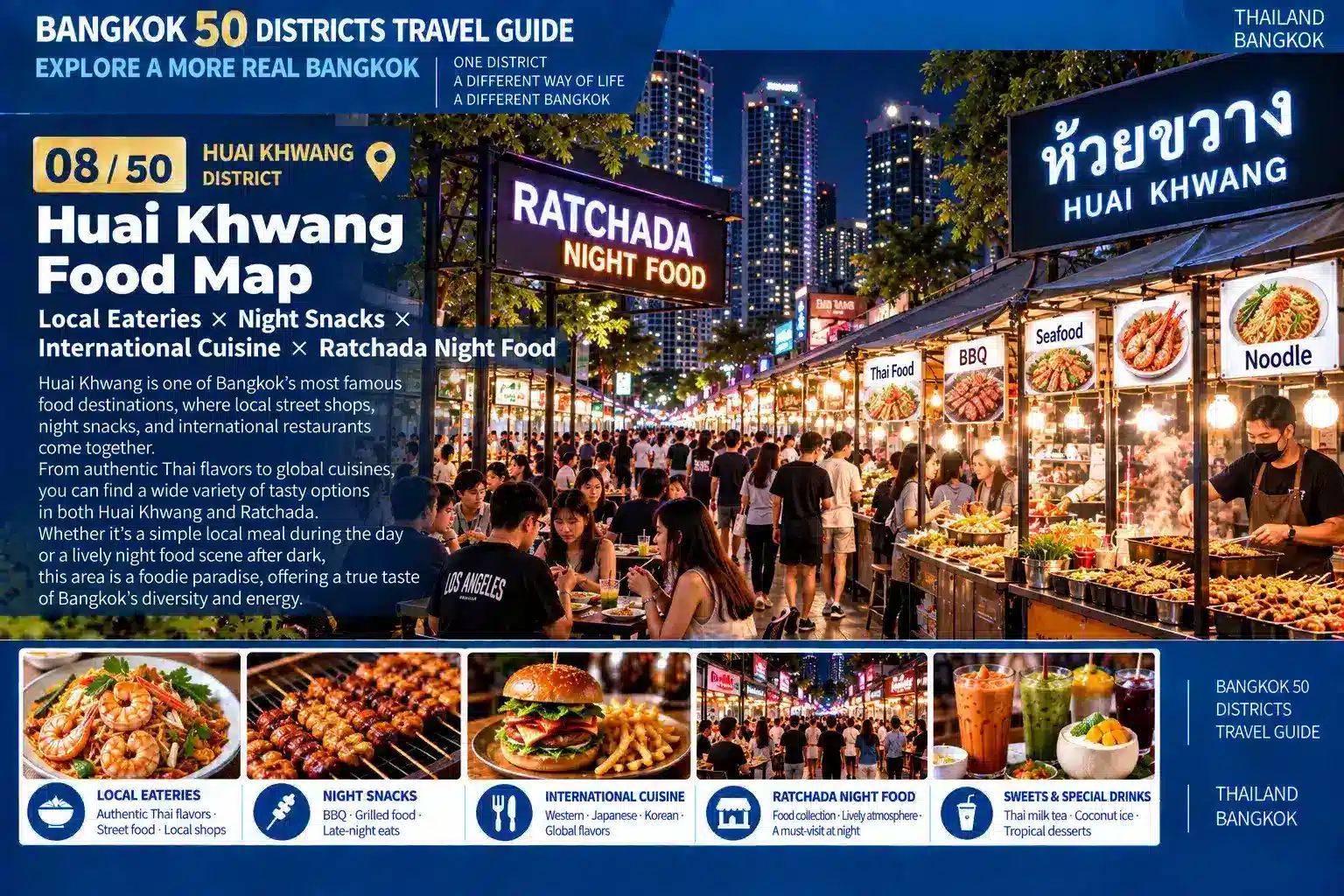
Huai Khwang is a district where you do not necessarily need a list of ten “must-eat” restaurants.
It is often more enjoyable simply to explore and choose as you go.
Thai noodles, rice dishes, grilled food, seafood, hot pot, snacks, desserts, coffee and late-night meals are easy to find throughout the wider area.
Because the district serves a diverse mix of residents and visitors, its dining scene also offers a wide range of international choices.
You can eat in a small neighborhood restaurant or choose a modern dining space.
You can have a quick meal in a market or continue eating late into the night.
That is the real appeal of food in Huai Khwang.
It is not defined by one famous dish.
Instead, the district offers something increasingly valuable in a large city:
choice, convenience and food at almost every hour of the day.
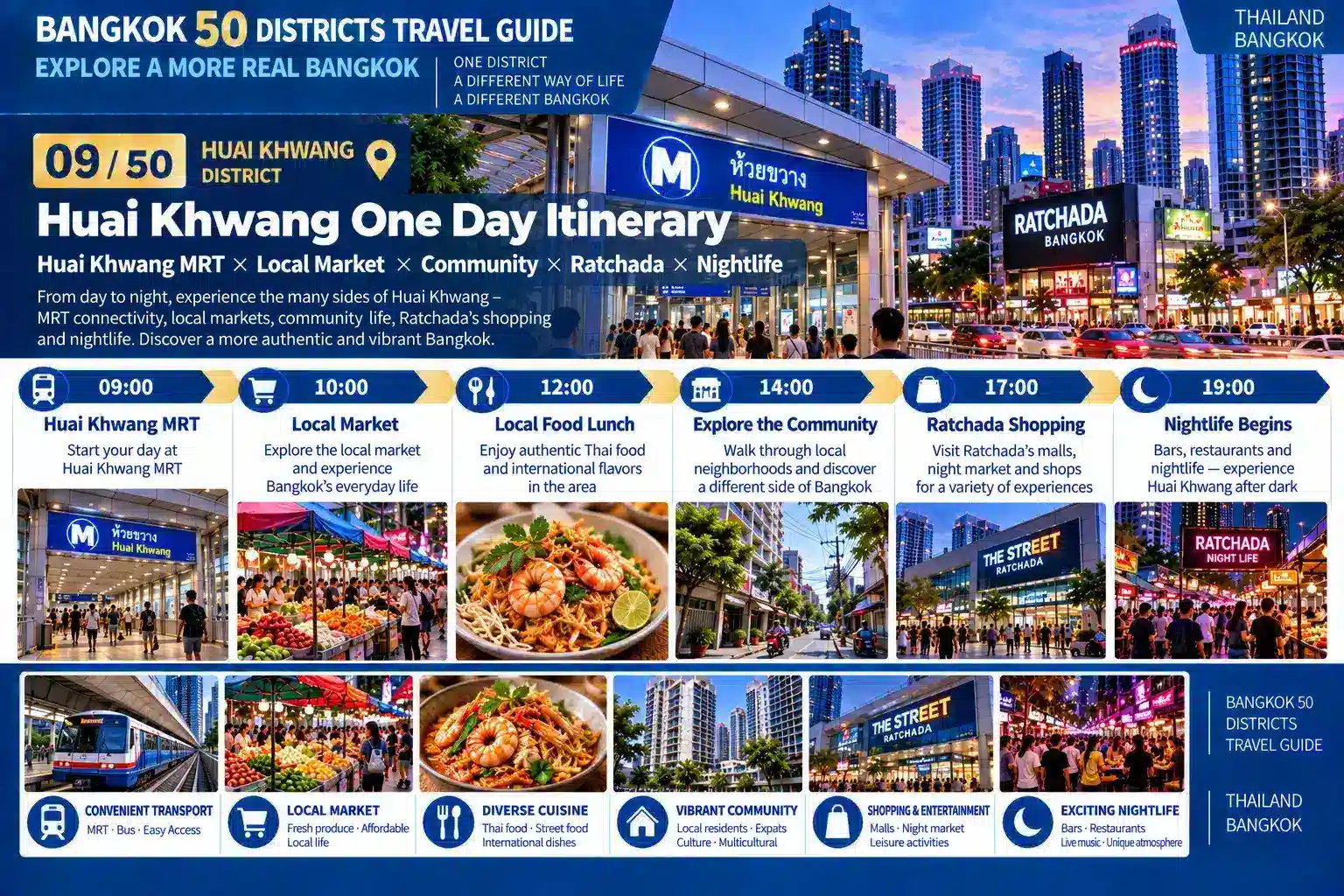
08|How to Spend One Day in Huai Khwang
Huai Khwang is not a district where you need to rush from one landmark to another.
Its character becomes clearer when you experience the transition from daytime community life to the evening atmosphere of Ratchada.
A possible itinerary could look like this:
09:00|Huai Khwang MRT
Begin at the MRT station and observe the commuters, businesses and everyday activity around the neighborhood.
10:00|Local Market
Explore fresh produce, prepared food, street stalls and businesses serving nearby residents.
12:00|Local Lunch
Choose a simple Thai restaurant or explore some of the district’s increasingly diverse dining options.
14:00|Explore the Community
Walk through residential streets and see how apartments, local shops and community spaces fit together.
17:00|Ratchada
Move toward the wider Ratchada area as the district begins transitioning from daytime business to evening activity.
19:00|Nightlife Begins
Finish with dinner, nighttime dining, entertainment or a walk through the illuminated streets.
When many of Bangkok’s traditional attractions are already closing, Huai Khwang may only be entering the busiest part of its day.
09|Why Huai Khwang Deserves a Full Day
First-time visitors to Bangkok may not place Huai Khwang among their top three destinations.
There is no Grand Palace here.
There is no Wat Arun.
And it does not have the same concentration of major luxury malls as Siam.
But once you begin exploring Bangkok beyond its famous attractions, Huai Khwang becomes much more interesting.
There are neighborhood markets and ordinary residences.
There is the MRT and a constant flow of commuters.
There are offices, restaurants, nightlife venues and modern commercial developments.
There are also community traditions and an increasingly international population.
More importantly, these different elements are not separated from one another.
They exist within the same urban space.
In the morning, you may experience a local market.
In the afternoon, you see commuters and commercial activity.
At night, the same district takes on a completely different personality.
That is why the most interesting thing about Huai Khwang is not one individual attraction.
It is the district itself.
Huai Khwang shows how a modern Asian metropolis can continuously change its identity from morning to night while remaining a place where people genuinely live, work, eat and build their everyday lives.
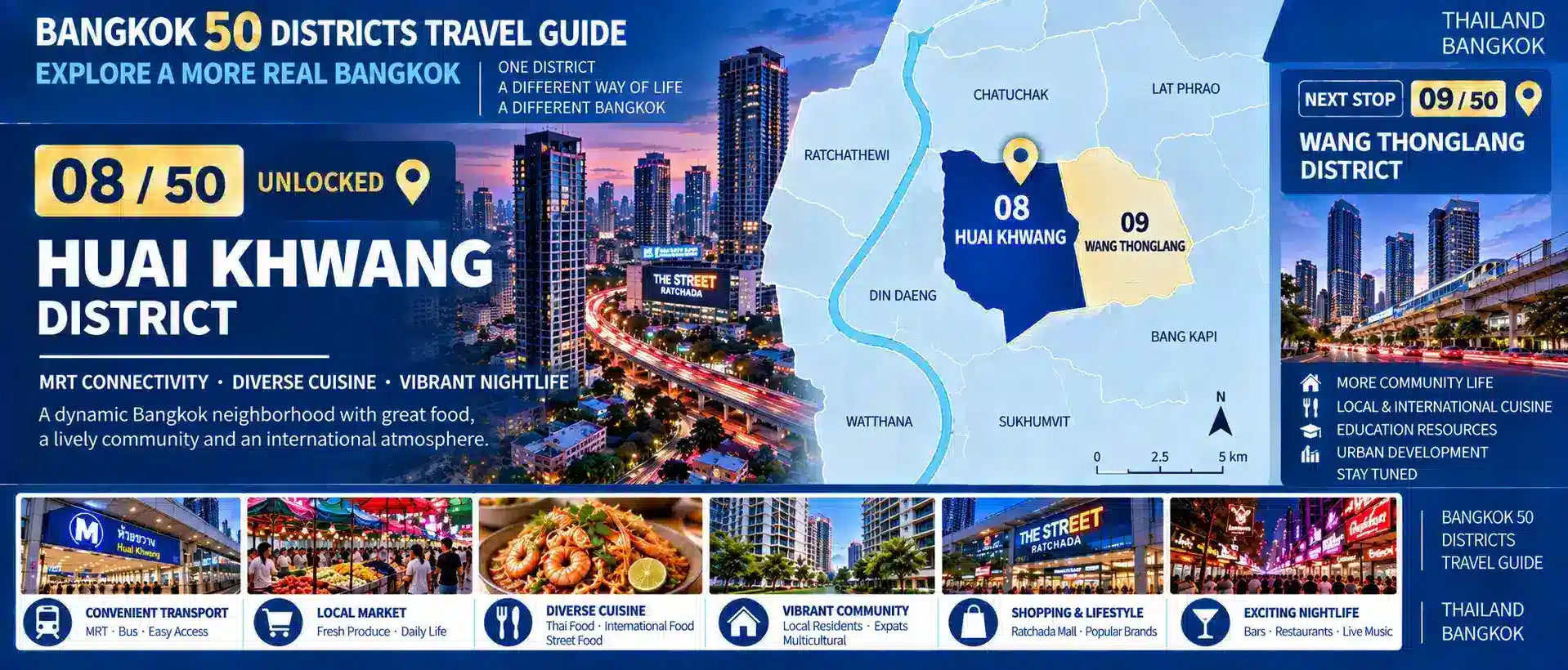
08 / 50 UNLOCKED
HUAI KHWANG ✓
Keywords:
Huai Khwang · Ratchada · MRT · Local Markets · Community Life · Nightlife · International Living · Urban Change
42 districts remaining.
NEXT STOP — 09 / 50
WANG THONGLANG
If Huai Khwang shows us a Bangkok that is becoming increasingly international and stays active from morning until late at night, our next stop takes us farther east into a district where residential life becomes even more prominent.
There, we continue looking for something at the heart of this entire series:
What remains of Bangkok when there are no world-famous attractions to define the journey?
Perhaps the answer is the most important thing of all—
the everyday life of the city itself.