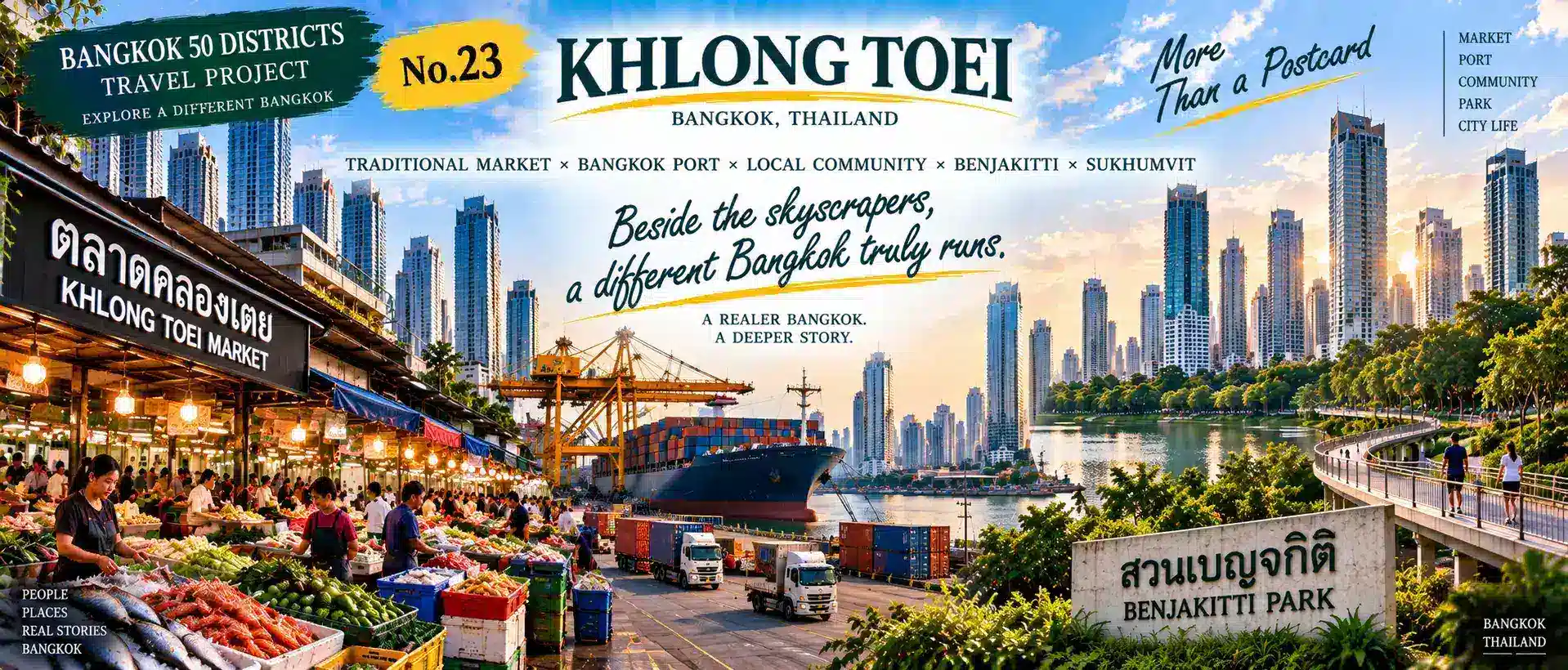
Stand around Sukhumvit and Bangkok may appear to be a city of:
High-rise condominiums.
Hotels.
Office towers.
Shopping centers.
BTS and MRT lines.
But travel just a little farther south and the urban landscape changes dramatically.
A huge traditional market.
Trucks.
Warehouses.
A working port.
Long-established communities.
Narrow streets.
Schools.
Small neighborhood shops.
And people whose everyday lives and jobs depend on this entire urban system.
This is:
Khlong Toei
It is one of the most interesting districts in the Bangkok 50 Districts series for understanding the city's contrasts.
Because here,
modern Bangkok and working Bangkok,
high-rise development and street-level communities,
large green spaces and dense neighborhoods,
and even international Sukhumvit and traditional markets
all exist surprisingly close to one another.
01|First, Meet Khlong Toei: Surprisingly Close to Central Bangkok
When people first hear about Khlong Toei, they may imagine somewhere far outside central Bangkok.
It isn't.
Travel south from the Asok and Sukhumvit area and you can reach Khlong Toei surprisingly quickly.
That proximity is one of the district's most interesting characteristics.
International commercial areas.
Modern residences.
Large parks.
Traditional markets.
Port logistics.
Local communities.
These places are not located at opposite ends of the city.
They exist remarkably close together.
So one of the first things Khlong Toei teaches us is:
Bangkok cannot simply be divided into “downtown” and “suburbs.”
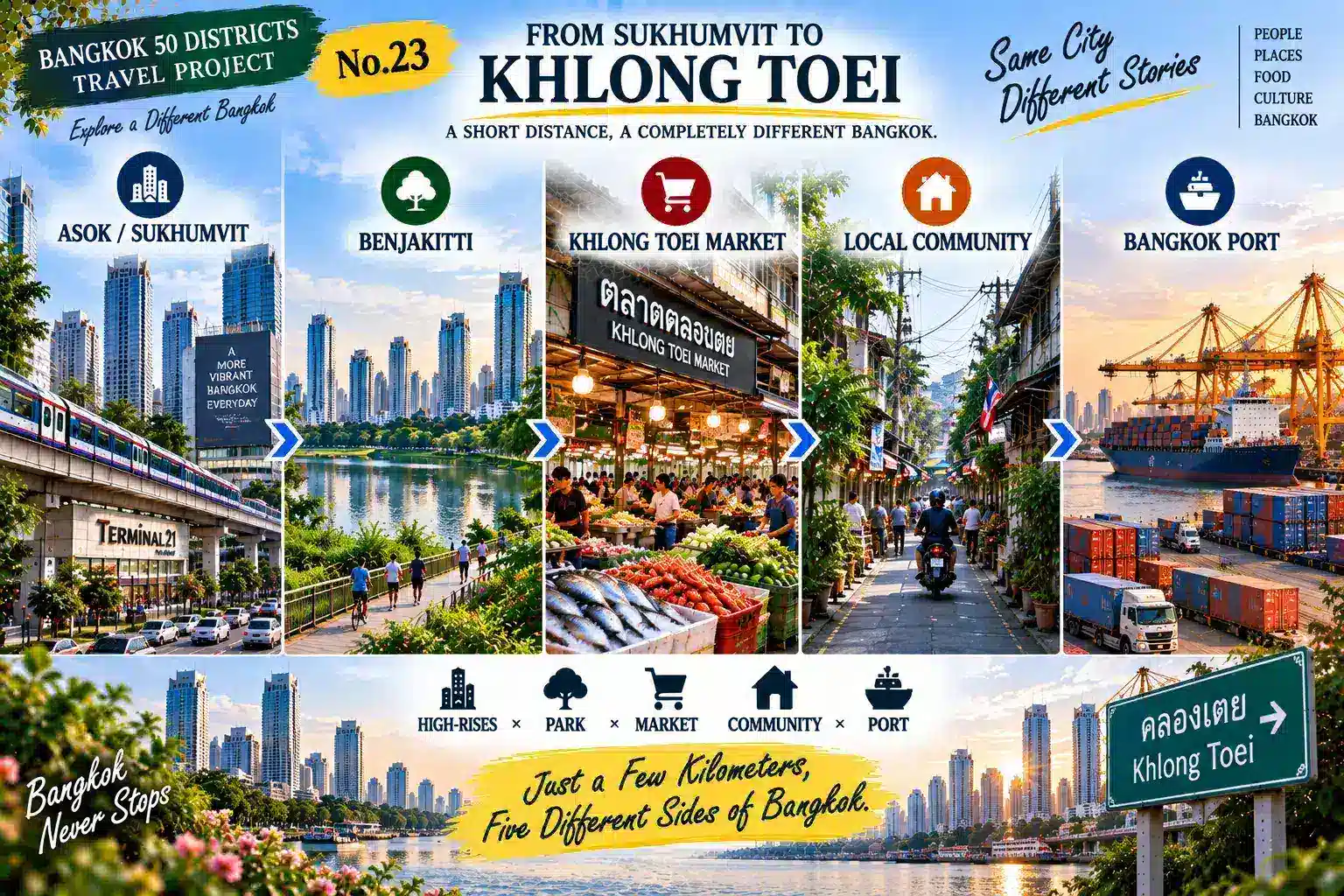
ASOK / SUKHUMVIT
↓
BENJAKITTI
↓
KHLONG TOEI MARKET
↓
LOCAL COMMUNITY
↓
BANGKOK PORT
HIGH-RISES × PARK × MARKET × COMMUNITY × PORT
**Within just a few kilometers,
discover five completely different sides of Bangkok.**
02|Khlong Toei Market: Where the City's Daily Food Supply Begins
One of Khlong Toei's most recognizable places is:
Khlong Toei Market
It is very different from the tourist-oriented night markets many visitors know.
Its primary purpose is not tourism.
It is part of Bangkok's everyday food-supply system.
Vegetables.
Fruit.
Meat.
Seafood.
Spices.
Prepared food.
Everyday ingredients constantly move through the market.
Vendors buy supplies.
Restaurants source ingredients.
Local residents shop for food.
Goods continuously enter and leave.
If you want to understand where some of the ingredients used by Bangkok's restaurants, street-food stalls and households come from,
traditional markets like this are an important part of the answer.
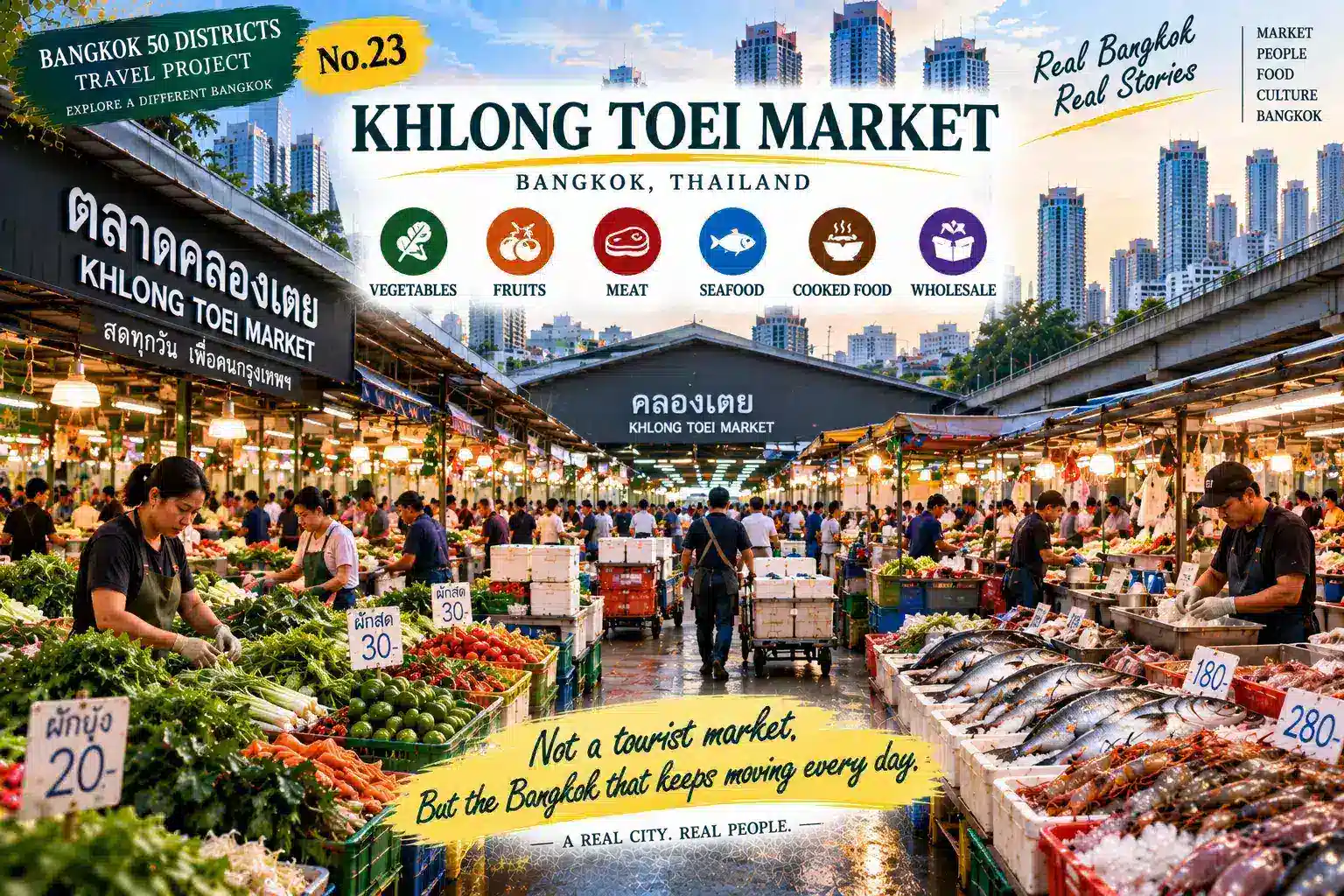
KHLONG TOEI MARKET
VEGETABLES × FRUIT × MEAT × SEAFOOD × SPICES × PREPARED FOOD × WHOLESALE
**This market was not created for tourists.
It exists first to serve a city that is constantly moving.**
03|The Market's Day Begins Before Most Visitors Wake Up
A large traditional market operates on a very different rhythm from an ordinary shopping street.
Before dawn,
goods are already arriving.
Early in the morning,
wholesale purchasing becomes busy.
Later in the morning,
businesses and local residents continue to arrive.
After midday,
the market keeps operating.
Its schedule is not designed around visitors.
It revolves around:
Food.
Transportation.
Purchasing.
Work.
That is why visiting Khlong Toei Market is not simply about seeing a market.
You are observing part of an urban supply system.
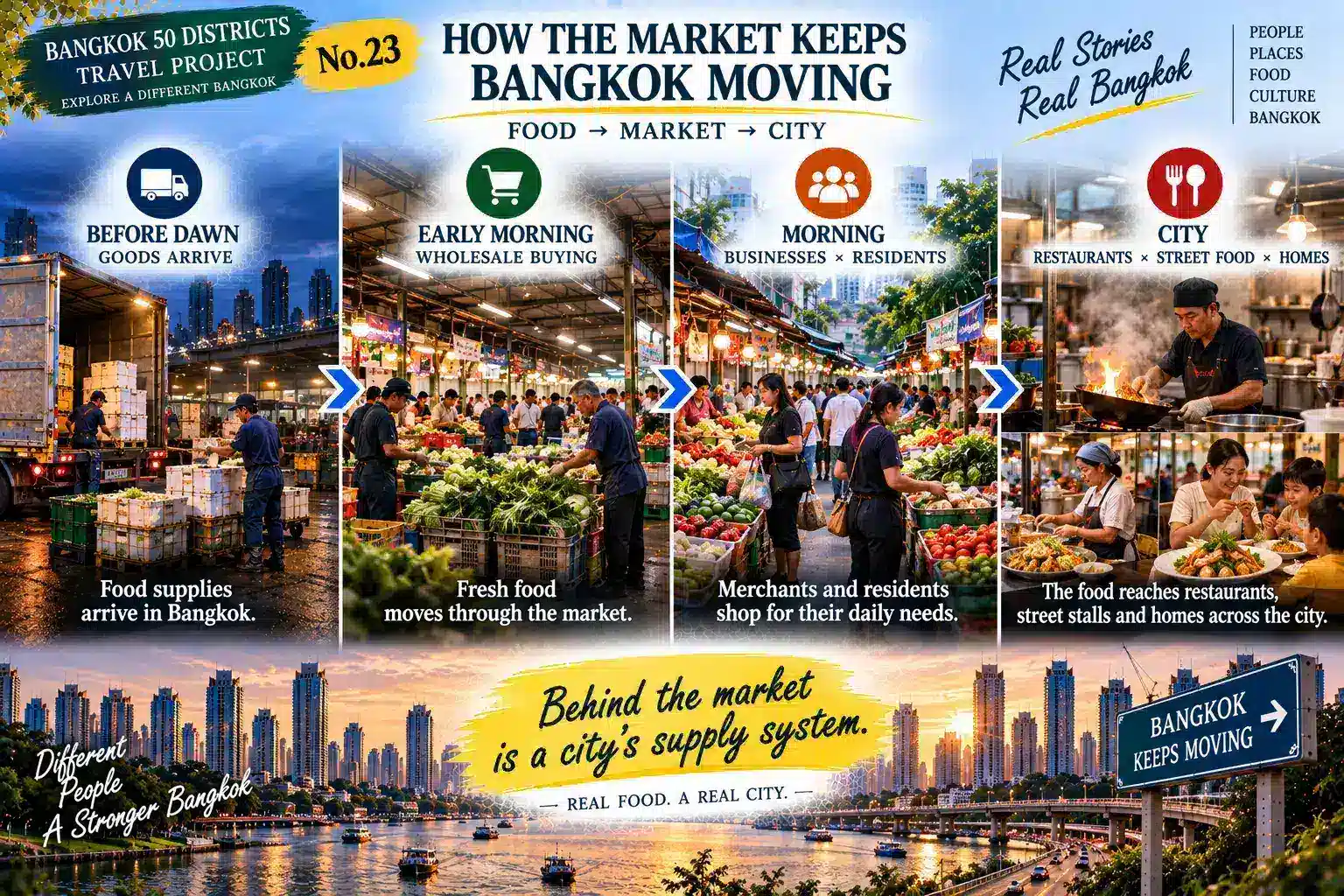
FOOD → MARKET → CITY
BEFORE DAWN|GOODS ARRIVE
↓
EARLY MORNING|WHOLESALE PURCHASING
↓
MORNING|BUSINESSES × RESIDENTS
↓
CITY|RESTAURANTS × STREET STALLS × HOMES
**Behind what a city eats every day
is an entire supply system most people never see.**
04|Continue South and You Reach Bangkok Port
Travel south from the market and Khlong Toei changes again.
Here you encounter:
Bangkok Port
Containers.
Trucks.
Warehouses.
Logistics.
Industrial facilities.
The river.
This is a completely different relationship with the Chao Phraya River from the one most visitors know.
Around the Grand Palace or ICONSIAM, the river often means:
Views.
Boats.
Hotels.
Tourism.
At the port, the river means:
Transportation.
Trade.
Logistics.
Work.
The same river serves completely different functions within the same city.
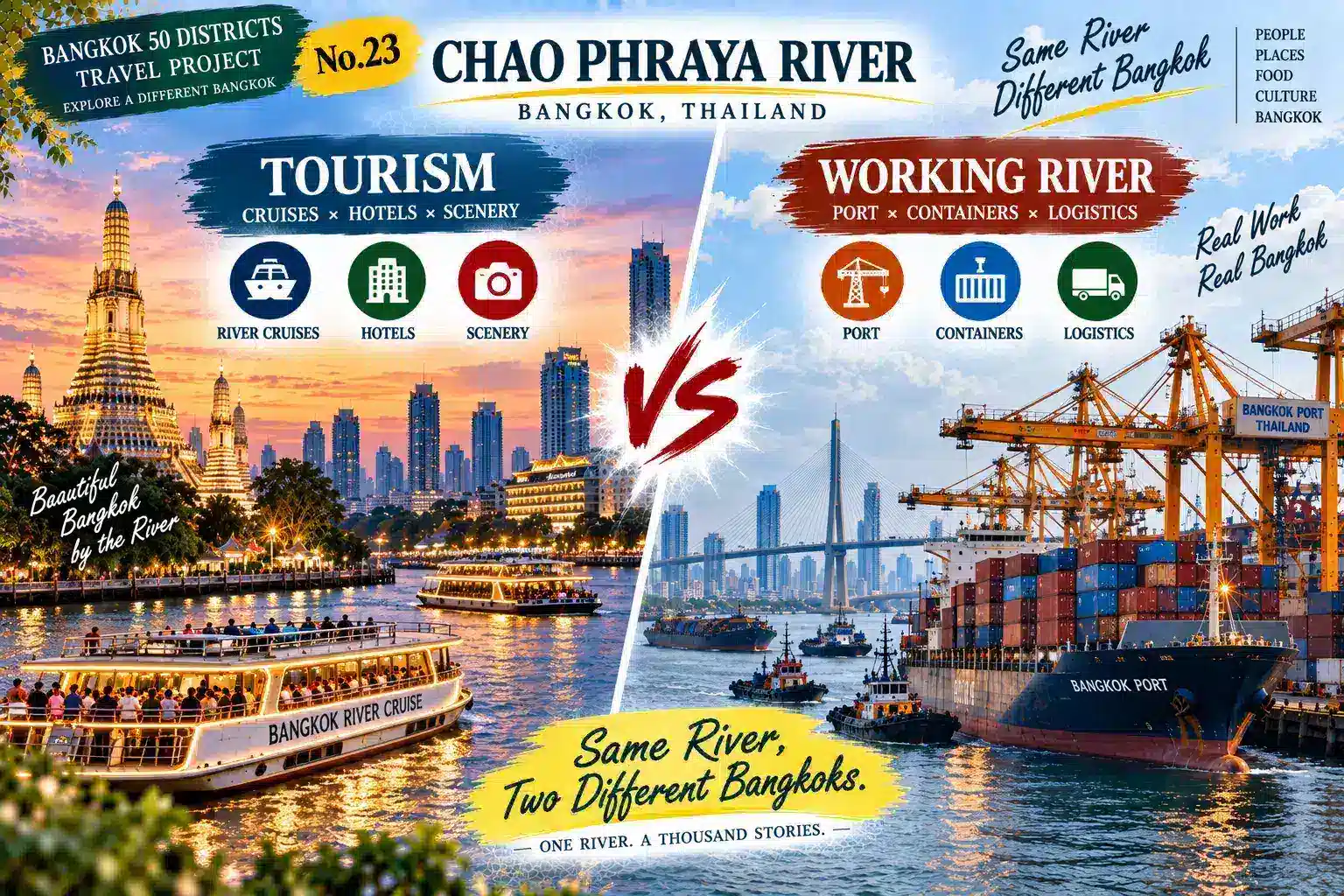
CHAO PHRAYA RIVER
TOURISM
BOATS × HOTELS × VIEWS × LANDMARKS
VS
WORKING RIVER
PORT × CONTAINERS × TRUCKS × LOGISTICS
**The same Chao Phraya River:
one side is admired, while the other helps keep the city moving.**
05|Beside the Market and Port Are Real Residential Communities
Khlong Toei is not only a market and a port.
It is also home to many residential communities.
Homes.
Schools.
Small shops.
Motorbikes.
Street restaurants.
Neighborhood roads.
Residents leave these communities for work every day.
Children travel from here to school.
In the evening, people return home.
Reducing these neighborhoods to a simple label of “poverty” misses the complexity of everyday urban life.
First and foremost:
These neighborhoods are home to people who have lived here for years.
For visitors, the goal should not be to treat the community as a spectacle.
It should be to explore respectfully.
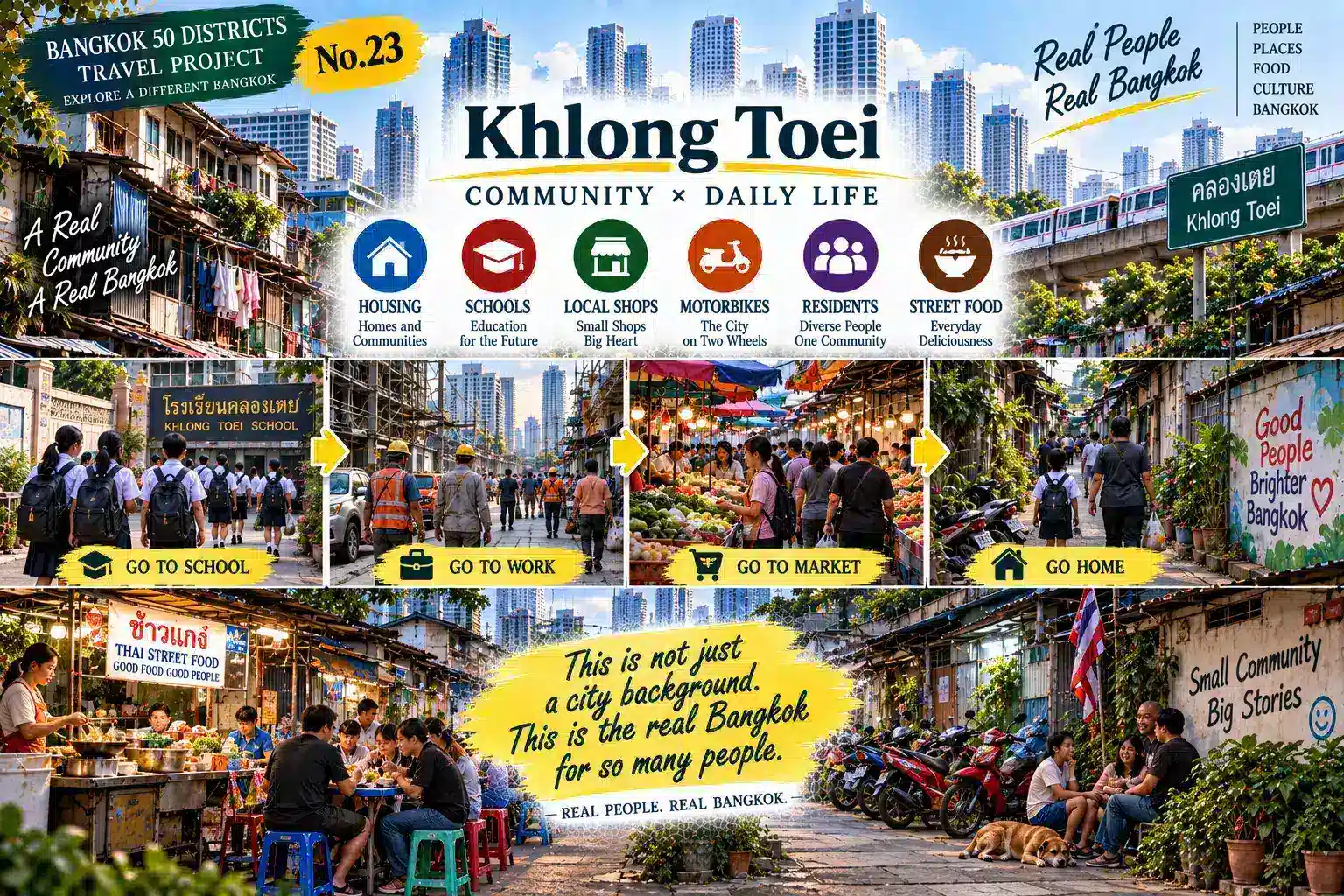
COMMUNITY × DAILY LIFE
HOMES × SCHOOLS × SMALL SHOPS × MOTORBIKES × RESIDENTS × STREET FOOD
SCHOOL
↓
WORK
↓
MARKET
↓
HOME
**This is not simply an urban backdrop.
For many people, this is their Bangkok.**
06|Benjakitti: A Huge Green Space at the Other End of the District
One of Khlong Toei's strongest urban contrasts appears around Benjakitti.
Not far from busy roads, markets and dense neighborhoods,
the city suddenly opens up.
Lakes.
Wetlands.
Walking paths.
Cycling routes.
Trees.
Large public spaces.
And behind them:
Bangkok's modern skyline.
This landscape says a great deal about contemporary Bangkok.
On one side is an increasingly dense metropolis.
On the other,
the city is creating more room for green public space.
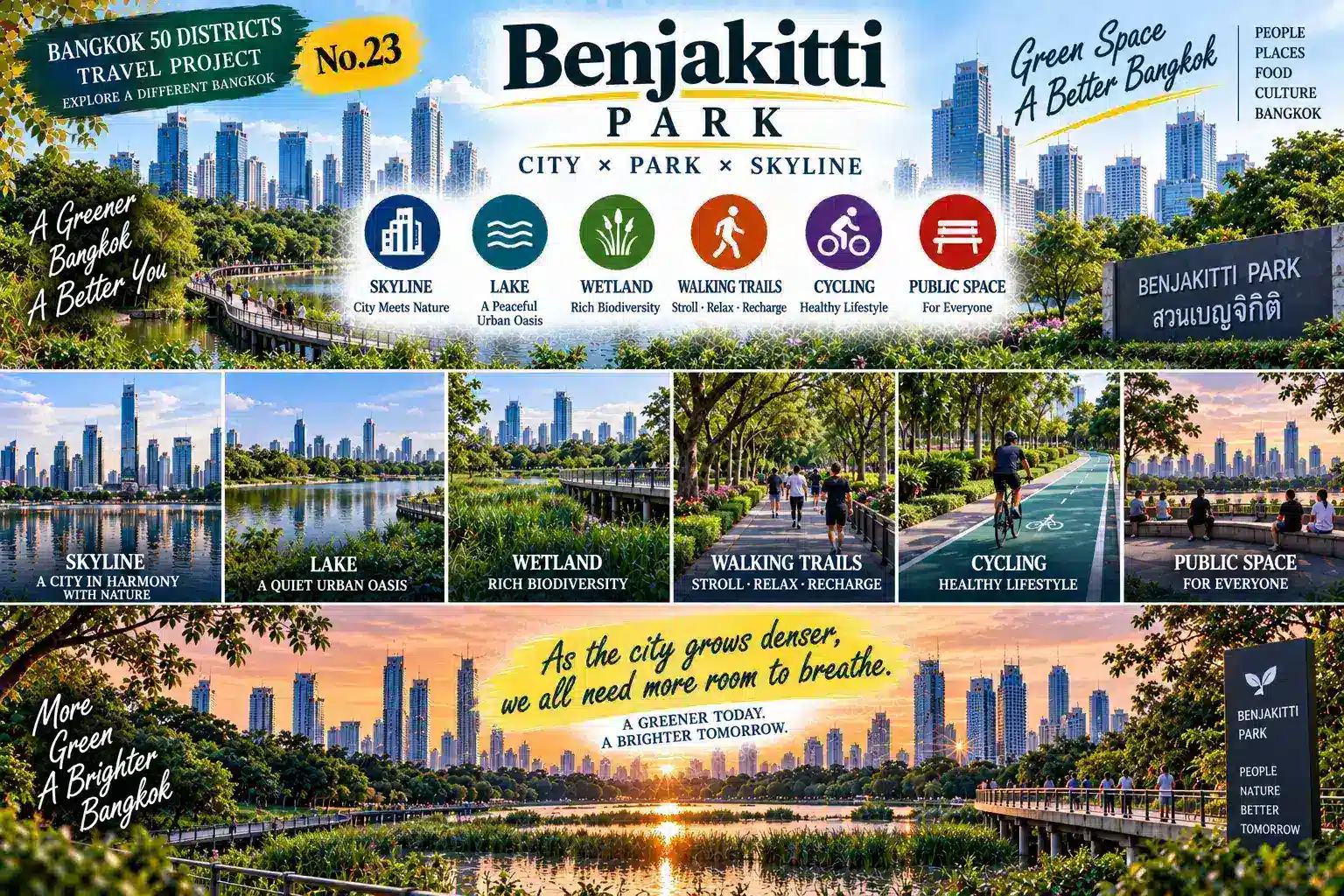
CITY × PARK × SKYLINE
HIGH-RISES
×
LAKES
×
WETLANDS
×
WALKING
×
CYCLING
×
PUBLIC SPACE
**Bangkok keeps becoming denser.
The city is also searching for more room to breathe.**
07|Why Is Khlong Toei So Good for Understanding Bangkok's Contrasts?
Because within a remarkably short distance, you can experience:
The international city of Sukhumvit.
The green city of Benjakitti.
The supply city of Khlong Toei Market.
The everyday city of local communities.
The logistics city of Bangkok Port.
These spaces may look as though they belong to five completely different cities.
But they are all Bangkok.
And they exist close together.
That is one of the most important things to understand about this metropolis:
Bangkok has never had only one version.
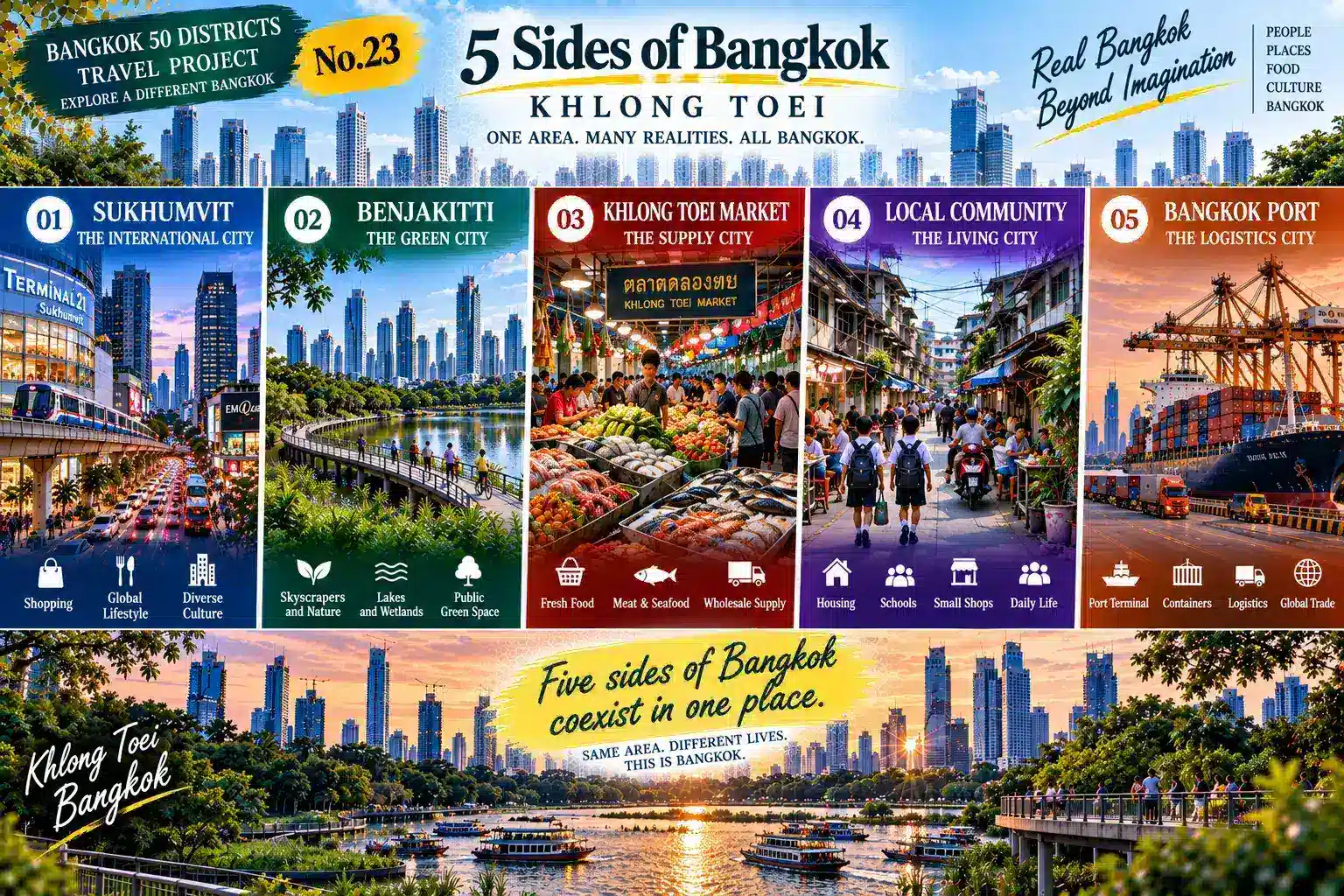
5 SIDES OF BANGKOK
01|SUKHUMVIT
INTERNATIONAL CITY
02|BENJAKITTI
GREEN CITY
03|KHLONG TOEI MARKET
SUPPLY CITY
04|LOCAL COMMUNITY
EVERYDAY CITY
05|BANGKOK PORT
LOGISTICS CITY
**Five completely different urban functions,
all existing in the same district.**
08|A One-Day Khlong Toei Travel Plan
For your first visit, think of the day as:
“From Modern Bangkok to the Working Systems Behind the City.”
08:00|Depart Central Bangkok
Start early.
The market is particularly active in the morning.
08:30|Khlong Toei Market
Begin inside the traditional market.
Observe ingredients, transportation, vendors and local shoppers.
10:00|Market Area × Local Commerce
See how the market connects with surrounding streets and businesses.
11:30|Local Lunch
Choose a simple neighborhood restaurant.
13:00|Community × Everyday Life
Explore community streets respectfully.
Observe homes, schools, small businesses and everyday routines.
14:30|Bangkok Port Area
Understand the relationship between the river, logistics and urban trade.
Some port areas are operational or restricted zones, so do not enter restricted spaces.
16:00|Benjakitti
Move from dense urban streets into a major green public space.
17:30|Lake × Skyline × Sunset
Watch the city lights gradually appear around the skyline.
18:30|Dinner × Return to the City
By the end of the day,
you will have experienced several completely different versions of Bangkok.
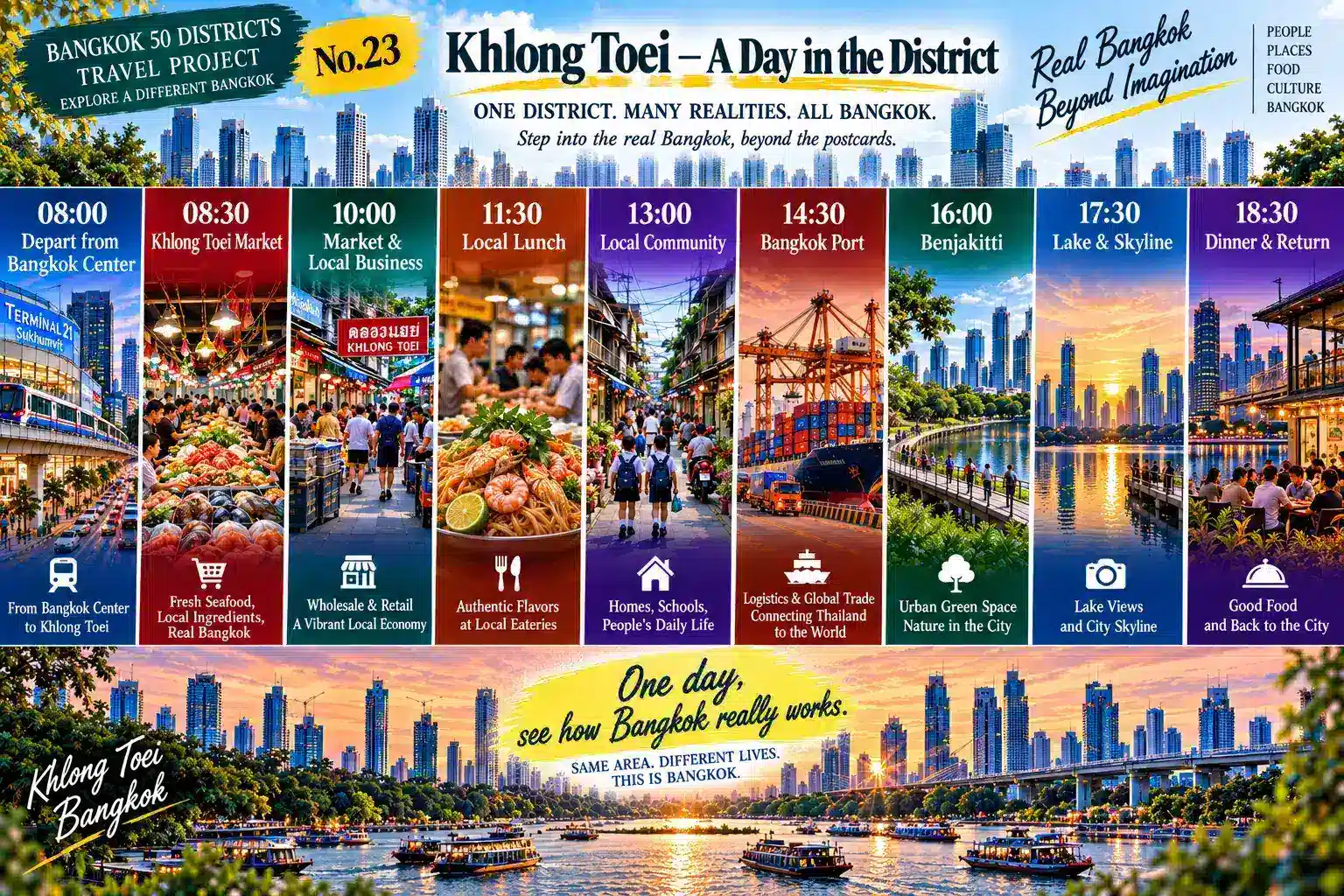
08:00|DEPART CENTRAL BANGKOK
08:30|KHLONG TOEI MARKET
10:00|MARKET AREA × LOCAL COMMERCE
11:30|LOCAL LUNCH
13:00|COMMUNITY × DAILY LIFE
14:30|BANGKOK PORT AREA
16:00|BENJAKITTI
17:30|LAKE × SKYLINE × SUNSET
18:30|DINNER × RETURN TO THE CITY
**One day,
from Sukhumvit into another urban system that helps keep Bangkok running every day.**
09|What Should You Know Before Visiting Khlong Toei?
01|Market
This is a real working traditional market.
Some areas may be wet or crowded.
Wear comfortable, practical shoes.
02|Time
If you want to experience the market at its most active,
arrive early.
03|Transportation
The district covers a considerable area.
The market, port surroundings and Benjakitti are not best explored entirely on foot.
Plan transportation between different sections.
04|Port
The port is first and foremost a working area.
Do not enter restricted zones or interfere with operations.
05|Community
Residential neighborhoods are not a “slum tourism” attraction.
Respect people's privacy and personal space.
Do not take close-up photographs of residents without permission.
10|Why Is Khlong Toei Worth Becoming District No.23?
Because this is where we begin to see the Bangkok behind the tourist map.
Behind a plate of Thai food,
there may be a market.
Behind the market,
there is transportation.
Transportation connects to logistics and the port.
And beside these working systems,
thousands of ordinary families continue their everyday lives.
At the same time,
Sukhumvit is not far away,
with its shopping centers, condominiums, hotels and international restaurants.
Benjakitti adds another completely different experience of a greener Bangkok.
These realities do not contradict one another.
Together, they form the real city.
If No.22 Watthana showed us:
How Bangkok connects with the world,
then No.23 Khlong Toei shows us:
**How the city actually keeps itself running every day.**
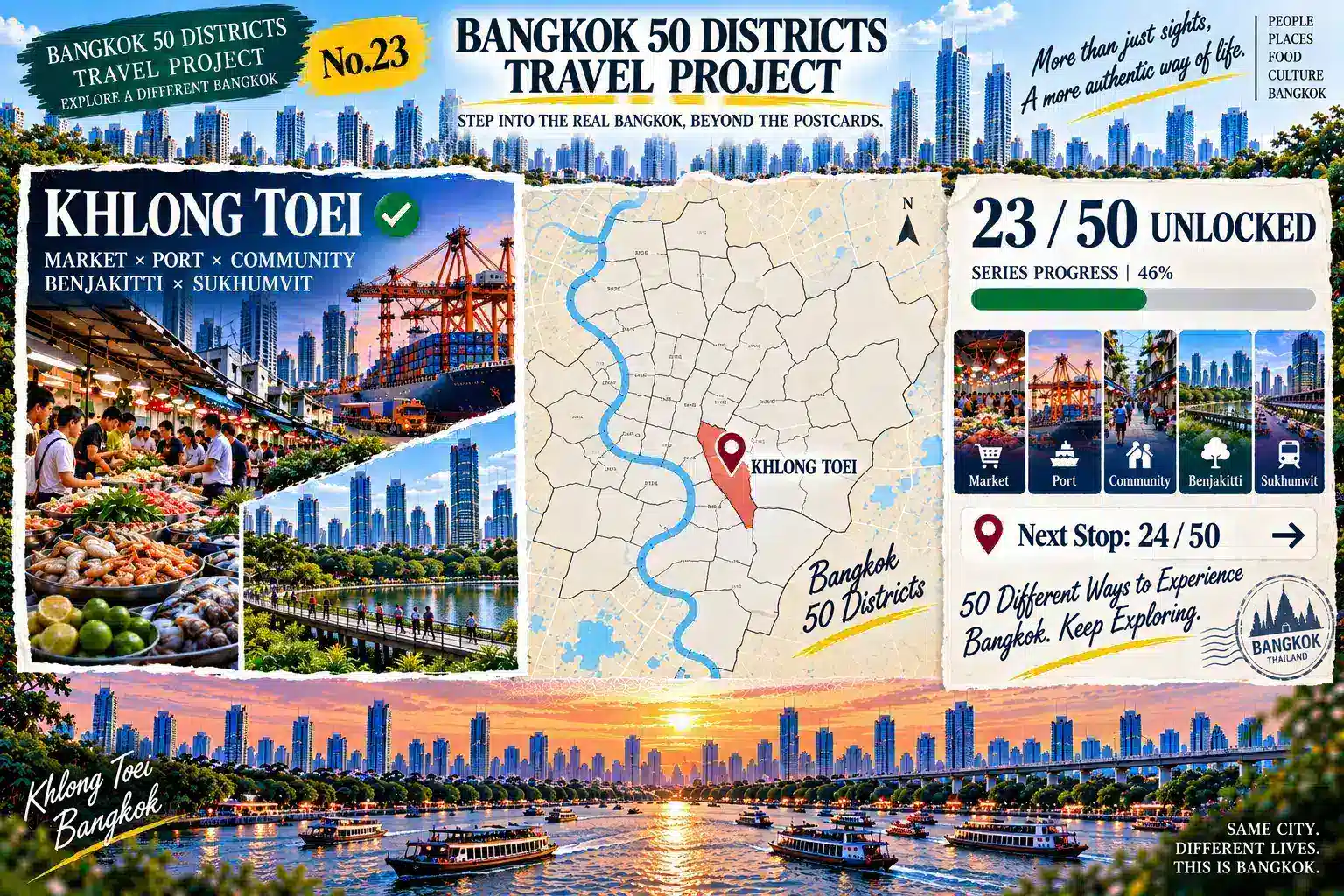
BANGKOK 50 DISTRICTS TRAVEL PROJECT
**23 / 50 UNLOCKED**
KHLONG TOEI ✓
SERIES PROGRESS|46%
KHLONG TOEI MARKET × BANGKOK PORT × OLD COMMUNITIES × BENJAKITTI × SUKHUMVIT × URBAN CONTRASTS
TRAVEL TIPS:
MARKET × TRANSPORT PLANNING × PORT BOUNDARIES × COMMUNITY RESPECT × OUTDOOR WEATHER
NEXT STOP: 24 / 50
**50 districts.
50 different ways of life.
Keep exploring Bangkok.**