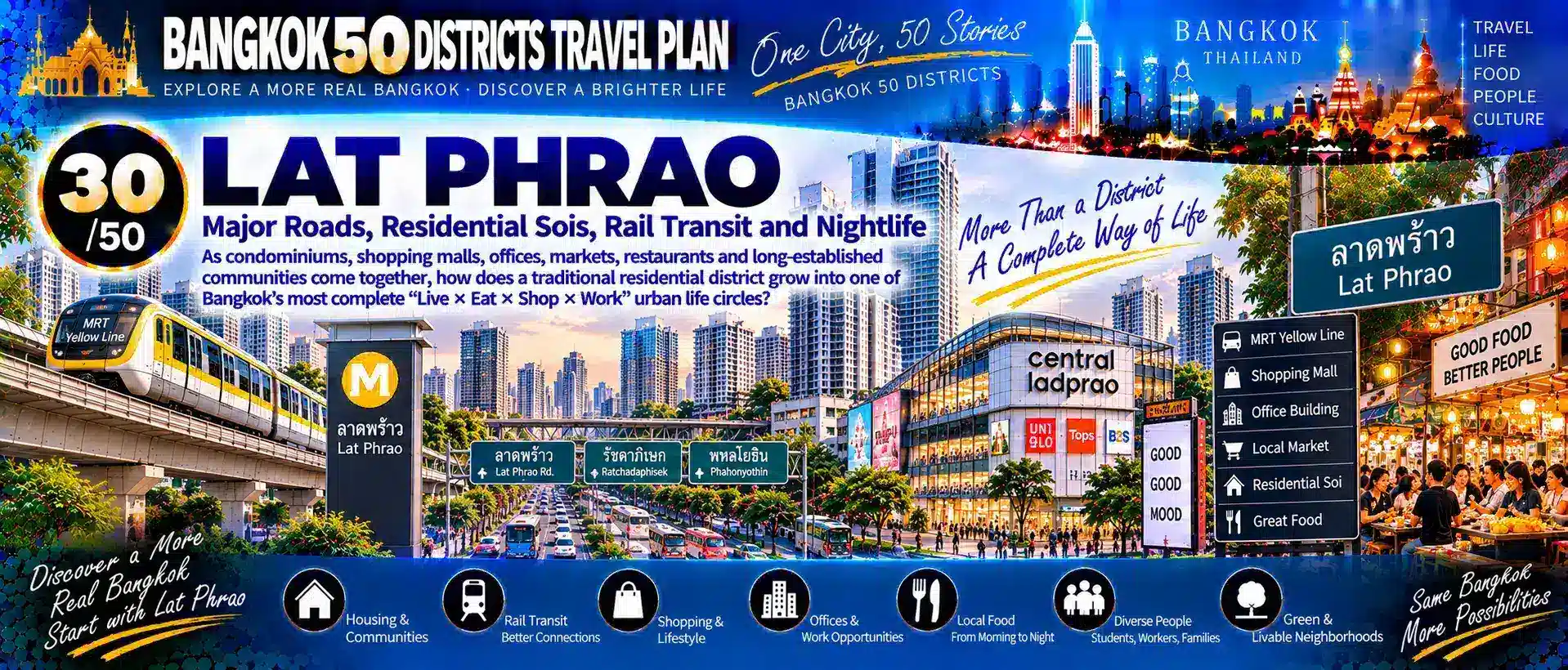
01|Where Is Lat Phrao?
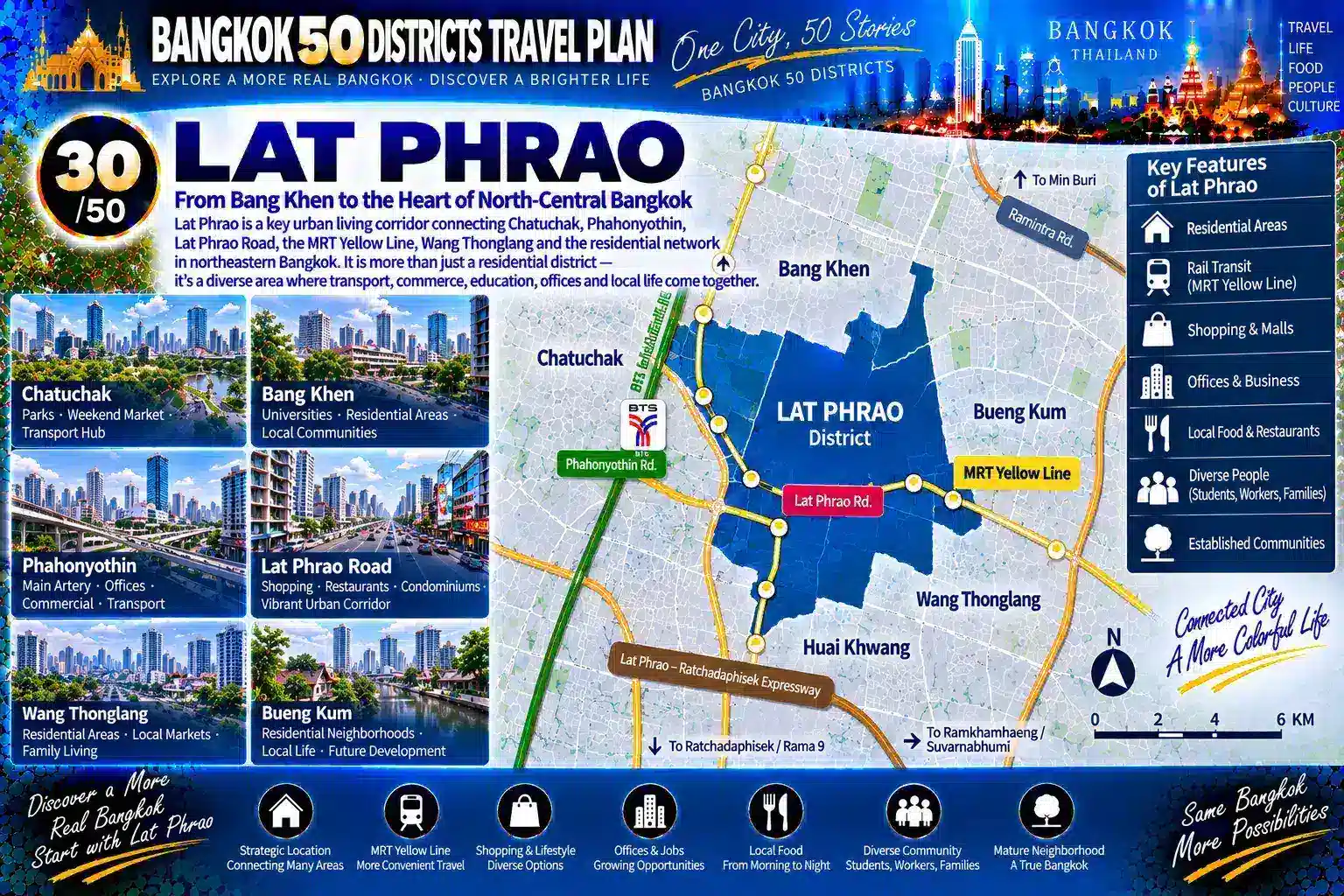
Lat Phrao is located in north-central Bangkok.
It is closely connected with:
Chatuchak.
Bang Khen.
Wang Thonglang.
Bueng Kum.
And large residential areas across northeastern Bangkok.
The best way to understand Lat Phrao is not to begin by searching for one famous attraction.
Instead, look at:
THE ROADS.
Lat Phrao and the surrounding major roads have long carried heavy east–west and cross-city traffic.
Along these roads, we find:
Housing.
Condominiums.
Shops.
Offices.
Schools.
Restaurants.
Markets.
Community businesses.
Major roads extend across the district.
Countless sois branch away from them and lead deeper into residential neighborhoods.
This creates one of Lat Phrao’s most characteristic urban structures:
MAIN ROAD × SOI
The main road connects the city.
The soi contains everyday life.
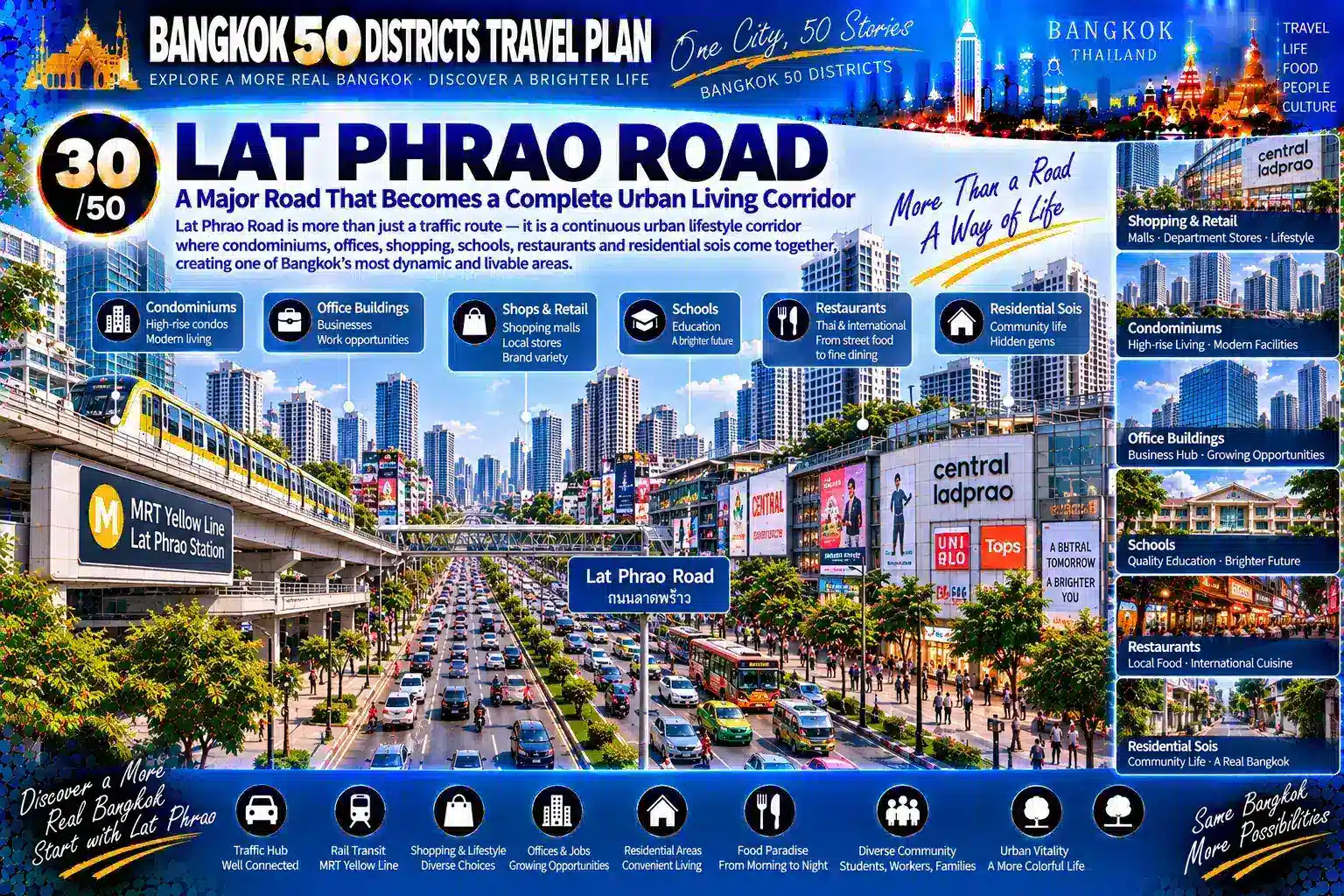
02|Lat Phrao Road: How Does One Road Become an Entire City?
When you first arrive in Lat Phrao, one thing quickly becomes clear.
The district is not organized around a single central square.
Instead, the city stretches continuously along major roads.
On either side, you find:
Office buildings.
Shops.
Condominiums.
Banks.
Convenience stores.
Restaurants.
Schools.
Clinics.
Community services.
Then, every so often, another soi appears.
Enter the soi and the city suddenly changes.
Traffic becomes lighter.
Housing becomes more dominant.
Small neighborhood businesses appear.
Motorcycles move through narrow streets.
Residents become the main characters.
The real importance of Lat Phrao Road is therefore not simply:
“WHERE CAN THIS ROAD TAKE YOU?”
The more interesting question is:
“HOW DID THE ROAD ITSELF BECOME A CONTINUOUS URBAN LIVING CORRIDOR?”
03|Residential Sois: Where Is the Real Lat Phrao Hidden?
If you only travel along Lat Phrao’s major roads, the district can feel like:
Heavy traffic.
Dense buildings.
Busy commerce.
Constant movement.
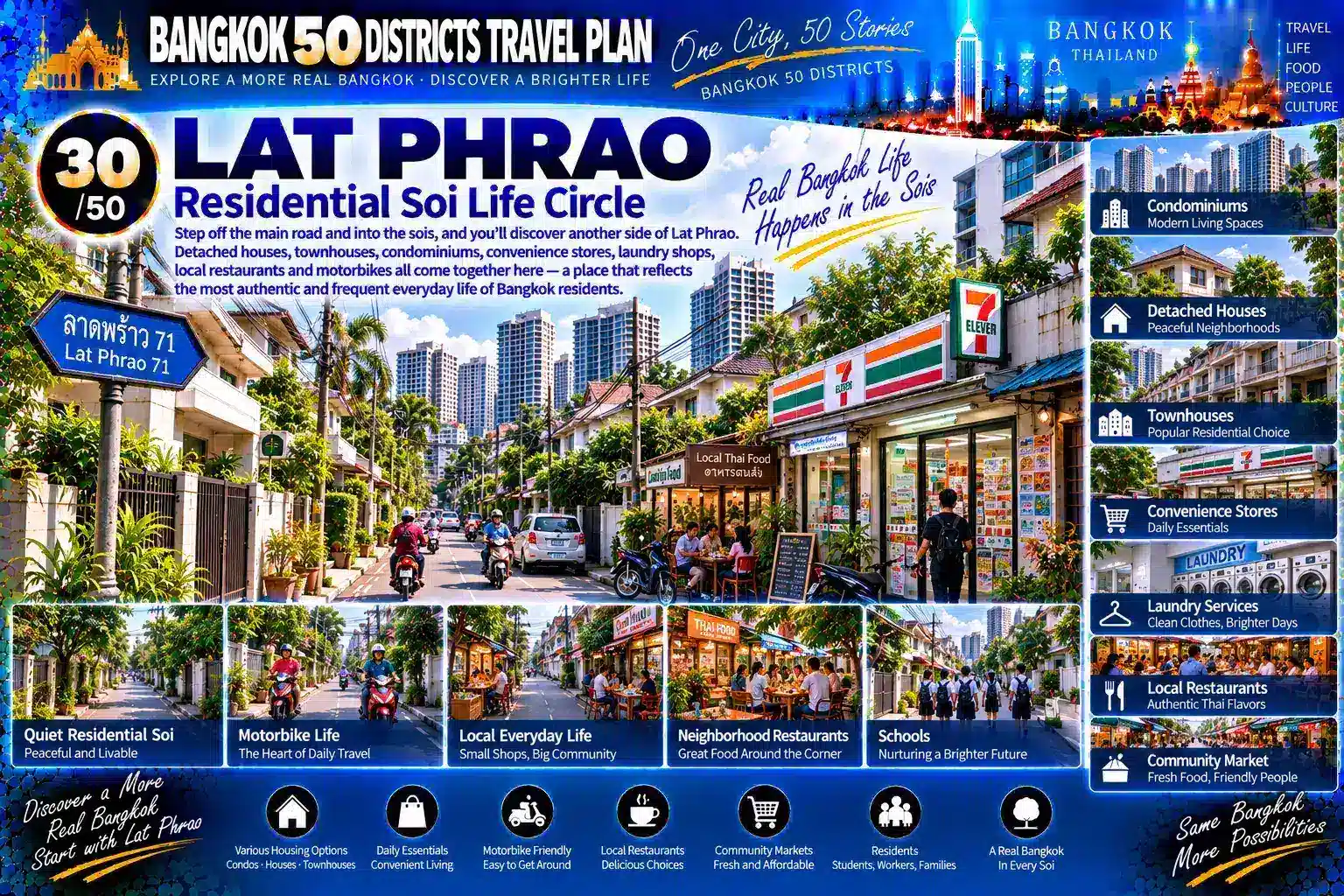
But once you enter the sois, another side appears.
Detached houses.
Townhouses.
Low-rise apartments.
Smaller condominiums.
Schools.
Laundry shops.
Convenience stores.
Neighborhood restaurants.
Motorcycle taxis.
Community markets.
These are the spaces where many Lat Phrao residents actually live their everyday lives.
Many parts of Bangkok are structured around sois.
But in Lat Phrao, this relationship is particularly important.
The main roads handle high-intensity urban movement.
The sois perform another role:
THEY TURN THE CITY BACK INTO A COMMUNITY.
Someone may work in Siam.
They return to Lat Phrao by rail, bus or car.
They enter their familiar soi.
Buy dinner.
Stop at a convenience store.
Then finally return home.
Within a short period of time, the scale of the city changes from:
“A metropolis shared by millions of people”
to:
“The street I know.”
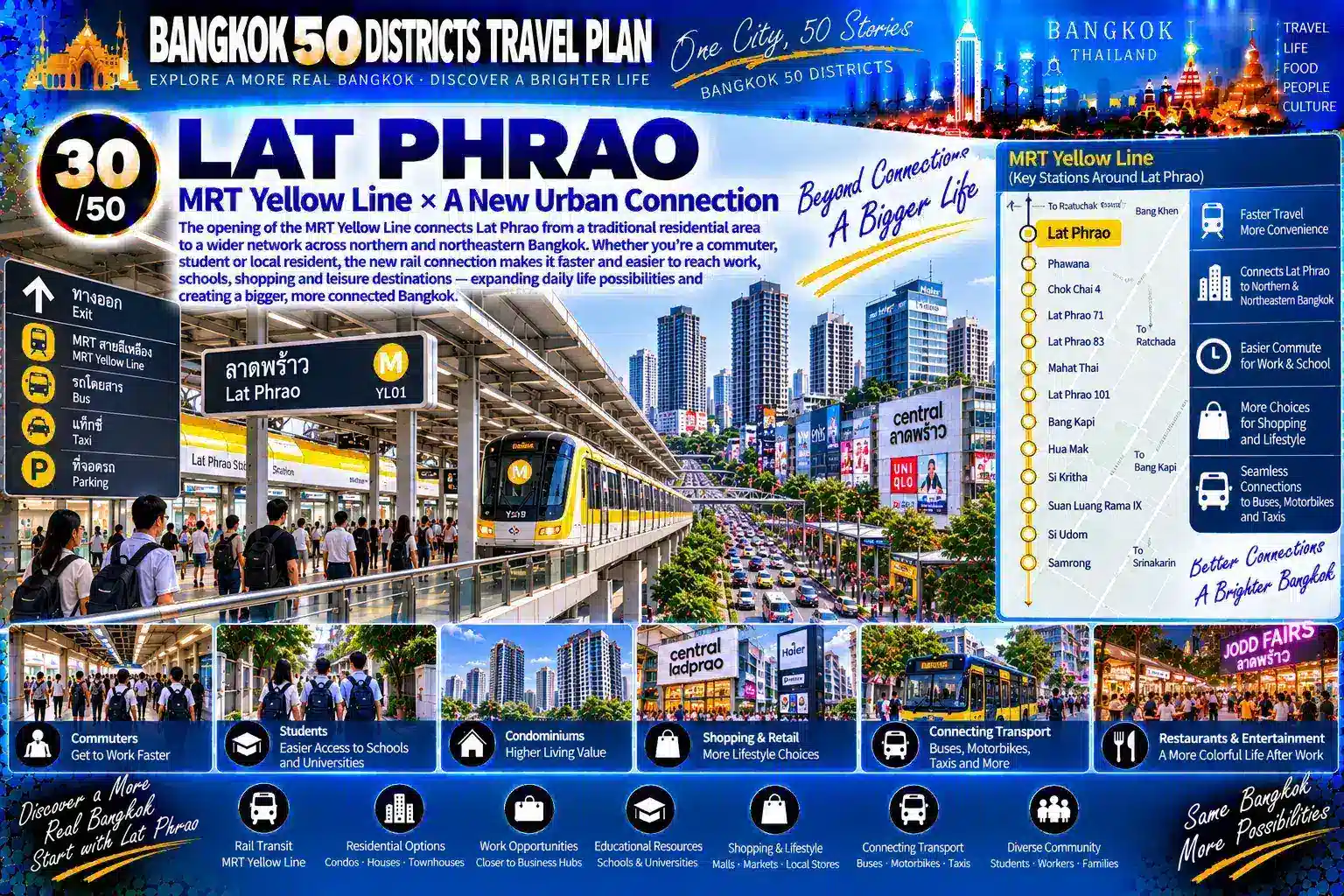
04|Rail Transit: Why Is Lat Phrao’s Everyday Radius Becoming Larger?
For many years, Lat Phrao depended heavily on road transportation.
Cars.
Buses.
Motorcycles.
Taxis.
All remain important.
But as Bangkok’s rail network has expanded, residents have gained more transportation choices.
One important example is:
MRT YELLOW LINE
The Yellow Line creates additional rail connections between Lat Phrao and residential and commercial areas across eastern and northeastern Bangkok.
Rail transit does more than reduce dependence on cars.
It can also change:
Where people choose to live.
Where businesses open.
Where condominiums are developed.
How people commute.
How students travel.
Where people spend weekends.
A place that once felt “a little too far away” can suddenly feel much closer once it becomes part of the rail network.
Transportation therefore does not only change physical distance.
It changes:
WHAT PEOPLE CONSIDER “CONVENIENT.”
05|Condominiums × Offices: Why Are More People Choosing to “Live Closer to Life”?
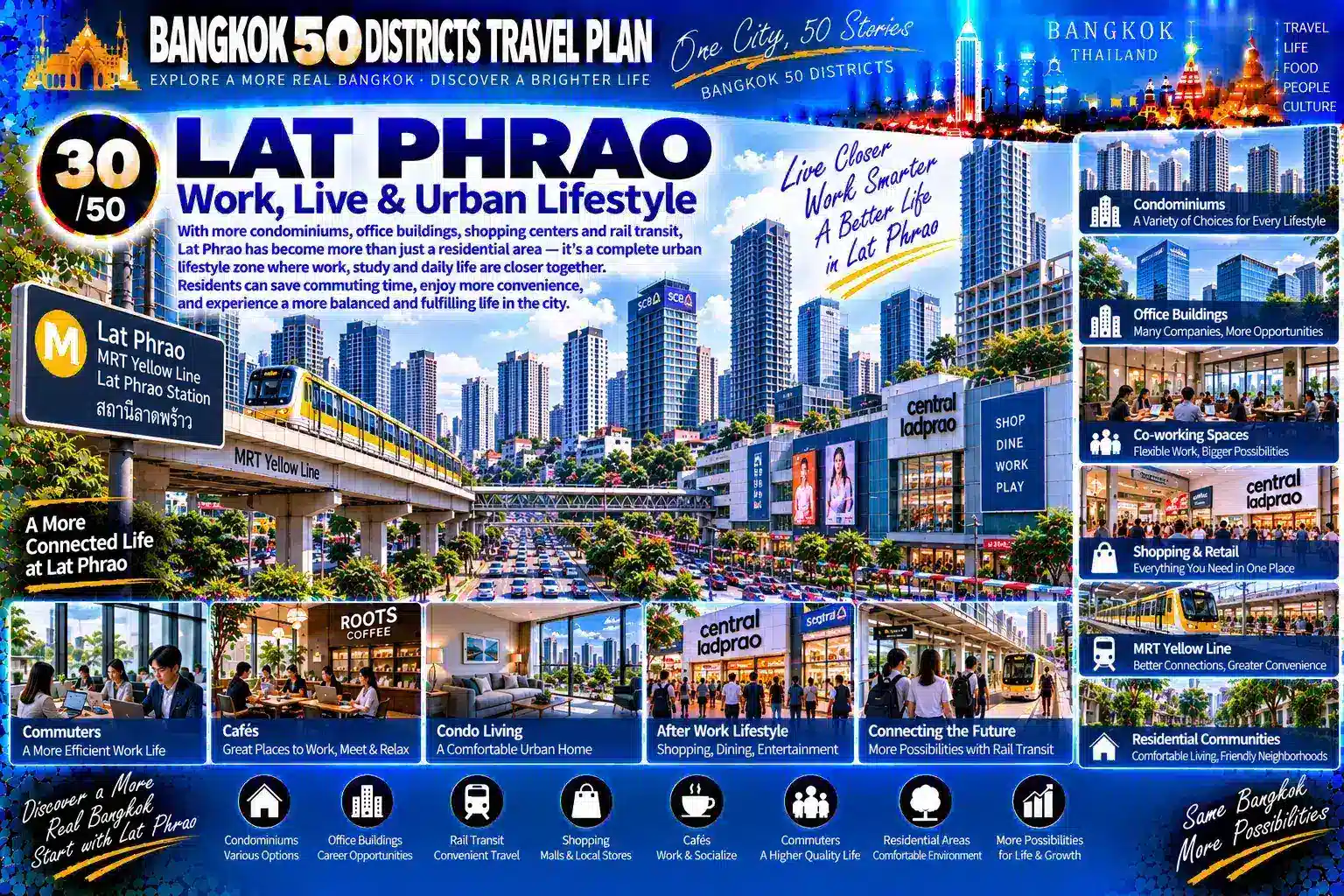
As Lat Phrao has matured, more of the following have appeared:
Apartments.
Condominiums.
Office buildings.
Community businesses.
Behind this development is a very practical urban choice.
Not everyone needs to:
Live in Siam.
Live in Asok.
Live in Thonglor.
What many people actually need is:
A convenient commute.
Reasonable housing costs.
Food nearby.
Shopping nearby.
Easy transportation.
A simple journey home at night.
This is why districts such as Lat Phrao can become highly attractive.
It may not be Bangkok’s traditional central business district.
But it offers something different:
A MORE COMPLETE BALANCE BETWEEN COST, CONVENIENCE AND EVERYDAY LIFE.
As housing, employment, commerce and transportation move closer together, people may also spend less time crossing the city every day.
This helps explain why mature residential districts gradually attract more office and commercial functions.
Because:
WHERE PEOPLE LIVE FOR THE LONG TERM, WORK AND CONSUMPTION EVENTUALLY FOLLOW.
06|Markets and Community Commerce: Why Haven’t Local Markets Disappeared After Modern Shopping Centers Arrived?
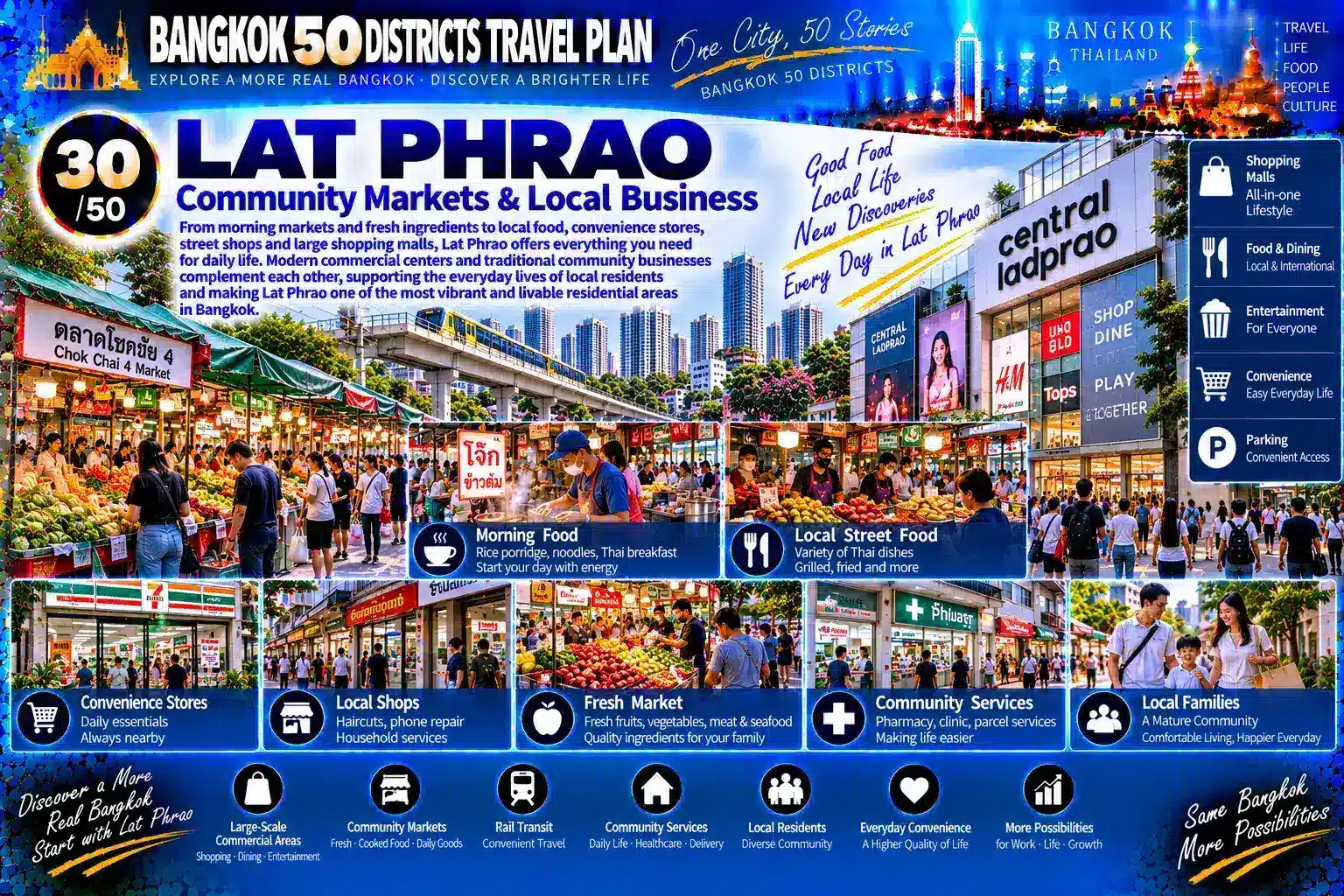
Modern Bangkok has more large-scale commercial developments than ever.
Yet everyday life in Lat Phrao still depends heavily on:
Markets.
Street shops.
Neighborhood restaurants.
Convenience stores.
Ready-to-eat food stalls.
Small local businesses.
The reason is simple.
Large shopping centers provide:
Choice.
Brands.
Entertainment.
Social spaces.
Community businesses provide something else:
EVERYDAY LIFE.
Breakfast needs to be bought.
Water needs to be bought.
Dinner needs to be bought.
Fruit needs to be bought.
Laundry needs to be done.
Sometimes a household item is needed immediately.
A genuinely mature district therefore is not a place where:
“Shopping malls replace markets.”
Instead, it is a place where:
SHOPPING MALLS × MARKETS × STREET SHOPS COEXIST.
Different prices.
Different times of day.
Different needs.
Together, they create the city residents actually use.
07|What to Eat in Lat Phrao? From Breakfast to Late-Night Food
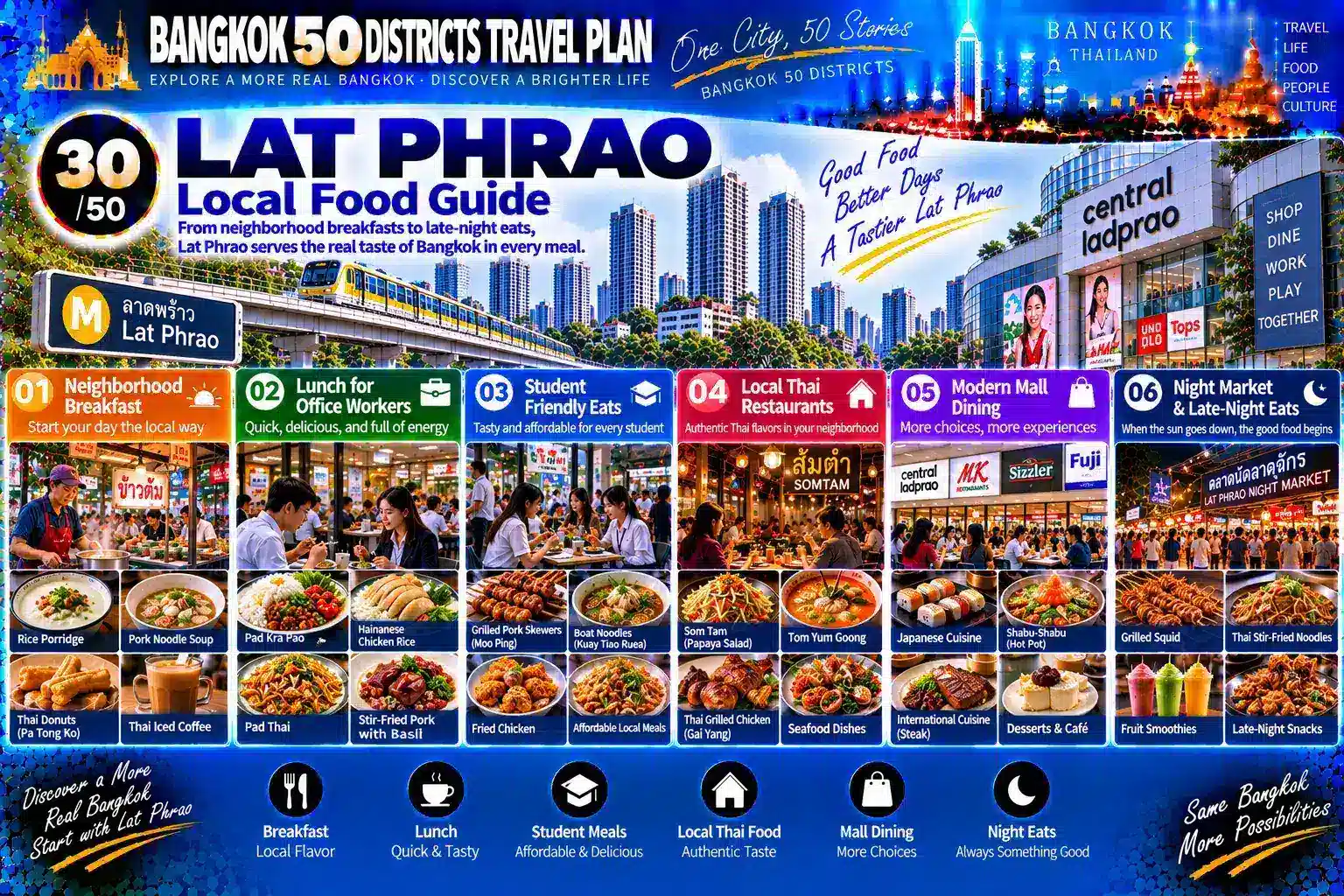
Food is one of the best ways to understand Lat Phrao.
The district’s restaurants do not exist primarily for tourists.
They serve:
Students.
Office workers.
Families.
Young people.
Long-term residents.
① Community Breakfast
Rice porridge.
Noodles.
Chicken rice.
Grilled pork skewers.
Coffee.
② Office-Worker Lunch
Fast.
Affordable.
Plenty of choices.
③ Affordable Student Meals
Portion size and price both matter.
④ Neighborhood Thai Food
The kind of food people can eat repeatedly throughout the week.
⑤ Shopping Center & Modern Dining
Chain restaurants.
Cafés.
Desserts.
International cuisine.
⑥ Nighttime Food
Barbecue.
Hot pot.
Isan food.
Night markets.
Late-night restaurants.
That is what makes Lat Phrao’s food culture interesting.
It is less about:
“Where should I eat once?”
And more about:
“IF I LIVED HERE, WHAT COULD I EAT EVERY DAY?”
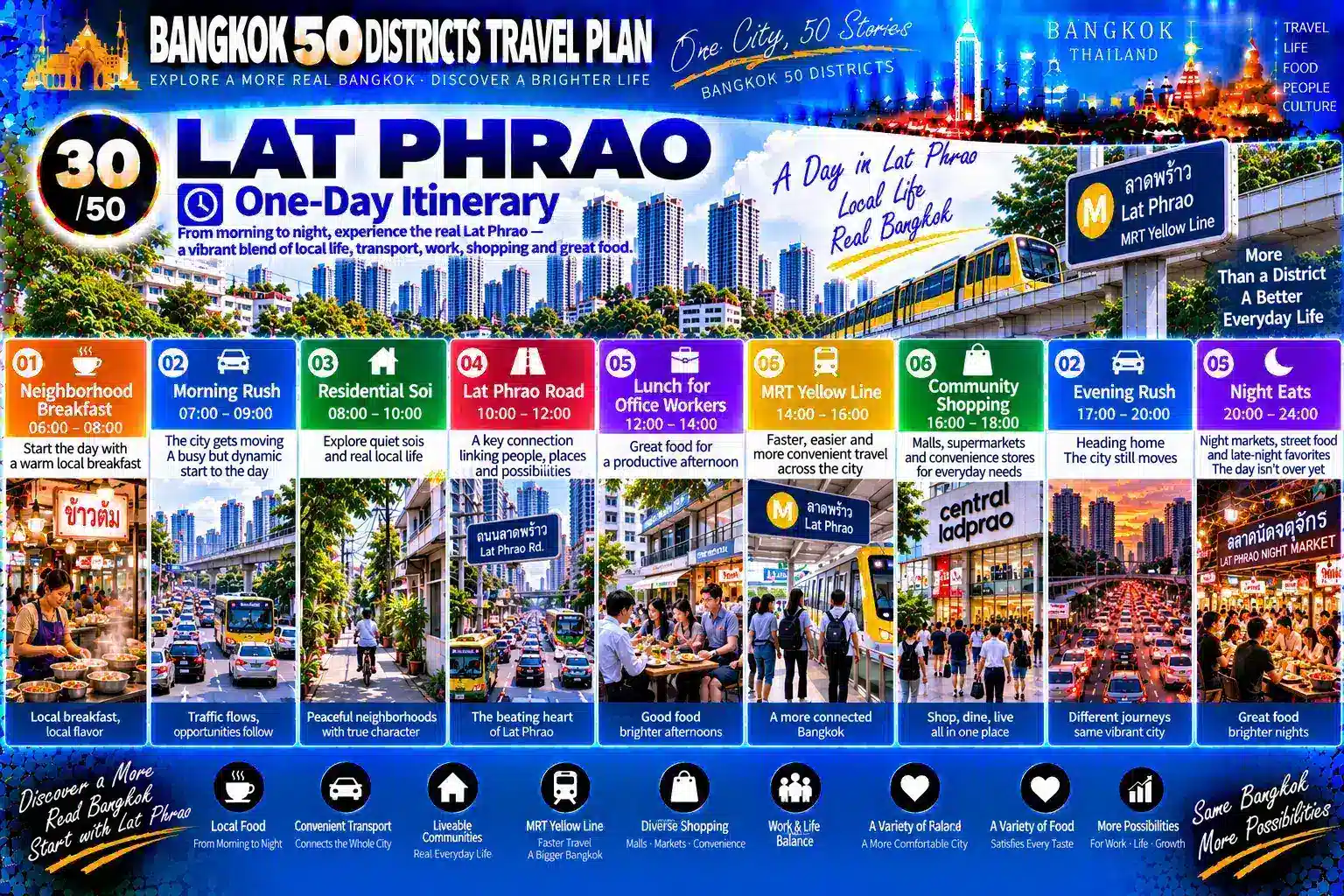
08|How to Spend One Day in Lat Phrao
Lat Phrao is best explored by spending a full day observing:
HOW A MATURE BANGKOK LIFE CIRCLE OPERATES FROM EARLY MORNING UNTIL LATE AT NIGHT.
06:30|Community Breakfast
Begin near a residential soi.
Watch how an ordinary day starts for local residents.
07:30|Morning Rush Hour
Cars.
Motorcycles.
Buses.
Rail transit.
Students and office workers enter the city at the same time.
09:00|Residential Soi
Leave the main road.
Discover Lat Phrao’s quieter side.
10:30|Lat Phrao Road
Return to the high-intensity urban corridor.
Observe how roads, housing, commerce and offices overlap.
12:00|Office-Worker Lunch
Experience one of the most reliable weekday population flows.
14:00|Rail-Connected Life
Follow the MRT Yellow Line and observe how rail is changing urban connectivity.
16:00|Community Commerce
Coffee shops.
Convenience stores.
Small businesses.
Markets gradually become busier.
18:00|Evening Rush × Dinner
Office workers return home.
Restaurants enter their busiest period.
20:00|Lat Phrao After Dark
Night markets.
Hot pot.
Barbecue.
Friends meeting for dinner.
At this point, something becomes clear:
Lat Phrao’s day does not end when offices close.
IT SIMPLY SWITCHES FROM A “WORKING CITY” INTO A “LIVING CITY.”
09|The Real Sign of Lat Phrao’s Maturity Is That It Does Not Need One Super Landmark
When people think about urban travel, they often search for:
The most famous temple.
The tallest building.
The largest shopping mall.
The most popular attraction.
But what makes Lat Phrao interesting is almost the opposite.
The most important thing here is not necessarily one building.
It is an entire:
EVERYDAY LIFE SYSTEM.
In the morning, you can eat breakfast in the neighborhood.
Then go to work.
Children can go to school.
Lunch is nearby.
Coffee is available in the afternoon.
Groceries can be bought after work.
Families can eat dinner together.
Friends can meet.
Restaurants and convenience stores remain open at night.
Then everyone returns to their own soi.
And all of this can happen without leaving the wider area.
That means Lat Phrao has gradually evolved from:
“A residential district outside central Bangkok”
into:
AN URBAN LIFE CIRCLE CAPABLE OF SUPPORTING A COMPLETE DAILY ROUTINE OF ITS OWN.
This reflects a broader transformation across modern Bangkok.
The city is no longer defined only by traditional centers such as:
Siam.
Silom.
Asok.
Thonglor.
More residential districts across Bangkok are developing their own:
Dining centers.
Commercial centers.
Transport nodes.
Employment spaces.
Community life.
Nighttime economies.
As a result, the idea of the “city center” becomes increasingly blurred.
For someone who has lived in Lat Phrao for years, the real center of the city may not be Siam several kilometers away.
It may be:
The rail station near home.
The restaurant they visit every week.
The market they regularly use.
The familiar café.
Their child’s school.
The soi they travel through every evening.
THE TRUE CENTER OF A CITY IS OFTEN THE PLACE PEOPLE USE AGAIN AND AGAIN EVERY DAY.
That is what makes Lat Phrao worth understanding.
It does not need a world-famous attraction to prove its importance.
Because hundreds of thousands of ordinary routines—
Working.
Studying.
Eating.
Shopping.
Commuting.
Returning home.
—already make it a complete part of Bangkok.
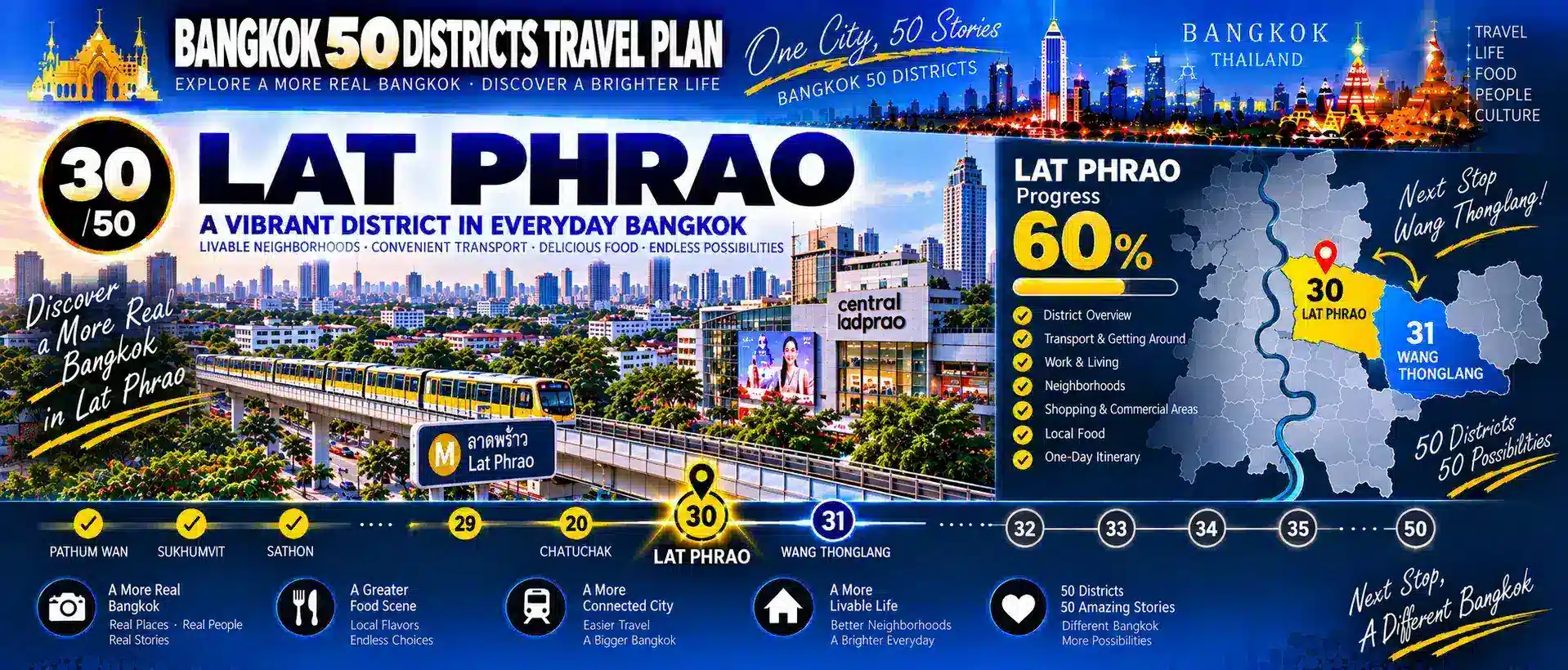
30 / 50 UNLOCKED
LAT PHRAO ✓
SERIES PROGRESS|60%
At this point, the Bangkok 50 Districts Travel Plan has officially reached 60% completion.
Keywords:
Lat Phrao · Lat Phrao Road · MRT Yellow Line · Residential Soi · Condominiums · Office Workers · Community Markets · Local Food · Nightlife · Urban Living
20 districts remaining.