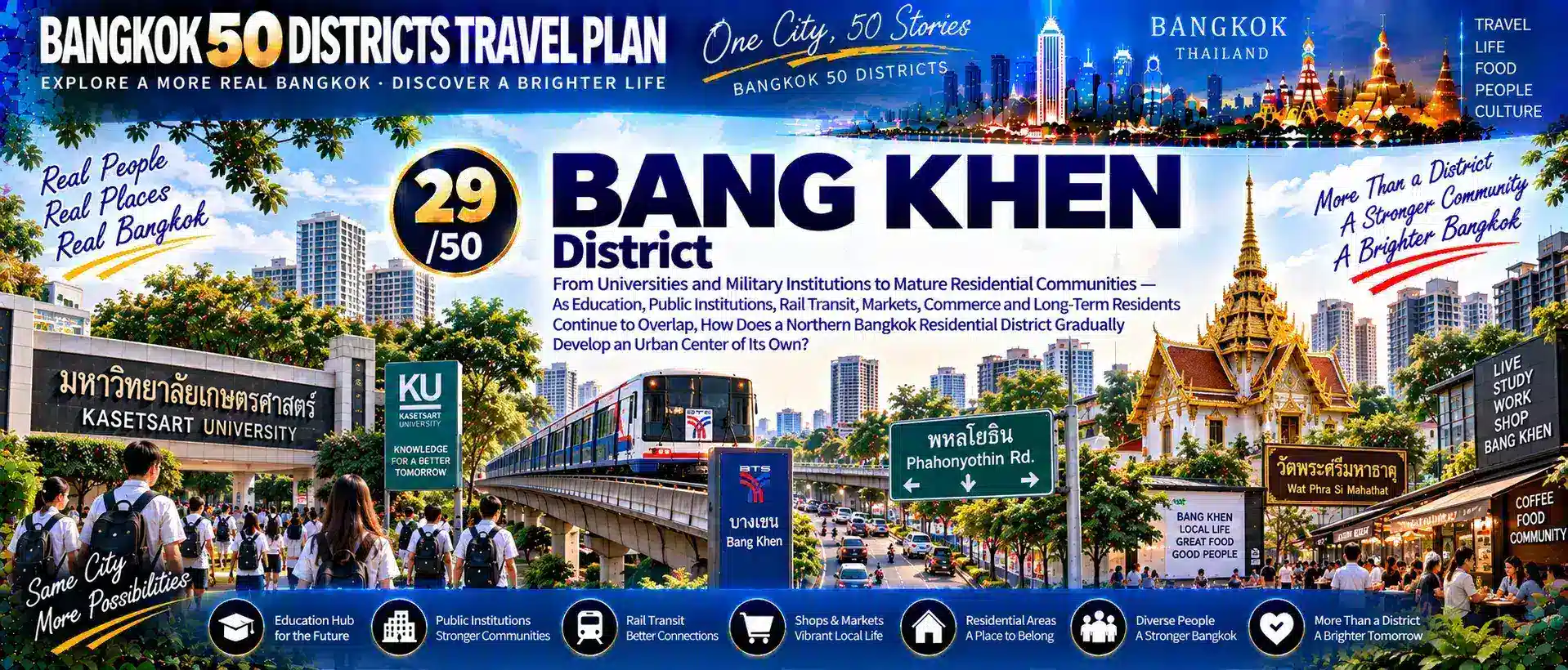
01|Where Is Bang Khen?
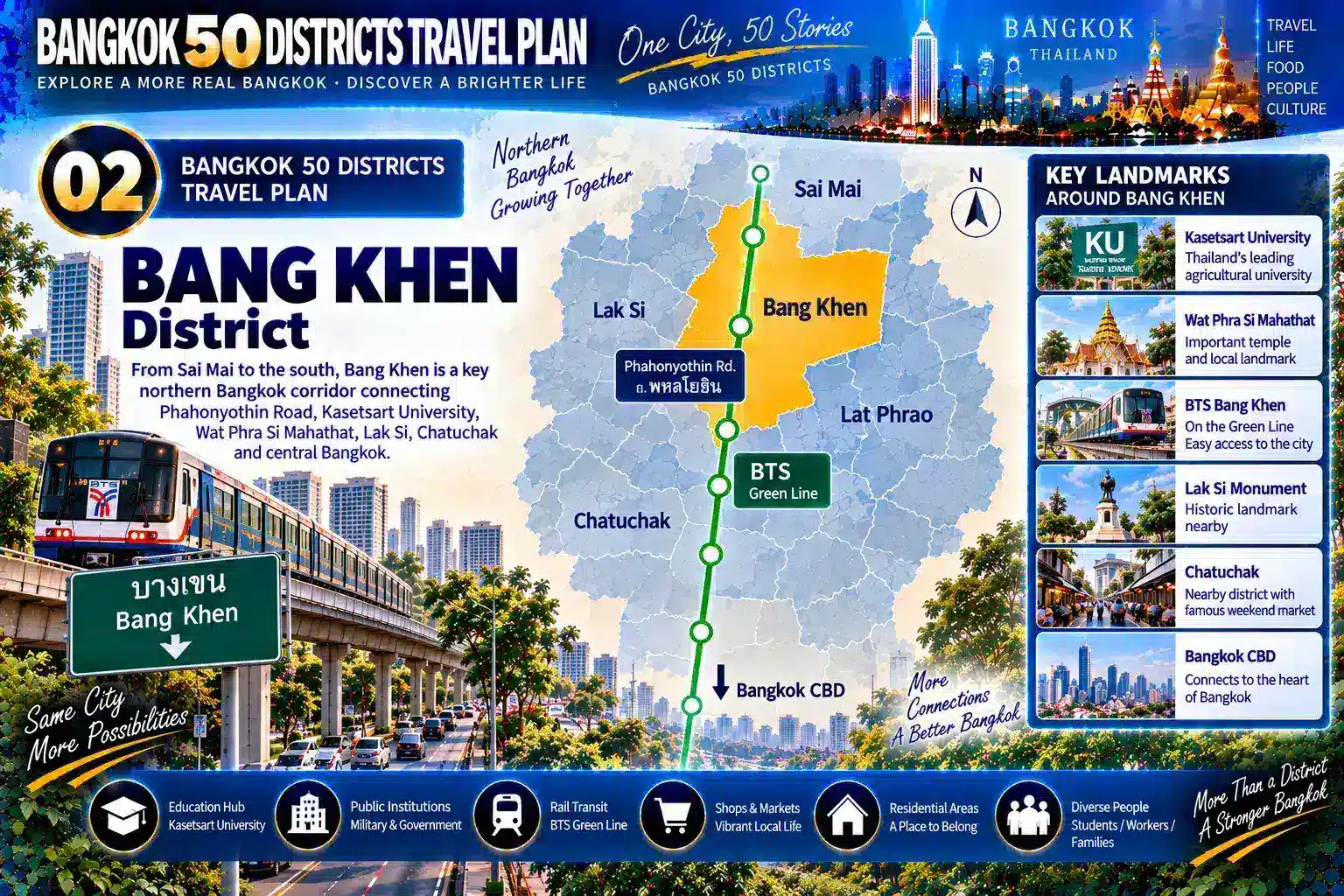
Bang Khen is located in northern Bangkok.
As we travel south from Sai Mai into Bang Khen, urban density begins to increase noticeably.
The district is closely connected with:
Lak Si.
The Chatuchak area.
Sai Mai.
The Lat Phrao area.
And other residential districts across northern Bangkok.
One of the most important urban corridors here is:
PHAHONYOTHIN ROAD
This major north–south artery carries far more than automobile traffic.
The BTS Green Line also follows this important northern Bangkok corridor.
Along and around it, we increasingly find:
Housing.
Schools.
Universities.
Government and military institutions.
Markets.
Businesses.
Rail stations.
Bang Khen is therefore no longer simply:
“a place where people live.”
It has become:
A MATURE NORTHERN BANGKOK DISTRICT WHERE MULTIPLE URBAN FUNCTIONS COME TOGETHER.
02|Universities and Students: How Does Education Transform a District?
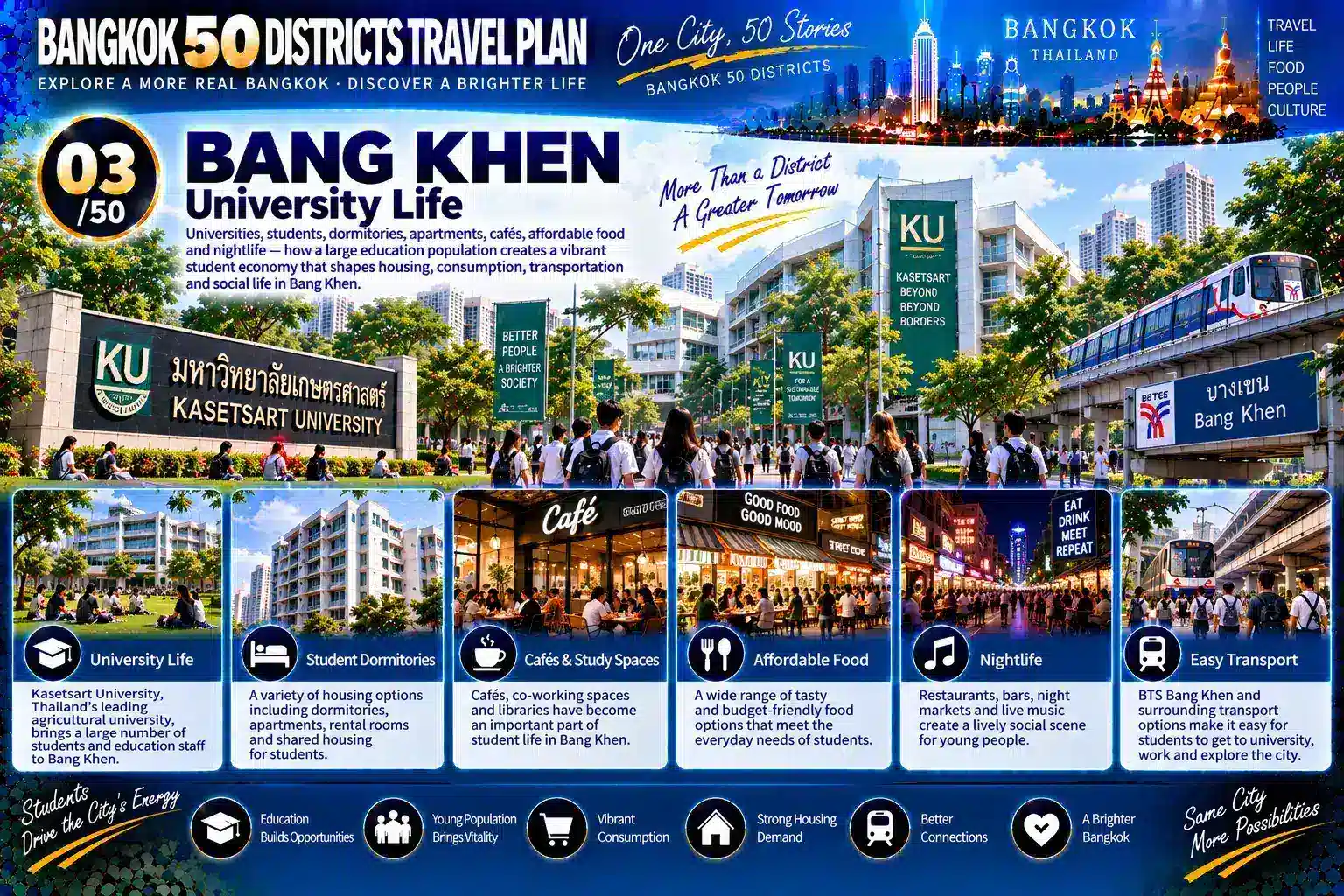
One of the strongest urban forces in and around Bang Khen comes from:
UNIVERSITIES AND THE EDUCATION COMMUNITY
One of the most representative examples is the area around Kasetsart University.
A large university brings much more than a campus.
It also brings:
Students.
Lecturers.
Researchers.
Staff.
Dormitories.
Apartments.
Restaurants.
Coffee shops.
Printing services.
Convenience stores.
Tutoring and training.
Nighttime dining.
Transportation demand.
Once thousands of young people are concentrated in one area for long periods of time, the surrounding commercial environment naturally begins to change.
Food needs to be:
Affordable.
Fast.
Varied.
Available for longer hours.
Housing needs to be:
Close to campus.
Well connected.
Reasonably priced.
Local businesses also become younger and more dynamic.
A university therefore creates a distinctive:
STUDENT ECONOMY
Educational institutions do not simply educate students.
They reshape entire neighborhoods.
03|Military and Public Institutions: Another Source of Stable Urban Population
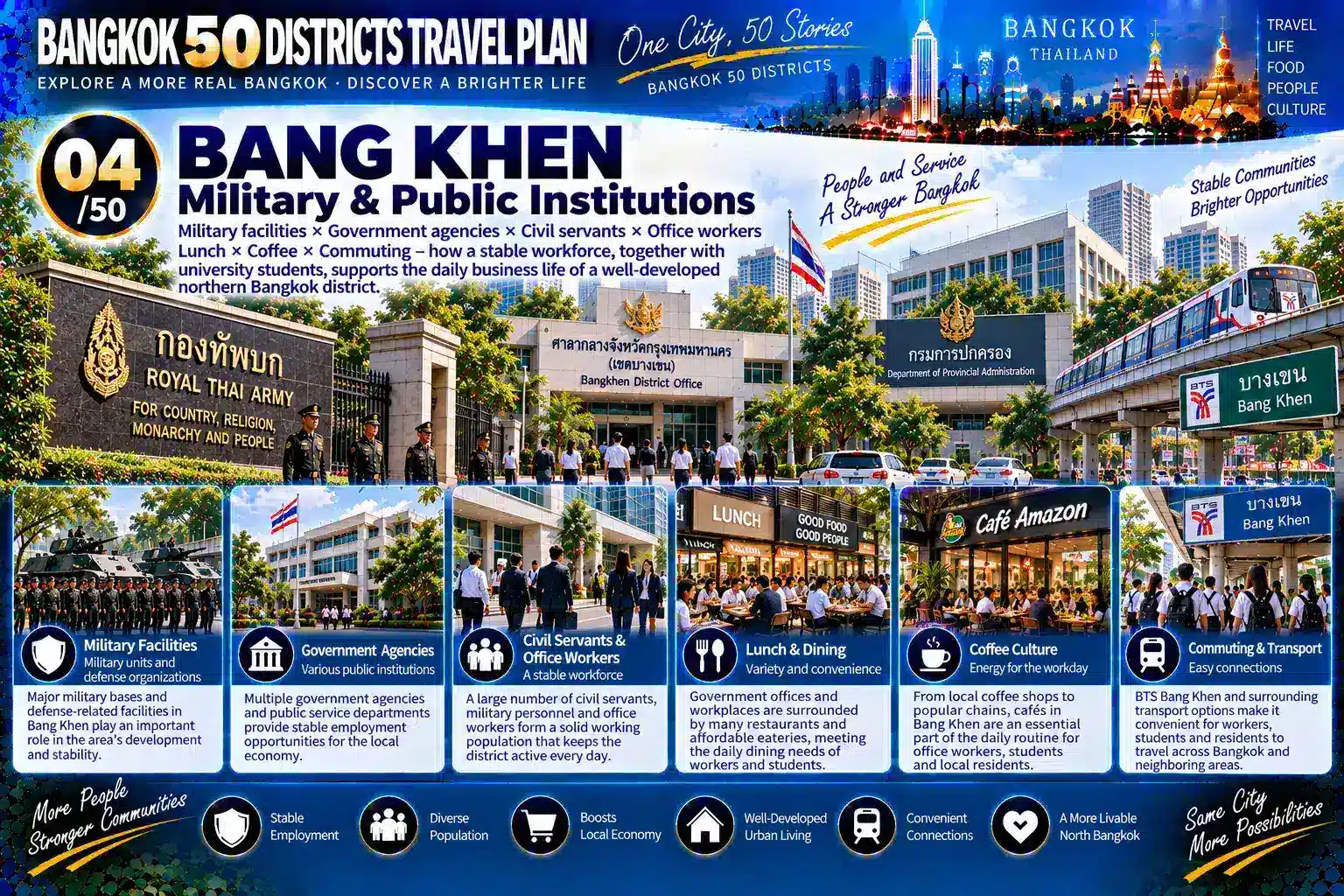
Bang Khen also contains an urban system very different from student life:
MILITARY AND PUBLIC INSTITUTIONS
Northern Bangkok has long contained a range of military and government-related facilities.
Their effect differs from that of a university.
Universities generate a large, young and relatively mobile student population.
Government and military institutions create:
A more stable employment population.
Every day, workers:
Go to work.
Eat lunch.
Buy coffee.
Use transportation.
Handle everyday errands.
Finish work.
Return home.
These actions may seem ordinary.
But repeated every day, they provide reliable demand for:
Restaurants.
Coffee shops.
Convenience stores.
Housing.
Transportation.
Community services.
Bang Khen therefore has an interesting demographic combination:
YOUTHFUL STUDENT ENERGY × STABLE PUBLIC-SECTOR EMPLOYMENT
One population changes constantly.
The other provides continuity.
Together, they help sustain the district’s everyday urban economy.
04|BTS Green Line: How Does Rail Transit Change Northern Bangkok?
In the past, many residential areas in northern Bangkok depended heavily on:
Cars.
Buses.
Motorcycles.
Roads.
But as rail transit expanded northward, everyday mobility began to change.
The BTS Green Line makes it easier for Bang Khen residents to reach:
Chatuchak.
Ari.
Victory Monument.
Siam.
And Bangkok’s wider rail network.
But rail transit changes more than:
“HOW QUICKLY YOU CAN REACH CENTRAL BANGKOK.”
It also changes how land around stations is used.
Near rail stations, it becomes more common to see:
Condominiums.
Retail.
Restaurants.
Convenience stores.
Office space.
Residential developments.
Rail transit therefore reorganizes the city itself.
A lifestyle once structured primarily around roads begins to concentrate around stations.
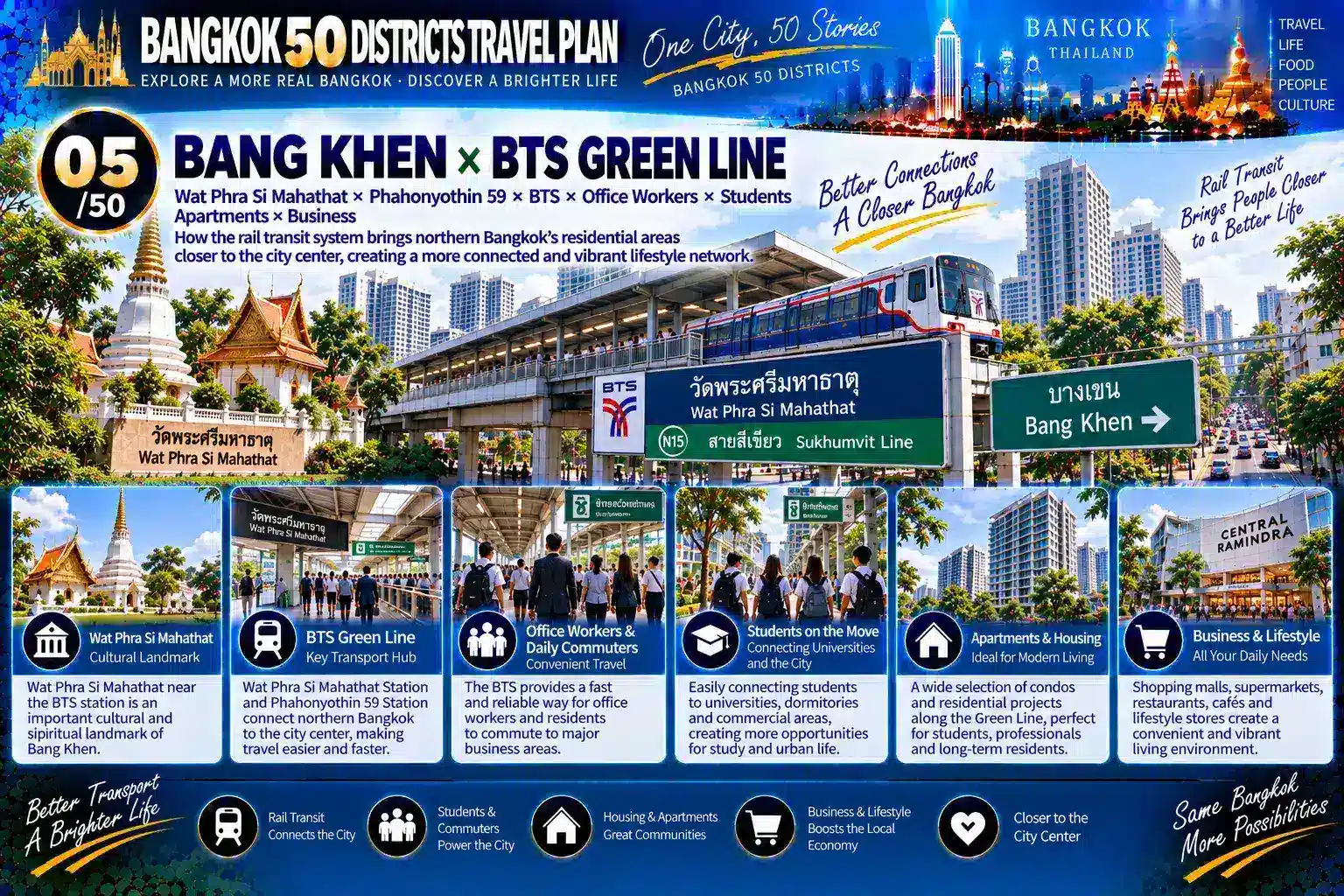
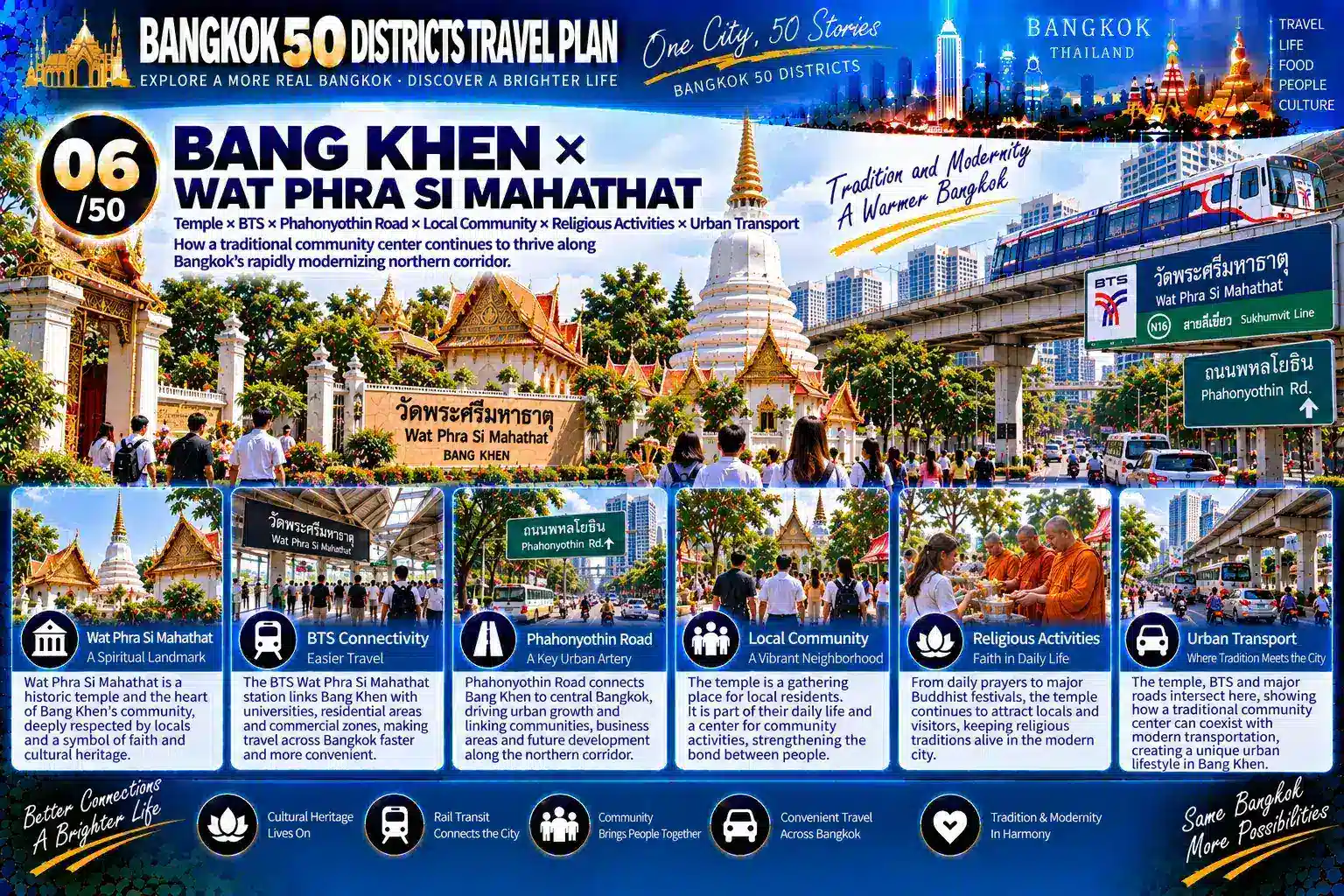
05|Wat Phra Si Mahathat: Why Does a Modern Transport Corridor Still Need a Traditional Community Center?
One of Bang Khen’s most recognizable landmarks is:
WAT PHRA SI MAHATHAT
In a modern city, we often think of rail stations, shopping malls and office buildings as urban “centers.”
Traditional communities have another kind of center:
The temple.
A temple serves more than a religious function.
It is also connected with:
Festivals.
Family ceremonies.
Community relationships.
Historical memory.
Public activities.
This creates a very characteristic Bangkok scene in Bang Khen.
The BTS passes nearby.
Cars move along major roads.
Higher-density development gradually appears.
Yet the temple remains.
Modern transportation has not completely erased the traditional community structure.
Instead, both continue to exist within the same urban space.
THIS IS ONE OF BANGKOK’S MOST CHARACTERISTIC FORMS OF MODERNIZATION: NEW SYSTEMS KEEP ARRIVING, WHILE OLDER WAYS OF LIFE DO NOT IMMEDIATELY DISAPPEAR.
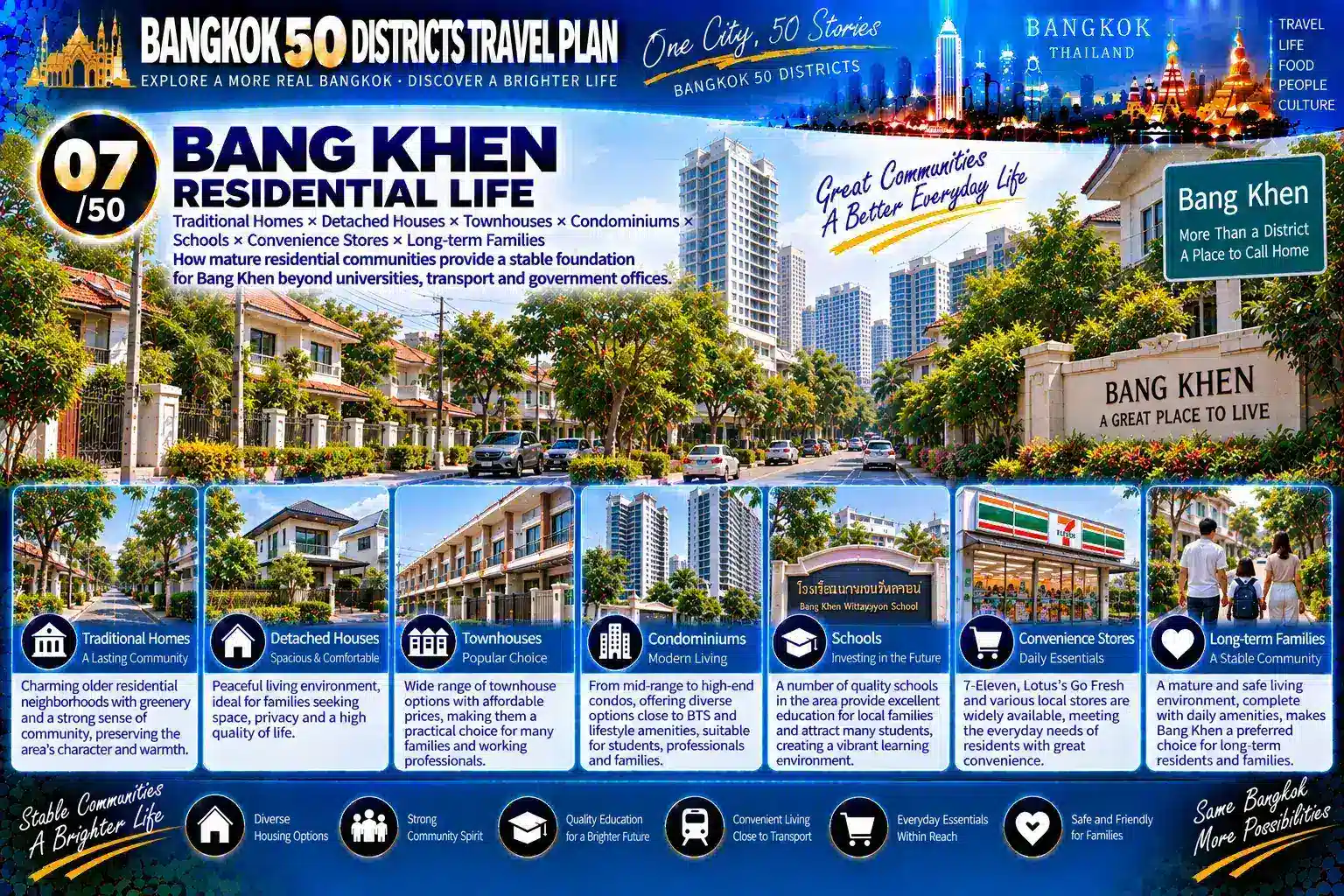
06|Residential Life: Why Do Mature Districts Still Depend on Ordinary Families?
Universities matter.
Rail transit matters.
Public institutions matter.
But what often gives a district stability over several decades is:
LONG-TERM RESIDENTS
Leave the major roads and BTS stations behind and Bang Khen still contains many:
Residential sois.
Detached houses.
Townhouses.
Condominiums.
Schools.
Small restaurants.
Convenience stores.
Community markets.
People here are not spending every day “experiencing Bangkok.”
They are simply:
Going to work.
Taking children to school.
Buying breakfast.
Going to the market.
Returning home.
These ordinary, repetitive routines form the real foundation of a mature district.
Students may graduate and leave after several years.
Office workers may change jobs.
But the community relationships accumulated by long-term families create something much more stable:
THE FEELING THAT “THIS IS HOME.”
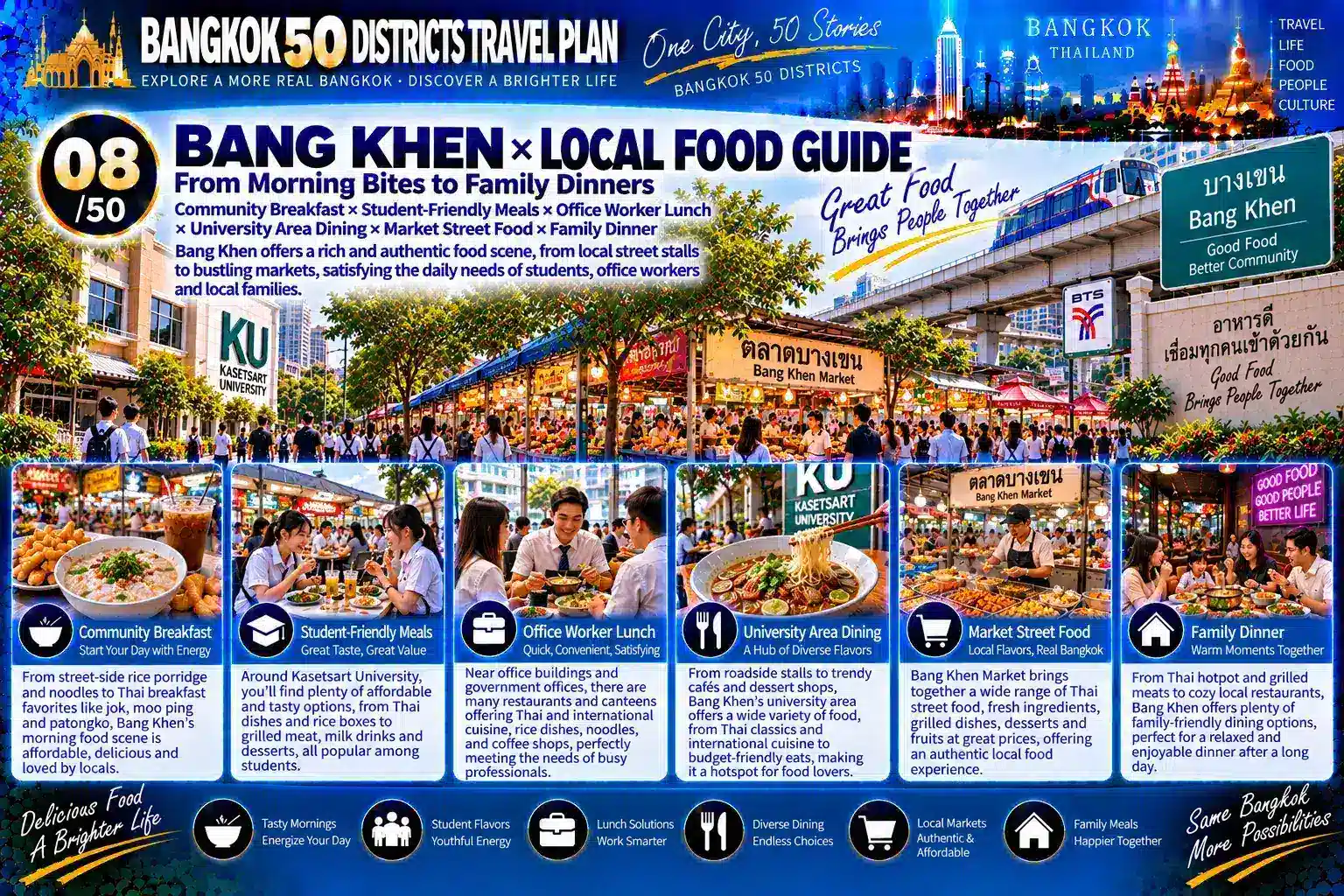
07|What to Eat in Bang Khen? Students, Office Workers and Families All Shape the District’s Food Culture
Bang Khen’s food scene reflects the district’s diverse population.
Several different consumer groups live, study and work here at the same time.
① Community Breakfast
Rice porridge.
Chicken rice.
Noodles.
Grilled pork skewers.
Coffee.
② Affordable Student Meals
Price matters.
Portion size matters.
Speed matters too.
③ Office-Worker Lunch
Weekday lunch hours create reliable daily demand.
④ University-Area Dining
Small restaurants.
Coffee shops.
Desserts.
Evening dining.
⑤ Community Market Ready-to-Eat Food
An everyday resource for local families.
⑥ Family Dinner
Thai food.
Isan cuisine.
Hot pot.
Barbecue.
Bang Khen’s food culture therefore does not belong to only one type of person.
It is:
A DISTRICT FLAVOR CREATED TOGETHER BY STUDENTS × OFFICE WORKERS × LONG-TERM RESIDENTS.
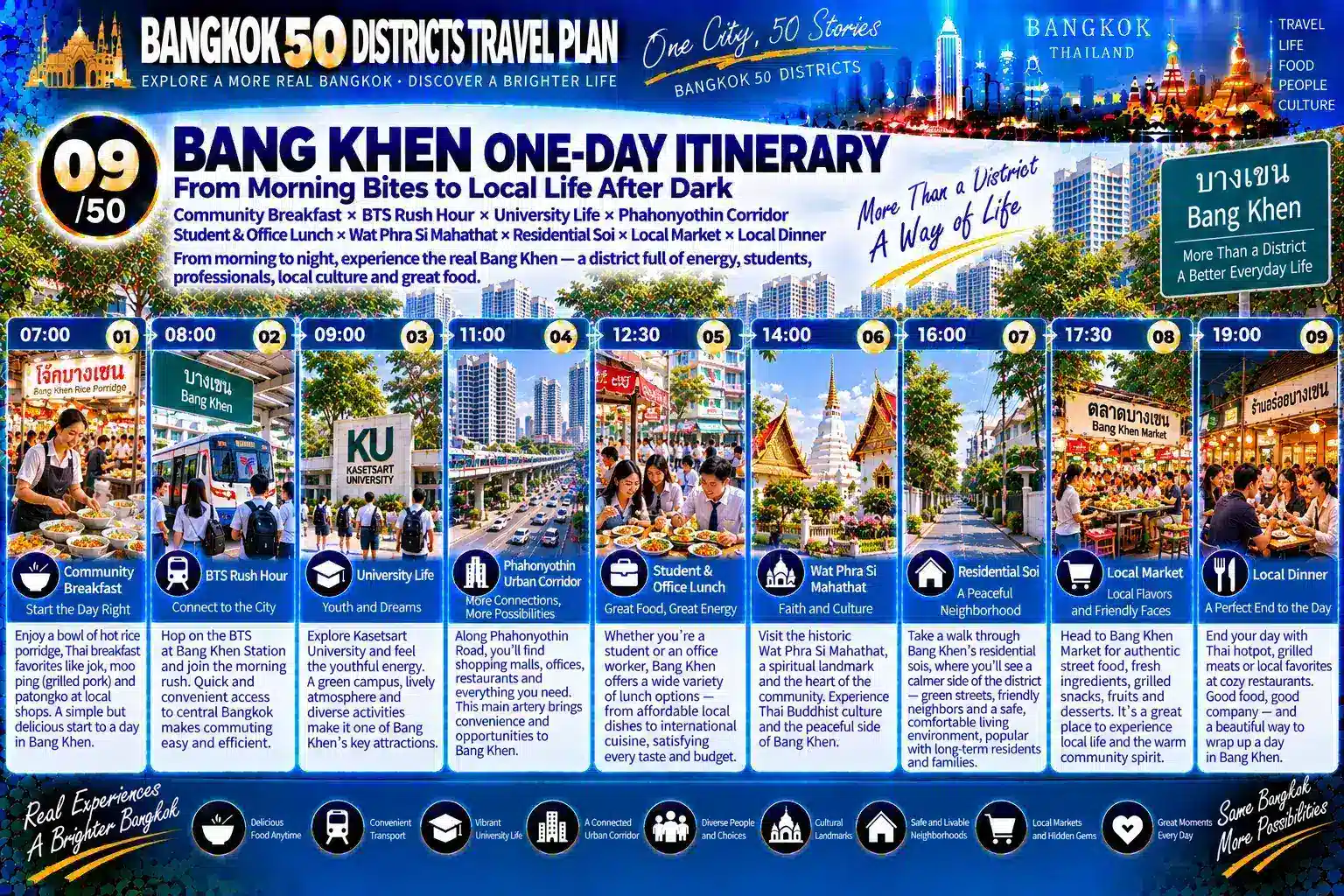
08|How to Spend One Day in Bang Khen
The best way to experience Bang Khen is not to rush from attraction to attraction.
Instead, observe:
HOW A MATURE URBAN DISTRICT OPERATES FROM MORNING TO NIGHT.
06:30|Community Breakfast
Start near a residential soi.
Watch local families and office workers begin their day.
07:30|BTS Morning Rush
Students and commuters enter the transportation network at the same time.
09:00|University Life
Observe how a large young population reshapes neighborhood businesses.
10:30|Phahonyothin Urban Corridor
See how BTS, roads, housing and commerce overlap.
12:00|Student & Office-Worker Lunch
Experience the lunchtime rush created by two of the district’s most important populations.
14:00|Wat Phra Si Mahathat
Move from modern transportation back into a traditional community space.
16:00|Residential Soi
Discover the ordinary Bang Khen hidden behind the major roads.
17:30|Community Market
Students finish school.
Office workers head home.
Families begin buying groceries.
19:00|Local Dinner
Finish the day at a neighborhood restaurant.
09|Why Is Bang Khen Beginning to Develop an Urban Center of Its Own?
When does a district stop being simply:
“a residential area outside the city center”?
The answer is not:
When one high-rise appears.
When a shopping mall opens.
Or when another BTS station is built.
The real transformation begins when:
MORE AND MORE DAILY NEEDS CAN BE MET WITHIN THE DISTRICT ITSELF.
People living here can:
Study.
Work.
Eat.
Shop.
Take the BTS.
Visit the market.
Go to the temple.
See a doctor.
Meet friends.
Return home.
When more everyday needs can be met without always traveling to Siam, Silom or Asok, a new urban center begins to emerge.
Bang Khen illustrates this process clearly.
Universities provide education and a young population.
Military and public institutions provide stable employment.
Rail transit connects the district with the larger city.
Roads support local and cross-city commuting.
Markets provide everyday shopping.
Restaurants serve different groups.
Residential neighborhoods provide a long-term population.
Temples preserve community memory.
No single one of these functions can create an urban center by itself.
But once they overlap—
A DISTRICT BEGINS TO DEVELOP A COMPLETE URBAN LIFE SYSTEM OF ITS OWN.
This is becoming increasingly important in a megacity like Bangkok.
The city no longer operates around only one center.
Instead, it develops multiple:
Commercial centers.
University centers.
Transport hubs.
Administrative centers.
Residential centers.
Community centers.
They connect with one another while serving different purposes.
To understand Bang Khen, then, we should not ask only:
“What attractions are here?”
A more useful question is:
“WHY CAN MORE AND MORE PEOPLE COMPLETE AN ENTIRE DAY OF LIFE HERE?”
When the answer becomes:
You can study here.
You can work here.
You can eat here.
You can shop here.
You can commute from here.
You can live here.
Then the district is no longer merely part of Bangkok’s “outer area.”
It is becoming:
ONE OF NORTHERN BANGKOK’S OWN URBAN CENTERS.
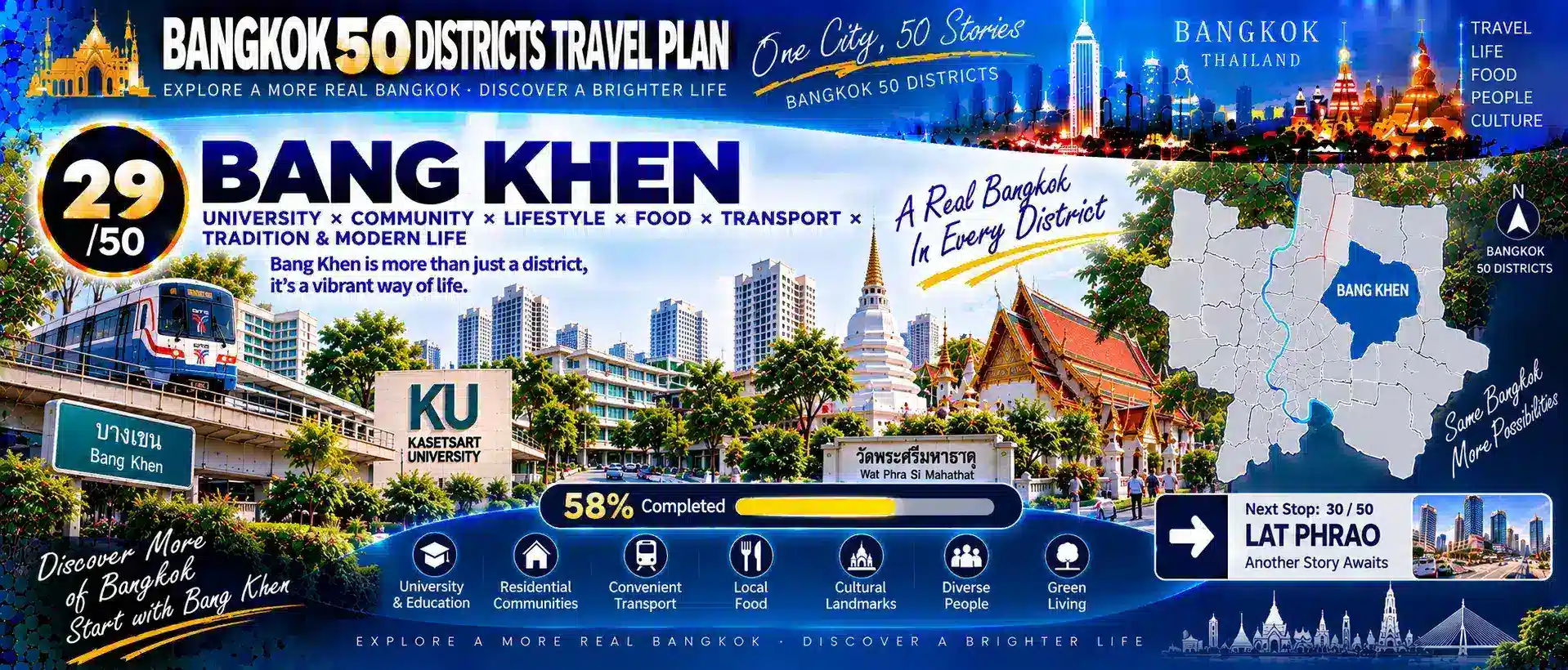
29 / 50 UNLOCKED
BANG KHEN ✓
SERIES PROGRESS|58%
Keywords:
Bang Khen · Kasetsart University · Phahonyothin Road · BTS Green Line · Wat Phra Si Mahathat · Students · Public Institutions · Residential Communities · Local Markets · Northern Bangkok
21 districts remaining.
NEXT STOP|30 / 50
LAT PHRAO
After Bang Khen, we continue toward a denser, more commercial and increasingly urbanized part of north-central Bangkok.
Major roads.
Residential sois.
Condominiums.
Shopping centers.
Night markets.
Restaurants.
Offices.
Rail transit.
All begin to overlap at greater intensity.
If Bang Khen asks:
“How does a mature residential district gradually develop an urban center of its own?”
then District 30, Lat Phrao, asks:
“When residential density, commerce, rail transit, nightlife and neighborhood dining all reach a higher level of intensity, how does a district originally developed along major roads become one of Bangkok’s most complete places to live, eat, shop and work?”