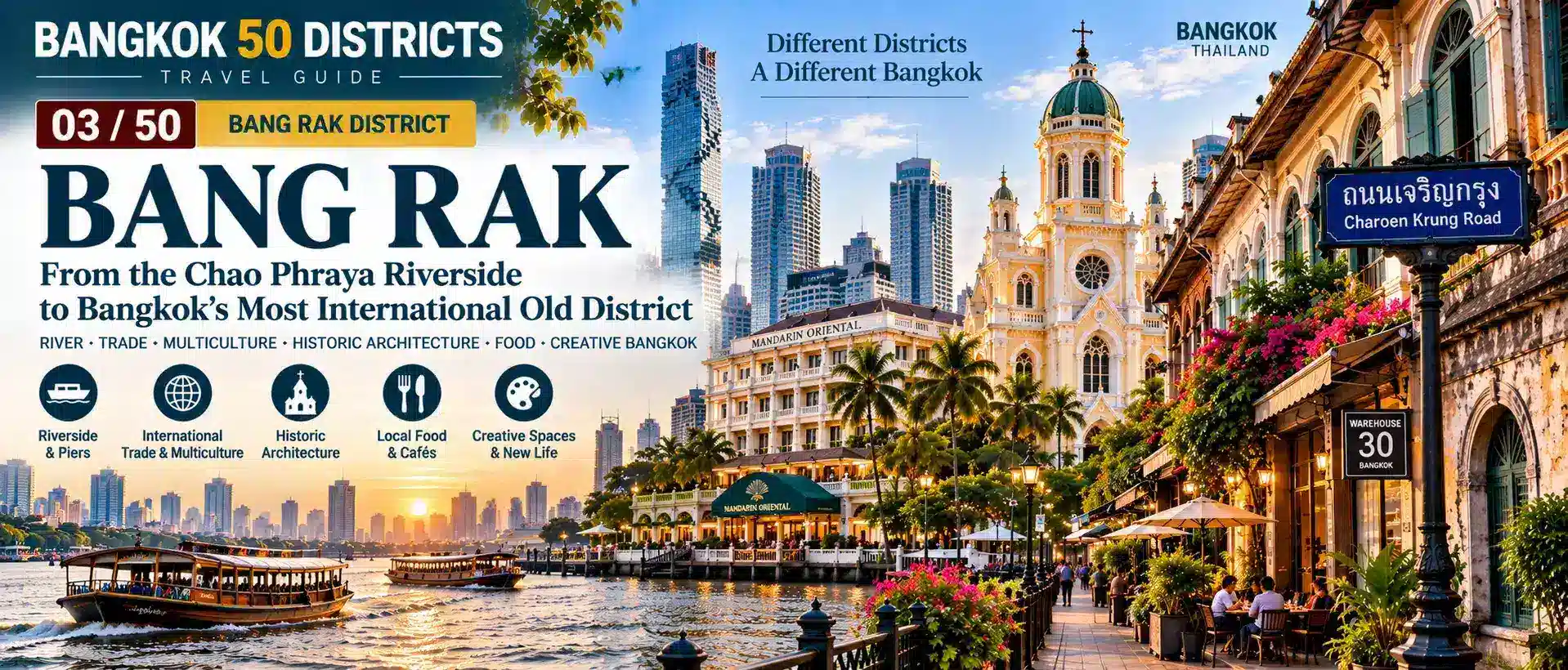
For our third stop, we change direction.
This time, we head toward the eastern bank of the Chao Phraya River:
Bang Rak.
Here, the story is no longer mainly about royal palaces.
It is about something that shaped Bangkok just as deeply:
the river and international trade.
Chinese merchants, European businesses, Indian and Muslim communities, churches, piers, warehouses, historic hotels and today's creative spaces have all left their mark on this district.
If you want to understand how Bangkok grew into the international city we know today, Bang Rak is an essential part of the story.
01|Where Is Bang Rak?
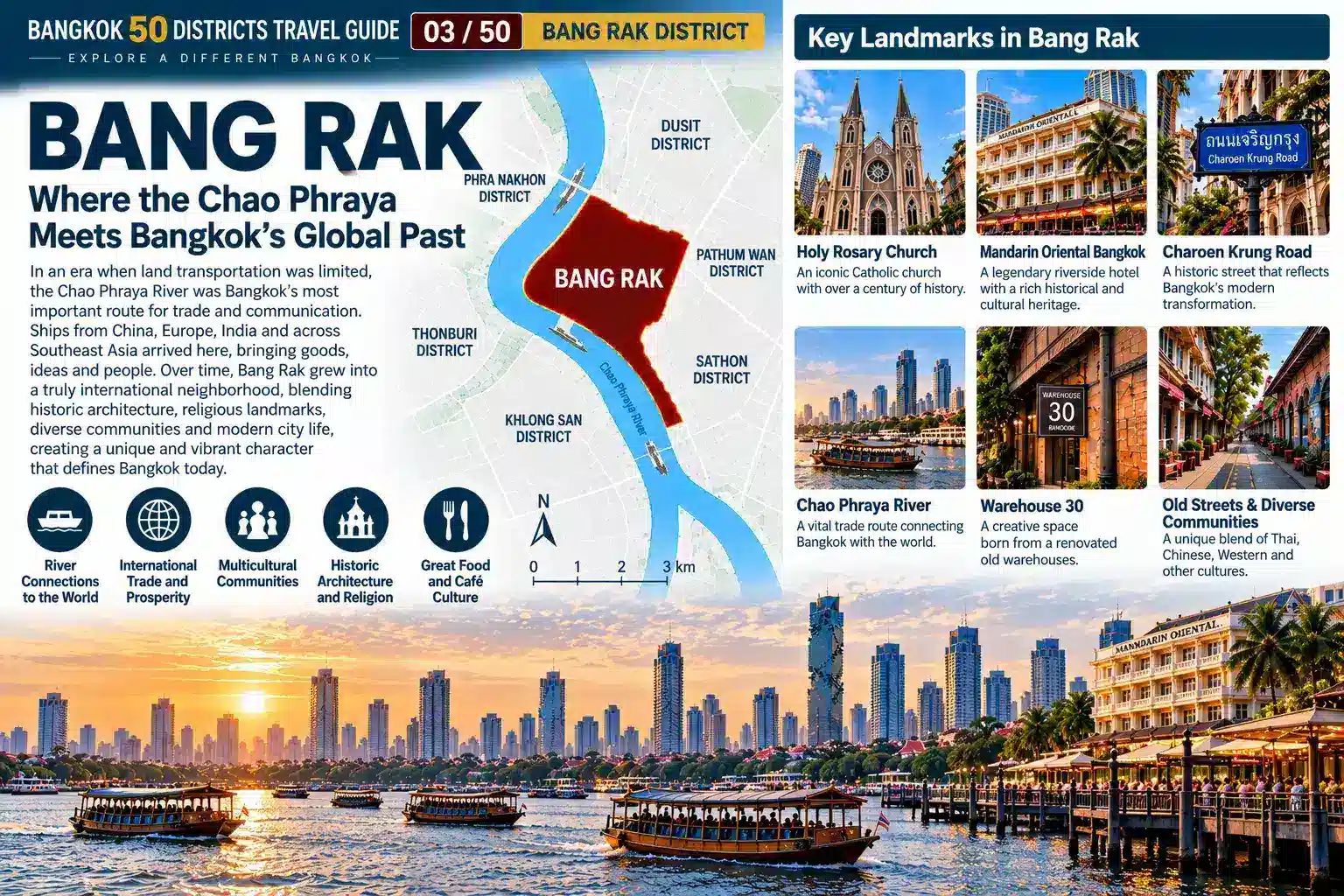
Bang Rak lies in central Bangkok, along the eastern side of the Chao Phraya River.
To the north are the historic areas around Bangkok's old city and Chinatown, while farther south the city transitions toward modern business districts such as Sathorn.
Its riverside location played an important role in its development.
Long before Bangkok had today's extensive road and rail networks, the Chao Phraya River was one of the city's most important transportation and commercial routes.
Ships arrived.
Goods were unloaded.
Merchants, diplomats, missionaries and travelers passed through the riverfront.
Over time, communities from different backgrounds began to settle here.
The result was a Bangkok neighborhood very different from the royal center of Phra Nakhon.
02|The Chao Phraya River: The Real Main Character
When visiting Bang Rak, forget about individual attractions for a moment.
Start with the river.
Today, the Chao Phraya is filled with commuter boats, ferries, hotels and views of Bangkok's modern skyline.
Historically, however, it was much more than scenery.
It was one of Bangkok's main connections to the outside world.
Ships brought people, products, ideas and cultures into the city.
Bang Rak's position along this important river corridor helped turn it into a commercial and multicultural district.
One of the best ways to understand the neighborhood is therefore very simple:
follow the river.
Old piers, heritage buildings, hotels, warehouses and modern towers may belong to different periods, but together they tell the story of Bang Rak.
03|Charoen Krung Road: When Bangkok Began Moving Beyond the Water
Walk inland from the river and another important piece of Bangkok's history appears:
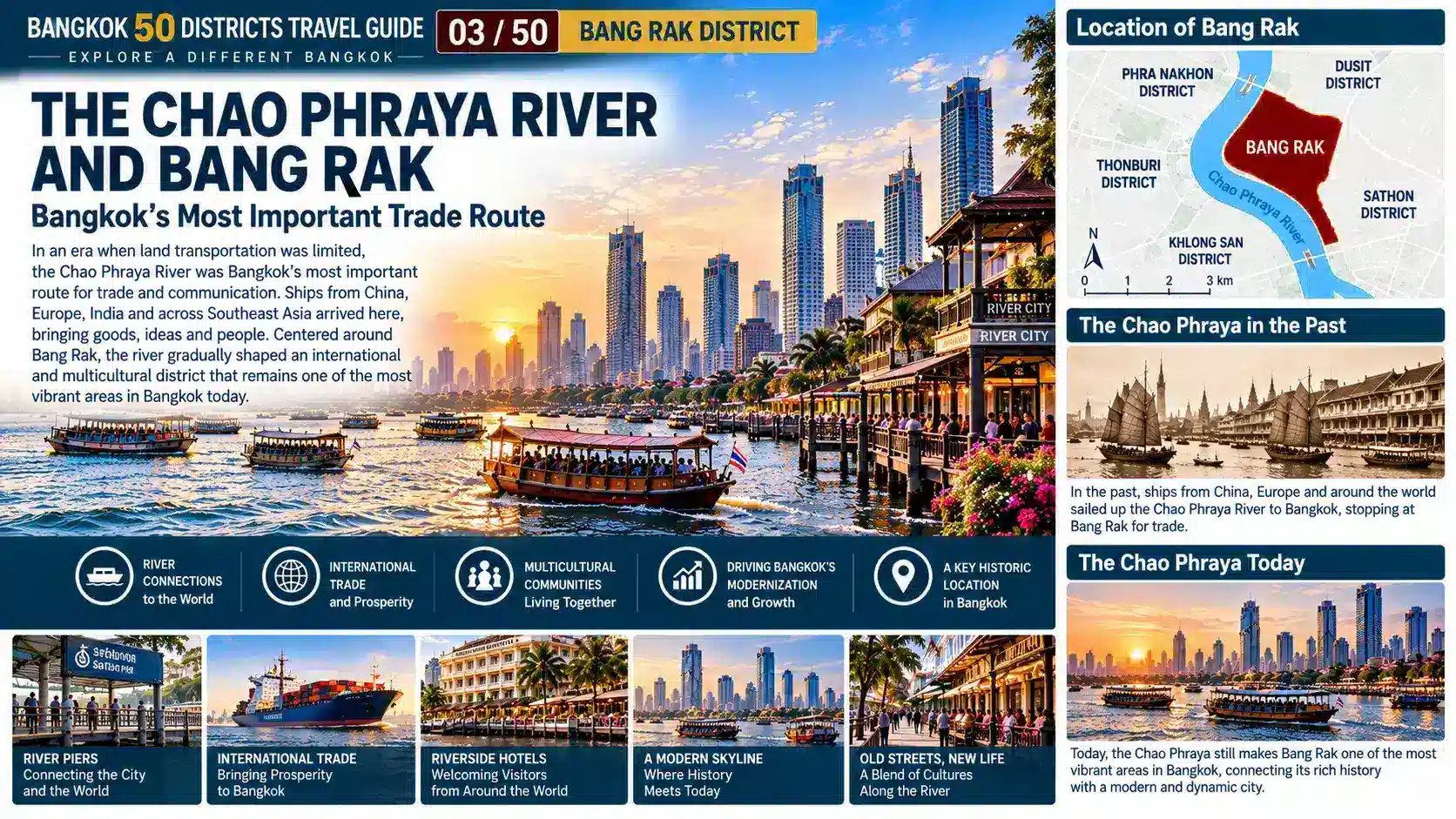
Charoen Krung Road.
It is one of Bangkok's oldest major modern roads.
For generations, life in Bangkok depended heavily on rivers and canals.
But as the city expanded and international communities grew, better land transportation became increasingly important.
Charoen Krung represented part of that transition.
Today, the street is lined with restaurants, old shophouses, cafés, galleries and creative businesses.
But beneath the modern activity is a much older story.
This road witnessed Bangkok gradually changing from a city dominated by waterways into a modern urban capital.
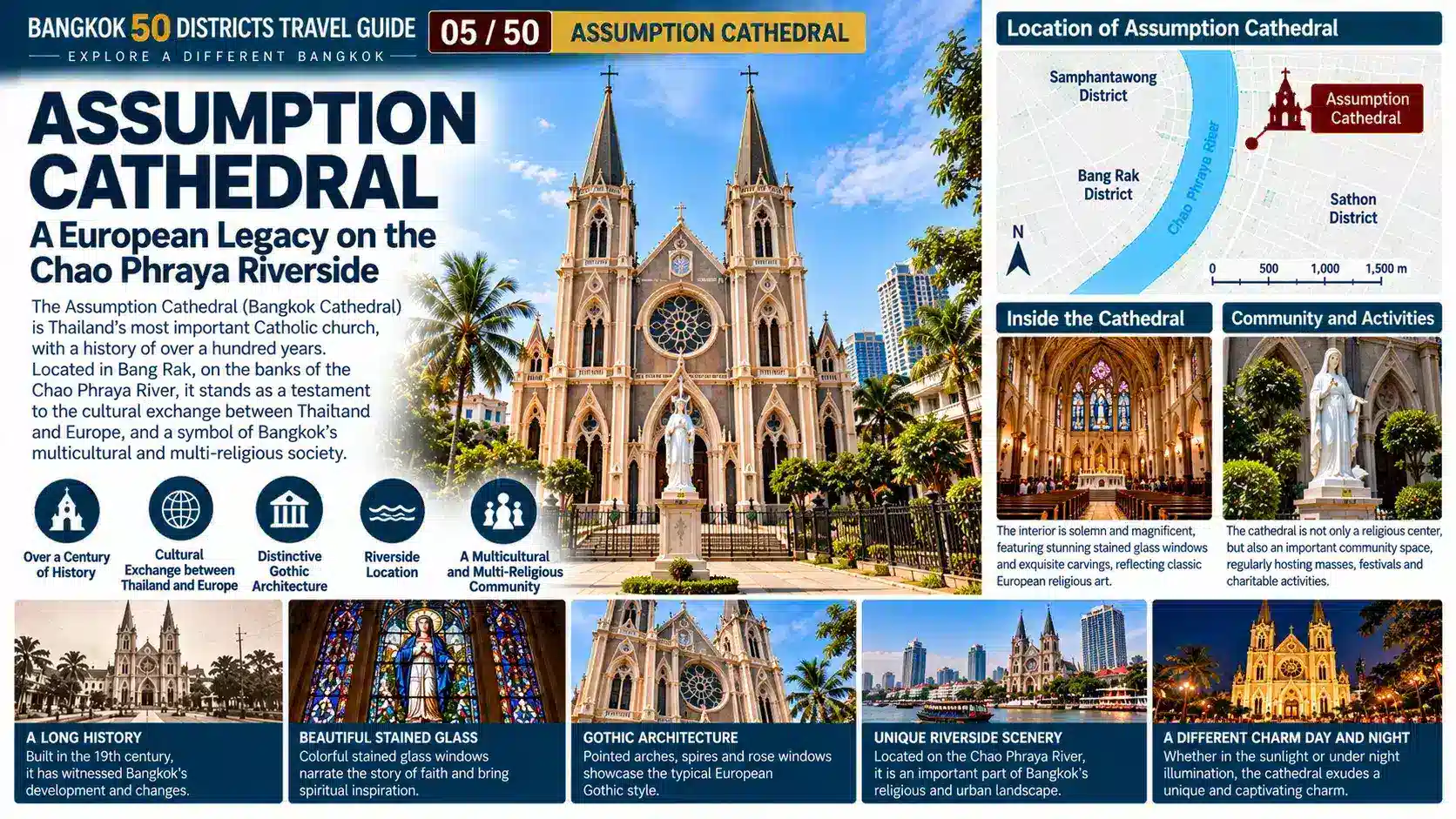
04|Assumption Cathedral: A European Legacy in Bangkok
One of the most fascinating things about Bang Rak is how closely different cultures exist side by side.
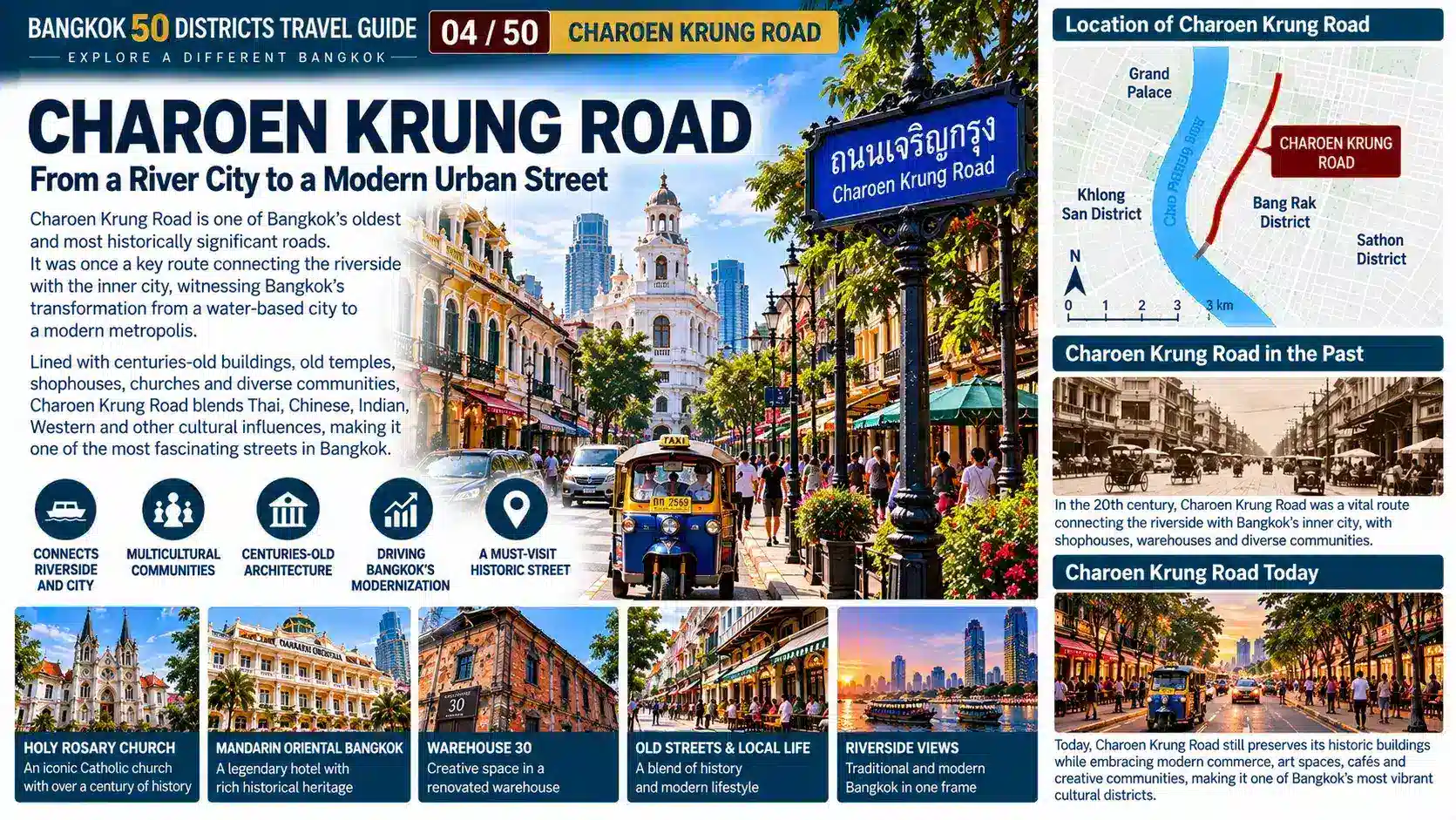
A striking example is Assumption Cathedral.
Its European-influenced architecture immediately feels different from the Buddhist temples associated with Bangkok's traditional royal districts.
That contrast raises an interesting question:
Why is a major Catholic cathedral here?
The answer leads back to international trade and migration.
As foreign merchants, diplomats and missionaries became more active in Bangkok, communities of different religions and nationalities developed around the river.
Their presence became part of the city's architecture and everyday life.
Bang Rak therefore tells us something important:
Bangkok's history was never shaped by only one cultural influence.
It was also shaped by centuries of encounters between different communities.
05|Historic Hotels and Old Piers: Bangkok's Gateway to the World
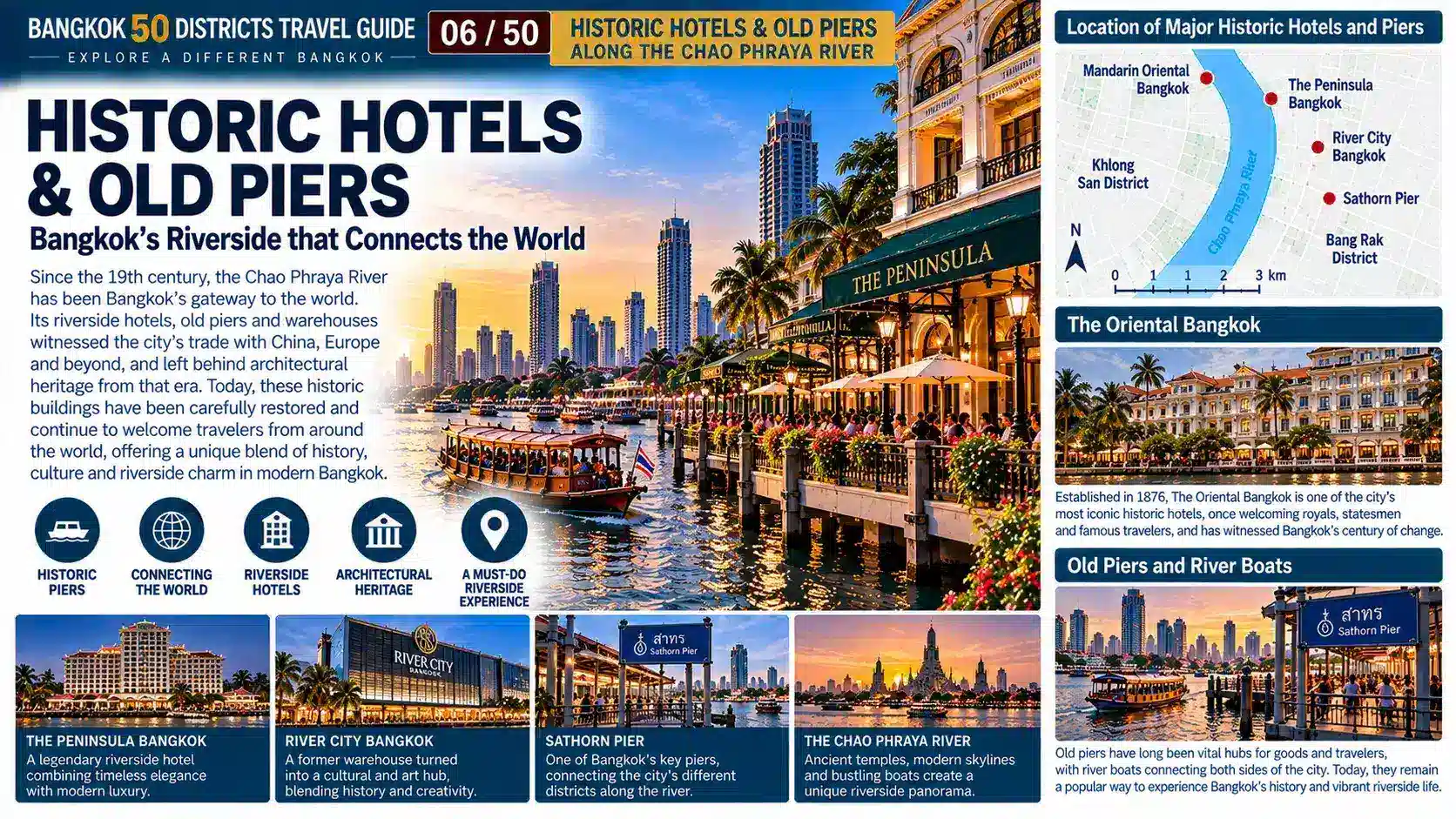
Continue along the river and another side of Bang Rak begins to appear.
Historic hotels, old piers and former commercial buildings remind us that this part of Bangkok once played an important role in welcoming international visitors.
Among the best-known examples is the historic Mandarin Oriental Bangkok, whose story is closely connected with the development of Bangkok's riverside.
But don't focus only on one building.
Look at the entire riverfront.
Hotels, piers, boats, restored buildings and the modern skyline overlap in the same view.
This helps explain why Bang Rak feels so different from Phra Nakhon.
Phra Nakhon tells the story of Bangkok as a royal capital.
Bang Rak tells another story:
how Bangkok connected with the wider world.
06|Charoen Krung × Warehouse 30: Old Bangkok Becomes Creative Bangkok
Bang Rak is not simply a historic district preserved in the past.
It is still changing.
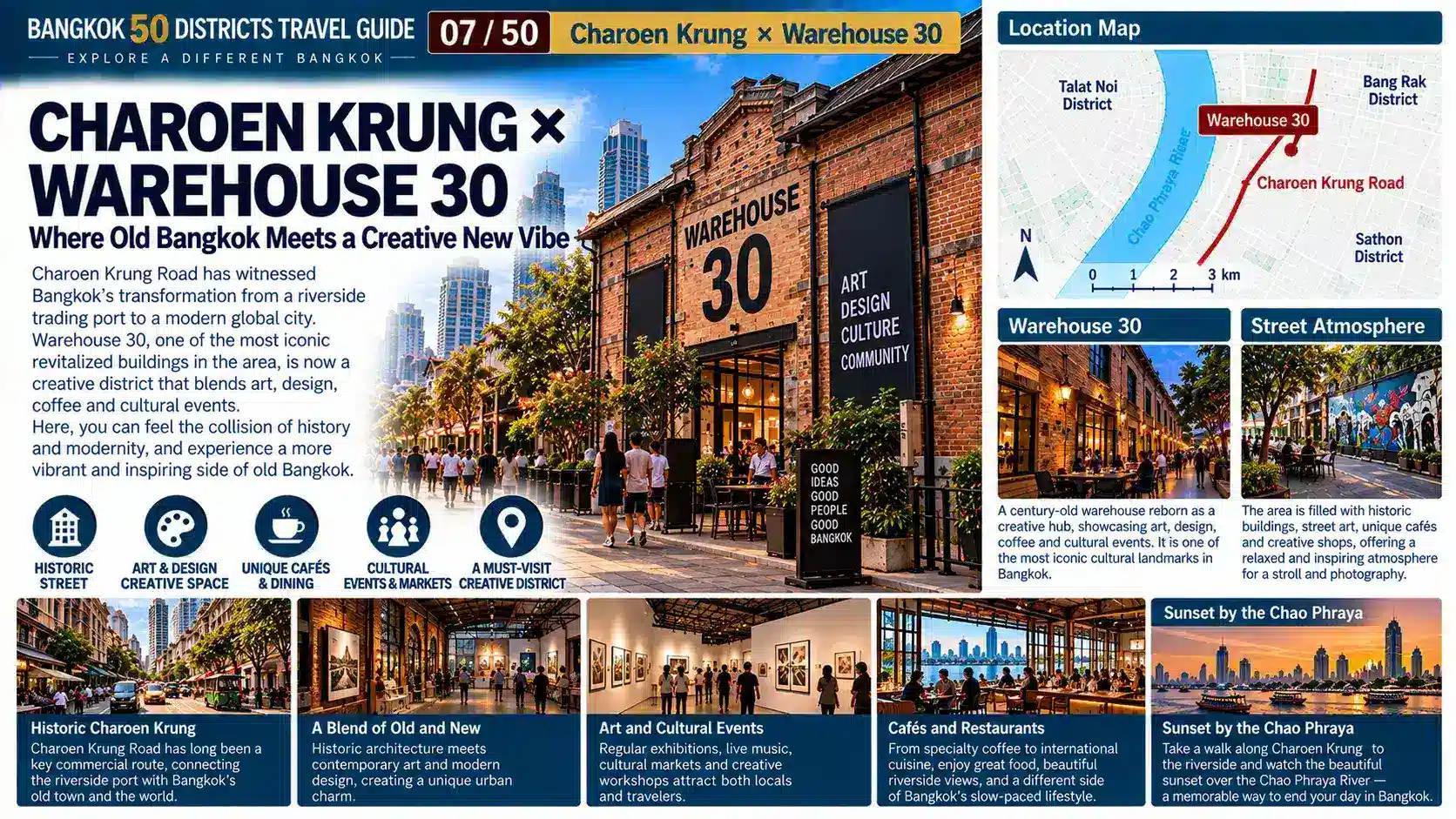
In recent years, Charoen Krung and the surrounding streets have developed into one of Bangkok's most interesting creative areas.
Old buildings have found new uses.
Former warehouses have become spaces for design, exhibitions, food, coffee and cultural events.
Street art appears beside heritage architecture.
Independent shops and creative businesses sit alongside long-established local communities.
Warehouse 30 is one of the best-known examples of this transformation.
The interesting thing is that the new has not completely replaced the old.
You might pass a traditional shop that has been there for generations, then enter a contemporary gallery or café only a few minutes later.
That contrast gives Bang Rak much of its character.
History here is not locked inside a museum. It continues to live alongside modern Bangkok.
07|Bang Rak Is Also a Great Place to Eat
There is another reason to explore Bang Rak slowly:
food.
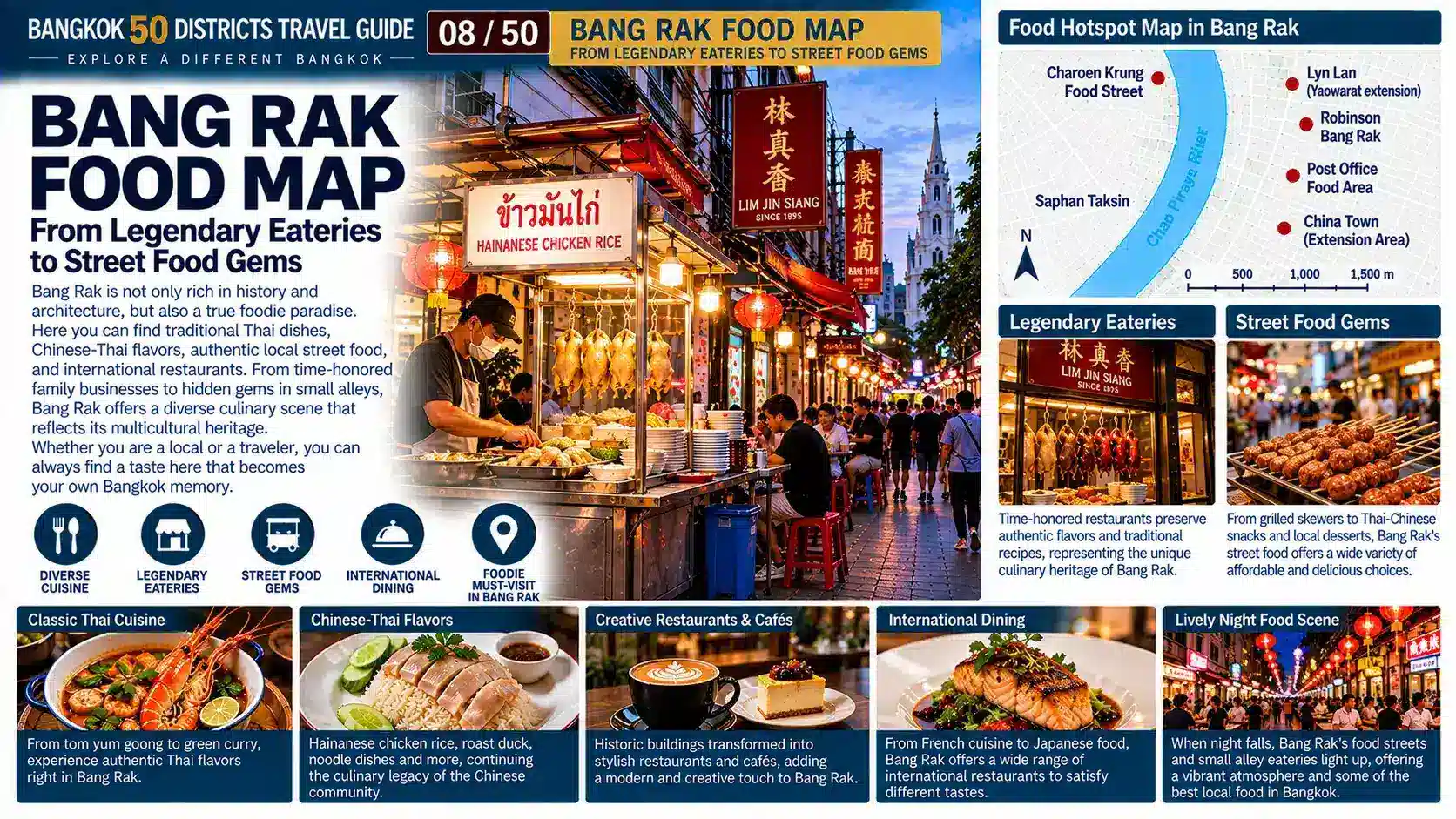
The district's multicultural history can also be tasted.
Thai street food, Chinese-Thai dishes, Muslim cuisine, international restaurants, historic eateries and modern cafés all exist within the wider area.
You do not necessarily need to chase the most famous restaurant on social media.
A better way to experience Bang Rak is often to walk.
Explore Charoen Krung and the surrounding streets.
Look for busy neighborhood restaurants.
Stop when something looks interesting.
Try a dish you have never ordered before.
In Bang Rak, food is not simply a break between attractions.
It is part of the neighborhood's story.
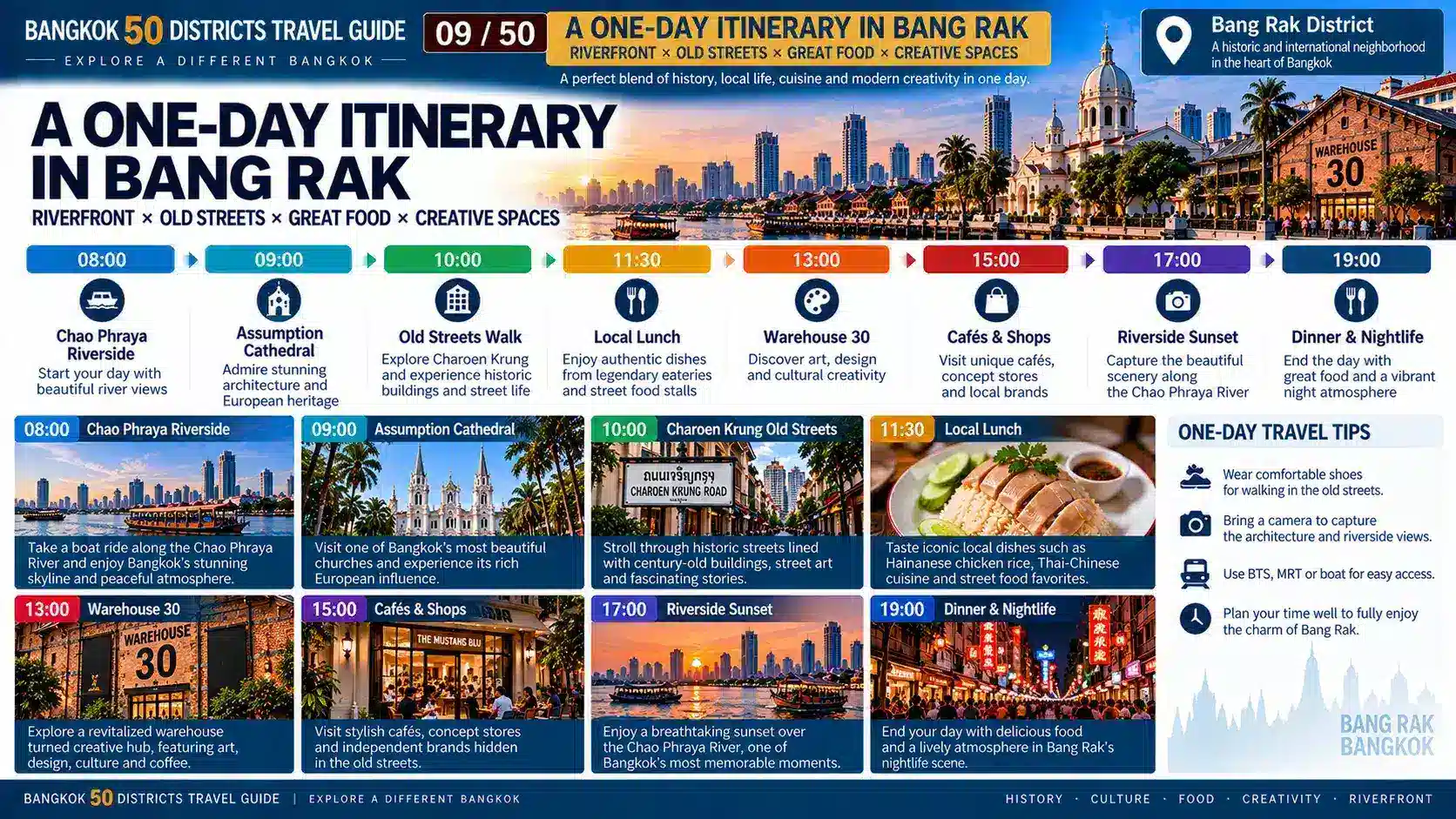
08|How to Spend One Day in Bang Rak
Bang Rak works particularly well with a combination of walking, river boats and BTS.
There is no need to rush.
A relaxed one-day itinerary could look like this:
08:00|Chao Phraya Riverside
Start the morning by the river and watch Bangkok slowly come to life.
↓
09:00|Assumption Cathedral
Explore one of the district's most recognizable examples of European religious architecture.
↓
10:00|Charoen Krung Old Streets
Walk through historic streets and look for old buildings, local businesses and traces of the neighborhood's past.
↓
11:30|Local Lunch
Try Thai, Chinese-Thai or another local favorite.
↓
13:00|Warehouse 30
Explore a creative space where old architecture meets contemporary art and design.
↓
15:00|Cafés & Independent Shops
Slow down and discover another side of modern Bang Rak.
↓
17:00|Riverside Sunset
Return toward the Chao Phraya and watch the light change across the city.
↓
19:00|Dinner & Nightlife
Finish the day with dinner and experience Bang Rak after dark.
In one day, you can move from historic Bangkok to creative Bangkok without ever leaving the district.
09|Why Should Bang Rak Be Part of Your Bangkok Trip?
For many first-time visitors, Bangkok begins with a familiar list:
The Grand Palace.
Temples.
Shopping malls.
Night markets.
All of them are worth experiencing.
But give Bang Rak a day and you begin to see another version of the city.
There is no single attraction that defines the entire district.
Instead, its identity comes from layers:
Thai culture + Chinese commercial heritage + European architecture + Muslim communities + river trade + contemporary creative culture.
They do not exist separately.
They overlap.
And that may be the best reason to visit Bang Rak.
It shows that Bangkok has always been more international, more complicated and more culturally connected than it first appears.
BANGKOK 50 DISTRICTS
03 / 50 UNLOCKED
BANG RAK ✓
River · Trade · Heritage · Multicultural Communities · Food · Creative Bangkok
Our journey so far:
01|PHRA NAKHON ✓
Bangkok's historic royal core
02|DUSIT ✓
Bangkok's transition toward a modern capital
03|BANG RAK ✓
Where Bangkok connected with the wider world
We have now completed:
03 / 50
47 districts remain.
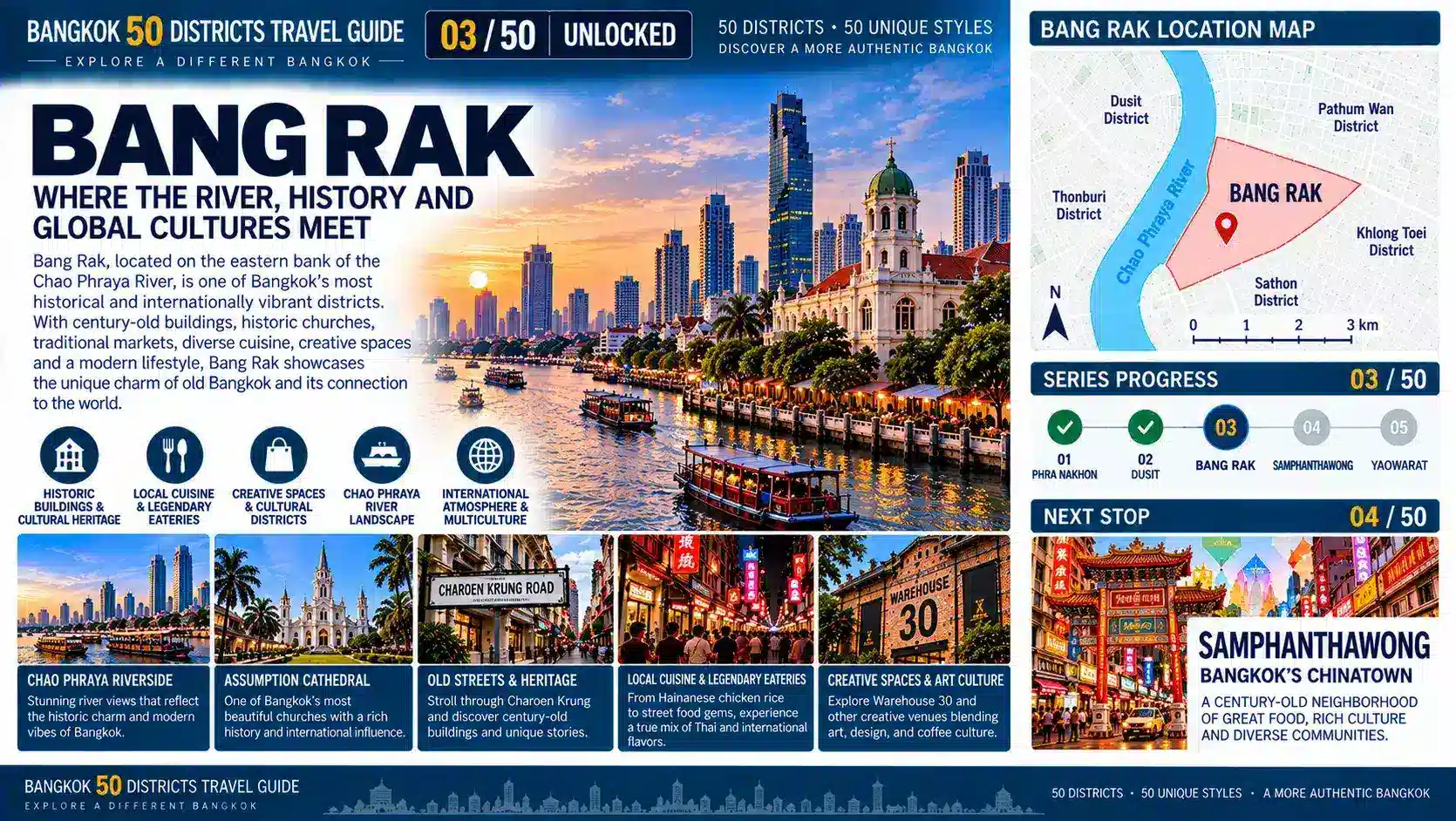
NEXT STOP → 04 SAMPHANTHAWONG
For our fourth stop, we continue exploring Bangkok's commercial history.
But this time, the story centers on a community that has played an enormous role in shaping the city:
Bangkok's Chinese community.
Yaowarat Road, Sampeng Market, gold shops, traditional businesses, Chinese temples, old trading streets and legendary street food will take us into one of Bangkok's most energetic historic neighborhoods.
BANGKOK 50 DISTRICTS · 04 / 50
SAMPHANTHAWONG
Bangkok's Chinatown
Trade · Chinese Heritage · Old Markets · Temples · Gold · Street Food
To be continued.