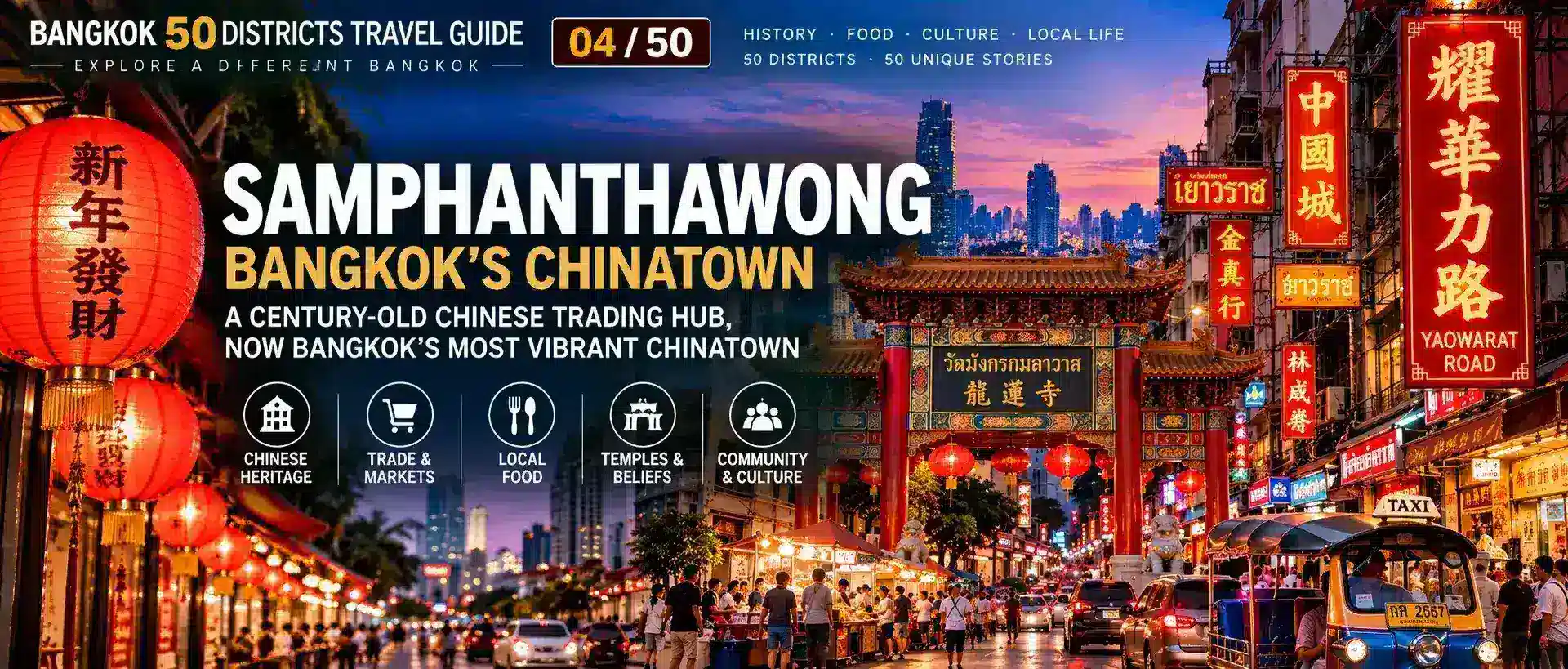
For our fourth stop, we continue following the story of old Bangkok’s commercial development.
This time, we arrive in:
Samphanthawong
The district name may not sound familiar to every first-time visitor.
But almost everyone knows its most famous neighborhood:
Yaowarat — Bangkok’s Chinatown.
Yet Yaowarat Road is only part of the story.
Behind the neon signs, gold shops and famous street food are old markets, Chinese temples, traditional businesses and communities whose roots go back generations.
To understand how Bangkok’s Chinese community helped shape the city we see today, Samphanthawong is an essential stop.
01|Where Is Samphanthawong?
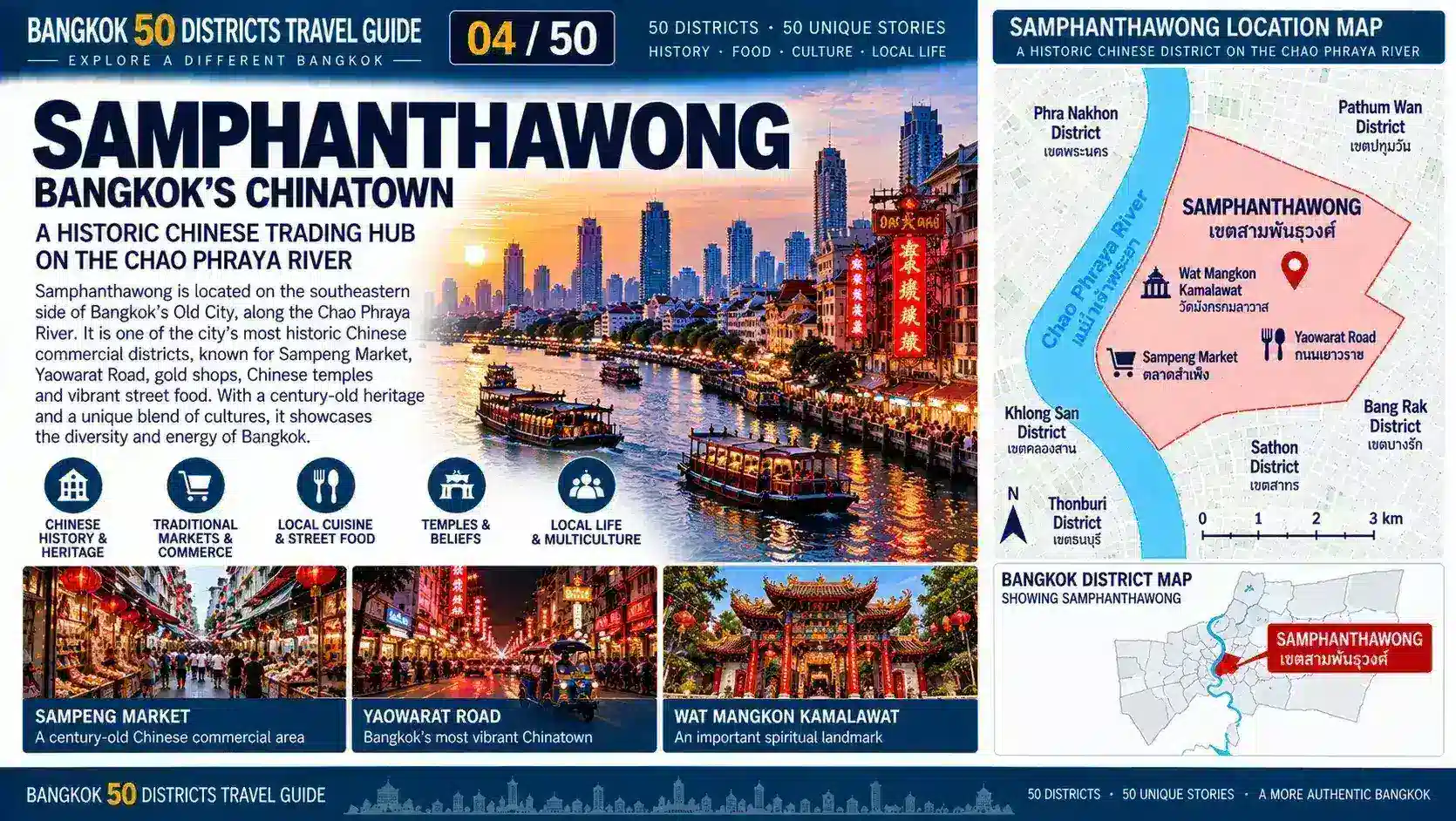
Samphanthawong is a compact historic district near Bangkok’s Old Town and the Chao Phraya River.
Despite its relatively small size, it contains one of the city’s most important traditional commercial areas.
Its history is closely connected with Bangkok’s Chinese community.
As Bangkok developed as the new capital, Chinese merchants and communities established themselves around the Sampeng area.
The nearby river supported trade and transportation, while narrow streets became increasingly filled with shops, warehouses and homes.
Later, as Bangkok expanded and new roads were built, Yaowarat Road developed into another major commercial center.
That history explains why Samphanthawong still feels like two different worlds.
There is the narrow, crowded and deeply traditional Sampeng.
And there is the bright, energetic and internationally famous Yaowarat.
02|Sampeng Market: The Story Began Before Yaowarat
Many visitors head directly to Yaowarat Road.
But to understand Bangkok’s Chinatown, start with:
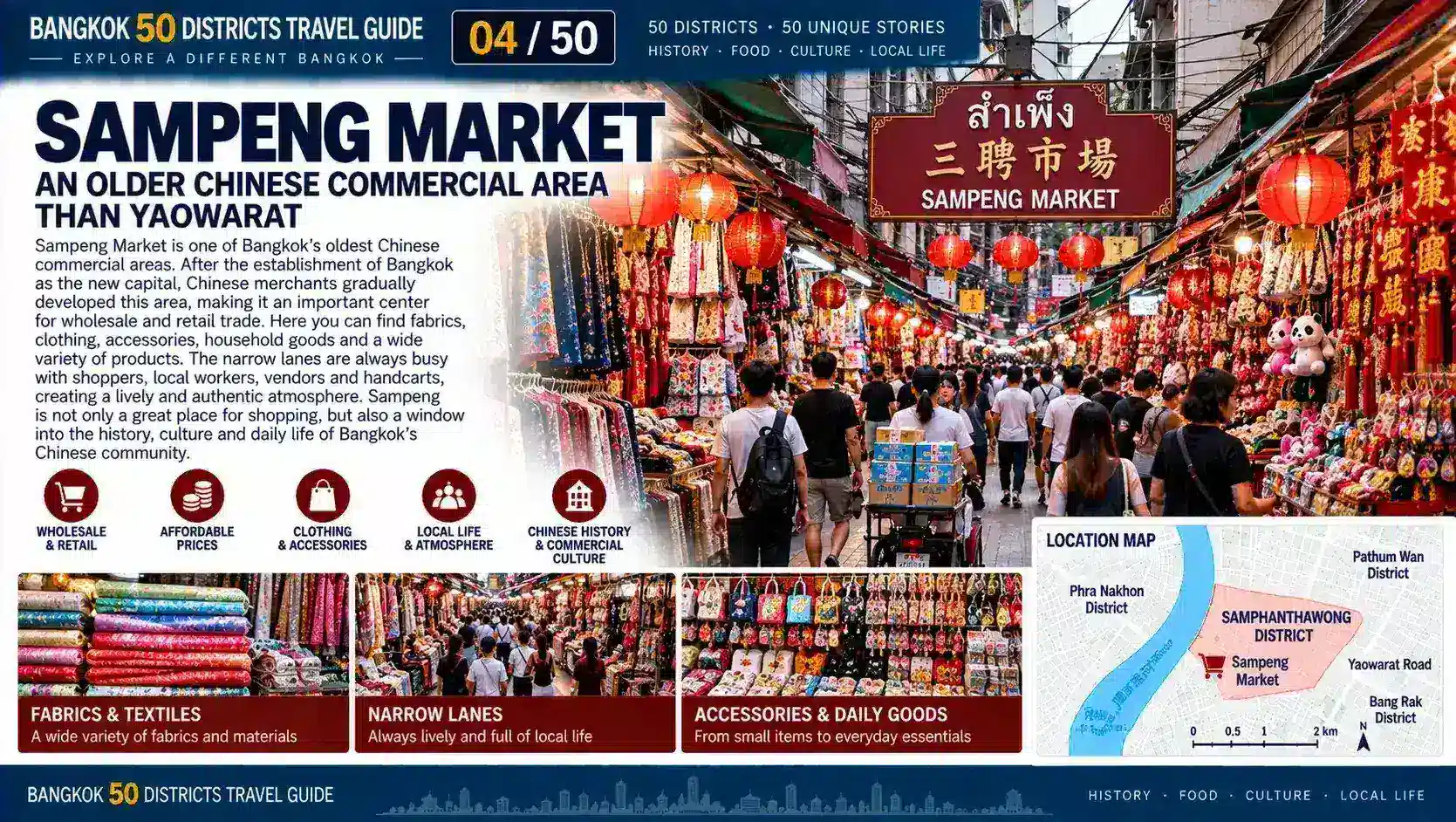
Sampeng Market
Its narrow lanes are packed with fabrics, accessories, household goods, wholesale products and small shops.
It can feel crowded and chaotic.
That is part of its character.
Goods move through the alleys.
Shopkeepers work from tightly packed storefronts.
Customers, carts and motorcycles share limited space.
Compared with Bangkok’s modern shopping malls, Sampeng may not feel particularly convenient.
But that is exactly why it is worth seeing.
Here, you can still experience something closer to the traditional commercial life that helped build Bangkok’s Chinatown.
03|Yaowarat Road: Bangkok’s Chinatown by Day and Night
Next comes the street that made this district famous:
Yaowarat Road
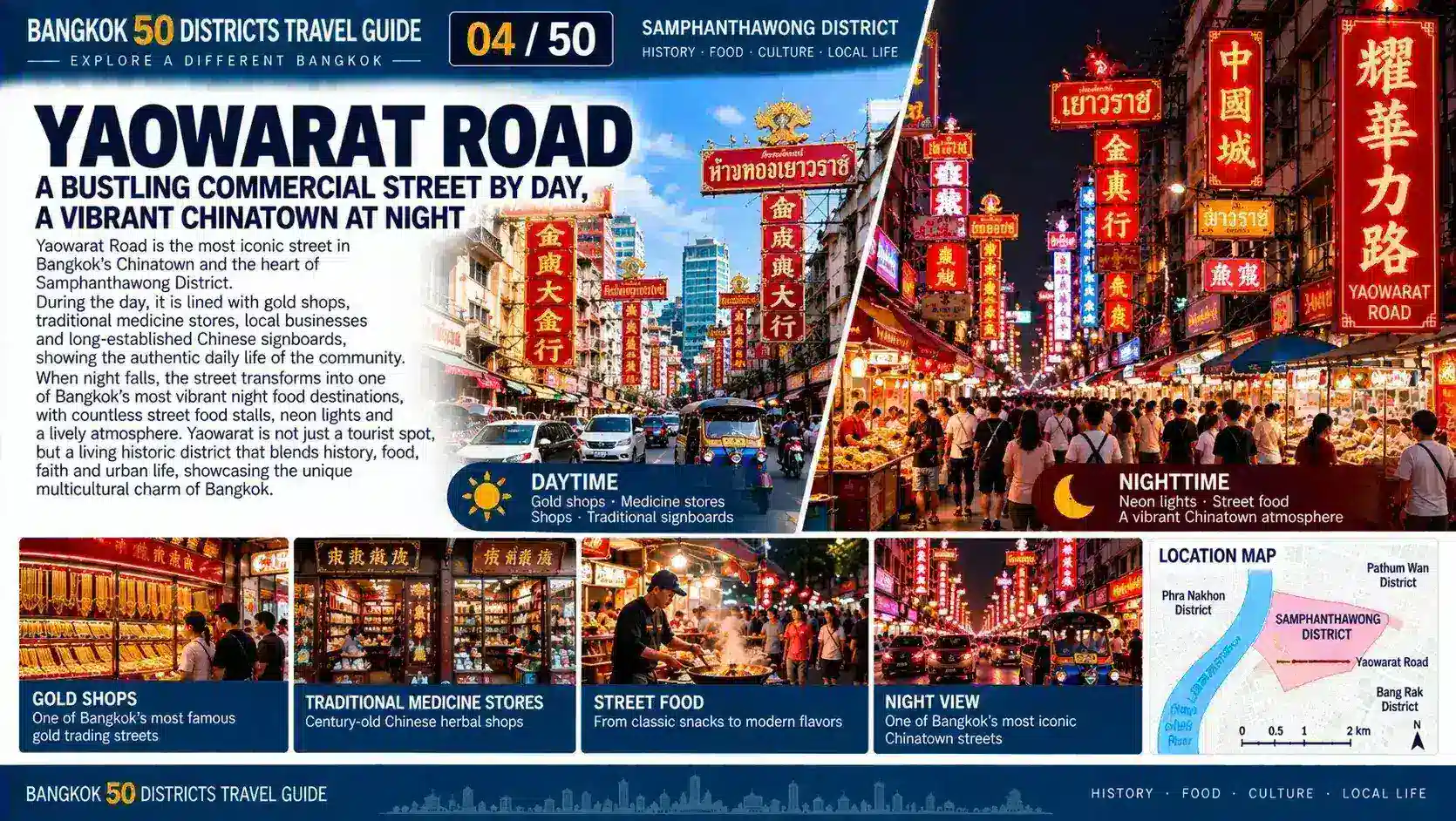
The fascinating thing about Yaowarat is how completely its atmosphere changes throughout the day.
During daylight hours, it is a working commercial street.
Gold shops, traditional medicine stores, local businesses and long-established shops line the road.
Then evening arrives.
Neon signs switch on.
Street-food stalls begin opening.
Tables appear along the sidewalks.
The crowds grow.
And Yaowarat transforms into one of Bangkok’s most recognizable nighttime destinations.
It is often described simply as a food street.
But Yaowarat is much more than that.
It is still a living commercial district where tourism, local business, food and community life exist side by side.
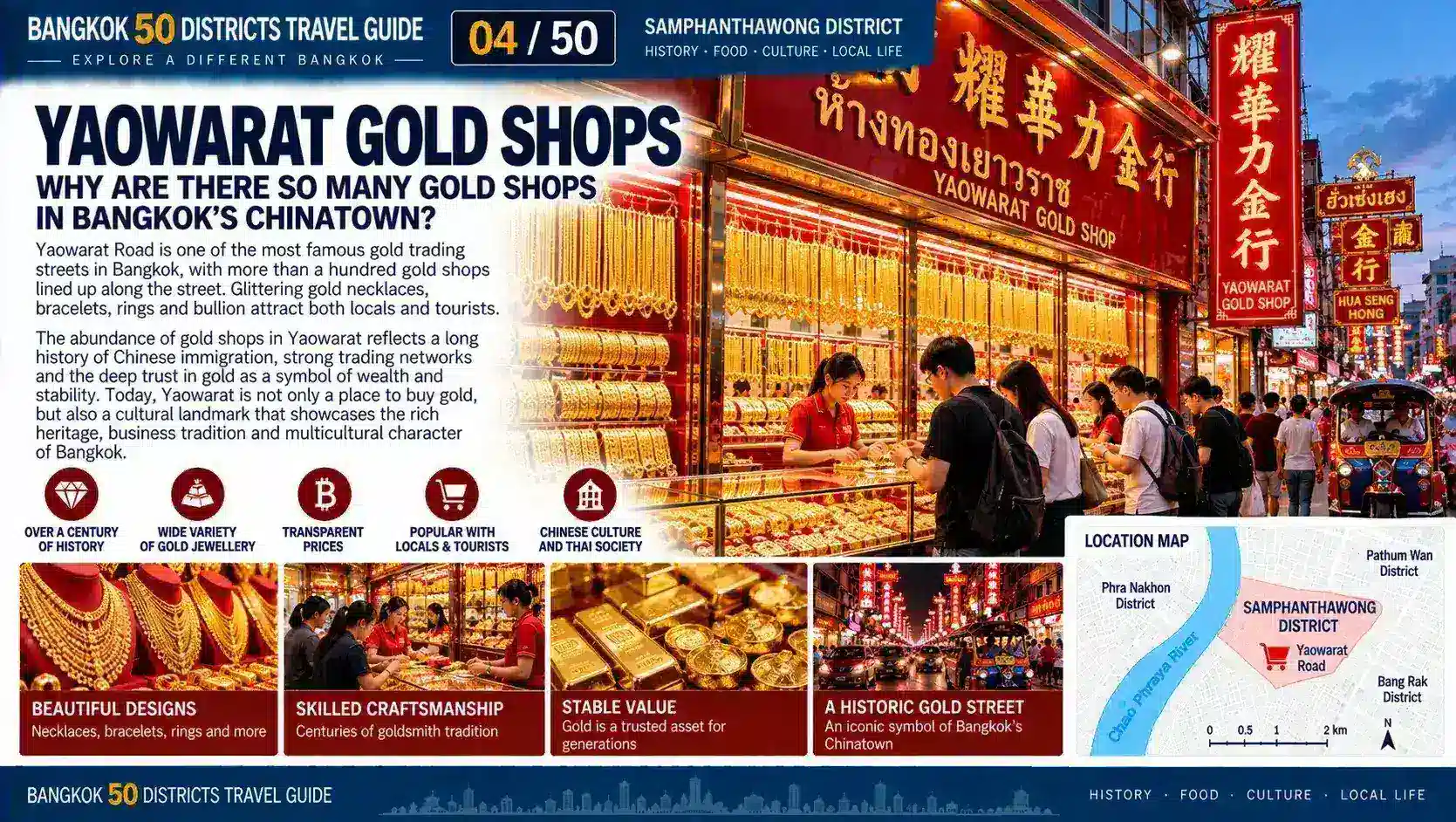
04|Why Are There So Many Gold Shops in Yaowarat?
Walk along Yaowarat and one color is impossible to miss:
Gold.
Gold shops have become one of the most recognizable features of Bangkok’s Chinatown.
Their bright red storefronts and glittering displays are not simply decorations for tourists.
Gold trading has long been connected with the commercial culture of the Chinese community here.
For many families, gold has traditionally served not only as jewelry but also as a way to store wealth.
Over time, generations of businesses turned Yaowarat into one of Bangkok’s best-known areas for gold trading.
So when you see rows of gold shops, you are looking at more than a shopping street.
You are seeing a commercial tradition that remains part of everyday Bangkok.
05|Wat Mangkon Kamalawat: Faith in the Heart of Chinatown
Samphanthawong is not only about trade.
It is also about:
faith.
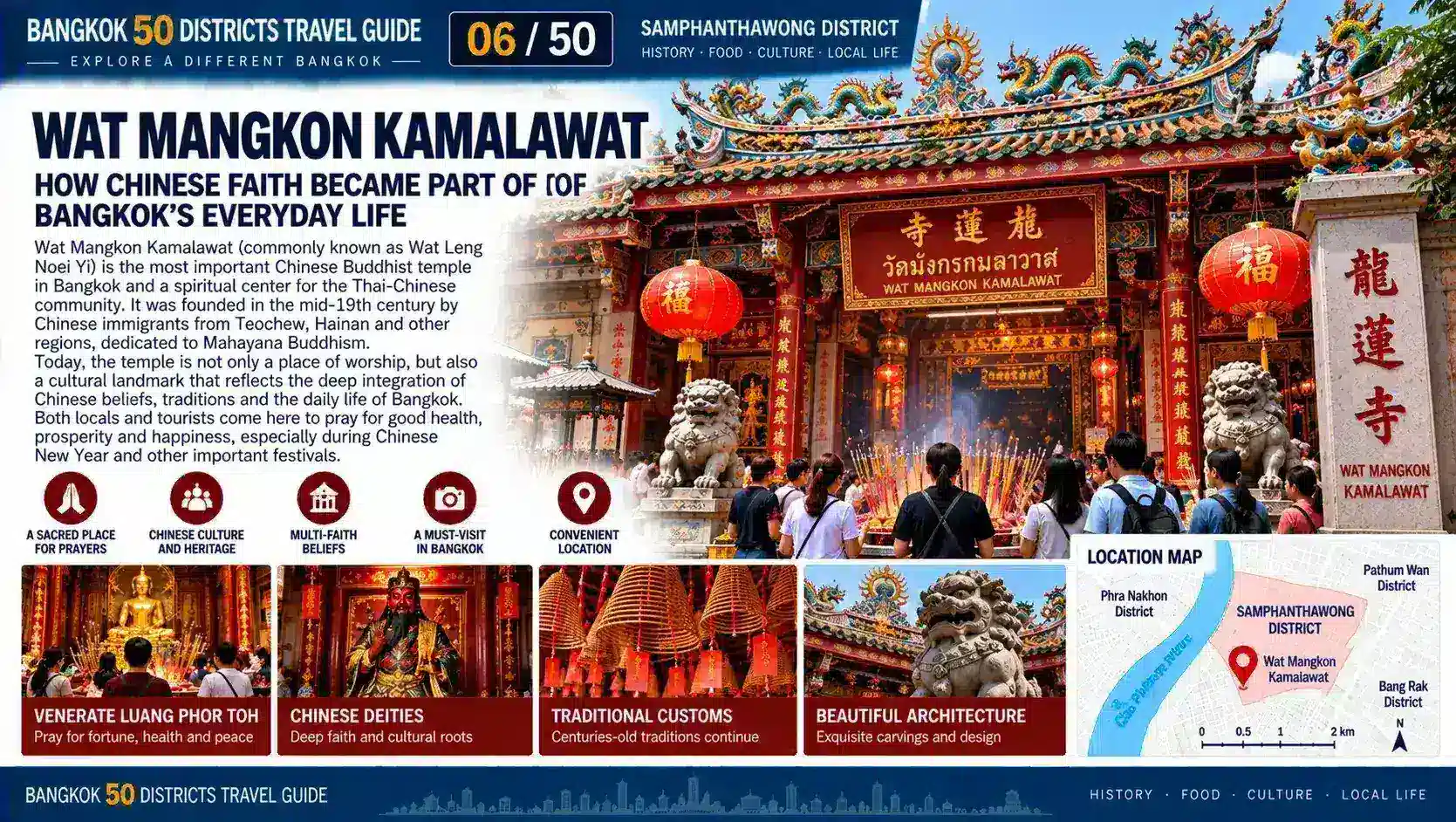
One of the most important landmarks associated with Bangkok’s Chinese community is:
Wat Mangkon Kamalawat
Also widely known as Wat Leng Noei Yi, the temple is an important center of Chinese Buddhist religious life in Bangkok.
During Chinese New Year and other major festivals, large numbers of worshippers come here to pray and make offerings.
Red lanterns, incense, Chinese architectural details and religious traditions create an atmosphere very different from Bangkok’s Thai royal temples.
But this difference is precisely what makes the temple important to the story of the city.
Chinese traditions were not simply preserved separately from Thai society.
Over generations, they became woven into Bangkok’s everyday cultural landscape.
06|Old Shops and Alleys: A Living Piece of Old Bangkok
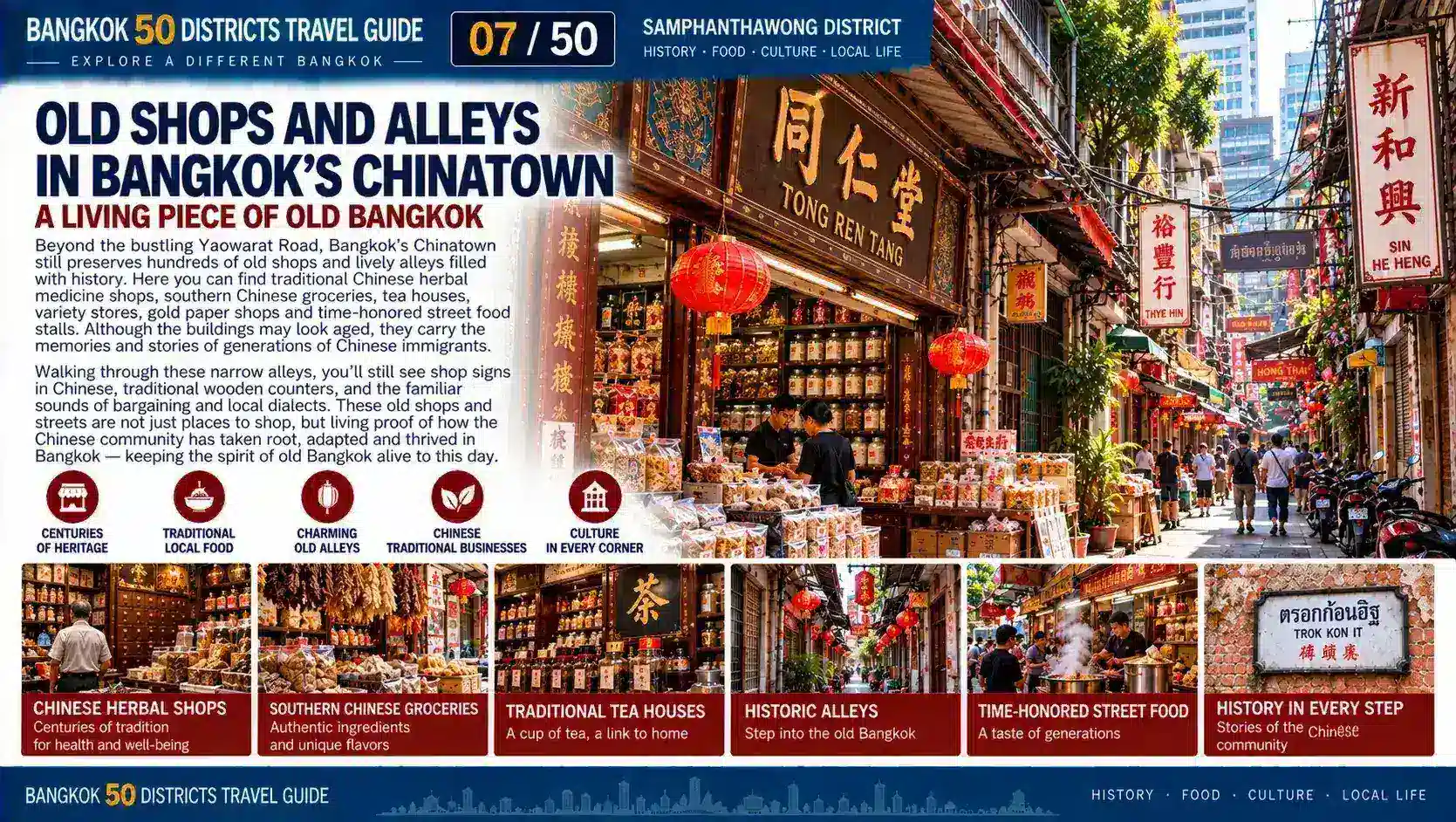
To discover another side of Chinatown, leave the main road.
Walk into the smaller streets and alleys around Yaowarat and Sampeng.
Here you may find:
Traditional herbal shops.
Dry-goods stores.
Old tea shops.
Family-run businesses.
Historic shophouses.
Street-food stalls that have served the neighborhood for generations.
These places are not always designed for tourists.
And that is exactly what makes them interesting.
Samphanthawong is not a Chinatown recreated as a tourist attraction.
People still live here.
They work here.
They shop here.
Families continue businesses started by earlier generations.
Behind the famous neon lights, old Bangkok is still alive.
07|A Food Journey Through Yaowarat
And now we arrive at the part many visitors have been waiting for:
Food.
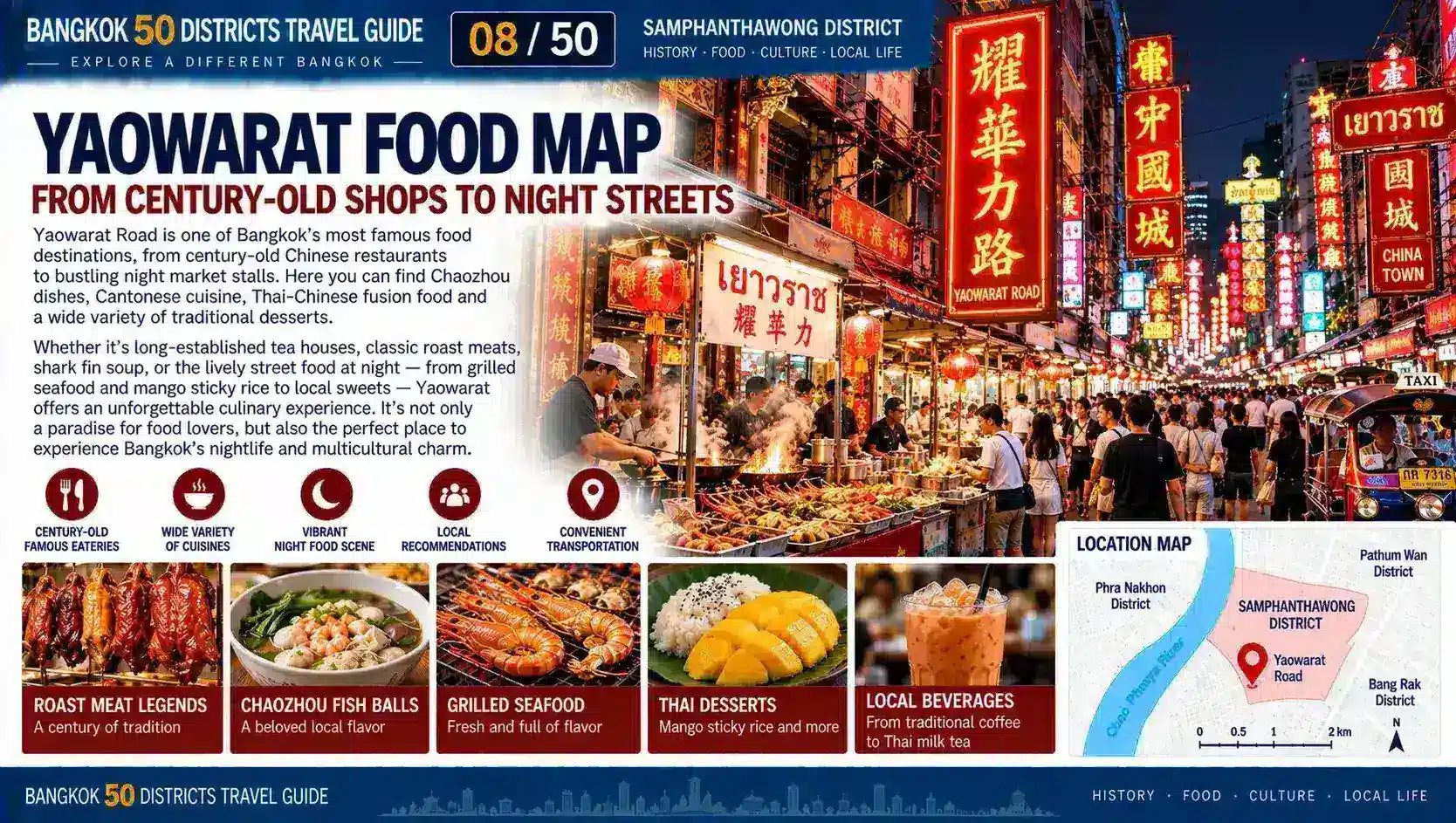
The best way to eat in Yaowarat is not necessarily to choose one restaurant and stay there all evening.
Instead:
walk, explore and eat a little at a time.
During the day, look for long-established local restaurants.
As evening approaches, street-food stalls begin to take over.
Roast meats, noodles, seafood, Chinese-Thai dishes, desserts, fruits and drinks can all become part of the journey.
Some dishes clearly reveal influences from southern Chinese food traditions.
Others have changed over generations and developed into flavors that feel distinctly Bangkok.
That is what makes eating in Chinatown so interesting.
It is not simply “Chinese food in Thailand.”
It is the result of Chinese culinary traditions evolving within Bangkok for generations.
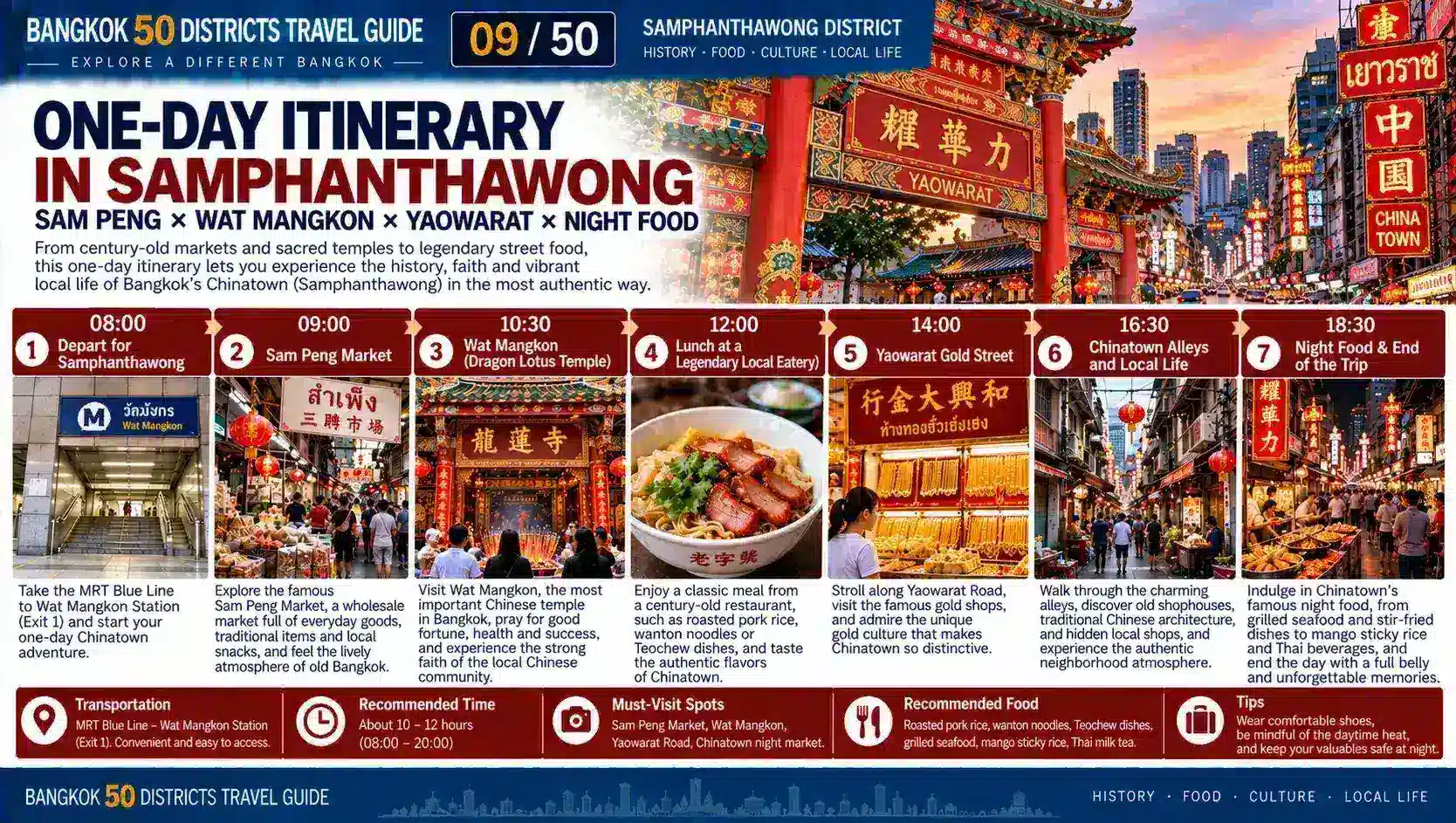
08|How to Spend One Day in Samphanthawong
For this district, it is better to start a little later and stay into the evening.
That way, you can experience Chinatown both before and after the neon lights come on.
13:00|Sampeng Market
Begin with the old commercial lanes.
Explore wholesale shops, small businesses and the crowded market atmosphere.
↓
14:30|Old Streets & Traditional Shops
Walk without rushing.
Look for old shophouses, traditional businesses and everyday neighborhood life.
↓
15:30|Wat Mangkon Kamalawat
Experience one of Bangkok Chinatown’s most important centers of Chinese faith and culture.
↓
17:00|Yaowarat Road
This is when the district begins to change.
Daytime commerce slowly gives way to evening crowds and food stalls.
↓
18:00|Chinatown Dinner
Do not eat too much at one place.
Try smaller portions from several different shops or stalls.
↓
19:30|Street Food Round Two
Desserts, fruit, snacks and drinks.
There is always room for one more stop.
↓
21:00|Yaowarat at Night
Before leaving, take one final walk along the main road.
Neon signs, traffic, street stalls, crowds and old buildings come together to create one of Bangkok’s most distinctive night scenes.
09|Why Does Samphanthawong Deserve Its Own Stop?
Because this district explains something important about Bangkok:
the city has never been shaped by only one culture.
Thai culture forms the foundation of Bangkok.
But Chinese communities also played a major role in the city’s trade, markets, food culture, religious life and commercial development.
The Yaowarat we see today is therefore more than a famous place to eat dinner.
Behind it are stories of:
migration · trade · family · faith · business · food · generations of city life
If you visit only for a photograph under the neon signs, you see the surface of Chinatown.
Walk through Sampeng, enter the temple, explore the old alleys and watch local businesses at work—
and you begin to understand the neighborhood itself.
BANGKOK 50 DISTRICTS
04 / 50 UNLOCKED
SAMPHANTHAWONG ✓
Chinese Heritage · Trade · Sampeng · Yaowarat · Faith · Gold · Street Food
Our journey so far:
01|PHRA NAKHON ✓
Bangkok’s historic royal heart
02|DUSIT ✓
Bangkok’s transition toward a modern capital
03|BANG RAK ✓
Where Bangkok connected with the wider world
04|SAMPHANTHAWONG ✓
Chinese heritage and Bangkok’s historic Chinatown
We have now completed:
04 / 50
46 districts remain.
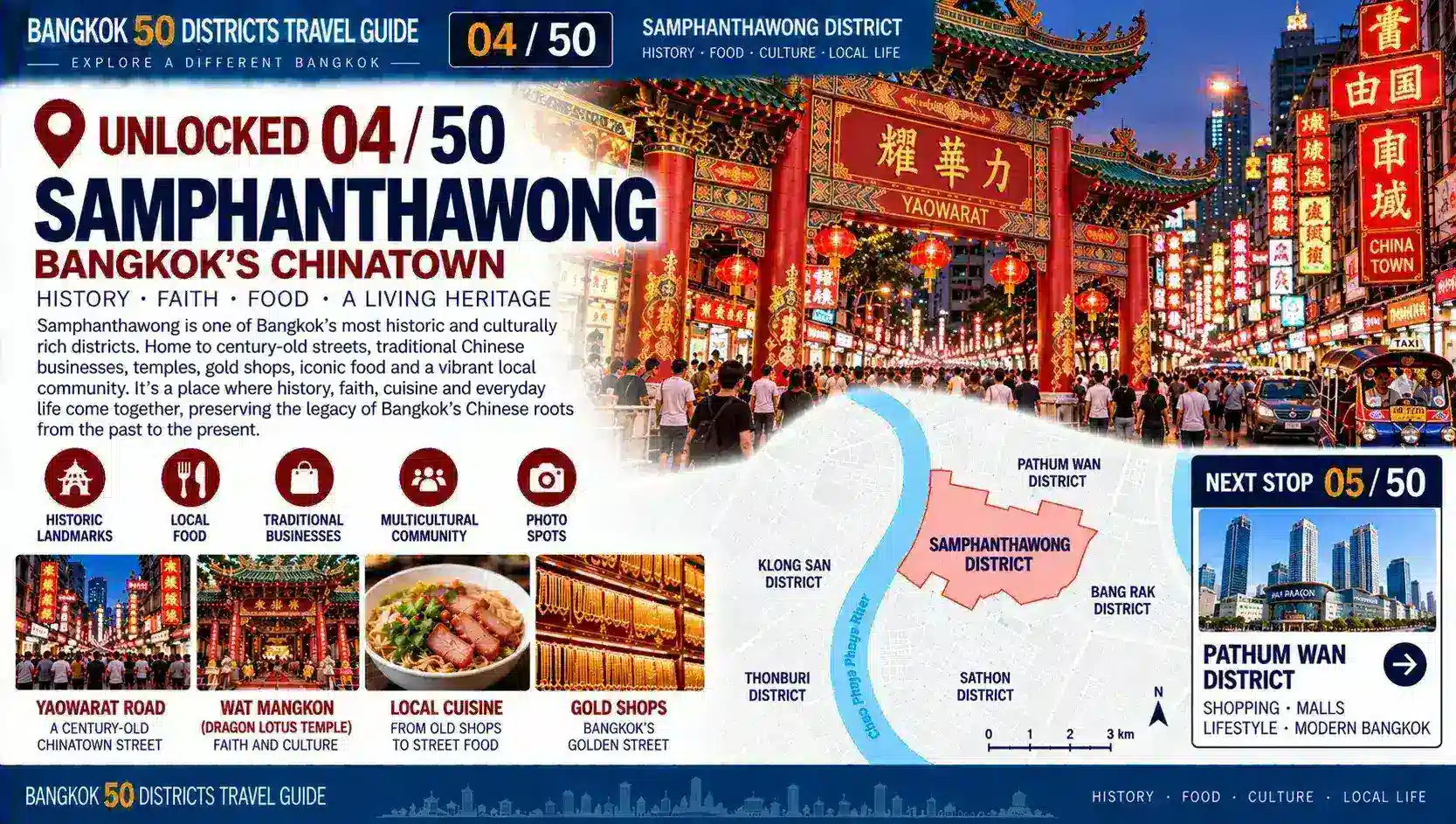
NEXT STOP → 05 PATHUM WAN
For our fifth stop, the atmosphere changes completely.
We leave behind old markets, traditional shophouses and Chinatown—
and enter the Bangkok that many international visitors recognize immediately:
Modern Central Bangkok.
Siam, major shopping malls, university life, contemporary art, busy skywalks and some of the city’s most famous intersections all come together here.
From Siam Paragon and MBK to CentralWorld, the Bangkok Art and Culture Centre, Chulalongkorn University and the Erawan Shrine, Pathum Wan represents another chapter in Bangkok’s evolution.
BANGKOK 50 DISTRICTS · 05 / 50
PATHUM WAN
From Siam to the Heart of Modern Bangkok
Shopping · Youth Culture · Art · University · City Center · Modern Bangkok
Next stop: Pathum Wan.