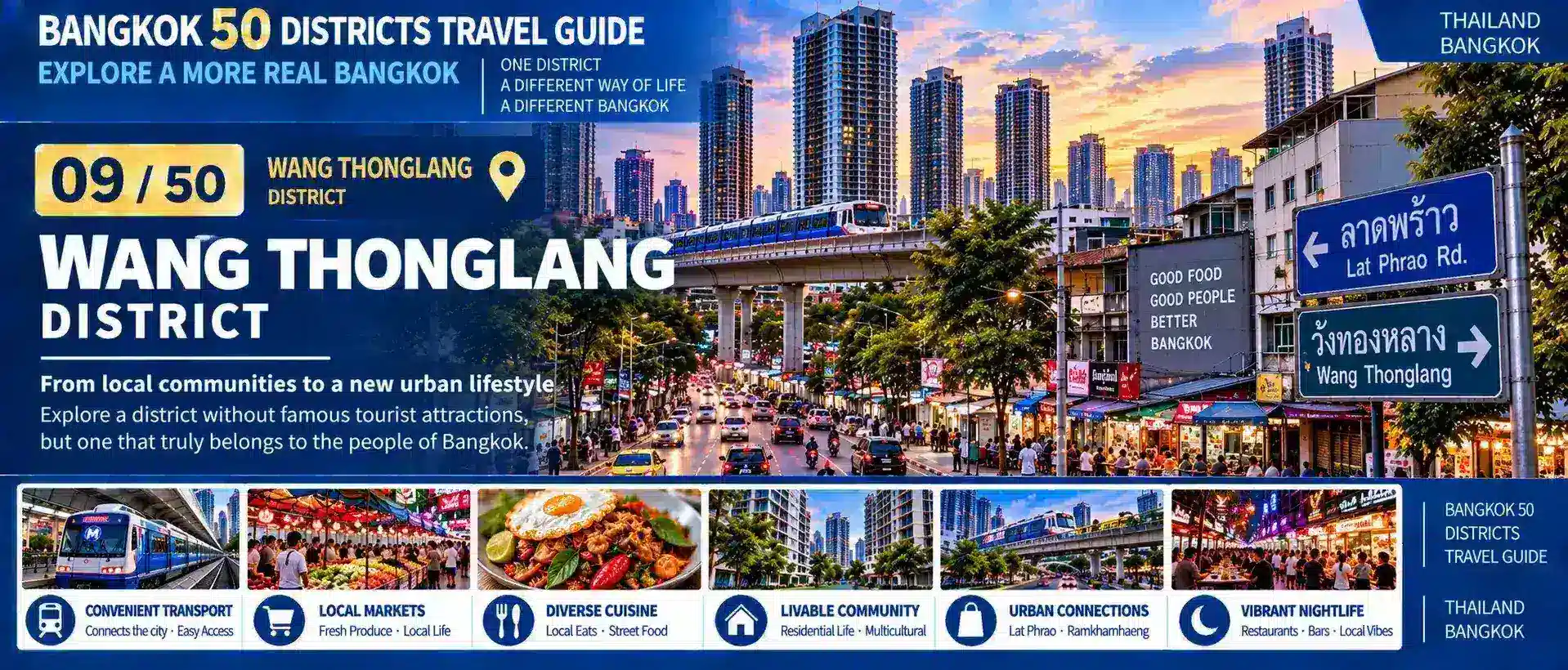
If our previous stop, Huai Khwang, showed us a fast-changing Bangkok shaped by the MRT, nightlife and an increasingly international lifestyle, then moving farther east into Wang Thonglang brings us into a very different urban environment.
There are fewer tourists here.
There are fewer famous attractions.
Instead, you find residential neighborhoods, local markets, schools, restaurants, small businesses and ordinary Bangkok residents moving through their daily routines.
Wang Thonglang may not be a district that appears on a first-time visitor’s must-see list.
But that is exactly why it belongs in our Bangkok 50 Districts Travel Guide.
Once the famous landmarks disappear, we can begin asking a more interesting question:
What does the Bangkok where people actually live really look like?
01|Where Is Wang Thonglang?
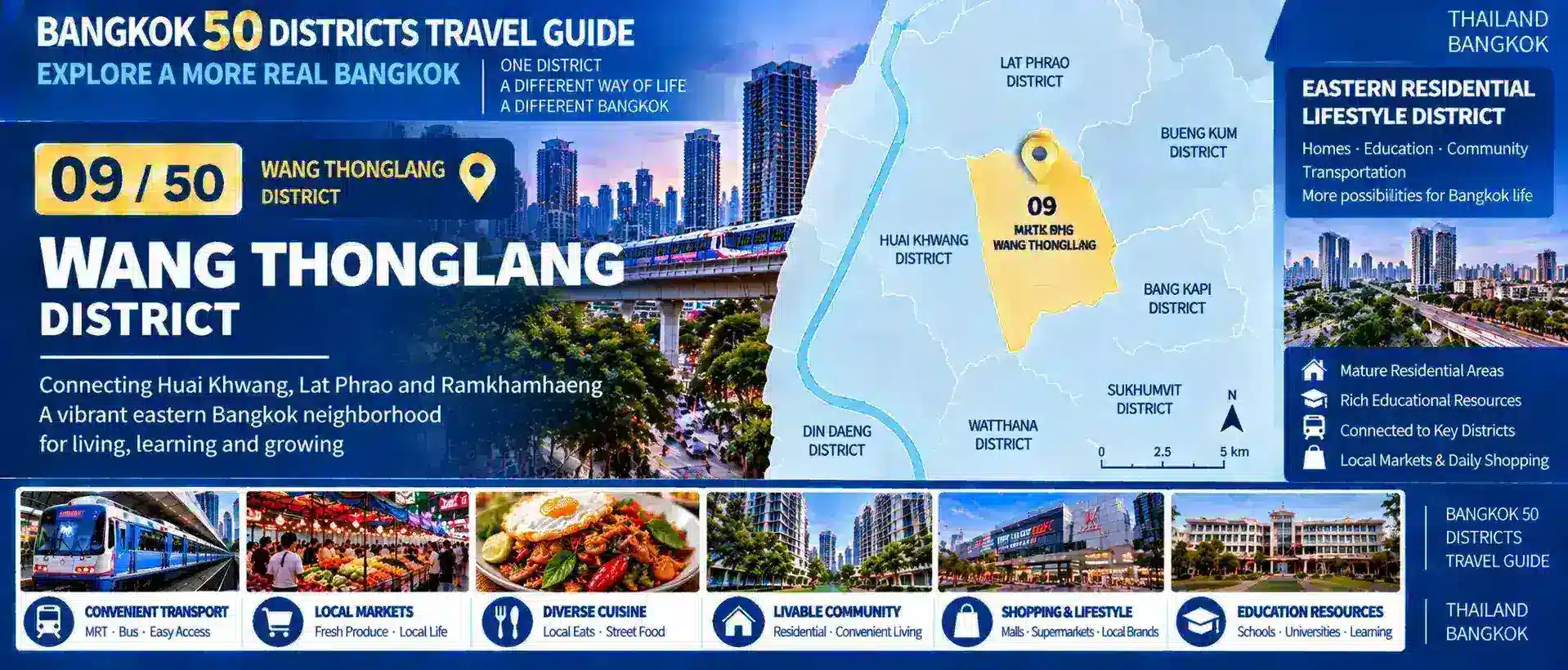
Wang Thonglang lies east of central Bangkok, surrounded by some of the city’s major residential and commercial corridors, including areas connected with Huai Khwang, Lat Phrao and Ramkhamhaeng.
Unlike Siam, Yaowarat or Ratchada, Wang Thonglang does not revolve around a single landmark recognized by almost every visitor.
Instead, the district is made up of residential neighborhoods, community roads, markets, schools, restaurants and businesses serving local residents.
Travel east from central Bangkok and the character of the city gradually changes.
The concentration of major tourist attractions begins to fade, and everyday urban life becomes more visible.
Large commercial developments still exist in the wider area, but they do not define the district by themselves.
What really shapes Wang Thonglang are its neighborhoods—and the people who live in them.
This is not primarily tourist Bangkok.
It is:
everyday Bangkok.
02|Local Communities: What Does Bangkok Look Like Without Tourists?
One of the most interesting things to experience in Wang Thonglang is not a particular attraction.
It is simply the streets themselves.
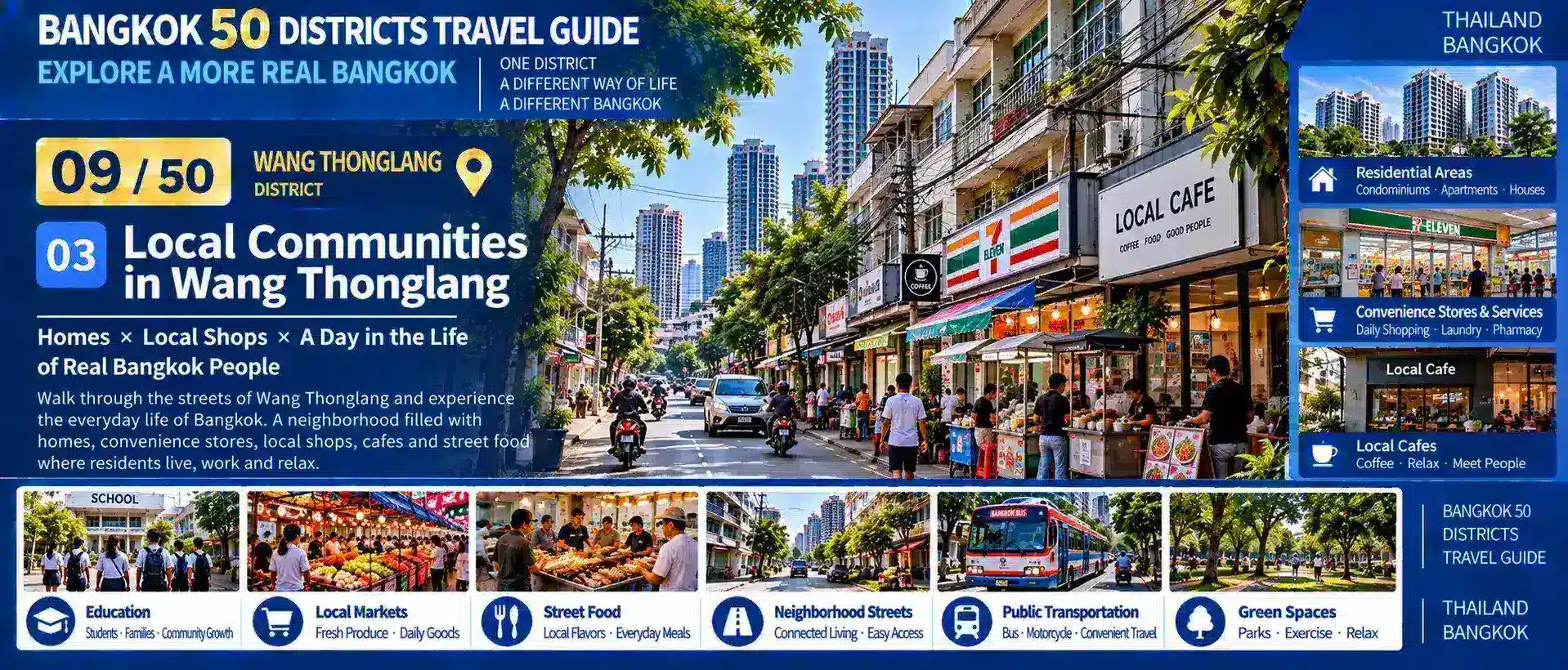
Walk through the neighborhoods and you will see apartments, townhouses, detached homes, laundries, salons, convenience stores, cafés, motorcycle taxis and small local restaurants.
In the morning, parents take children to school while commuters leave for work.
Around noon, neighborhood restaurants fill with nearby residents and workers.
The streets become quieter in the afternoon.
Then, as evening arrives, markets and restaurants become busy again.
Individually, none of these scenes may seem extraordinary.
But together, they represent the daily Bangkok experienced by millions of people.
This is one of the most interesting changes that happens when you begin exploring a city more deeply.
The question is no longer simply:
“What attractions are here?”
Instead, you begin asking:
“How do people here actually live?”
03|Local Markets: A Window into Everyday Family Life
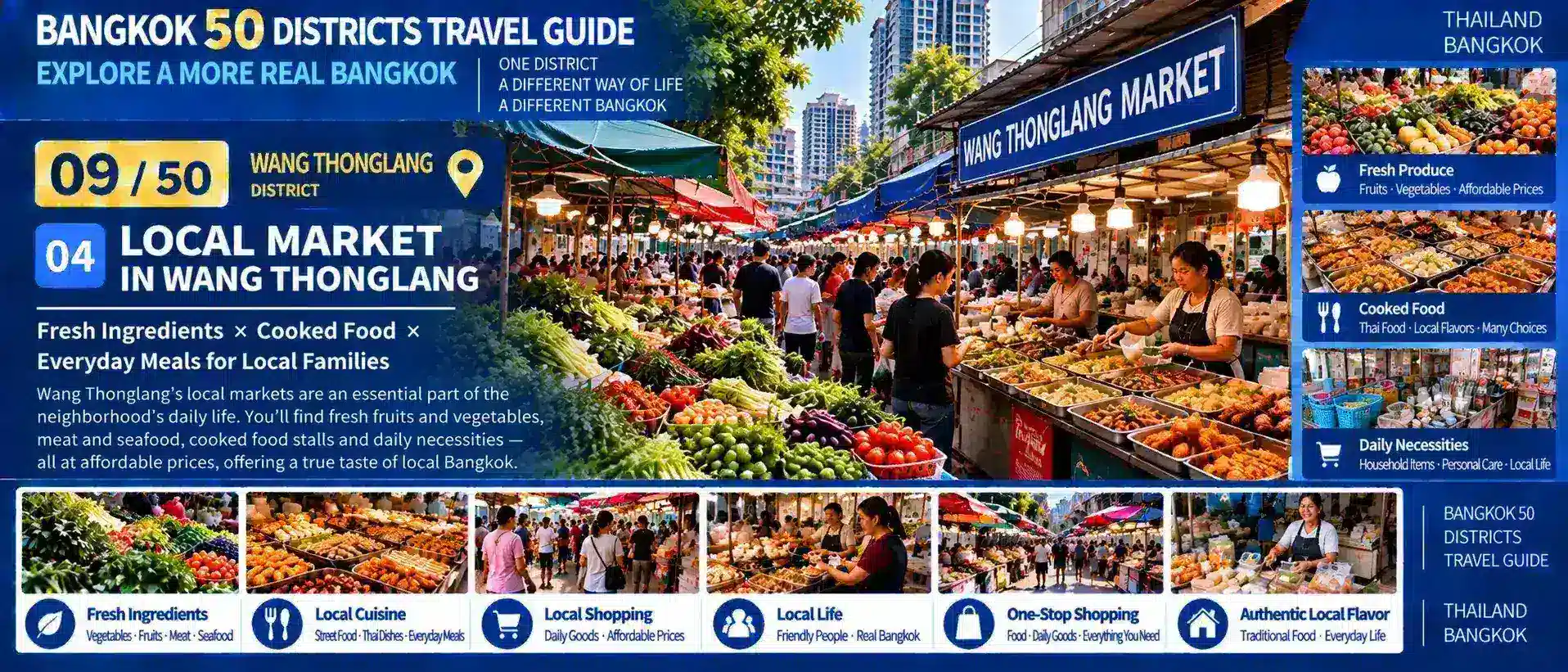
Like many residential districts across Bangkok, local markets remain an important part of everyday life in Wang Thonglang.
These markets are designed primarily for nearby residents rather than tourists.
Fresh vegetables, fruit, meat, seafood, seasonings, prepared dishes, desserts and household necessities all form part of the daily neighborhood economy.
In the morning, people shop for ingredients.
At lunchtime, they can pick up a simple meal.
After work, residents return to buy prepared dishes to take home for dinner.
A local market therefore tells us much more than simply what Thai food looks like.
It shows us how a neighborhood solves some of the most ordinary questions of everyday life:
What should we eat today?
Where should we buy it?
How much does it cost?
What is the most convenient option?
For travelers interested in understanding Bangkok beyond its attractions, these simple questions can reveal more about the city than another famous restaurant.
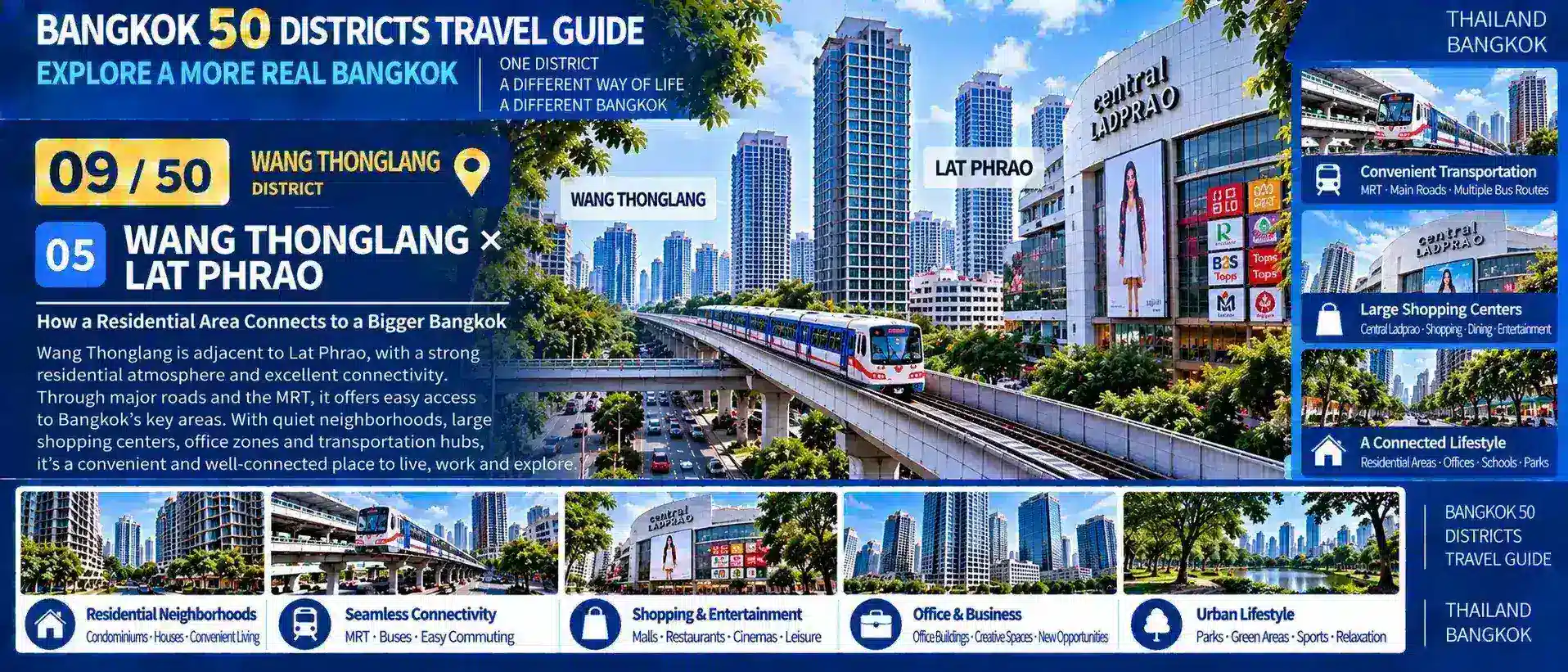
04|Wang Thonglang × Lat Phrao: Connecting to Greater Bangkok
To understand Wang Thonglang, it is useful to look beyond administrative boundaries.
The roads and urban corridors surrounding the district are just as important.
Lat Phrao is one of the key names in this wider urban landscape.
Across the broader Lat Phrao area, residential neighborhoods, apartments, schools, restaurants, offices, shops and community services form an extensive urban network.
For many residents, traveling between home, work, school and shopping areas is part of everyday life.
That means transportation here is not simply practical information for visitors.
Transportation is part of the story of the district itself.
During rush hour, roads fill with cars, buses, motorcycles and commuters moving between different parts of Bangkok.
It reminds us that Bangkok is not a city built around a single downtown core.
Millions of residents live across a vast network of neighborhoods and travel between multiple business, education and commercial centers every day.
Wang Thonglang is one part of this much larger urban system.
05|Wang Thonglang × Ramkhamhaeng: A Younger Urban Lifestyle
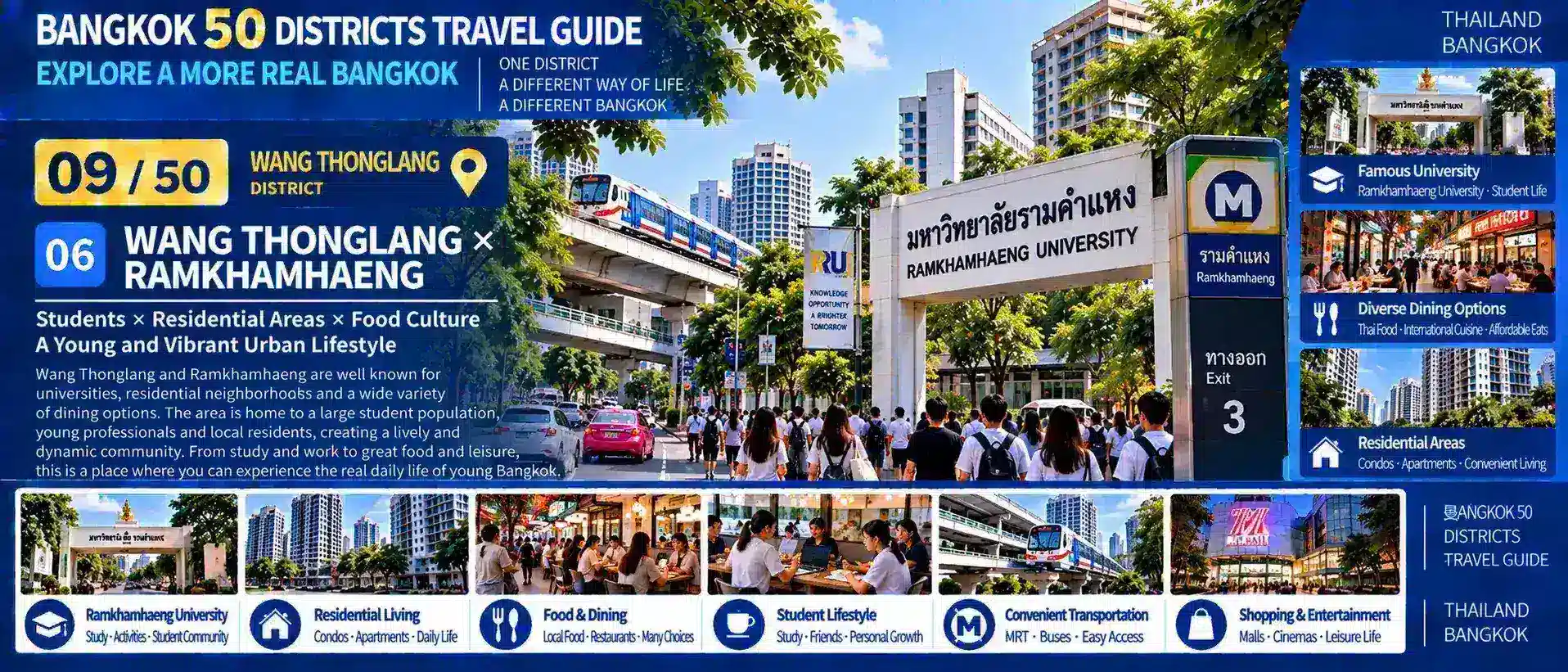
The southern side of Wang Thonglang and its surrounding urban life are also closely connected with the broader Ramkhamhaeng area.
This part of Bangkok is characterized by dense residential communities, educational institutions, commercial activity and a wide variety of affordable dining options.
As a result, the people you encounter here can feel quite different from those in Bangkok’s traditional tourist districts.
Students, young professionals, long-term residents and families form an important part of everyday street life.
Affordable restaurants, apartments, convenience stores and daily services naturally develop around this population.
The result is a very recognizable form of eastern Bangkok living:
busy streets,
constant movement,
dense commercial activity,
and a lifestyle that can feel very different from areas such as Siam or Thonglor.
For visitors who want to understand how students and younger Bangkok residents experience the city, the wider Ramkhamhaeng area provides an interesting window into that world.
06|Old Neighborhoods × New Condos: How Is Residential Bangkok Changing?
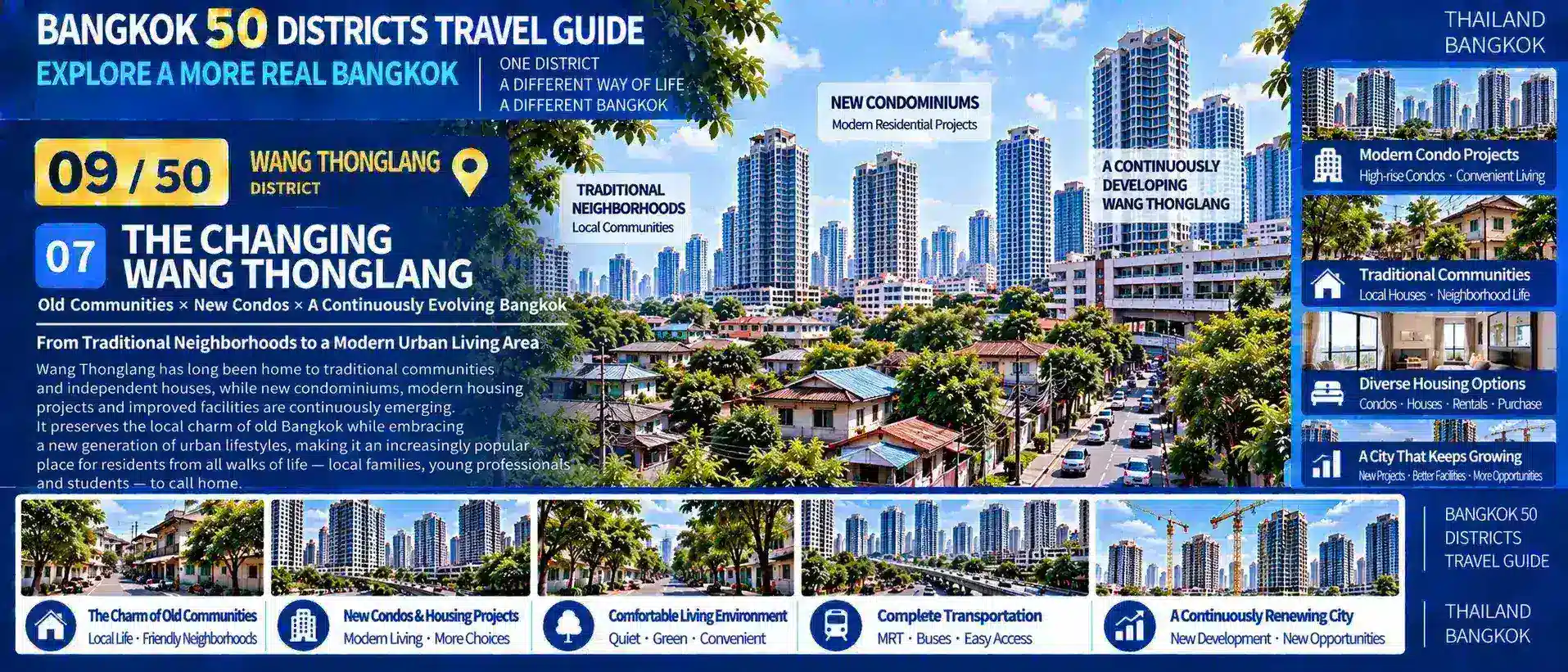
Walk around Wang Thonglang and you can see different generations of Bangkok housing existing side by side.
On one street, there may be long-established low-rise homes, townhouses and older residential communities.
Nearby, newer condominiums, modern housing projects and commercial spaces are gradually appearing.
This contrast reflects a much broader transformation taking place across Bangkok.
As transportation networks improve, land values change and residents move between different parts of the city, some traditionally lower-density residential areas are gradually being redeveloped.
But this transformation does not happen overnight.
That creates some of the most interesting urban scenes in Wang Thonglang.
An older house may stand beside a modern condominium.
A traditional neighborhood shop may face a new café.
New lifestyle businesses may appear close to a long-established community market.
Old Bangkok has not simply disappeared.
New Bangkok has not completely replaced it.
The two are slowly overlapping on the same streets.
07|Local Food: The Taste of Everyday Wang Thonglang
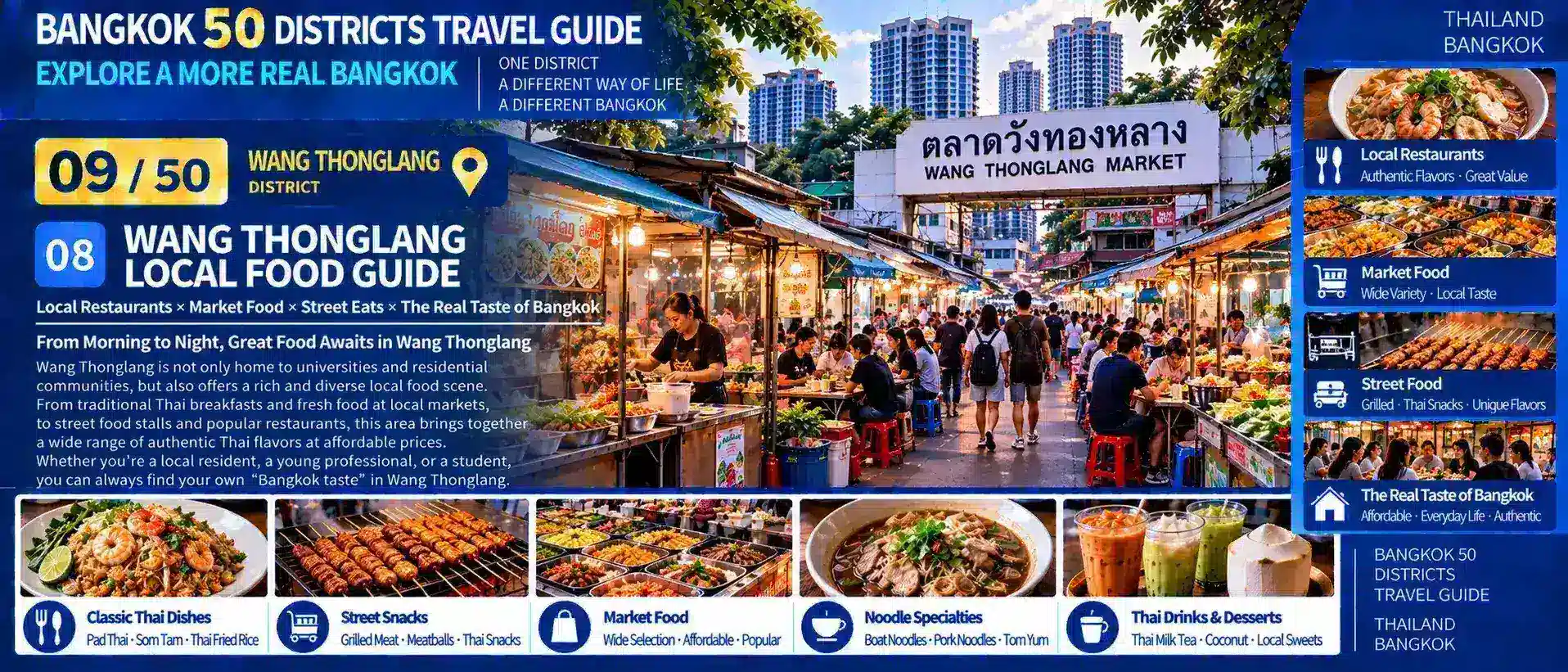
Wang Thonglang is not the kind of district where you necessarily need a list of ten famous “must-eat” restaurants.
It can be more enjoyable to eat the way local residents do.
See a neighborhood restaurant filled with regular customers?
Take a look.
Notice a prepared-food stall with a queue?
Try something.
Across the district and surrounding neighborhoods, everyday dishes such as noodles, pad kra pao, grilled meats, chicken rice, braised pork rice, made-to-order Thai dishes, Isan food, snacks, desserts and drinks are easy to find.
These restaurants exist primarily because local people need somewhere to eat every day.
That gives the food scene a different atmosphere from areas built heavily around tourism.
Not every dish needs to become famous online.
Sometimes a simple, affordable and satisfying meal is enough.
That may be the best way to understand Wang Thonglang’s food culture:
Don’t eat for the check-in photo. Eat like someone who lives here.
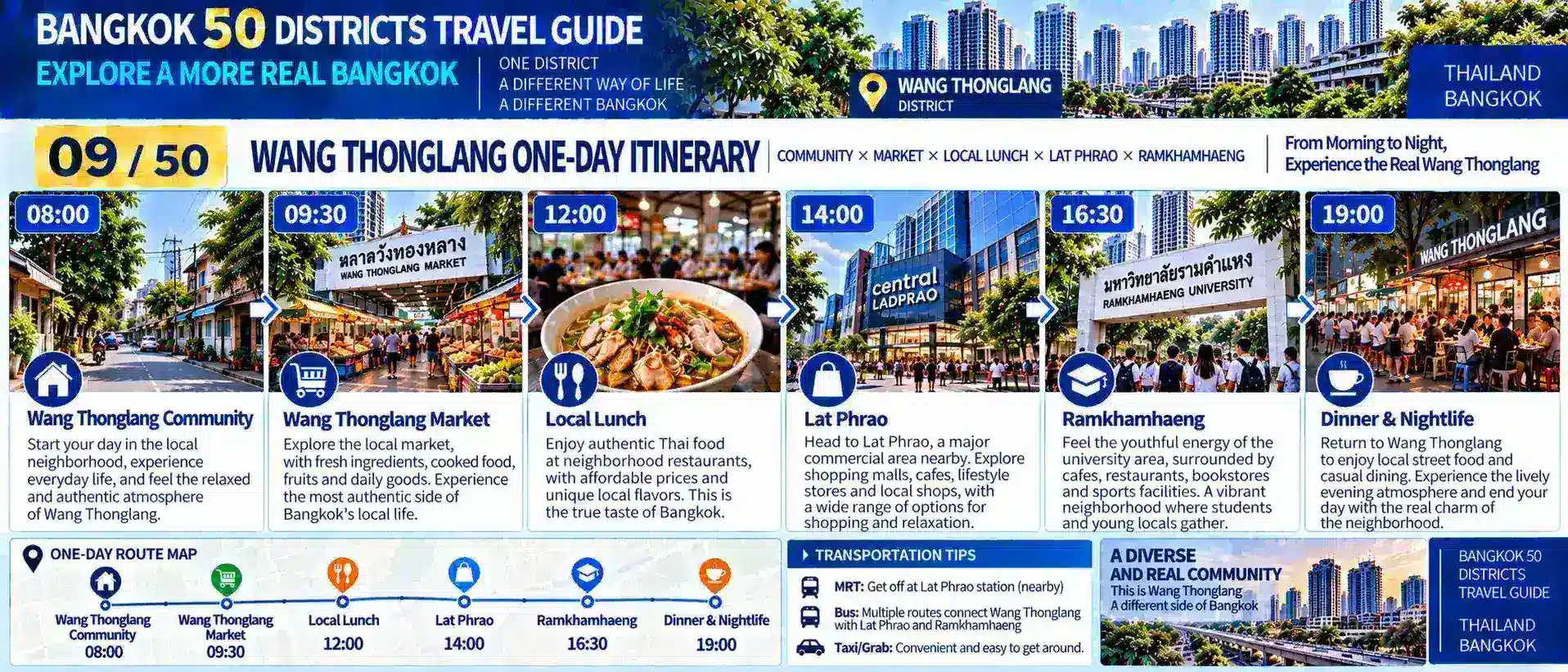
08|How to Spend One Day in Wang Thonglang
Wang Thonglang is not best explored as a checklist of famous attractions.
A better approach is to give the day to the neighborhood itself.
09:00|Explore a Local Community
Begin along the neighborhood streets and observe morning life around homes, shops and small businesses.
10:30|Visit a Local Market
See what local families buy—from fresh ingredients and prepared food to everyday necessities.
12:00|Local Lunch
Choose a simple neighborhood restaurant and experience the kind of meal ordinary Bangkok residents eat every day.
14:00|Community Walk
Explore the mixture of houses, apartments, schools, small shops and cafés that make up the district’s residential landscape.
16:30|Lat Phrao Urban Corridor
See how residential communities connect with the wider Bangkok metropolitan lifestyle through major roads and commercial areas.
18:00|Ramkhamhaeng Area
Experience another side of eastern Bangkok shaped by students, younger residents, food and dense urban activity.
19:30|Dinner and Evening Streets
Finish the day with a local dinner and watch the neighborhood transition into its evening rhythm.
There may be no monumental attraction waiting at the end.
But you may leave feeling closer to the real Bangkok than you would after following a conventional sightseeing route.
09|Why Does Wang Thonglang Belong in the Bangkok 50 Districts Travel Guide?
This question matters especially here.
According to the logic of a conventional travel guide, Wang Thonglang may not appear to have enough “must-see attractions.”
But our Bangkok 50 Districts Travel Guide was never intended to be another ranking of famous landmarks.
If we only visit the Grand Palace, Wat Arun, Yaowarat, Siam and a few night markets, we see only the part of Bangkok that is easiest for visitors to recognize.
The city is also made up of countless districts like Wang Thonglang.
Here, someone takes their child to school every morning.
Someone rides a motorcycle to work.
Someone runs a small restaurant that has served the neighborhood for years.
Someone has just moved into a new condominium.
Someone stops at the market every evening to buy dinner.
These ordinary routines, repeated by millions of people, are what actually make a metropolis function.
So the most important thing to see in Wang Thonglang is not a building.
It is not a viral street.
It is not even a particular restaurant.
It is something much bigger:
how Bangkok continues to live when the tourism filter is removed.
And that is exactly why Wang Thonglang matters to this series.
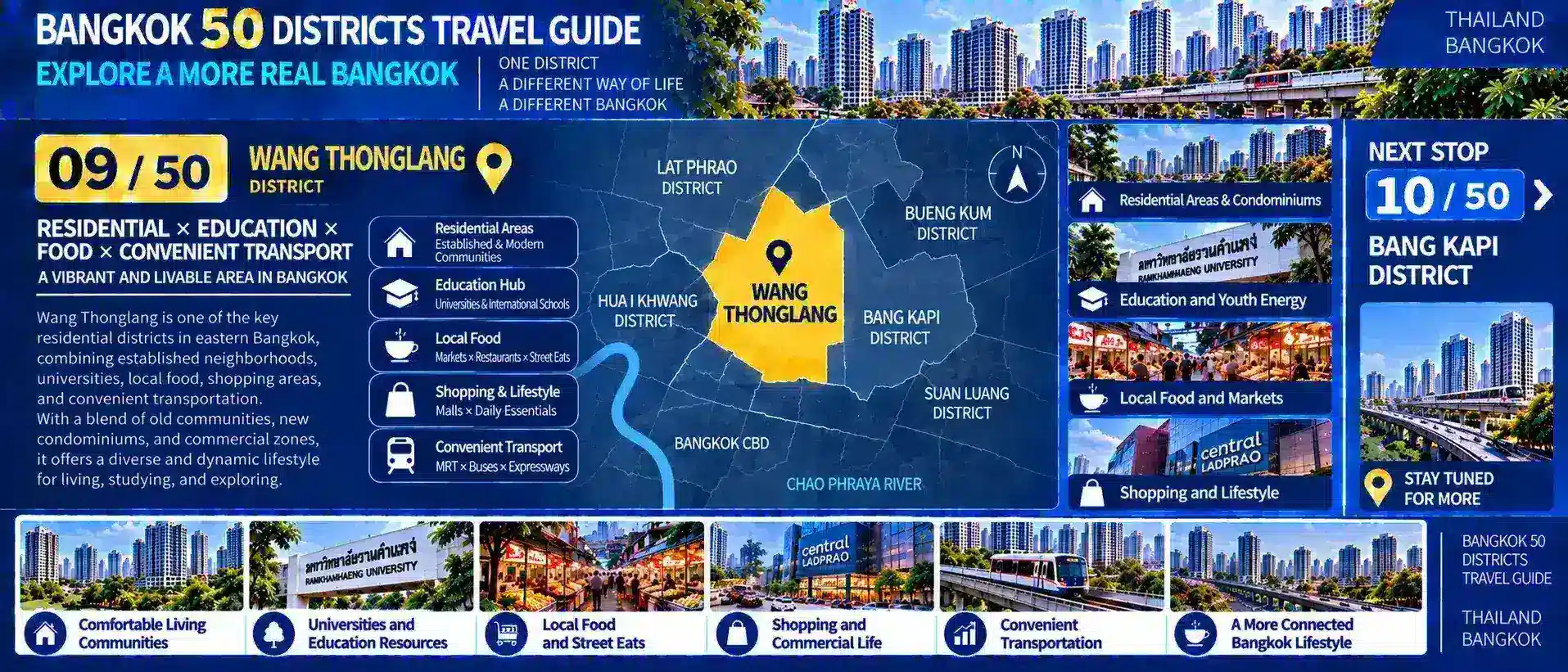
09 / 50 UNLOCKED
WANG THONGLANG ✓
Keywords:
Local Communities · Residential Life · Local Markets · Street Food · Lat Phrao · Ramkhamhaeng · Urban Change · Everyday Bangkok
41 districts remaining.
NEXT STOP — 10 / 50
BANG KAPI
Continuing east from Wang Thonglang, we enter a larger and busier center of everyday Bangkok.
The story will expand beyond residential communities to include:
shopping centers, markets, universities, canal transportation, sports facilities and the enormous urban network of eastern Bangkok.
If Wang Thonglang helps answer the question—
“Where do ordinary Bangkok residents live?”
then in Bang Kapi, we will explore the next question:
How can a district far from Bangkok’s traditional center become a city center of its own?