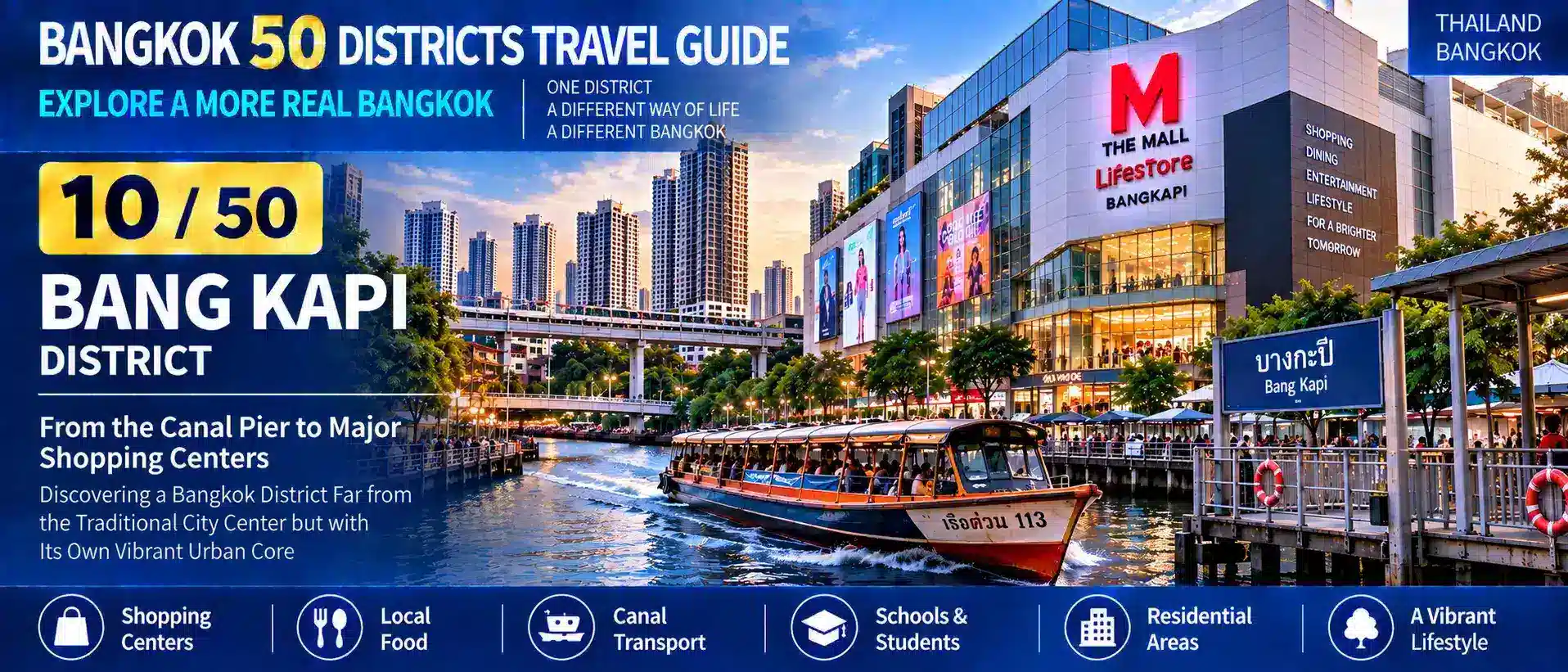
After exploring Wang Thonglang in our ninth stop, we have gradually moved away from the Bangkok most tourists know.
Continue east into Bang Kapi, and something interesting begins to happen.
We are now farther from the Grand Palace, Siam, Silom and Bangkok’s traditional city center, yet the city does not become quieter.
Instead, there are more people.
The shopping centers are larger.
The roads, markets, schools, residential communities and transport networks become increasingly dense.
Bang Kapi reveals something very important about understanding modern Bangkok:
Bangkok does not have only one city center.
When a district has enough residents, businesses, schools, transportation and everyday services, it can develop into an urban center of its own.
And Bang Kapi is one of the best places in eastern Bangkok to see how that happens.
01|Where Is Bang Kapi?
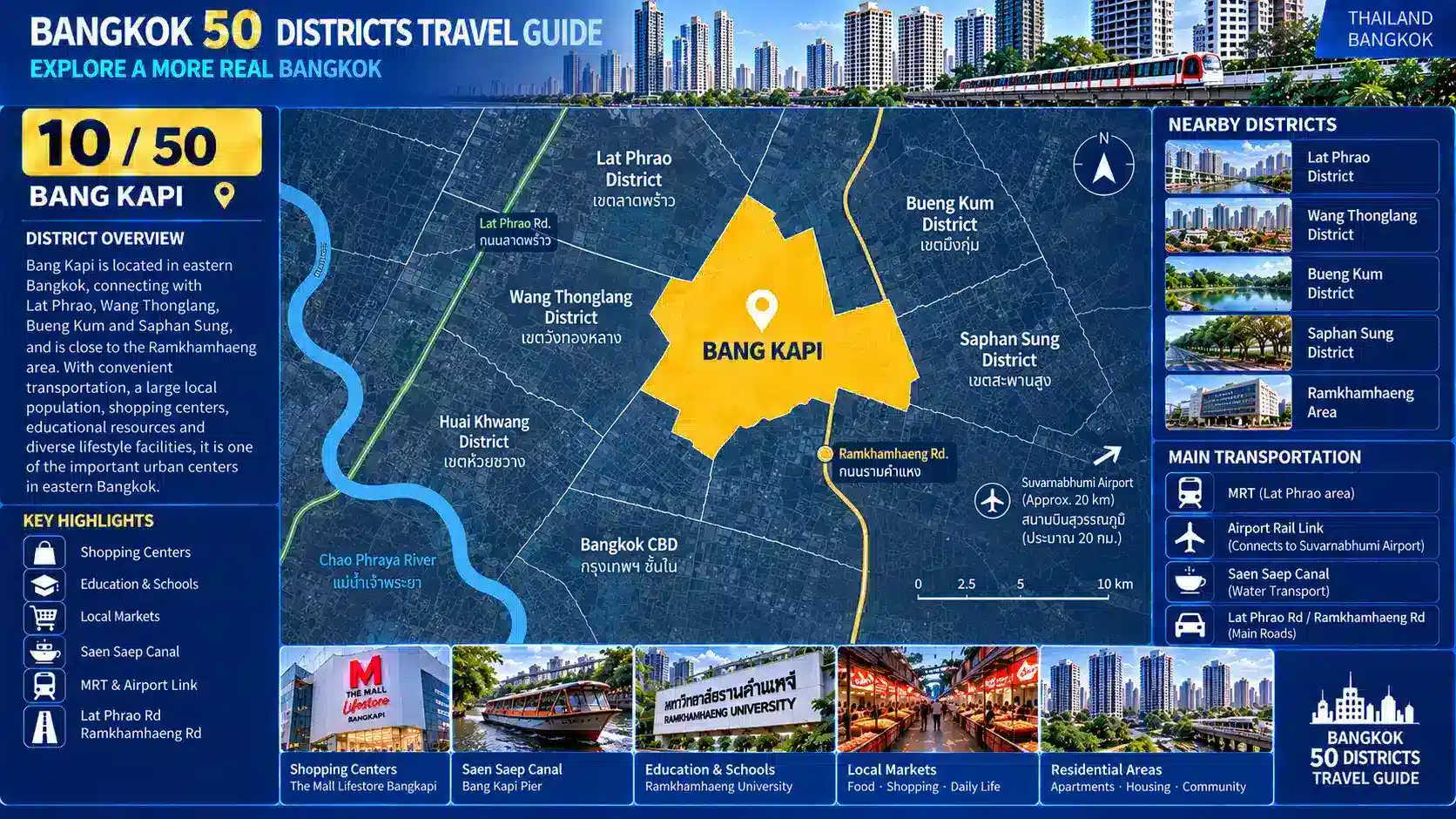
Bang Kapi lies in eastern Bangkok.
If we travel east from Siam through areas such as Ratchathewi, Din Daeng, Huai Khwang and Wang Thonglang, the enormous scale of Bangkok’s eastern residential districts gradually becomes clear.
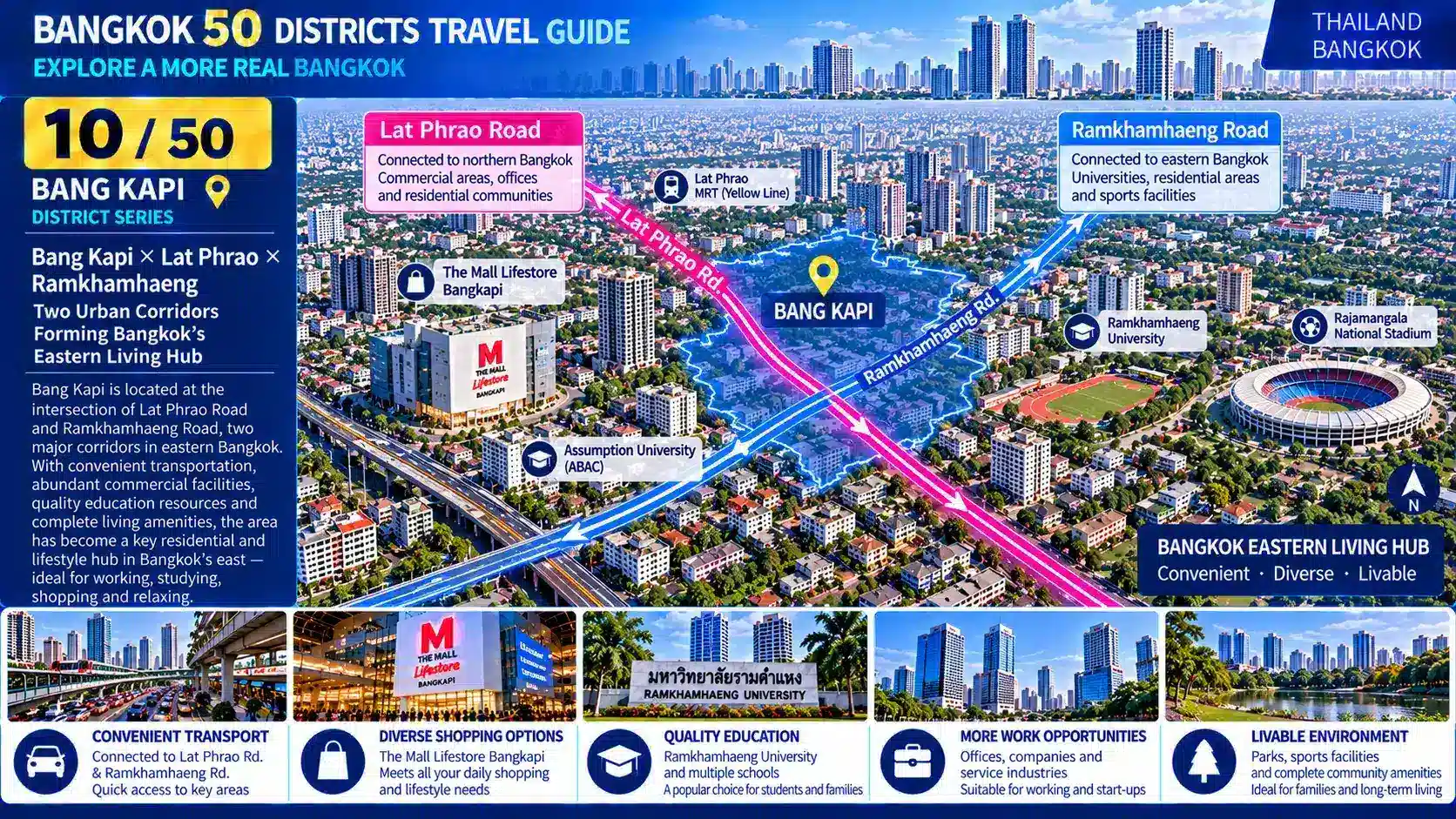
Bang Kapi is closely connected with major urban corridors such as Lat Phrao and Ramkhamhaeng.
Unlike Bangkok’s Old Town, the district did not develop its modern importance around royal palaces, ancient temples or historic tourist streets.
Its urban growth follows a different logic:
Residential Population + Commerce + Education + Transportation + Everyday Services
A large population lives in this part of Bangkok.
People need places to shop, study, work, eat, relax and travel.
Over time, those needs have helped create a complete urban center.
For travelers, this means you do not need to search for one famous building that “represents” Bang Kapi.
The district itself is the story.
02|The Mall Lifestore Bangkapi: Why Does Eastern Bangkok Need Such a Large Shopping Center?
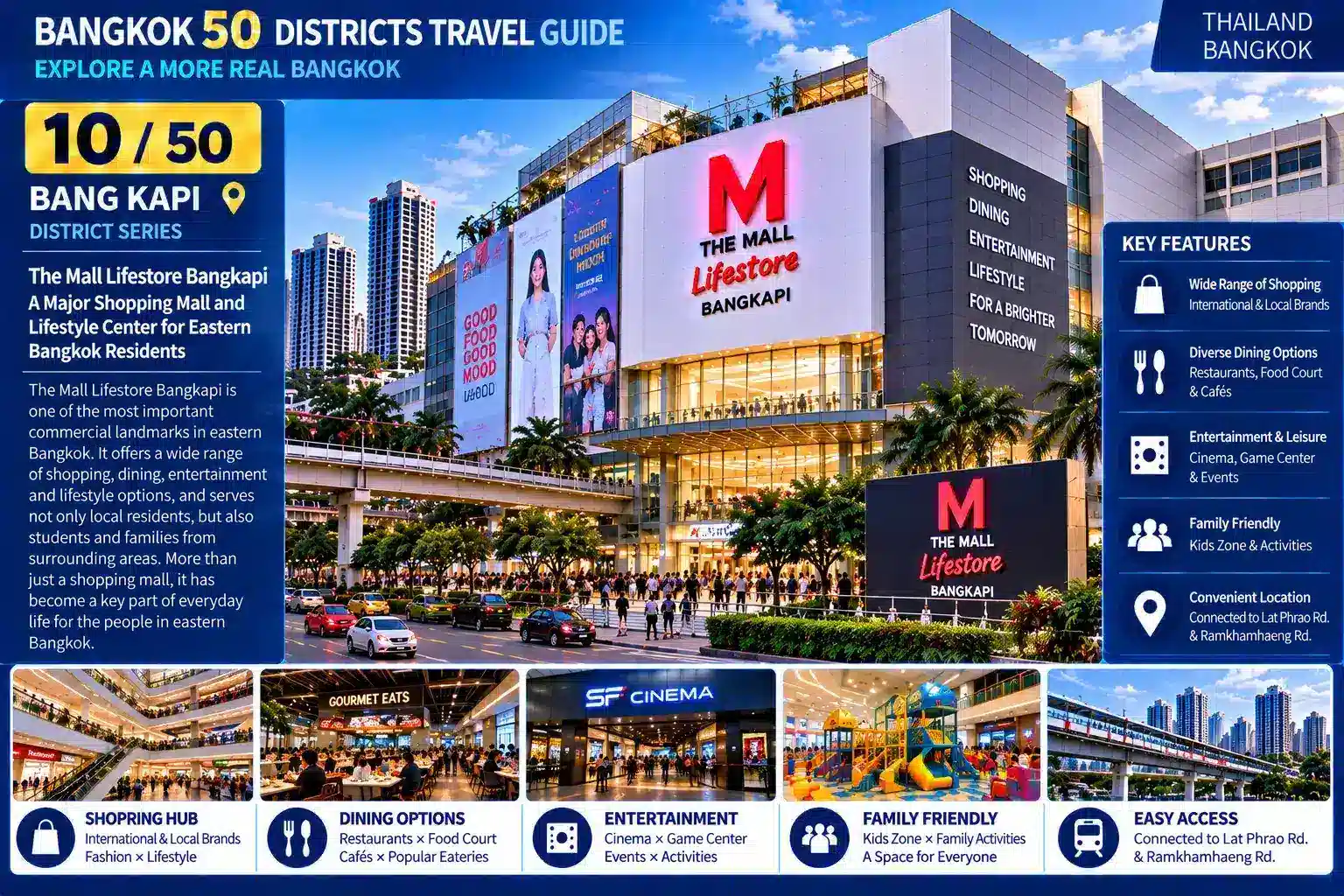
It is difficult to talk about modern Bang Kapi without mentioning The Mall Lifestore Bangkapi.
This large shopping complex is one of the district’s most recognizable commercial landmarks.
But its importance is not simply about shopping.
Earlier in our journey, Pathum Wan showed us the world of Siam—an international commercial center filled with tourists, office workers, major brands and premium retail.
Bang Kapi represents another side of Bangkok’s shopping culture.
Its large commercial centers serve an enormous local population.
Residents come here for daily necessities.
Families spend their weekends eating and shopping together.
Students meet friends.
People watch movies, drink coffee, shop for clothes or simply escape Bangkok’s heat for a few hours.
In a tropical megacity like Bangkok, the modern shopping mall has become much more than a place to buy things.
It can function as an all-weather urban living room.
And in Bang Kapi, that role is especially visible.
03|Bang Kapi × Happy Land: The Commercial Memory Behind the Modern District
Bang Kapi did not suddenly become commercial when modern shopping malls arrived.
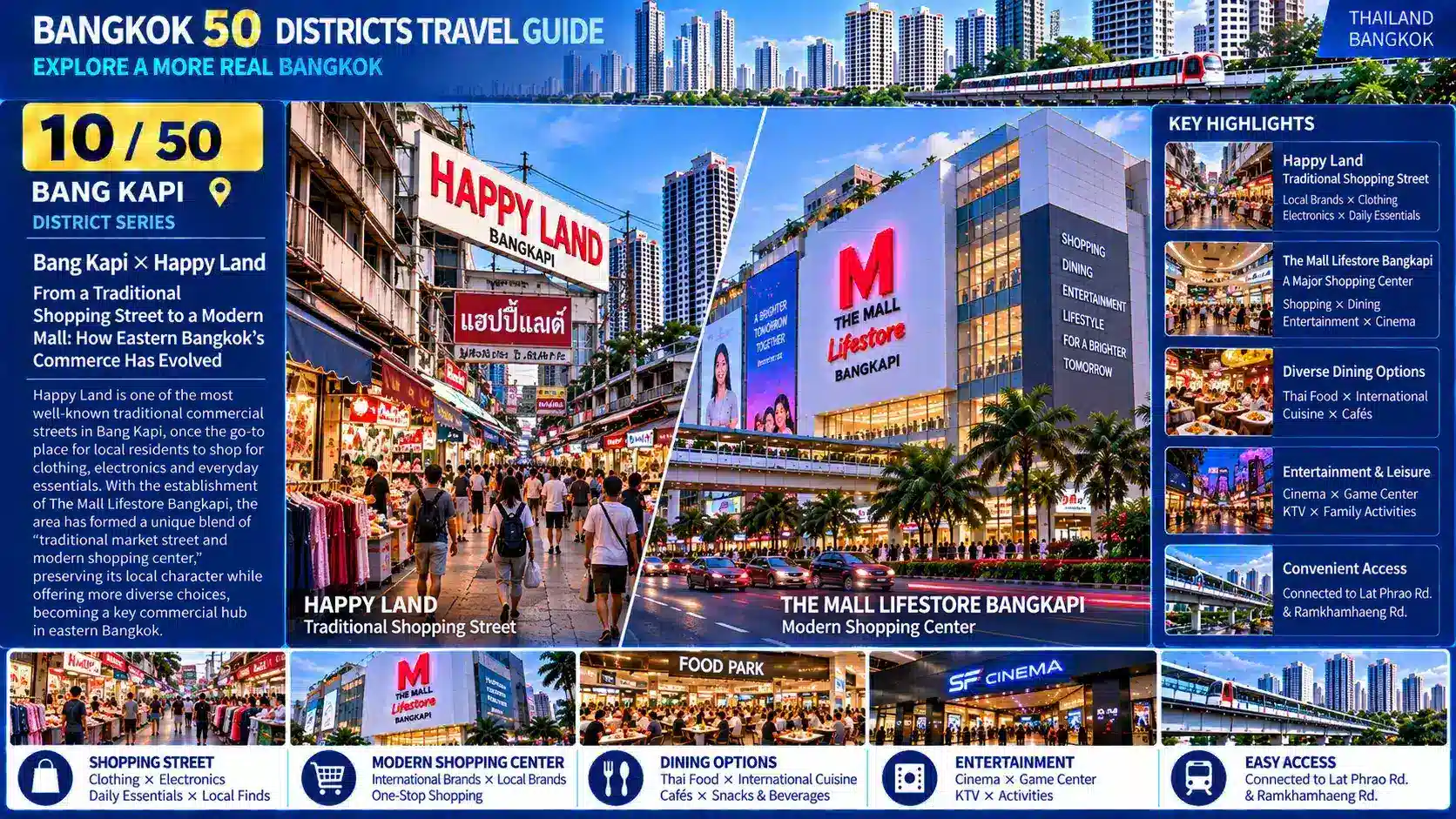
The area already had its own long-established local shopping culture.
Happy Land is one of the names associated with that older commercial identity.
Around this part of Bang Kapi, the contrast between old and new Bangkok becomes especially interesting.
Inside a modern mall, you find air-conditioning, chain restaurants, cinemas and international brands.
Walk into the surrounding streets and the atmosphere changes.
Small shops, local restaurants, markets and older commercial spaces continue to serve nearby communities.
These two systems are not necessarily competitors.
They often serve the same residents in different ways.
A person may buy groceries from a neighborhood market, eat at a street-side restaurant and later spend the evening inside a modern shopping mall.
That is one of Bang Kapi’s most interesting characteristics:
Old Bangkok and new Bangkok do not always replace one another. Sometimes they simply learn to exist side by side.
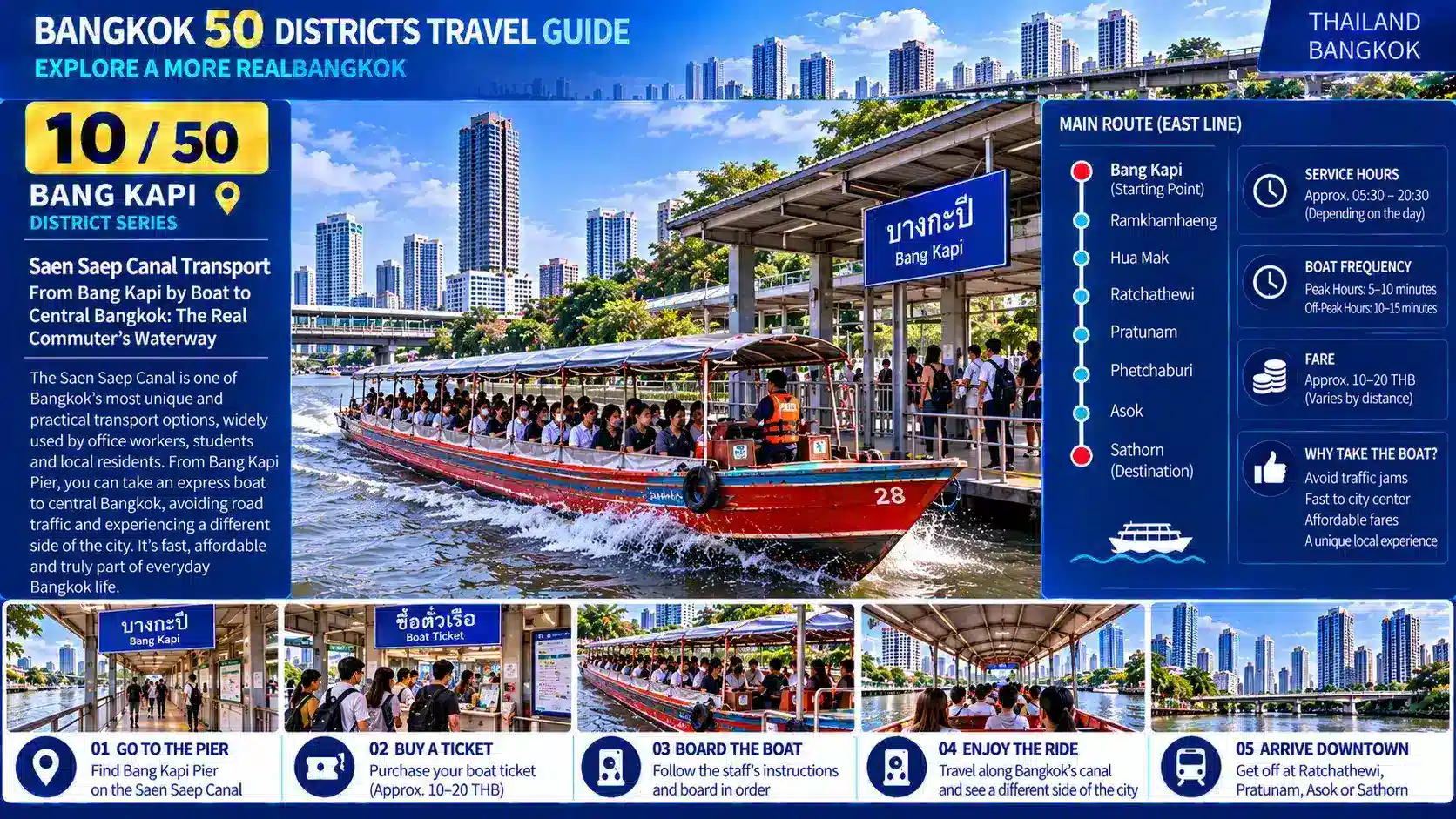
04|Saen Saep Canal: Bangkok Transportation Is More Than BTS and MRT
For many visitors, Bangkok transportation begins with the BTS Skytrain and MRT.
Bang Kapi introduces another side of the city:
Khlong Saen Saep — the Saen Saep Canal.
Canal boats have long been part of Bangkok’s practical transportation network.
For many passengers, these boats are not tourist attractions.
They are public transport.
People board at local piers, travel along the canal, get off closer to work or school, and connect with other forms of transportation.
The experience is very different from taking a sightseeing boat along the Chao Phraya River.
Here, the focus is not on famous riverside monuments.
Instead, you see Bangkok from the perspective of commuters.
Buildings, bridges, neighborhoods and roads pass beside the canal as the boat moves through the city.
Bang Kapi therefore adds another layer to our understanding of Bangkok transportation:
Roads, railways and waterways can all be part of the same urban mobility network.
05|Bang Kapi × Lat Phrao × Ramkhamhaeng: Two Urban Corridors Shaping Eastern Bangkok
To understand why Bang Kapi has developed into such an important urban center, we need to look beyond the district itself.
Two names are especially important:
Lat Phrao and Ramkhamhaeng.
These wider urban corridors connect extensive residential communities, schools, universities, restaurants, shopping areas and other parts of eastern Bangkok.
Every day, large numbers of people move through this network.
Someone is traveling to school.
Someone is heading to work.
Someone is going shopping.
Someone is transferring to another part of Bangkok.
All of this movement creates demand.
More residents create more businesses.
More businesses create more jobs.
More schools attract more students.
More transportation encourages more residential development.
And the cycle continues.
Bang Kapi is therefore not simply an isolated district far from downtown.
It is a major node inside the enormous urban network of eastern Bangkok.
06|Schools, Students and the Young Side of Bang Kapi
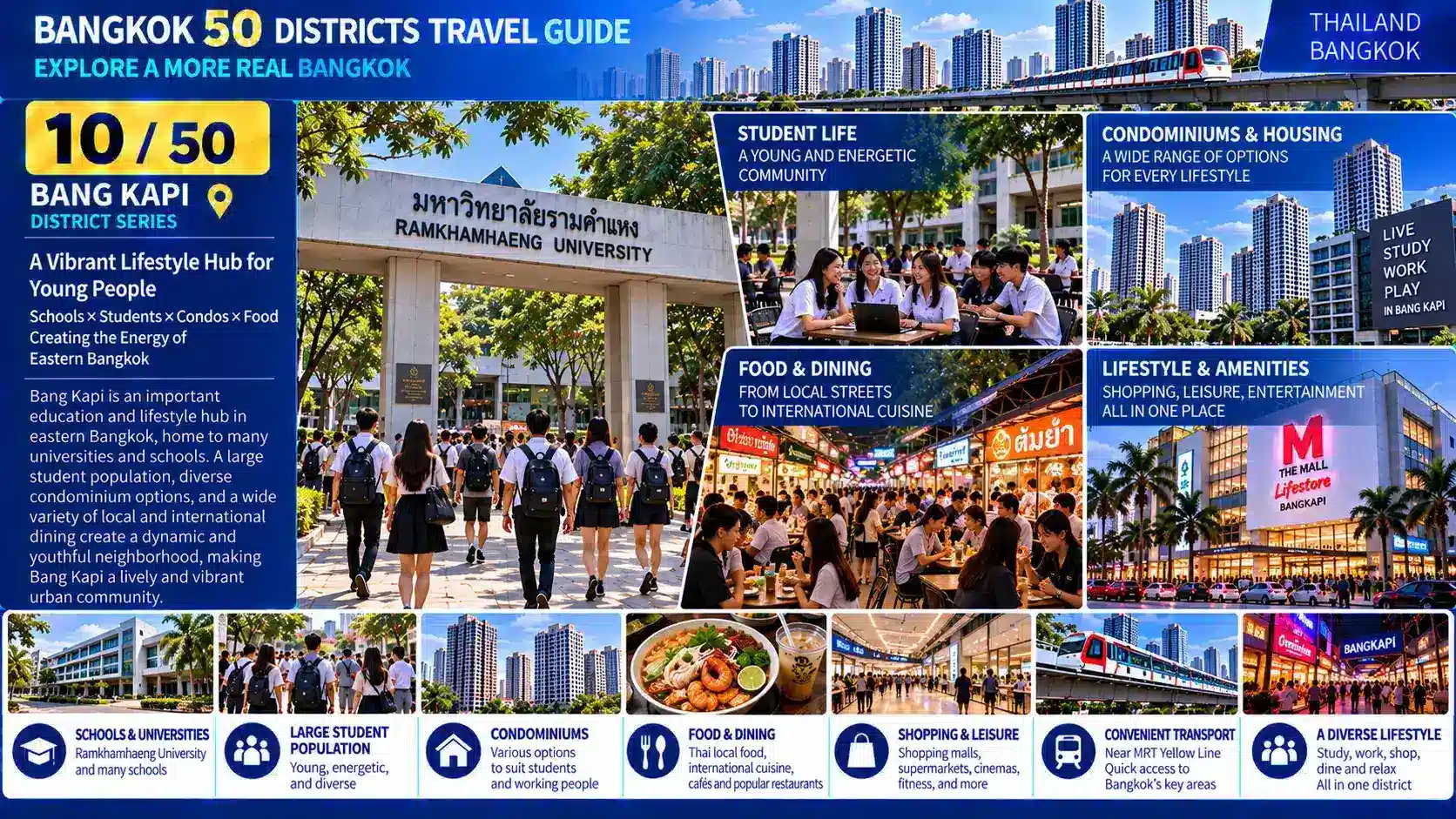
Another important part of Bang Kapi and the surrounding eastern Bangkok area is its youthful population.
Schools, universities and educational institutions across the wider area bring large numbers of students into this part of the city.
And students change the urban environment around them.
They need affordable food.
They need apartments and rental housing.
They need cafés, convenience stores, printing services, phone shops and everyday businesses.
They also need places to shop, exercise, meet friends and relax.
This creates a distinctive rhythm across Bang Kapi and nearby areas.
During the day, people study and work.
In the late afternoon, restaurants and cafés become busier.
In the evening, shopping centers, food streets and neighborhood businesses remain active.
That helps explain why Bang Kapi never feels like a quiet outer suburb.
The local population is large enough to generate its own energy.
This is a city within the city.
07|Eating in Bang Kapi: Follow the Locals and Students
Bang Kapi is not a district where you need to chase only famous restaurants.
A better strategy is simple:
Eat where local people eat.
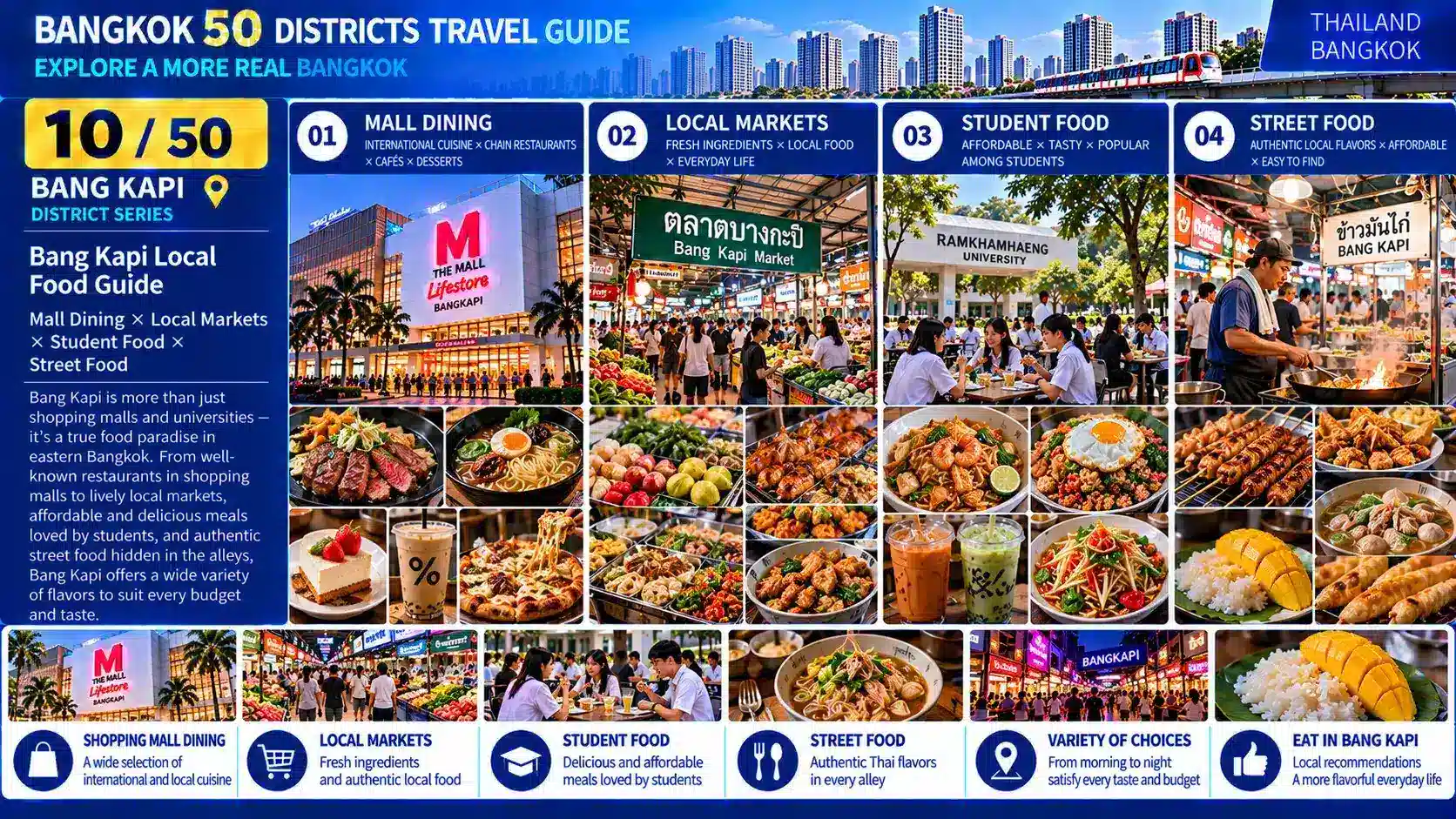
Inside shopping centers, there are restaurants, cafés and food courts.
In community markets, you will find fresh ingredients, prepared dishes and snacks.
Near schools and residential areas, affordable restaurants serve students, workers and local families.
Across the wider neighborhood, you can find familiar everyday Thai dishes such as noodles, pad kra pao, chicken rice, grilled meats, made-to-order dishes, Isan food, desserts and drinks.
At lunchtime, students and office workers want something fast and affordable.
In the evening, families and groups of friends sit down for dinner.
Later at night, smaller restaurants and street-food stalls continue serving the neighborhood.
This food culture does not exist because someone decided to create a “food attraction.”
It exists because:
a huge number of people genuinely need somewhere to eat every day.
And that everyday demand is often what creates the most interesting food neighborhoods in a city.
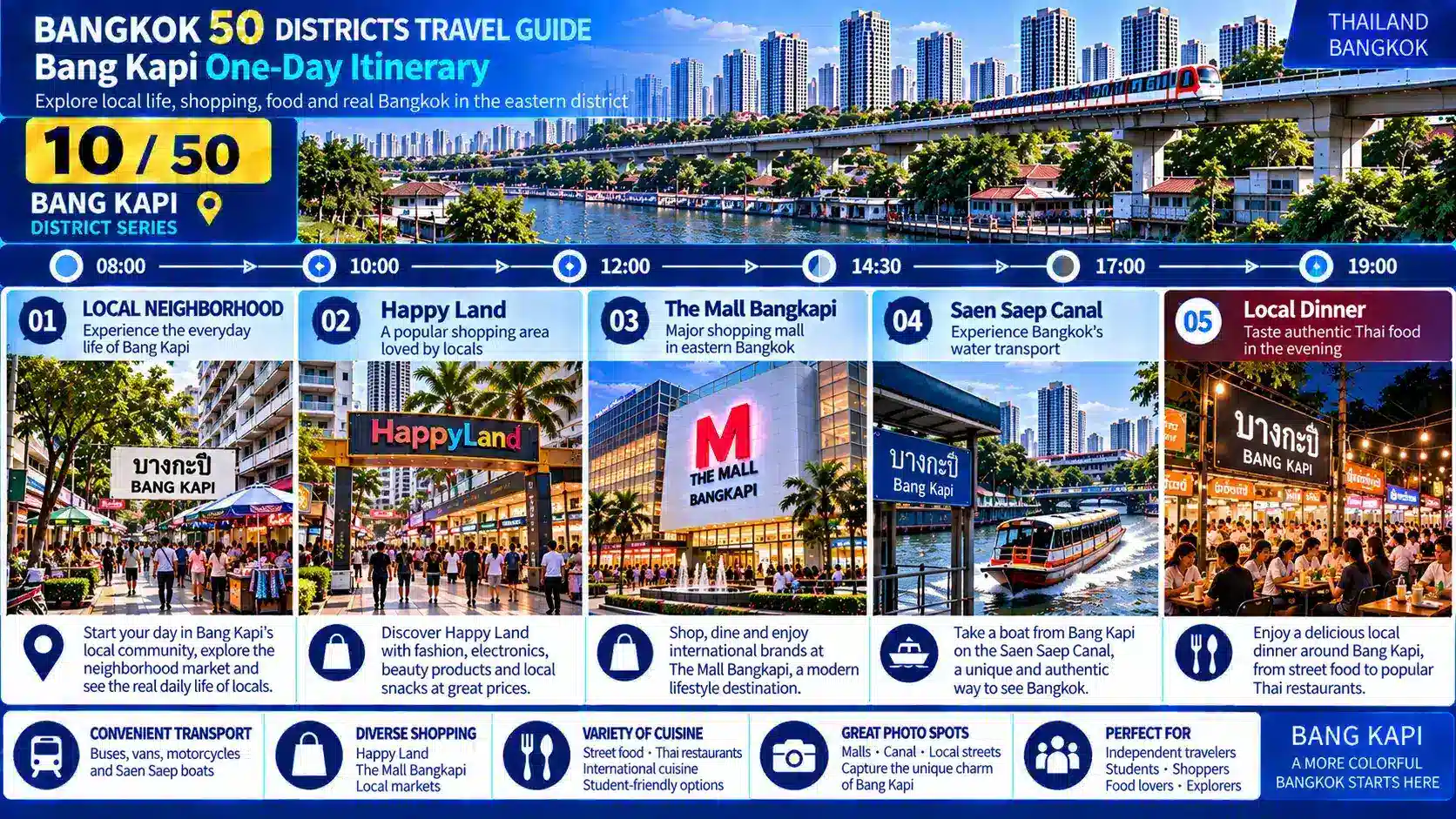
08|How to Spend One Day in Bang Kapi
Bang Kapi is a good district for combining local neighborhoods, shopping and public transportation into a single day.
09:00|Start with Local Bang Kapi
Do not rush straight into a shopping mall.
Begin with the streets.
Watch morning traffic, local businesses, residential communities, commuters and breakfast stalls as eastern Bangkok starts its day.
10:30|Happy Land and Local Commercial Areas
Explore the more local side of Bang Kapi and see how residents shop for clothing, food and everyday necessities.
12:00|Local Lunch
Choose a neighborhood restaurant, market stall or simple Thai restaurant.
The goal is not to find the most famous place.
The goal is to eat at the rhythm of the district.
13:30|The Mall Lifestore Bangkapi
Move into one of the area’s major modern commercial centers.
Shopping, dining, entertainment and social life all come together under one roof.
15:30|Saen Saep Canal
Head toward the canal and observe one of Bangkok’s most distinctive commuter transport systems.
If your route and operating conditions allow, take a canal boat and experience the city from the water.
17:00|Explore the Wider Eastern Bangkok Lifestyle
Observe how major roads, residential communities, schools and commercial areas connect Bang Kapi with the wider Lat Phrao and Ramkhamhaeng urban corridors.
19:00|Local Dinner
Finish the day with Thai food around Bang Kapi.
By this point, the district has shifted from daytime shopping and commuting into its evening rhythm.
This itinerary has no Grand Palace.
No Wat Arun.
And no famous riverside sunset viewpoint.
But it reveals something equally important:
how a metropolis continues to function far beyond its traditional tourist center.
09|How Did Bang Kapi Become a “City Center” of Its Own?
By the tenth stop of our journey, we can begin to rethink what the words “Bangkok city center” really mean.
On a tourist map, the center may be Siam.
On a historical map, it may be Rattanakosin Old Town.
For business and offices, people may think of Silom and Sathorn.
But for someone living around Bang Kapi, there is no need to travel to Siam every day just to live a complete urban life.
There are major shopping centers here.
There are markets.
There are schools and educational institutions.
There are restaurants.
There are residential communities.
There are road networks and public transportation.
There is even canal transport.
When shopping, education, transportation, dining, entertainment and housing can all be found within the same wider urban area, that area begins to function as a center in its own right.
And this is one of the most important ways to understand Bangkok today.
Bangkok is increasingly a network of multiple urban centers rather than a city defined by only one downtown.
Bang Kapi is a perfect example.
So the most important thing to see here is not a single “must-visit attraction.”
It is a much larger urban story:
Why does Bangkok remain so busy and complete even after we leave the traditional city center?
Bang Kapi gives us one answer.
Because for many people who live in eastern Bangkok—
this is already their center.
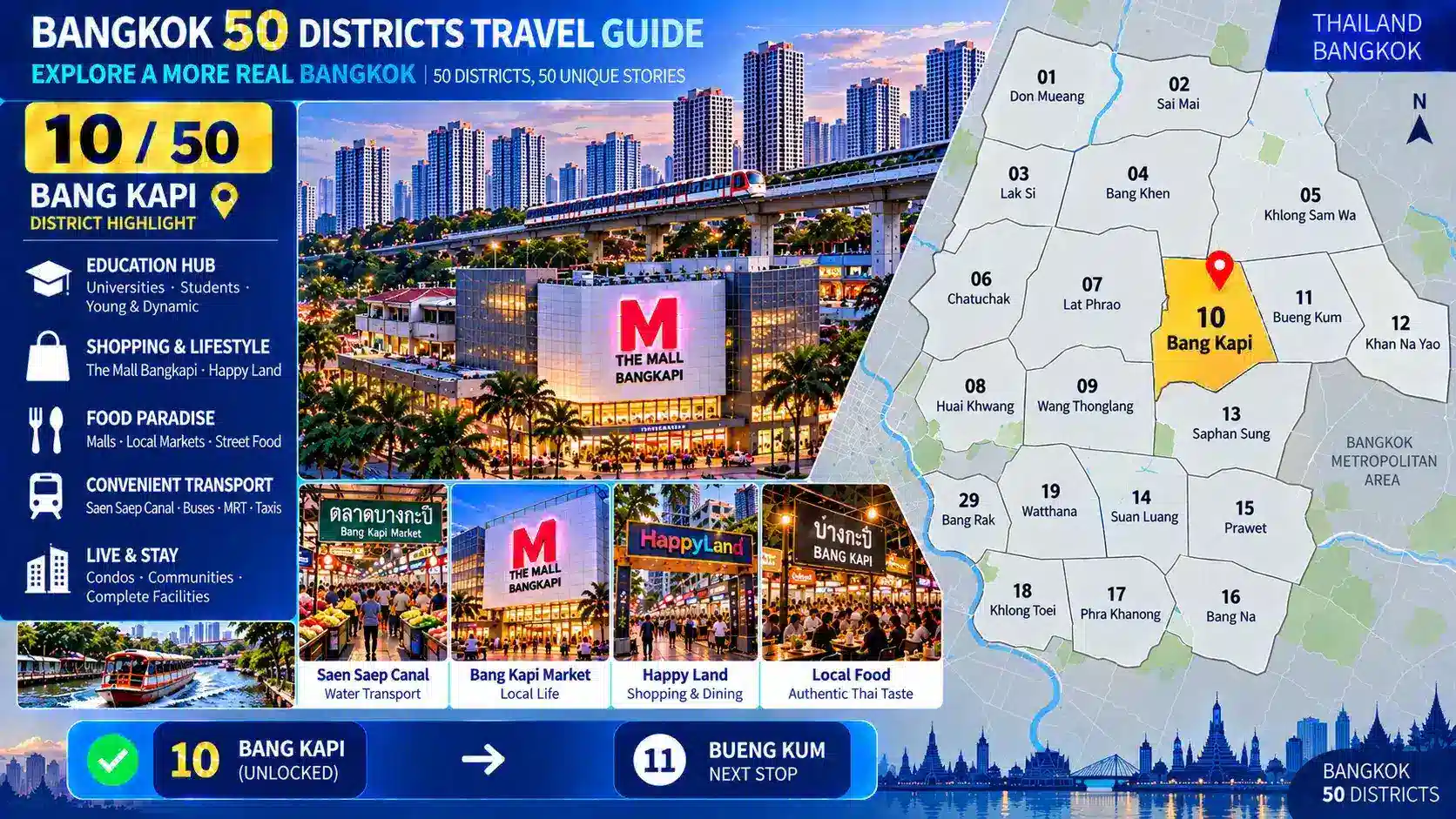
10 / 50 UNLOCKED
BANG KAPI ✓
Keywords:
Shopping Hubs · Happy Land · Saen Saep Canal · Water Transport · Lat Phrao · Ramkhamhaeng · Student Life · Local Food · Eastern Bangkok
40 districts remaining.
NEXT STOP — 11 / 50
BUENG KUM
After Bang Kapi, our journey continues farther into northeastern Bangkok.
The density of major commercial centers begins to decrease, while residential communities, neighborhood markets and everyday urban spaces become more important.
If Bang Kapi asks:
“How can a district far from Bangkok’s traditional center become a city center of its own?”
then Bueng Kum will take us into another side of the capital:
When major commercial landmarks fade into the background, how does a district built around homes and communities create its own rhythm of everyday life?