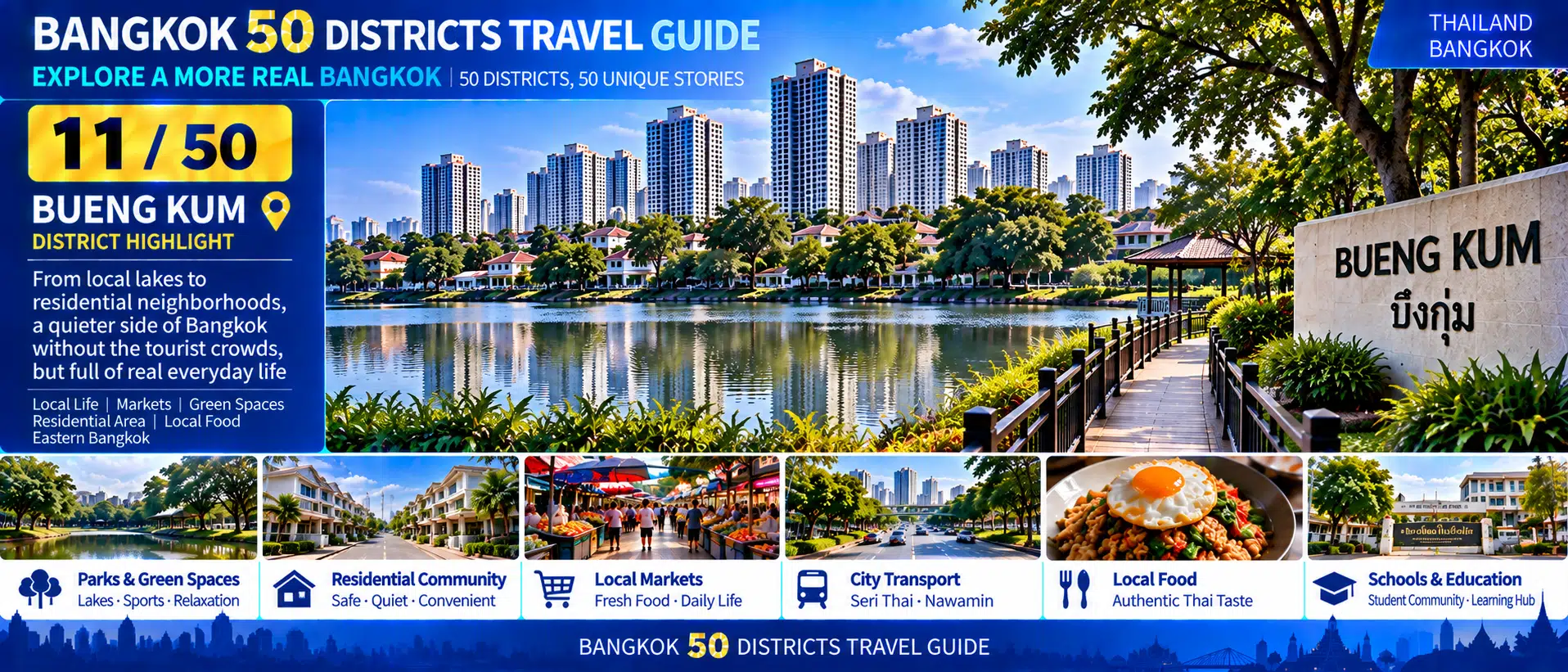
After exploring Bang Kapi in our tenth stop, we saw how a district far from Bangkok’s traditional center can develop into a major urban hub of its own.
Continue northeast into Bueng Kum, and the rhythm of the city changes again.
Large shopping centers are no longer the main attraction.
Tourist crowds become noticeably smaller.
Residential neighborhoods, local roads, markets, small restaurants, parks and ordinary family life begin to dominate the landscape.
For a first-time visitor, one question may immediately come to mind:
“What is there to see here?”
But by the eleventh stop of our Bangkok 50 Districts journey, it is time to gradually move beyond the traditional idea that travel must always revolve around famous attractions.
What makes Bueng Kum interesting is not one landmark that everyone needs to photograph.
It is another side of Bangkok:
a district designed primarily for living rather than tourism.
01|Where Is Bueng Kum?
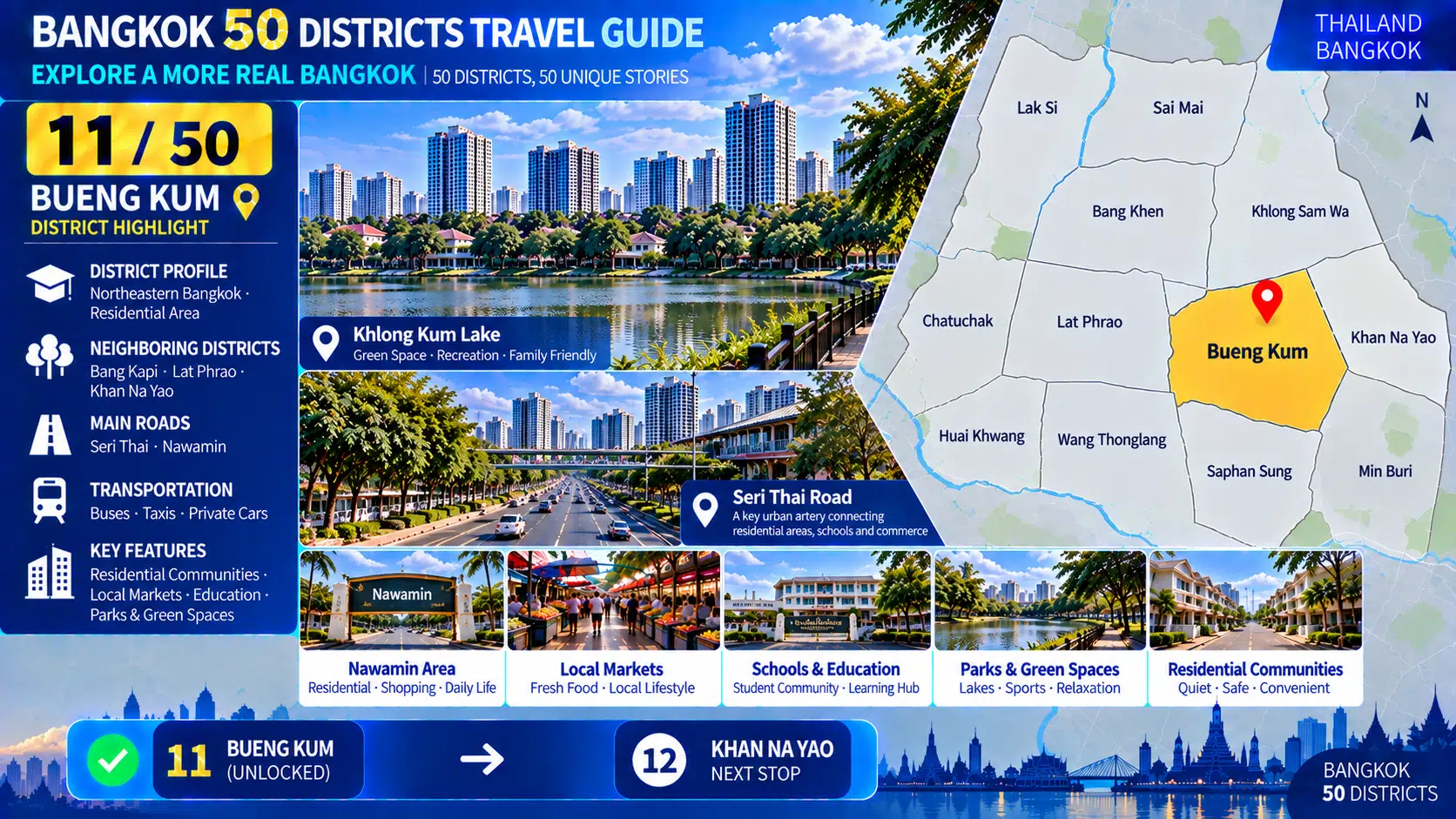
Bueng Kum is located in northeastern Bangkok.
Travel northeast from Bang Kapi, and the highly concentrated commercial landscape gradually gives way to a more residential urban environment.
Bueng Kum forms part of a much larger northeastern Bangkok living network together with surrounding districts such as Bang Kapi, Lat Phrao and Khan Na Yao.
Within Bueng Kum itself, names such as Nawamin, Khlong Kum and Nuan Chan are often more relevant to everyday life than internationally recognized tourist landmarks.
The urban landscape also begins to change.
There are fewer massive commercial centers.
There are more residential communities.
Along the streets, local restaurants, schools, markets, convenience stores and neighborhood services become increasingly visible.
If Bangkok is imagined as an enormous urban network, Bueng Kum is not an empty area somewhere on its outer edge.
It is better understood as an important:
residential and everyday-life hub.
Every morning, residents leave this part of Bangkok for work, school and other parts of the city.
Every evening, many of them return home.
02|The Name “Bueng Kum” Tells a Story About Water
The name Bueng Kum itself gives us a clue about the area.
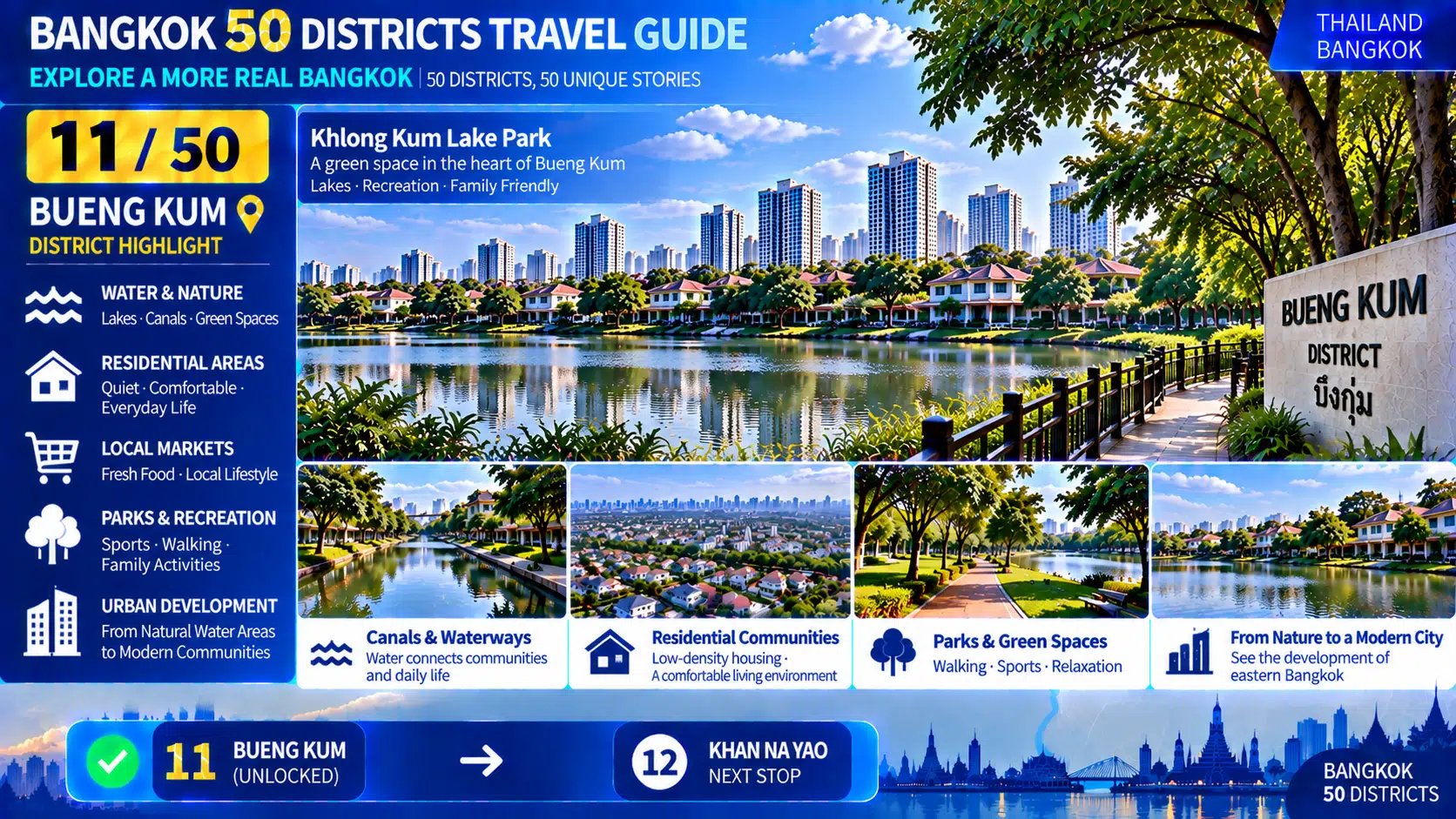
In Thai, “bueng” generally refers to a pond, lake, marsh or similar body of water.
That reminds us that before today’s roads, housing developments and dense urban neighborhoods appeared, this part of Bangkok had a very different natural landscape.
Bangkok has always had a deep relationship with water.
Rivers, canals, wetlands, low-lying land and agricultural areas once shaped much of the wider city.
As Bangkok expanded outward, roads and residential development gradually transformed many of these landscapes.
But water never completely disappeared.
Across Bueng Kum and the surrounding area, lakes, waterways and green community spaces still provide reminders of the older relationship between the city and its natural environment.
So when traveling through Bueng Kum, we are not only looking at today’s residential Bangkok.
We can also ask:
What did this landscape look like before the roads and neighborhoods arrived?
03|Seri Thai: How One Road Supports an Entire Living Area
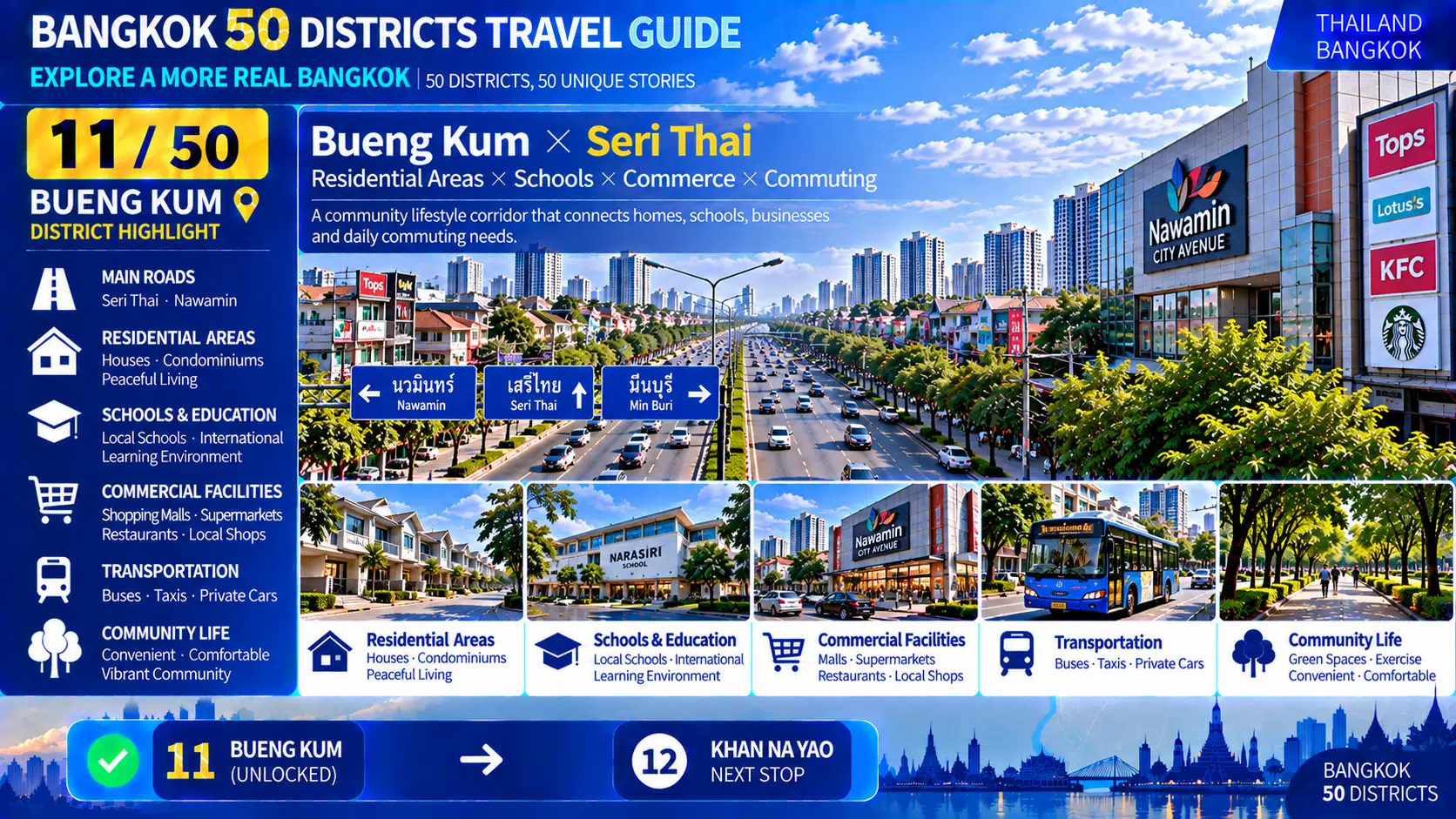
One important road to understand in Bueng Kum and the surrounding area is Seri Thai Road.
Tourists rarely travel across Bangkok specifically to visit a road.
For residents, however, roads are part of everyday life.
Housing spreads outward from them.
Schools, restaurants, shops, petrol stations, convenience stores and other services appear along them.
Buses, cars, motorcycles and taxis carry residents in different directions.
During the morning rush hour, the road supports commuting.
Around midday, it connects neighborhood businesses and daily errands.
In the evening, it helps bring workers and students back toward residential communities.
If Bangkok is viewed only through tourist attractions, roads like this may seem unremarkable.
But if we ask how a metropolis actually functions, they become extremely important.
A city of millions cannot operate through BTS and MRT lines alone.
Countless urban roads like Seri Thai connect Bangkok’s neighborhoods into one enormous living system.
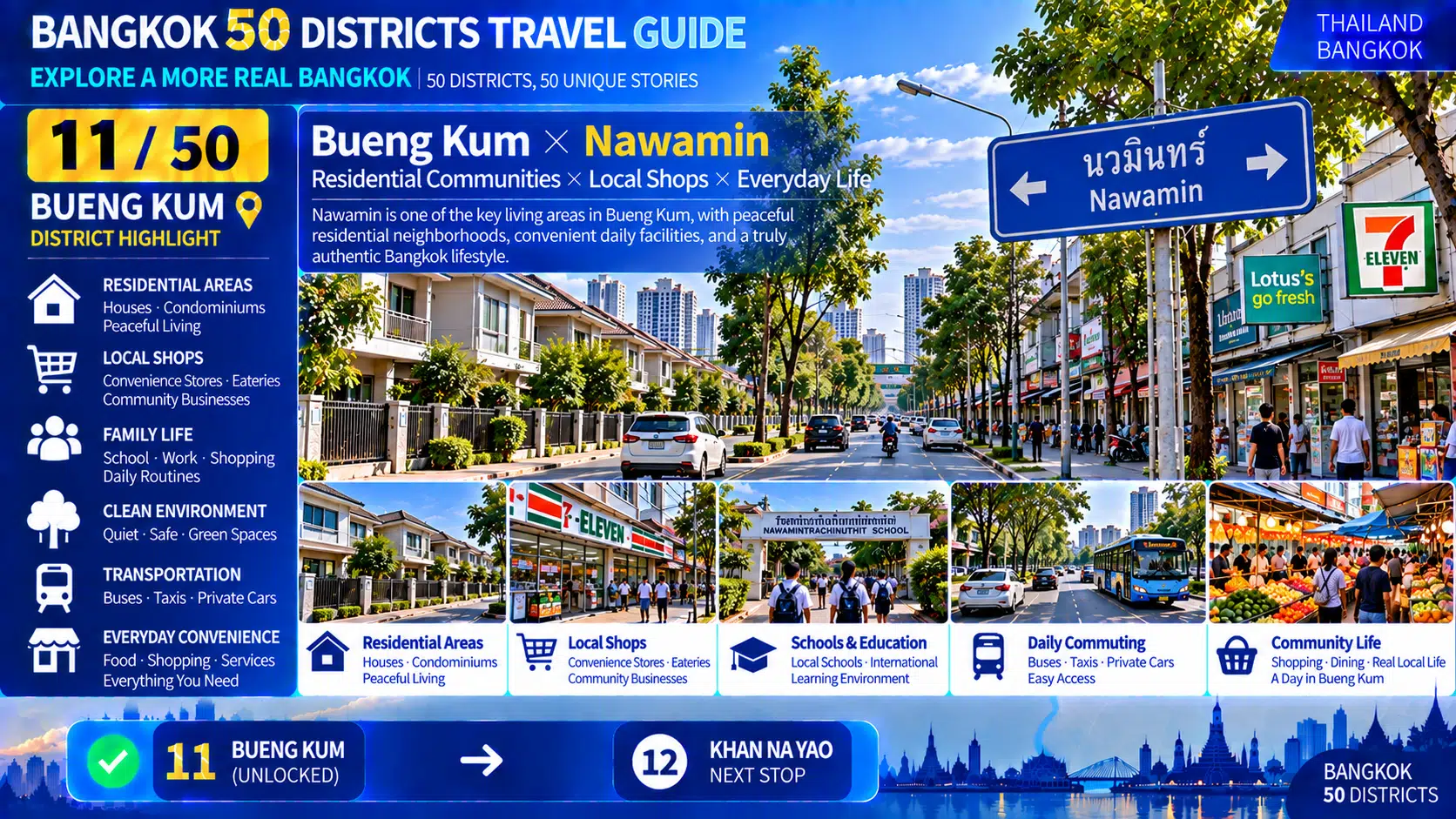
04|Nawamin: The Background of Everyday Bangkok Life
Around Nawamin, the difference between Bueng Kum and Bangkok’s tourist districts becomes even clearer.
Very few people are walking around looking for the perfect photo spot.
Most people are simply doing ordinary things.
Going to work.
Taking children to school.
Buying groceries.
Eating lunch.
Stopping at a convenience store.
Riding a motorcycle home.
Houses, townhomes, condominiums, small businesses and roadside restaurants exist side by side, creating a very typical Bangkok neighborhood landscape.
For someone visiting Thailand for the first time, these scenes may not feel as spectacular as the Grand Palace.
But after spending more time in Bangkok, something becomes obvious:
Places like this make up a huge part of the real city.
Tourist districts may be Bangkok’s cover.
Neighborhoods like Nawamin are much closer to the pages inside.
05|Green Spaces: Why Residential Bangkok Needs Room to Breathe
For many visitors, Bangkok’s first impression is a combination of traffic, heat, high-rises and busy roads.
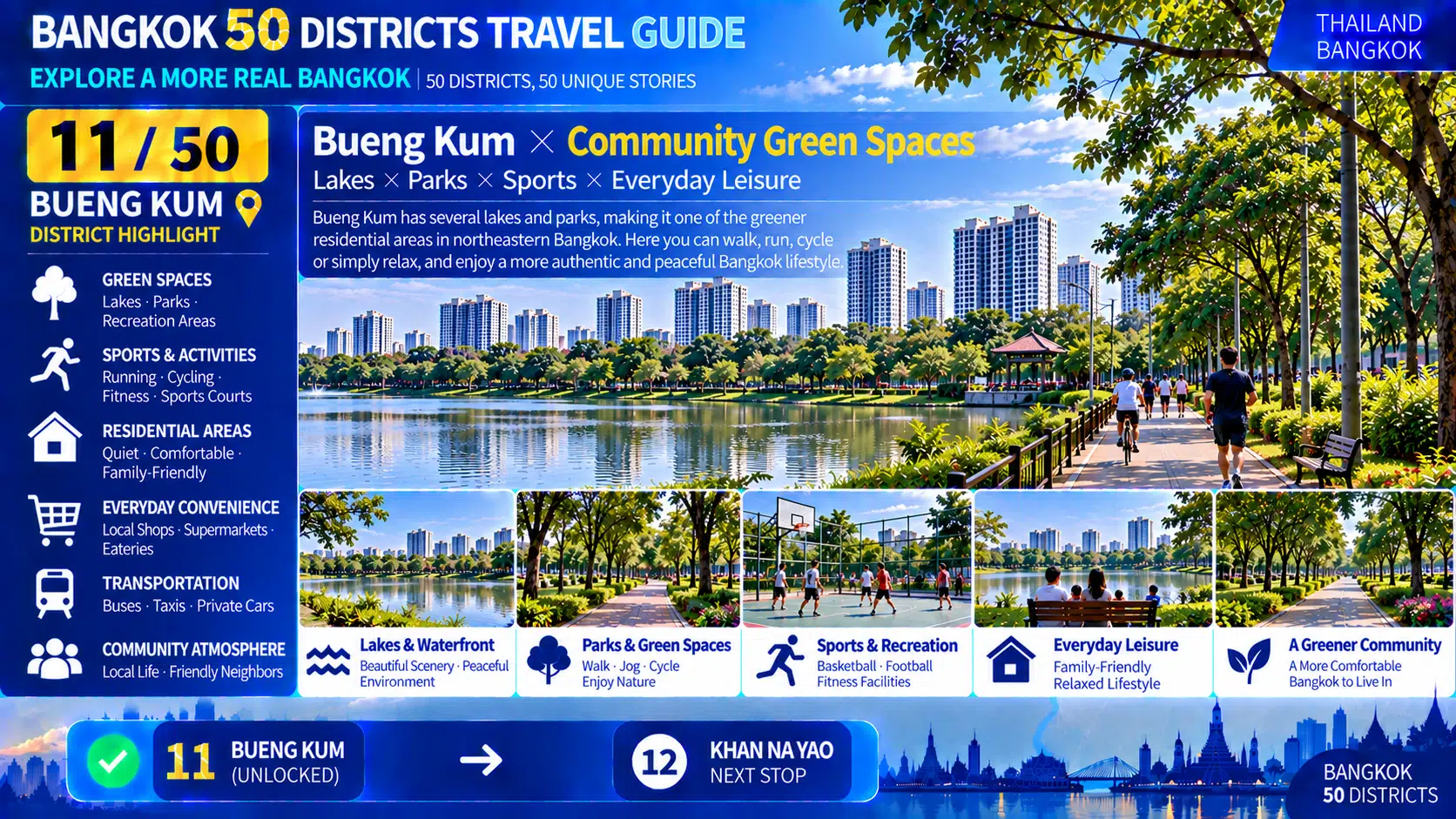
But once you begin exploring its residential districts, green space becomes increasingly important.
Across Bueng Kum and the surrounding living areas, parks, waterside spaces, exercise areas and community greenery provide residents with a different rhythm of life.
In the morning, people walk.
In the evening, people run.
Children spend time outdoors.
Older residents sit and rest.
Young people exercise, talk or meet friends.
These places may never appear on an international visitor’s list of “Bangkok must-see attractions.”
But for people who actually live in a neighborhood, they may matter far more than tourist attractions.
Because when deciding whether an area is comfortable to live in, the question is not only:
“What can I visit here?”
It is also:
“Where can people go after work?”
06|Community Markets: One of the Best Places to Observe Local Life
If I could choose only one type of place to understand everyday Bueng Kum, I would choose a:
community market.
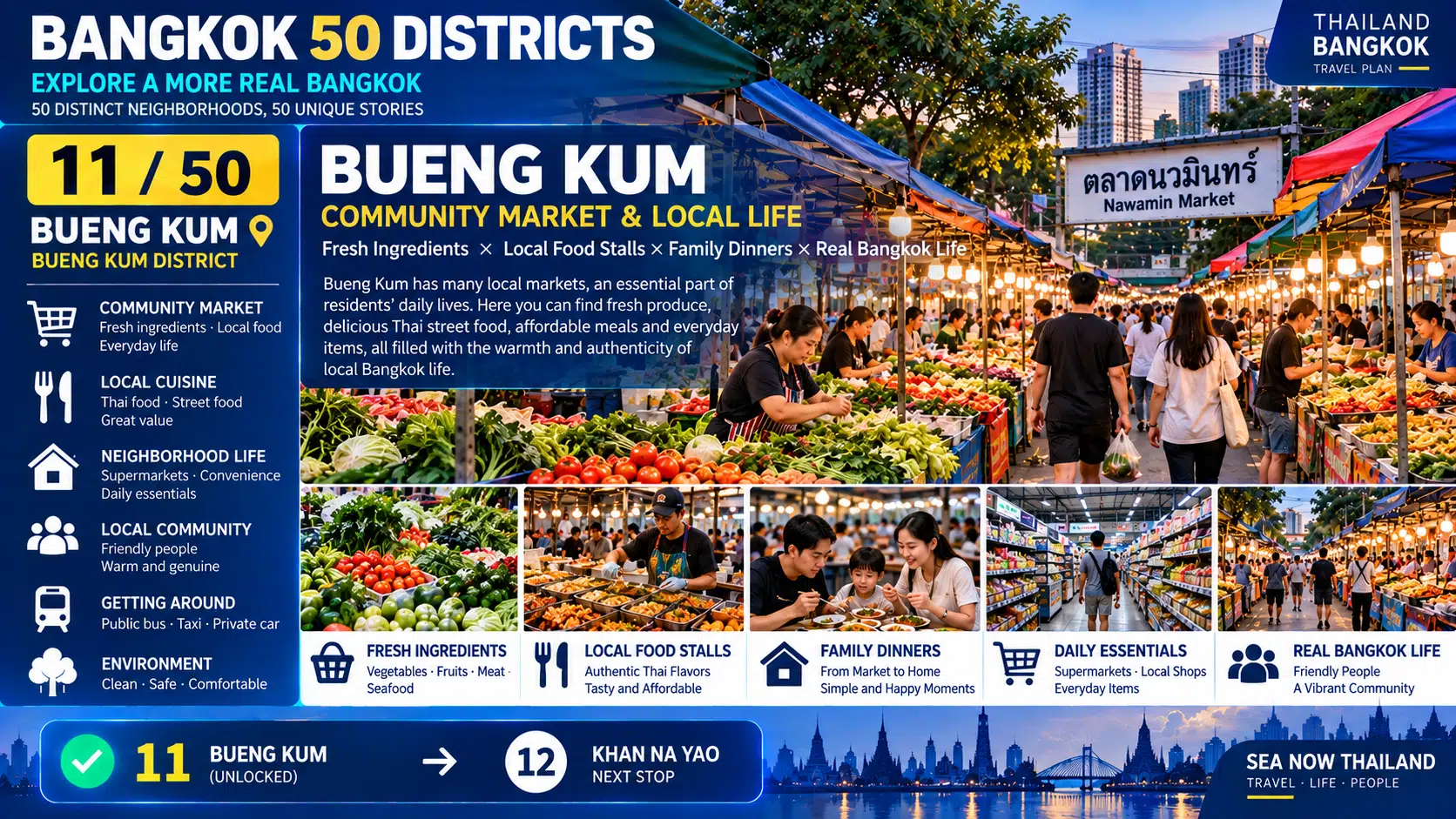
Markets are among the clearest reflections of residential life.
In the morning, people shop for fresh ingredients.
At lunchtime, prepared food offers an easy meal.
In the evening, workers stop by on the way home to buy dinner.
Vegetables, fruit, meat, seafood, curries, grilled chicken, noodles, desserts and drinks reveal what an ordinary household might actually eat throughout the day.
And the business logic here is very different from a tourist night market.
Most vendors are not relying primarily on visitors who may never return.
Their customers are nearby residents who might come back tomorrow, next week and next month.
That means price, taste and convenience need to work for everyday life.
This is exactly why neighborhood markets are so valuable for travelers who want to understand Bangkok.
They do not simply answer:
“What should tourists eat?”
They answer a much more interesting question:
“What do people who live here actually eat every day?”
07|Eating in Bueng Kum: Good Food Does Not Need a Viral Ranking
By District 11, our way of traveling should become a little more relaxed.
We do not need to search for “Top 10 Restaurants” every time we enter a new neighborhood.
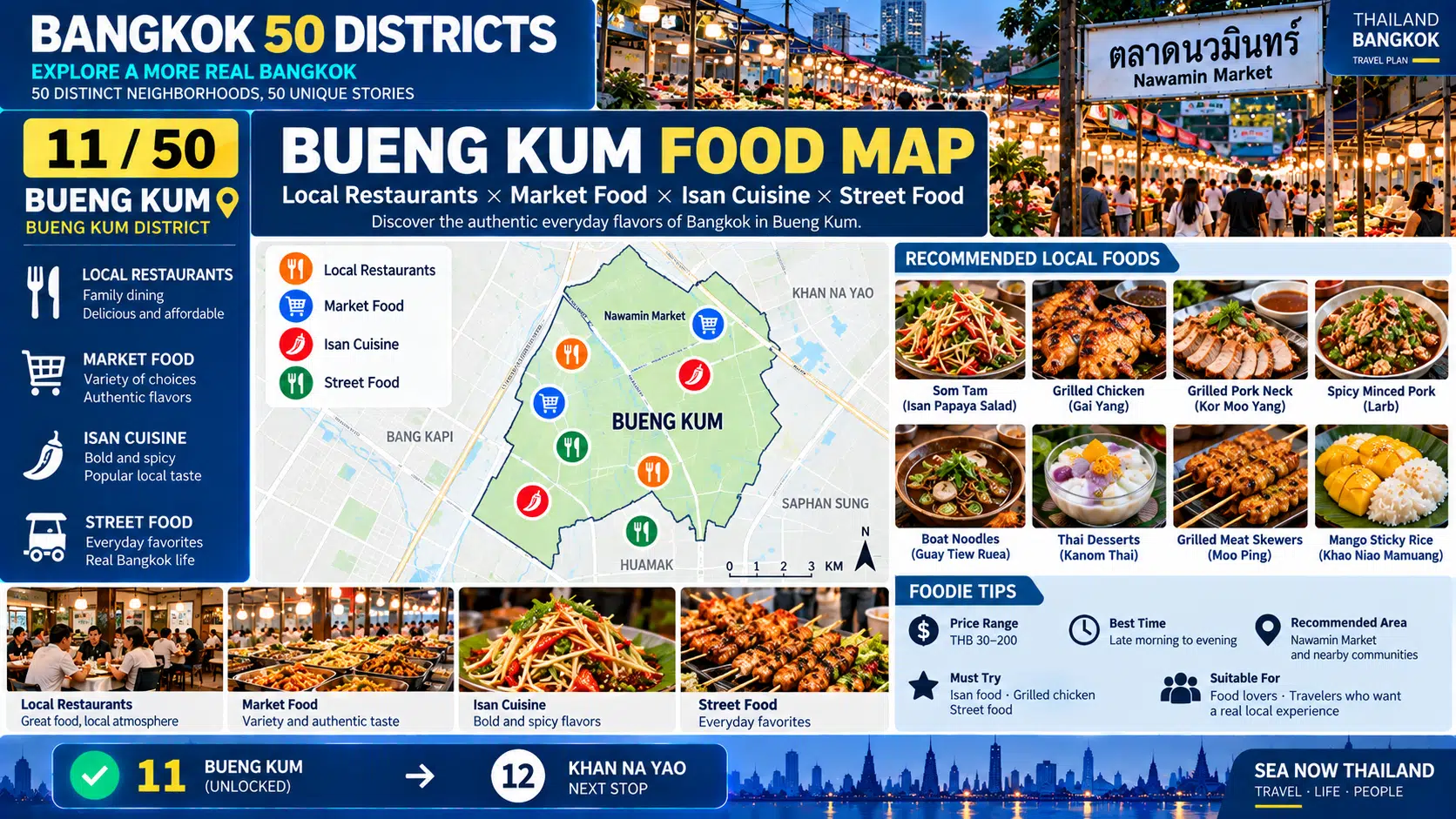
In Bueng Kum, it can be more interesting simply to notice where local residents are eating.
A small Thai made-to-order restaurant.
A prepared-food stall inside a neighborhood market.
A noodle shop beside a residential street.
An Isan restaurant filled with nearby residents in the evening.
These places may not have beautifully designed English menus.
They may not have interiors created for social media.
But together they form the district’s real food culture.
Typical choices can include pad kra pao, noodles, chicken rice, grilled chicken, grilled pork neck, som tam, Isan dishes, curries, desserts and everyday Thai drinks.
The key words for eating in Bueng Kum are not necessarily “must visit.”
They are:
affordable, convenient, varied and good enough to return to again tomorrow.
And that may be one of the most authentic flavors of Bangkok.
08|How to Spend One Day in Bueng Kum
Bueng Kum does not need a tightly packed itinerary.
In fact, slowing down is part of the experience.
After all, the purpose of this stop is to experience an ordinary day in a residential part of Bangkok.
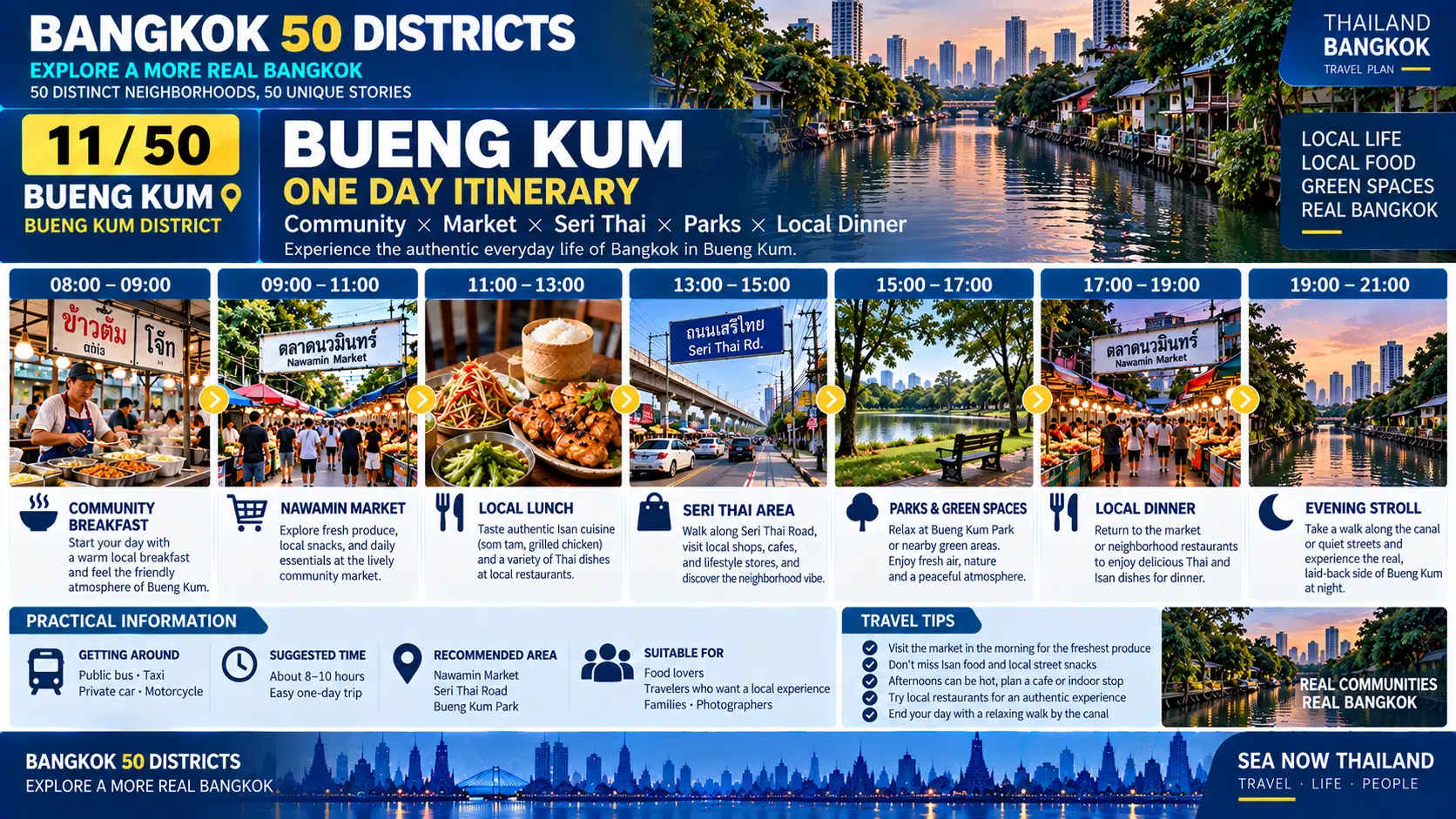
08:00–09:00|Community Breakfast
Start with a simple local breakfast.
Find a neighborhood restaurant, rice-and-curry shop, noodle stall or another place where residents are beginning their day.
Do not search for the most photogenic restaurant.
Watch how the neighborhood wakes up.
09:00–11:00|Community Market
Explore a local market around the wider Nawamin area.
Look at fresh vegetables, fruit, meat, prepared dishes and everyday household items.
This is one of the easiest places to understand the rhythm of local life.
11:00–13:00|Local Lunch
Choose a simple Thai or Isan restaurant.
Som tam, grilled chicken, grilled pork, noodles and made-to-order dishes are all good ways to experience everyday local food.
13:00–15:00|Seri Thai
Spend some time around the Seri Thai corridor.
Instead of searching for a major attraction, observe how housing, schools, shops, cafés, roads and transportation fit together.
15:00–17:00|Parks and Green Spaces
Bangkok afternoons can be hot, so this is a good time to slow down.
Find a park, lakeside area or neighborhood green space.
Walk, sit down, exercise or simply watch how residents use public space.
17:00–19:00|Local Dinner
As the temperature begins to drop, community markets and restaurants become lively again.
Return to a neighborhood market or local restaurant for dinner.
This is one of the best times to see the residential district at its busiest.
19:00–21:00|An Evening Walk
Finish the day with a relaxed walk through the neighborhood, along a quieter street or near a canal-side community.
There may be no famous skyline viewpoint waiting at the end.
That is exactly the point.
By now, you are experiencing Bangkok at the pace of the people who actually live here.
09|Why Visit Bueng Kum If It Has No Famous Tourist Attraction?
This is the most important question in District 11.
If we were creating a simple “Top 10 Bangkok Attractions” guide, Bueng Kum might never appear.
But this is the:
Bangkok 50 Districts Travel Plan.
Our goal is not only to see the parts of Bangkok designed for visitors.
The Grand Palace helps us understand Bangkok’s history.
Siam shows us its modern commercial power.
Yaowarat reveals migration, food and street culture.
Bang Kapi shows how an outer district can develop into an urban center of its own.
Bueng Kum tells us something equally important:
One of the most fundamental purposes of a city is simply to give ordinary people a place to live.
In the morning, someone takes a child to school.
At noon, someone eats lunch at a roadside restaurant.
In the afternoon, someone buys groceries.
In the evening, someone runs in a park.
At night, families sit down for dinner.
The next morning, it begins again.
There is no spectacular tourism scene.
No famous photo spot requiring a queue.
There may not even be one landmark capable of representing the entire district.
But these ordinary routines, repeated thousands of times every day, are what create the real Bangkok.
And after reaching Bueng Kum, our way of traveling begins to change.
Instead of constantly asking:
“What is there to see here?”
we begin asking:
“What would it feel like to live here?”
Once you start asking that question, Bangkok stops being only a travel destination.
It becomes a real city.
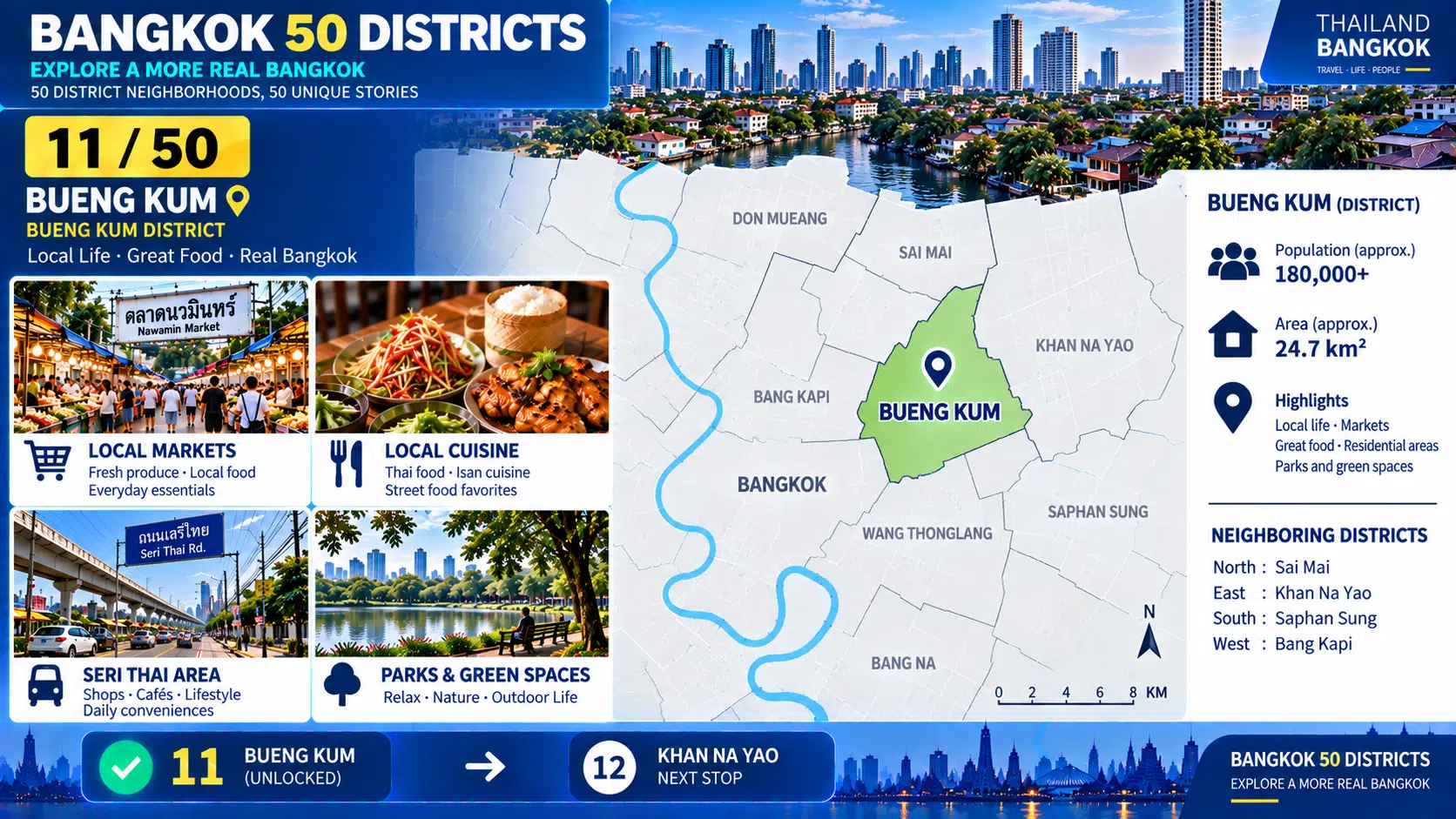
11 / 50 UNLOCKED
BUENG KUM ✓
Keywords:
Local Life · Seri Thai · Nawamin · Khlong Kum · Community Markets · Green Spaces · Residential Neighborhoods · Local Food · Northeastern Bangkok
39 districts remaining.
NEXT STOP|12 / 50
KHAN NA YAO
From Bueng Kum, our journey continues farther east.
Residential communities continue to spread outward, but the urban landscape begins to change again as major roads, newer housing developments, shopping destinations and leisure spaces become increasingly important.
If Bueng Kum asks:
“Why is a residential district without famous tourist attractions still worth exploring?”
then Khan Na Yao takes us to the next question:
As Bangkok continues expanding outward, how are entirely new residential, commercial and lifestyle centers being created on the edges of the metropolis?