After exploring Bueng Kum in our 11th stop, we discovered a side of Bangkok that rarely appears in traditional travel guides.
There were no crowds moving from one famous attraction to another.
Instead, neighborhood markets, parks, residential streets and ordinary family life became the main story.
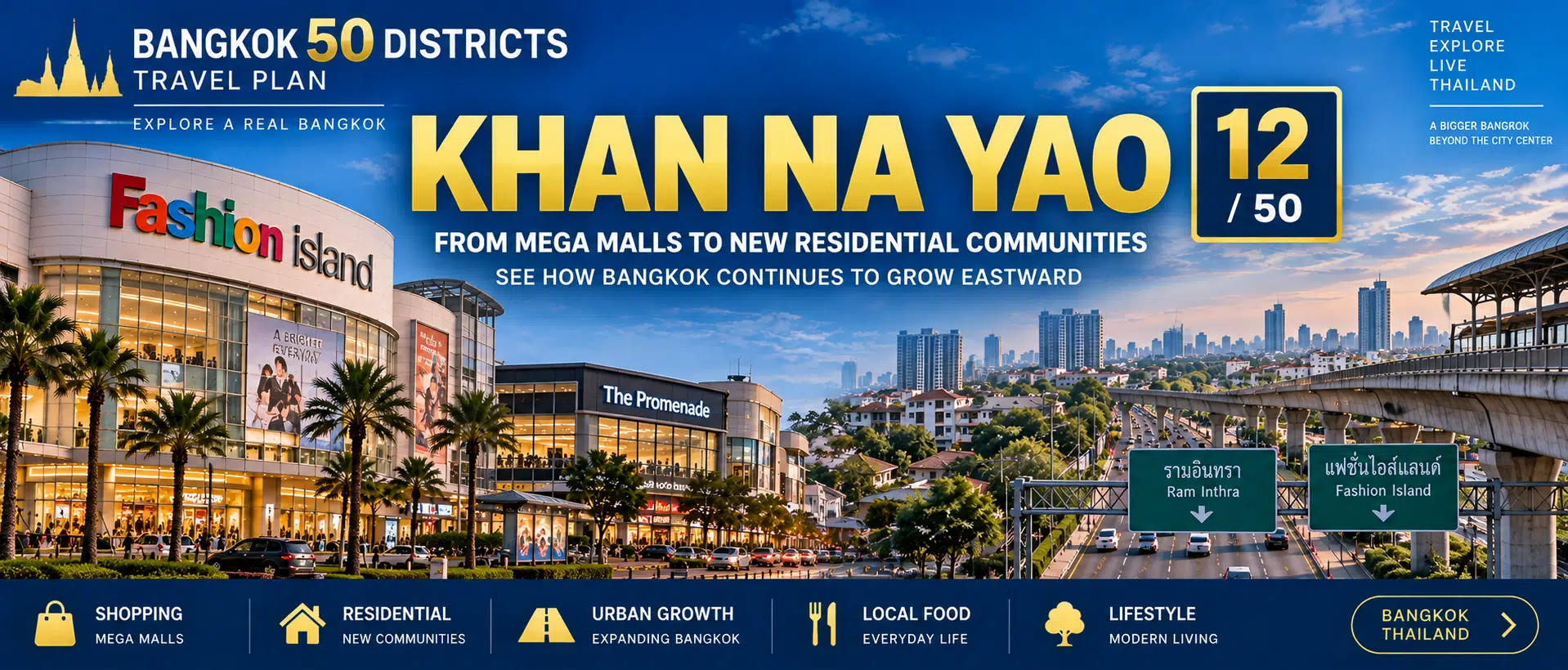
Continue east into our 12th district, Khan Na Yao, and Bangkok begins to change again.
The roads become wider.
New residential developments become more visible.
Large-scale commercial facilities return to the landscape.
And major destinations such as Fashion Island show how a district far from Bangkok’s traditional center can develop a complete urban lifestyle of its own.
If Bueng Kum represented the everyday rhythm of a mature residential community, Khan Na Yao gives us a different question to explore:
As Bangkok continues to expand outward, how are entirely new urban centers created?
Khan Na Yao is far from Siam.
It is even farther from the Grand Palace.
But for many people living in eastern and northeastern Bangkok, going into the traditional city center is no longer necessary for every part of daily life.
More and more of the city is coming to them.
01|Where Is Khan Na Yao?
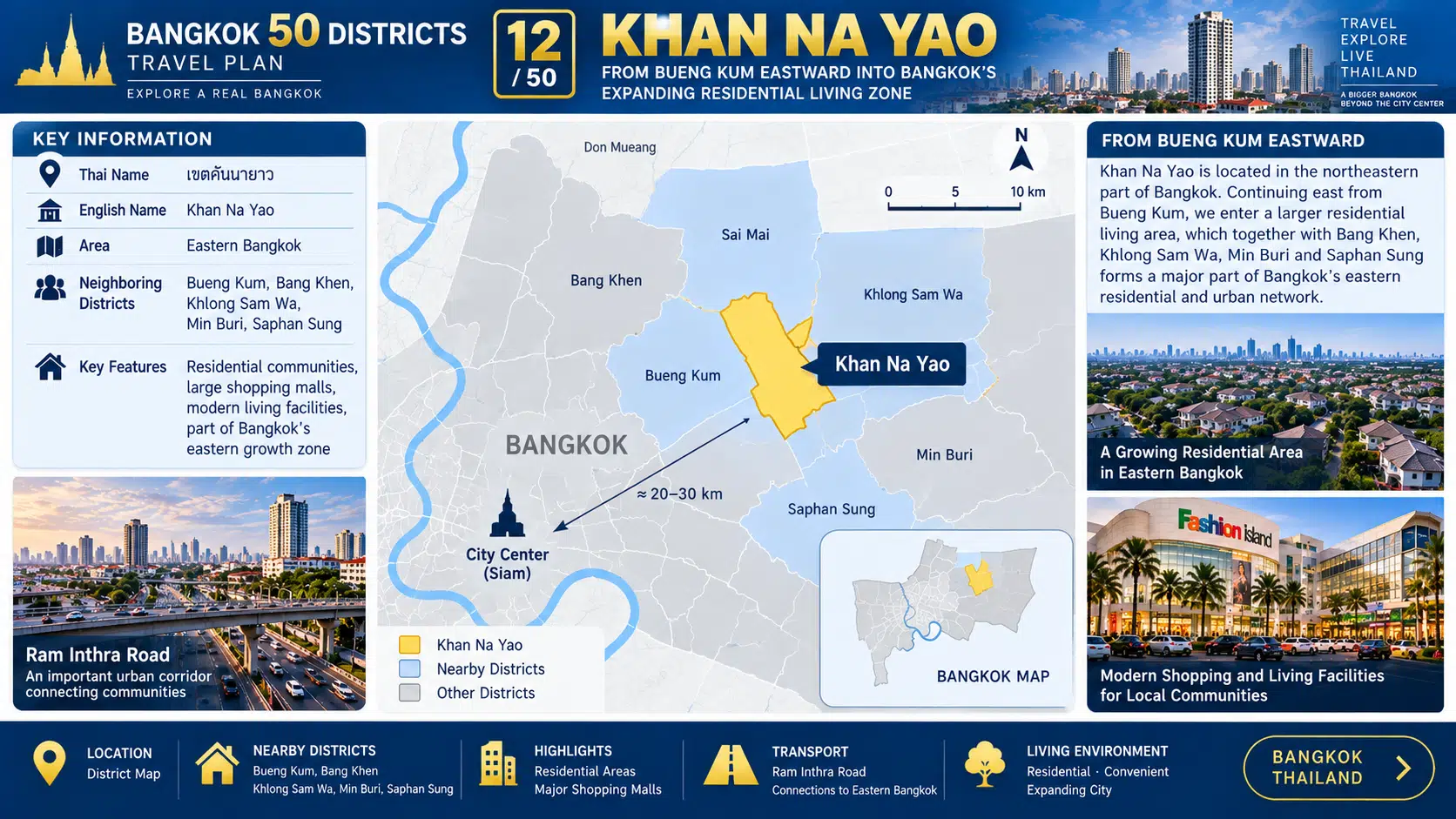
Khan Na Yao lies in the eastern to northeastern part of Bangkok.
Continuing east from our previous stop, Bueng Kum, we gradually enter a landscape that feels increasingly characteristic of Bangkok’s outer residential zones.
Together with surrounding districts such as Bueng Kum, Bang Khen, Khlong Sam Wa, Min Buri and Saphan Sung, Khan Na Yao forms part of a much larger residential and urban network in eastern Bangkok.
For a visitor staying around Siam, this may seem far away.
But “far from Siam” does not mean “far from the city.”
That distinction is important.
As Bangkok has expanded outward over the decades, housing, schools, hospitals, restaurants, shopping centers and everyday services have expanded with it.
A new urban pattern has emerged:
Where people live, commerce and services eventually follow.
That makes Khan Na Yao an especially interesting place to understand how Bangkok is continuing to grow.
02|Ram Inthra: An Urban Corridor That Helps Explain Khan Na Yao
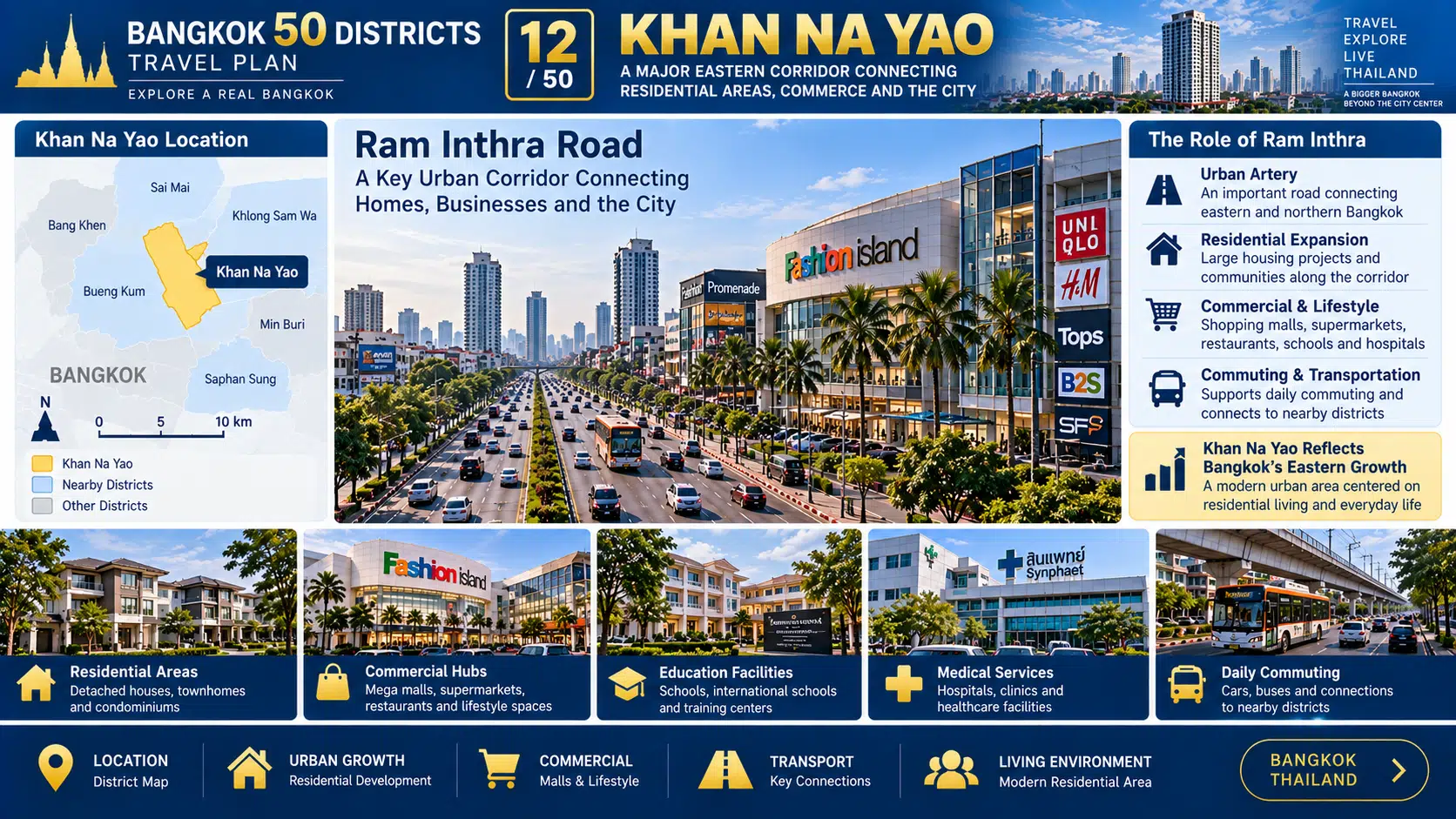
One name you will encounter repeatedly around Khan Na Yao is:
Ram Inthra.
For a first-time visitor, it may appear to be just another large Bangkok road.
But if we want to understand how northern and northeastern Bangkok developed, major roads like this become extremely important.
Housing projects expand along these corridors.
Commercial centers emerge at major intersections and activity nodes.
Schools, hospitals, restaurants, supermarkets, convenience stores and automotive services gradually cluster nearby.
Every day, large numbers of residents use these roads to commute between home, work, school and other parts of Bangkok.
In the traditional city center, visitors often learn Bangkok through BTS station names.
In the outer districts, we need another way of reading the city.
Here:
roads themselves become part of the urban framework.
Khan Na Yao did not grow around an ancient square or one historic monument.
Much of its modern identity developed through the expansion of roads, housing and commercial activity.
03|Fashion Island: Why Does Outer Bangkok Need Such a Large Mall?
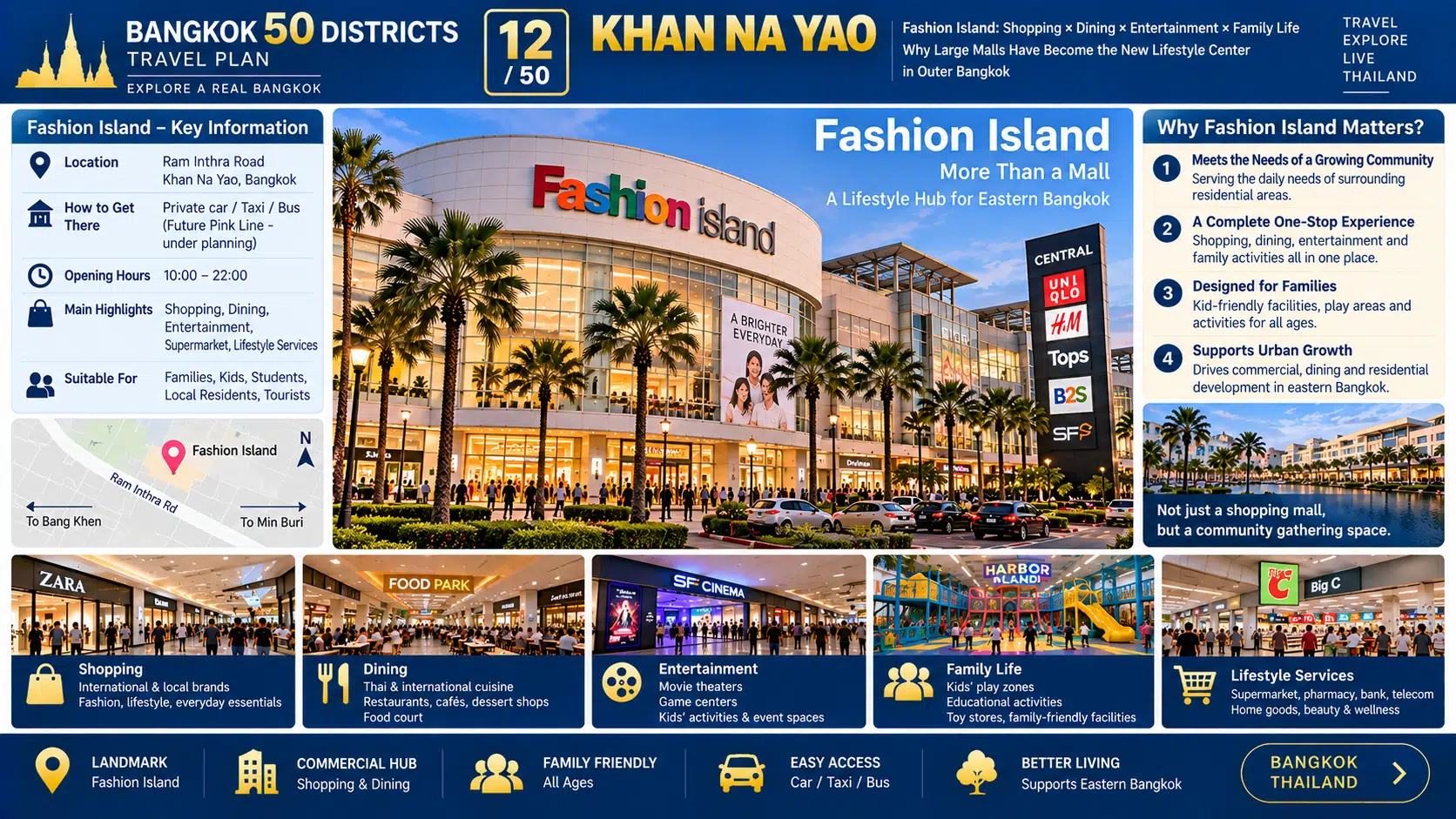
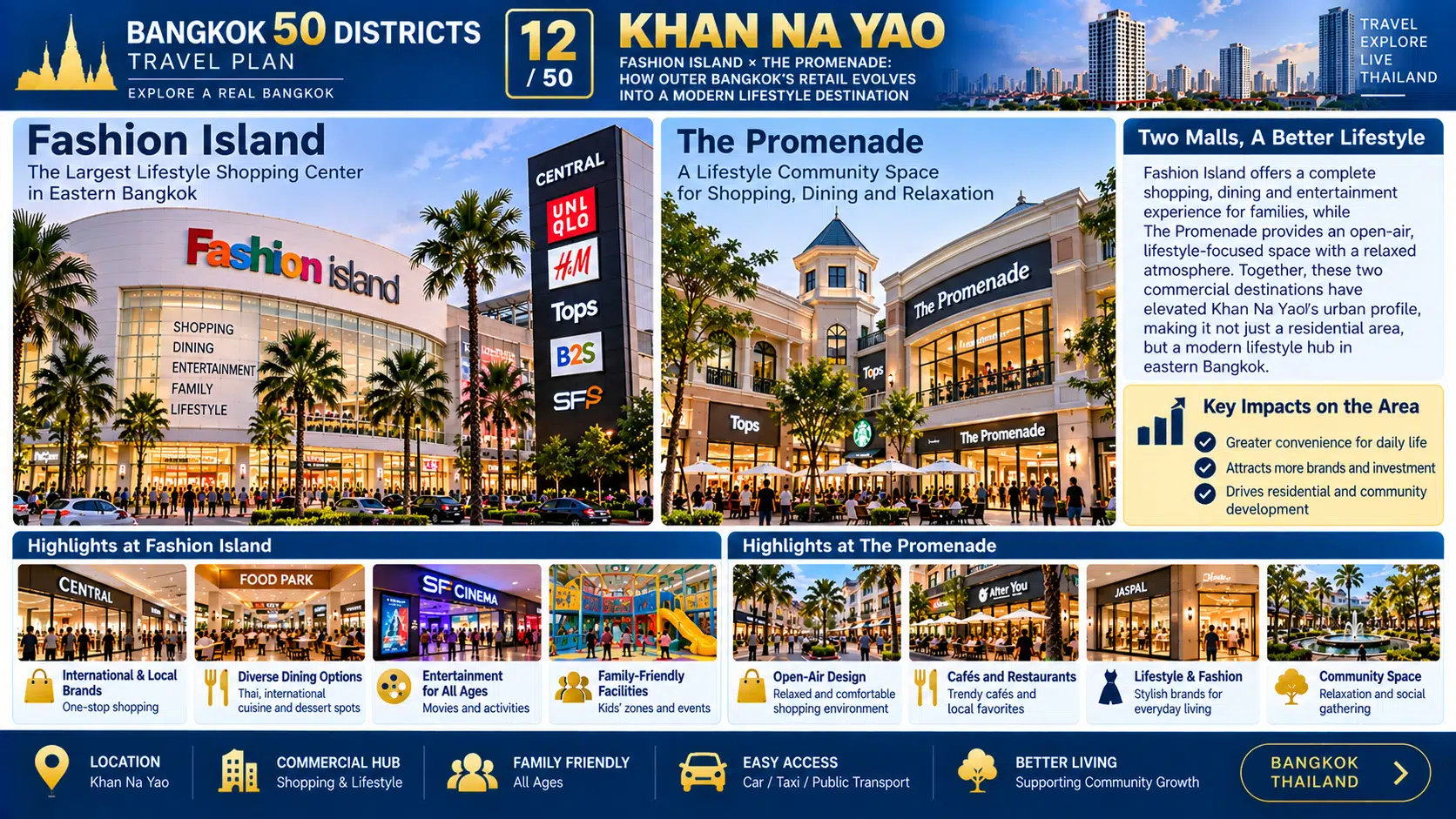
One of Khan Na Yao’s most recognizable modern landmarks is Fashion Island.
But simply describing it as “a shopping mall” misses the more interesting story.
In Siam, major malls serve a mixture of tourists, office workers, residents and international shoppers.
In Bangkok’s outer districts, a large shopping center can play an even broader role.
People come to shop.
Eat.
Watch movies.
Meet friends.
Bring their children.
Buy groceries and everyday necessities.
Have coffee.
Use services.
Or simply spend a few comfortable hours indoors during Bangkok’s hottest part of the day.
For nearby residents, a large mall increasingly functions like an:
all-weather urban living room.
This helps explain why enormous commercial centers can succeed far beyond Bangkok’s traditional downtown.
They are not simply copies of Siam.
They serve a different urban population with different everyday needs.
04|The Promenade: From Shopping to Lifestyle
Near Fashion Island is another type of modern commercial space:
The Promenade.
If the traditional large mall is designed around the idea of having almost everything under one roof, newer commercial spaces increasingly emphasize something else:
atmosphere, dining, leisure and lifestyle.
People do not necessarily come only because they need to buy something.
They may meet friends for dinner.
Sit in a café.
Take a walk.
Spend an afternoon with family.
Or simply find somewhere comfortable to relax close to home.
This reflects an important shift in outer Bangkok.
During the earlier stages of urban expansion, the basic question was:
“Can I find what I need here?”
As residential populations grew and communities matured, the question gradually became:
“Is this a good place to spend my time?”
That transition—from basic commercial infrastructure to lifestyle-oriented spaces—is itself a sign of urban maturity.
05|Housing Is Redefining Bangkok’s Urban Boundary
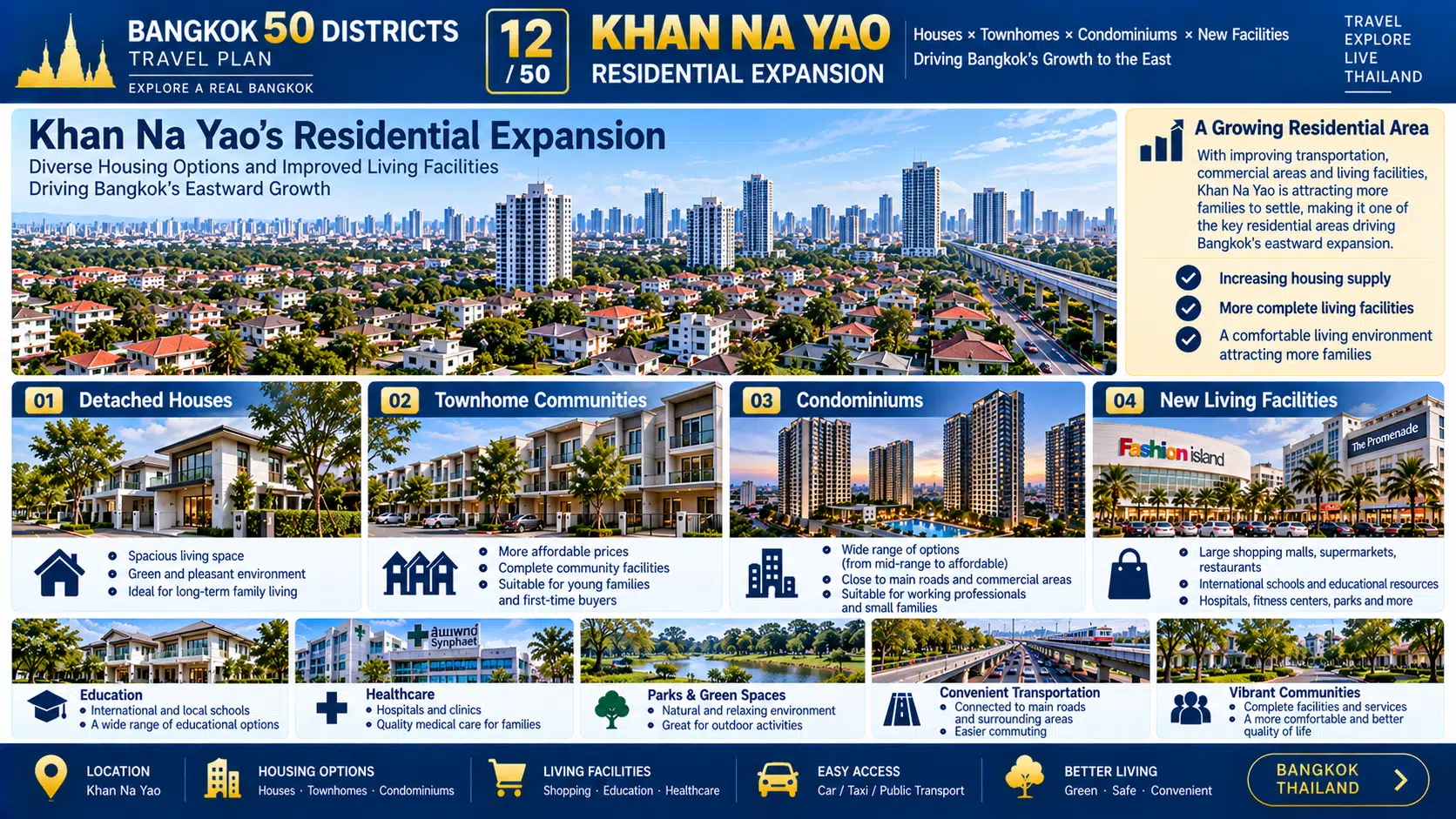
Travel deeper into Khan Na Yao and residential development becomes impossible to ignore.
Detached houses.
Townhomes.
Condominiums.
Gated communities.
Older neighborhoods beside newer housing projects.
None of these may appear in a conventional Bangkok sightseeing guide.
But they explain why large malls, schools, hospitals and other services have developed nearby.
Because one of the strongest forces behind urban expansion is simply:
people.
As more families choose to live farther from Bangkok’s traditional center, new needs appear.
They need schools.
Supermarkets.
Hospitals.
Restaurants.
Transportation.
Parks and leisure spaces.
Shopping and services.
As these functions accumulate, places once considered “far from the city center” gradually develop complete urban systems of their own.
This is how Bangkok’s boundary keeps changing.
Not through one dramatic moment when the city suddenly expands.
But through housing, roads, commerce and population gradually pushing urban life farther outward.
06|From “Going Downtown” to Having Almost Everything Nearby
This is one of the most interesting changes to observe in Khan Na Yao.
We often imagine a major city through a traditional pattern:
Work downtown.
Shop downtown.
Find entertainment downtown.
Eat downtown.
But modern Bangkok is increasingly becoming a polycentric city—a metropolis with multiple centers serving different parts of the population.
Bang Kapi already gave us an early example.
Khan Na Yao makes the trend even clearer.
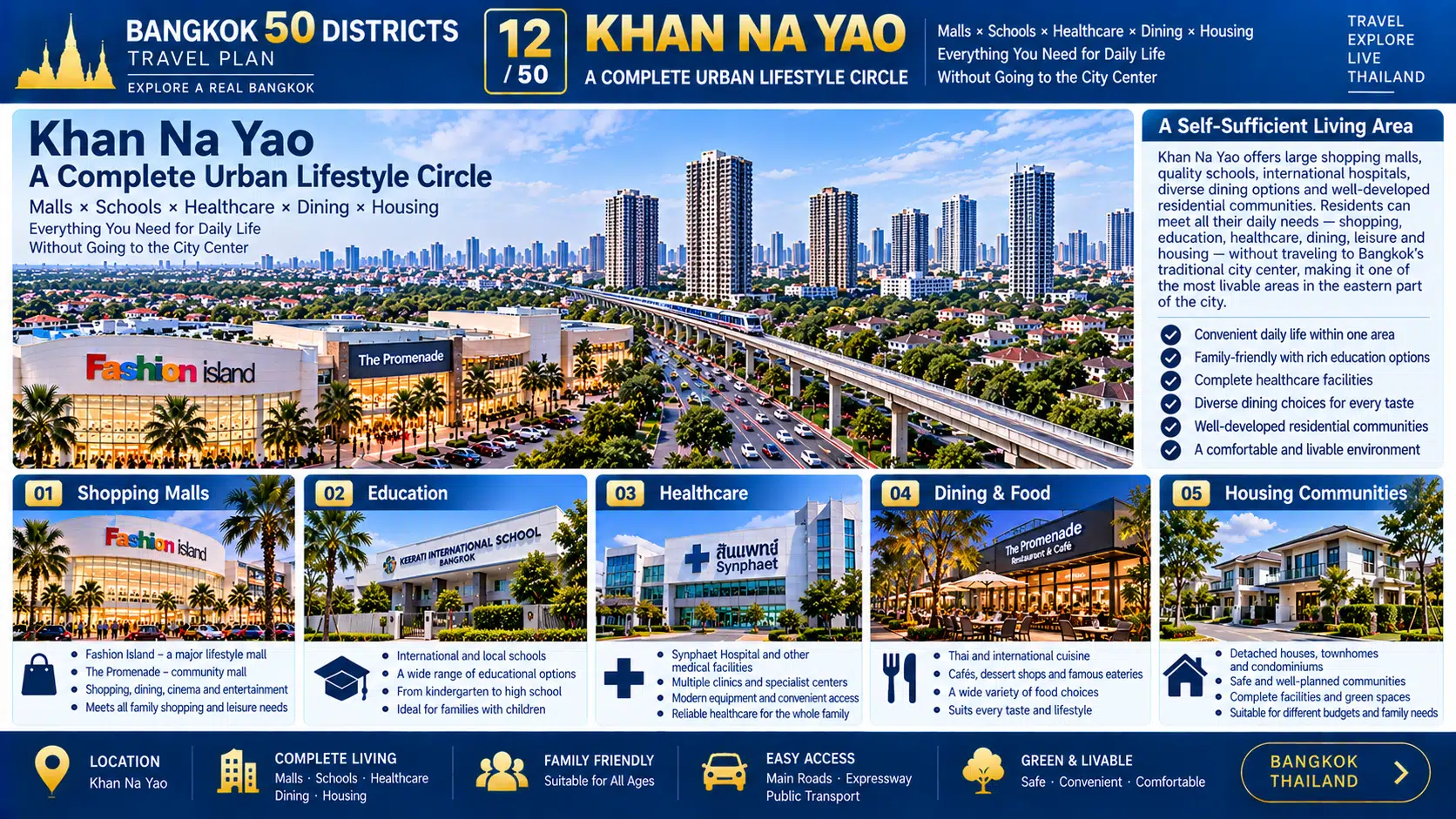
If the area around your home already provides:
shopping malls, restaurants, supermarkets, schools, hospitals, cafés, fitness facilities and everyday services,
then many daily activities no longer require a trip to Siam.
This does not mean Bangkok’s traditional center is becoming unimportant.
It means the city now contains more and more different levels of local urban centers.
For residents, this changes everyday mobility.
For travelers, it offers another way to understand Bangkok.
Instead of only asking:
“Where is Bangkok’s city center?”
we can ask:
“What does ‘the center’ mean to people living in different parts of Bangkok?”
07|What to Eat in Khan Na Yao
The food culture of Khan Na Yao shares something important with Bueng Kum:
it is not primarily built around tourists.
Local residents support much of the district’s restaurant economy.
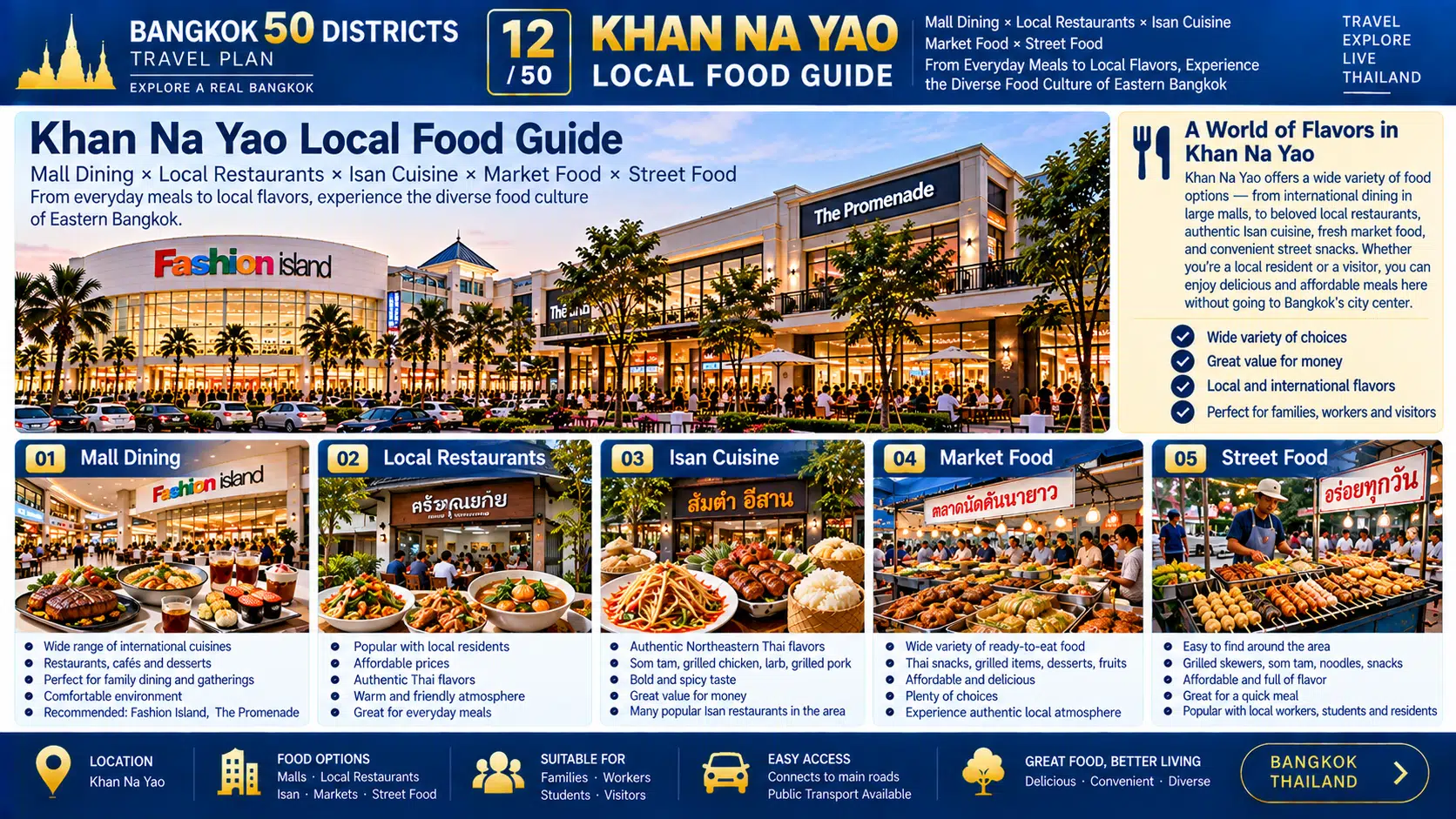
Inside large shopping centers, there is an enormous range of dining options.
Around residential communities, you will find everyday Thai made-to-order restaurants.
Markets offer prepared dishes, snacks, fruit and quick meals.
And across eastern and northeastern Bangkok, Isan cuisine is easy to find.
Som tam.
Grilled chicken.
Grilled pork neck.
Larb.
Sticky rice.
Hot pot.
Noodles.
Pad kra pao.
You do not need to search for a viral restaurant every time.
For our Bangkok 50 Districts project, a more interesting approach is often:
find somewhere that nearby residents genuinely return to.
That tells us far more about what a neighborhood actually likes to eat.
The best local meal does not always need a ranking.
Sometimes it simply needs regular customers.
08|How to Spend One Day in Khan Na Yao
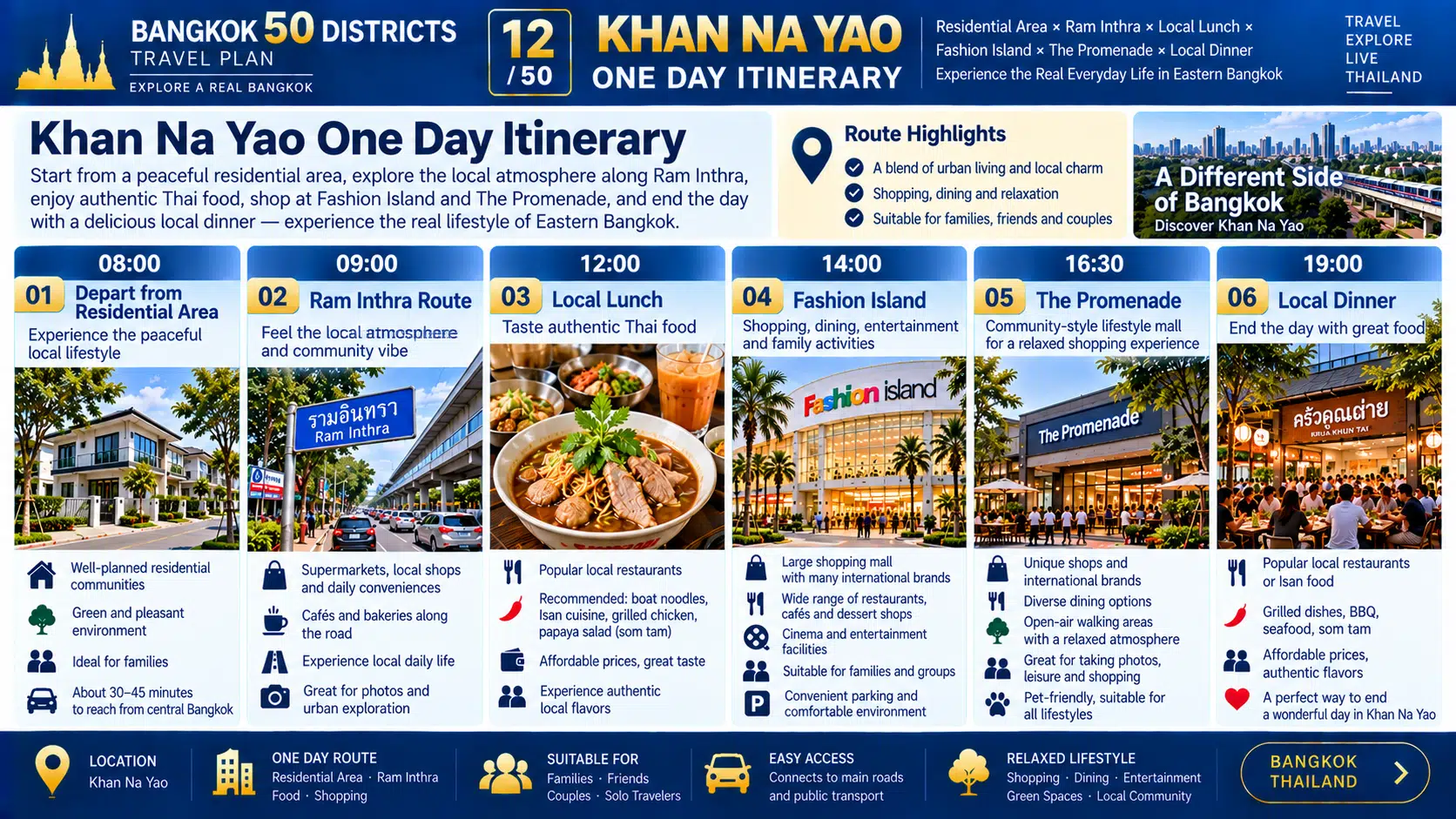
Khan Na Yao works best as a day of urban observation, local food and modern lifestyle exploration rather than traditional sightseeing.
08:00|Start in a Residential Community
Do not begin inside a shopping mall.
Start with an ordinary residential neighborhood.
Look at detached houses, townhome developments, condominiums, local shops and the morning rhythm of residents beginning their day.
The point is to understand what kind of district Khan Na Yao actually is before entering its commercial centers.
09:00|Explore the Ram Inthra Corridor
Move toward Ram Inthra and observe the scale of outer Bangkok.
How do roads, housing, schools, businesses and transportation fit together?
The road itself becomes part of the district’s story.
12:00|Local Lunch
Choose a neighborhood restaurant or an Isan restaurant.
There is no need to chase a viral ranking.
Som tam, grilled chicken, grilled pork neck, sticky rice or noodles can already make a very satisfying local lunch.
14:00|Fashion Island
Spend the afternoon at Fashion Island.
But do not look at it only as a place to shop.
Watch how families, students, young people and nearby residents actually use the space.
Shopping is only one part of its role.
16:30|The Promenade
Move into a more relaxed lifestyle environment.
Find a café.
Walk around.
Sit down for a while.
Notice how outer Bangkok’s commercial spaces are evolving from simple shopping destinations into places designed for leisure and social life.
19:00|Local Dinner
Leave the shopping centers and finish the day at a neighborhood restaurant or local dining area.
As evening arrives, workers return home, families go out for dinner and restaurants become busier.
By this point, one thing becomes very clear:
Even far from Bangkok’s traditional downtown, urban life here is complete, active and self-sustaining.
09|What Is Really Worth Seeing in Khan Na Yao?
By traditional tourism standards, Khan Na Yao may not be considered a “must-visit district.”
There is no Grand Palace.
No Wat Arun.
No internationally famous street like Yaowarat.
And no concentration of foreign visitors comparable to Siam.
But by the 12th stop of our Bangkok 50 Districts Travel Plan, we should no longer judge every district by whether it contains a famous attraction.
What Khan Na Yao allows us to see is something much bigger:
how Bangkok is growing.
From the historic core outward.
From one traditional commercial center toward multiple regional centers.
From lower-density land toward residential communities.
Housing brings people.
People create demand.
Demand brings commerce and services.
Roads and transportation connect those new communities with the rest of the metropolis.
Eventually, a place once considered far from central Bangkok can develop a complete urban life of its own.
So Khan Na Yao is not really the story of one attraction.
It is the story of an expanding metropolis.
If we only stand in Siam and look at Bangkok, the city center may seem fixed.
But once we reach Khan Na Yao, we begin to understand:
Bangkok’s urban boundary is constantly moving outward.
And the idea of a single “city center” is becoming increasingly difficult to define.
For someone living here, Fashion Island may be more familiar than Siam.
The neighborhood market may matter more than Yaowarat.
A local restaurant may be more important than any viral food destination.
That is exactly what the Bangkok 50 Districts Travel Plan is trying to document.
Not only the Bangkok built for visitors.
But:
the Bangkok where people actually live.
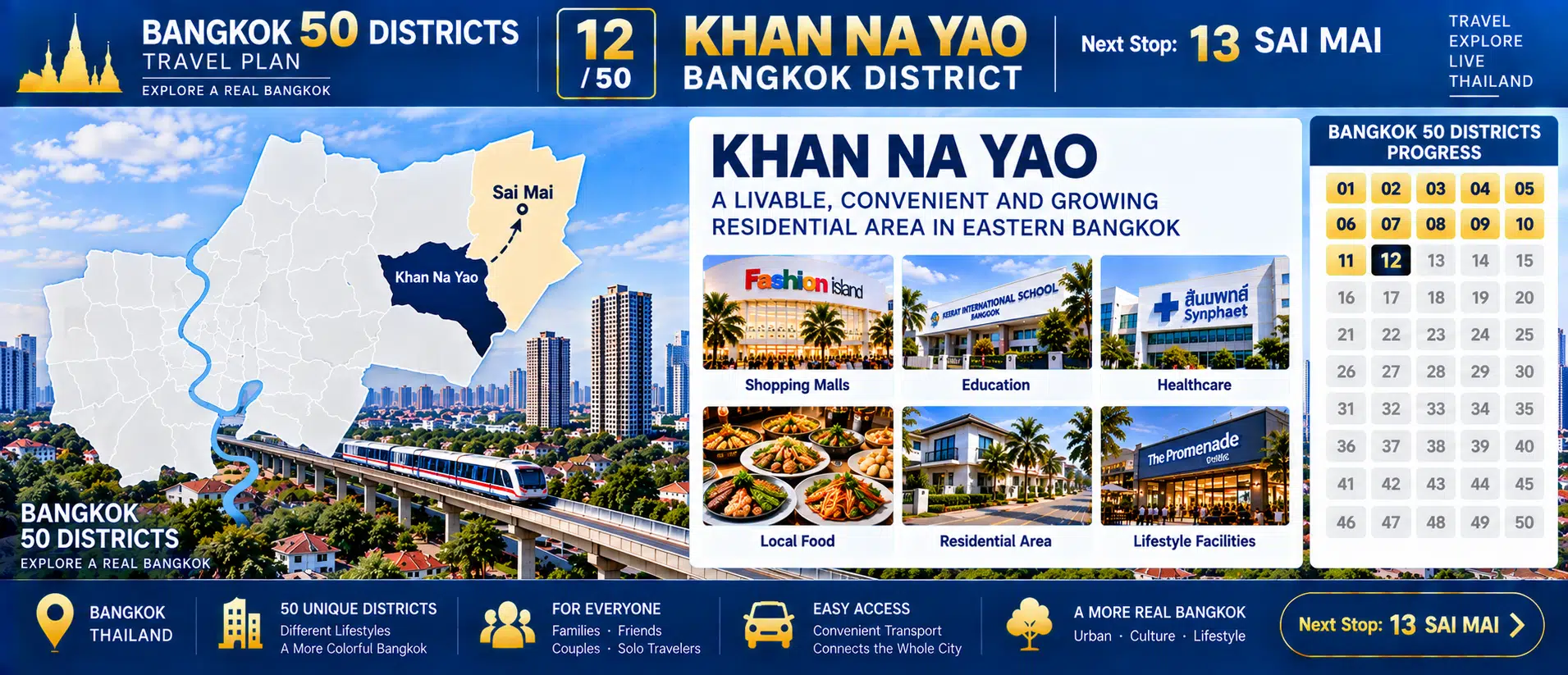
12 / 50 UNLOCKED
KHAN NA YAO ✓
Keywords:
Ram Inthra · Fashion Island · The Promenade · Residential Communities · Urban Expansion · Shopping & Lifestyle · Local Food · Eastern Bangkok · Polycentric City
38 districts remaining.
NEXT STOP|13 / 50
SAI MAI
From Khan Na Yao, our journey continues toward northern and northeastern Bangkok.
Major commercial landmarks gradually become less dominant, while residential communities, neighborhood markets and ordinary family life move back to the center of the story.
If Khan Na Yao asks:
“How do large residential developments and commercial centers push Bangkok’s urban boundary outward?”
then Sai Mai takes us to the next question:
When major malls and tourist attractions fade into the background, what does everyday life look like in a Bangkok outer district built primarily around homes, communities, markets and ordinary families?