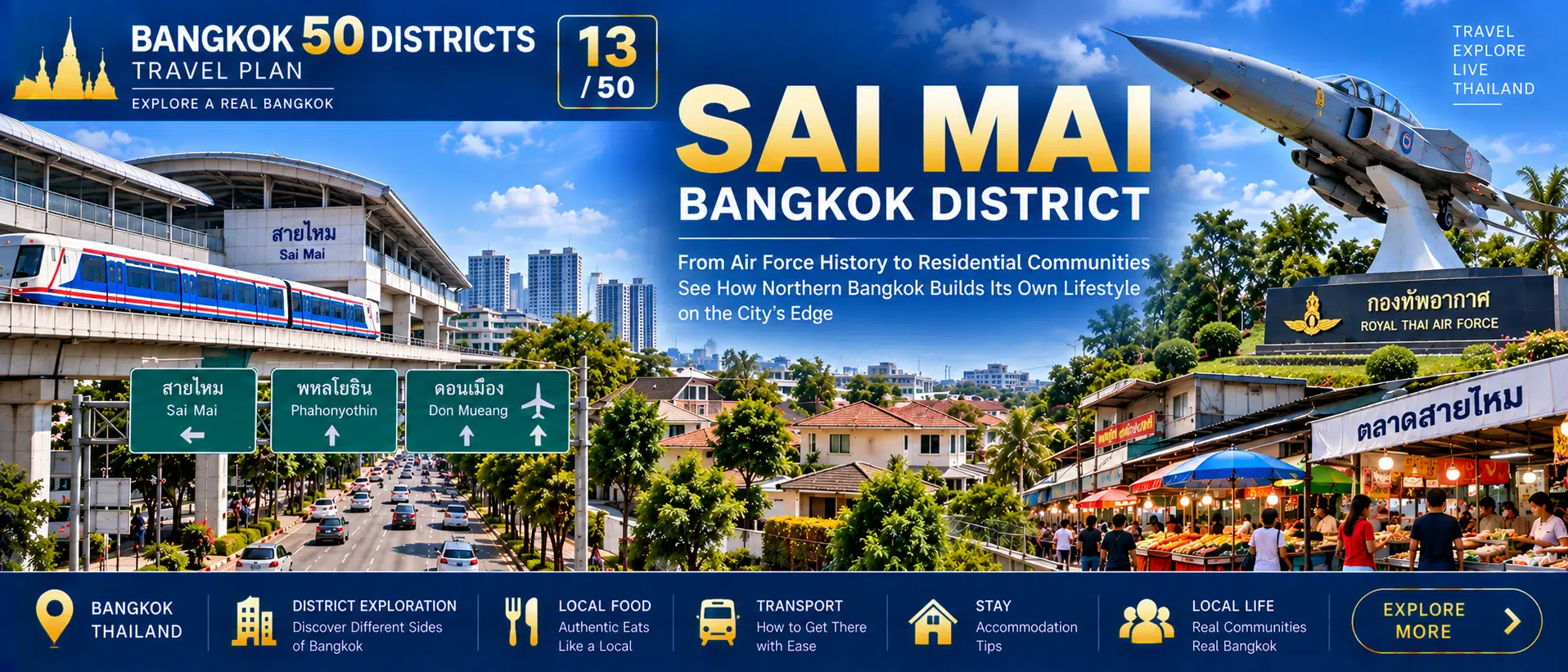
After completing our 12th stop, Khan Na Yao, we saw another result of Bangkok’s continuous outward expansion.
Large residential developments were growing.
Commercial centers such as Fashion Island and The Promenade were creating increasingly complete lifestyle hubs for people living far from the traditional city center.
Now, at our 13th stop, Sai Mai, the rhythm changes again.
Major commercial landmarks begin to fade into the background.
There are fewer tourists.
Homes, schools, markets, roads, neighborhood restaurants and ordinary families once again become the main characters.
But Sai Mai is more than simply another residential district.
As we move farther into northern Bangkok, we enter an area whose urban development has long been influenced by Don Mueang, aviation, the Royal Thai Air Force and Bangkok’s expansion toward the north.
So this time, instead of asking:
“What are the must-see attractions in Sai Mai?”
we want to ask something different:
“How does a Bangkok outer district designed primarily for residents actually work?”
01|Where Is Sai Mai?
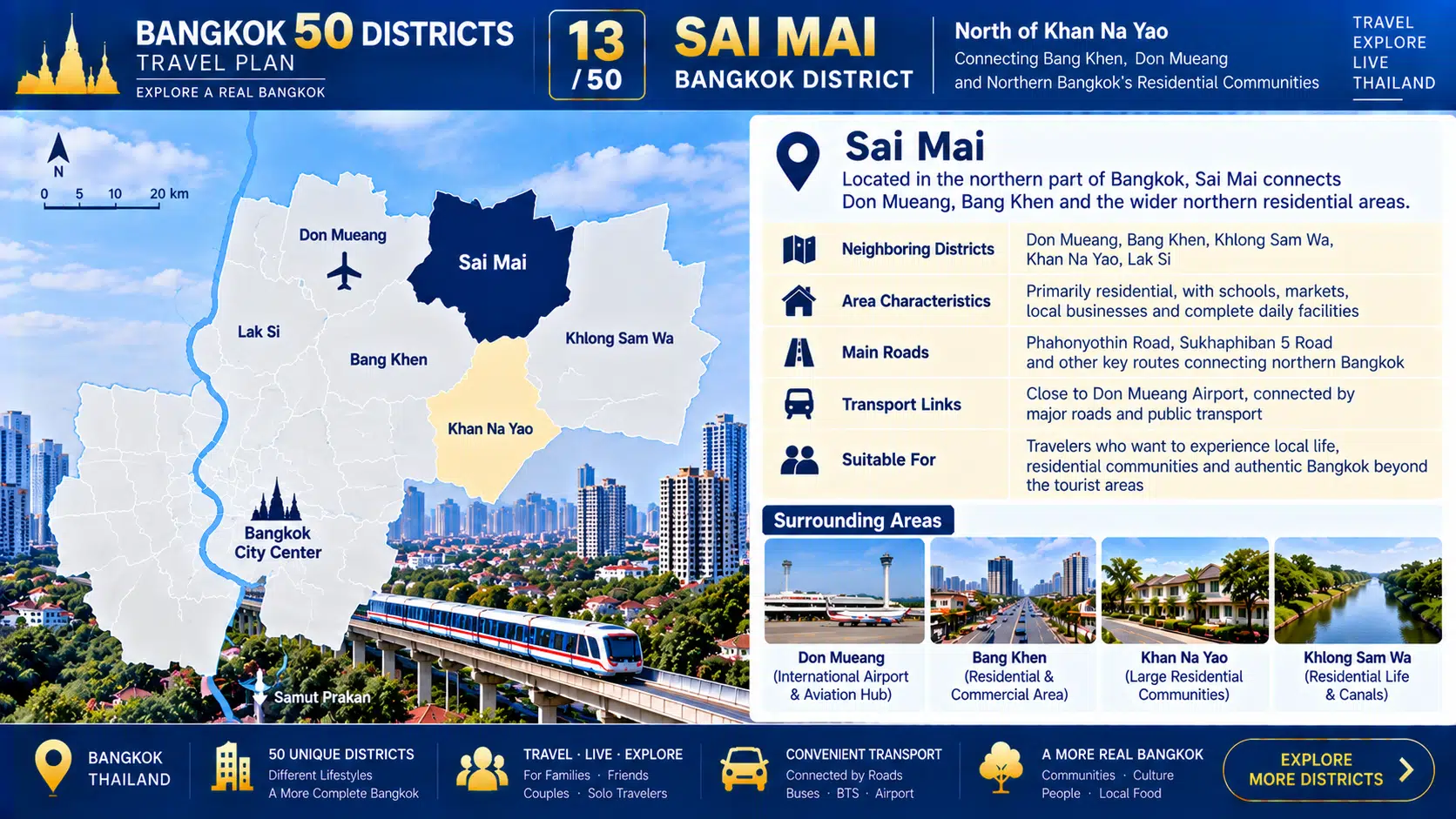
Sai Mai lies in the northern to northeastern part of Bangkok.
Travel north from Khan Na Yao and the urban landscape gradually shifts away from the combination of mega malls and newer residential developments we saw in the previous district.
Residential communities become increasingly dominant.
Sai Mai connects with the wider northern Bangkok network around areas such as Bang Khen, Khlong Sam Wa, Don Mueang and Lak Si.
It is far from the Grand Palace.
It is also far from Siam.
But after reaching District 13, we should already be familiar with one important fact:
Bangkok does not revolve around Siam alone.
Every morning, residents leave northern Bangkok.
Some go to work.
Some take their children to school.
Some travel to government offices.
Some commute toward commercial districts or other parts of the city.
In the evening, those movements reverse as people return home.
Sai Mai exists inside this enormous northern residential and commuting network.
It is not an empty corner at the edge of the Bangkok map.
It is part of the city’s everyday life.
02|Sai Mai’s Character: Homes Matter More Than Attractions
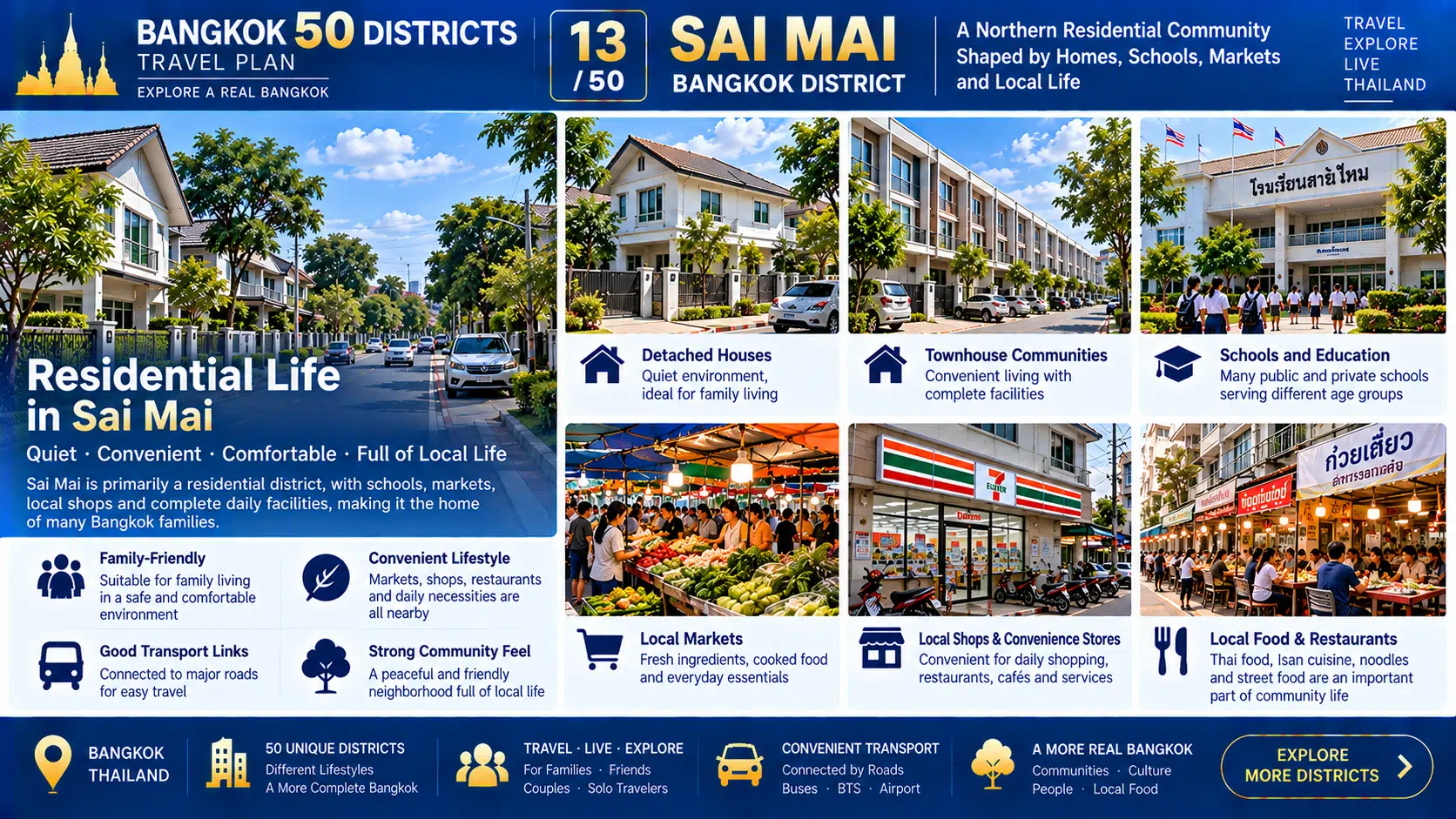
A first-time visitor to Sai Mai might immediately think:
“There doesn’t seem to be much to see here.”
And that is precisely what makes this district interesting.
Most Bangkok residents do not wake up every morning beside the Grand Palace, Siam or Yaowarat.
They live in districts like this.
Detached houses.
Townhome communities.
Low-rise apartments.
Residential developments.
Schools.
Convenience stores.
Community markets.
Roadside restaurants.
Motorcycle taxi stands.
Individually, none of these things seems extraordinary.
Together, however, they form a complete urban ecosystem.
In the morning, parents take children to school.
At lunchtime, neighborhood restaurants fill with residents and workers.
During the afternoon, markets begin preparing for the evening rush.
After work, residential streets become busy again as people return home.
Later at night, much of the neighborhood becomes quiet.
Sai Mai’s value for this journey is not about discovering one spectacular landmark.
It is about:
watching an ordinary Bangkok residential district move through an entire day.
03|Phahonyothin: A Corridor Connecting Northern Bangkok
It is difficult to understand northern Bangkok without encountering the name:
Phahonyothin.
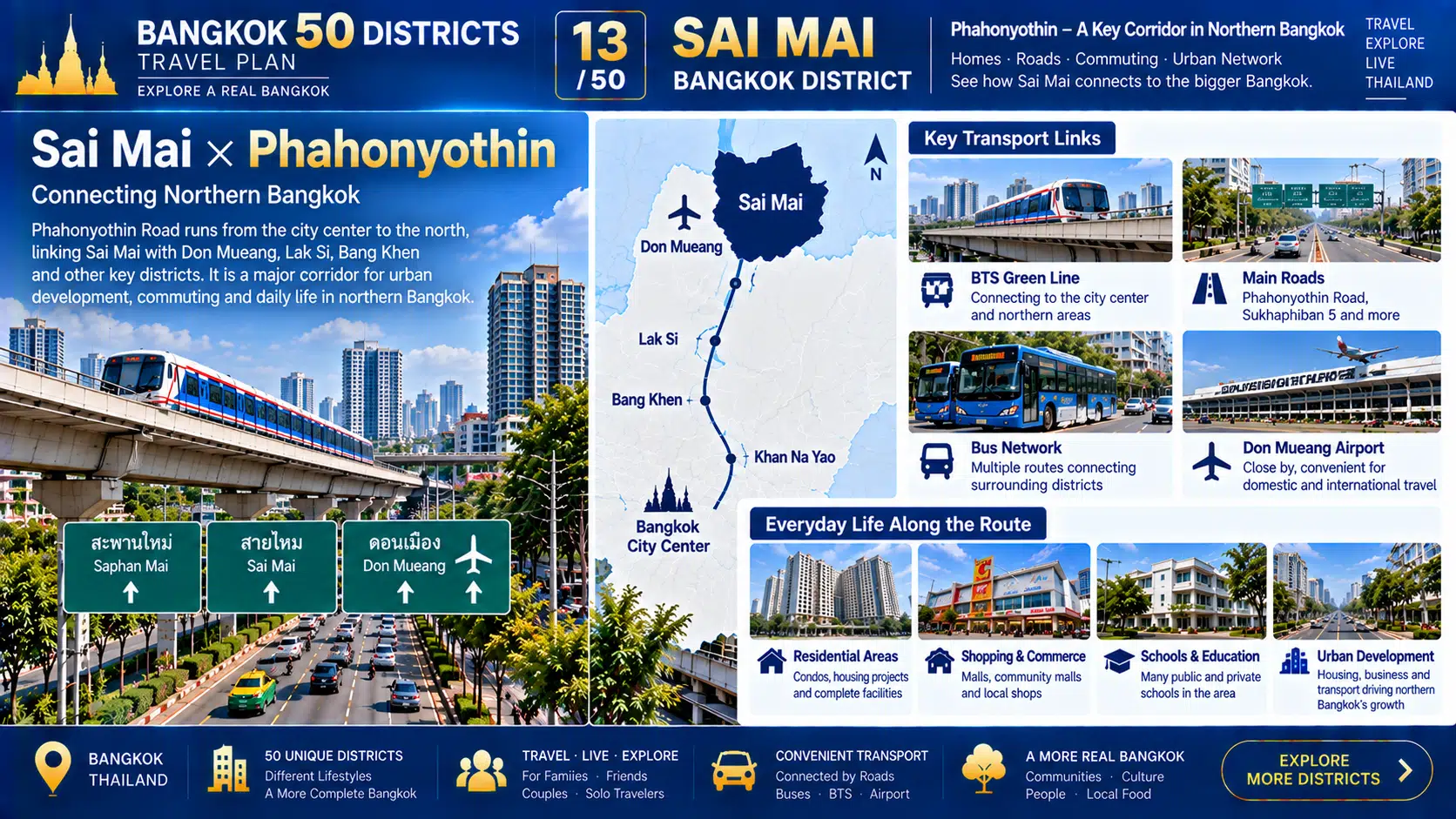
This major corridor extends northward from Bangkok and has long played an important role in connecting different parts of the metropolitan area.
As Bangkok expanded, the surrounding urban network grew with it.
Residential areas.
Commercial activity.
Government facilities.
Schools.
Aviation-related areas.
And numerous northern communities all became connected through roads and transportation corridors.
Around Sai Mai, the scale of the city feels very different from central Bangkok.
Roads are longer.
Residential areas are more spread out.
Cars, buses, motorcycles and connections to rail transport become increasingly important in everyday mobility.
This reminds us again that once we reach Bangkok’s outer districts, we cannot understand an area only by asking:
“Where is the nearest BTS station?”
Roads, commuting patterns and connections between neighborhoods are equally important parts of the city.
For people living here, the key question is rarely:
“Which attraction is closest?”
It is:
“How do I get to work or school every day—and how do I get home?”
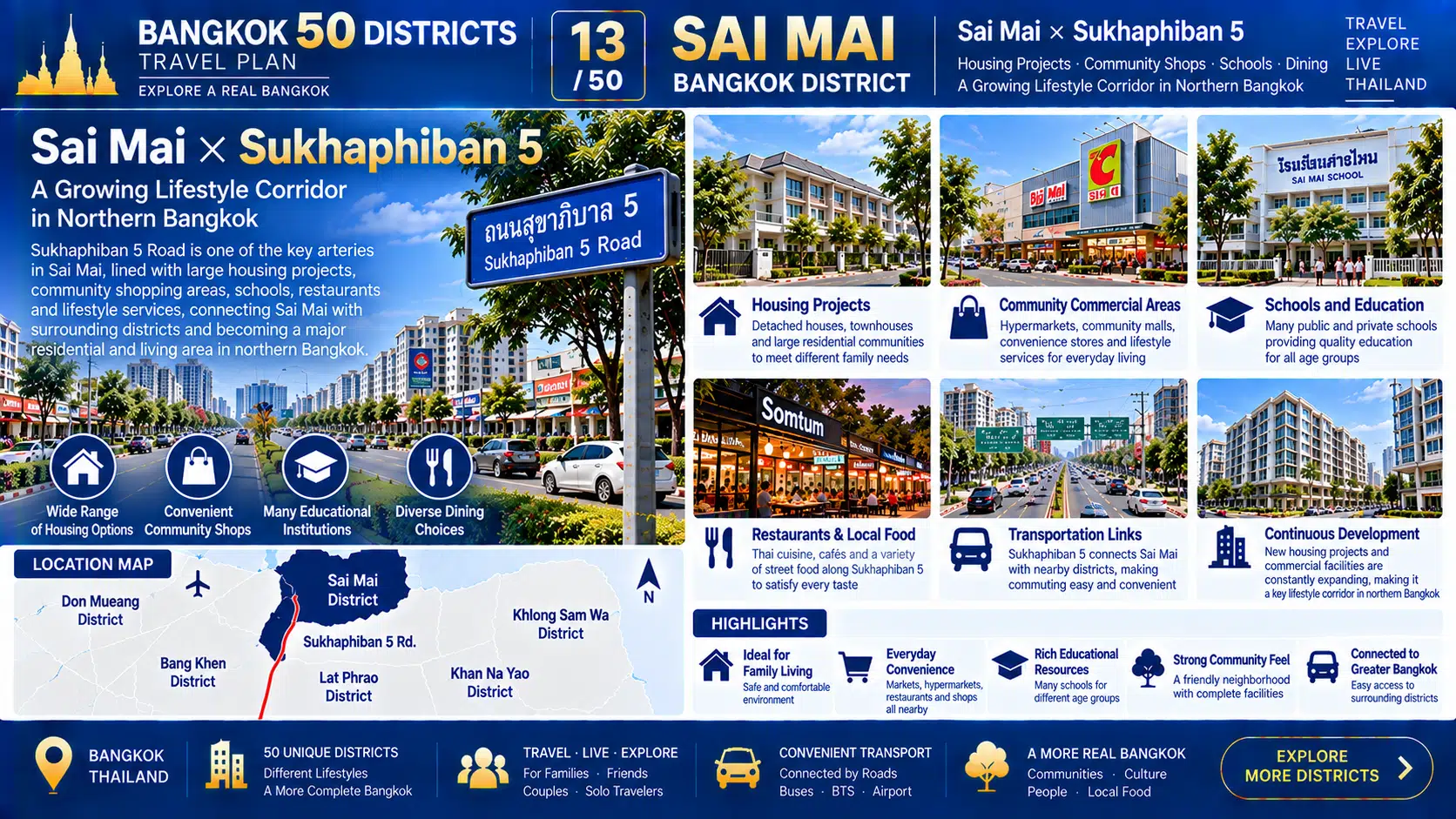
04|Sukhaphiban 5: Residential Expansion Along a Major Local Corridor
To understand Sai Mai’s residential character more deeply, another important name is:
Sukhaphiban 5.
Travel along this corridor and residential development becomes increasingly visible.
Community entrances.
Townhomes.
Detached houses.
Small commercial centers.
Restaurants.
Cafés.
Schools.
Convenience stores.
Automotive services.
These places were not created primarily for visitors.
They exist because people live nearby.
This is one of the most common patterns of urban growth in outer Bangkok:
people move in first, and everyday services gradually follow.
As the population grows, communities need more shops.
More restaurants.
More schools.
More healthcare.
More transportation.
Over time, what began primarily as a residential area develops into a much more complete lifestyle zone.
Urban development is not only about adding skyscrapers.
Sometimes, the steady appearance of neighborhoods, schools, restaurants and local businesses along one road tells us much more about how a city is actually growing.
05|Wongsakorn: When “Close to Home” Becomes the Real Center of Daily Life
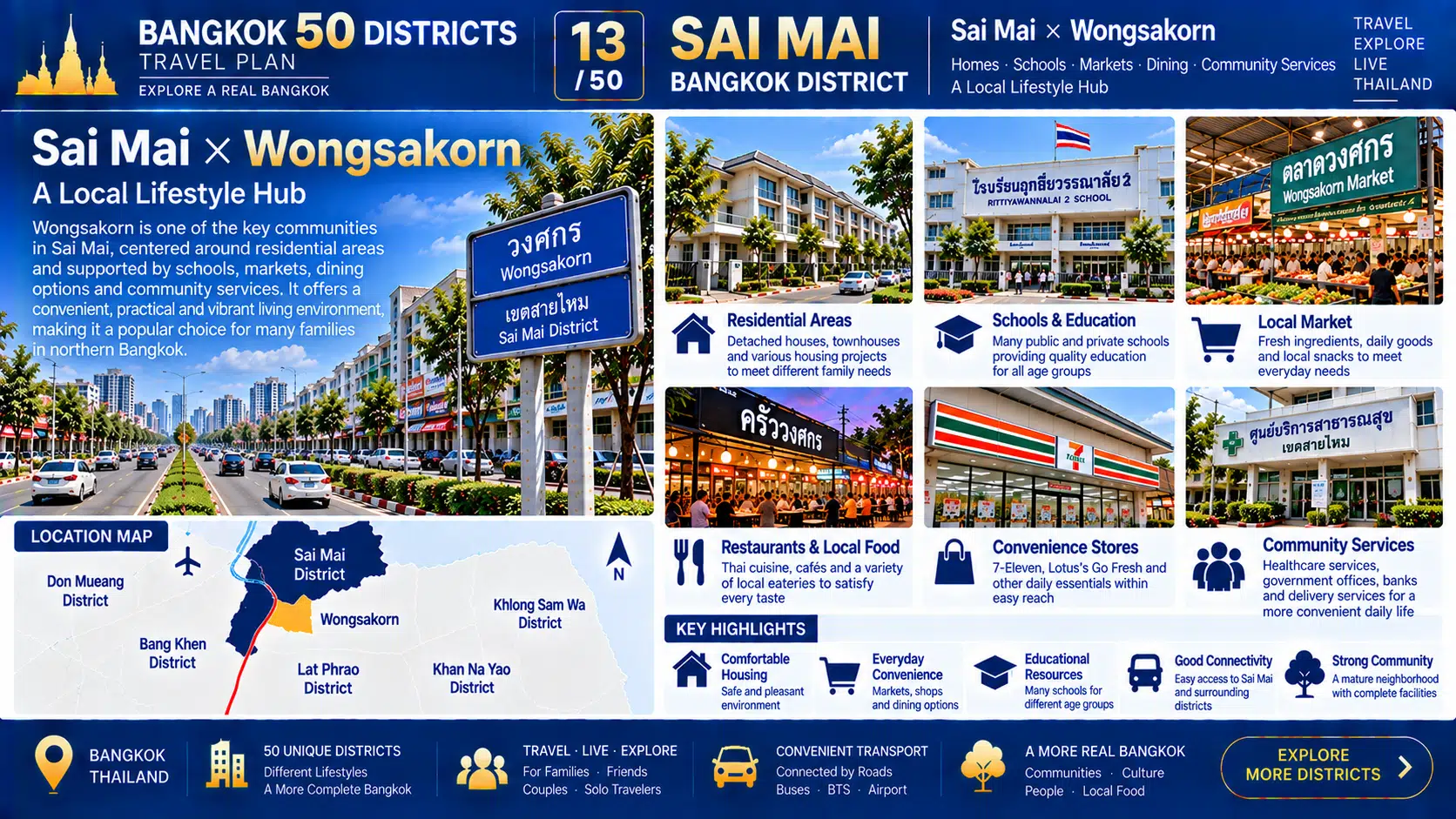
In a residential district like Sai Mai, one of the best ways to understand the city is to ask:
How much of everyday life can residents complete close to home?
Around Wongsakorn and nearby communities, many daily needs can be handled without traveling into Bangkok’s traditional center.
Breakfast is available nearby.
Children can attend schools in the surrounding area.
Groceries and household goods can be purchased locally.
Neighborhood restaurants handle lunch.
Cafés provide somewhere to meet or relax.
In the evening, residents can buy prepared food from a market or eat with their families at a local restaurant.
This lifestyle may not look as spectacular as Siam.
But it tells us something important about modern Bangkok.
When residential districts gain increasingly complete services, residents become less dependent on the traditional city center.
We have already seen different versions of this transformation in Bang Kapi and Khan Na Yao.
Bangkok is gradually evolving from a city dominated by one center into a vast metropolis containing multiple centers of everyday life.
Sai Mai makes this process feel especially ordinary.
It does not need a giant landmark to prove that it is part of the city.
A community that people genuinely use every day is already an urban center in its own way.
06|Aviation and the Air Force: Why Northern Bangkok Feels Different
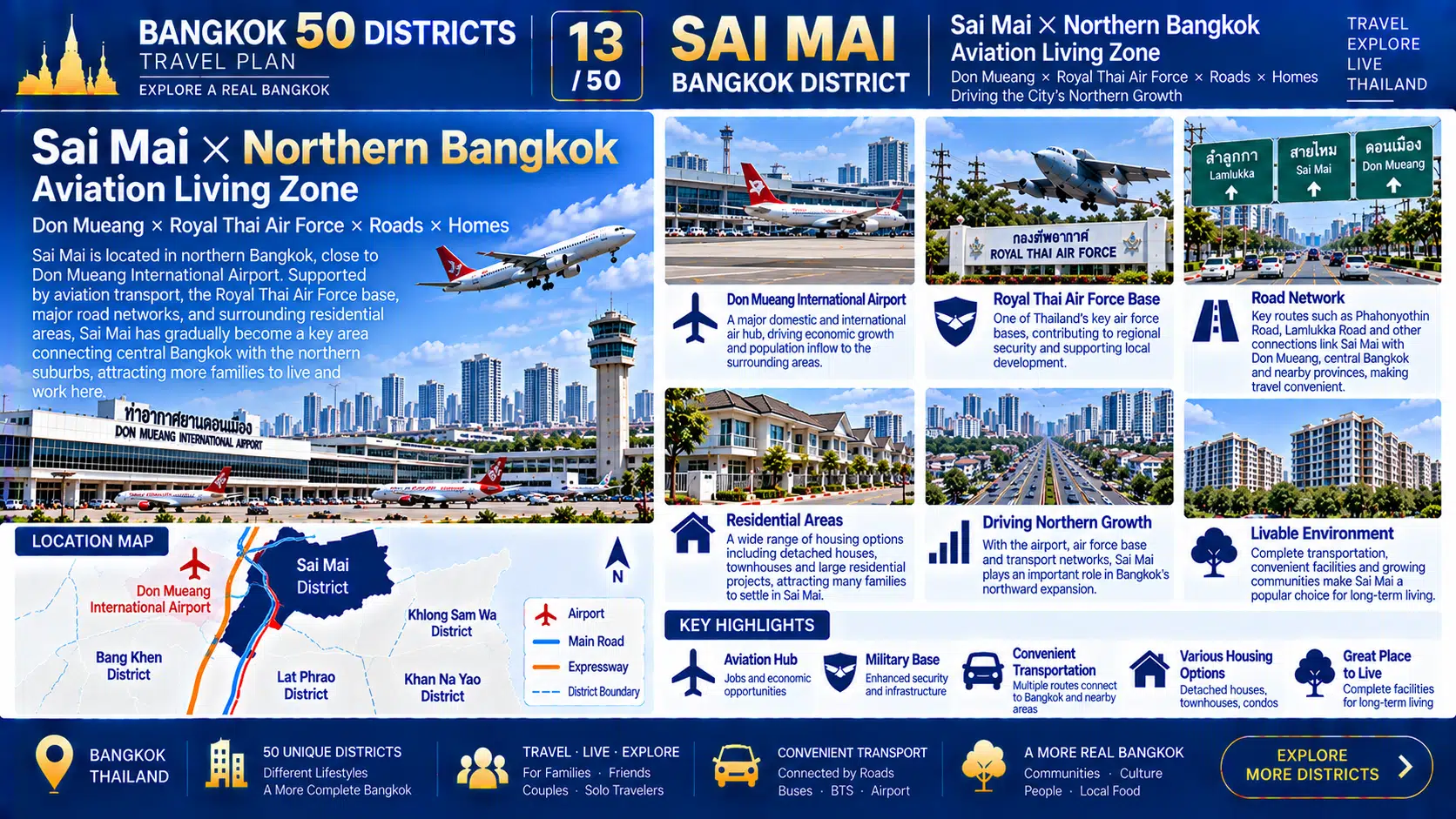
Sai Mai also has another important geographical and historical context:
aviation and the military.
Northern Bangkok has long been closely associated with Don Mueang Airport, the Royal Thai Air Force and related infrastructure.
As we move through Sai Mai, Bang Khen and the wider Don Mueang area, aviation is not simply the story of an airport.
Its presence has influenced surrounding roads.
Employment.
Housing.
Government facilities.
Transportation.
And the direction in which Bangkok expanded northward.
For ordinary travelers, this does not mean entering or photographing restricted military facilities.
Relevant security rules and photography restrictions should always be respected.
The more interesting question is:
Why did northern Bangkok develop the way it did?
Aviation infrastructure and military facilities are part of that answer.
Cities are never shaped only by shopping malls and housing developments.
Airports, transportation infrastructure, government institutions and historical land uses can influence the development of entire areas for decades.
07|Community Markets: One of the Best Places to Understand Sai Mai
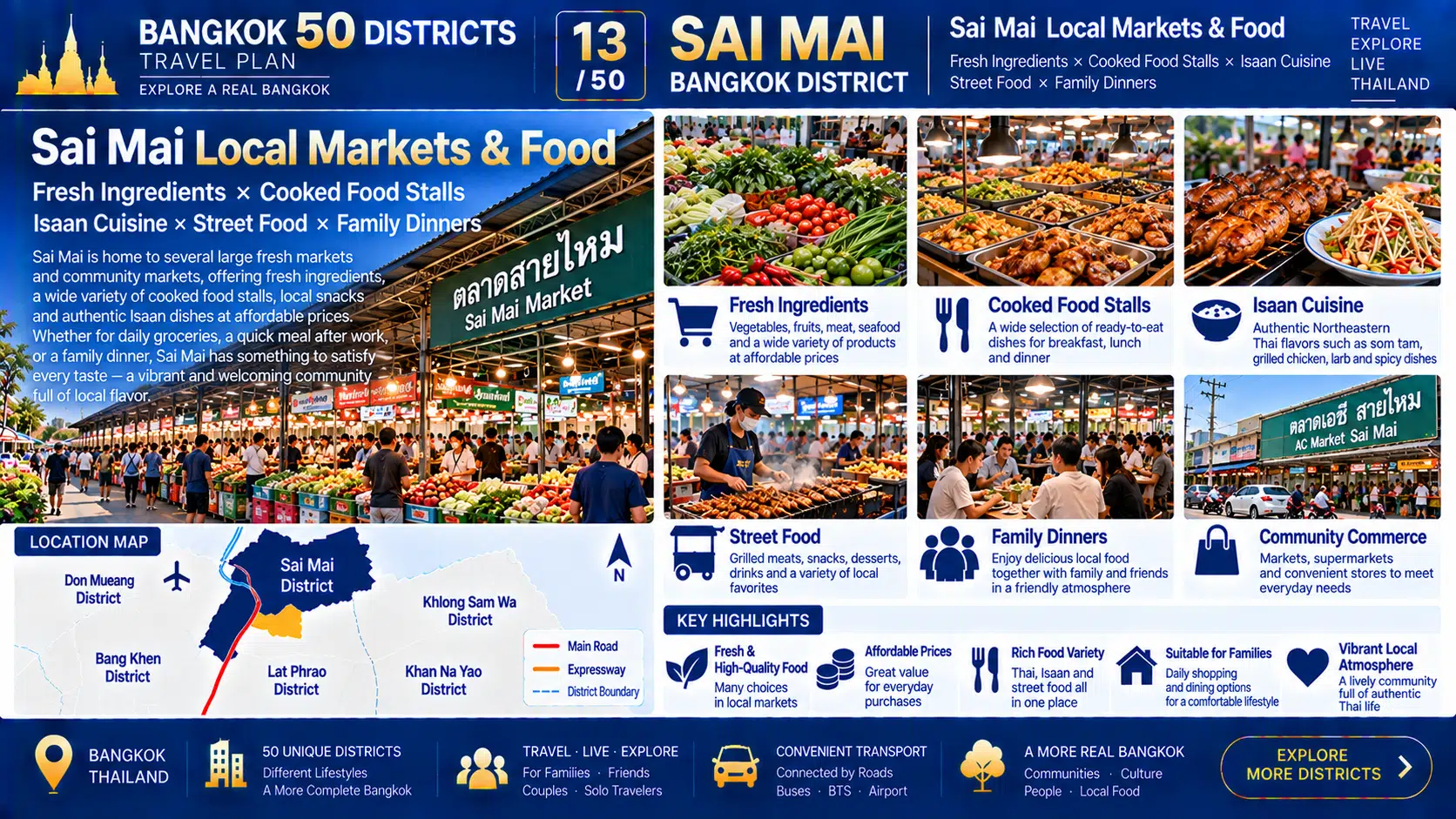
If I could choose only one type of place to observe everyday life in Sai Mai, I would once again choose a:
community market.
The reason is similar to what we saw in Bueng Kum, but Sai Mai’s strongly residential character makes the connection even clearer.
In the morning, people buy breakfast.
During the day, markets sell vegetables, fruit, meat, seafood and household necessities.
Later in the afternoon, more prepared-food stalls begin serving the evening crowd.
By early evening, workers and families become some of the most important customers.
You might see:
Curries.
Grilled chicken.
Fried chicken.
Som tam.
Grilled meat.
Noodles.
Desserts.
Fruit.
And rows of prepared dishes designed to be taken home for dinner.
For travelers, the most interesting thing is not necessarily finding one famous stall.
It is watching how the entire market serves the surrounding community.
Someone buys two dishes for dinner.
A parent shops with a child.
A motorcyclist stops briefly to pick up food.
A regular customer chats with a vendor they already know.
These repeated everyday relationships are what make a community market meaningful.
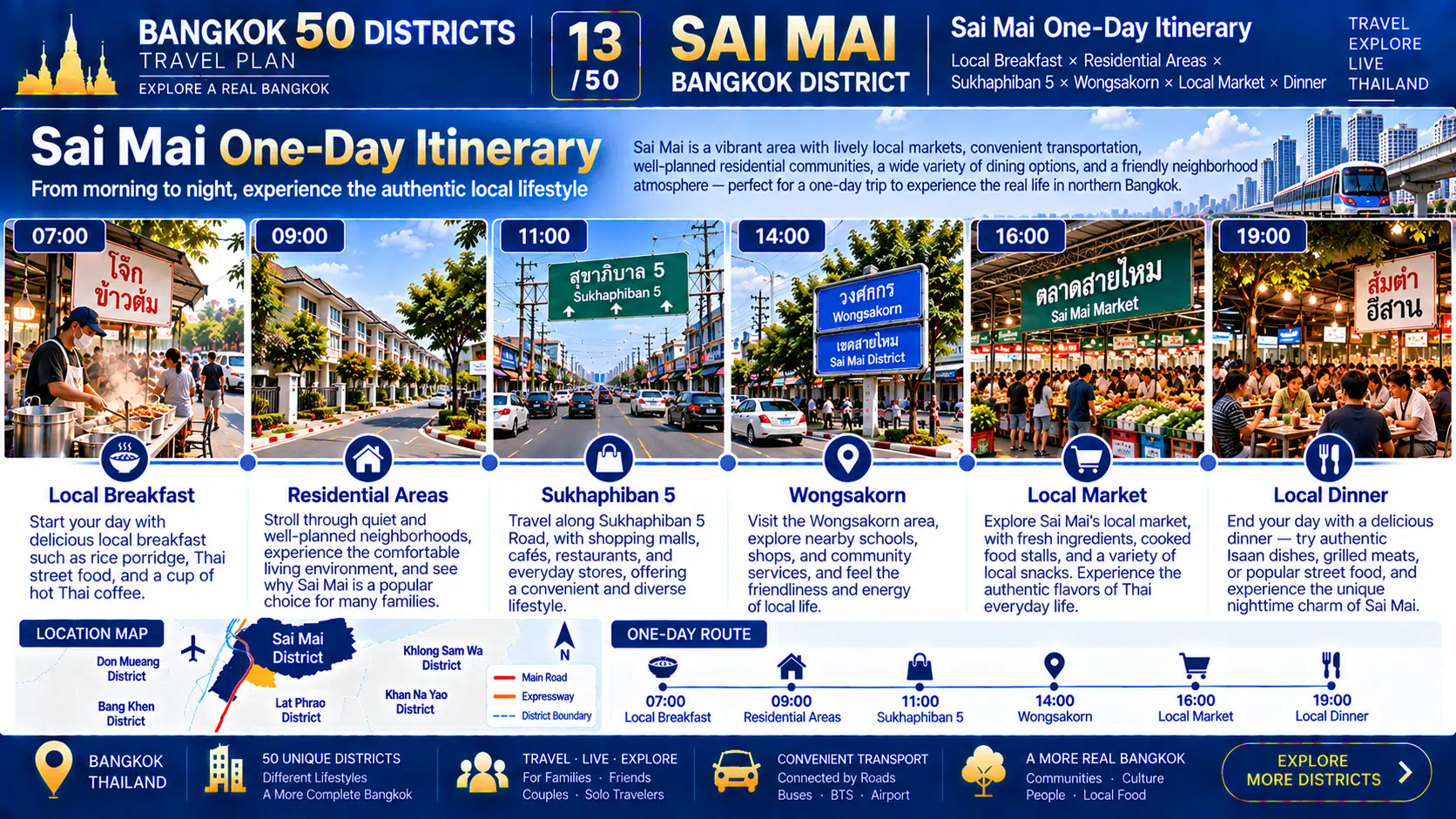
08|How to Spend One Day in Sai Mai
Sai Mai is not a district that needs a checklist of five major attractions.
A better approach is to treat it as:
one day observing community life in northern Bangkok.
07:00|Local Breakfast
Start near a residential neighborhood.
Choose a simple rice porridge shop, noodle stall or Thai breakfast restaurant.
Do not begin by searching for the highest-ranked place online.
Look at what nearby residents actually eat in the morning.
09:00|Residential Streets
Walk through a quiet residential area.
Observe detached houses, townhomes, apartments, schools and small neighborhood businesses.
Here, “ordinary” is exactly what we came to see.
11:00|Sukhaphiban 5
Continue along one of Sai Mai’s important lifestyle corridors.
Watch how residential developments spread along the road and how shops, restaurants, cafés and services have followed the population.
12:30|Local Lunch
Choose a restaurant popular with nearby residents.
Thai made-to-order food, noodles or Isaan cuisine are all good options.
Do not worry too much about decoration.
The food and neighborhood atmosphere matter more.
14:00|Wongsakorn and the Surrounding Community
Explore the local lifestyle around Wongsakorn.
See how residents shop, eat, meet friends and handle everyday errands without traveling into central Bangkok.
This is one of the best places in the district to understand the idea that:
“everything you need can increasingly be found close to home.”
16:00|Community Market
Visit a neighborhood market before the evening rush.
Buy some fruit.
Look through the prepared-food stalls.
Watch residents begin shopping for dinner.
This is one of the most active times of day in Sai Mai.
19:00|Local Dinner
Finish with dinner at a neighborhood restaurant or near the market.
Choose somewhere busy with local residents rather than somewhere designed specifically for tourists.
20:00|Sai Mai After Dark
There is no need to look for nightlife.
Take a short walk through an ordinary neighborhood instead.
Convenience stores remain brightly lit.
Restaurants still have customers.
Motorcycles occasionally pass.
Residential streets gradually become quiet.
This may not be the “Bangkok nightlife” shown in travel advertisements.
But for millions of Bangkok residents, this is what an ordinary evening actually looks like.
09|Why Write an Entire Article About a District With Few Famous Attractions?
By District 13, this question has become increasingly important.
If the Bangkok 50 Districts Travel Plan eventually becomes nothing more than:
“What attractions are here?”
“Where is the best photo spot?”
“Which restaurant is trending?”
then we are still looking at Bangkok through the limits of a traditional tourist guide.
But a real city does not exist only for visitors.
Sai Mai is a perfect example.
Its importance does not come from one internationally famous landmark.
It comes from something much simpler:
people actually live here.
Every morning, someone leaves for work.
Someone takes a child to school.
Someone buys groceries at the market.
Someone eats lunch at a roadside restaurant.
Someone comes home in the afternoon.
Someone buys dinner in the evening.
Someone takes a walk through the neighborhood at night.
None of these moments sounds extraordinary.
But multiply those ordinary routines by hundreds of thousands of people, day after day, and they become a city.
That is why, by our 13th stop, this series feels less and less like a simple:
“Bangkok Attractions Guide.”
What we are really trying to document is:
why Bangkok became the city it is today.
The Old City tells us about history.
Siam tells us about commerce.
Yaowarat tells us about migration and food culture.
Bang Kapi shows us how an outer urban center can emerge.
Bueng Kum reveals the importance of residential life.
Khan Na Yao shows us how Bangkok continues expanding outward.
And Sai Mai reminds us:
the largest part of a city may be made up of places tourists would never think to visit.
Once we begin walking through those places, Bangkok slowly stops being just a travel map.
It becomes a city we can actually begin to understand.
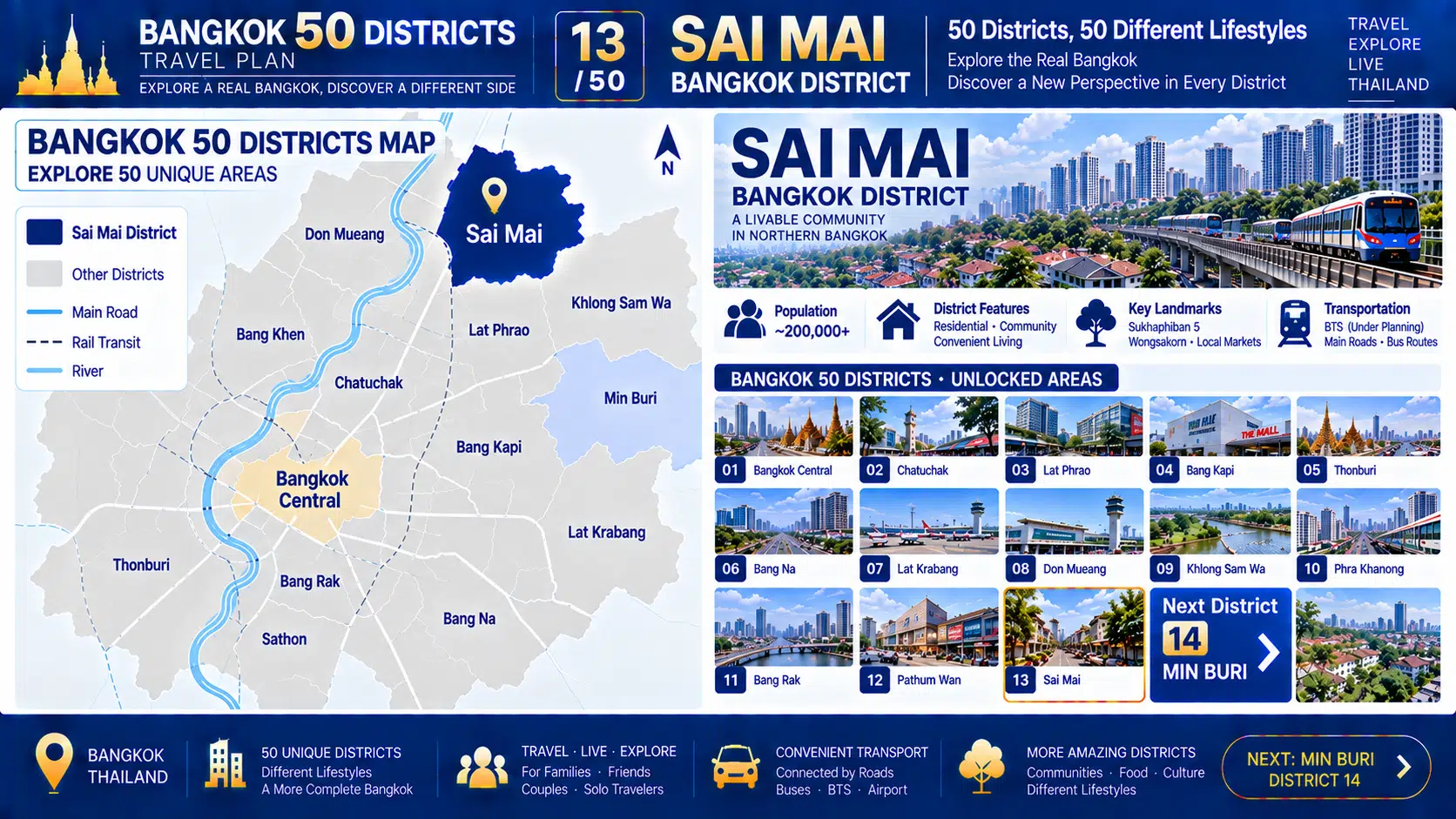
13 / 50 UNLOCKED
SAI MAI ✓
Keywords:
Sai Mai · Phahonyothin · Sukhaphiban 5 · Wongsakorn · Residential Communities · Local Markets · Aviation History · Local Food · Northern Bangkok · Everyday Life
37 districts remaining.
NEXT STOP|14 / 50
MIN BURI
Leaving Sai Mai, our journey will turn back toward eastern Bangkok.
In Min Buri, the story changes again.
Residential communities remain important, but they are joined by older markets, canals, diverse local communities and a rapidly changing transportation and residential network.
If Sai Mai asks:
“How does a Bangkok outer district built primarily around ordinary families actually live?”
then Min Buri takes us to another question:
“When old markets, canals, diverse communities and modern urban expansion exist side by side, how does a once more independent eastern town gradually become part of modern Bangkok?”