After completing our 13th stop, Sai Mai, we saw one of the most residential sides of northern Bangkok.
There were few tourists.
Homes, schools, markets, small businesses and ordinary family life shaped the district’s everyday rhythm.
Now we turn east again.
Our 14th stop is:
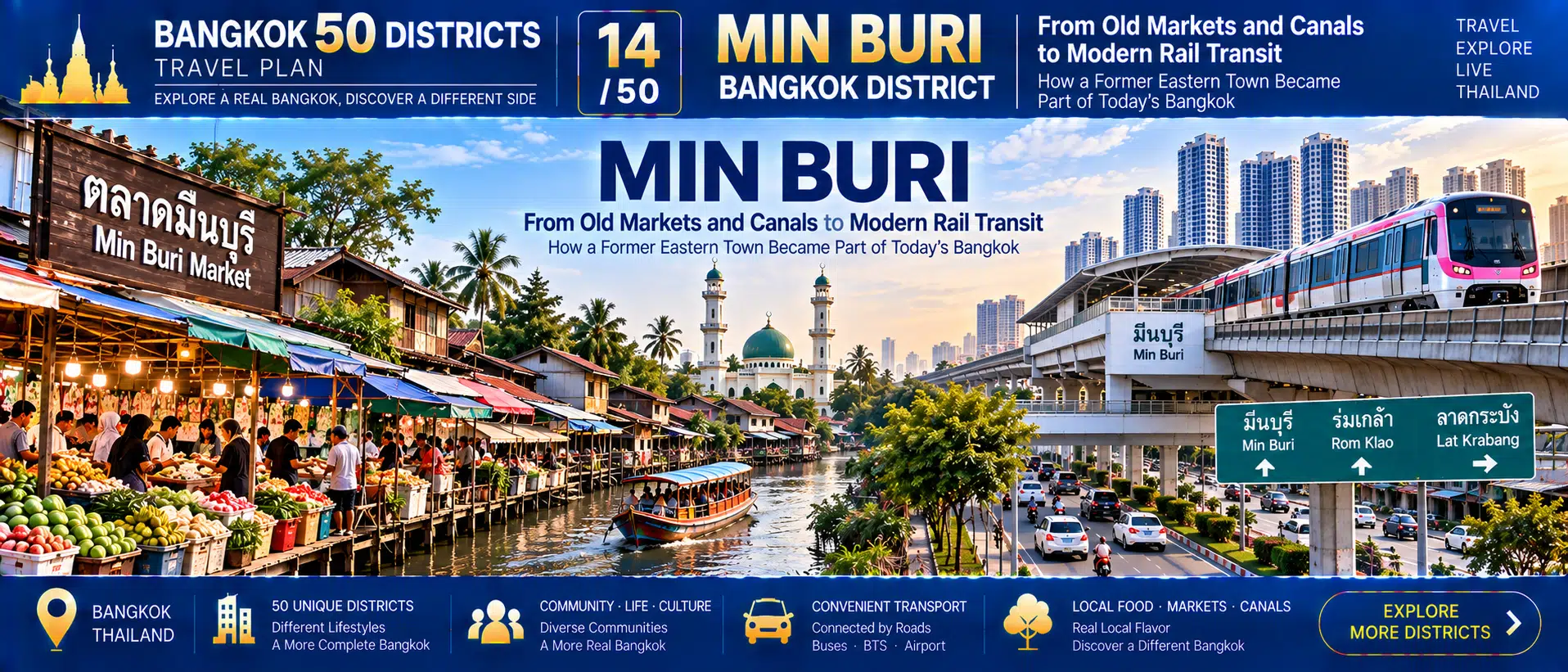
MIN BURI
Min Buri feels different from Bueng Kum, Khan Na Yao and Sai Mai.
It is not simply another residential district created by Bangkok’s outward expansion.
Min Buri has its own older market, canals, long-established communities and a strong sense of being a local center in its own right.
At the same time, modern roads, residential development and newer rail connections are changing the way the district connects with the rest of Bangkok.
This creates one of the most interesting contrasts in our journey so far.
On one side:
markets, canals, mosques, older communities and ways of life that have existed here for generations.
On the other:
new transportation, housing, commerce and the continuously expanding modern metropolis.
That gives us the central question for District 14:
How did an eastern area with its own local center gradually become integrated into the Bangkok we know today?
01|Where Is Min Buri?
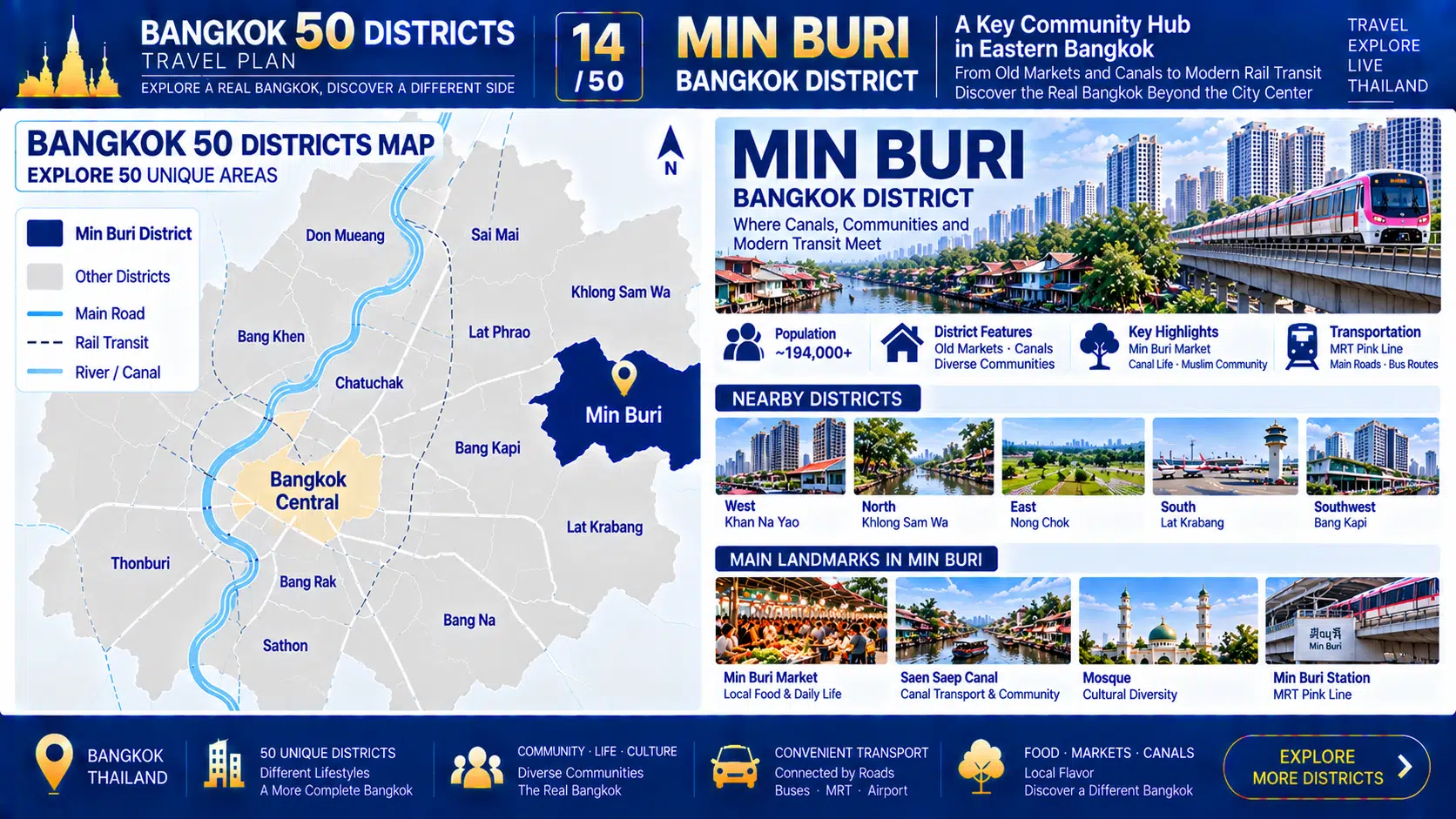
Min Buri is located in eastern Bangkok.
Travel east from Bangkok’s traditional center through areas such as Bang Kapi, Bueng Kum and Khan Na Yao, and the urban landscape gradually opens into the wider eastern part of the metropolis.
Min Buri connects with districts including Khlong Sam Wa, Khan Na Yao, Saphan Sung, Lat Krabang and Nong Chok.
Continue farther east and the city increasingly overlaps with lower-density residential areas, canals and more open land.
This is one of the reasons Min Buri feels distinctive.
It clearly belongs to modern metropolitan Bangkok, yet it still retains the character of a local center with its own everyday identity.
Many residents do not need to travel to Siam for every part of daily life.
Shopping.
Food.
Markets.
Schools.
Healthcare.
Religious activities.
Everyday services.
Much of this can already be found locally.
So the first question we should ask in Min Buri is not:
“How far is it from downtown Bangkok?”
It is:
“Why has Min Buri been able to function as a center of its own?”
02|Min Buri Market: Why Did a Local Center Develop Here?
One of the best places to begin understanding Min Buri is:
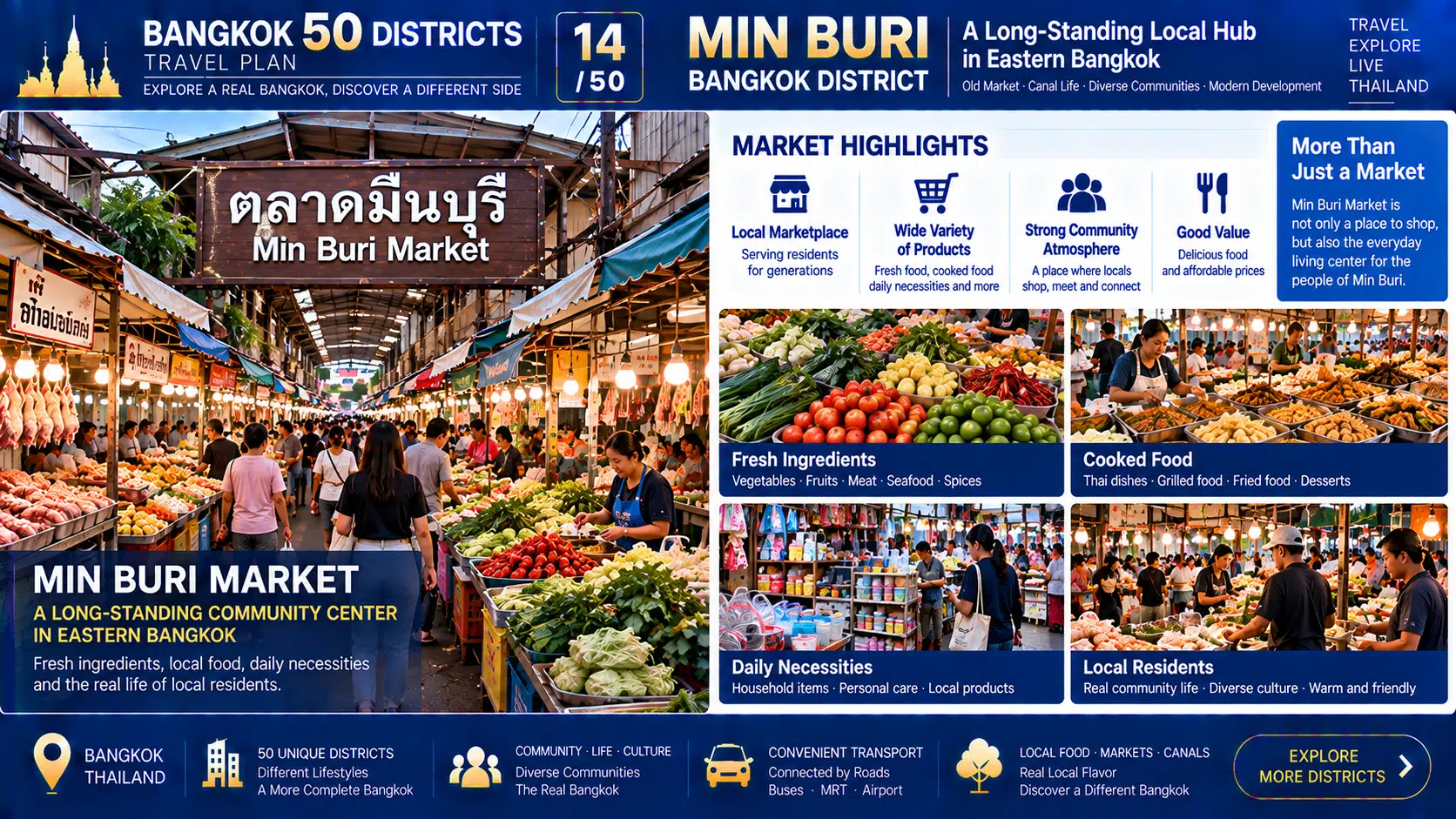
MIN BURI MARKET
Before giant modern shopping malls became part of everyday Bangkok, markets were among the most important centers of local life.
People came to buy ingredients.
Eat.
Trade.
Meet neighbors.
Run businesses.
And find many of the things their households needed every day.
When these activities remain concentrated in one place for years, a wider network of shops, services and communities naturally develops around them.
That is why an old market is more than somewhere to buy food.
It records how an area once organized its daily life.
Even today, Min Buri’s market environment still feels strongly local.
Vegetables.
Fruit.
Meat.
Fish and seafood.
Spices.
Prepared food.
Desserts.
Household goods.
Most customers are not looking for souvenirs to take home from Thailand.
They are buying things they will actually cook, eat or use that day.
And that is one of the clearest differences between a community market and a tourist-oriented night market.
One serves visitors.
The other serves:
everyday life.
03|Water Came Before the Roads
When we think about transportation in Bangkok today, the first things that usually come to mind are:
BTS.
MRT.
Expressways.
Taxis.
Cars.
But go farther back in time and the most important transportation network across many parts of Bangkok was not the road.
It was:
WATER
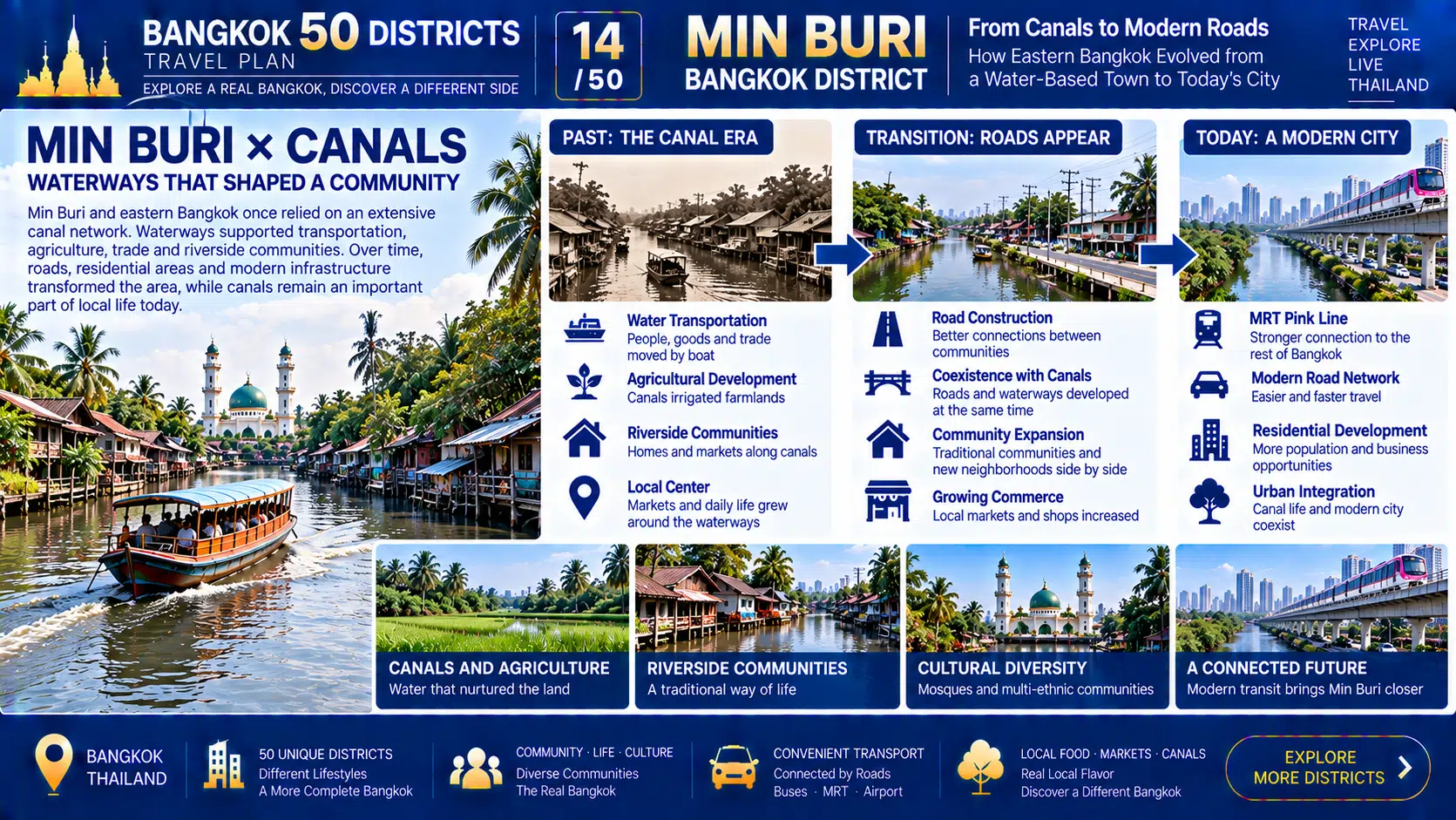
Min Buri and the wider eastern Bangkok landscape developed among canals, waterways, agricultural land and communities built close to water.
Water was not simply part of the scenery.
It was transportation.
It supported agriculture.
It moved goods.
It influenced where communities formed.
And it affected where people built their homes.
This means that much of the road-based city we see today developed on top of an older landscape organized around waterways.
So if we visit Min Buri and look only at its modern roads, we miss one of the most important layers of its history.
The more interesting story is this:
the arrival of roads did not make canal life disappear completely.
Instead, the older water-based city gradually moved into the background while modern Bangkok developed around it.
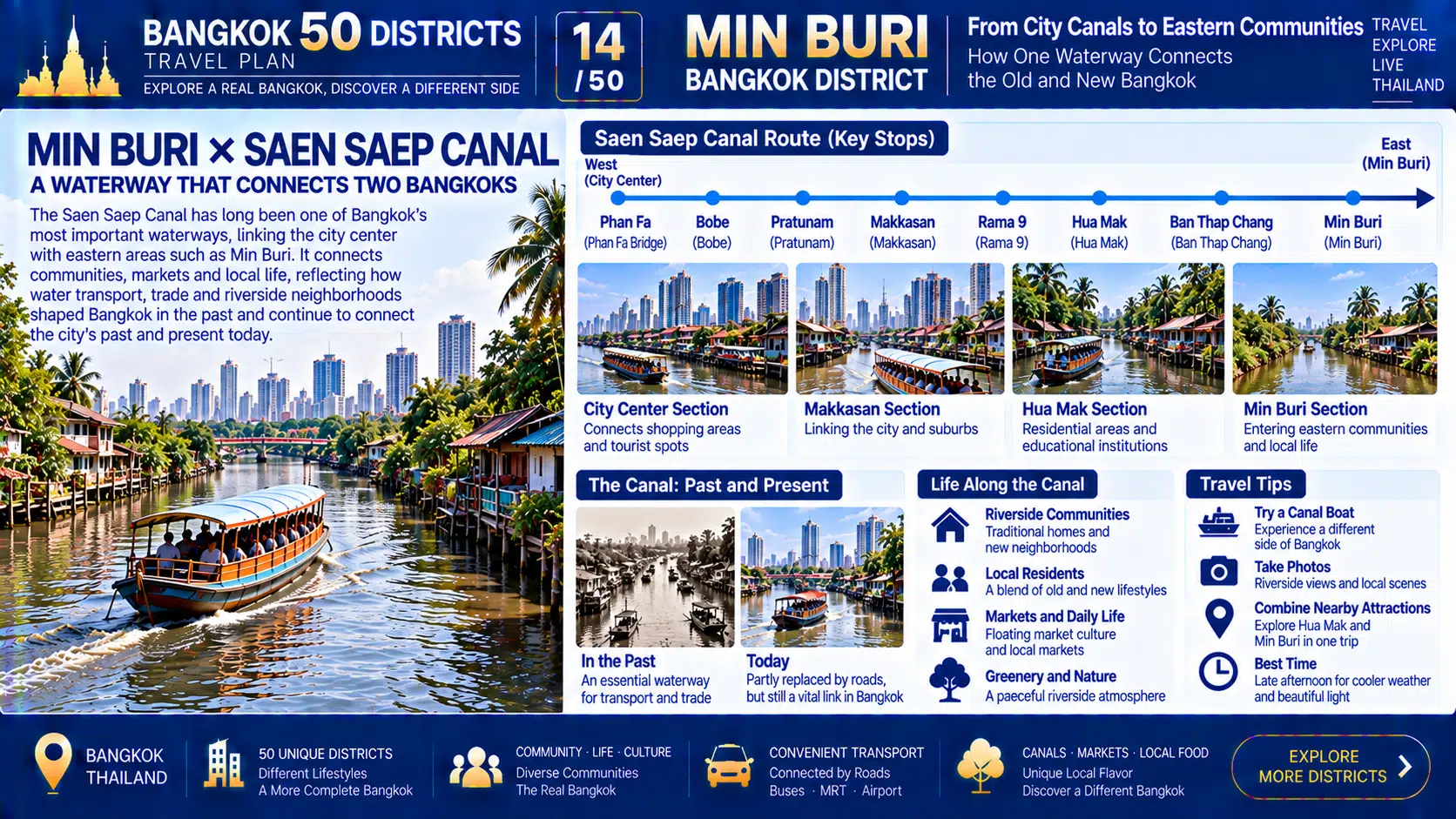
04|Saen Saep Canal: One Waterway, Two Very Different Bangkoks
Many travelers in Bangkok have heard of:
Khlong Saen Saep.
In central Bangkok, it is often understood primarily as a useful public-transport route for avoiding road congestion.
But follow the wider waterway system eastward and its meaning becomes much bigger than simply “taking a boat.”
It takes us back to an older logic of Bangkok.
As we move east, high-rise commercial development becomes less dominant.
Residential communities increase.
Urban density changes.
Waterways and roads begin to exist side by side.
The same canal system therefore helps us understand two very different versions of Bangkok.
One is intensely urban and modern.
The other is shaped more strongly by eastern communities and the older relationship between people and water.
This is one of the most fascinating things about Min Buri.
It reminds us that:
Bangkok did not simply erase its old city and replace it with a new one.
In many places, old and new urban systems continue to overlap.
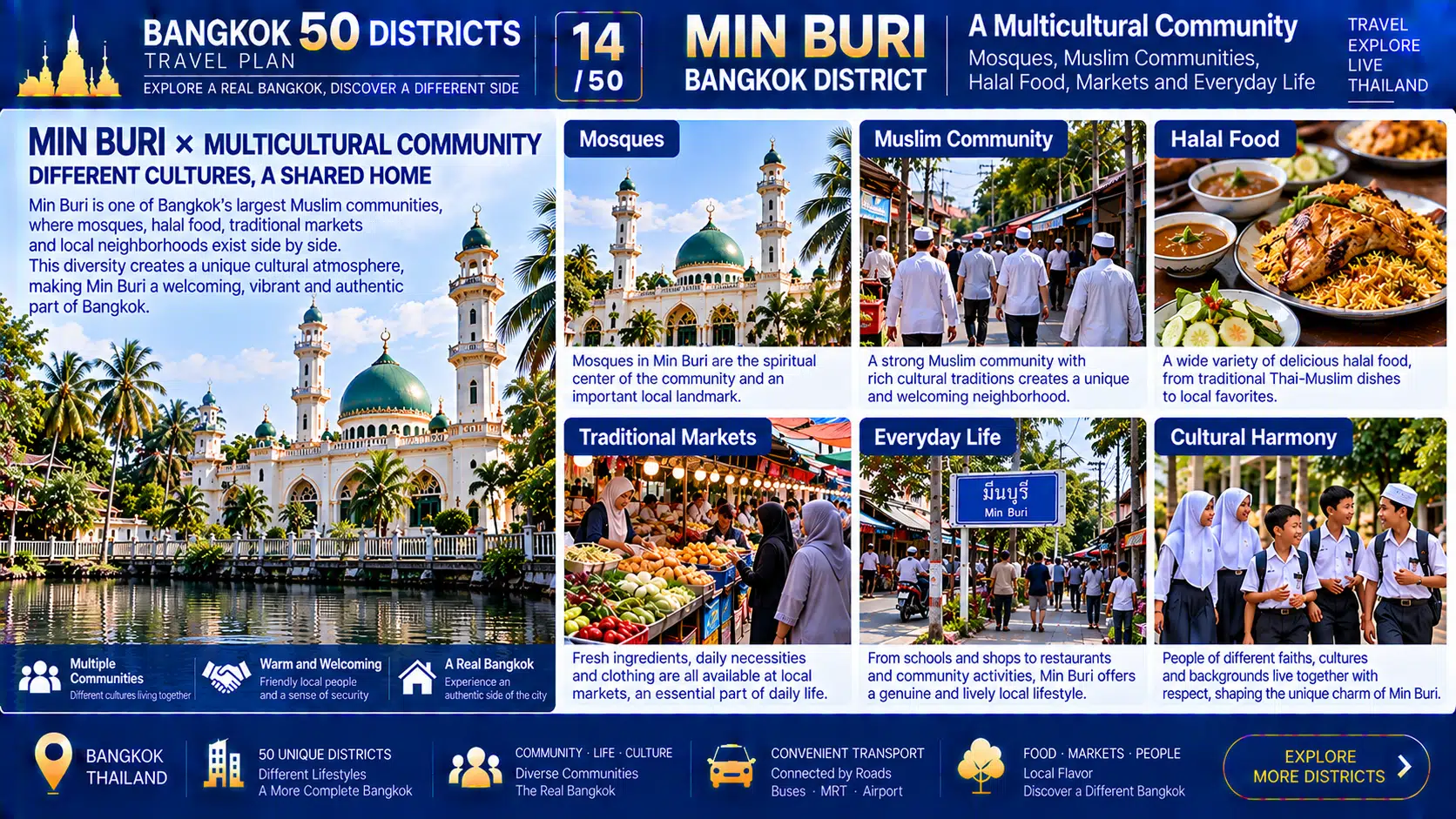
05|Min Buri’s Diverse Communities: Mosques Are Part of the Urban Landscape Too
As we travel farther into eastern Bangkok, another change becomes increasingly visible:
the cultural landscape becomes more diverse.
Min Buri and the wider eastern part of Bangkok are home to long-established Muslim communities.
That gives parts of the district a different visual and cultural character from Bangkok’s best-known tourist areas.
Mosques.
Halal restaurants.
Muslim families.
Community markets.
People of different religious and cultural backgrounds sharing the same wider city.
This is not a “cultural village” created for visitors.
It is ordinary daily life.
That also means travelers should approach these communities with respect rather than treating them as something exotic.
Respect religious spaces.
Respect local residents.
Ask before taking close photographs of people.
Follow dress and behavioral requirements when entering religious sites.
A city does not become interesting because every neighborhood looks the same.
It becomes interesting because:
different communities can live in different ways while still belonging to the same city.
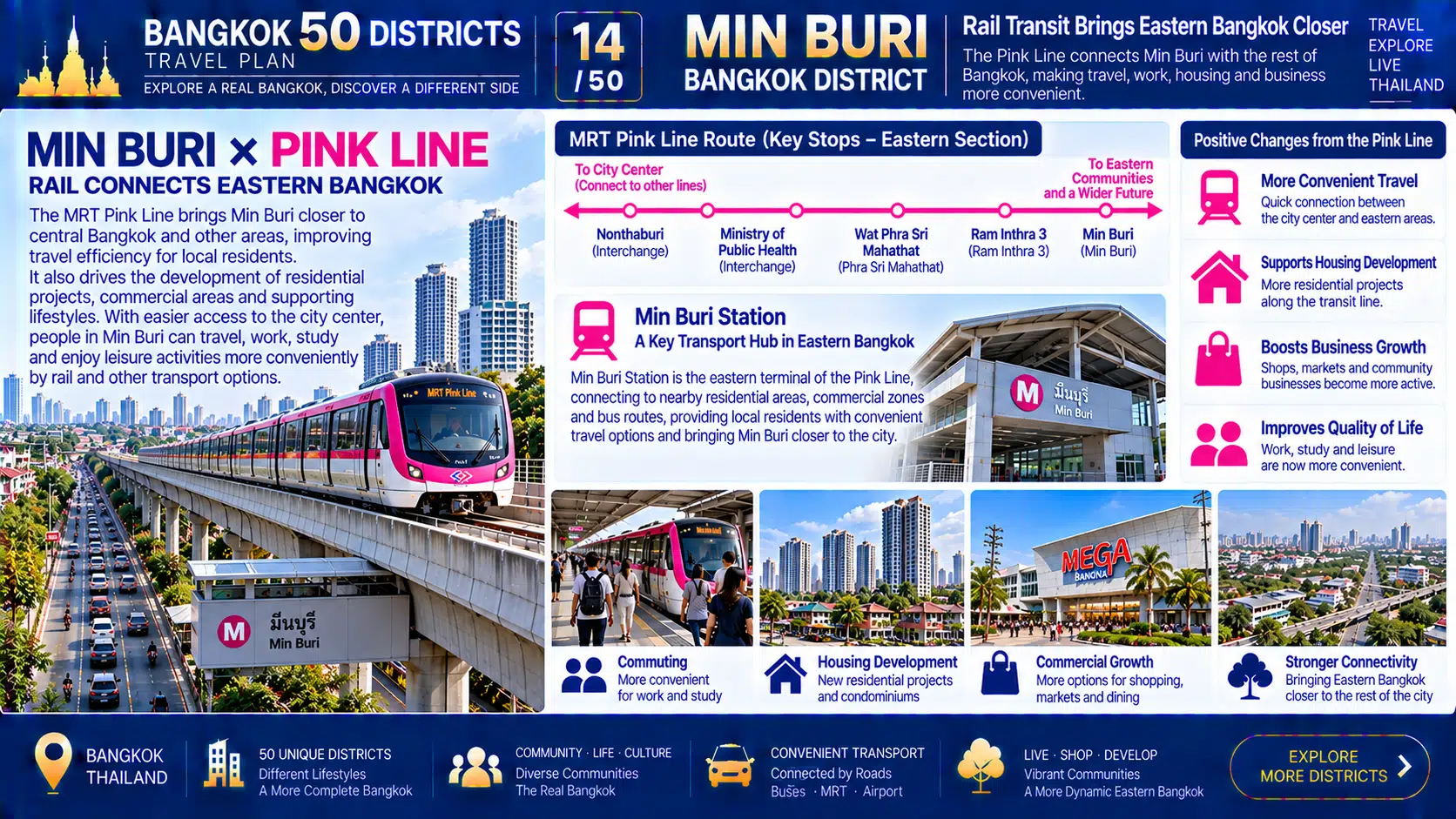
06|The Pink Line: Changing the Distance Between Min Buri and the Rest of Bangkok
If old markets and canals represent Min Buri’s older urban logic, modern rail transit represents something very different:
a new way of connecting the district to the metropolis.
As Bangkok’s rail network has expanded outward, northern and eastern areas that once depended much more heavily on roads have gained additional public-transport options.
For a visitor, rail transit means:
“Getting here is easier.”
For residents, however, the effects can be much larger.
Commuting patterns change.
Job opportunities become accessible across a wider area.
Commercial activity develops around stations.
Residential development can increase.
New shops and services appear.
Even decisions about where a family chooses to live can be influenced by transportation.
That is why a new rail line is not simply another colored line on a transit map.
It can redefine a much more important question:
“How far away is this place from Bangkok?”
In the past, distance was measured mainly in kilometers.
In a modern metropolis, distance is increasingly measured in:
travel time.
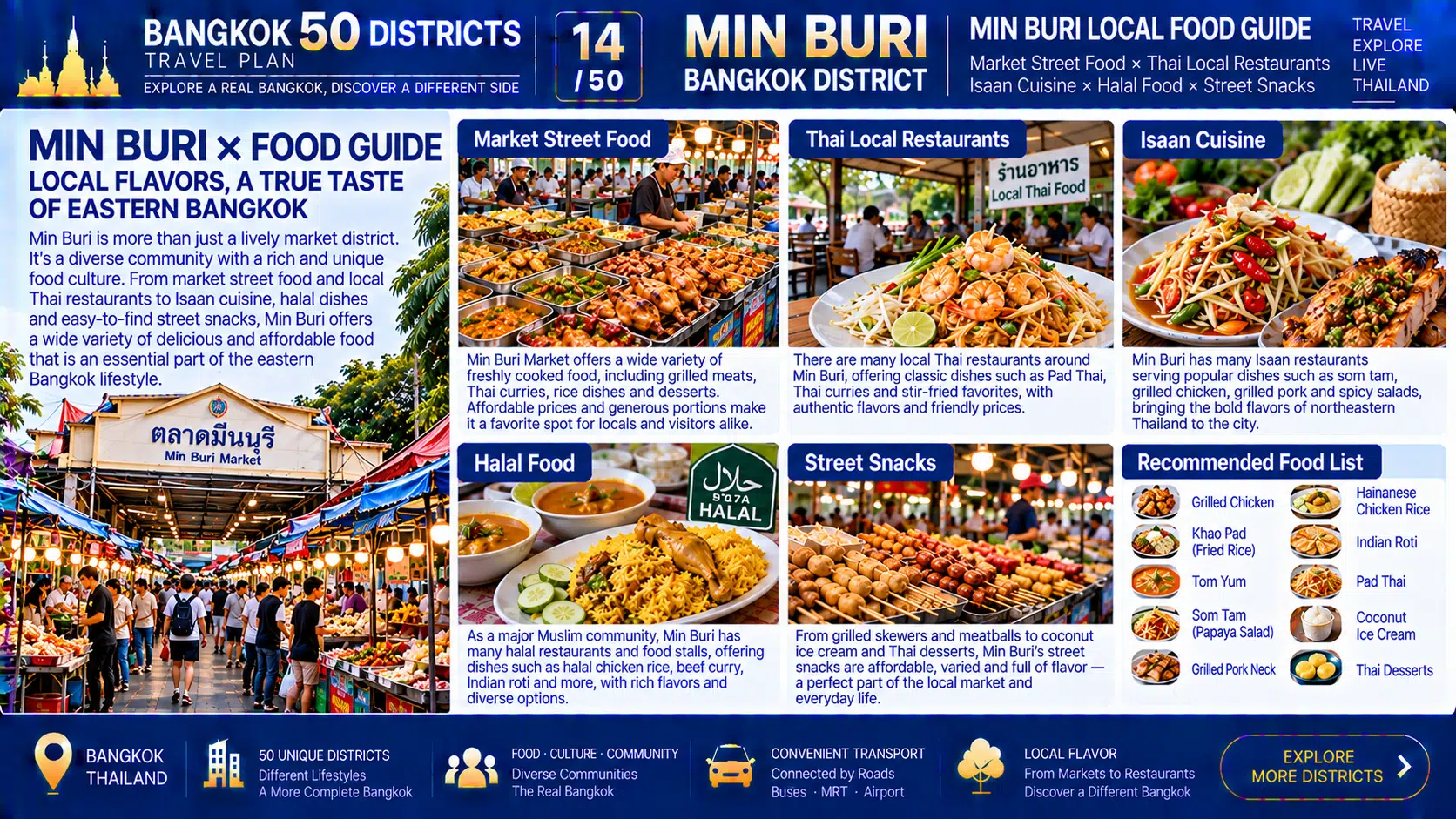
07|What to Eat in Min Buri
Min Buri is especially interesting for our 50 Districts project because several different food cultures overlap here.
① Market Food
This is everyday Min Buri.
Curries.
Stir-fried dishes.
Fried foods.
Desserts.
Rice dishes.
Prepared meals that residents can take home for dinner.
② Everyday Thai Neighborhood Restaurants
Pad kra pao.
Noodles.
Chicken rice.
Thai fried rice.
Boat noodles.
Made-to-order Thai dishes.
These are the meals people eat as part of ordinary life rather than special occasions.
③ Isan Cuisine
Som tam.
Grilled chicken.
Grilled pork neck.
Larb.
Sticky rice.
The familiar flavors of northeastern Thailand remain easy to find throughout Bangkok’s residential communities.
④ Halal and Muslim Community Food
This is one of the most interesting parts of Min Buri’s food culture.
Rice dishes.
Curries.
Chicken and beef dishes.
Local halal restaurants.
And different foods influenced by Thailand’s Muslim culinary traditions.
So instead of asking:
“What is the number-one restaurant in Min Buri?”
try something more interesting.
Spend the day eating three completely different kinds of food.
Have breakfast in the neighborhood.
Eat lunch around the market.
Finish with a local halal or family restaurant.
You may discover that:
sometimes you can taste the history of a district in a single meal.
08|How to Spend One Day in Min Buri
For District 14, I recommend combining four themes in a single day:
markets + canals + diverse communities + modern transportation.
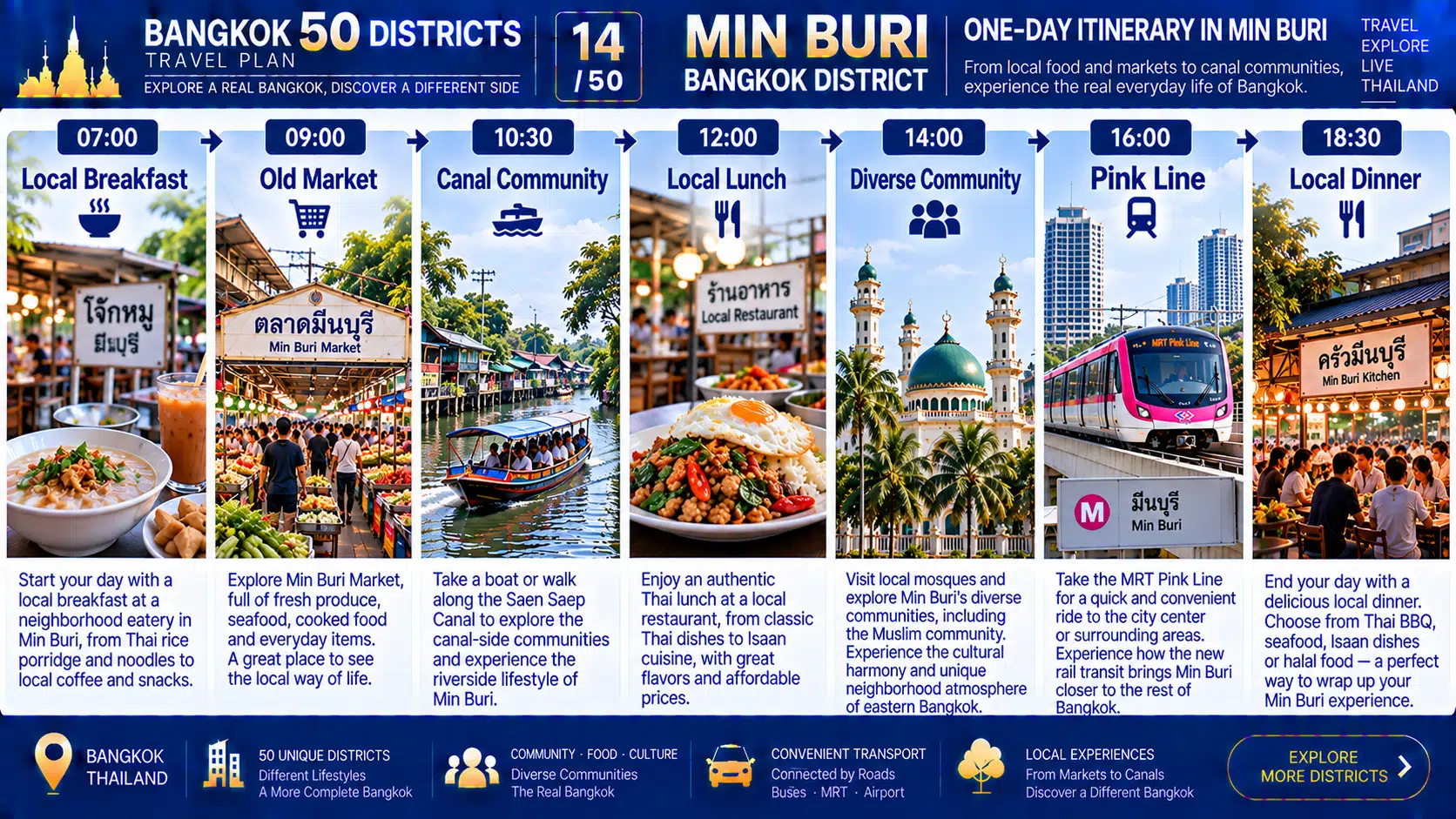
07:30|Local Breakfast
Begin with an ordinary neighborhood breakfast.
Noodles, rice porridge, Thai breakfast dishes or local halal food are all good options.
Do not worry about finding a viral restaurant.
Start by observing how the neighborhood begins its day.
09:00|Min Buri Market
Explore the old market.
Look at what local residents are actually buying.
Fresh ingredients, prepared food, spices, desserts and household goods all reveal something about everyday life.
11:00|Older Communities and Canals
Leave the market and slow down.
Observe how older neighborhoods, waterways and modern roads exist together.
This is where Min Buri’s historical layers become easier to see.
12:30|Local Lunch
Choose a Thai restaurant around the market or inside a nearby community.
A busy restaurant filled with local residents is often a better sign than a place designed specifically for visitors.
14:00|Muslim Communities and Local Life
Explore the wider community respectfully.
Notice mosques, halal restaurants and neighborhood spaces.
The purpose is not simply to take photographs.
It is to understand why eastern Bangkok has a cultural structure that feels different from many of the city’s tourist districts.
16:00|Modern Min Buri
Shift your attention toward newer housing, commerce and transportation infrastructure.
Moving from the old market in the morning to modern urban development in the afternoon makes the district’s different historical layers much easier to understand.
17:30|Rail Transit and Urban Connections
Observe or use modern public transportation to understand how Min Buri now connects with the wider Bangkok network.
At this moment, the canal from the morning and the rail system from the afternoon suddenly become part of the same story.
Both answer the same basic question:
How do people move?
19:00|Local Dinner
Finish at a halal restaurant, neighborhood restaurant or popular local dining area.
End District 14 with a meal that genuinely belongs to eastern Bangkok.
09|Why Is Min Buri Such an Important Stop in the 50 Districts Project?
By District 14, we have already seen many different Bangkoks.
The historic center.
Modern commercial districts.
Chinatown.
Large residential areas.
Outer-city shopping hubs.
Ordinary neighborhoods.
But in Min Buri, several of those urban stories begin to overlap.
There is the old.
And there is the new.
There are waterways.
And there is modern rail transit.
There are long-established local markets.
And there are newer residential and commercial developments.
There are Buddhist communities.
And there are long-established Muslim communities.
So the most important thing to see in Min Buri is not one attraction.
It is:
TIME
Old Bangkok has not completely disappeared.
Modern Bangkok has not completely replaced it.
They exist together.
A modern road may run beside an old canal.
New housing may appear near a long-established market.
An area that once required a long road journey can become increasingly connected to the rail network.
This is what makes a real metropolis so interesting.
A city is never suddenly “finished.”
It is always changing.
Sai Mai taught us that:
ordinary daily life is worth documenting.
Min Buri adds another idea:
the city we see today is the result of different eras being layered on top of one another over decades—or even longer.
Once we begin seeing canals, markets, religion, housing, roads and rail transit at the same time, we are no longer looking only at a travel destination.
We are beginning to understand:
how Bangkok became the city it is today.
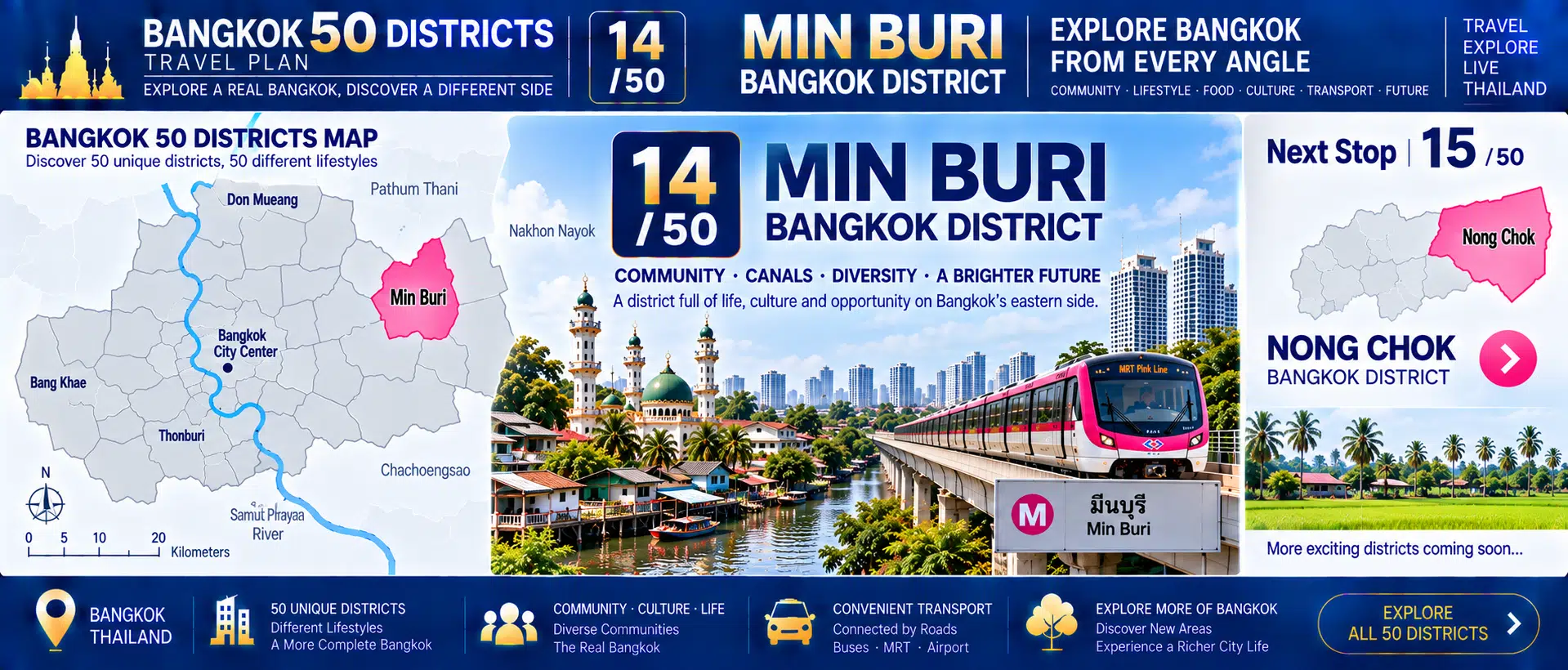
14 / 50 UNLOCKED
MIN BURI ✓
Keywords:
Min Buri · Min Buri Market · Saen Saep Canal · Pink Line · Muslim Communities · Halal Food · Local Markets · Canal Life · Eastern Bangkok · Urban Expansion
36 districts remaining.
NEXT STOP|15 / 50
NONG CHOK
Continue east from Min Buri and Bangkok changes dramatically again.
Building density begins to fall.
Large areas of green appear.
Canals, agricultural land, mosques and low-density communities become increasingly common.
We are about to enter a part of the capital that many first-time visitors would hardly imagine could still be Bangkok:
a place officially inside the city, yet visually far removed from the image of a giant Asian metropolis.
If Min Buri asks:
“How can old markets, canals and modern rail transit exist together?”
then Nong Chok takes us to the next question:
“When skyscrapers and shopping malls begin to disappear, and farmland, canals and village-like communities return to the foreground, why is this still Bangkok?”