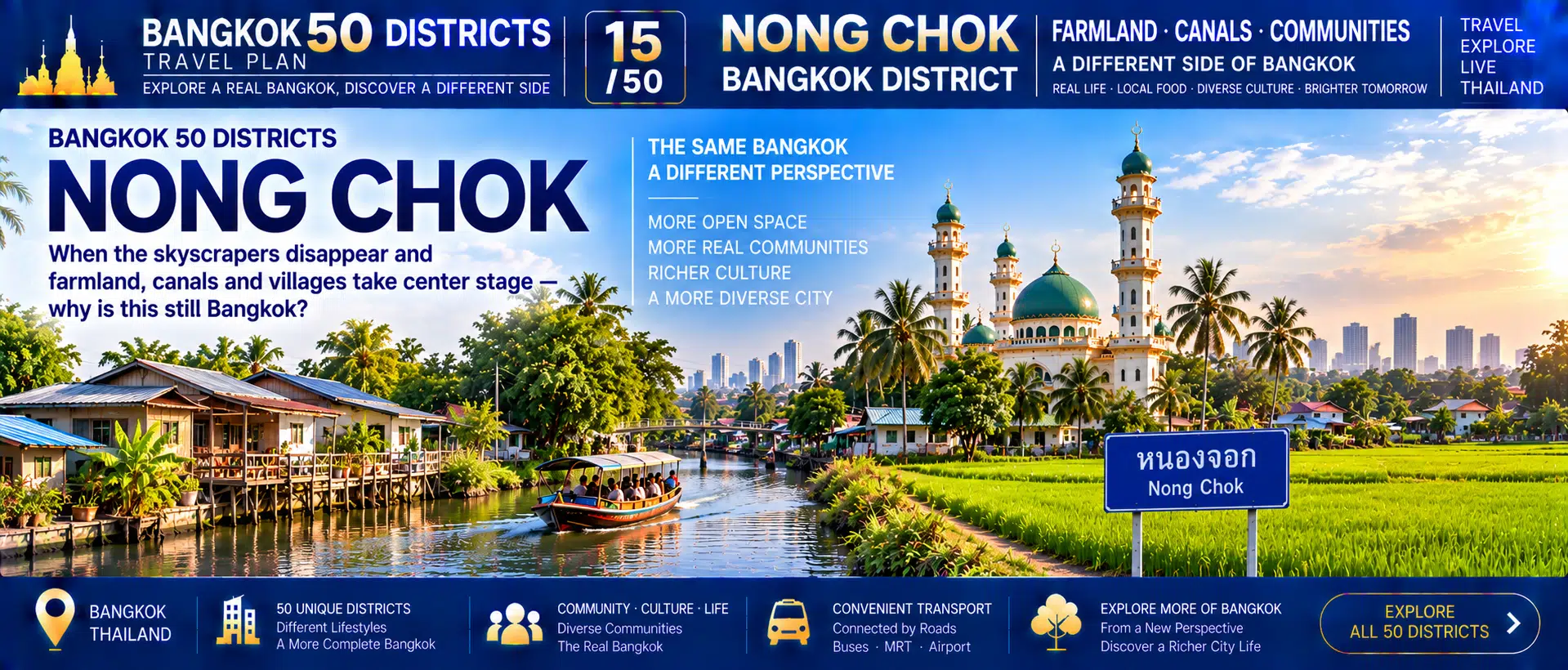
After completing our 14th stop, Min Buri, we began to see several layers of Bangkok overlapping in the same place.
The old market was still there.
The canals were still there.
Long-established Muslim communities remained an important part of local life.
At the same time, the MRT Pink Line, modern housing and newer commercial developments were becoming part of this traditional eastern Bangkok center.
Continue farther east to our 15th stop:
NONG CHOK
And Bangkok suddenly changes.
The high-rises begin to disappear.
Large areas of green appear along the roads.
Canals once again become an important part of the landscape.
Homes are more widely spaced.
Farmland, open fields, mosques, village-like settlements and low-density communities begin to dominate the scenery.
If you showed a first-time visitor a photograph of some parts of Nong Chok without telling them where it was taken, they might find it difficult to believe:
This is still Bangkok.
And that is exactly why Nong Chok deserves such an important place in our 50 Districts Travel Plan.
Bangkok is not only skyscrapers, shopping malls, BTS trains and traffic jams.
At the far eastern edge of the capital, another completely different way of life still exists.
So District 15 asks one of the biggest questions in our journey so far:
When a megacity begins to look like the countryside, is it still the Bangkok we think we know?
01|Where Is Nong Chok?
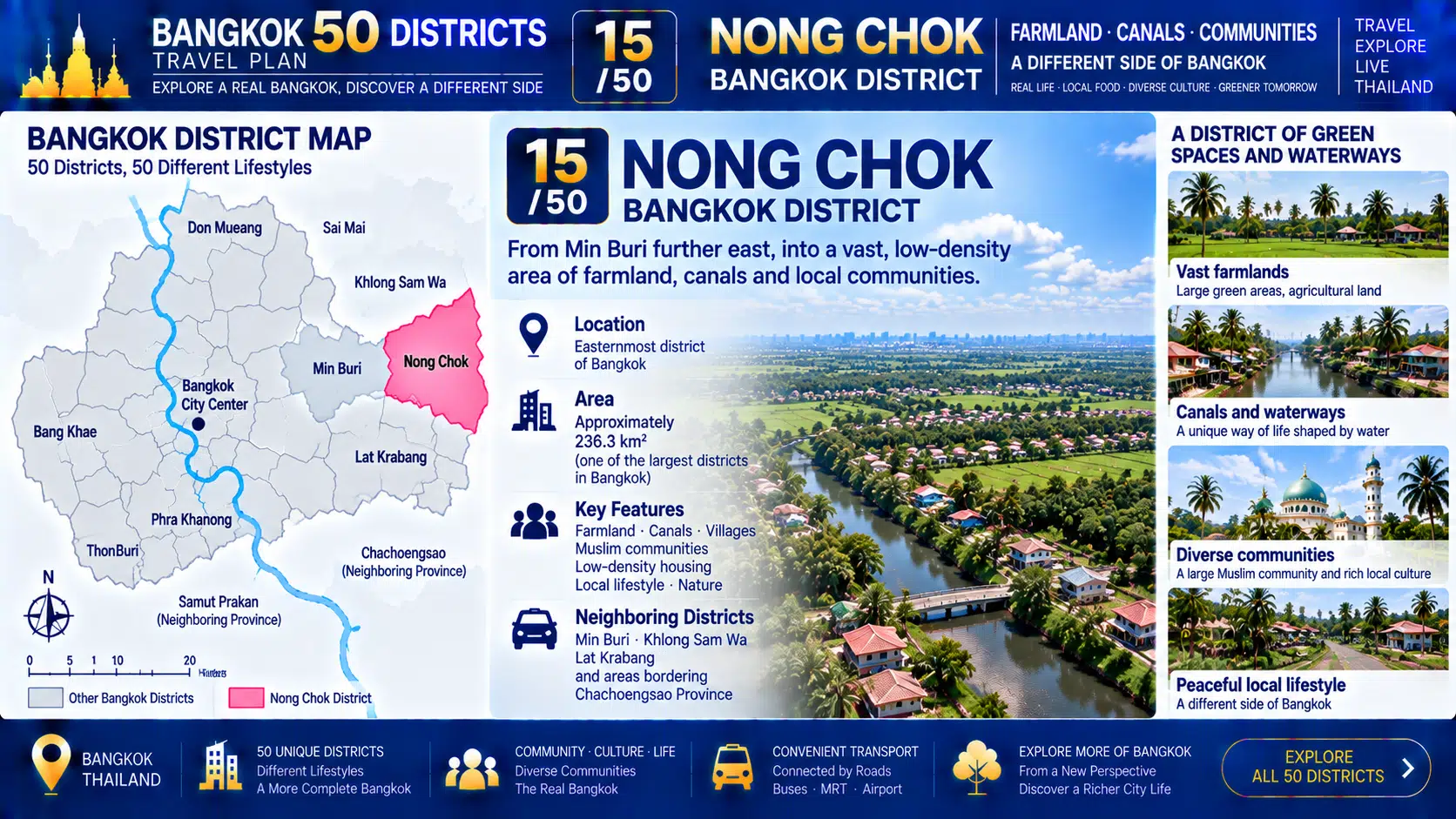
Nong Chok is located in the far eastern part of Bangkok.
Continue east from Min Buri and the density of the city begins to drop noticeably.
It connects with Bangkok districts such as Min Buri, Khlong Sam Wa and Lat Krabang, while its eastern side approaches the broader metropolitan edge toward neighboring provinces.
On a map, Nong Chok immediately stands out.
It covers a very large area.
But once you actually arrive, another contrast becomes obvious:
There is a great deal of land, but development is far less dense than in central Bangkok.
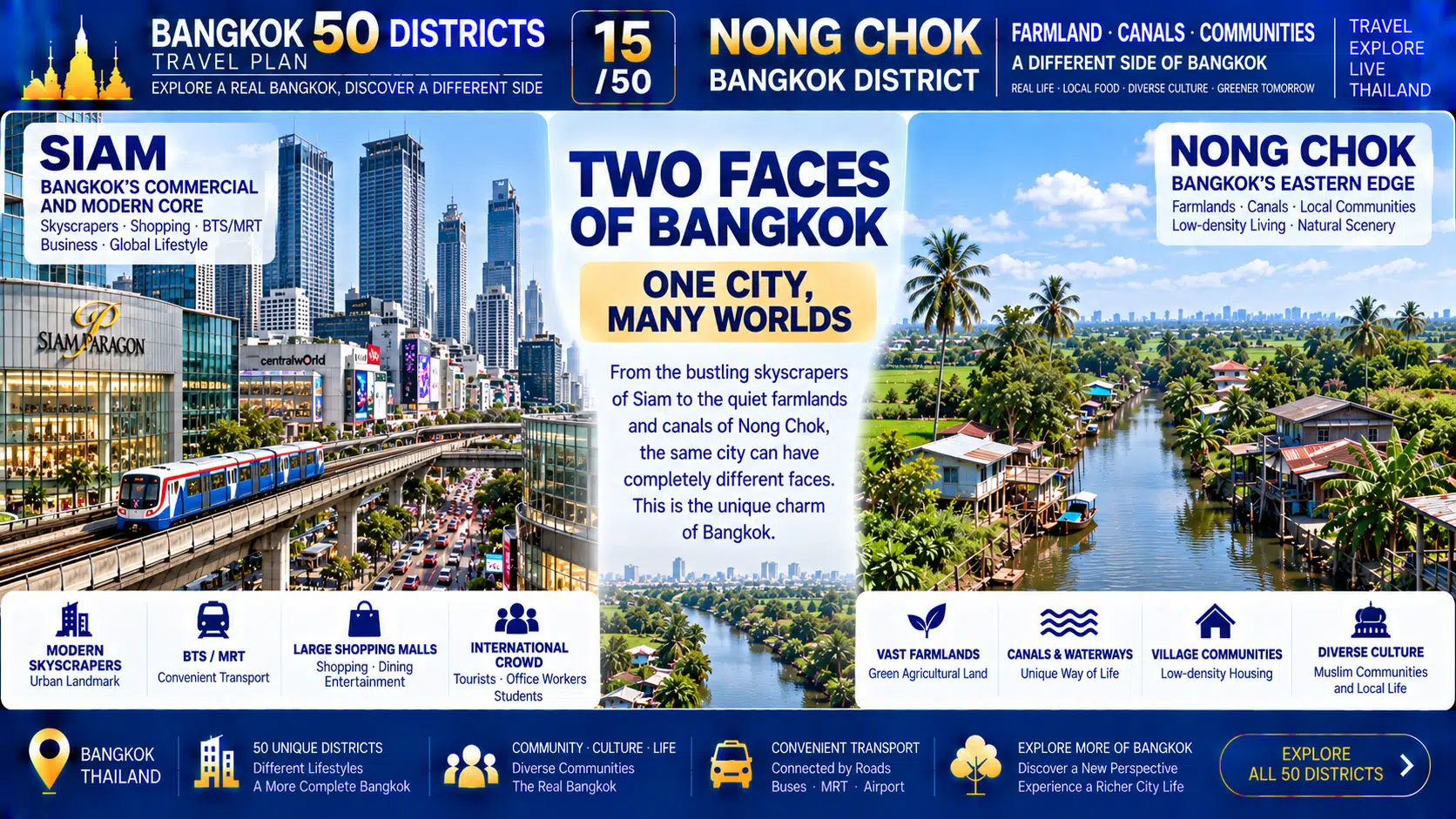
This is a completely different urban logic from Siam.
In the city center, land is expensive.
Buildings grow vertically.
Shopping malls, hotels, condominiums and offices are concentrated into a relatively small area.
In Nong Chok, the city spreads horizontally.
Homes.
Farmland.
Canals.
Schools.
Mosques.
Markets.
Community roads.
They are distributed across a much larger landscape.
So the first thing we need to change when arriving here is our definition of what a city should look like.
A place does not need a skyline full of high-rises to be part of Bangkok.
02|Why Does Nong Chok Look So Different From Bangkok?
This is probably the first question many visitors would ask.
Most of us already carry a fixed image of “Bangkok” in our minds:
BTS trains moving between high-rises.
Enormous shopping centers.
Multi-lane roads.
Condominiums.
Billboards.
Motorcycles.
Crowded intersections.
But in many parts of Nong Chok, the scenery is completely different.
You might find yourself on a quiet road.
Green land stretches beside it.
Homes appear farther apart.
A canal runs beside a community.
Mosque domes and minarets rise between the trees.
A motorcycle passes occasionally.
There are no large tour groups.
No dense collection of famous attractions.
No endless row of tourist cafés.
And that is when something becomes very clear:
Administrative Bangkok is far larger and more diverse than the “central Bangkok” most visitors know.
One city can contain extremely high-density and extremely low-density environments at the same time.
Nong Chok represents the other end of that metropolitan spectrum.
03|Farmland: Bangkok Has Not Completely Left Agriculture Behind
This is one of the things about Nong Chok that most strongly challenges the usual image of Bangkok.
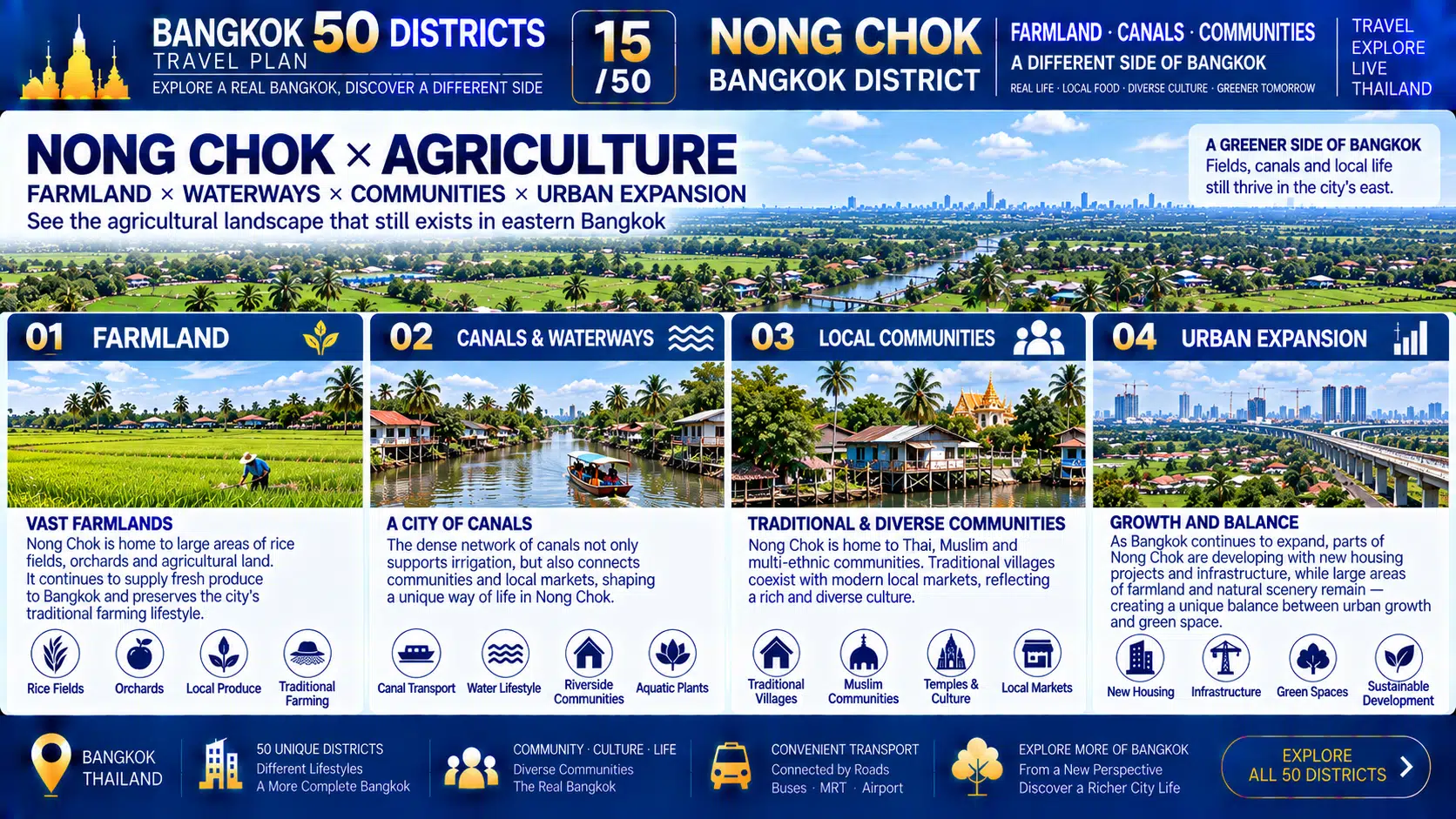
Agriculture still exists inside Bangkok.
Here, large areas of green are not simply landscaped parks designed to make the city look attractive.
Some of the land is genuinely connected to agricultural use.
This landscape reminds us that Bangkok did not suddenly transform from countryside into a modern megacity overnight.
Urban expansion has taken place over a long period.
Some areas urbanized rapidly.
Others retained lower-density land uses for much longer.
So when we look at farmland in Nong Chok, we are seeing more than beautiful greenery.
We are looking at part of Bangkok’s urban history.
How did agriculture shape this area?
Why were canals so important?
Why did communities develop around water and roads?
What happened to these landscapes as Bangkok expanded?
Those questions are far more interesting than simply taking a photograph of a green field.
Because they reveal something important:
beneath modern Bangkok, traces of older ways of using the land are still visible.
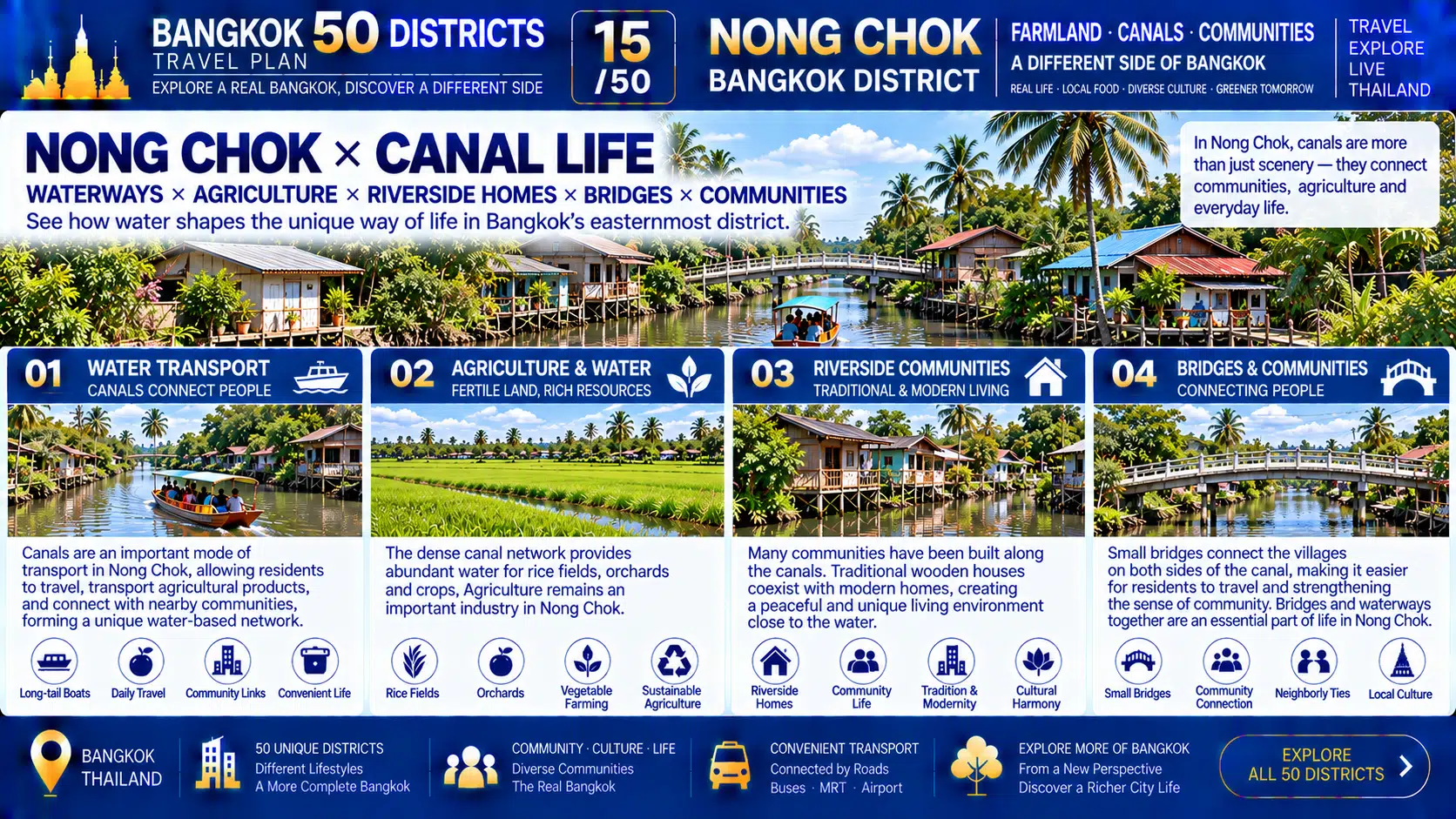
04|Canals: One of the Real Frameworks of Nong Chok
It is difficult to travel through Nong Chok without noticing water.
Canals of different sizes cross this vast district.
Today, roads are among the main ways people travel.
But to understand how the area developed, we need to remember:
canals once determined many aspects of everyday life.
Where agriculture could develop.
How goods could move.
Where residents settled.
Where markets formed.
How religious and community facilities were distributed.
This is similar to what we saw in Min Buri.
But in Nong Chok, the relationship between water and land becomes even more visible.
As urban density decreases, canals are no longer narrow waterways hidden behind high-rises and roads.
They become part of the wider landscape again.
Trees.
Homes.
Fields.
Small bridges.
Roads.
Canals.
Together, they create the physical environment of everyday life.
This is one reason Nong Chok feels so different.
We have not suddenly left Bangkok.
Instead, we have entered:
an older spatial logic of Bangkok that remains visible today.
05|Muslim Communities: One of Nong Chok’s Most Important Cultural Layers
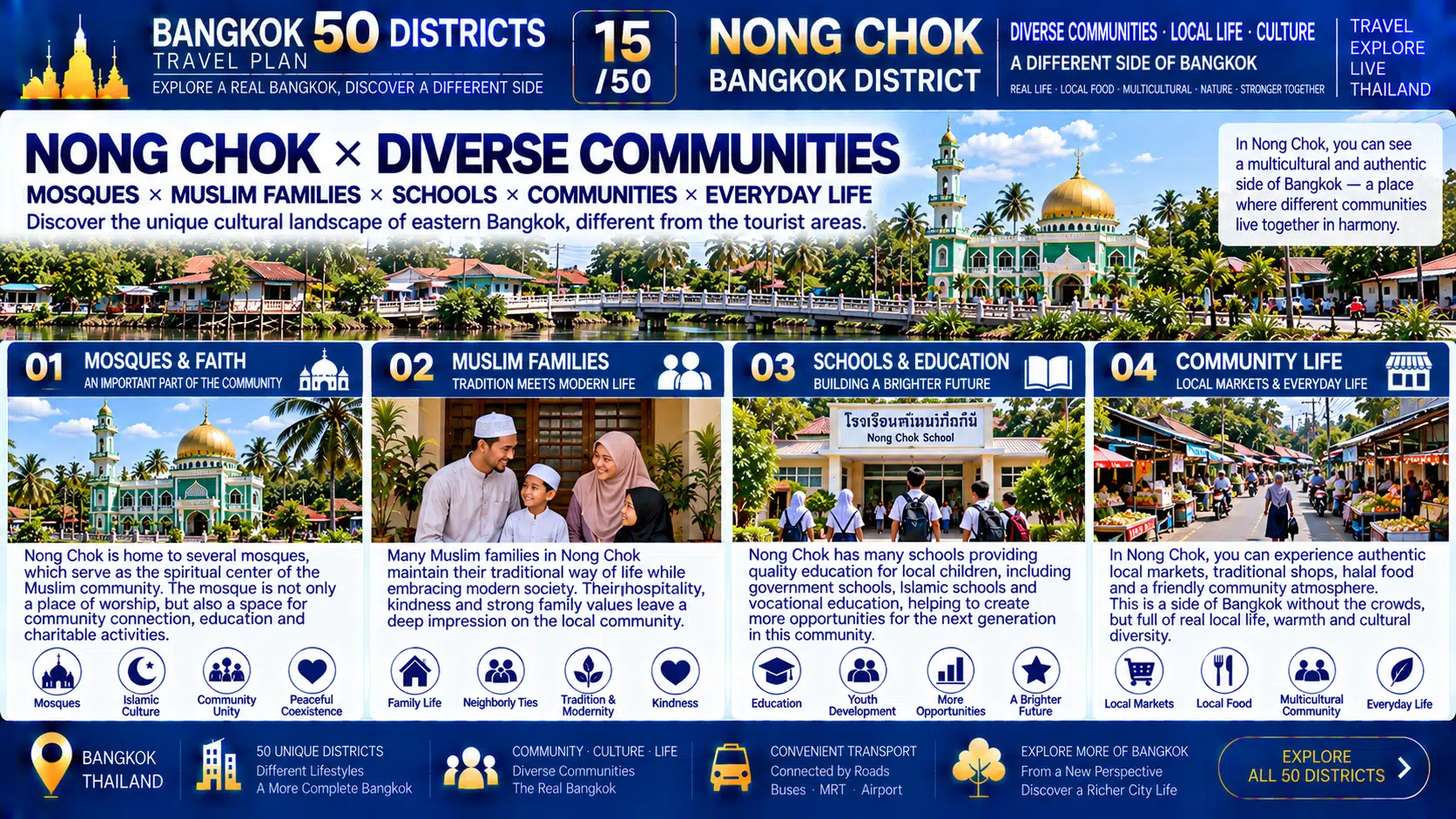
Continue from Min Buri toward Nong Chok and the presence of Muslim communities becomes increasingly visible.
Mosques are not occasional or unusual landmarks here.
In many communities, they are important centers of local life.
Religion.
Family.
Education.
Neighborhood relationships.
Food.
Festivals and community activities.
Many aspects of daily life are connected through these local networks.
This gives Nong Chok a cultural atmosphere that feels noticeably different from Bangkok’s best-known tourist districts.
For visitors, the important thing is not to treat mosques simply as exotic backgrounds for photographs.
Instead, understand that:
these communities have always been part of Bangkok.
Dress appropriately when entering religious spaces.
Do not interrupt prayers.
Ask before taking close photographs of people.
If you are unsure whether visitors or photography are permitted, ask first.
Respect is the first step toward understanding a place.
And as our 50 Districts journey continues, Nong Chok makes something increasingly clear:
Bangkok has never had just one cultural identity.
06|Nong Chok Markets: Why Does a Low-Density District Still Need Its Own Center?
Homes and farmland can be spread across a wide area.
But everyday life still needs places where people come together.
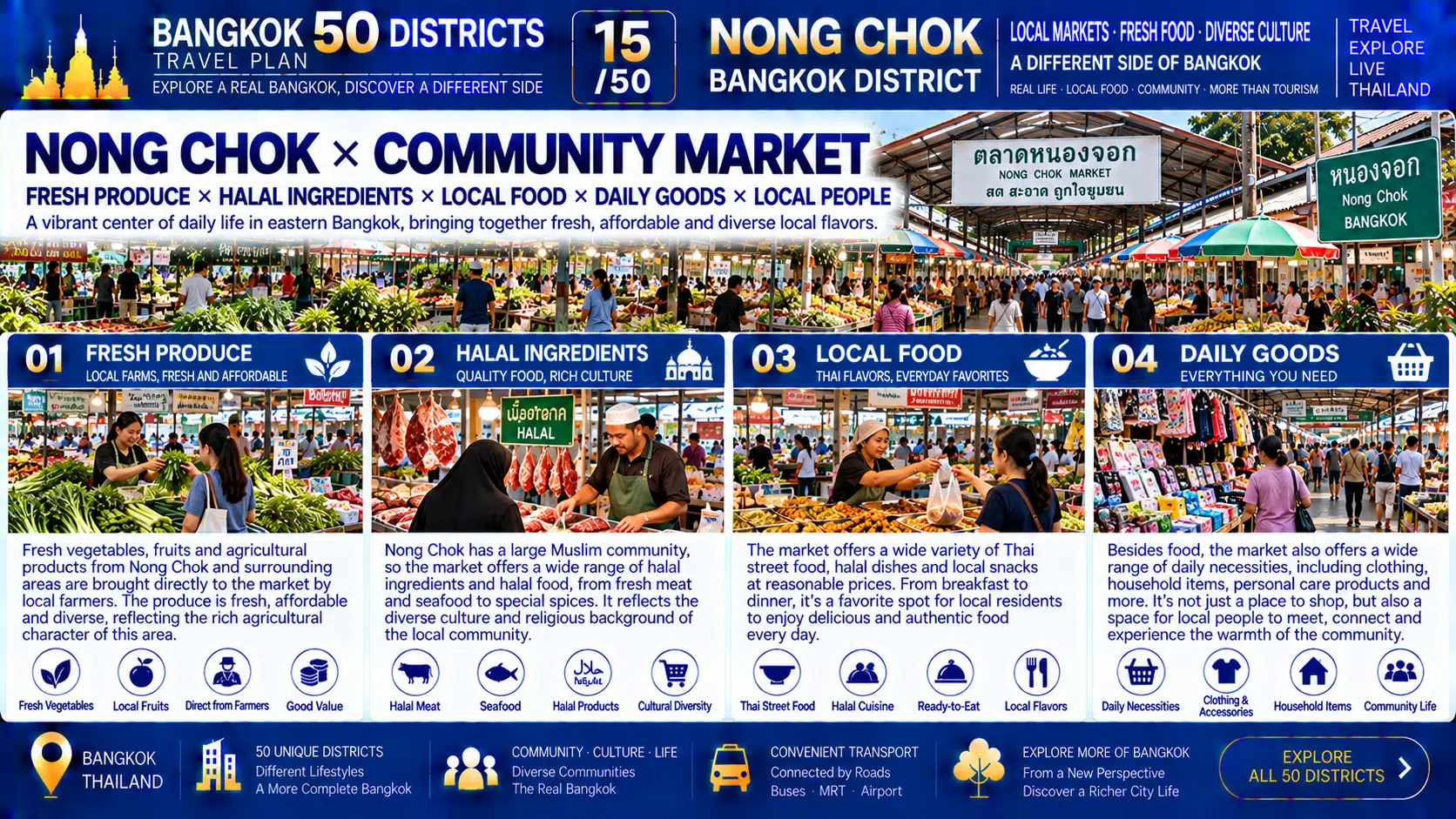
That is why markets remain so important.
In Nong Chok, local markets perform a very practical community function.
Residents come for vegetables.
Fruit.
Meat.
Fish.
Spices.
Prepared food.
Household necessities.
Some stop for breakfast or lunch.
Others buy several dishes to take home for dinner.
The market becomes a meeting point between communities that may otherwise be spread across a large district.
There are similarities with what we saw in Min Buri.
But Nong Chok’s lower-density environment makes the role of the market even easier to understand.
When residents live across a much wider landscape, a stable market becomes something close to a genuine:
local town center.
It may not shine like Siam Paragon.
But it solves the problems people living nearby actually face every day.
07|What to Eat in Nong Chok: Look for the Taste of the Community
The food experience in Nong Chok is very different from central Bangkok.
There is no need to build your day around a Michelin checklist.
What is more interesting is discovering:
what local communities actually eat every day.
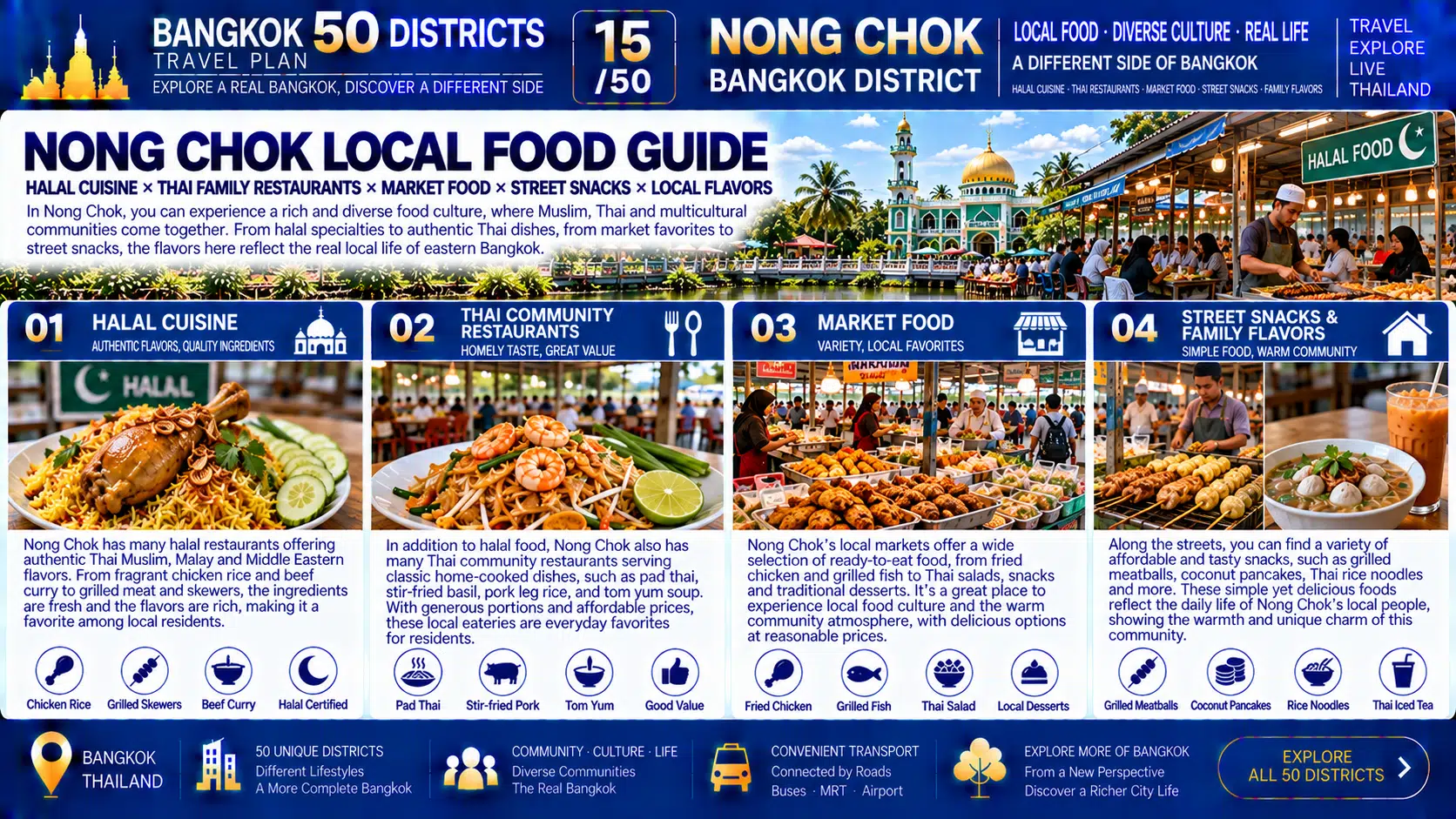
① Halal Food
Because Muslim communities are an important part of Nong Chok, halal food is central to the district’s culinary identity.
Chicken.
Beef.
Curries.
Rice dishes.
Soups.
Noodles.
Family-style meals.
② Everyday Thai Food
Pad kra pao.
Fried rice.
Noodles.
Curry rice.
Chicken rice.
Made-to-order Thai dishes.
Simple, familiar food that forms part of everyday life.
③ Market Food
One of the easiest ways to understand what local families eat for dinner.
Many residents simply buy several prepared dishes from the market and take them home.
④ Desserts and Street Snacks
Small stalls around markets and along local roads can sometimes tell you more about a neighborhood than a famous dessert café ever could.
The most interesting way to eat in Nong Chok is not to ask:
“What is the number-one restaurant?”
Instead:
find somewhere with almost no tourists but a steady flow of local residents.
Sit down.
Order a meal.
Look around.
That meal itself becomes part of District 15.
08|How to Spend One Day in Nong Chok
Nong Chok is not a district to rush through.
Its greatest value comes from doing exactly the opposite:
slow down.
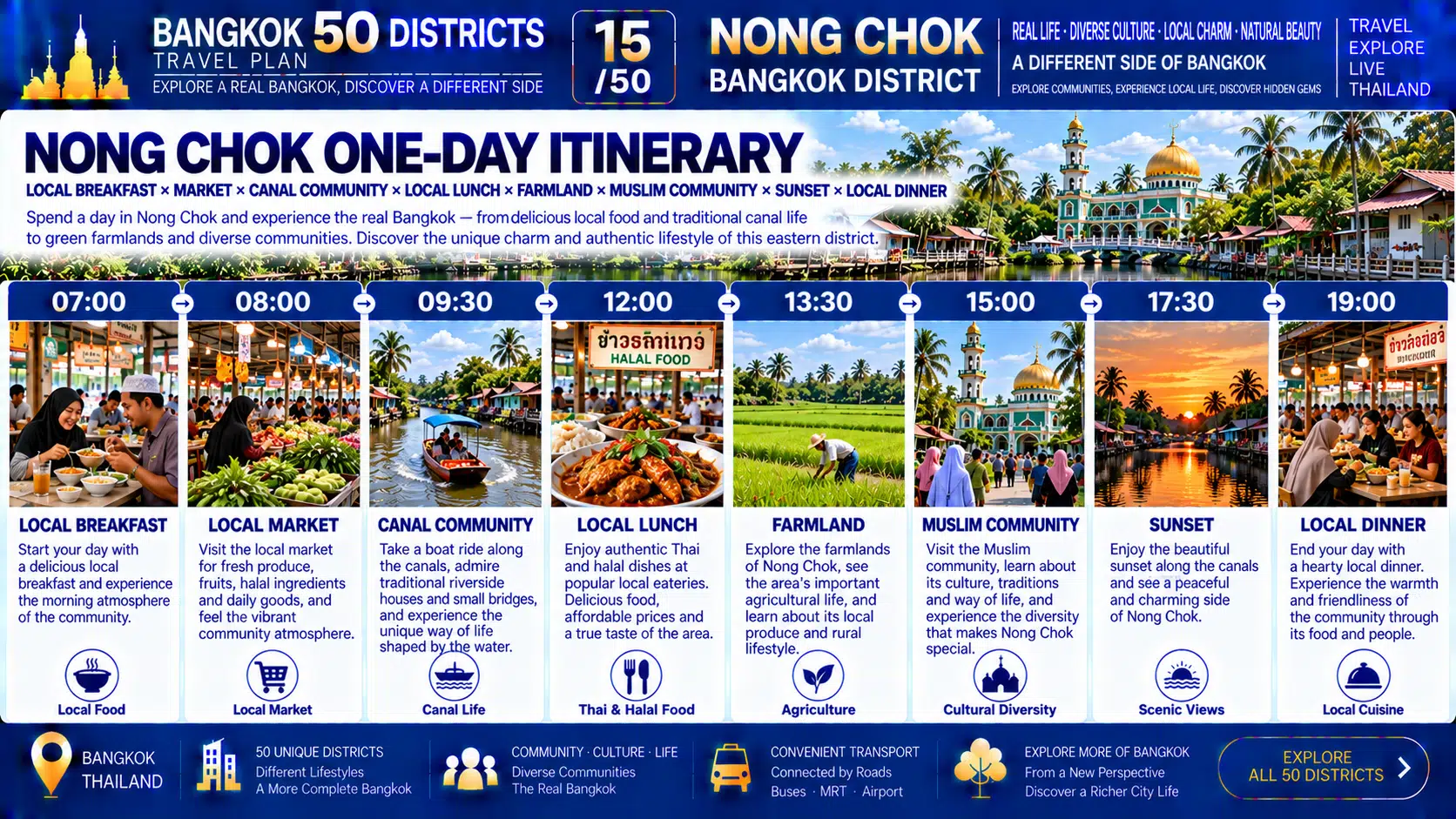
07:30|Local Breakfast
Start at a neighborhood breakfast shop or halal restaurant.
Begin the day the same way local residents do.
09:00|Local Market
Explore fresh ingredients, prepared food and everyday necessities from the surrounding communities.
Observe how a market serves such a geographically large, low-density district.
10:30|Canal Communities
Move slowly along community roads and canal-side areas.
Do not search constantly for an “attraction.”
Look at the bridges, homes, water, trees and ordinary routines around you.
12:00|Local Lunch
Choose a Thai or halal restaurant popular with nearby residents.
In Nong Chok, the everyday experience matters more than rankings.
13:30|Farmland and Green Landscapes
Continue into the more open parts of Nong Chok.
This may be one of the strongest contrasts with the traditional image of Bangkok we have encountered anywhere in the series so far.
15:30|Muslim Communities
With respect for local customs, learn more about the relationship between mosques and surrounding communities.
Religious spaces should never be treated merely as photo backdrops.
17:00|Rural Roads and Sunset
Nong Chok is especially atmospheric in the late afternoon.
As the light softens, farmland, canals, trees and low-density housing create a version of Bangkok completely different from the city center.
18:30|Community Dinner
Return to a market or neighborhood restaurant.
Finish the day with a local family-style dinner.
As darkness arrives, you may find yourself thinking:
This does not look like the Bangkok I know.
And yet:
it has been Bangkok all along.
09|Why Nong Chok May Be One of the Best Districts for Explaining the Entire 50 Districts Project
If this series contained only ten articles, we might never have reached Nong Chok.
Traditional Bangkok travel guides naturally prioritize places such as:
The Grand Palace.
Wat Arun.
Siam.
Yaowarat.
The Chao Phraya River.
Chatuchak.
Those places are important.
But if we never move beyond them, the Bangkok we understand will always be a carefully selected version of the city.
That is why Nong Chok matters.
It forces us to reconsider one very basic question:
What actually counts as Bangkok?
Does Bangkok need skyscrapers?
Does it need BTS trains?
Does it need giant shopping malls?
Does it need international tourists?
If the answer to all of those questions is yes, then Nong Chok may not look like Bangkok at all.
But if a city is really defined by:
the people who share the same administrative, economic and social networks, together with the land, transportation, communities and cultures they use every day,
then Nong Chok is unquestionably Bangkok.
And it may explain the complexity of the capital better than many famous attractions do.
Here:
Farmland is Bangkok.
Canals are Bangkok.
Mosques are Bangkok.
Low-density communities are Bangkok.
A family dinner bought from a local market is Bangkok too.
Siam’s skyscrapers and Nong Chok’s green fields may look completely different.
But both belong to the same city.
And that is why we want to complete all 50 districts.
Not to prove:
“Bangkok has 50 places worth visiting.”
But to understand something much bigger:
One Bangkok can contain 50 completely different ways of life.
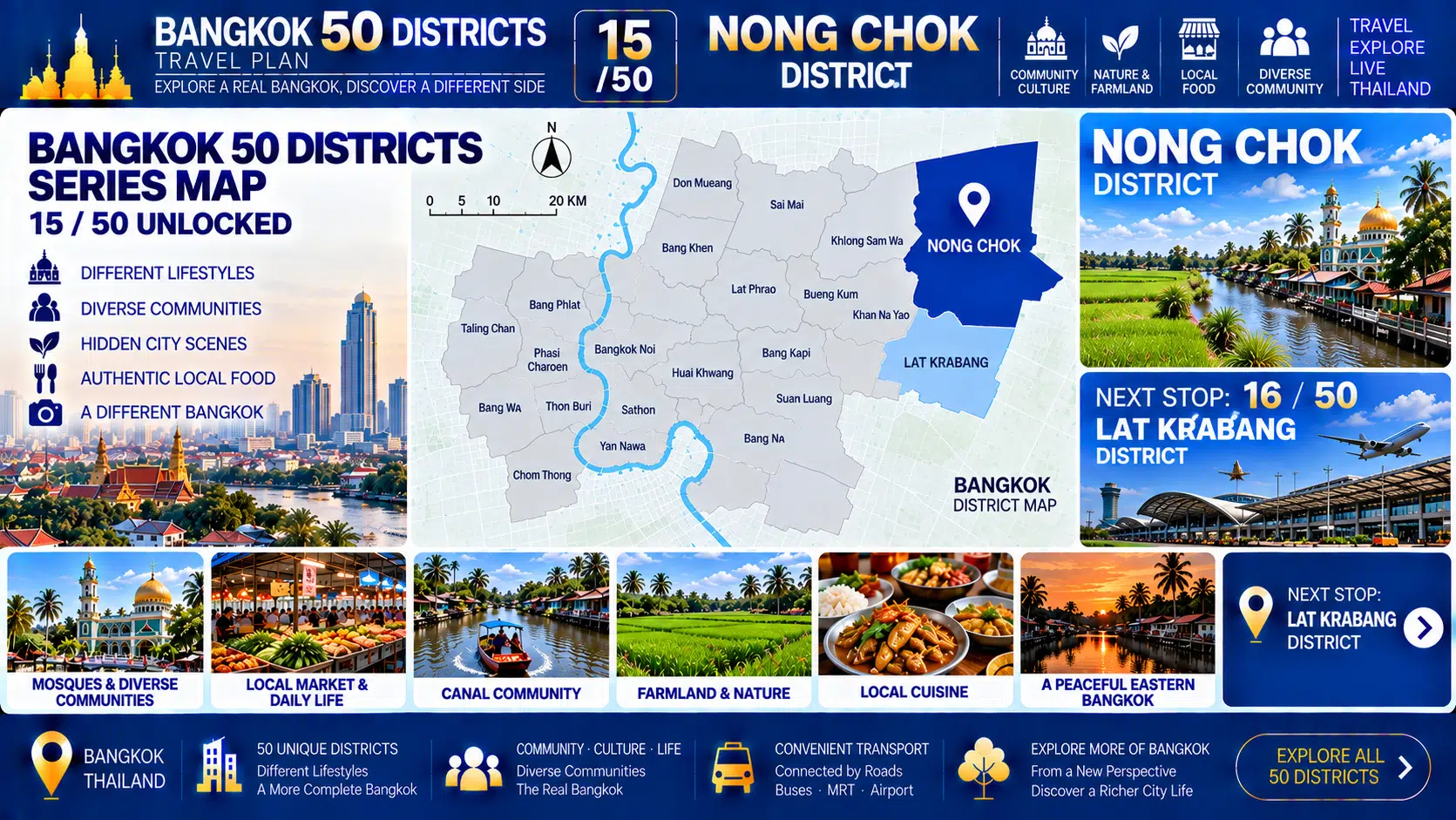
15 / 50 UNLOCKED
NONG CHOK ✓
Keywords:
Nong Chok · Farmland · Canals · Muslim Communities · Halal Food · Community Markets · Green Bangkok · Low-Density Living · Eastern Bangkok · Urban Edge
35 districts remaining.
NEXT STOP|16 / 50
LAT KRABANG
Continue south and southeast from Nong Chok and the urban landscape changes dramatically once again.
Farmland and canals do not disappear completely.
But a new force begins to dominate the story:
Suvarnabhumi Airport.
Aircraft.
Airport hotels.
Airport Rail Link.
Major roads.
Logistics.
Industry.
Universities.
And new communities that have developed around one of Southeast Asia’s major international aviation gateways.
If Nong Chok asks:
“Why can farmland, canals and village-like communities still be part of Bangkok?”
then Lat Krabang takes us to the next question:
“When an international airport becomes one of the main forces shaping an area, how does it transform what was once Bangkok’s outer edge?”