After completing our 15th stop, Nong Chok, we saw a side of Bangkok that many visitors would hardly associate with a megacity.
Farmland.
Canals.
Low-density neighborhoods.
Mosques.
Community markets.
Large areas of green.
Nong Chok reminded us that even within one of Southeast Asia’s largest metropolitan areas, the outer edge of the city can preserve a completely different way of life.
Now we move south and southeast from Nong Chok.
Our 16th stop is:
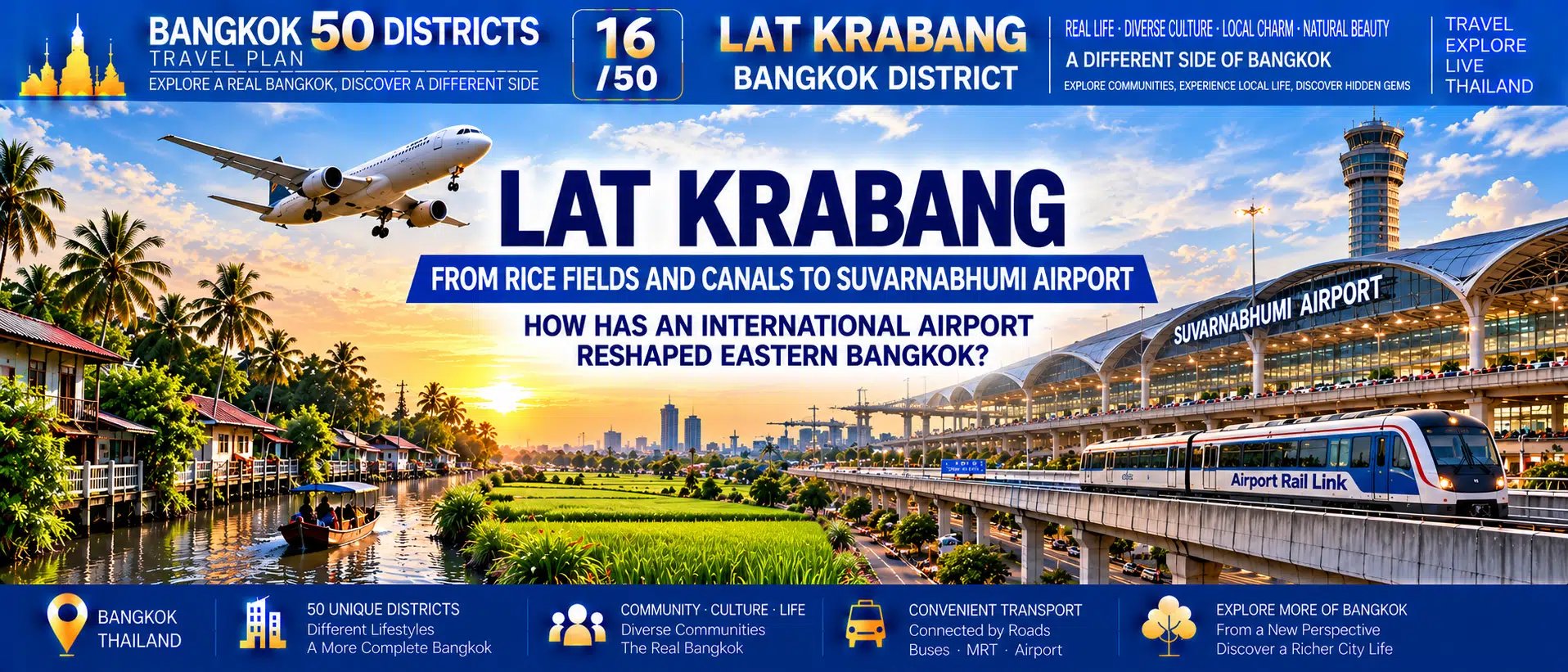
LAT KRABANG
And once again, Bangkok suddenly changes.
There are more airplanes in the sky.
Major roads begin to dominate the landscape.
Logistics facilities and warehouses appear.
Airport hotels become more common.
The Airport Rail Link crosses the district.
Students, airport employees, logistics workers, local families and international travelers begin to share the same urban space.
Behind all of this is one name that is almost impossible to ignore:
SUVARNABHUMI AIRPORT
But Lat Krabang is much more than simply “the area next to the airport.”
Before the airport transformed this part of eastern Bangkok, Lat Krabang already had canals, agriculture, local communities and its own everyday way of life.
After the airport arrived, the district became increasingly connected to global aviation, logistics, tourism and the wider modern Bangkok economy.
So the real question for District 16 is not:
“What can I do in Lat Krabang during an airport layover?”
Instead, we want to understand:
“When an international airport appears on the edge of a city, how can it reshape the surrounding area for decades?”
01|Where Is Lat Krabang?
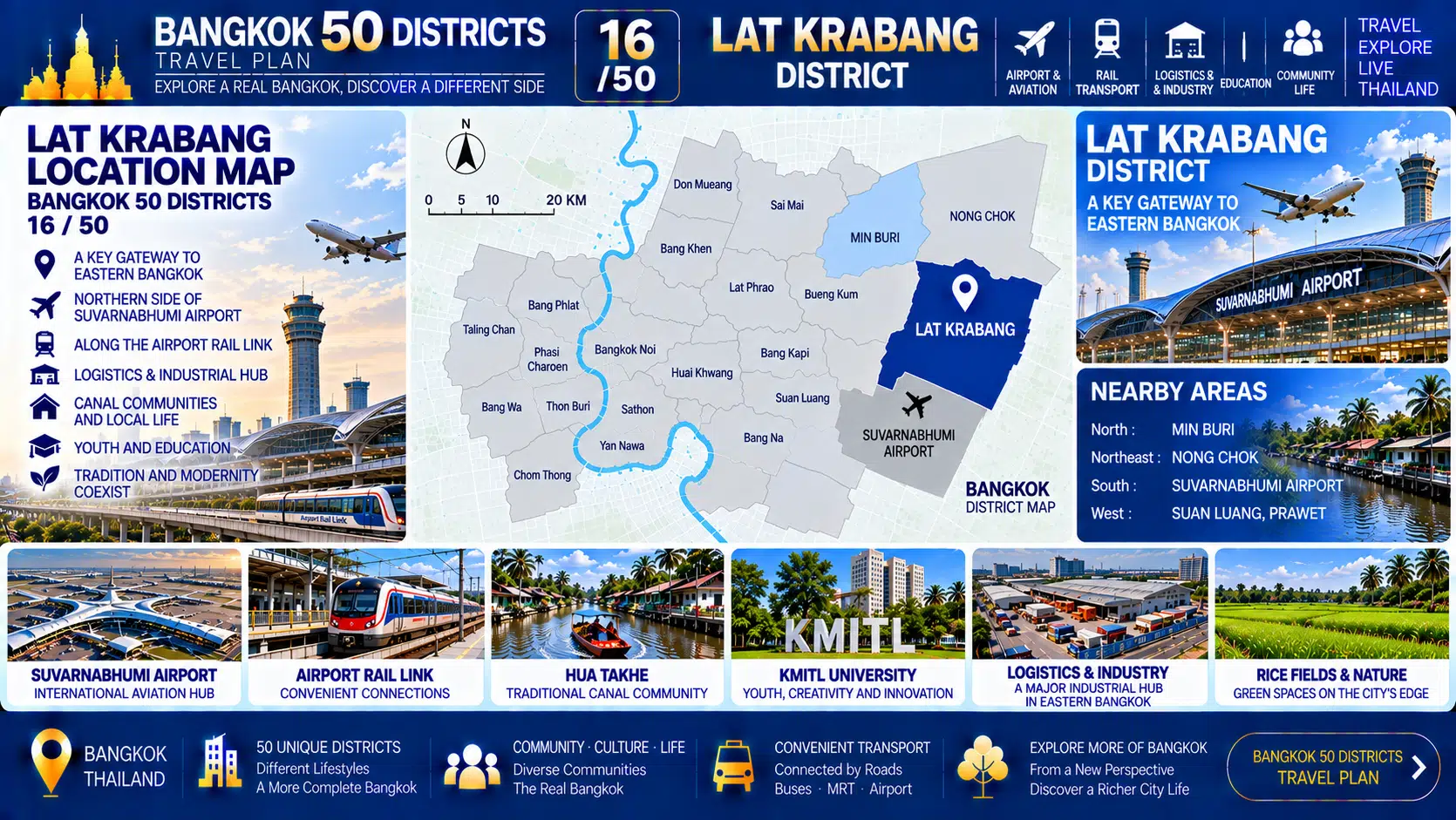
Lat Krabang is located in eastern Bangkok.
Its geographical position makes it especially interesting.
To the north lies Min Buri.
To the northeast is Nong Chok.
To the west, it connects with other parts of eastern Bangkok.
And to the south and southeast lies the place where millions of international travelers first encounter Thailand:
Suvarnabhumi Airport.
Lat Krabang therefore sits between several very different urban worlds.
On one side is traditional eastern Bangkok:
Canals.
Older communities.
Markets.
Agricultural land.
On the other side is the modern global city:
Airports.
Major roads.
Railways.
Hotels.
Logistics.
Industry.
International travelers.
One system has not completely replaced the other.
Instead, they overlap.
And that is exactly what makes Lat Krabang worth exploring.
02|Suvarnabhumi Airport: How Can One Airport Transform an Entire Area?
Suvarnabhumi Airport began commercial operations in 2006.
For international travelers, its purpose seems straightforward.
Arrivals.
Departures.
Connections.
Duty-free shopping.
Baggage.
Taxis.
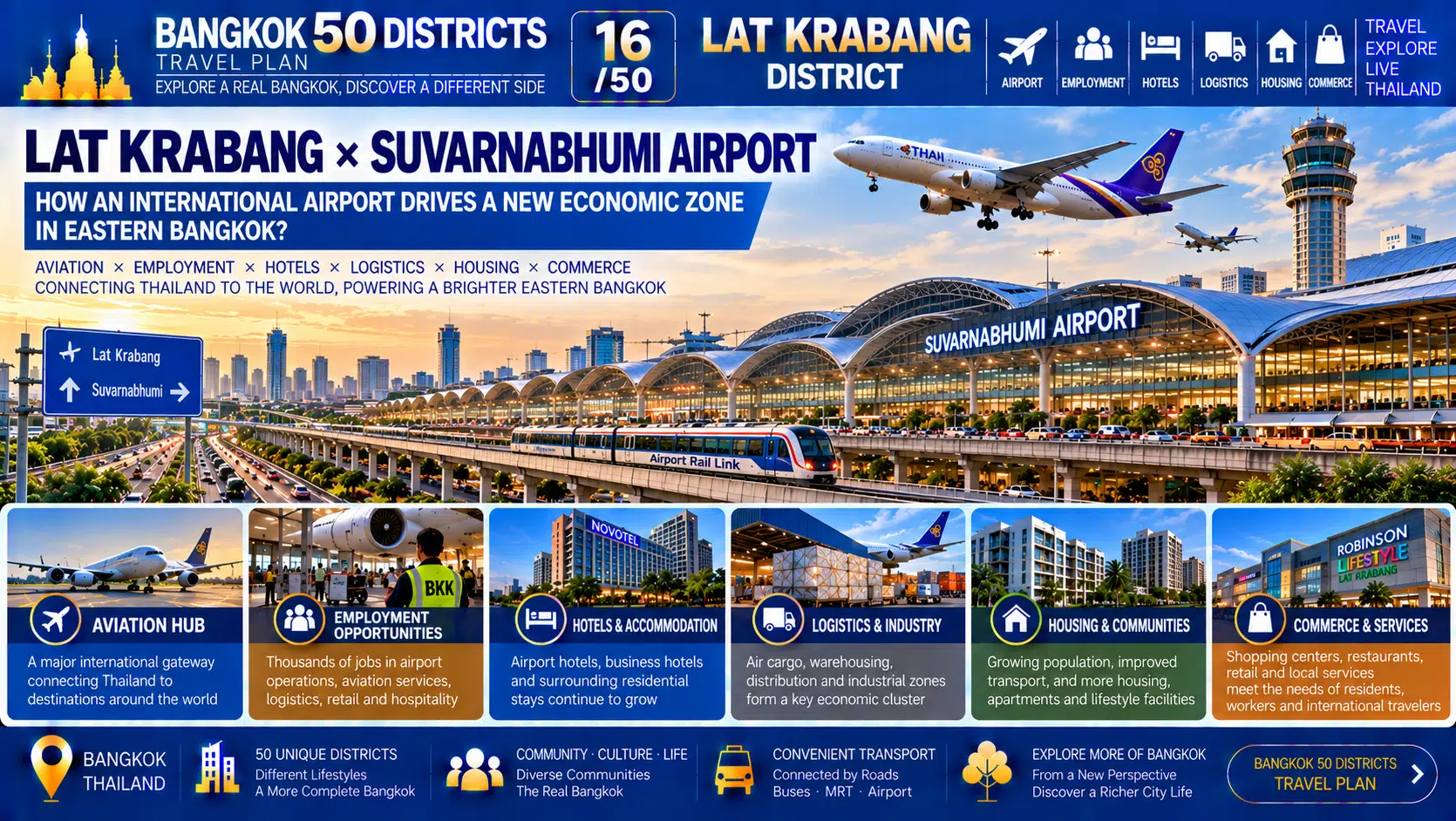
But from the perspective of urban development, an airport means much more.
Think about everything a major international airport requires:
Roads.
Railways.
Hotels.
Warehouses.
Aviation services.
Restaurants.
Employee housing.
Maintenance facilities.
Logistics.
Commercial services.
Taxis.
Public transportation.
And an enormous workforce.
When all of these demands appear in one place, the surrounding area cannot remain simply “the edge of the city.”
Population grows.
Housing develops.
Businesses appear.
Land use changes.
Road infrastructure improves.
New jobs are created.
The airport gradually becomes a powerful engine of urban development.
So when we visit Lat Krabang, the most important thing is not the size of the airport terminal.
The more interesting question is:
Why did the city outside the airport change because the airport was built?
03|Airport Rail Link: Bringing the Airport and Central Bangkok Closer Together
An airport without efficient urban transportation can still remain relatively isolated from the city around it.
The Airport Rail Link changed that relationship.
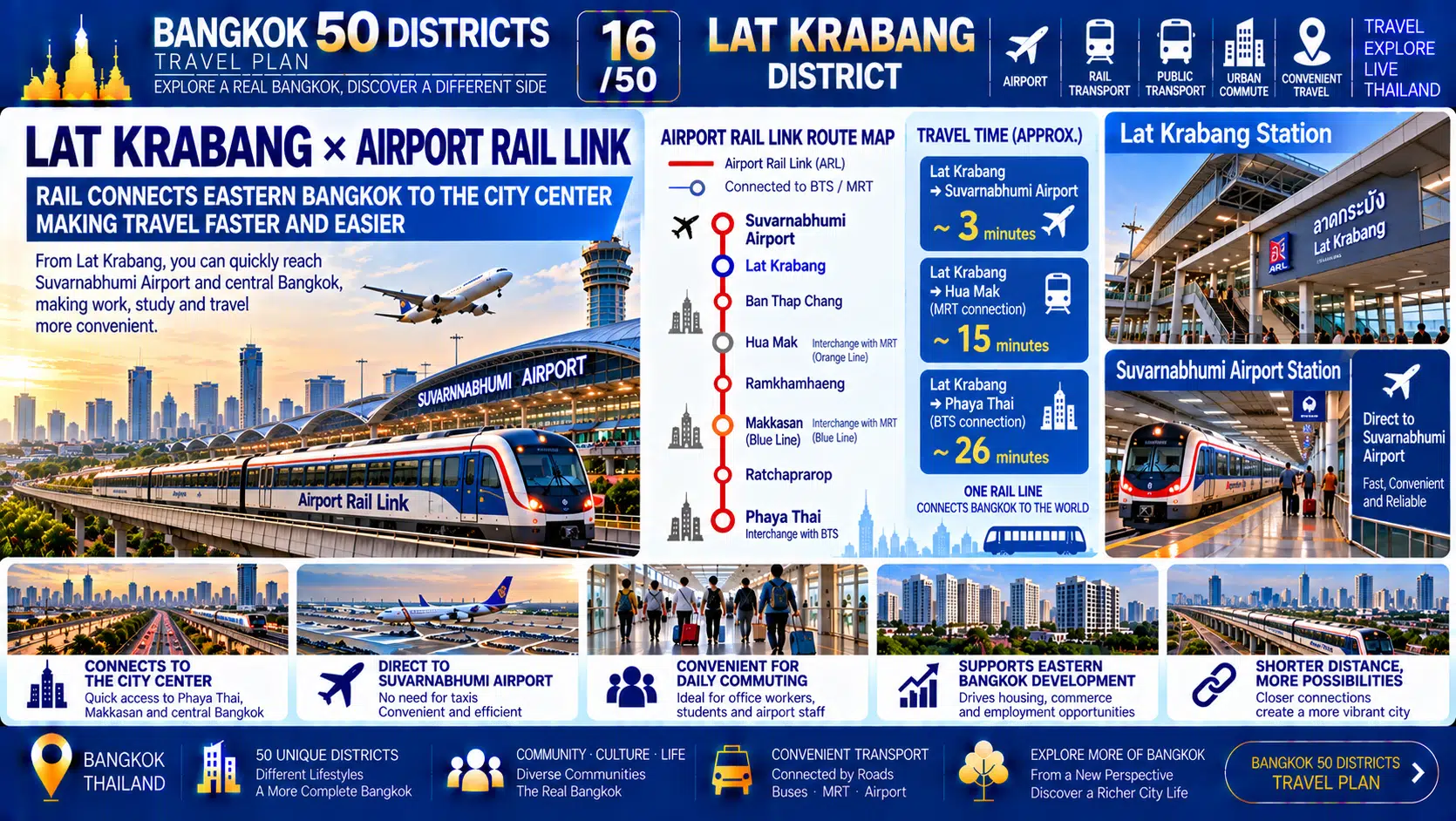
Running from the Suvarnabhumi side toward Bangkok, the railway connects the airport, Lat Krabang and areas closer to the city center.
For travelers, the benefit is simple:
you do not have to rely entirely on taxis.
For Lat Krabang, however, the impact is much greater.
Residents can commute.
Students can travel more easily.
Airport employees can get to work.
The time-distance between local communities and central Bangkok becomes shorter.
This is similar to what we saw with the Pink Line in Min Buri.
In a modern city, physical distance is no longer the only thing that matters.
Increasingly, the real question is:
“How long does it take to get from here to there?”
When travel time decreases, urban relationships change.
A place once considered too distant may suddenly become practical for housing.
A workplace that once felt inaccessible may enter a realistic commuting range.
Transportation is not simply the result of urban development.
Very often:
transportation itself creates new patterns of urban development.
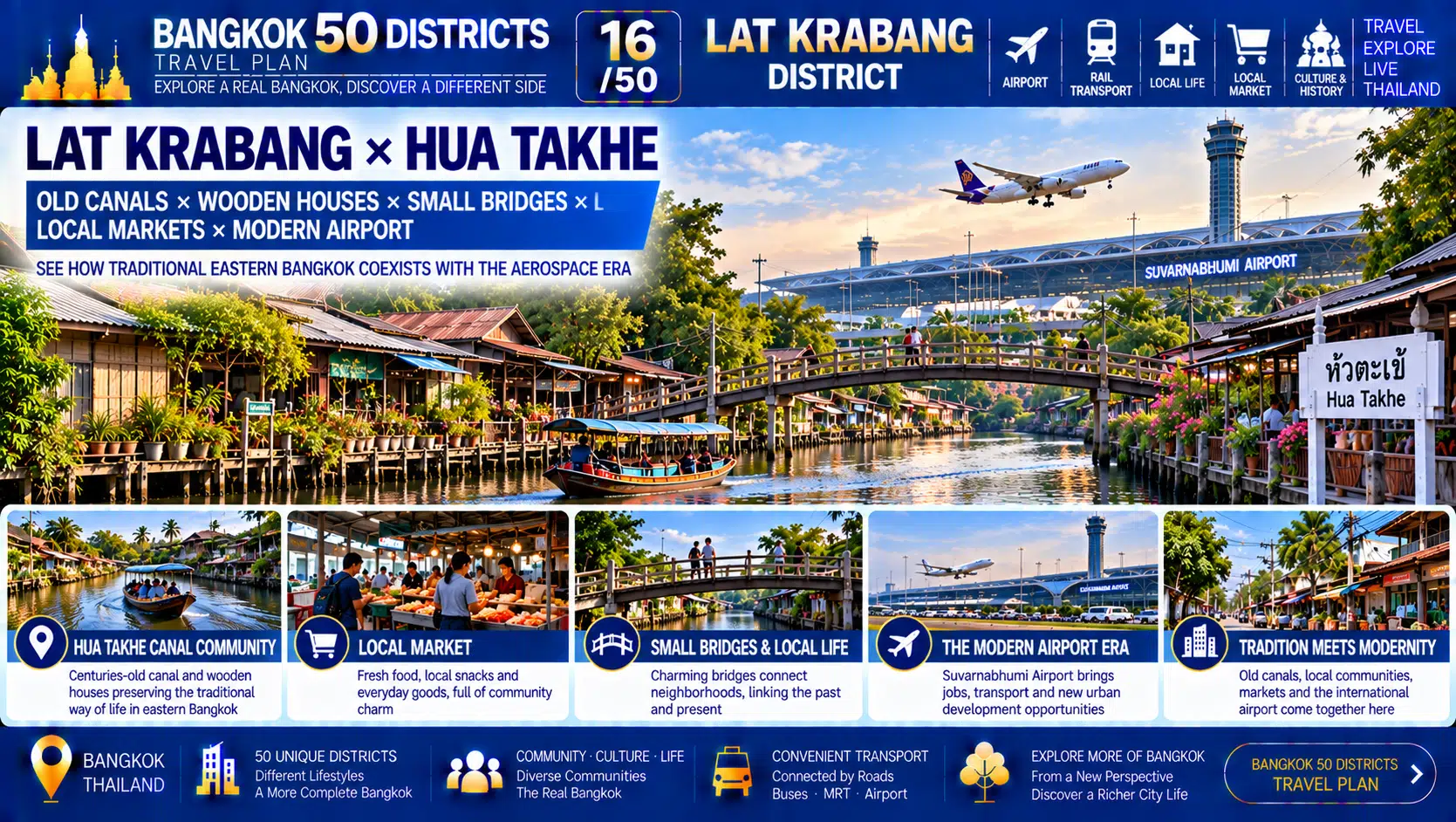
04|Hua Takhe: Why Does an Old Canal Community Still Exist Beside an International Airport?
If we look only at the airport, expressways and modern transportation, it is easy to imagine Lat Krabang as part of a completely “new Bangkok.”
But move into its local neighborhoods and another side appears.
HUA TAKHE
This is one of the places worth understanding in Lat Krabang.
Canals.
Wooden houses.
Small bridges.
Community spaces.
Local restaurants.
Art and everyday life.
Hua Takhe reminds us of something important:
the airport was not the beginning of Lat Krabang’s story.
Long before major aviation infrastructure arrived, people were already living along the waterways.
Canals supported transportation.
Communities developed beside the water.
Markets and local businesses emerged around everyday needs.
Visit today and the most striking thing is not simply that the old buildings look attractive.
It is the contrast.
A major international airport is nearby.
Aircraft may pass overhead.
Modern roads and railways are not far away.
Yet along the canal, another rhythm of life continues.
That contrast is one of the most fascinating things about Lat Krabang.
05|University Life: Why Are There So Many Young People in Lat Krabang?
Another group becomes very noticeable in Lat Krabang:
students.
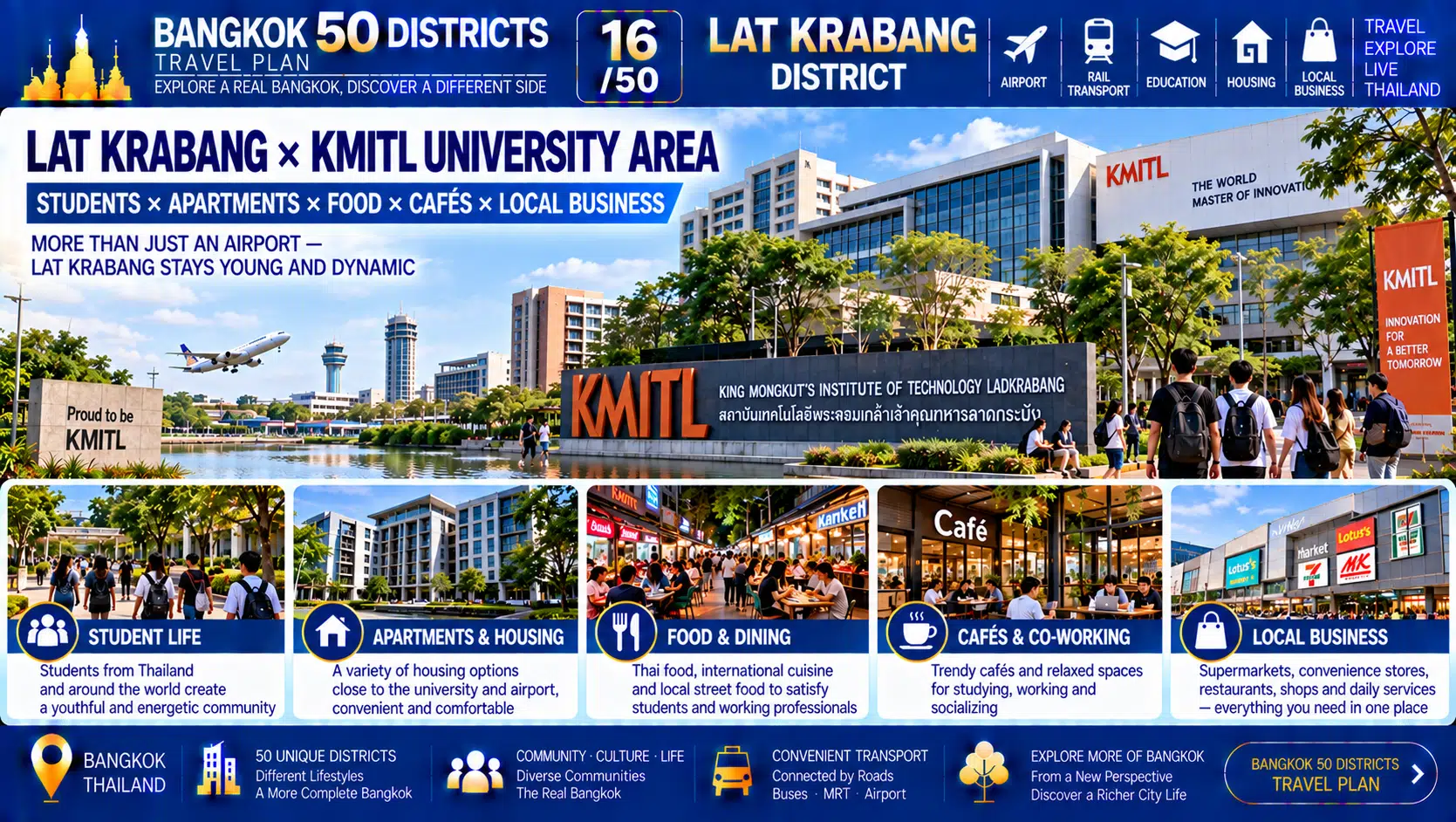
The district is home to important educational institutions, including one of its best-known:
King Mongkut’s Institute of Technology Ladkrabang — KMITL.
What does a major university bring to a neighborhood?
Student housing.
Apartments.
Restaurants.
Cafés.
Convenience stores.
Printing shops.
Food delivery.
Late-night dining.
Youth-oriented businesses.
And an entire service economy built around campus life.
That means Lat Krabang is not simply an “airport worker district.”
It also contains a significant university lifestyle zone.
This creates an unusual mix of people.
Local families.
Students.
Airport employees.
Logistics workers.
International travelers staying for a short time.
All may occupy the same district while following completely different daily routines.
The airport connects Lat Krabang to the world.
The university continuously brings new generations of young people into the area.
06|Logistics: Your Suitcase Is Only the Most Visible Part of a Much Larger System
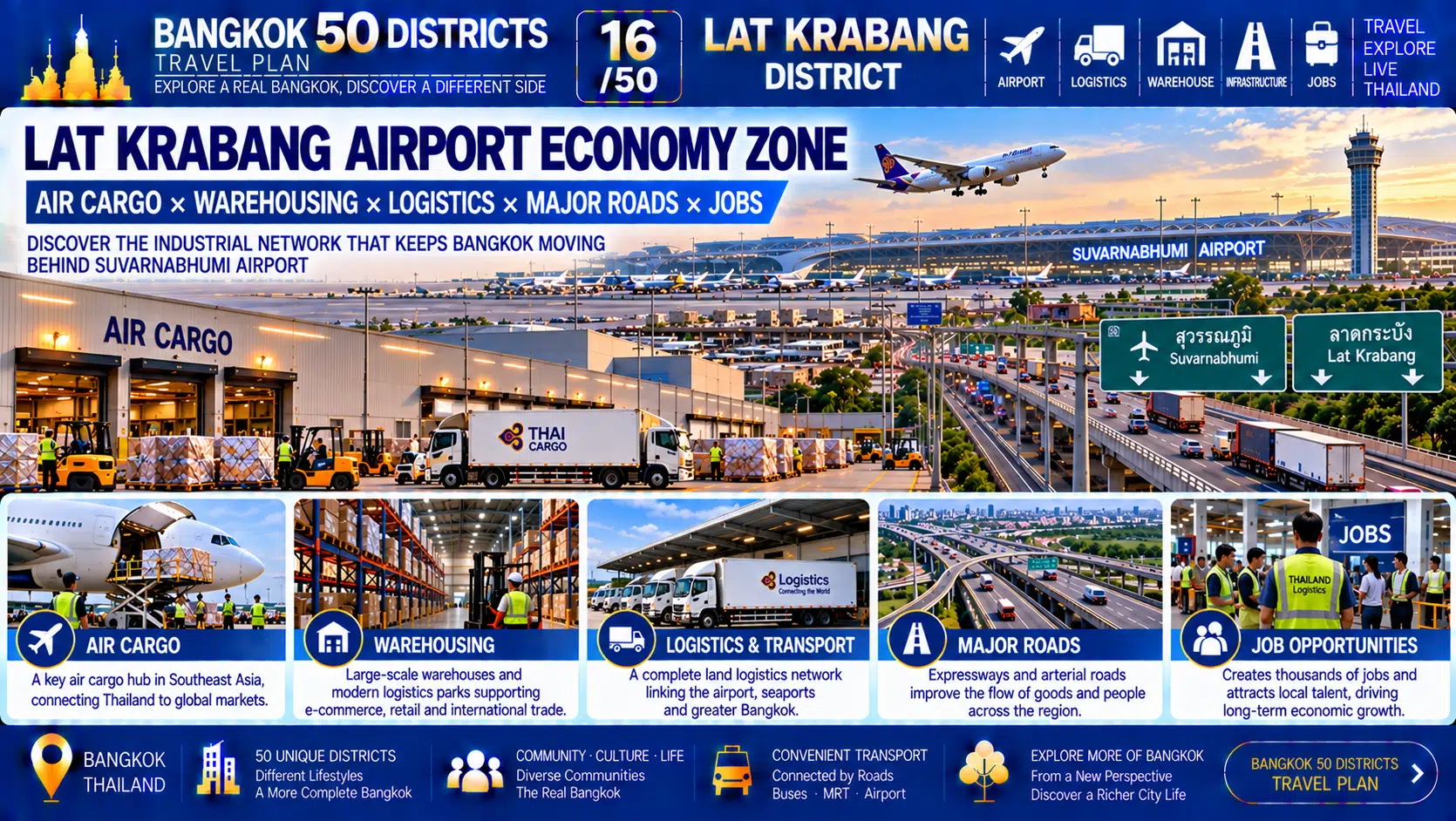
There is another side of the airport economy that most travelers barely notice:
LOGISTICS
Aircraft do not only transport passengers.
They transport cargo.
That makes airport surroundings naturally attractive for:
Warehousing.
Freight.
Distribution.
Supply chains.
Industrial services.
Transportation companies.
Related office space.
Combined with eastern Bangkok’s major road network, Lat Krabang and surrounding areas have become important locations for logistics and industrial activity.
This also explains why the urban landscape here feels completely different from Siam.
Large shopping malls do not dominate every view.
Instead, you may see:
Trucks.
Warehouses.
Industrial buildings.
Wide roads.
Freight facilities.
Worker housing.
None of these places is likely to appear on a “Top 10 Bangkok Attractions” list.
But without them, modern Bangkok could not function properly.
Some of the most important parts of a city are not the parts designed to look good in travel photographs.
07|What to Eat in Lat Krabang: An Airport District Is Not the Same as Airport Food
For many travelers, their food memories of Lat Krabang may consist entirely of:
Airport restaurants.
Hotel breakfasts.
Convenience stores.
But once you enter the local neighborhoods, the food scene becomes completely different.
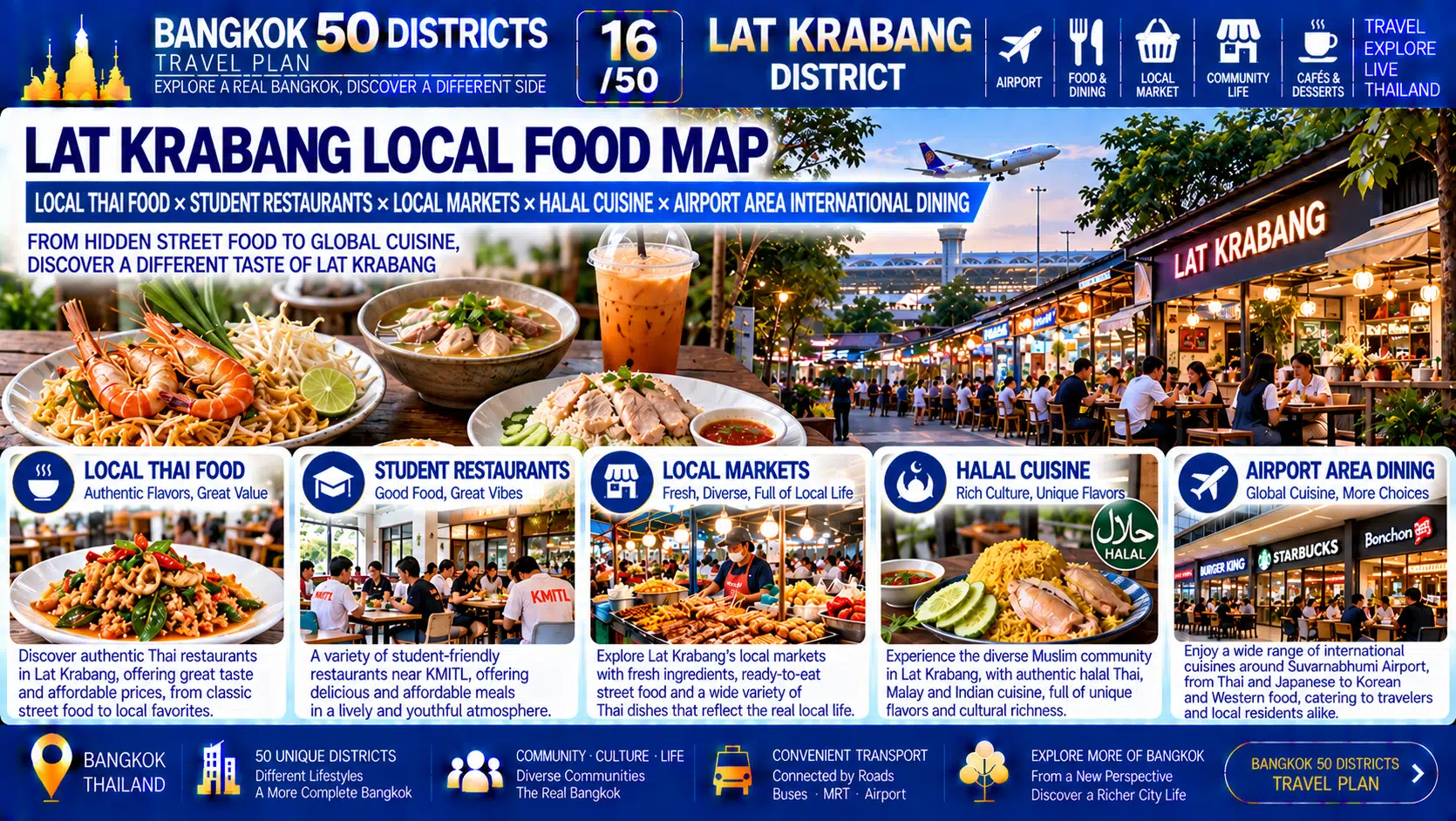
① Local Thai Restaurants
Pad kra pao.
Fried rice.
Noodles.
Curry rice.
Made-to-order Thai dishes.
These are the everyday meals eaten by residents, students and workers.
② Student Food
Restaurants around university areas usually focus on:
Price.
Portion size.
Speed.
Variety.
That makes the area ideal for finding simple, affordable and genuinely everyday Thai food.
③ Market Food
Grilled meat.
Fried chicken.
Curries.
Desserts.
Fruit.
Prepared dishes to take home.
④ Halal Cuisine
The cultural diversity of eastern Bangkok continues into Lat Krabang, so halal restaurants and food options can also be found around the district.
⑤ International Food Around the Airport
This is one of the biggest differences between Lat Krabang and Nong Chok.
International travelers, hotels and the airport workforce create demand for a wider range of dining options.
That means Lat Krabang’s food culture is shaped by four different groups:
local communities + students + airport workers + international travelers
And together, they determine what the district eats.
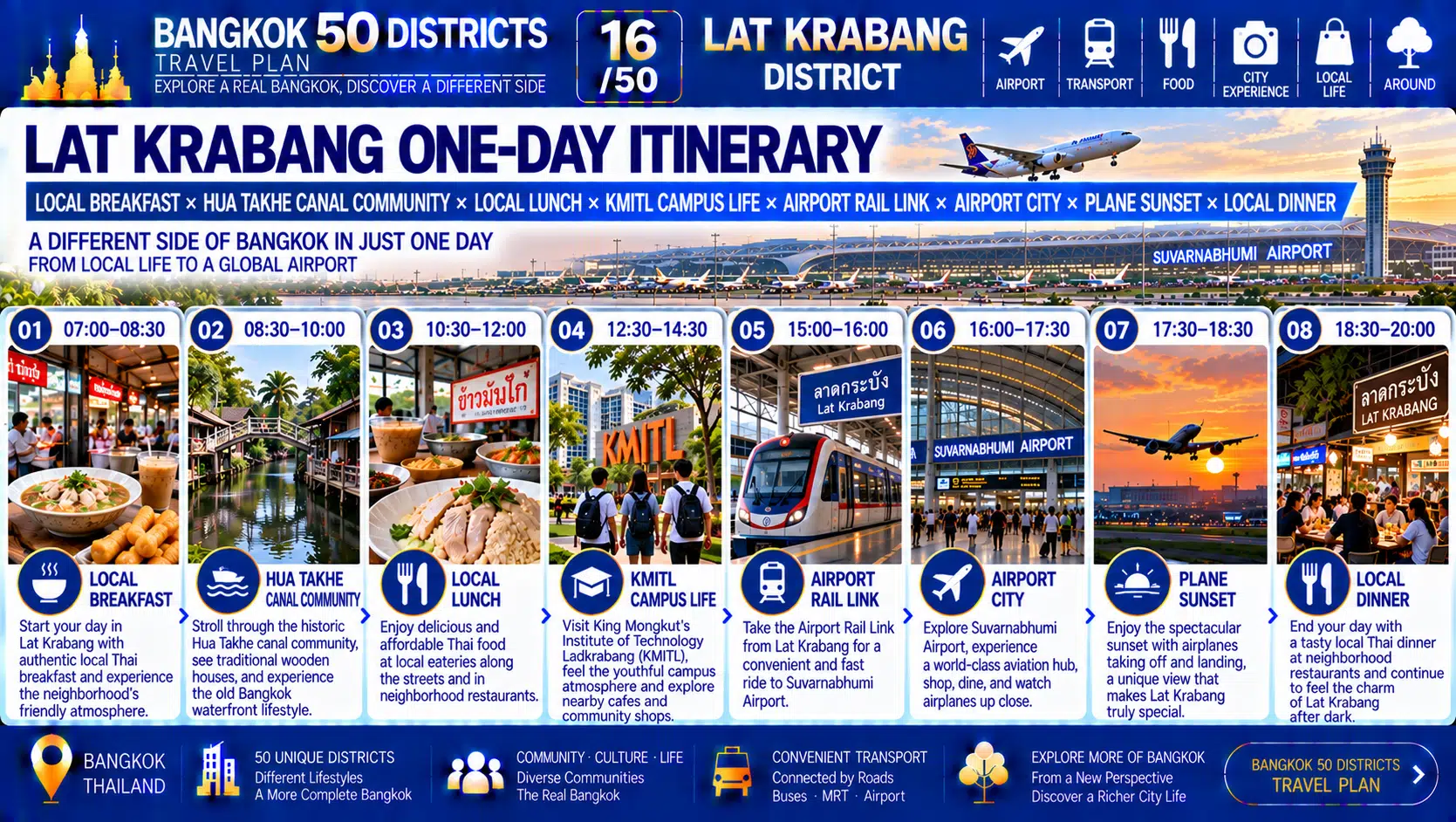
08|How to Spend One Day in Lat Krabang
District 16 works best as:
“Old Eastern Bangkok × New Airport City” in One Day
07:30|Local Breakfast
Do not begin inside the airport.
Start in an ordinary Lat Krabang neighborhood.
Try rice porridge, noodles, chicken rice or a simple Thai breakfast.
09:00|Hua Takhe Canal Community
Walk slowly along the waterfront.
Look at wooden houses, small bridges, local shops and the remaining canal lifestyle.
This part of the day represents Lat Krabang’s older urban logic.
11:30|Local Lunch
Eat in the community or around the university area.
Choose somewhere popular with local residents or students.
13:00|KMITL and the University Lifestyle Zone
Observe how students, apartments, restaurants, cafés and neighborhood businesses form an ecosystem around the university.
This is where Lat Krabang suddenly feels much younger.
15:00|Airport Rail Link
Experience the rail connection between Lat Krabang, Suvarnabhumi Airport and the wider city.
In a single day, you can move from a traditional canal community to a modern railway system.
16:30|Airport Edge and the Modern City
There is no need to spend the entire afternoon inside the terminal.
Instead, observe the hotels, major roads, businesses, residential development and logistics infrastructure around the airport.
This is where the airport’s impact on the surrounding city becomes easier to understand.
18:00|Aircraft and Sunset
From a legal and safe public area, experience the atmosphere around the airport as evening approaches.
Aircraft.
Sunset.
Road traffic.
This is when Lat Krabang feels most like an “airport city.”
Do not enter restricted areas, stop in prohibited zones or photograph where photography is not permitted.
19:30|Local Dinner
Return to a neighborhood, university area or local community near the airport.
Finish the day with a meal that feels genuinely connected to Lat Krabang.
In the morning, you saw canals.
In the evening, you saw aircraft.
And both belong to the same district.
09|Why Is Lat Krabang So Important for Understanding Modern Bangkok?
By District 16, the logic behind our 50 Districts project is becoming increasingly clear.
No Bangkok district exists in isolation.
The Old City was shaped by palaces, temples and the Chao Phraya River.
Yaowarat was shaped by trade and Chinese migration.
Bang Kapi was transformed by residential and commercial expansion.
Min Buri reflects the overlap of markets, canals and modern transportation.
Nong Chok continues to preserve farmland, waterways and low-density communities.
And in Lat Krabang:
the airport becomes a major force shaping the city.
This matters because an airport is not simply a building.
It brings people.
Jobs.
Transportation.
Hotels.
Logistics.
Housing.
Commerce.
Changes in land value.
And even changes in how people think about distance.
Lat Krabang may once have felt like a distant eastern edge of Bangkok.
Today, for many international travelers, the area around it is instead:
the first part of Thailand they ever see.
The aircraft lands.
You turn on your phone.
You pass immigration.
Collect your luggage.
Walk out of the terminal.
And feel Thailand’s air for the first time.
In one sense, Bangkok’s traditional center lies around the Grand Palace.
Its modern commercial center is around Siam.
But for international travelers, modern Bangkok also has another extremely important place:
its first gateway — Suvarnabhumi Airport.
And Lat Krabang lives beside that global gateway.
What makes the district even more interesting is that the airport has not completely erased what came before.
Hua Takhe’s canals remain.
Local communities remain.
Markets remain.
The university continues to grow.
And aircraft fly overhead every day on their way to destinations around the world.
Lat Krabang therefore tells a much larger story:
how a city can preserve parts of its past while being reconnected to the world through globalization.
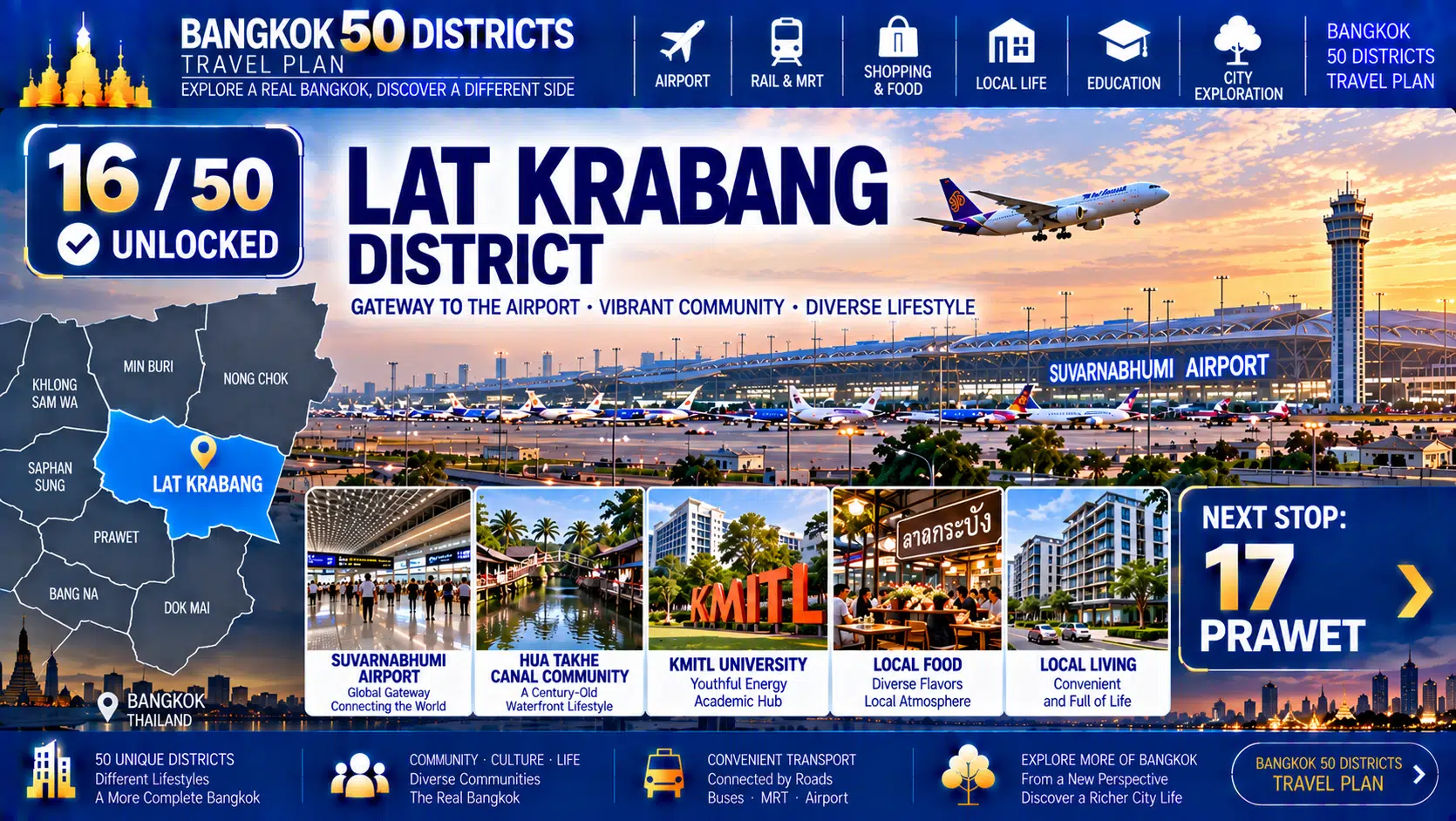
16 / 50 UNLOCKED
LAT KRABANG ✓
Keywords:
Lat Krabang · Suvarnabhumi Airport · Airport Rail Link · Hua Takhe · KMITL · Canal Communities · Airport Economy · Air Cargo & Logistics · University Life · Local Food · Eastern Bangkok
34 districts remaining.
NEXT STOP|17 / 50
PRAWET
Leaving Lat Krabang, we move west toward Prawet.
The influence of the airport does not suddenly disappear.
But the next district introduces a different set of urban forces:
large residential communities, the Srinagarindra corridor, commercial life, transportation and major green spaces in eastern Bangkok.
We will move away from the airport, logistics and university environment and return to a more typical eastern Bangkok residential lifestyle zone.
If Lat Krabang asks:
“How can an international airport reshape the edge of a city?”
then District 17, Prawet, takes us to the next question:
“When housing, commerce, transportation and major urban parks come together, how does eastern Bangkok create a complete lifestyle center without depending on the traditional city center?”