After completing our 16th stop, Lat Krabang, we saw how an international airport can reshape an entire part of a city.
Suvarnabhumi Airport brought aviation, logistics, hotels, employment and new demand for housing.
The Airport Rail Link shortened the time-distance between eastern Bangkok and the urban core.
At the same time, the old canal community of Hua Takhe reminded us of something important:
Modern development does not always erase what came before.
Now we move west from Lat Krabang.
Our 17th stop is:
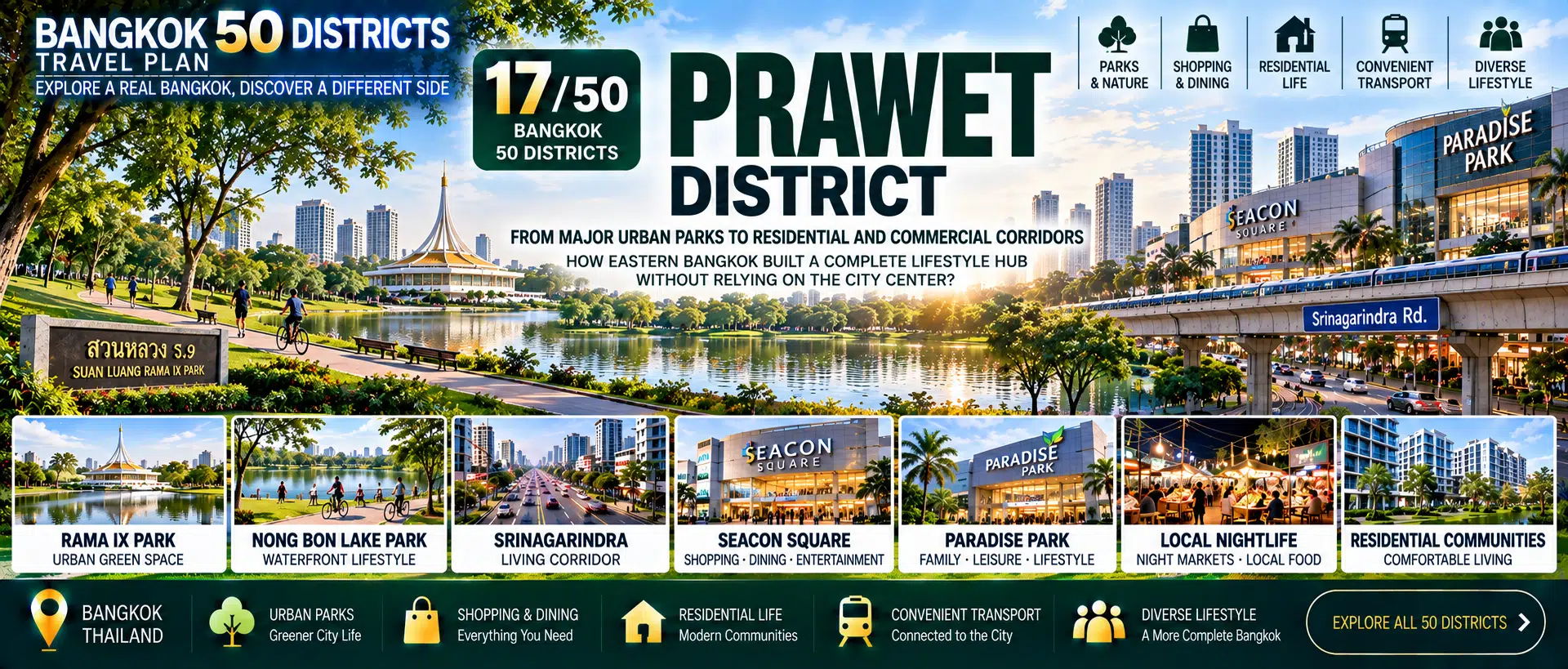
PRAWET
Here, aircraft are no longer the main character.
Instead, another version of eastern Bangkok begins to take over:
Large residential communities.
The Srinagarindra urban corridor.
Shopping centers.
Neighborhood restaurants.
Nighttime commerce.
Parks.
Lakes.
And an increasingly complete network of everyday services.
If Lat Krabang represented:
“How can an airport create a new urban economic zone?”
then Prawet asks a different question:
“When housing, commerce, transportation and major green spaces all mature together, can an area far from the traditional city center become a center of its own?”
In Prawet, the answer is becoming increasingly clear.
01|Where Is Prawet?
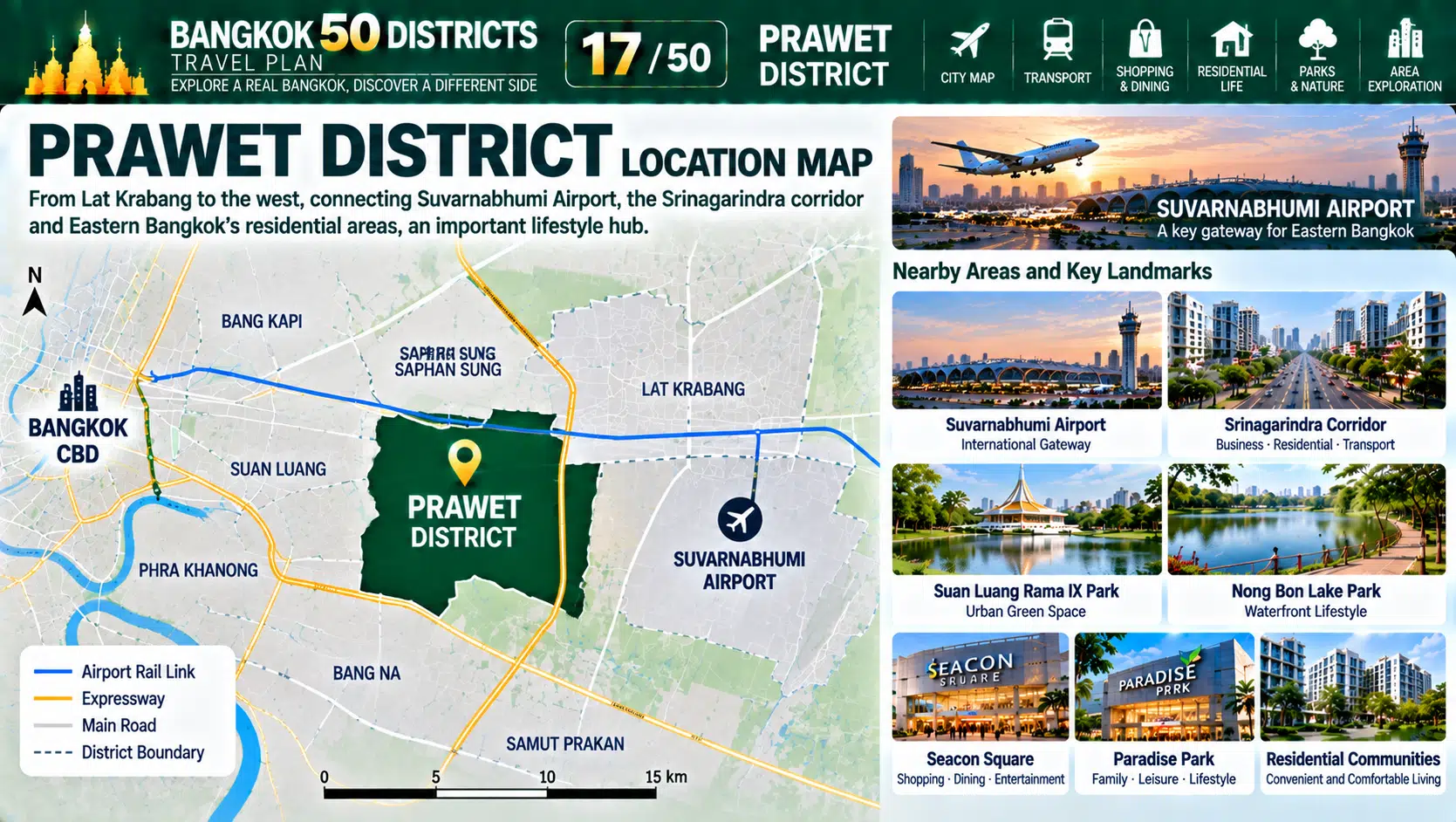
Prawet is located in eastern Bangkok.
Its position places it between Bangkok’s traditional urban core and the wider Suvarnabhumi Airport zone.
Travel east and you move toward Lat Krabang and the airport.
To the north lies the wider Suan Luang area.
Move west and southwest, and Bangkok gradually becomes denser.
But the most important thing about Prawet is not:
“How many kilometers is it from Siam?”
What matters is that the district has developed its own network of everyday life.
Residents can stay nearby to:
Buy groceries.
Eat.
Shop.
Exercise.
Study.
Watch a movie.
Visit a park.
Handle everyday family needs.
And enjoy a large part of their leisure time.
This brings us back to one of the most important themes of our 50 Districts journey:
A city does not need to have only one center.
02|Srinagarindra: How Does a Road Become an Urban Lifestyle Corridor?
To understand Prawet, one name is especially important:
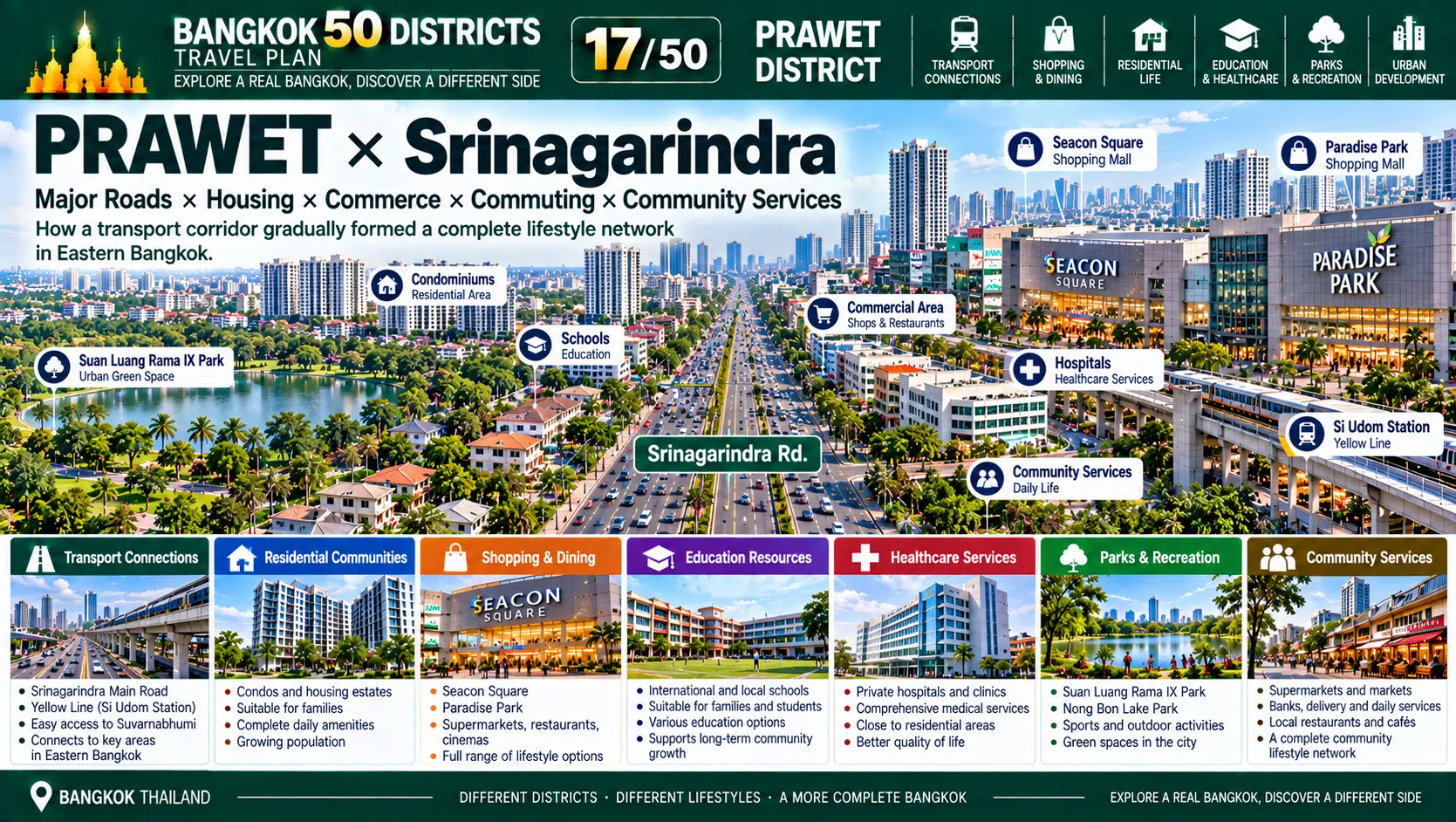
SRINAGARINDRA ROAD
On a map, it is simply a major road.
But once you explore the surrounding neighborhoods, you begin to see something much bigger.
Housing developments.
Condominiums.
Shopping centers.
Restaurants.
Schools.
Healthcare services.
Automotive businesses.
Markets.
Offices.
Community services.
These functions stretch along the corridor, gradually transforming it into something more than a transportation route.
It becomes:
an urban lifestyle corridor.
People live along it.
Work along it.
Shop along it.
Eat along it.
Commute along it.
Spend their free time along it.
The city expands outward following the road.
This is very different from the way older Bangkok developed.
Many traditional communities were shaped around rivers, canals, temples and markets.
Modern eastern Bangkok is increasingly shaped by another combination:
major roads + housing + commerce + automobile-based mobility.
03|Rama IX Park: Why Does a Growing City Need Truly Large Green Spaces?
One of the most important urban experiences around Prawet is its access to major green spaces.
The most representative is:
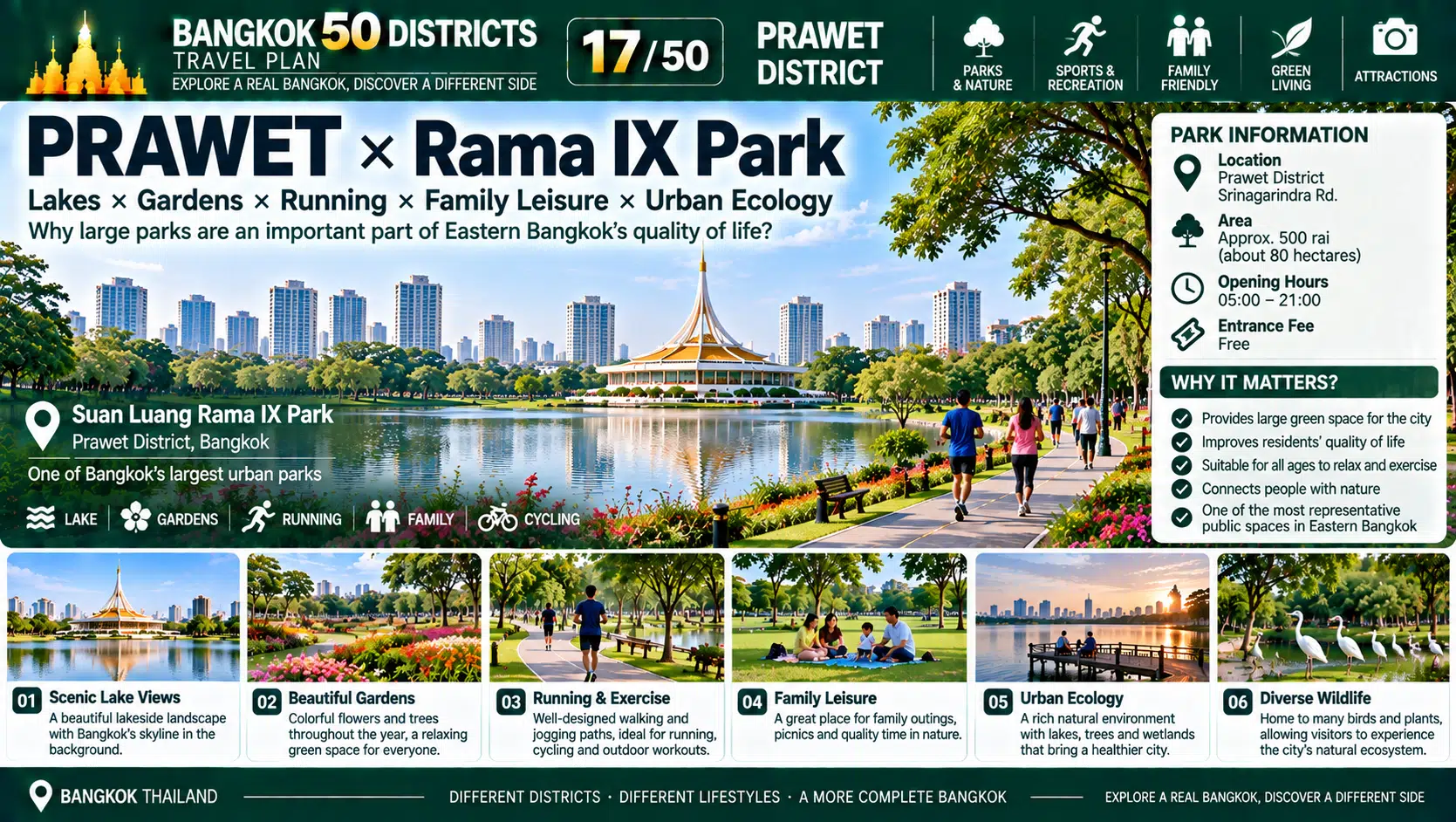
SUAN LUANG RAMA IX PARK
Step inside and the sound of Bangkok suddenly changes.
Traffic becomes more distant.
Roads disappear behind trees.
The landscape becomes:
Lakes.
Lawns.
Gardens.
Walking paths.
Trees.
Morning runners.
Families taking a walk.
People cycling and exercising.
A major urban park is not simply a “beautiful attraction.”
It is also a form of:
urban infrastructure.
As population density increases, housing expands and roads become busier, residents need somewhere to:
Exercise.
Walk.
Rest.
Spend time in nature.
Bring their children.
Temporarily escape traffic and commercial spaces.
That means a mature urban lifestyle is not defined only by:
“Is there a shopping mall nearby?”
It also depends on:
“Is there a real green space nearby where people can slow down?”
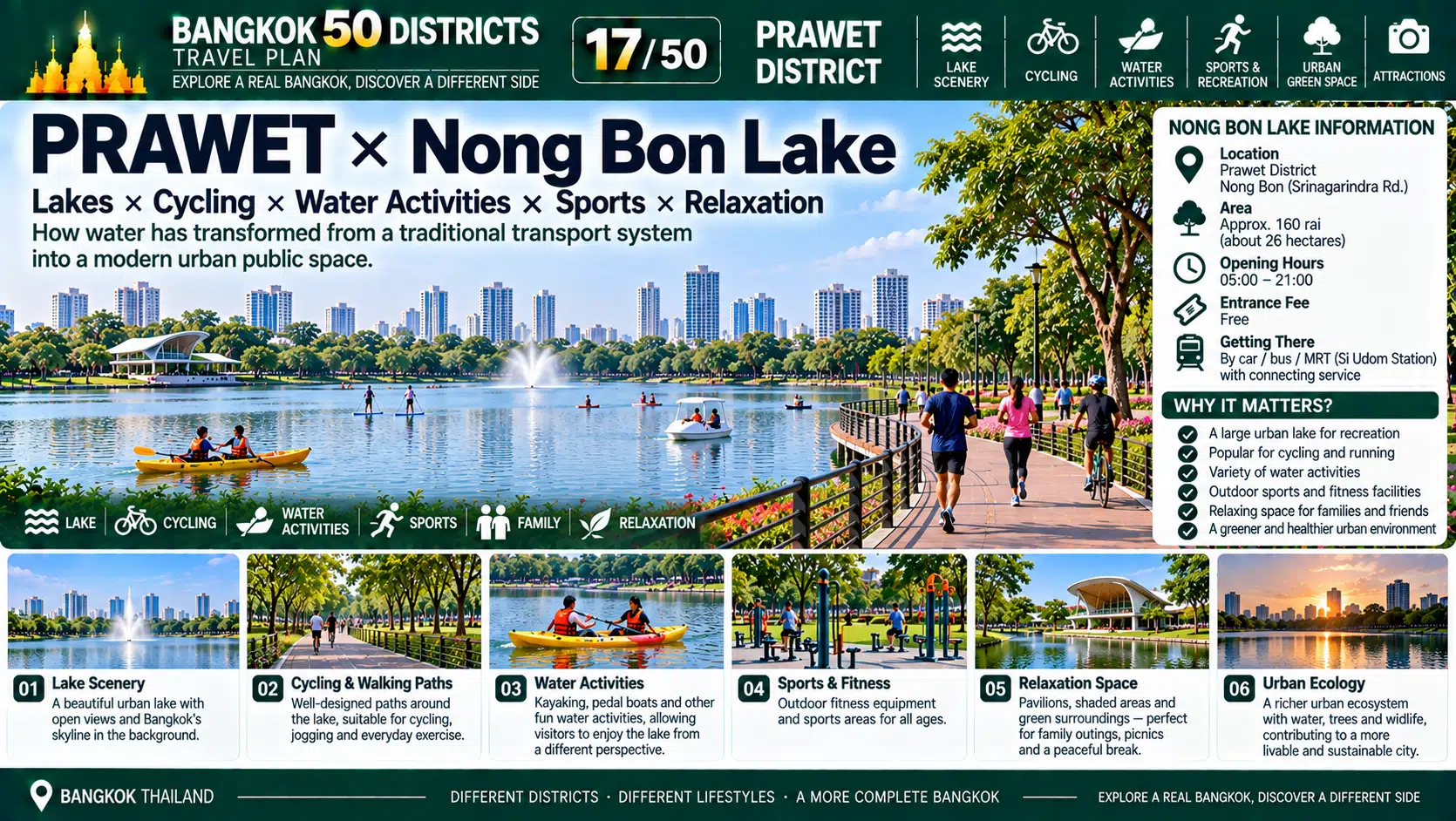
04|Nong Bon Lake Park: Bangkok Has This Kind of Waterfront Life Too?
If Rama IX Park represents the large urban garden, nearby Nong Bon Lake Park offers another kind of experience.
Its defining element is:
WATER
Open lake views.
Green space.
Walking paths.
Cycling.
Exercise.
Waterfront recreation.
After traveling through Min Buri, Nong Chok and Lat Krabang, we have seen that water never really disappeared from our journey.
But its role keeps changing.
In Min Buri, water represented historic canals and local life.
In Nong Chok, it connected agriculture and communities.
In Hua Takhe, it preserved an older canal culture.
Now, in Prawet, water becomes:
part of modern urban recreation.
The same natural element can represent completely different periods of urban development.
This is one reason the 50 Districts project becomes more interesting as we continue.
We are no longer simply asking:
“Where is the best place to visit?”
Instead, we are observing:
how the same element can perform different functions in different parts of the city.
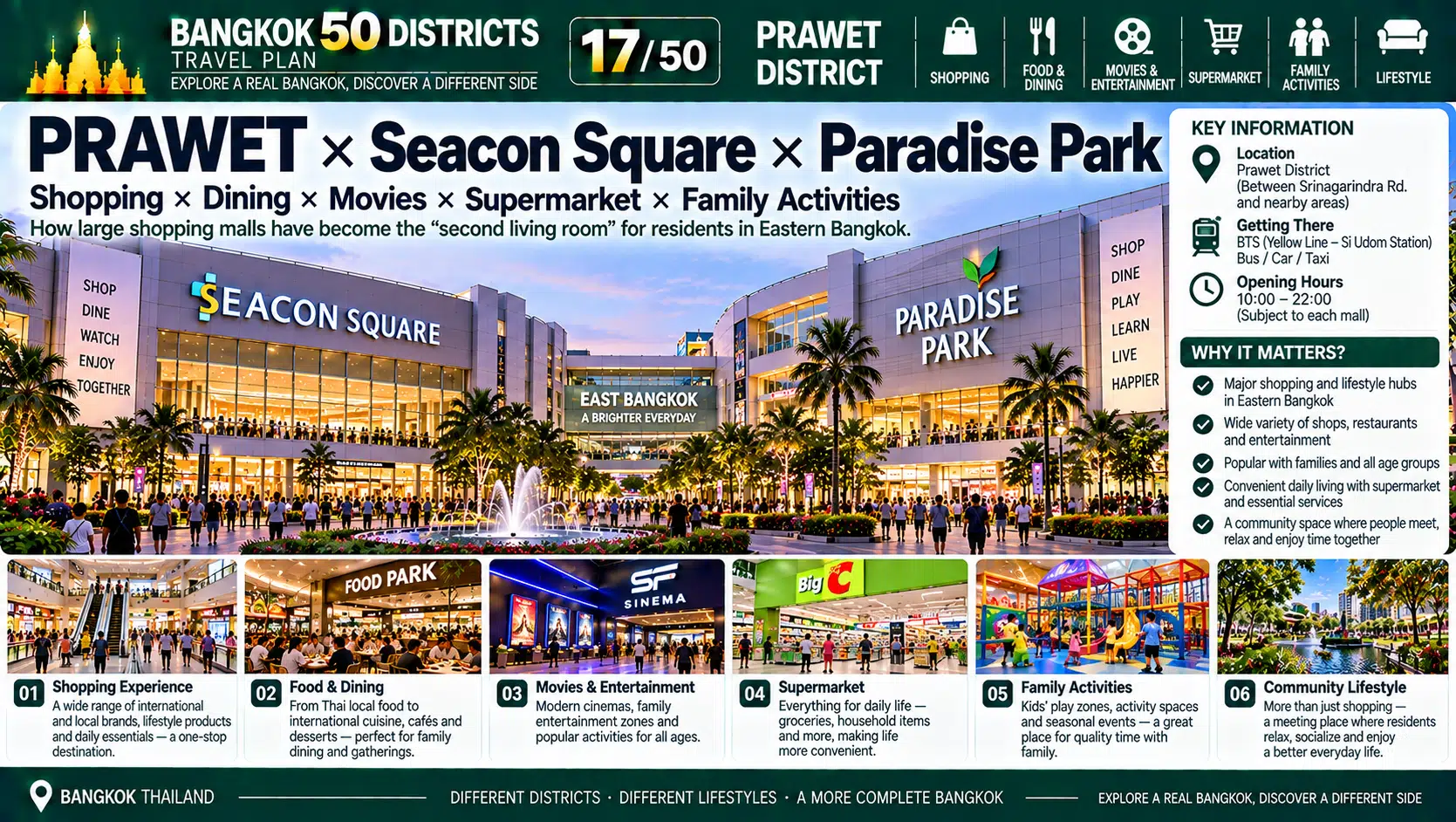
05|Seacon Square × Paradise Park: Why Do Outer-City Shopping Malls Become a “Second Living Room”?
In central Bangkok, visitors often think of large shopping centers primarily in terms of:
Shopping.
Brands.
Restaurants.
But in residential districts such as Prawet, malls serve a much broader purpose.
The area around Seacon Square Srinagarindra and Paradise Park is a good example.
Residents do not come only to shop.
They may come to:
Eat.
Watch a movie.
Buy household goods.
Spend time with their children.
Meet friends.
Have coffee.
Visit a supermarket.
Handle phone or banking services.
Escape Bangkok’s heat.
Wait for transportation.
In outer residential districts, the shopping mall increasingly functions as:
the community’s “second living room.”
It does not need to contain the city’s most luxurious international brands.
Its importance comes from the number of everyday functions it provides.
We saw a similar pattern around Fashion Island in Khan Na Yao.
As housing expands toward the edge of the city, commerce has to follow the people.
Eventually:
Siam is no longer the only place where urban life happens.
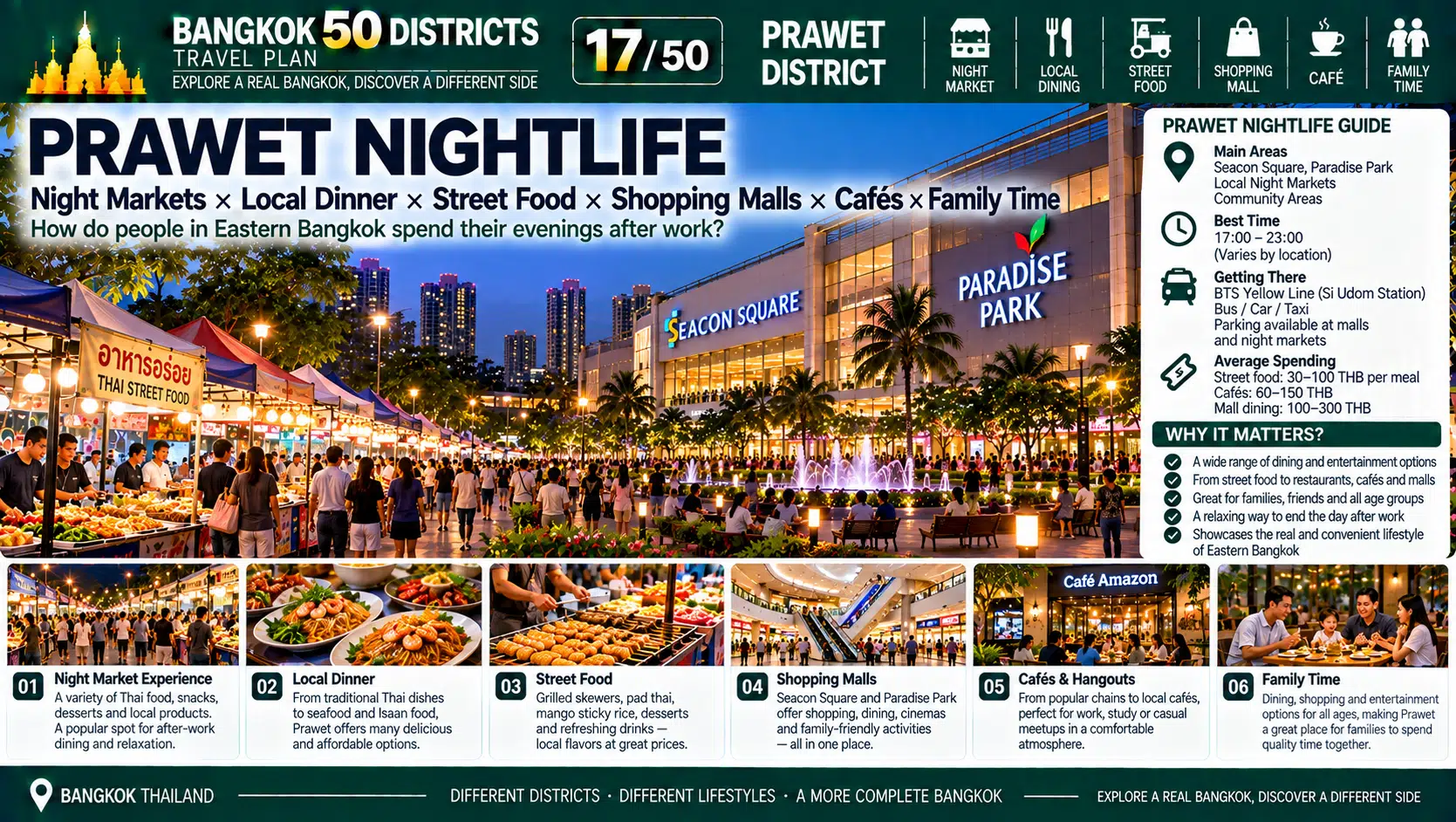
06|Srinagarindra After Dark: How Is Nightlife Here Different From Central Bangkok?
When visitors hear the words “Bangkok nightlife,” they often immediately imagine:
Bars.
Nightclubs.
Asok.
Thonglor.
Khao San Road.
But for most residents, an ordinary evening looks completely different.
Nighttime life around Prawet is more likely to involve:
Dinner.
Markets.
Shopping malls.
Street food.
Cafés.
Family meals.
Meeting friends.
Shopping.
The wider Srinagarindra area has long had a strong culture of evening commerce, particularly around markets, restaurants and neighborhood-oriented nighttime activities.
The important question here is not:
“How late can you party?”
It is:
“Where do residents go after work?”
Those are two completely different questions.
One reflects the tourist imagination of Bangkok.
The other explains how the city actually lives.
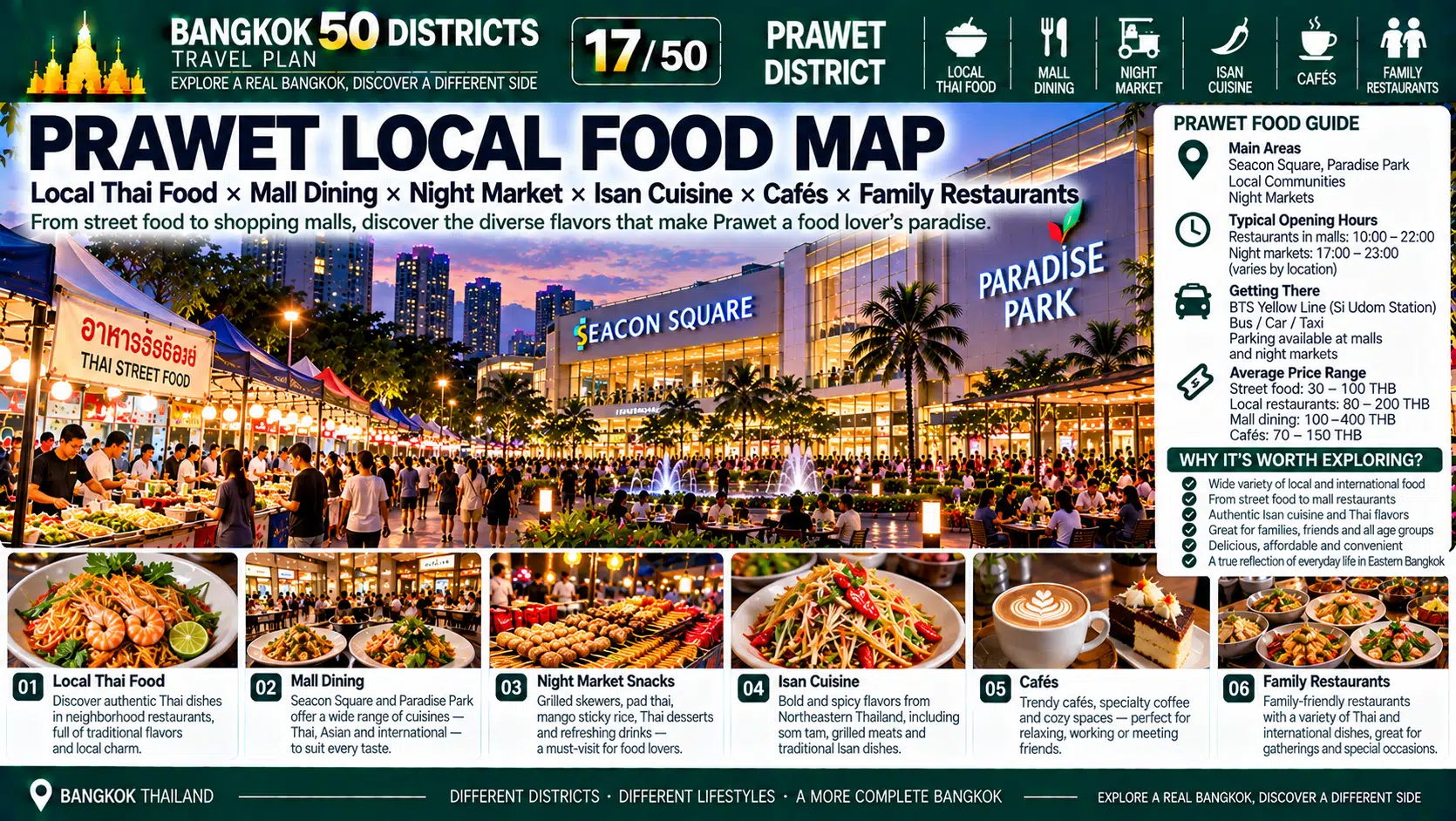
07|What to Eat in Prawet: A District Built for Everyday Dining
Prawet has an extremely complete food ecosystem.
That is because it serves many different groups:
Families.
Students.
Office workers.
Local residents.
Mall visitors.
Night-market customers.
The result is a wide variety of dining options.
① Neighborhood Thai Food
Pad kra pao.
Tom yum.
Fried rice.
Noodles.
Made-to-order Thai dishes.
These remain some of the most reliable everyday meals.
② Shopping Mall Dining
Thai food.
Japanese food.
Korean food.
Chinese food.
Western food.
Chain restaurants.
There are plenty of options for families and groups.
③ Night Markets and Street Food
Grilled meats.
Seafood.
Fried snacks.
Desserts.
Drinks.
Food designed to be eaten while walking around.
④ Isan Cuisine
Som tam.
Grilled chicken.
Grilled pork neck.
Larb.
Sticky rice.
⑤ Cafés and Neighborhood Restaurants
As residential communities mature, more cafés and independent restaurants move into the area.
So the most interesting question in Prawet is not:
“What is the number-one must-eat restaurant?”
Instead, ask:
“How many different types of food does a mature residential district actually need?”
The answer is usually:
Far more than visitors expect.
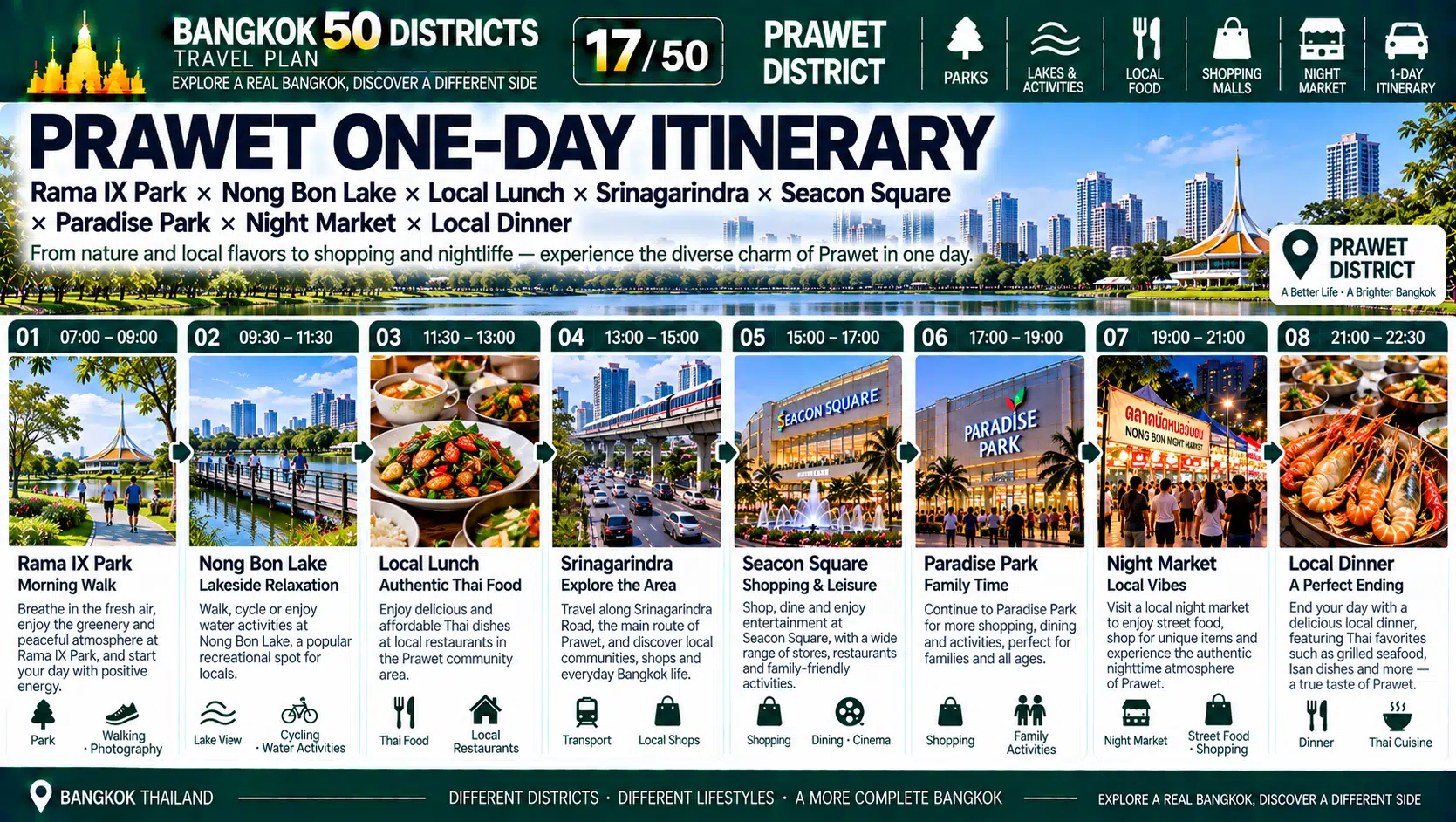
08|How to Spend One Day in Prawet
District 17 works especially well as:
“Green Bangkok × Eastern Lifestyle Hub” in One Day
07:00|Morning Walk at Rama IX Park
Start early.
Watch runners, walkers and people exercising.
Morning is one of the best times to observe how residents actually use public green space.
09:00|Nong Bon Lake Park
Continue to the lake and waterfront environment.
Walk or cycle and experience a side of eastern Bangkok that feels very different from the commercial center.
11:30|Neighborhood Lunch
After leaving the parks, choose a Thai restaurant popular with nearby residents.
There is no need to chase a viral restaurant.
13:00|The Srinagarindra Lifestyle Corridor
Observe how roads, housing, condominiums, schools, businesses and community services connect.
This is where Prawet’s urban structure becomes easier to understand.
14:30|Seacon Square
Enter one of the area’s major shopping centers.
Compare the way residents use an outer-city mall with the way tourists use shopping centers in central Bangkok.
16:30|Paradise Park and Surrounding Area
Continue exploring the residential-commercial environment.
Have a coffee and observe how families, students and nearby residents use these spaces.
18:00|Evening Market and Dinner
As evening begins, explore the nighttime life around Srinagarindra.
Food, markets, restaurants and local crowds become the main characters.
20:00|An Ordinary Evening in Eastern Bangkok
Do not rush away.
Watch people finish dinner, shop, talk with friends and gradually head home.
It may not feel as intense as Sukhumvit.
But it is much closer to:
what an ordinary Bangkok evening looks like for many residents.
09|Prawet Shows Us How Bangkok Is Changing From “One Center” Into “Many Centers”
By District 17, a clear pattern has begun to emerge.
Bangkok’s most important urban functions were once much more concentrated.
The Old City was the political and historical center.
Later, Siam developed into a major modern commercial center.
Sukhumvit became an international residential and business corridor.
But as Bangkok expanded, millions of people could not continue depending on the same central areas for every part of daily life.
So new lifestyle centers began to emerge.
Bang Kapi is one.
Khan Na Yao is another.
Min Buri is another.
And Prawet is another.
When housing expands, people need schools.
Healthcare.
Restaurants.
Supermarkets.
Shopping centers.
Parks.
Transportation.
Entertainment.
Once these functions become sufficiently complete, a district is no longer simply:
“a residential area where people sleep.”
It develops its own daily rhythm.
Its own consumption patterns.
Its own public spaces.
Its own evening life.
And eventually:
its own center.
That is one of the most important transformations in modern Bangkok:
the city is evolving from one dominant center into many centers of everyday life.
Prawet is especially interesting because it brings:
housing + commerce + roads + parks + lakes + evening life
together in the same area.
Lat Krabang showed us:
how globalization can reshape Bangkok through an international airport.
Prawet shows us something different:
once a city matures, what matters most may not be how many landmarks a district has, but whether residents can complete an entire day close to home.
A morning in the park.
Lunch in the neighborhood.
Shopping in the afternoon.
A market in the evening.
Then home.
No need to travel to Siam.
No need to travel to Sukhumvit.
That, too, is a complete version of Bangkok.
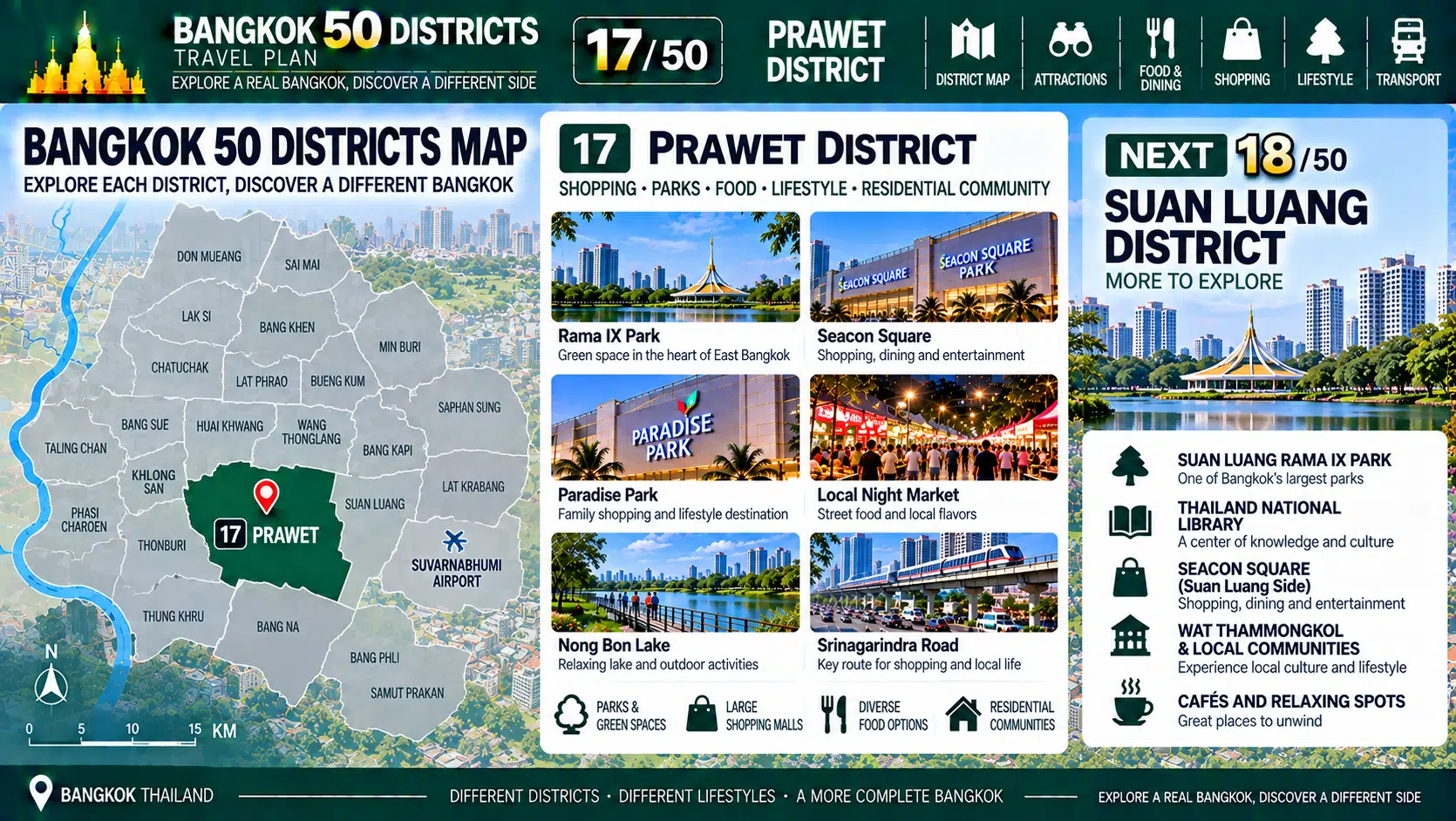
17 / 50 UNLOCKED
PRAWET ✓
Keywords:
Prawet · Srinagarindra · Rama IX Park · Nong Bon Lake Park · Seacon Square · Paradise Park · Night Markets · Residential Communities · Urban Green Space · Local Food · Eastern Bangkok Lifestyle
33 districts remaining.
NEXT STOP|18 / 50
SUAN LUANG
Leaving Prawet, we continue northwest into Suan Luang.
It shares many characteristics with the rapidly urbanizing eastern side of Bangkok, but the city begins to feel denser again.
Housing, condominiums, the Ramkhamhaeng and Srinagarindra transportation networks, neighborhood commerce and culturally diverse communities become more tightly interwoven.
If Prawet asks:
“How does an outer residential district become a complete lifestyle center?”
then District 18, Suan Luang, takes us to the next question:
“As lower-density eastern Bangkok transitions into a denser urban core, how do housing, transportation and diverse communities reorganize the city?”