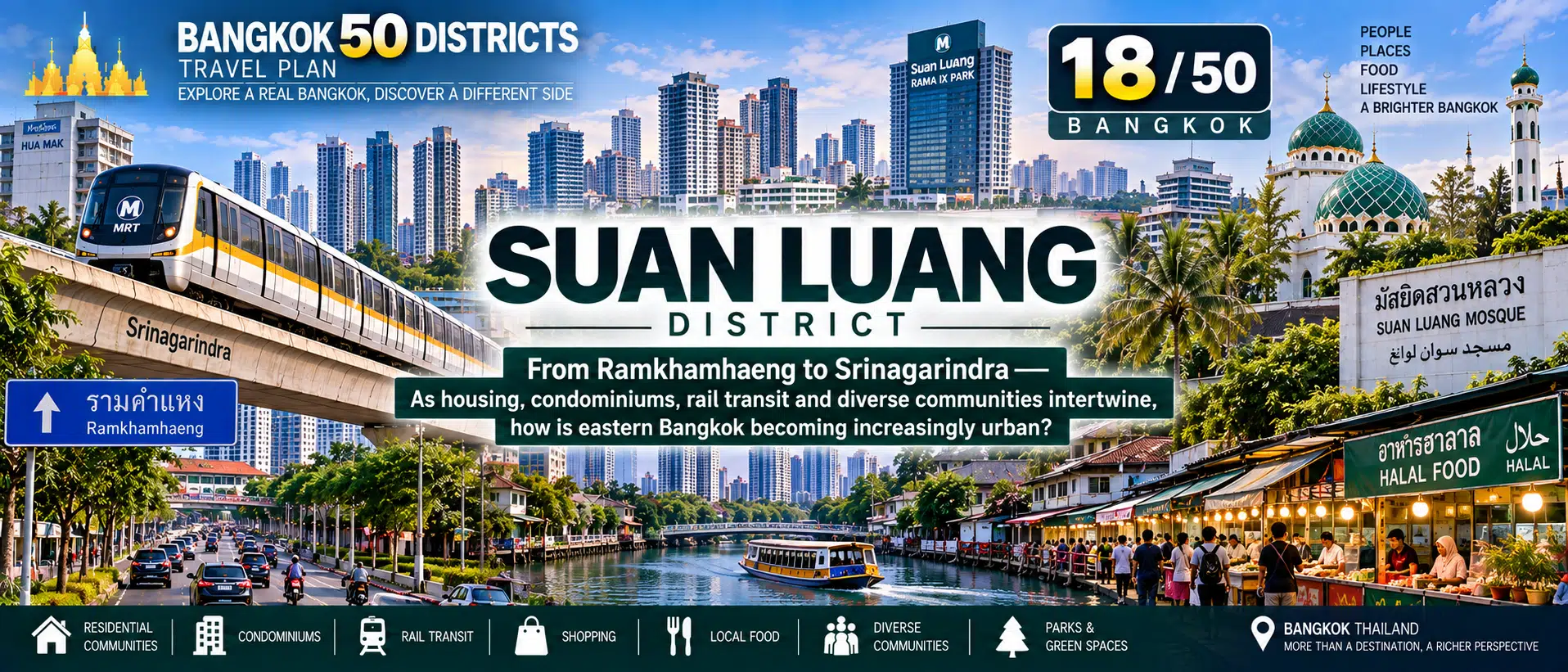
After completing our 17th stop, Prawet, we saw an increasingly complete lifestyle center in eastern Bangkok.
Large urban parks.
Lakes.
Residential communities.
Shopping malls.
Night markets.
The Srinagarindra urban corridor.
Residents can complete much of their daily life from morning until night without traveling to Siam or Sukhumvit.
Now we continue northwest.
The city begins to feel denser again.
There are more residential communities.
Condominiums rise higher.
Traffic becomes heavier.
Rail transit becomes increasingly important to everyday life.
Markets, schools, mosques, restaurants and neighborhood businesses are packed more closely together.
We have arrived at our 18th stop:
SUAN LUANG
There is no Grand Palace here.
No Chao Phraya tourist cruises.
And it is probably not a district that first-time visitors to Bangkok would normally dedicate an entire day to exploring.
But if our goal is to understand:
“How does the real Bangkok actually live?”
then Suan Luang becomes extremely important.
Because this district reveals one of the most important processes taking place in a modern megacity:
The urban outskirts are gradually becoming part of the city itself.
01|Where Is Suan Luang?
Suan Luang lies in the inner-eastern part of Bangkok.
If Prawet showed us a mature residential lifestyle center on the eastern side of the city, moving northwest into Suan Luang brings a noticeable increase in urban density.
The district connects into urban networks leading toward Prawet, Bang Kapi, Watthana and Phra Khanong, while major corridors such as Ramkhamhaeng, Srinagarindra and On Nut influence everyday movement and development around the area.
Its location is particularly interesting.
Continue west and Bangkok becomes increasingly central and dense.
Continue east and you return toward Prawet, Lat Krabang and Suvarnabhumi Airport.
In that sense, Suan Luang sits within a transition zone between:
Central Bangkok × Eastern Bangkok
And that position helps define its character.
Long-established local communities remain.
But modern housing and condominiums continue to expand.
Traditional markets and street restaurants remain.
But rail transit, modern commerce and new urban development are increasingly visible.
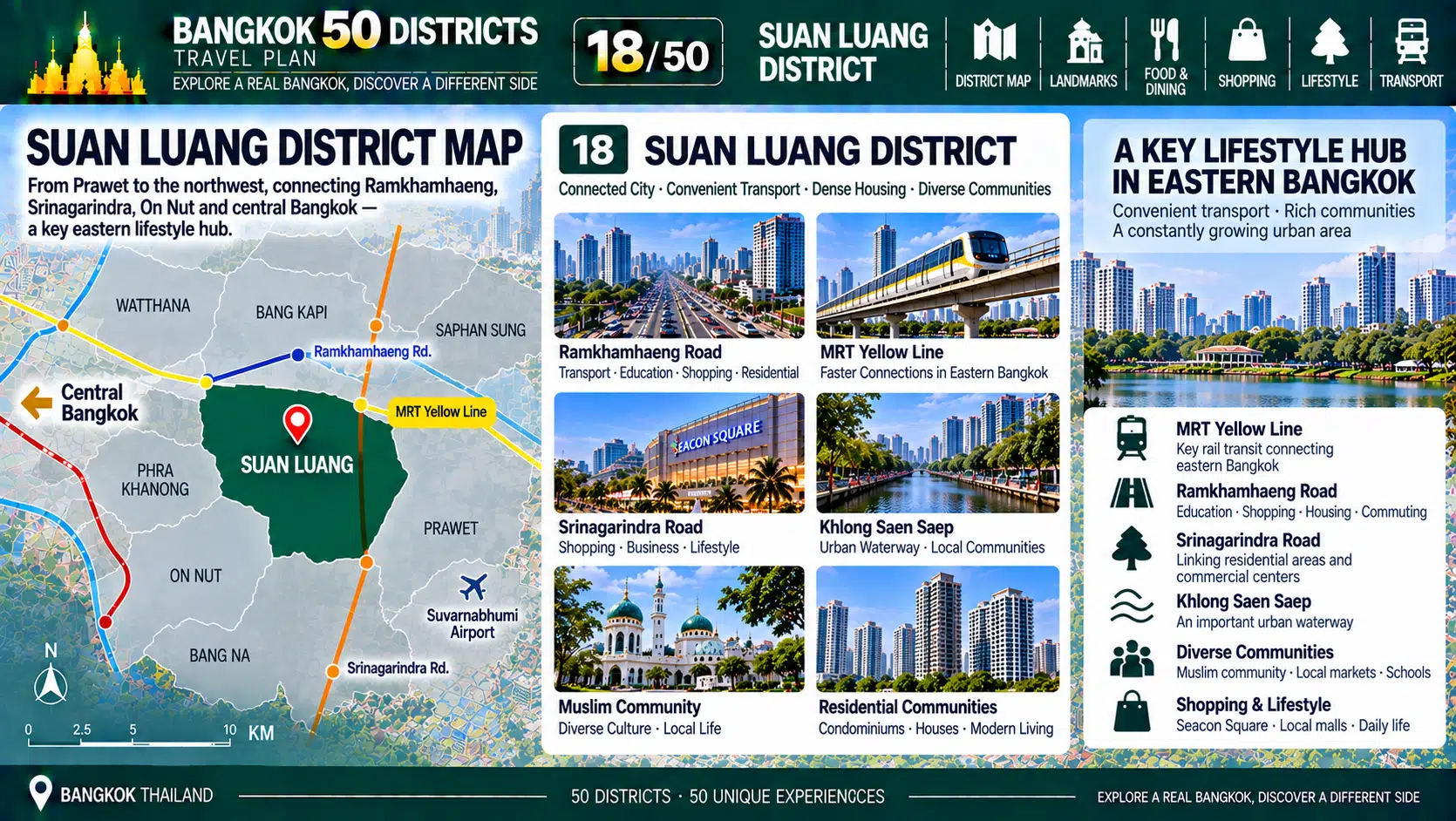
02|Ramkhamhaeng: Why Does It Always Feel Like Everyone Is Moving?
It is difficult to understand Suan Luang without talking about:
RAMKHAMHAENG
One of the strongest impressions here is:
movement.
Cars.
Buses.
Motorcycles.
Students.
Office workers.
Residents.
Delivery riders.
People heading to markets.
People are constantly moving in different directions.
Ramkhamhaeng is not a traditional tourist destination.
But it is an excellent place to understand the real rhythm of Bangkok.
Along the roads and surrounding neighborhoods, you repeatedly encounter:
Condominiums.
Shops.
Restaurants.
Schools.
Community markets.
Convenience stores.
Offices.
Residential sois.
Eventually, a major road stops being simply somewhere for vehicles to pass through.
It becomes:
an urban axis where everyday life happens.
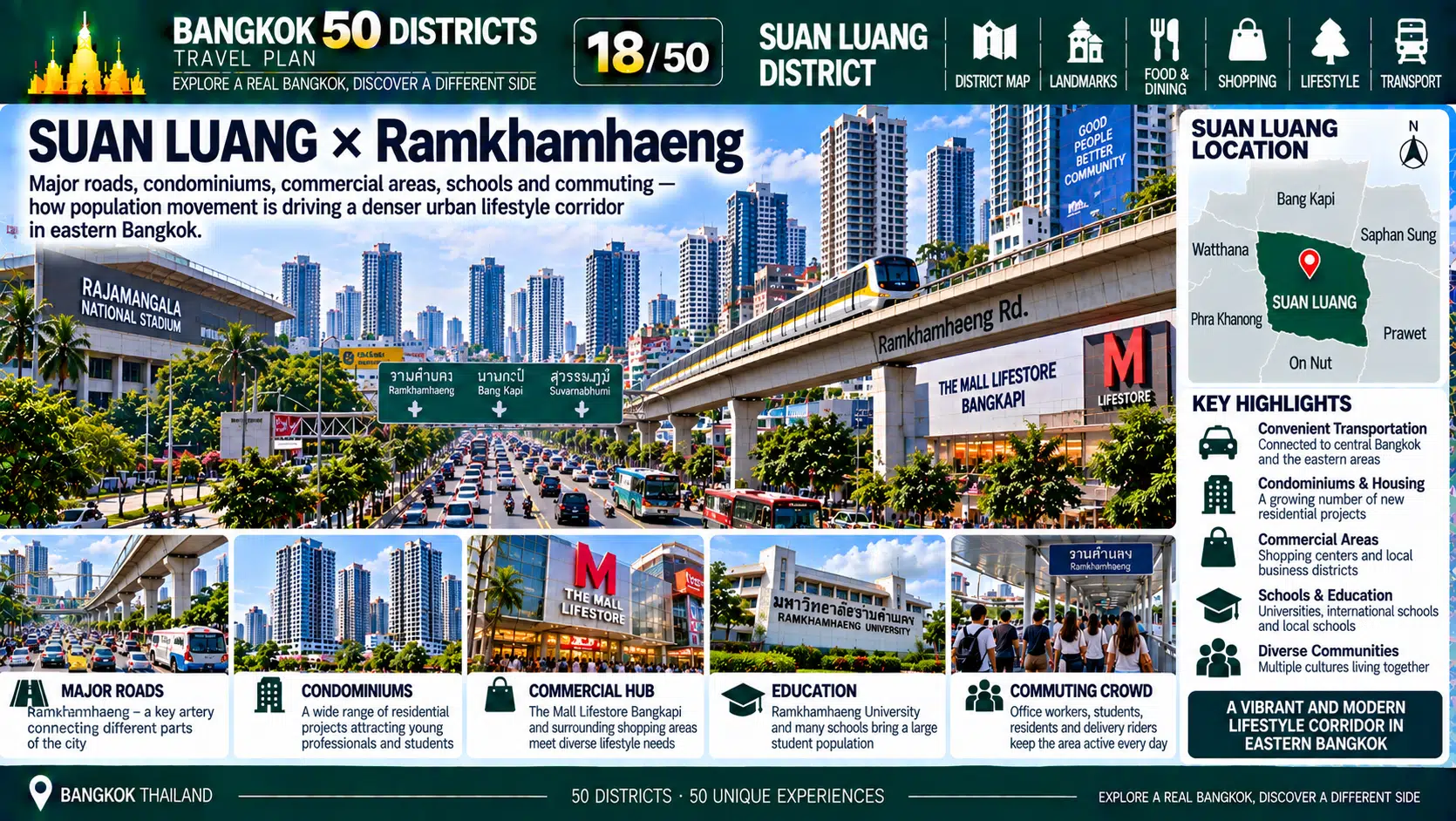
03|Srinagarindra × Yellow Line: How Is Rail Transit Reshaping Eastern Bangkok?
In Prawet, we already followed Srinagarindra through major residential communities, shopping areas and green spaces.
As we move into Suan Luang, this urban corridor continues to play an important role.
But now another factor becomes increasingly important:
MRT YELLOW LINE
For years, many parts of eastern Bangkok depended heavily on:
Cars.
Buses.
Taxis.
Motorcycles.
Major roads.
With rail transit entering the area, everyday mobility begins to change.
A journey that once required a car may now involve:
Walking + MRT.
Motorcycle + MRT.
Bus + MRT.
At first glance, this simply looks like another transportation option.
But over time, rail transit can influence:
Housing choices.
Condominium development.
Commercial locations.
Commuting patterns.
Land values.
And residents’ understanding of what counts as “near” or “far.”
So what the Yellow Line really changes is not simply transportation.
It changes:
Eastern Bangkok’s map of time.
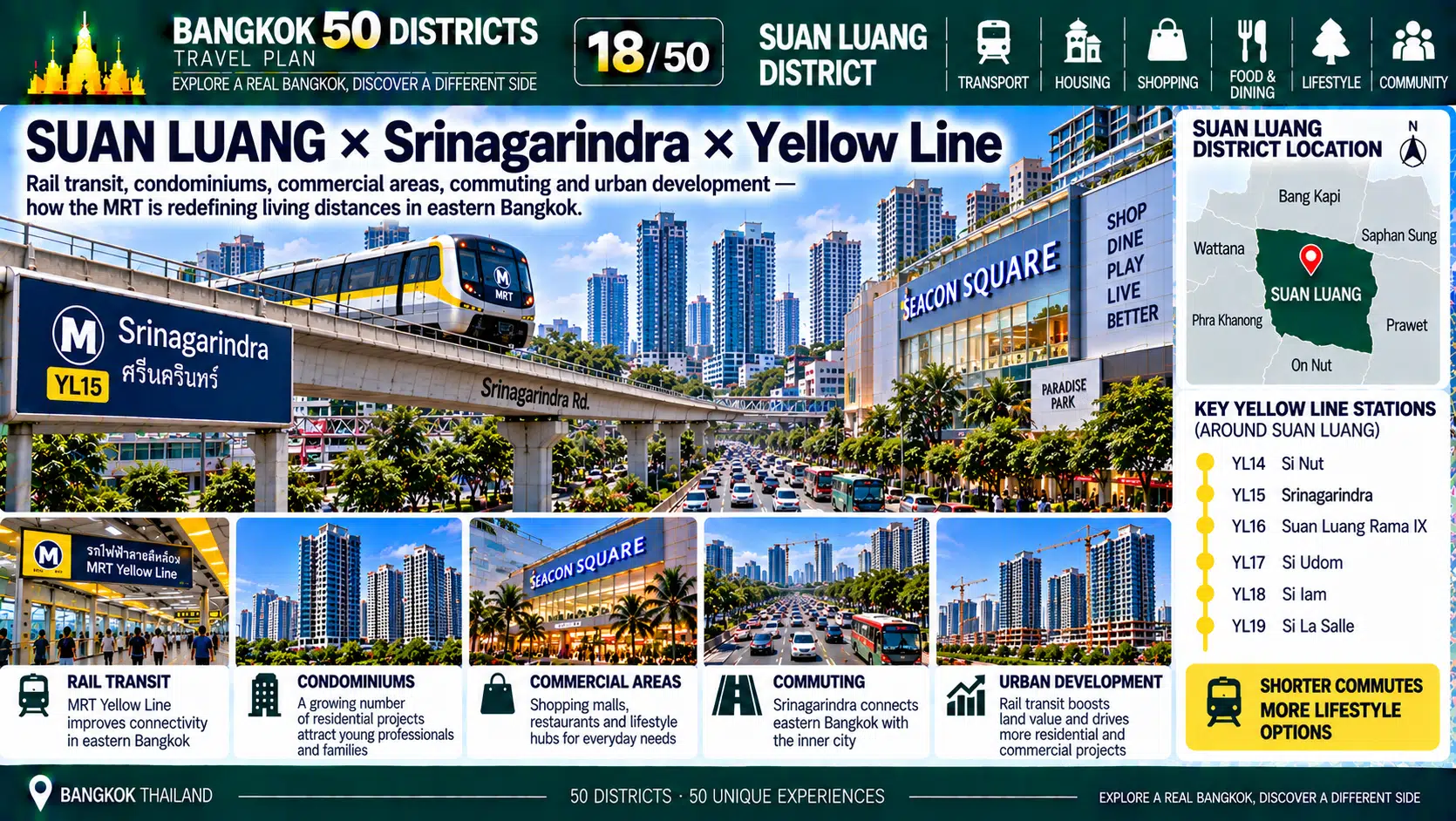
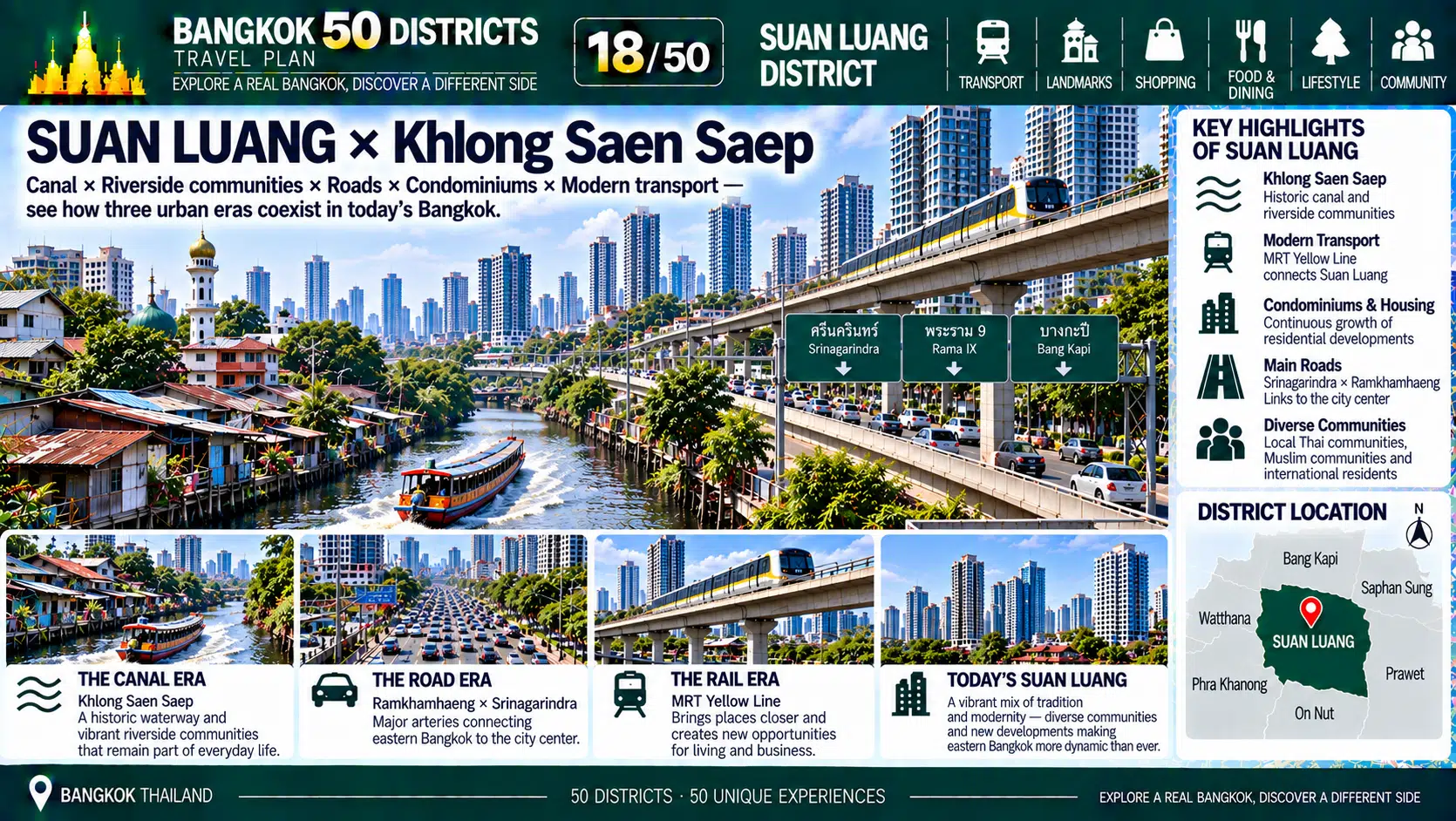
04|Khlong Saen Saep: Beneath the Modern City, the Waterways Never Completely Disappeared
We have traveled from Min Buri to Nong Chok and then to Lat Krabang.
Canals have appeared throughout the journey.
In Suan Luang, waterways return once again.
But the surrounding environment is now completely different.
There are no vast agricultural landscapes.
This is no longer a low-density rural edge.
Along the waterways you may now find:
Housing.
Condominiums.
Roads.
Communities.
Schools.
Commercial areas.
Waterways such as Khlong Saen Saep bring us back to one of Bangkok’s most important historical realities:
This city has always developed alongside water.
Roads arrived.
Elevated infrastructure arrived.
Rail transit arrived.
High-rise buildings arrived.
But water never completely left the city.
Canals still pass through communities.
They still influence urban space.
And some continue to support transportation.
Suan Luang therefore gives us an opportunity to observe several layers of Bangkok at the same time:
Canal Era + Road Era + Rail Era
All existing together.
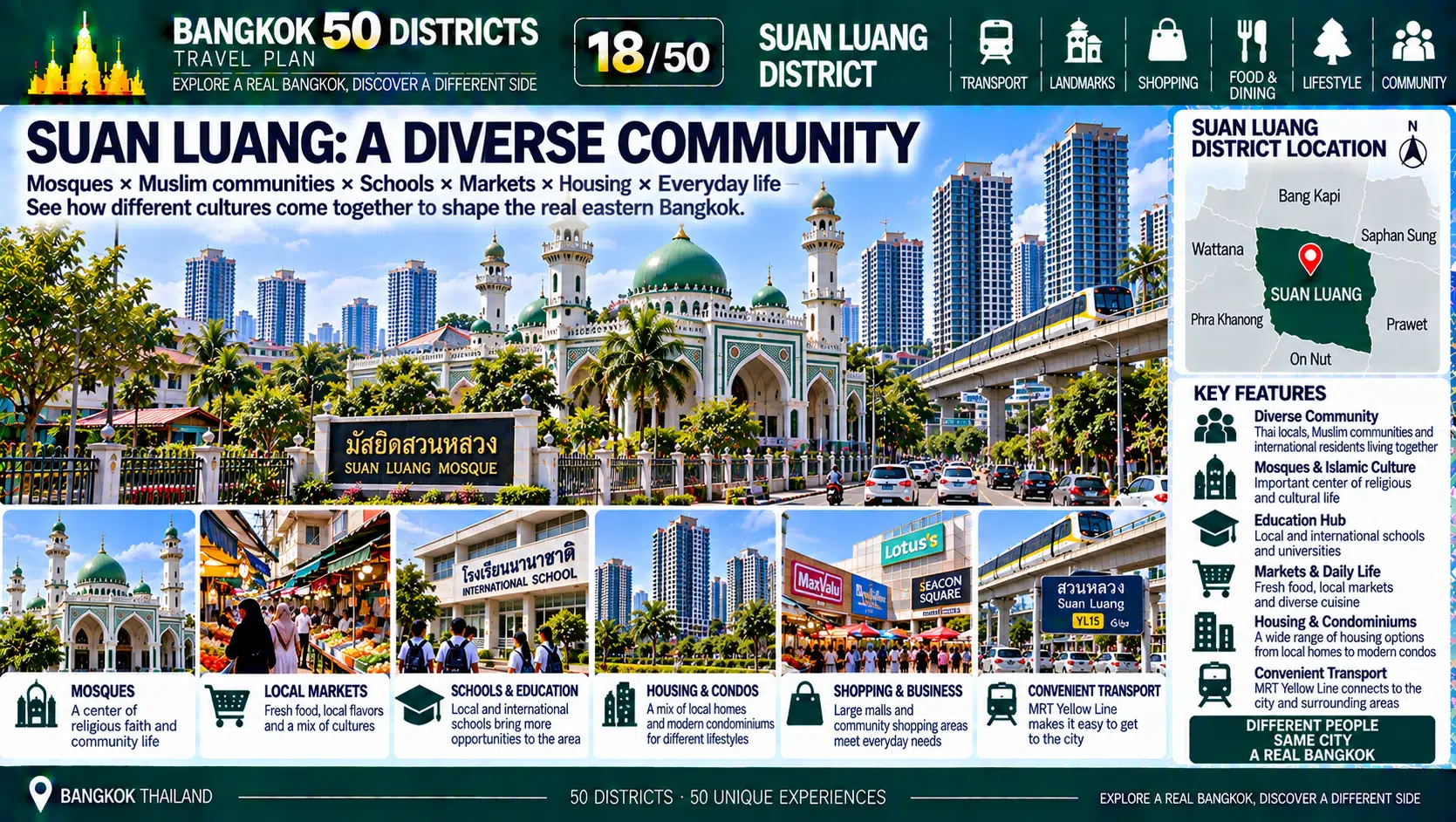
05|Diverse Communities: Why Is Suan Luang More Culturally Complex Than It First Appears?
On a map, Suan Luang may look like an ordinary residential district in eastern Bangkok.
But once you enter its neighborhoods, the cultural landscape becomes much more complex.
One particularly important part of that landscape is:
Muslim communities.
Mosques.
Halal restaurants.
Families.
Schools.
Local markets.
Neighborhood businesses.
These do not exist for tourists.
They are simply part of everyday local life.
At the same time, the district is home to residents from many different backgrounds.
Long-established local families.
Young office workers.
Students.
Condominium residents.
People who moved here for work.
This creates a very typical modern Bangkok condition:
Different people live in the same district while participating in different everyday networks.
This is what Bangkok’s diversity actually looks like.
It is not “multiculturalism” designed as a tourist attraction.
It is people sharing the same city every day while:
Going to school.
Working.
Buying groceries.
Eating.
Commuting.
Living.
06|From Detached Houses to Condominiums: How Does Urban Density Gradually Increase?
If we place Nong Chok, Lat Krabang, Prawet and Suan Luang side by side, a clear transformation becomes visible.
Nong Chok
Large amounts of land.
Relatively few buildings.
Lat Krabang
Airport, university and logistics development drive new urban growth.
Prawet
Large residential communities, shopping malls and parks create a complete lifestyle center.
Suan Luang
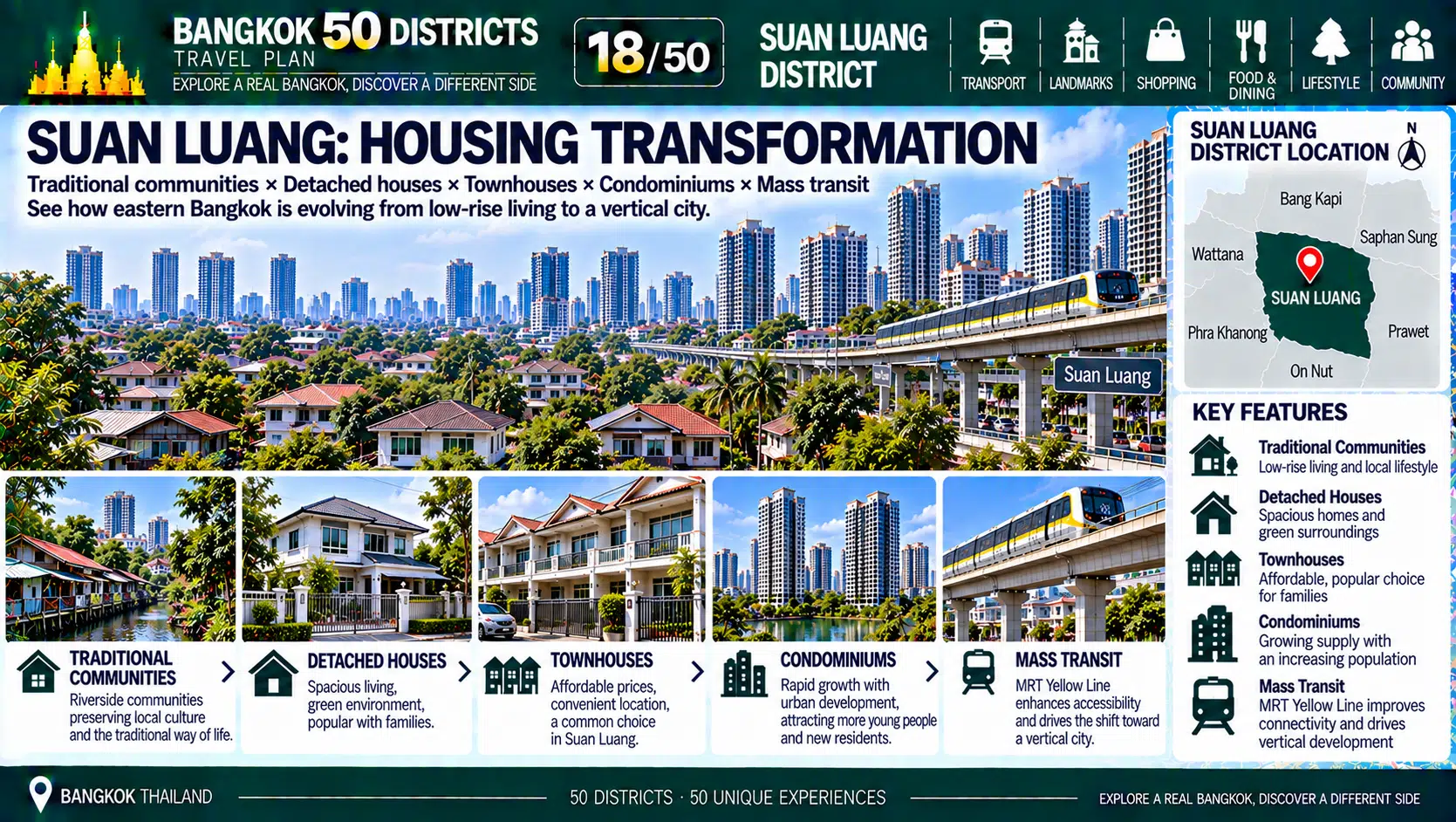
The city begins to grow upward.
Detached houses remain.
Townhouses remain.
Traditional communities remain.
But condominiums become increasingly common.
The same amount of land begins to accommodate more people.
Why?
Because the district is closer to the inner city.
Transportation is more convenient.
Employment opportunities are easier to reach.
Commerce is more mature.
Land values rise.
When more people need to live within the same area, one of the most direct urban responses is:
to shift gradually from horizontal expansion toward vertical development.
07|What to Eat in Suan Luang? The Food Here Comes From “Community Mixing”
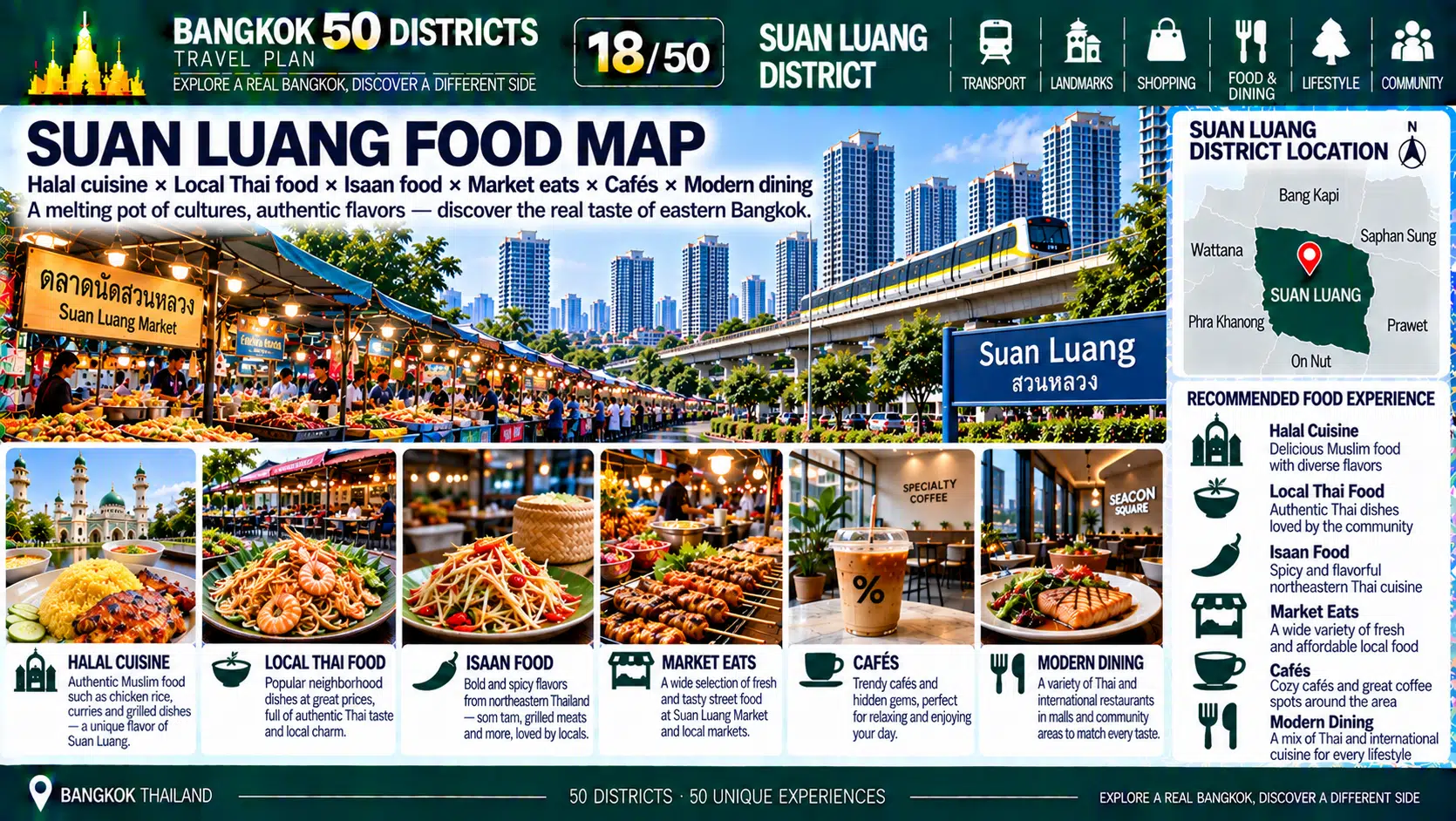
Food is one of the best ways to understand Suan Luang.
Because there is no single answer to what the district tastes like.
① Halal Cuisine
Chicken rice.
Beef dishes.
Curries.
Noodles.
South Asian-influenced and Thai-Muslim flavors.
This is an important part of the district’s cultural identity.
② Neighborhood Thai Food
Pad kra pao.
Fried rice.
Tom yum.
Noodles.
Curry rice.
Simple, ordinary and genuinely local.
③ Isan Cuisine
Som tam.
Larb.
Grilled chicken.
Grilled pork neck.
Sticky rice.
④ Market Food
Buying prepared dishes on the way home from work is one of the most ordinary parts of Bangkok life.
⑤ Cafés and Modern Dining
As condominiums and younger residents increase, cafés, desserts, Japanese restaurants, Korean food and modern dining options also continue to expand.
So the true taste of Suan Luang is not one particular dish.
It is:
the table created when different communities live together.
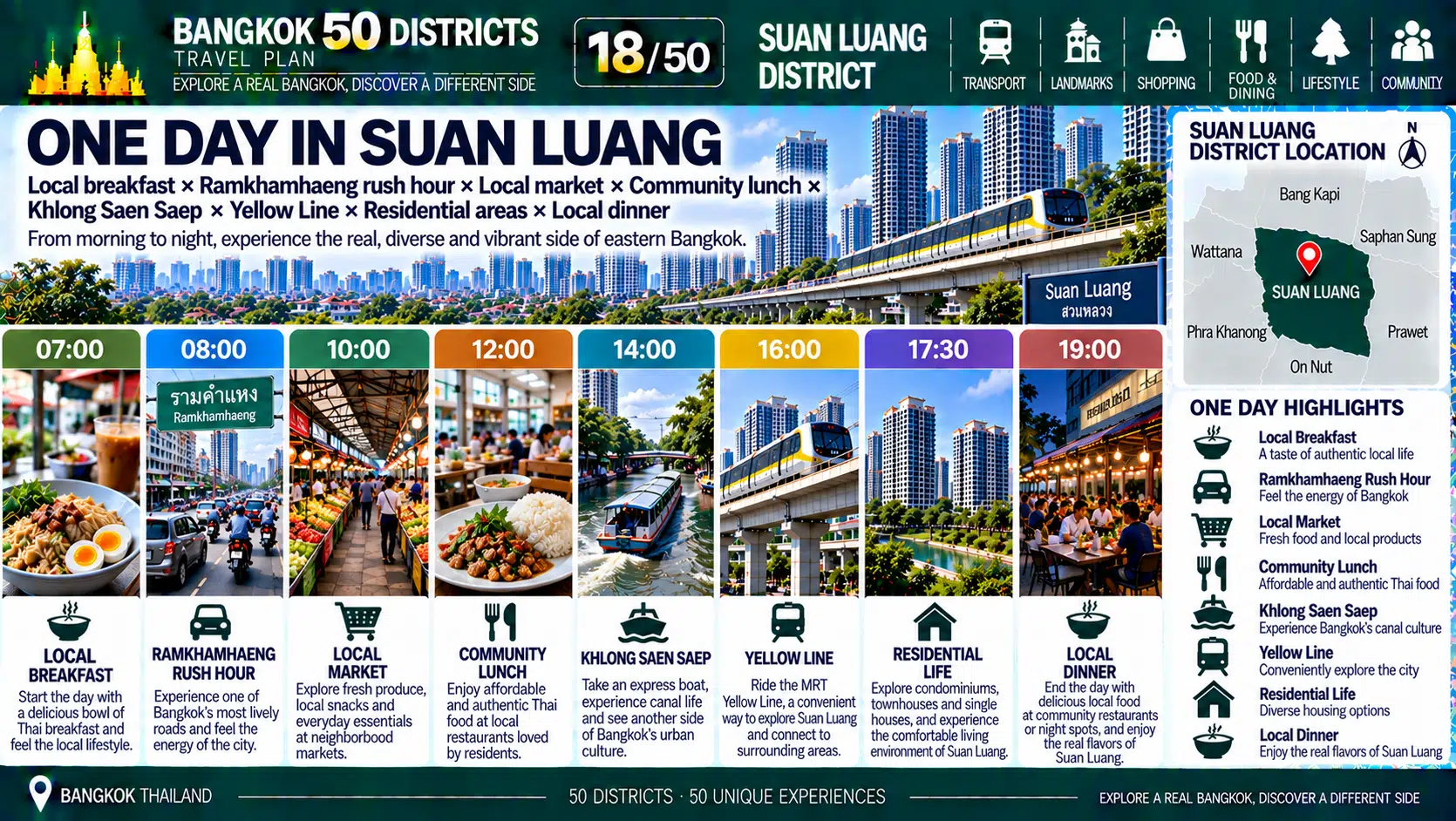
08|How to Spend One Day in Suan Luang
This district does not need a long checklist of traditional tourist attractions.
The best theme is:
“Live Like a Local for One Day.”
07:00|Community Breakfast
Start with a local breakfast.
Rice porridge.
Noodles.
Chicken rice.
Or breakfast at a halal restaurant.
08:30|Ramkhamhaeng Morning Rush
Do not avoid the traffic.
For this district, it is worth observing:
how Bangkok actually starts moving every morning.
Buses, motorcycles, office workers and students all enter the urban system together.
10:00|Local Neighborhoods and Markets
Enter the residential sois.
Look at traditional shops, markets, schools and everyday community services.
12:00|Local Lunch
Choose a neighborhood Thai restaurant or halal cuisine.
There is no need to chase viral restaurants.
13:30|Khlong Saen Saep
Observe how a canal continues to pass through modern housing and road networks.
This is an excellent place to understand the overlapping eras of Bangkok’s urban development.
15:00|Srinagarindra × Yellow Line
Ride or observe the MRT Yellow Line.
See how rail transit is entering an eastern Bangkok landscape that once depended heavily on roads.
17:00|Residential and Condominium Lifestyle Zone
Explore a modern residential area.
Observe how convenience stores, cafés, restaurants and neighborhood businesses develop around residents.
19:00|Local Dinner
Finish with an ordinary neighborhood meal.
This day may not contain a single “world-famous attraction.”
But what you see may be more important:
how Bangkok actually lives.
09|Why Is Suan Luang Such an Important “Transition District” in the 50 Districts Project?
Since District 14, Min Buri, we have moved through eastern Bangkok and gradually back toward the inner city.
Min Buri showed us:
A traditional eastern town center.
Nong Chok showed us:
Agriculture and low-density Bangkok.
Lat Krabang showed us:
Airports and globalization.
Prawet showed us:
A mature outer-city lifestyle center.
And in Suan Luang, another transformation becomes visible:
The outer city is beginning to connect with the inner city.
Residential density increases.
Rail transit arrives.
Condominiums multiply.
Commercial activity becomes more concentrated.
The population becomes more diverse.
Roads become busier.
But at the same time:
The canals remain.
Old communities remain.
Markets remain.
Mosques remain.
Street shops remain.
So this is not a story of:
“Old Bangkok being replaced by New Bangkok.”
A more accurate description is:
Different eras of Bangkok are being layered on top of one another.
A condominium can rise beside a canal.
An MRT line can pass near an old neighborhood.
A modern café can open close to a mosque.
A traditional market can sit just beyond a major urban road.
This combination may sometimes look chaotic.
But it is one of Bangkok’s most characteristic urban conditions.
Bangkok was not planned and built all at once.
It grew:
layer by layer.
And Suan Luang is one of the best districts for observing that process.
If Prawet taught us:
“A city can have many lifestyle centers,”
then Suan Luang takes that idea one step further:
“As those outer lifestyle centers continue to grow, they eventually connect with the original urban core, creating a megacity with almost no obvious boundary between center and edge.”
That is modern Bangkok.
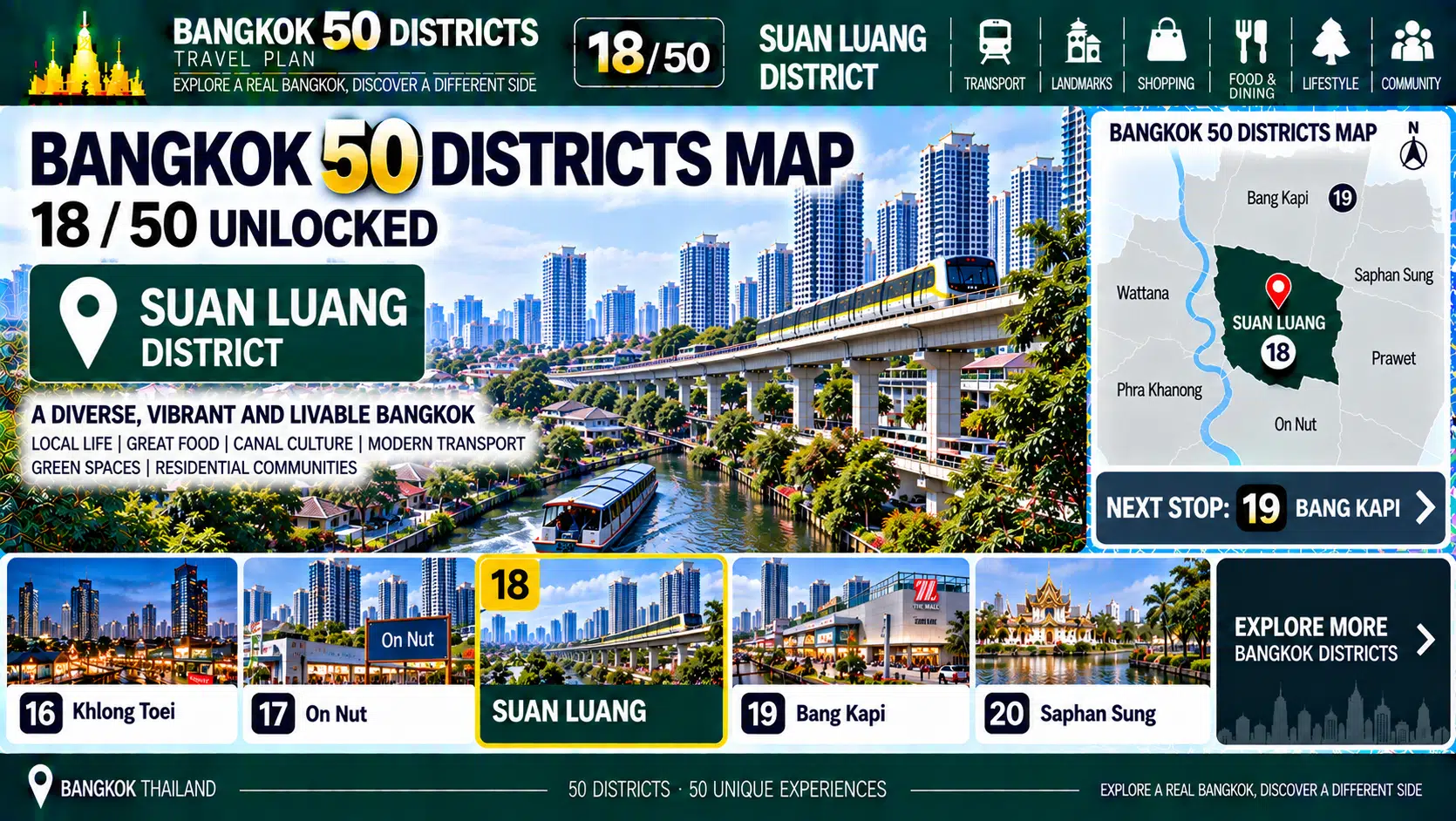
18 / 50 UNLOCKED
SUAN LUANG ✓
Keywords:
Suan Luang · Ramkhamhaeng · Srinagarindra · MRT Yellow Line · Khlong Saen Saep · Diverse Communities · Muslim Communities · Halal Food · Condominiums · Local Markets · Eastern Bangkok
32 districts remaining.