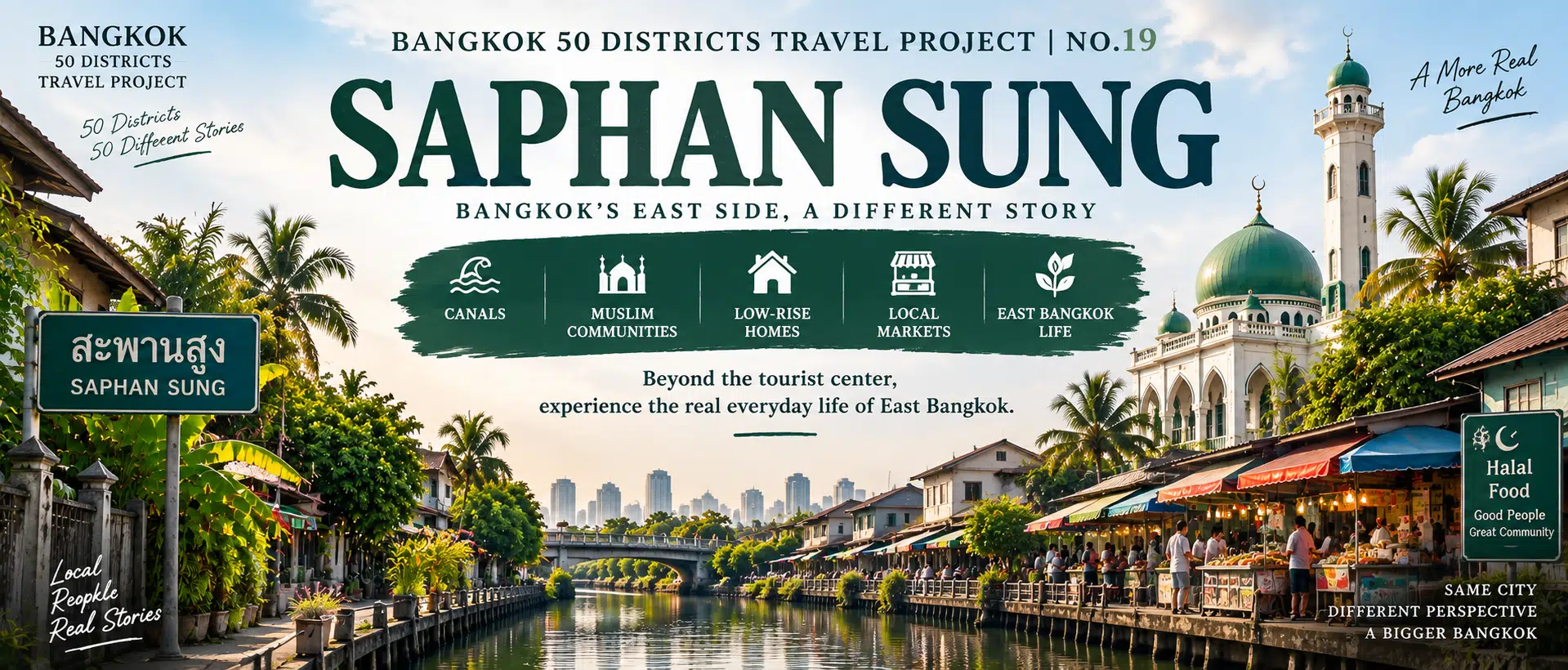
The farther east you travel in Bangkok, the less the city resembles the Bangkok most visitors know.
High-rises begin to disappear.
Large commercial centers no longer dominate the landscape.
Roads spread farther apart, while low-rise neighborhoods become increasingly common.
Then canals, schools, community markets, mosques and residential areas begin to take center stage.
This is:
Saphan Sung
There is no Grand Palace-scale landmark here.
There is no commercial concentration comparable to Siam or Sukhumvit.
But if you want to understand:
What does everyday life actually look like for families living beyond Bangkok's tourist center?
Saphan Sung offers a fascinating answer.
What matters here is not one famous building.
It is:
Canals × Muslim Communities × Low-Rise Homes × Local Markets × Family Life
01|First, Meet Saphan Sung: This Is Residential Bangkok
Travel east from central Bangkok and the city begins to change.
At first, commercial districts dominate.
High-rises, condominiums, shopping malls, BTS and MRT lines, and busy roads create the Bangkok most visitors recognize.
Continue toward Ramkhamhaeng and farther east, however, and building heights gradually fall.
Residential areas become more common.
Commercial density decreases.
Distances between major roads increase.
Once you enter Saphan Sung, the transformation becomes especially clear.
There is no highly concentrated district center comparable to Siam.
Homes, schools, markets, restaurants, mosques, neighborhood roads and canals are distributed throughout the area.
So don't arrive looking for:
“The No.1 attraction in Saphan Sung.”
The district itself is what we have come to explore.
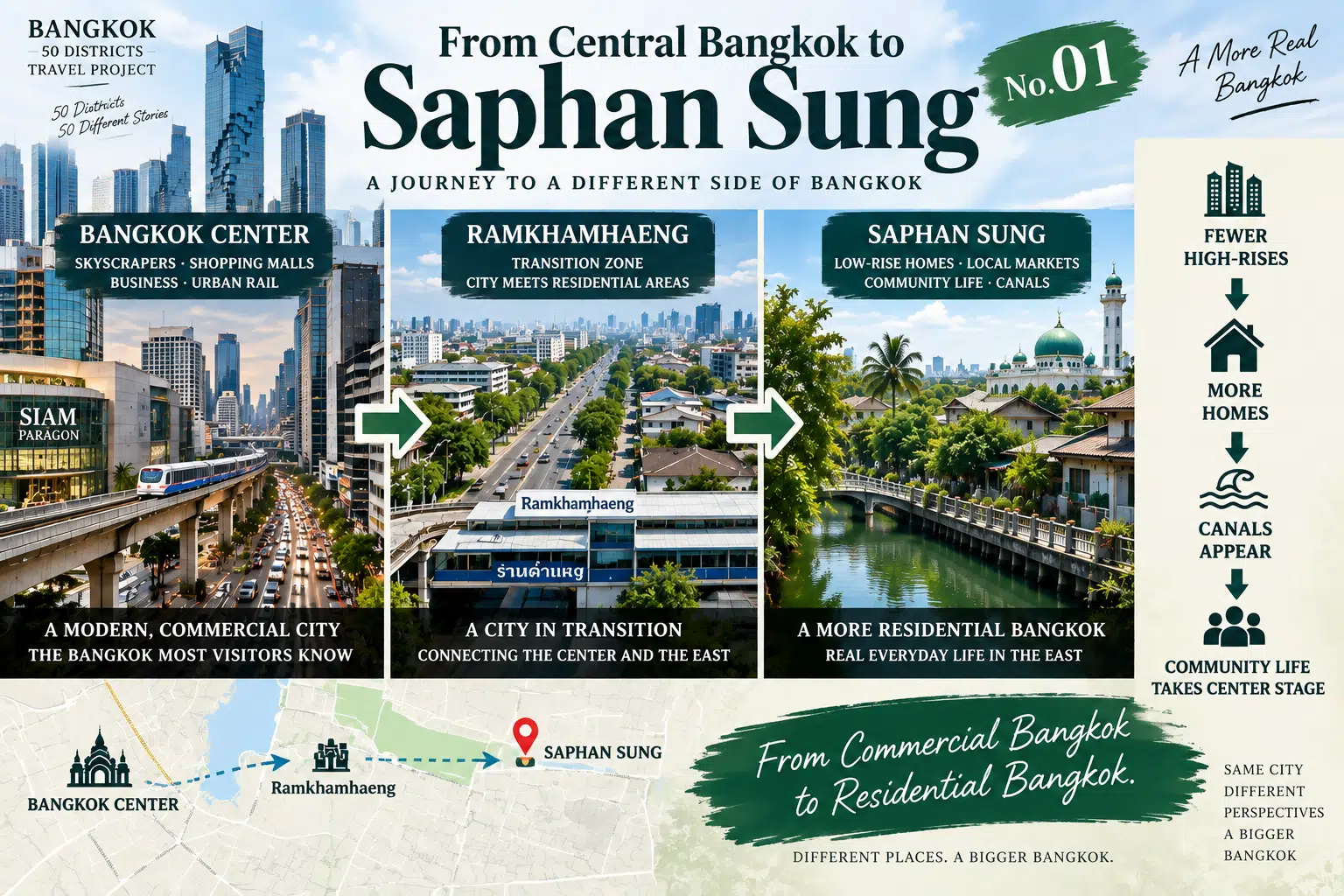
BANGKOK CENTER
↓
RAMKHAMHAENG
↓
SAPHAN SUNG
FEWER HIGH-RISES
↓
MORE HOMES
↓
CANALS APPEAR
↓
COMMUNITY LIFE TAKES CENTER STAGE
From commercial Bangkok to residential Bangkok.
02|Why Are There So Many Low-Rise Homes Here?
To understand Saphan Sung, we first need to understand Bangkok's outward expansion.
As land in central Bangkok became increasingly dense, residential development spread farther into the eastern parts of the city.
For many families, living directly beside Siam is not the goal.
What they may want instead is:
More living space.
A quieter neighborhood.
Parking.
Nearby schools.
Markets and supermarkets.
Road connections that support everyday family life.
As a result, Saphan Sung today contains large numbers of:
Detached houses.
Townhouses.
Residential developments.
Low-rise apartments.
Schools.
Convenience stores.
Neighborhood businesses.
This is an important side of Bangkok as a megacity, but one that rarely appears in tourism advertising.
The people who live in Bangkok do not all live in skyscrapers.
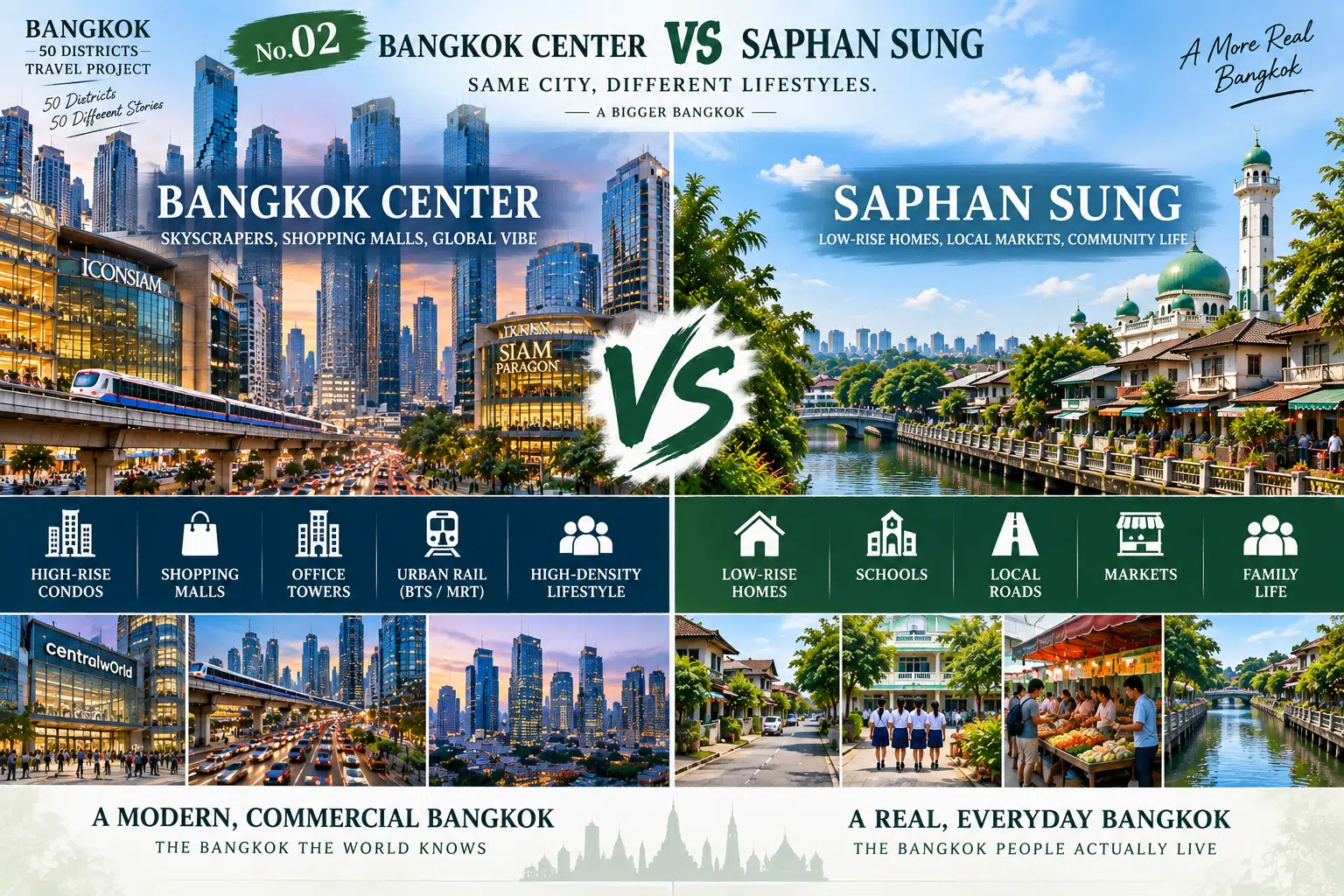
BANGKOK CENTER
HIGH-RISE CONDOS
×
SHOPPING MALLS
×
OFFICE TOWERS
×
URBAN RAIL
×
HIGH-DENSITY LIFE
SAPHAN SUNG
LOW-RISE HOMES
×
SCHOOLS
×
LOCAL ROADS
×
MARKETS
×
FAMILY LIFE
One Bangkok. Two completely different scales of everyday life.
03|Behind the Modern Neighborhoods, Canal Bangkok Still Exists
Today, Bangkok often feels like a city defined by roads and railways.
But historically, waterways played a major role in shaping communities across the city.
That older structure can still be seen in Saphan Sung.
Leave the major roads and enter the neighborhoods, and you will discover that the canals never completely disappeared.
Some run beside residential areas.
Others are hidden behind roads and houses.
Small bridges connect communities across the water.
Homes sit near the canals.
Trees and vegetation follow the banks.
Modern roads, cars and housing developments have transformed the district, but the older waterways remain embedded in its urban structure.
So when exploring Saphan Sung, don't stay only on the main roads.
Some of the most interesting transitions appear when you move through:
Main Road → Side Street → Homes → Small Bridge → Canal
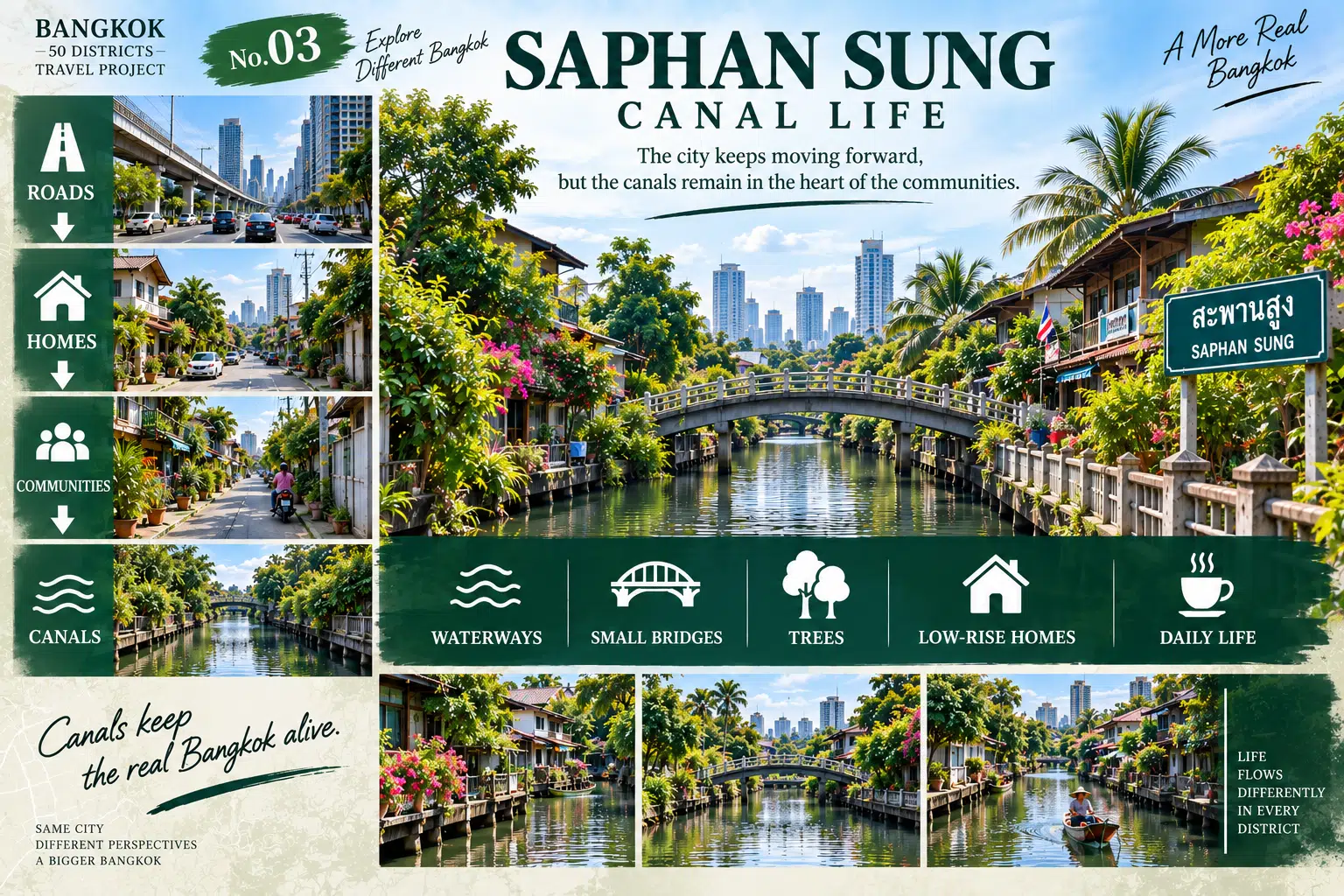
SAPHAN SUNG CANAL LIFE
ROADS
↓
HOMES
↓
COMMUNITIES
↓
CANALS
WATERWAYS × SMALL BRIDGES × TREES × LOW-RISE HOMES × DAILY LIFE
The city keeps moving forward, while canals remain woven into the community.
04|Mosques Are an Important Part of the Community Landscape
Explore deeper into Saphan Sung and another element becomes increasingly visible:
Mosques.
Eastern Bangkok has long-established Muslim communities.
As a result, the mosques here are not unusual buildings created for tourists to visit.
They belong first and foremost to the surrounding communities.
Around them, you may find:
Homes.
Schools.
Shops.
Restaurants.
Roads.
And the ordinary rhythm of daily life.
In the morning, residents leave for work.
Children go to school.
Nearby restaurants become busy around lunchtime.
At certain times of day, religious activities become part of the neighborhood rhythm.
This is an important part of Saphan Sung:
Religious space and everyday community space exist together.
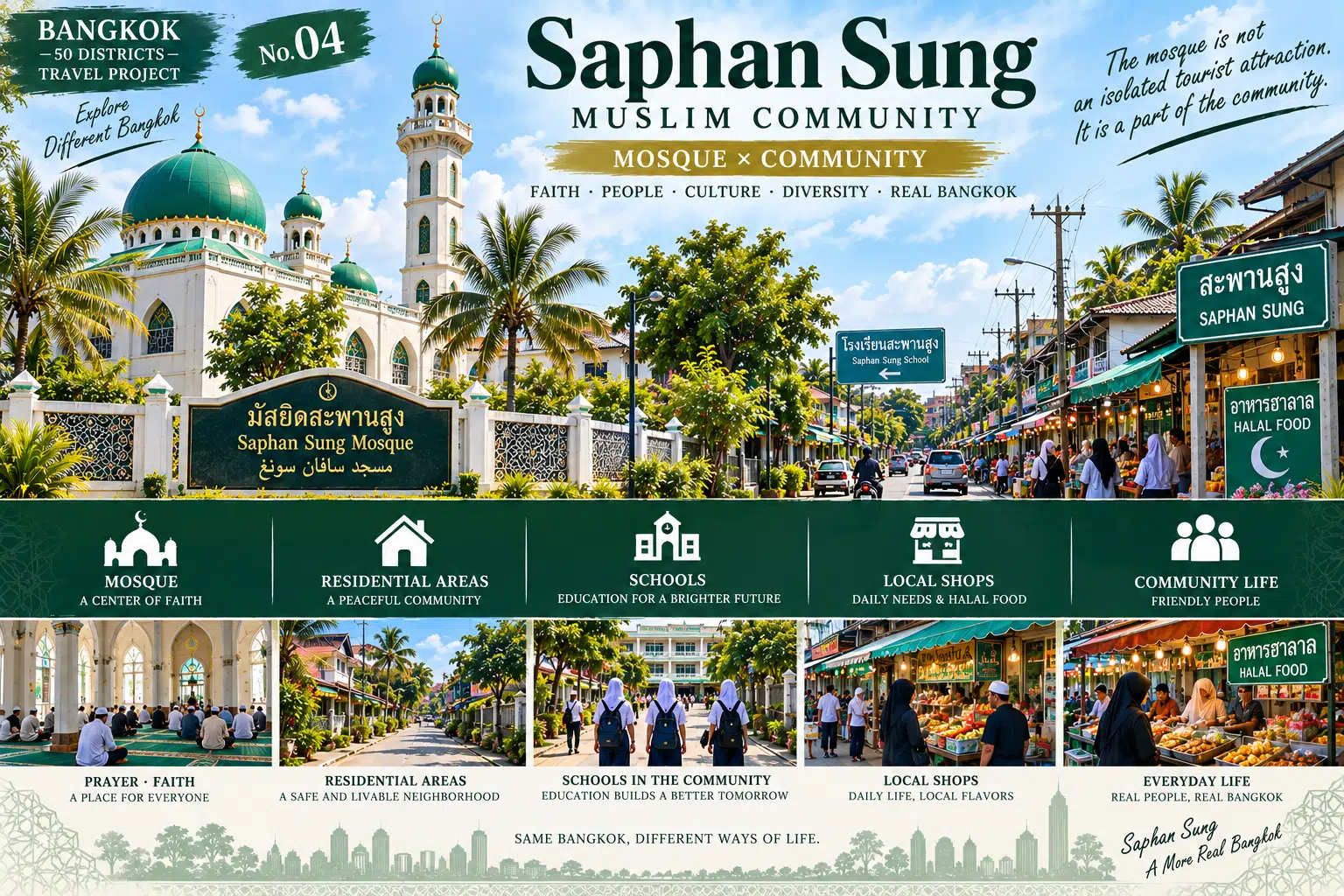
MOSQUE × COMMUNITY
MOSQUE
×
HOMES
×
SCHOOLS
×
SHOPS
×
COMMUNITY LIFE
**The mosque is not an isolated tourist attraction.
It has always been part of the community.**
05|This Is Bangkok's Cultural Diversity in Everyday Form
Many visitors first encounter Thailand's religious culture through Buddhist temples.
Wat Phra Kaew.
Wat Pho.
Wat Arun.
It is therefore easy to imagine Bangkok's religious landscape almost entirely through temples.
But once you begin exploring all 50 districts, the city becomes much more complex.
In Saphan Sung, cultural diversity is not something staged specifically for visitors.
It might simply be:
A halal restaurant.
A neighborhood mosque.
Students walking home after school.
Residents buying dinner at a local market.
Families from different backgrounds living within the same part of the city.
There is no stage.
No performance.
No specially packaged “cultural experience.”
Because this is simply everyday life.
06|The Local Market Is More Interesting Than Chasing Viral Restaurants
If you visit Saphan Sung, there is no need to spend your time searching for:
“Top 10 Instagram-famous restaurants.”
A local market may tell you much more.
Markets are one of the quickest ways to understand a residential district.
In the morning, you may find breakfast and simple prepared meals.
During the day, there are fruits, vegetables, meat and household goods.
By late afternoon, the market becomes lively again.
Residents return from work.
Students finish school.
Some people shop for ingredients.
Others buy prepared food to take home.
Some simply sit down nearby for dinner.
Because the area includes Muslim communities, you can also look for:
Halal food.
Curries.
Chicken dishes.
Beef dishes.
Rice.
Noodles.
Desserts.
Tea and iced drinks.
These may not be Bangkok's most famous foods.
But they tell us something more relevant to this journey:
What do the people who live here actually eat every day?
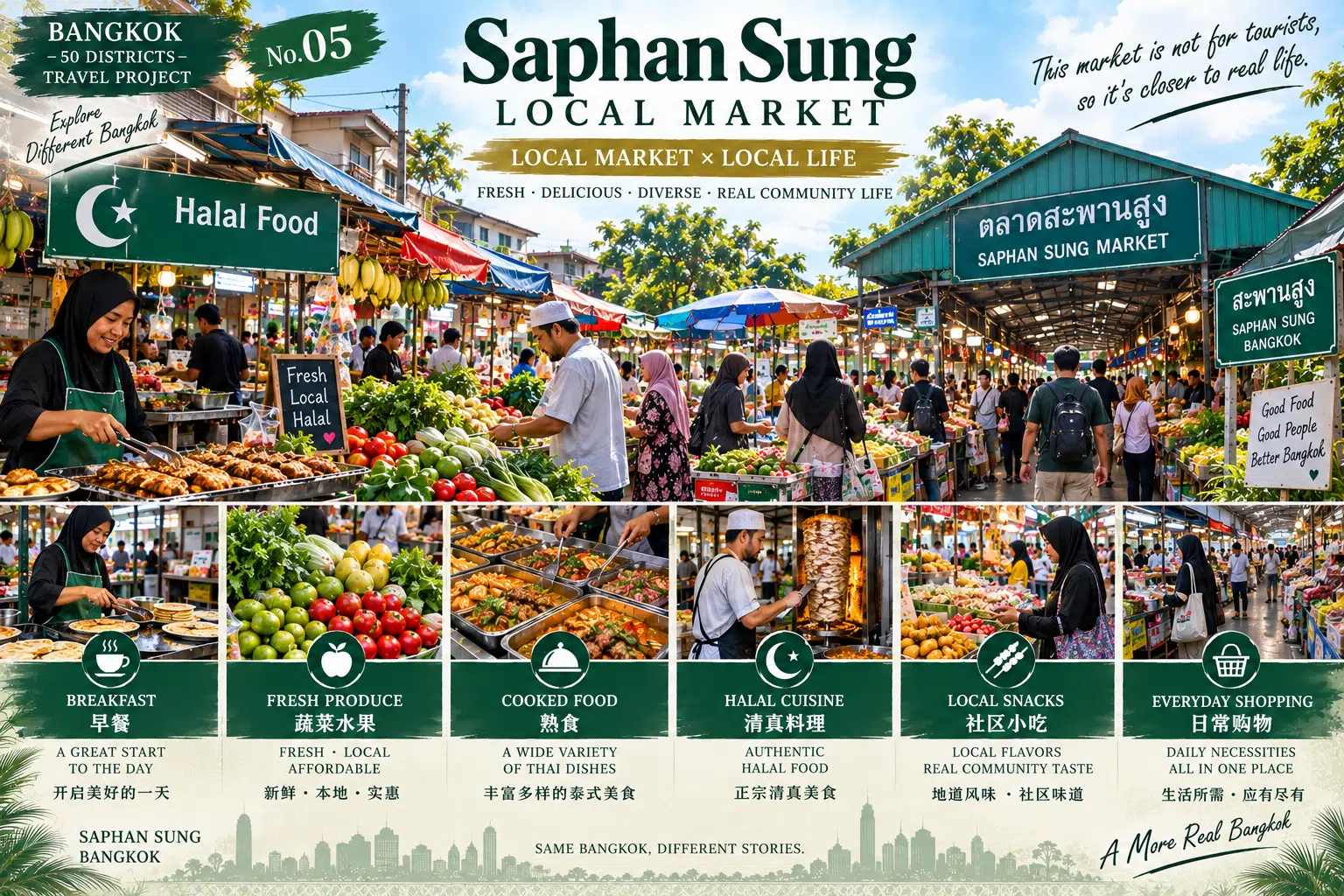
LOCAL MARKET × LOCAL LIFE
BREAKFAST
×
FRUIT & VEGETABLES
×
PREPARED FOOD
×
HALAL FOOD
×
LOCAL SNACKS
×
DAILY SHOPPING
**The market was not created for tourists.
That is exactly why it feels closer to real life.**
07|To Understand Saphan Sung, Watch an Ordinary Family Day
One of the most interesting ways to experience this district is through time.
07:00
Children leave for school.
Workers begin leaving residential neighborhoods.
Roads become busier.
09:00
The morning rush begins to fade.
Neighborhood streets become quieter.
Shops, markets and restaurants settle into the day.
12:00
Residents, students and workers fill local restaurants.
The community becomes busy again around lunchtime.
15:30
Schools begin to finish for the day.
Students return to the streets.
17:00
Residents begin coming home.
Markets enter one of their busiest periods.
18:30
Some people buy groceries.
Others pick up prepared food.
Some simply eat dinner nearby.
20:00
Residential streets become quiet again.
Another ordinary day comes to an end.
This may not sound like a traditional travel guide.
But it reveals something far more important:
What everyday Bangkok actually looks like.
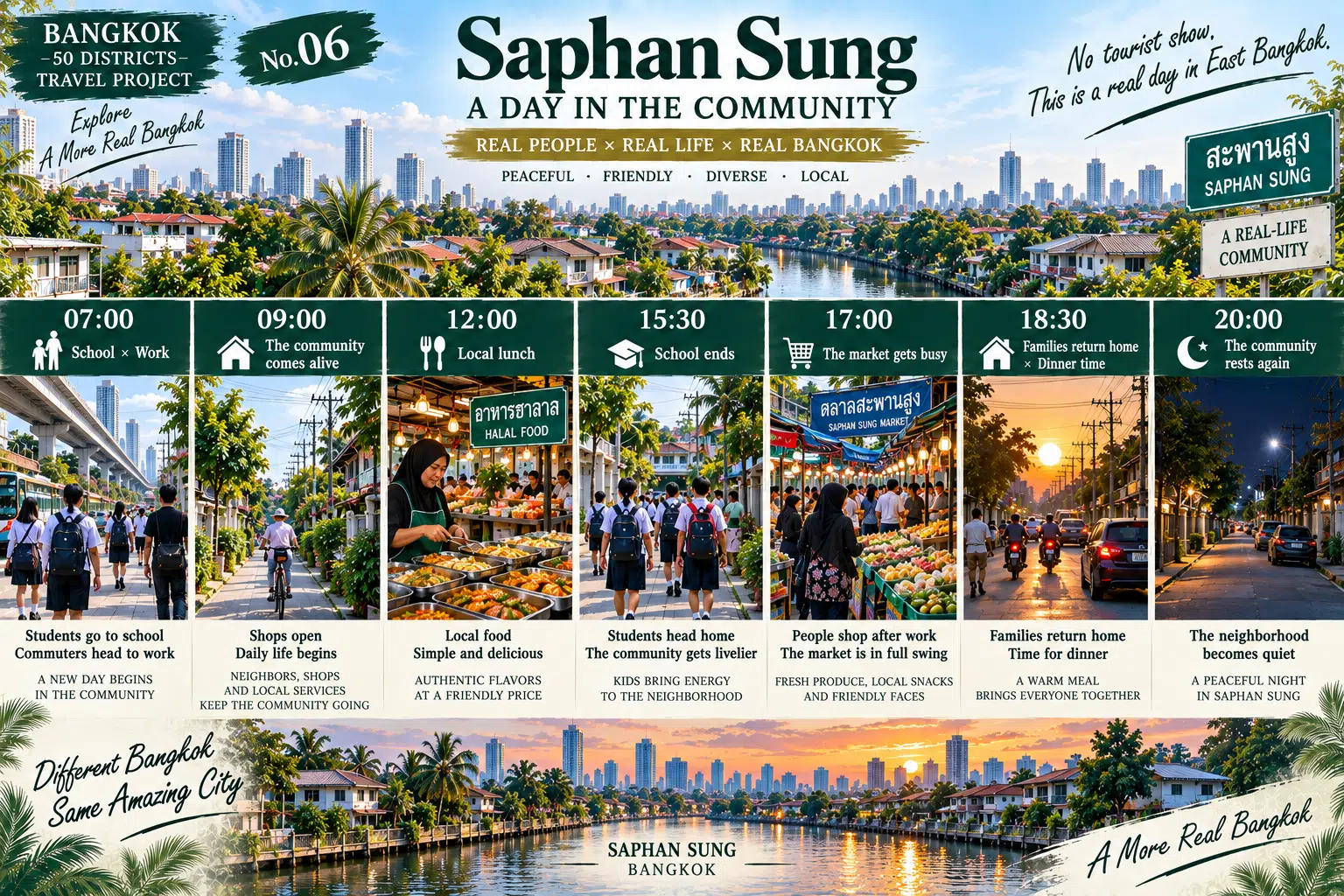
07:00|SCHOOL × WORK
09:00|THE COMMUNITY STARTS ITS DAY
12:00|LOCAL LUNCH
15:30|SCHOOL FINISHES
17:00|THE MARKET COMES ALIVE
18:30|HOME × DINNER
20:00|THE COMMUNITY BECOMES QUIET AGAIN
**No tourist performance.
Just a real day in East Bangkok.**
08|A One-Day Saphan Sung Travel Plan
For your first visit, think of the day as:
“A Day Inside an Ordinary East Bangkok Community.”
08:30|Leave Central Bangkok
Travel east toward Ramkhamhaeng.
Watch how building heights and urban density gradually change.
09:30|Enter Saphan Sung
Don't immediately search for an attraction.
Start by observing homes, schools, roads and the structure of the neighborhood.
10:30|Canals × Low-Rise Homes
Leave the major roads.
Enter quieter residential areas and observe how canals, small bridges and low-rise homes fit together.
11:30|Muslim Community × Mosque
See how mosques connect with homes, schools and neighborhood businesses.
If entering a religious space, follow local etiquette.
12:30|Local Lunch
Choose a neighborhood restaurant or halal restaurant.
Don't rely only on online rankings.
Look at where local residents are eating.
14:00|Residential Life
Continue through areas of detached houses, townhouses, schools, convenience stores and local businesses.
16:00|Local Market
Late afternoon is a good time to visit.
Residents begin shopping for groceries, prepared food and dinner.
17:30|Canals × East Bangkok Evening
As the sun begins to fall, the temperature becomes more comfortable.
Watch the canals, homes and neighborhood streets transition into evening.
18:30|Local Dinner × Return to Central Bangkok
Finish with a local dinner before heading back toward the city center.
When the high-rises and dense traffic return, the contrast becomes obvious:
You have just experienced another Bangkok.
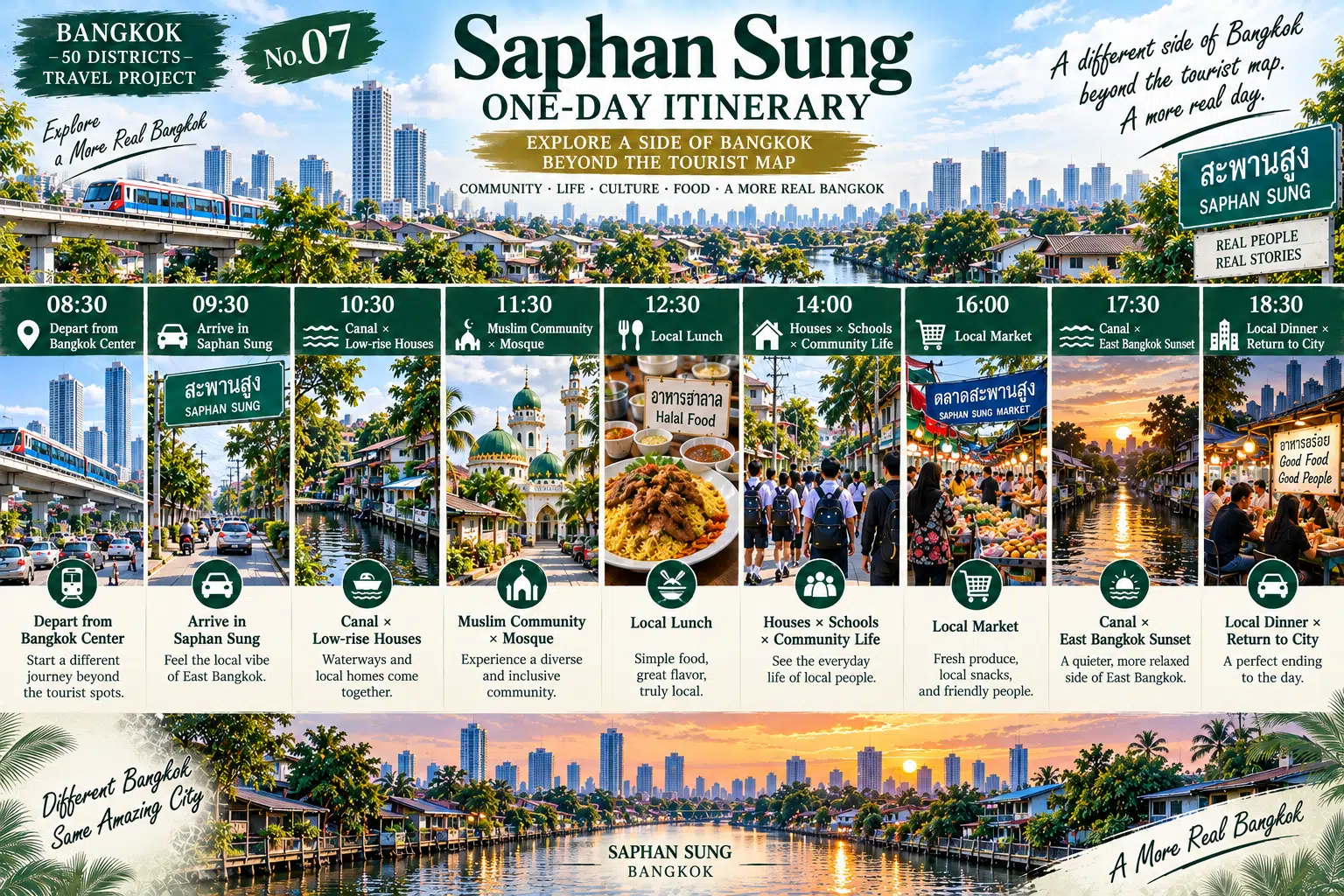
08:30|LEAVE CENTRAL BANGKOK
09:30|ENTER SAPHAN SUNG
10:30|CANALS × LOW-RISE HOMES
11:30|MUSLIM COMMUNITY × MOSQUE
12:30|LOCAL LUNCH
14:00|HOMES × SCHOOLS × COMMUNITY LIFE
16:00|LOCAL MARKET
17:30|CANALS × EAST BANGKOK EVENING
18:30|LOCAL DINNER × RETURN TO THE CITY
One day beyond Bangkok's tourist map.
09|What Should You Know Before Visiting Saphan Sung?
01|Transportation
This is not a conventional tourist district where everything can be explored on foot after leaving a single rail station.
The district covers a relatively large area, so planning transportation in advance is useful.
02|Time
Allow half a day to a full day.
The point is not to rush between attractions.
03|Weather
Much of the experience takes place outdoors.
Bring drinking water, sun protection and rain gear.
04|Religion
When entering mosques or other religious spaces, dress appropriately and follow local rules.
Remain quiet during prayer activities.
05|Photography
Remember that these are real residential communities first.
If you are clearly photographing residents, children, religious activities or private homes, ask permission whenever appropriate.
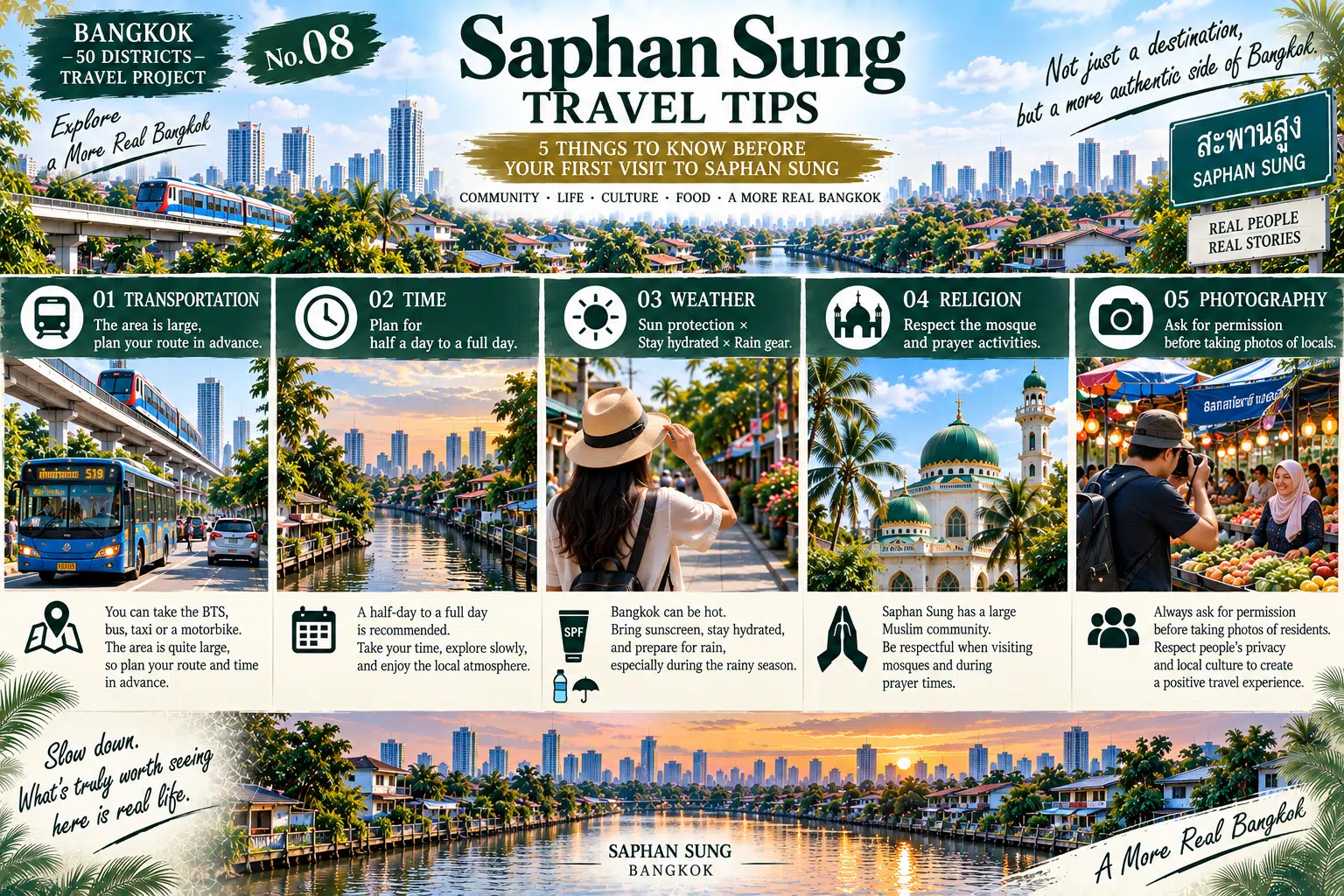
5 THINGS TO KNOW BEFORE VISITING SAPHAN SUNG
01|TRANSPORTATION
Large district — plan your route in advance.
02|TIME
Recommended: half day to full day.
03|WEATHER
Sun protection × Water × Rain gear
04|RELIGION
Respect mosques and prayer activities.
05|PHOTOGRAPHY
Ask before photographing residents.
**Slow down.
Everyday life is what makes Saphan Sung worth seeing.**
10|Why Is Saphan Sung Worth Becoming District No.19?
At this point in the Bangkok 50 Districts Travel Project, we need to change one common travel habit:
Not every destination needs a blockbuster attraction.
Saphan Sung does not have the Grand Palace.
It does not have Siam's enormous commercial concentration.
It does not have Sukhumvit's international nightlife.
But it does have:
Canals.
Homes.
Schools.
Markets.
Mosques.
Families.
Communities.
And the ordinary routines that actually fill a city every single day.
If we only visit Bangkok's most famous attractions, we will always see only the part of the city presented to visitors.
Once we enter Saphan Sung, we begin to understand:
Bangkok is truly built by everyday life.
That is what makes this stop important.
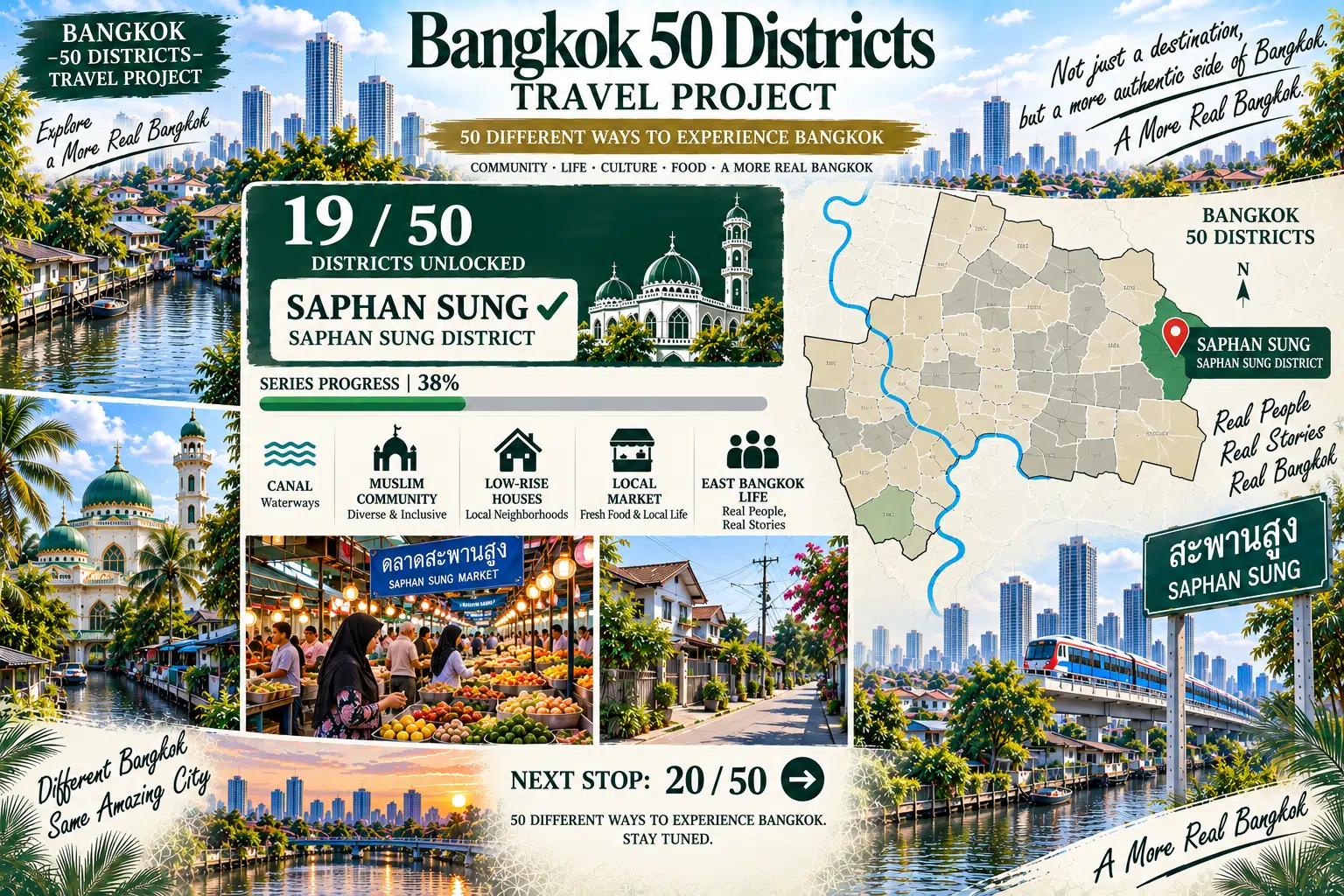
BANGKOK 50 DISTRICTS TRAVEL PROJECT
**19 / 50 UNLOCKED**
SAPHAN SUNG ✓
SERIES PROGRESS|38%
CANALS × MUSLIM COMMUNITIES × LOW-RISE HOMES × LOCAL MARKETS × EAST BANGKOK LIFE
NEXT STOP: 20 / 50
**50 districts.
50 different ways of life.
Keep exploring Bangkok.**