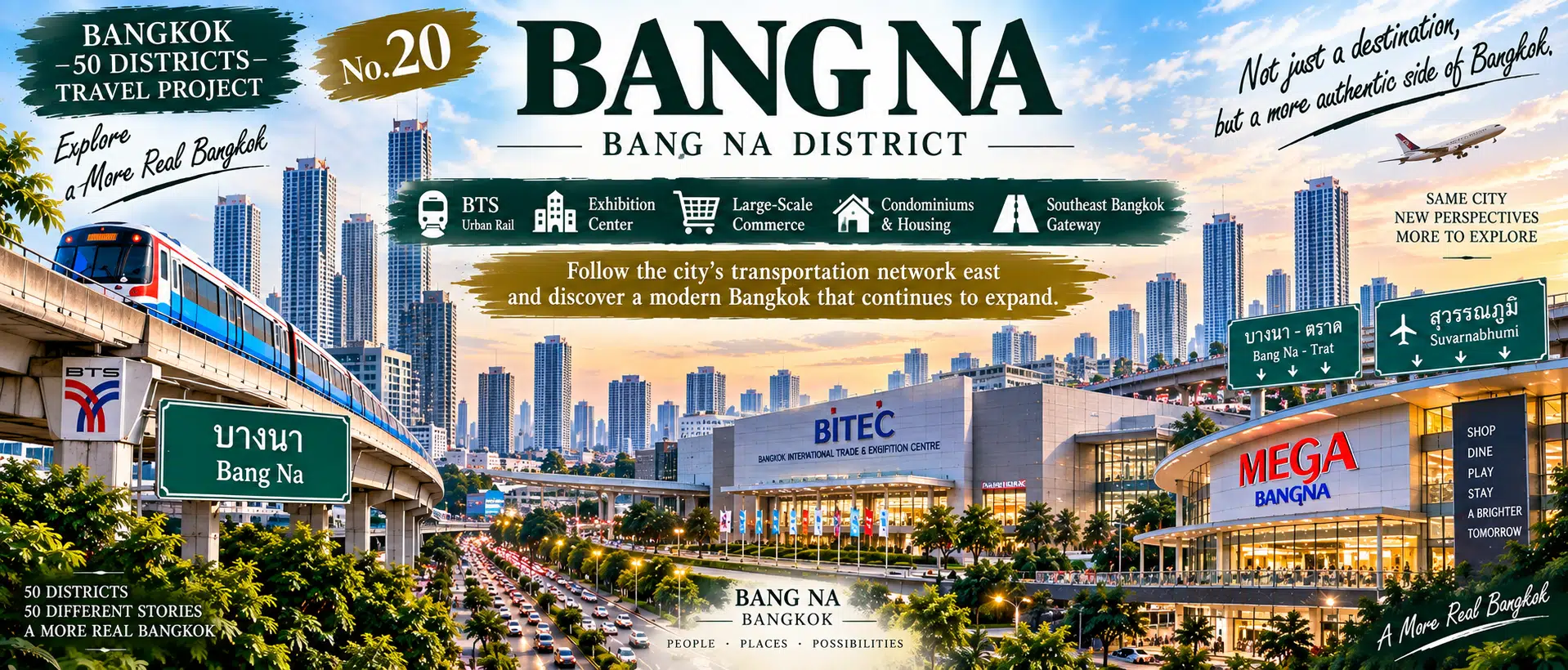
If District No.19, Saphan Sung, showed us canals, low-rise homes and community life, the urban scale changes dramatically when we arrive in Bang Na.
Elevated rail returns.
Major roads stretch into the distance.
Condominiums, office buildings, shopping centers, hotels and exhibition facilities begin to dominate the landscape.
Traffic flows along the Bang Na–Trat corridor toward the outskirts of the city.
Continue east and you move toward the Suvarnabhumi Airport area.
Continue south and the city gradually connects with Samut Prakan.
This is:
Bang Na
Many visitors first experience Bang Na simply by passing through on the BTS.
But stop here and the district reveals another important side of Bangkok:
How a megacity continues to grow outward along its transportation corridors.
01|First, Meet Bang Na: Bangkok's Gateway to the Southeast
Open a map of Bangkok and follow Sukhumvit southeast from the city center.
Thong Lo.
Phra Khanong.
On Nut.
Udom Suk.
And then Bang Na.
You begin to realize that Sukhumvit does not suddenly end.
Instead, it acts like a major urban development corridor.
The BTS continues along this direction.
Housing follows.
Commercial development follows.
Offices and hotels increase.
Road networks expand.
Bang Na sits directly within this process of outward urban growth.
So the first keyword for understanding Bang Na is not “attraction.”
It is:
CONNECTION
It connects central Bangkok with the southeastern parts of the city.
And it also helps connect Bangkok with surrounding areas.
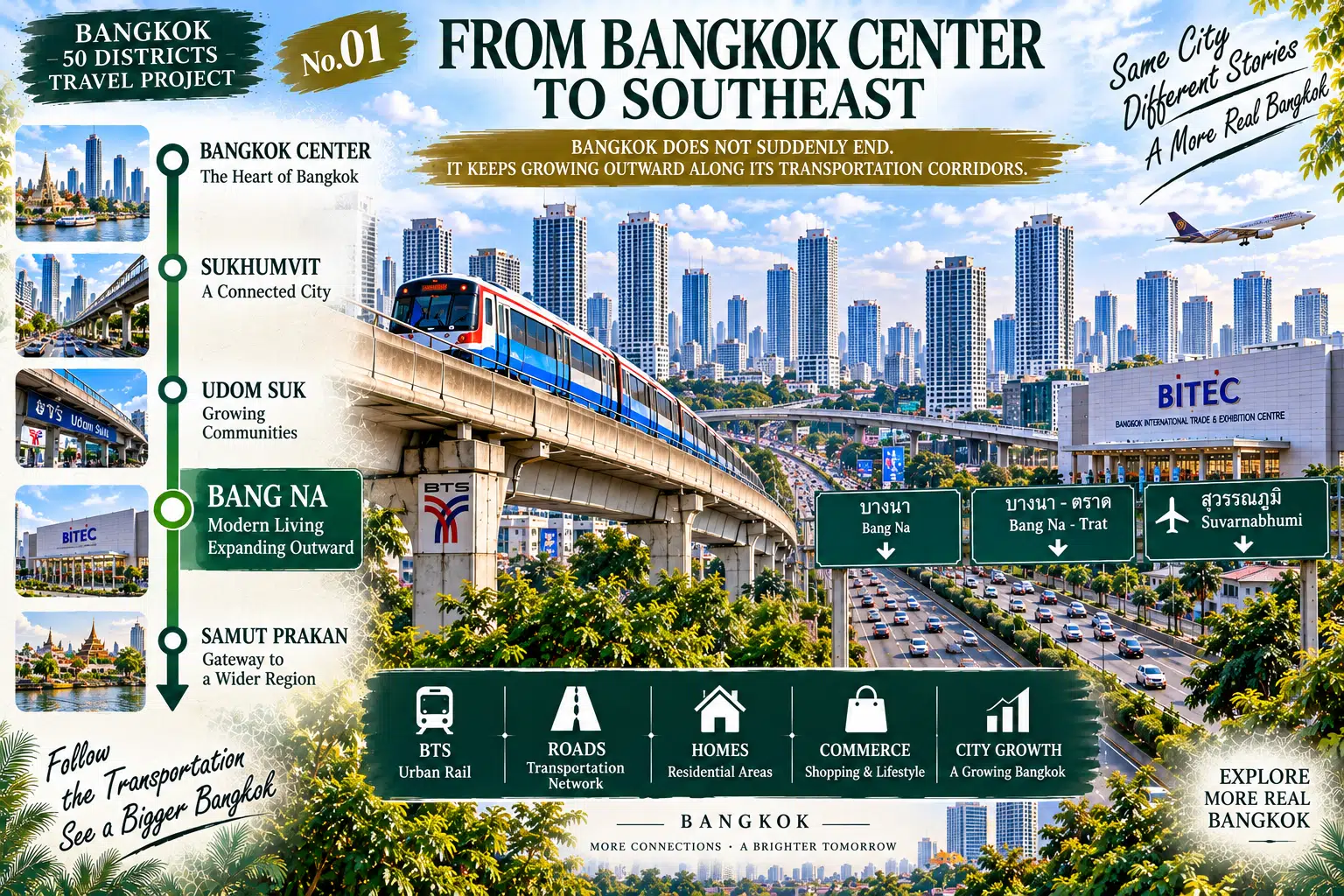
BANGKOK CENTER
↓
SUKHUMVIT
↓
UDOM SUK
↓
BANG NA
↓
SAMUT PRAKAN
BTS × ROADS × HOMES × COMMERCE × URBAN EXPANSION
**Bangkok does not suddenly end.
It keeps growing outward along its transportation corridors.**
02|How BTS Changed the Distance to Bang Na
In the past, traveling from central Bangkok to the southeastern outskirts felt much farther.
As the urban rail network expanded, that sense of distance began to change.
Today, the BTS Sukhumvit Line connects the Bang Na area directly with many important parts of Bangkok.
And this creates a pattern that can be seen throughout the city:
Where rail transit goes, urban life tends to follow.
Condominiums appear around stations.
Condominiums bring residents.
Residents create demand for convenience stores, restaurants, cafés and neighborhood businesses.
More offices and commercial facilities attract even more people.
Eventually, an area once considered peripheral becomes a complete urban living zone.
Bang Na is an excellent place to observe this transformation.
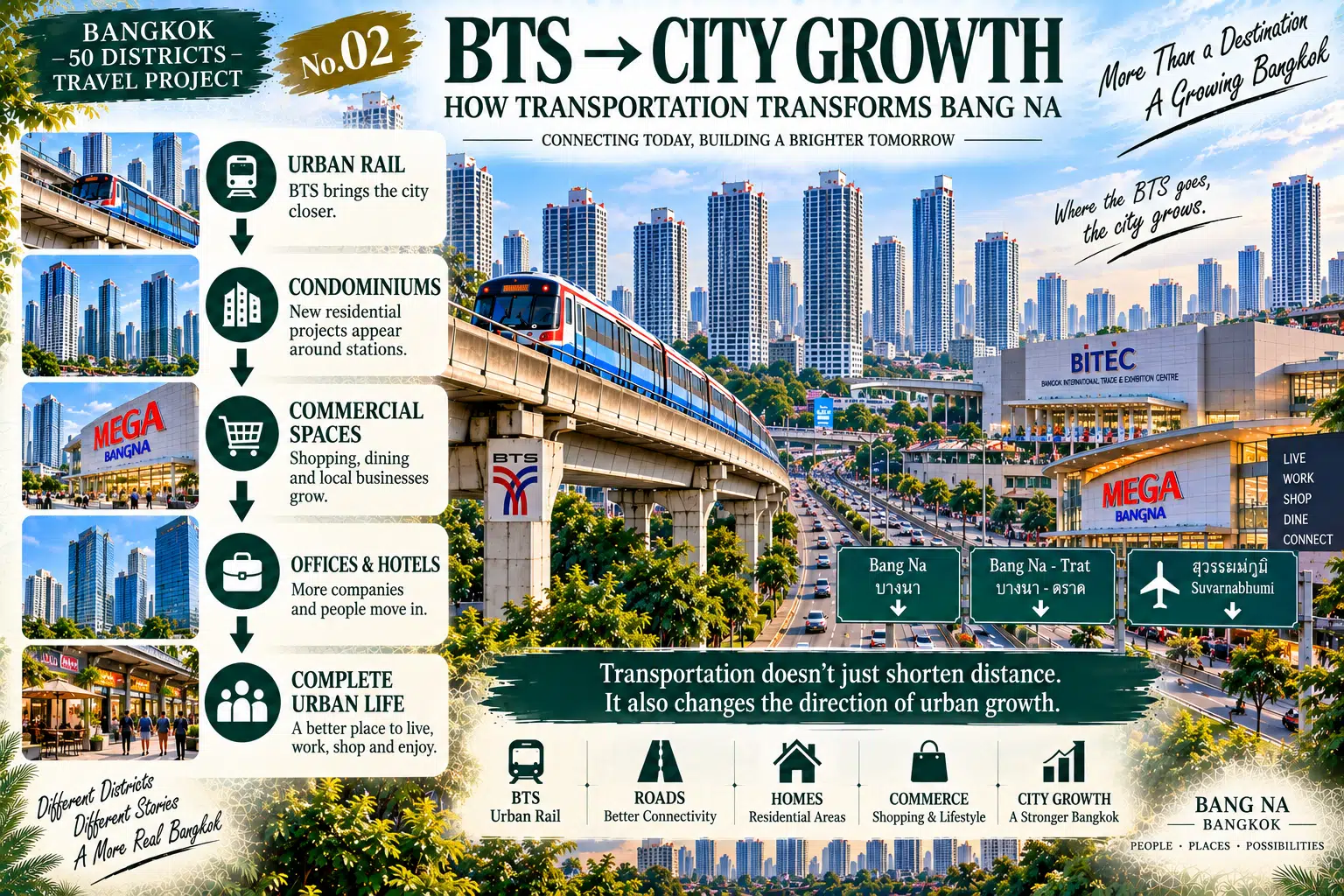
BTS → CITY GROWTH
URBAN RAIL
↓
CONDOMINIUMS
↓
COMMERCIAL SPACES
↓
OFFICES & HOTELS
↓
COMPLETE URBAN LIFE
**Transportation doesn't only shorten distance.
It also changes the direction of urban growth.**
03|BITEC: Why Do So Many People Come to Bang Na for Work?
Bang Na is home to an important urban landmark:
BITEC
BANGKOK INTERNATIONAL TRADE & EXHIBITION CENTRE
The venue hosts exhibitions, conferences, business events and industry trade shows.
As a result, not everyone coming to Bang Na is a local resident.
Some come for exhibitions.
Some come for work.
Companies arrive to participate in trade events.
Other visitors stay in the area temporarily because of major events.
This gives Bang Na a very different character from a purely residential district.
On an ordinary weekday, it may feel like a commuter area.
During a major exhibition, the same area can suddenly attract people from across Thailand and abroad.
Bang Na is therefore not only a place where people live.
It is also:
One of Bangkok's important business and exhibition hubs.
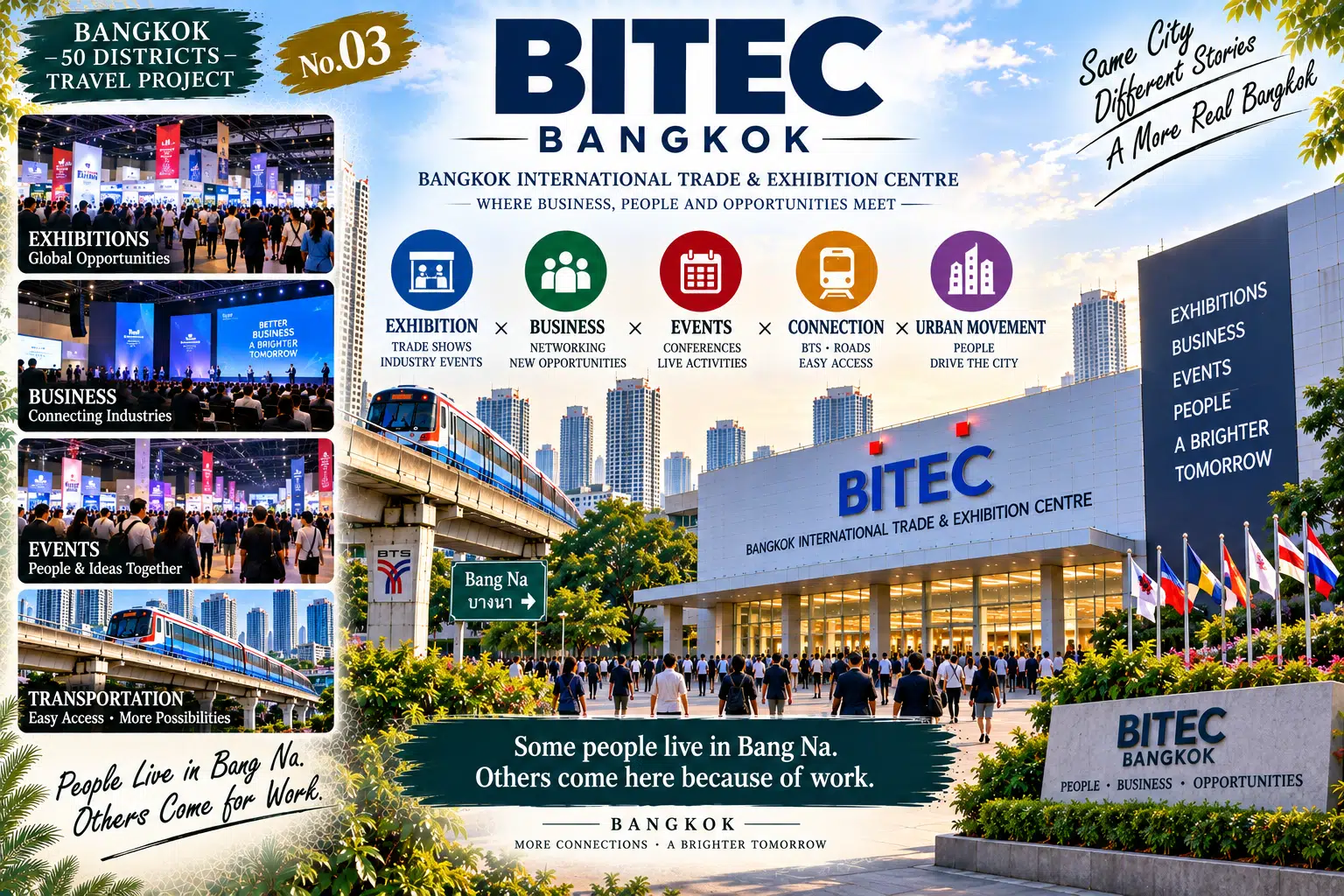
BITEC BANGKOK
EXHIBITIONS
×
BUSINESS
×
EVENTS
×
TRANSPORTATION
×
URBAN MOVEMENT
**Some people live in Bang Na.
Others come here because of work.**
04|From Small Streets to Mega Roads: Two Very Different Urban Scales
Leave the BTS corridor and continue toward Bang Na–Trat, and the scale of the city changes again.
Roads become much wider.
Traffic moves faster.
Large commercial developments become increasingly visible.
Warehouses, offices, hotels and other urban functions spread along major transportation corridors.
This creates a striking contrast with the small streets of central Bangkok.
In the center, we are accustomed to:
Walking.
Small sois.
Street shops.
Rail stations.
Along the Bang Na–Trat corridor, the dominant elements become:
Cars.
Major roads.
Large developments.
Longer urban distances.
This is the new scale created as Bangkok continues to expand outward.
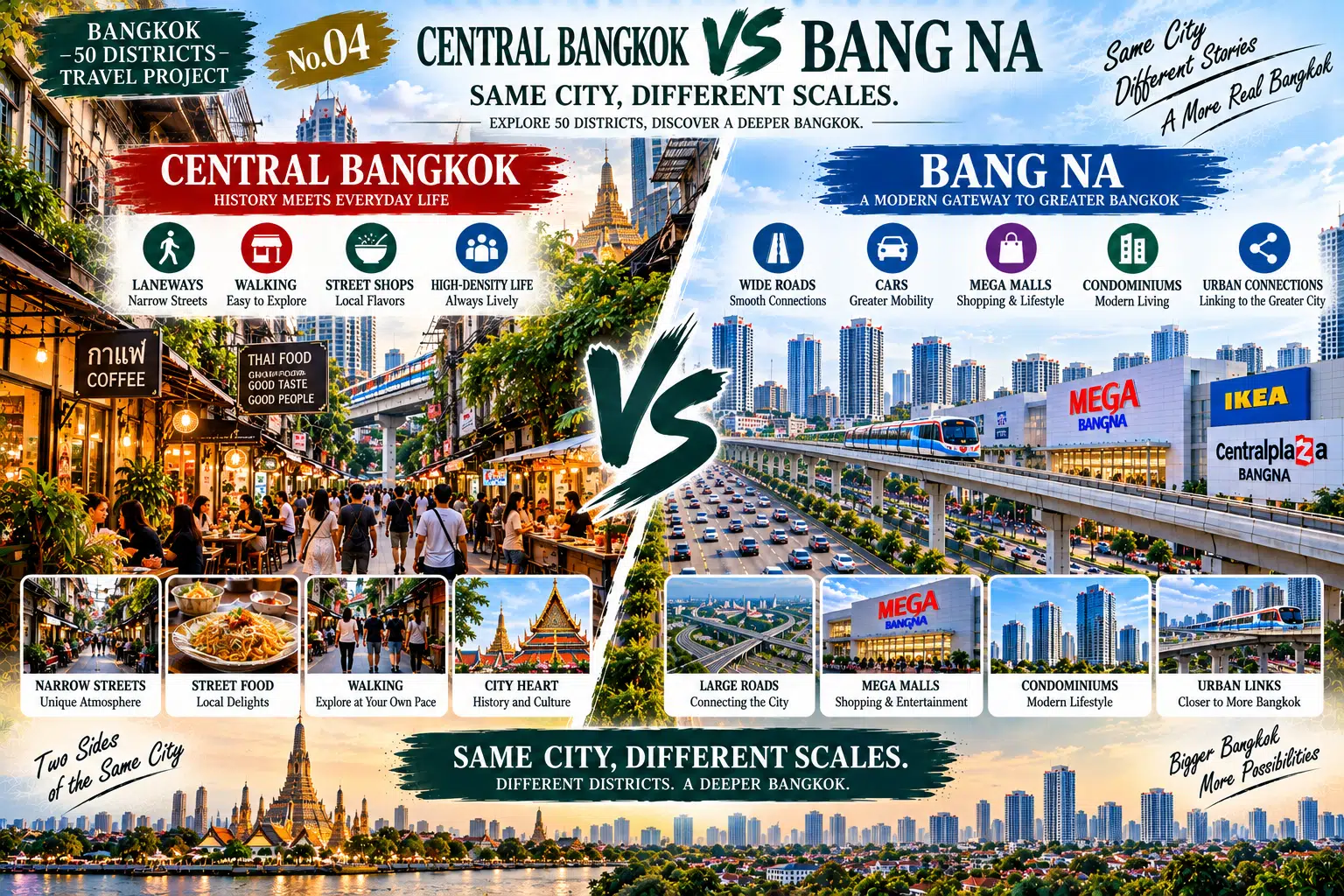
CENTRAL BANGKOK
SMALL STREETS × WALKING × STREET SHOPS × HIGH DENSITY
BANG NA
MAJOR ROADS × CARS × LARGE-SCALE COMMERCE × CONDOMINIUMS × OUTER-CITY CONNECTIONS
Same city. Completely different urban scale.
05|Bang Na Is Also Becoming a Mature Residential District
Bang Na is not only about roads and exhibition facilities.
The people who keep the district running every day are still its residents.
Around BTS stations and major roads, more condominiums and residential developments have appeared.
And with them comes an entire everyday lifestyle:
Convenience stores.
Supermarkets.
Coffee shops.
Restaurants.
Schools.
Gyms.
Neighborhood businesses.
Every morning, residents leave their homes.
Some enter the BTS.
Some drive to work.
Children head to school.
In the evening, everyone gradually returns to the neighborhood.
Behind Bang Na's large-scale infrastructure is something much more ordinary:
Everyday family life.
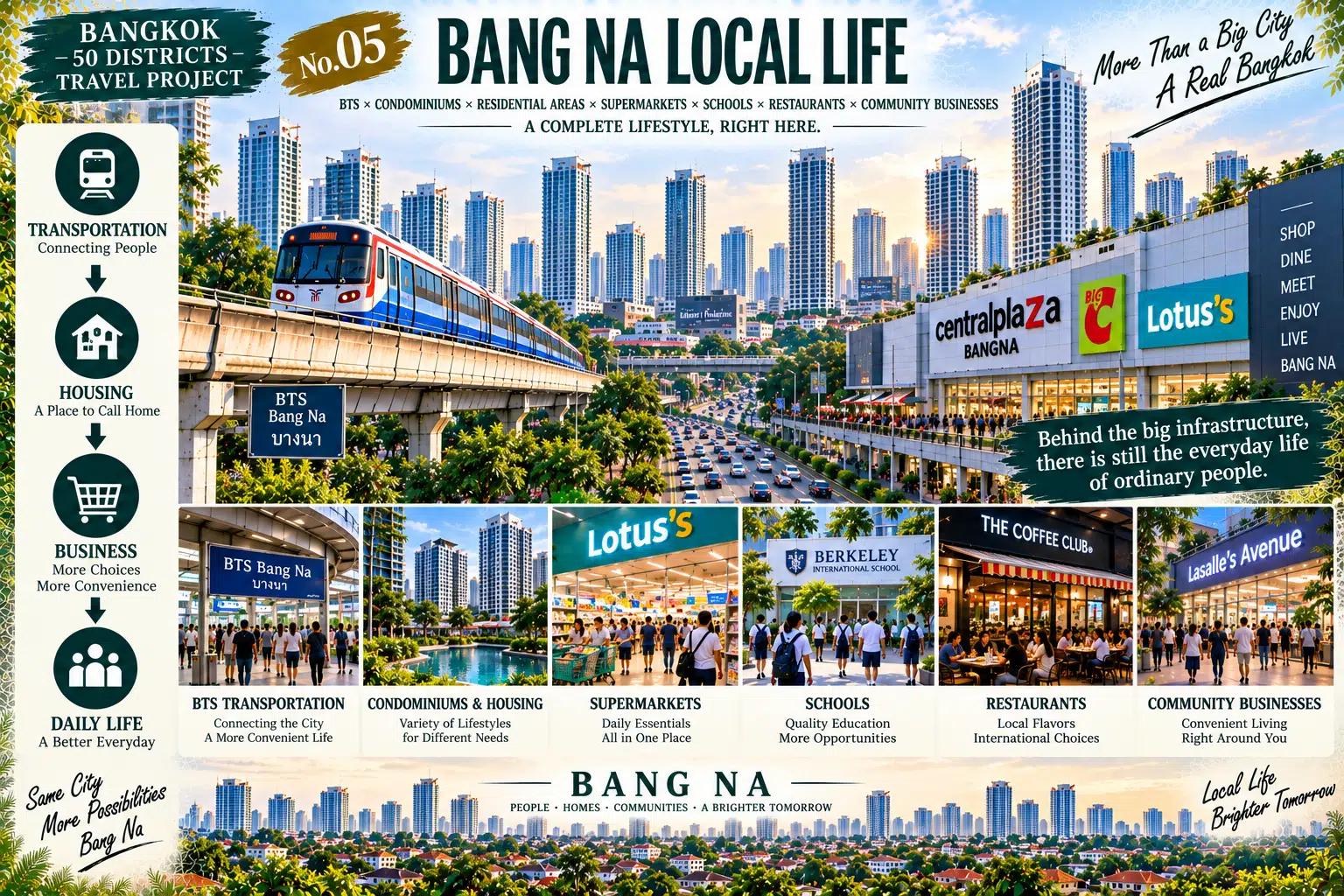
BANG NA LOCAL LIFE
BTS
×
CONDOMINIUMS
×
HOMES
×
SUPERMARKETS
×
SCHOOLS
×
RESTAURANTS
×
LOCAL BUSINESSES
**Behind the large-scale infrastructure,
ordinary everyday life continues.**
06|Large-Scale Shopping Is Another Part of Bang Na's Identity
Continue along the Bang Na–Trat direction and another feature becomes obvious:
This area is well suited to large commercial developments.
The reasons are straightforward.
There is more space.
Road access is convenient for drivers.
The surrounding residential population continues to grow.
Consumers from eastern Bangkok and nearby provinces can also reach the area relatively easily.
As a result, Bang Na and its surrounding urban corridor have developed a commercial model very different from the small shops of central Bangkok.
Here you find:
Large shopping centers.
Home and lifestyle retail.
Supermarkets.
Restaurant complexes.
Large parking areas.
Family-oriented weekend activities.
This commercial pattern reflects the lifestyle of outer Bangkok particularly well.
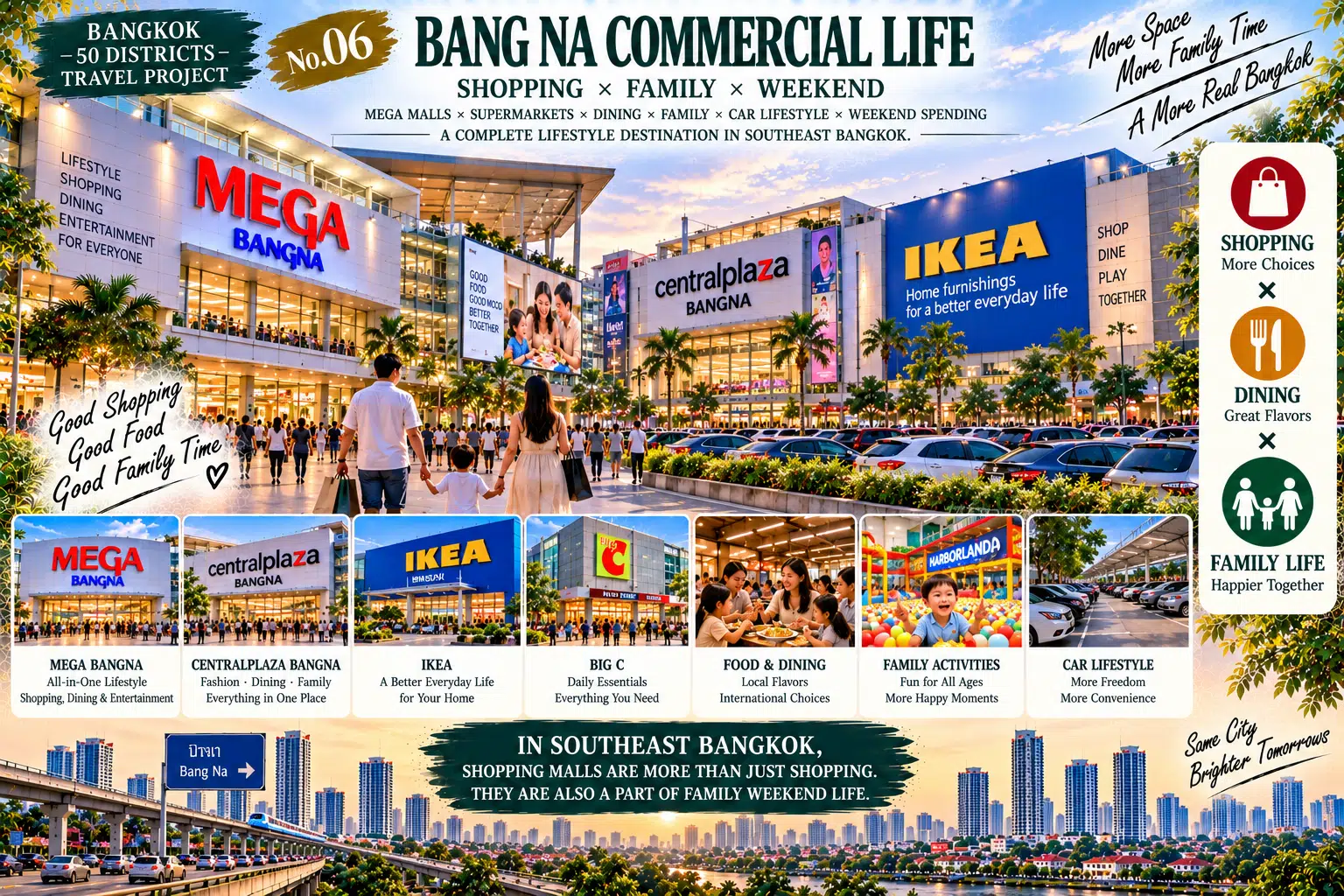
SHOPPING × FAMILY × WEEKEND
SHOPPING CENTERS
×
SUPERMARKETS
×
DINING
×
FAMILIES
×
CAR-ORIENTED LIFE
×
WEEKEND ACTIVITIES
**In Southeast Bangkok, shopping centers are not only for shopping.
They are also part of family weekend life.**
07|What Makes Bang Na Interesting Is That the City Is Still Growing Here
If we return to the same city ten or twenty years later, the places that often change the most are not its historic centers.
They are the outskirts.
New rail lines appear.
New condominiums rise.
New roads are built.
New commercial developments arrive.
New residents move in.
Places that once felt “far away” gradually become part of everyday urban life.
Bang Na is a good example of this transformation.
Instead of asking:
“What did Bangkok look like in the past?”
Bang Na encourages us to ask a different question:
“What Is Bangkok Becoming?”
08|A One-Day Bang Na Travel Plan
For a first visit, think of the day as:
“Following the BTS to See How Bangkok Grows Southeast.”
09:00|Leave Central Bangkok
Take the BTS Sukhumvit Line southeast.
Watch how the urban landscape changes along the route.
10:00|BTS × Bang Na
Begin around the BTS corridor.
Observe how rail transit, condominiums and neighborhood businesses fit together.
11:00|BITEC × Exhibition City
Explore Bang Na's business and exhibition identity.
If a suitable public exhibition is taking place, you can adjust the itinerary accordingly.
12:30|Local Lunch
Have lunch around the BTS or a nearby neighborhood area.
14:00|Homes × Community Businesses
Explore condominiums, residential areas, supermarkets, cafés and everyday services.
15:30|Bang Na–Trat × Large Urban Scale
Move toward the major road corridor.
Notice the difference between central Bangkok and the city's outer urban landscape.
16:30|Large-Scale Shopping × Family Life
Enter one of the area's large commercial zones.
Observe how Bangkok families combine shopping, dining and weekend activities.
18:00|Bang Na Evening Rush
The evening commute begins.
BTS stations, roads and commercial areas all become busier.
19:00|Dinner × Return to Central Bangkok
Finish with dinner before taking the BTS back toward the city center.
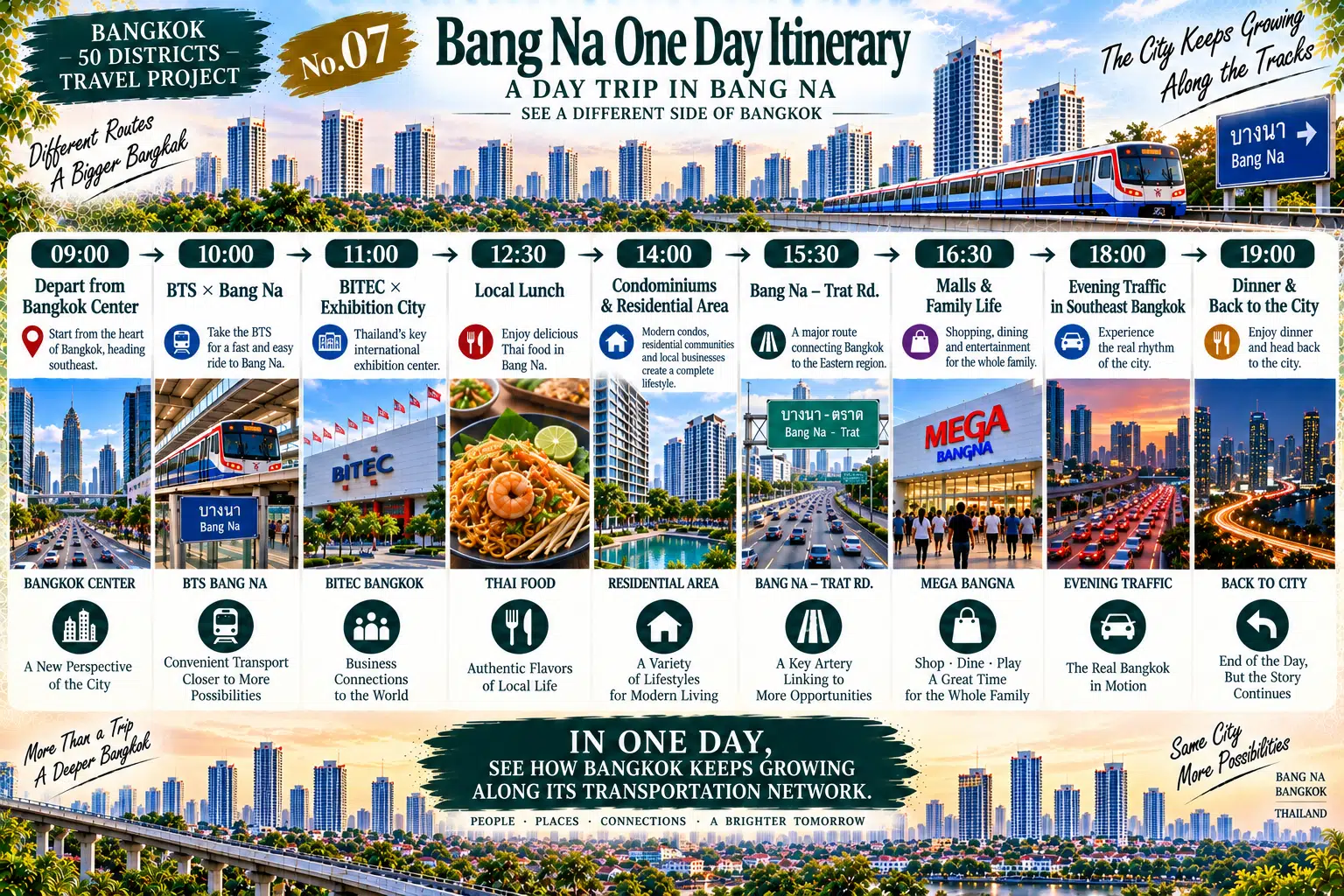
09:00|DEPART CENTRAL BANGKOK
10:00|BTS × BANG NA
11:00|BITEC × EXHIBITION CITY
12:30|LOCAL LUNCH
14:00|CONDOS × HOMES × LOCAL BUSINESSES
15:30|BANG NA–TRAT × MAJOR ROADS
16:30|LARGE-SCALE SHOPPING × FAMILY LIFE
18:00|SOUTHEAST BANGKOK RUSH HOUR
19:00|DINNER × RETURN TO THE CITY
One day to understand how Bangkok keeps growing along its transportation corridors.
09|What Should You Know Before Visiting Bang Na?
01|Transportation
The BTS is an excellent starting point for exploring Bang Na.
But if you travel deeper toward the Bang Na–Trat corridor or other parts of the wider area, taxis, ride-hailing services or other road transportation may be useful.
02|Distance
Do not assume that nearby-looking locations on a map are always comfortable to walk between.
The urban scale here is much larger than in central Bangkok.
03|Time
Allow half a day to a full day.
If a major event is taking place at BITEC, consider adding extra time.
04|Weather
Bangkok can be hot, so bring sun protection and drinking water when moving outdoors.
Rain gear is also useful during the rainy season.
05|Rush Hour
Road traffic and BTS passenger numbers can increase significantly during weekday commuting hours.
Leave some flexibility in your schedule.
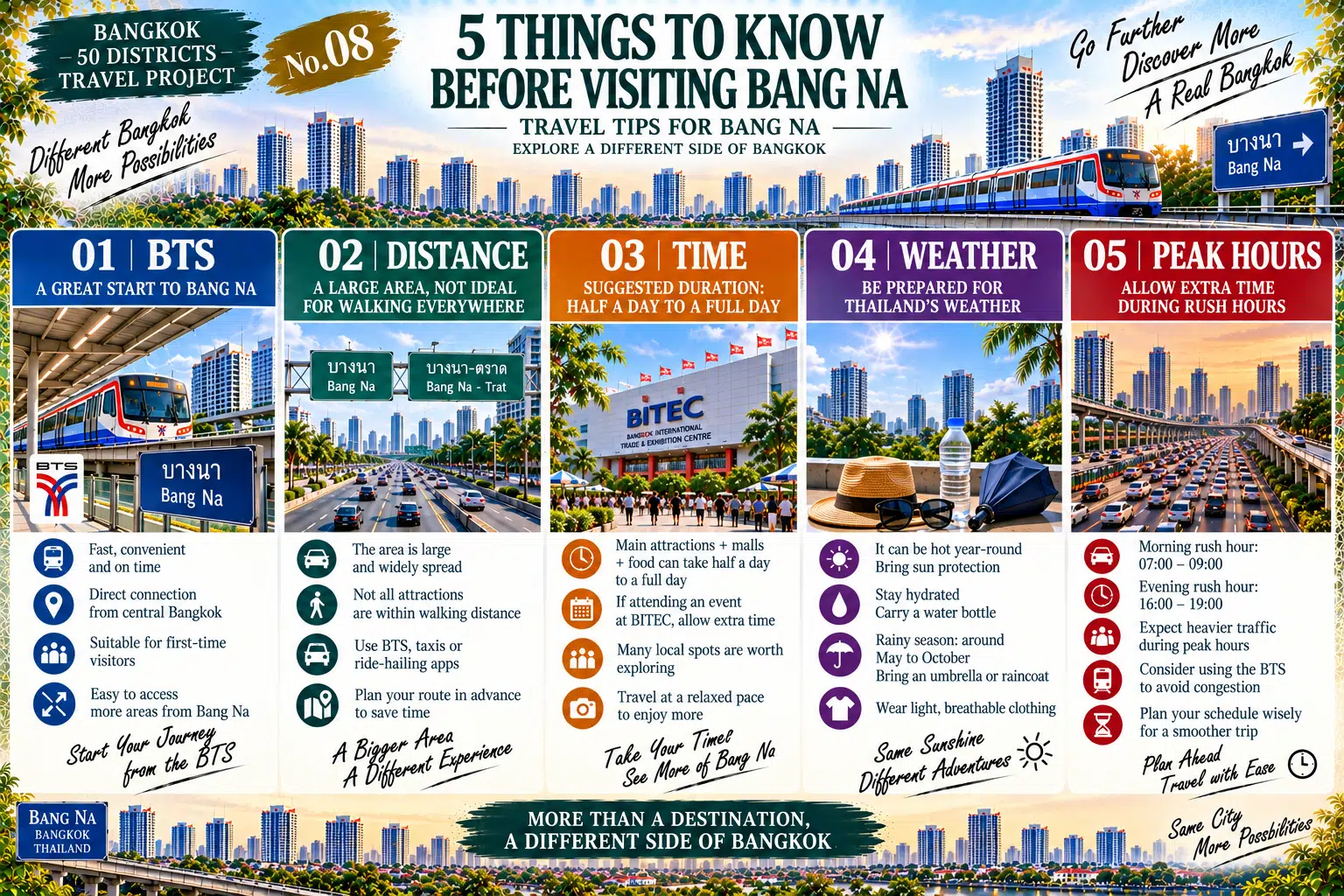
5 THINGS TO KNOW BEFORE VISITING BANG NA
01|BTS
Urban rail is a great starting point.
02|DISTANCE
Large urban scale — don't plan to walk everywhere.
03|TIME
Recommended: half day to full day.
04|WEATHER
Sun protection × Water × Rain gear
05|RUSH HOUR
Allow extra travel time during commuting hours.
**Don't just pass through Bang Na.
Stop and see where Bangkok is still growing.**
10|Why Is Bang Na Worth Becoming District No.20?
The Bangkok 50 Districts Travel Project has already shown us many different versions of the city.
The history of the old town.
The energy of commercial centers.
The everyday rhythm of residential districts.
The slower pace of canal communities.
Bang Na introduces a completely different question:
How Does a City Expand?
The answer is visible here.
The BTS extends outward.
Roads grow larger.
Housing increases.
Commercial development follows.
Exhibition and office functions arrive.
More residents move in.
And what once felt like the “outskirts” gradually becomes part of the city itself.
Bang Na may not provide Bangkok's most iconic postcard image.
But it helps us understand something much more important:
Modern Bangkok exists far beyond its traditional city center.
The city is still expanding.
And Bang Na is one of the places where that transformation is especially visible.
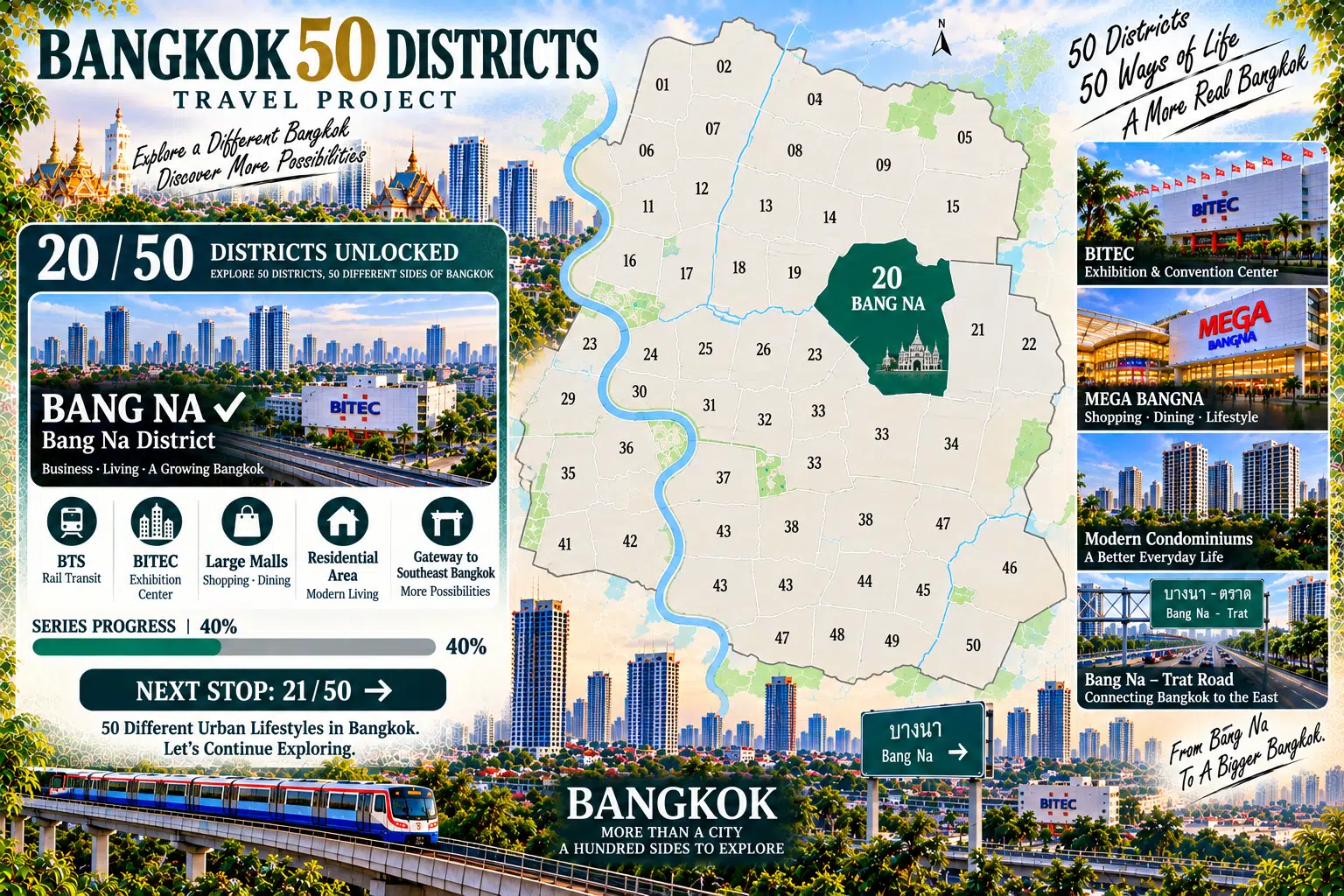
BANGKOK 50 DISTRICTS TRAVEL PROJECT
**20 / 50 UNLOCKED**
BANG NA ✓
SERIES PROGRESS|40%
BTS × EXHIBITION CENTER × LARGE-SCALE COMMERCE × CONDOMINIUMS × SOUTHEAST BANGKOK GATEWAY
NEXT STOP: 21 / 50
**50 districts.
50 different ways of life.
Keep exploring Bangkok.**