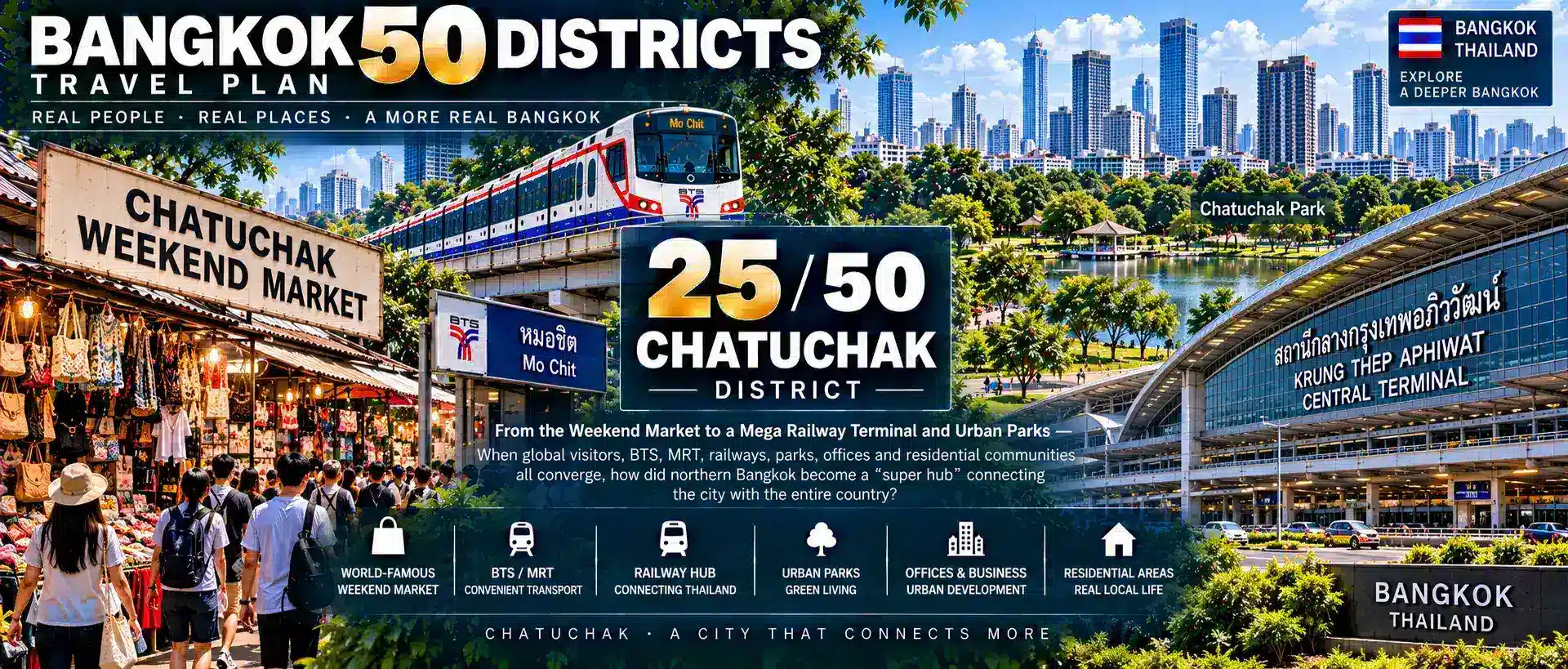
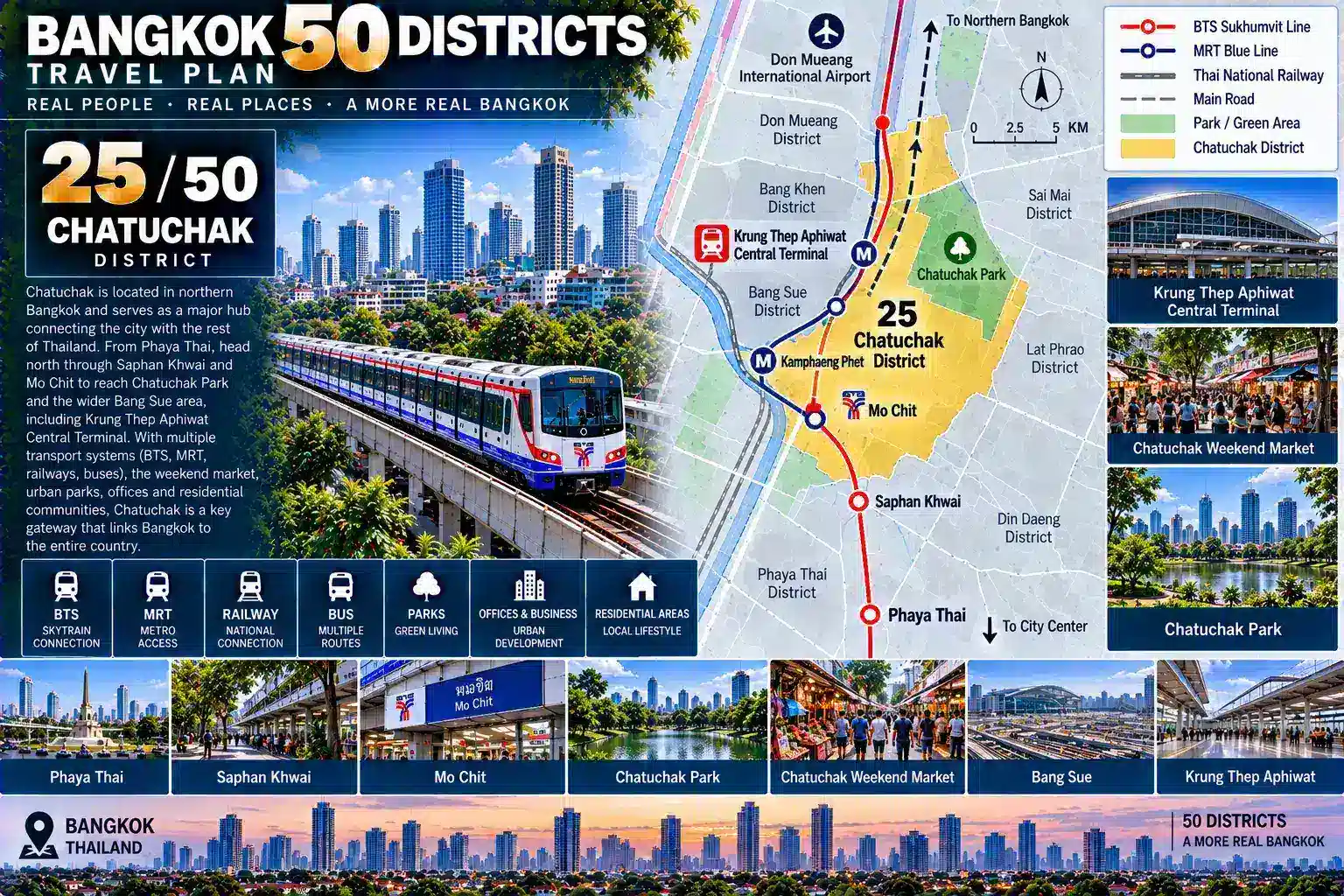
01|Where Is Chatuchak?
Chatuchak occupies an important urban corridor in northern Bangkok.
Continue north from Phaya Thai and the city gradually enters:
Saphan Khwai.
Mo Chit.
Chatuchak Park.
And the large transportation network around Bang Sue.
Few parts of Bangkok combine so many different transport systems in one area:
BTS.
MRT.
City buses.
Major roads.
Railways.
These different networks overlap throughout the district.
Travel south and you can quickly reach Siam and central Bangkok.
Continue north and you move deeper into northern Bangkok.
Use the railway network and the scale expands again, connecting Bangkok with other parts of Thailand.
Chatuchak therefore is not simply:
“a residential district in northern Bangkok.”
It functions more like:
AN URBAN-SCALE CONVERTER
Here, neighborhood transportation becomes metropolitan transportation.
And metropolitan transportation begins connecting with the national network.
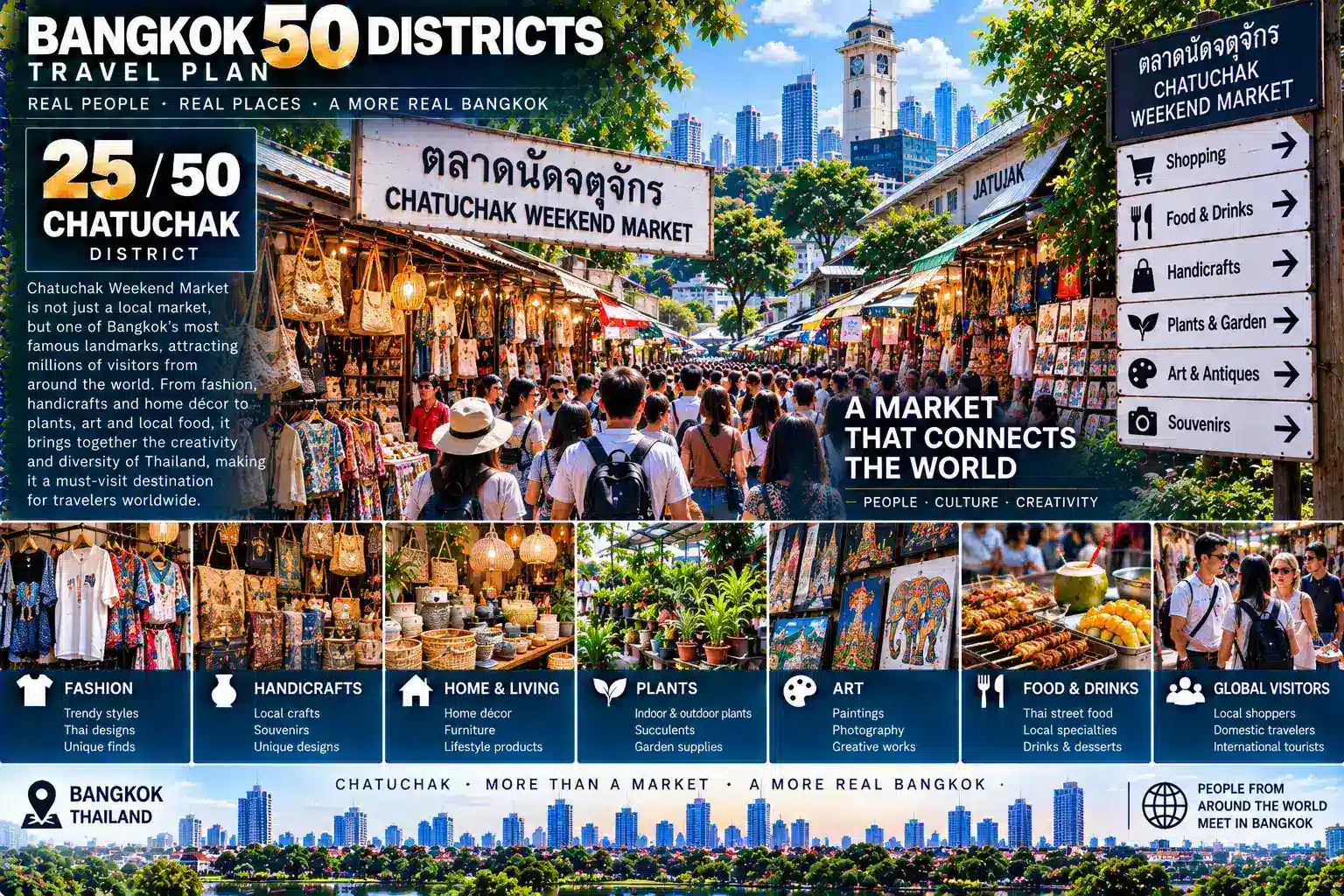
02|Chatuchak Weekend Market: How Can a Market Attract the Entire World?
When people hear “Chatuchak,” the most famous name is naturally:
CHATUCHAK WEEKEND MARKET
It has long since grown beyond the role of an ordinary neighborhood market.
Clothing.
Handicrafts.
Home décor.
Furniture and decorative objects.
Art.
Plants.
Second-hand goods.
Souvenirs.
Food.
Coffee.
Small brands and independent merchants are packed into an enormous market network.
The people coming here are equally diverse.
Bangkok residents.
Domestic travelers.
International tourists.
Wholesale buyers.
Designers.
Collectors.
Young people.
A market therefore begins serving many different functions at once:
Shopping.
Tourism.
Cultural experience.
Small business.
Creative economy.
Social life.
This is one of the most fascinating things about Chatuchak:
Commerce itself has become an urban attraction.
People do not simply happen to shop here while visiting Bangkok.
Many deliberately dedicate half a day—or even an entire day—to exploring the market.
A commercial space that once primarily served local needs has gradually become:
one of the gateways through which the world experiences Bangkok.
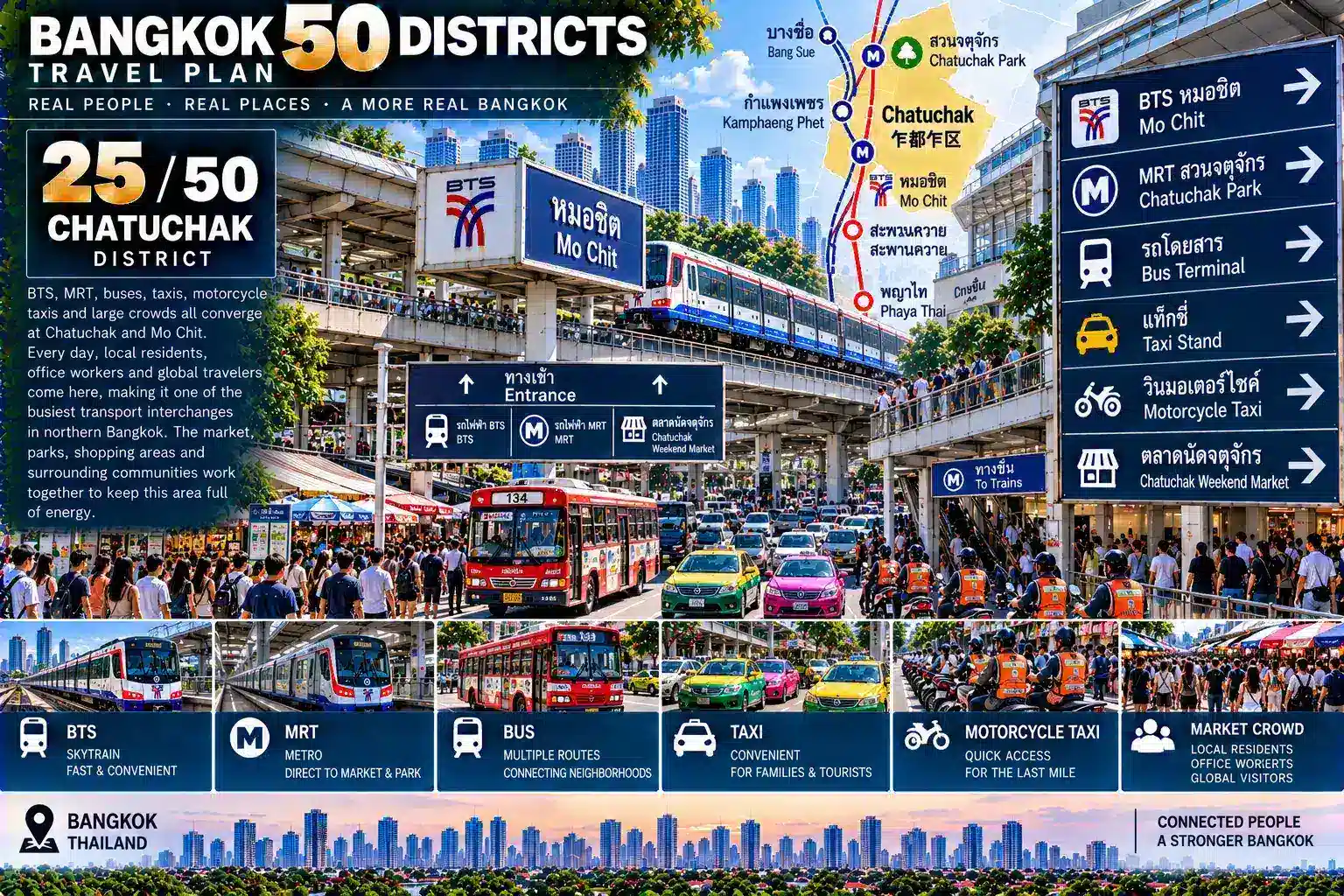
03|Mo Chit × BTS × MRT: Why Did This Area Become a Mega Interchange?
A massive market creates massive human flows.
And massive human flows require transportation.
That is why the Chatuchak story cannot be separated from:
BTS × MRT
BTS Mo Chit.
MRT Chatuchak Park.
MRT Kamphaeng Phet.
Together, these rail nodes serve:
Tourists.
Residents.
Office workers.
Students.
Market merchants.
Weekend shoppers.
On weekends, the relationship becomes especially visible.
Rail systems deliver huge numbers of people into the district.
The market absorbs them.
The parks redistribute them.
Buses, taxis and motorcycle taxis complete the final stage of their journeys.
Together, they form a complete:
URBAN PEOPLE-DISTRIBUTION SYSTEM
Transportation does not simply make the market more accessible.
The market, parks and employment base also make the transport nodes more important.
Urban functions and transportation networks reinforce each other.
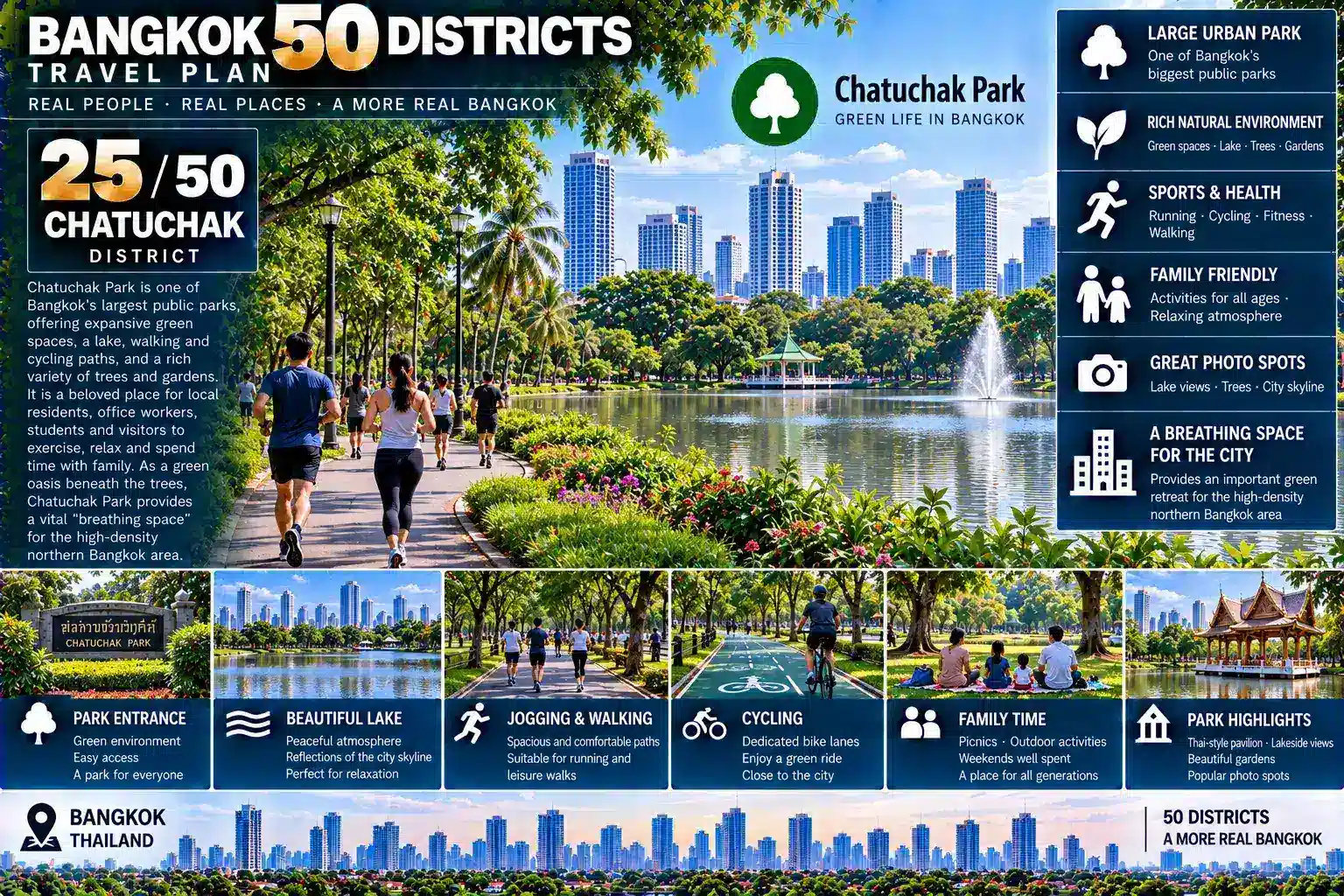
04|Chatuchak Park: Why Does a Megacity Still Need Large Green Spaces?
Walk out of the crowded market and you can quickly enter an entirely different urban environment.
Trees.
Grass.
Lakes.
Joggers.
Cyclists.
Families.
Older residents.
Young people.
This is another side of Chatuchak that makes the district unusual.
Next to one of Bangkok’s busiest transportation and commercial zones are large public green spaces, including Chatuchak Park and the wider park network nearby.
It reminds us that:
Urban efficiency is not the whole purpose of urban life.
People need to move.
But they also need to stop.
They need to work.
But they also need exercise.
They need shopping.
But they also need shade.
If a city contains only:
Roads.
Railways.
Shopping malls.
Offices.
Housing.
Eventually, it becomes exhausting.
The real purpose of a park therefore goes far beyond:
“beautiful scenery.”
It provides:
URBAN RECOVERY SPACE
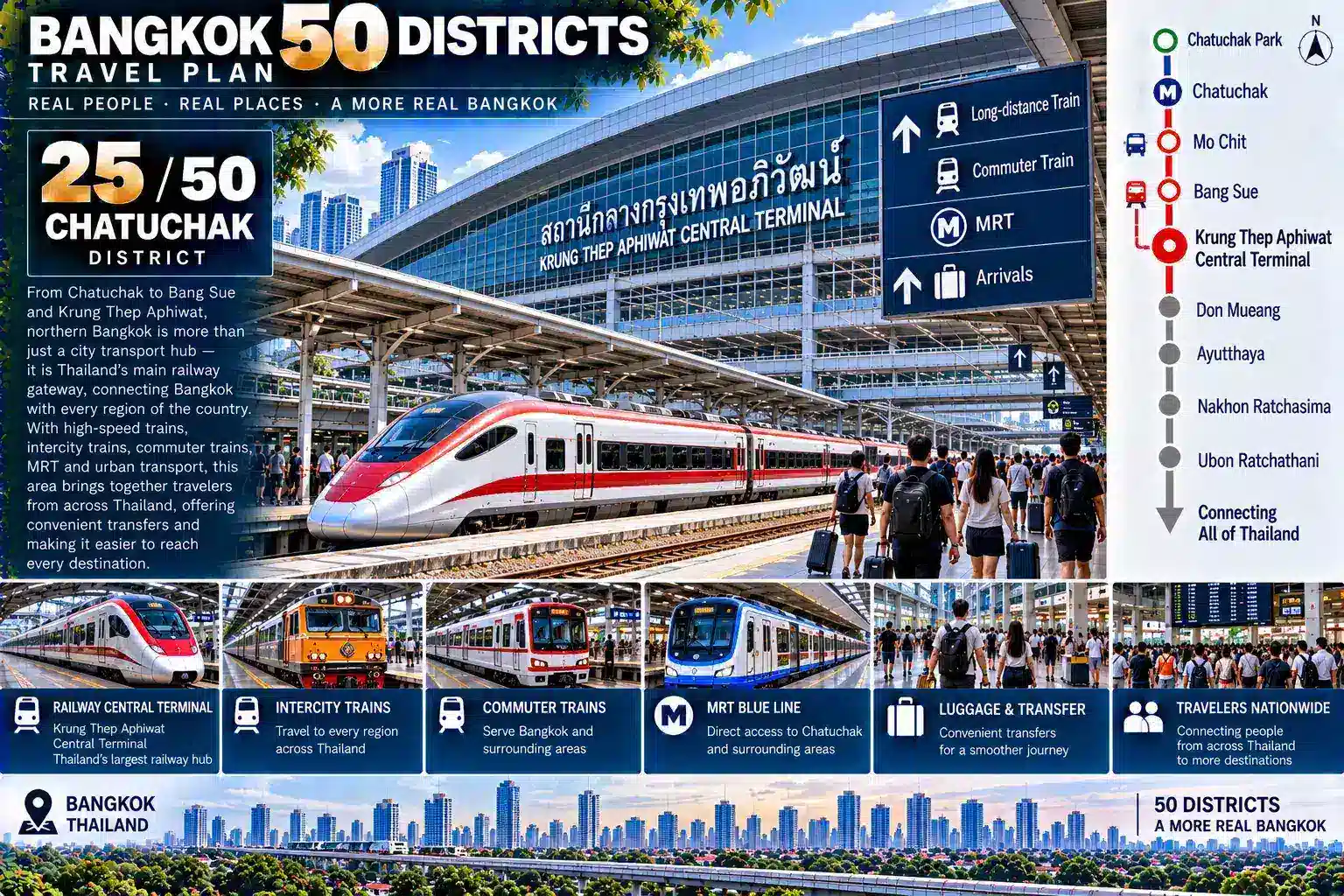
05|Bang Sue × Krung Thep Aphiwat: Why Does Bangkok Need a New Mega Railway Terminal?
Continue northwest and the scale of the city expands again.
We enter the wider Bang Sue area.
One of the most important pieces of modern transport infrastructure here is:
KRUNG THEP APHIWAT CENTRAL TERMINAL
A major railway terminal performs a completely different role from an ordinary BTS station.
BTS primarily solves:
movement within the city.
A major railway system must handle:
Intercity travel.
Interprovincial journeys.
Long-distance passengers.
Large volumes of luggage.
Rail transfers.
Future expansion of national transportation networks.
The wider Chatuchak–Bang Sue area therefore takes on another role:
A GATEWAY BETWEEN BANGKOK AND THE REST OF THAILAND
A traveler may still be in Bangkok in the morning.
A few hours later, they may already be traveling toward another part of the country.
The scale of movement therefore changes from:
Neighborhood
to:
Bangkok
and finally to:
Thailand’s national transportation network.
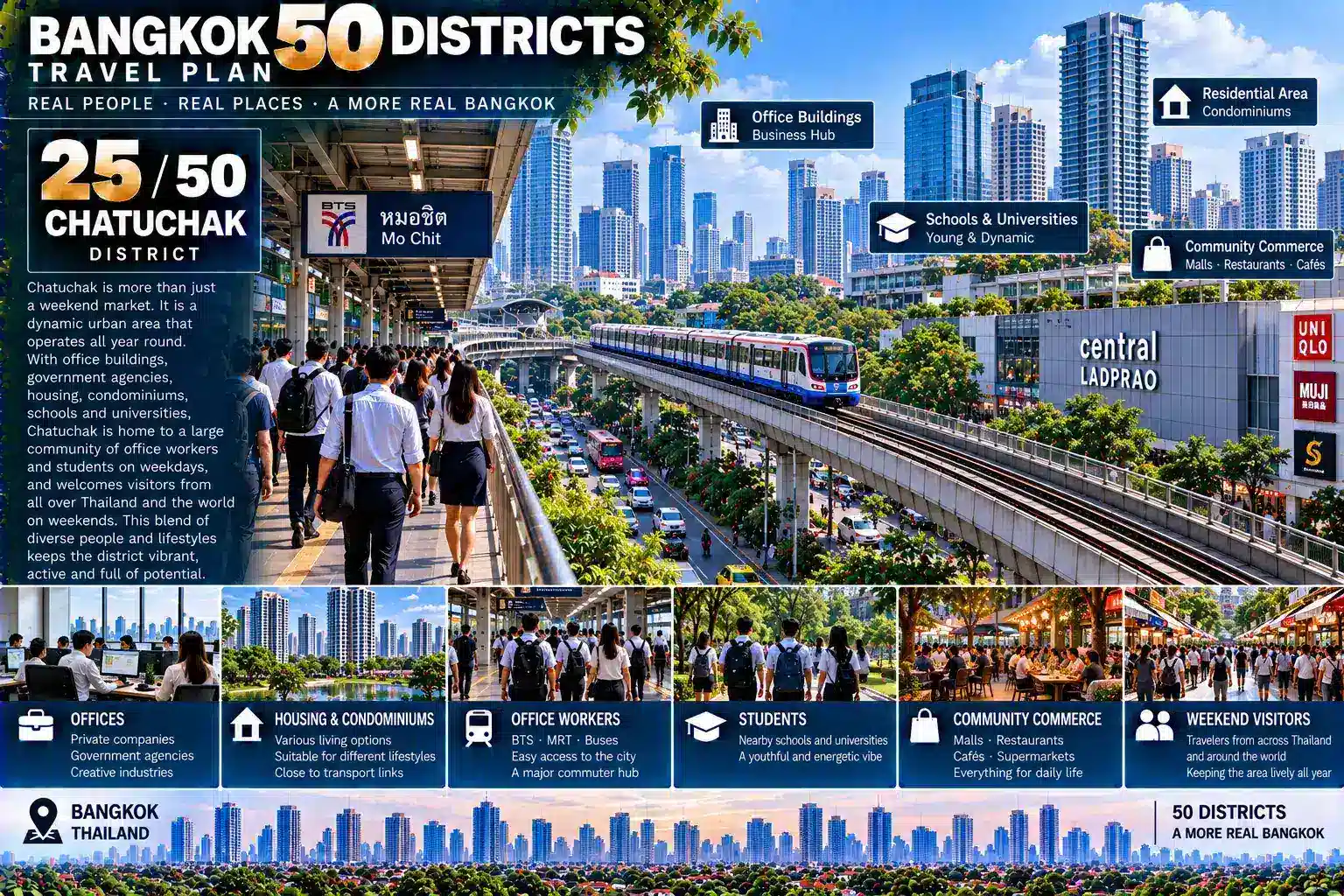
06|Offices × Housing: Chatuchak Does Not Come Alive Only on Weekends
If you visit Chatuchak only on a weekend, it is easy to assume that the district’s energy comes entirely from the market.
It does not.
What keeps the district functioning throughout the year also includes:
Offices.
Government institutions.
Businesses.
Residential neighborhoods.
Condominiums.
Schools.
Community commerce.
And large numbers of daily commuters.
From Monday to Friday:
Office workers generate foot traffic.
Residents use neighborhood services.
Students commute.
Restaurants serve lunch.
Cafés serve the working population.
Then the weekend arrives:
Tourists and shoppers dramatically increase the number of people in the district.
Chatuchak therefore has an unusually strong urban advantage:
It is busy on weekdays—and even busier on weekends.
Its businesses do not depend entirely on one type of visitor.
And the district does not simply switch off when the weekend market closes.
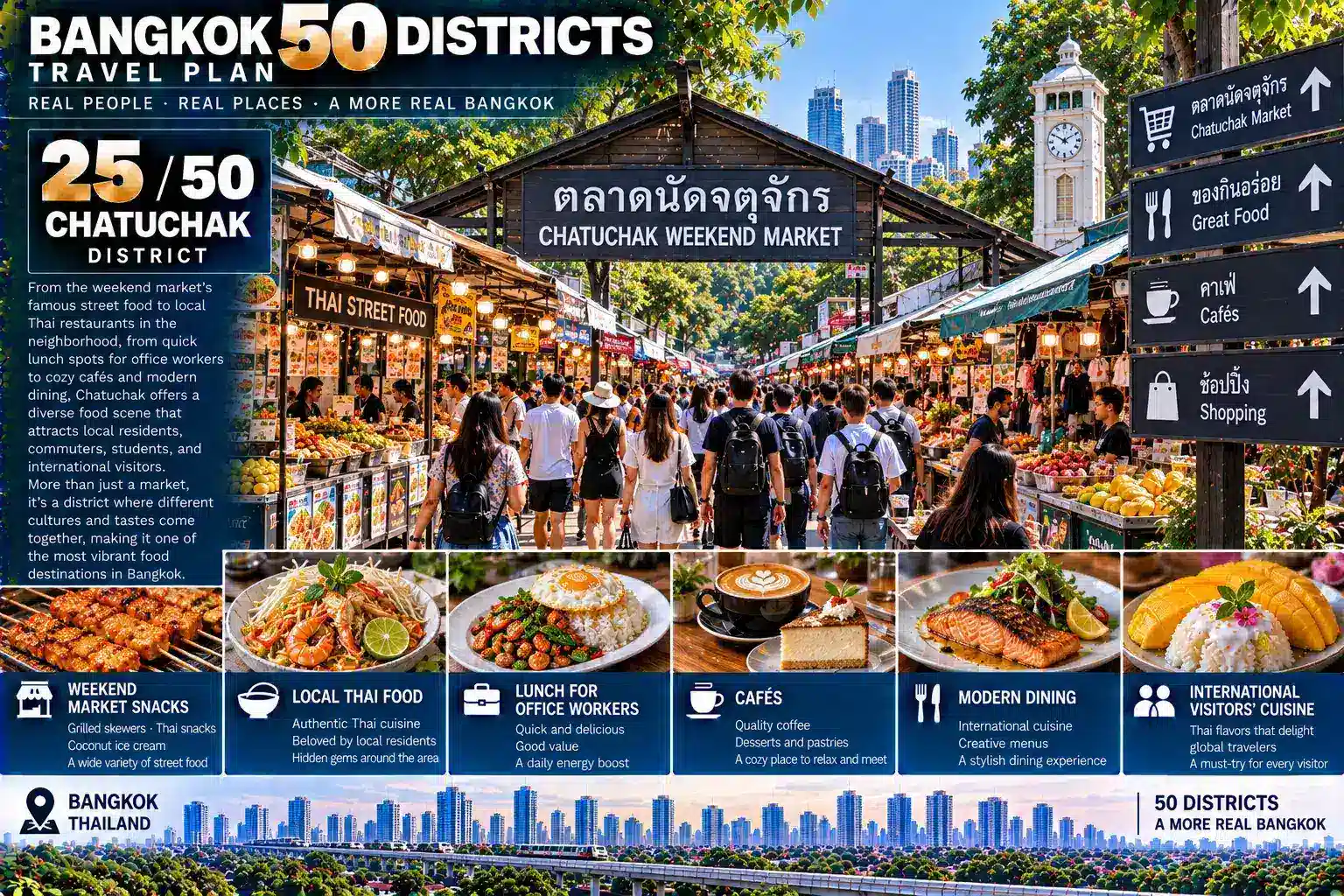
07|What to Eat in Chatuchak? Food Has to Follow the Crowds
Chatuchak’s food scene is heavily shaped by the different populations moving through the district.
① Weekend Market Snacks
Visitors need food that is:
Convenient.
Fast.
Easy to eat while walking.
Grilled meats.
Fried snacks.
Coconut ice cream.
Fruit.
Cold drinks.
Thai desserts.
② Neighborhood Thai Food
People who actually live nearby still need ordinary meals every day.
Pad kra pao.
Noodles.
Chicken rice.
Curry rice.
③ Office-Worker Lunches
One of the most important weekday food markets.
Fast.
Affordable.
Plenty of choices.
④ Cafés
Tourists need somewhere to rest.
Young people meet friends.
Office workers need an afternoon caffeine break.
⑤ Modern Dining
More contemporary restaurants naturally develop around major transport and commercial nodes.
⑥ Food for International Visitors
As global travelers arrive, menus become more multilingual.
International dining choices increase.
Different dietary preferences appear.
Chatuchak’s food map is therefore really:
A MAP OF HUMAN MOVEMENT
As the population changes, the food scene changes with it.
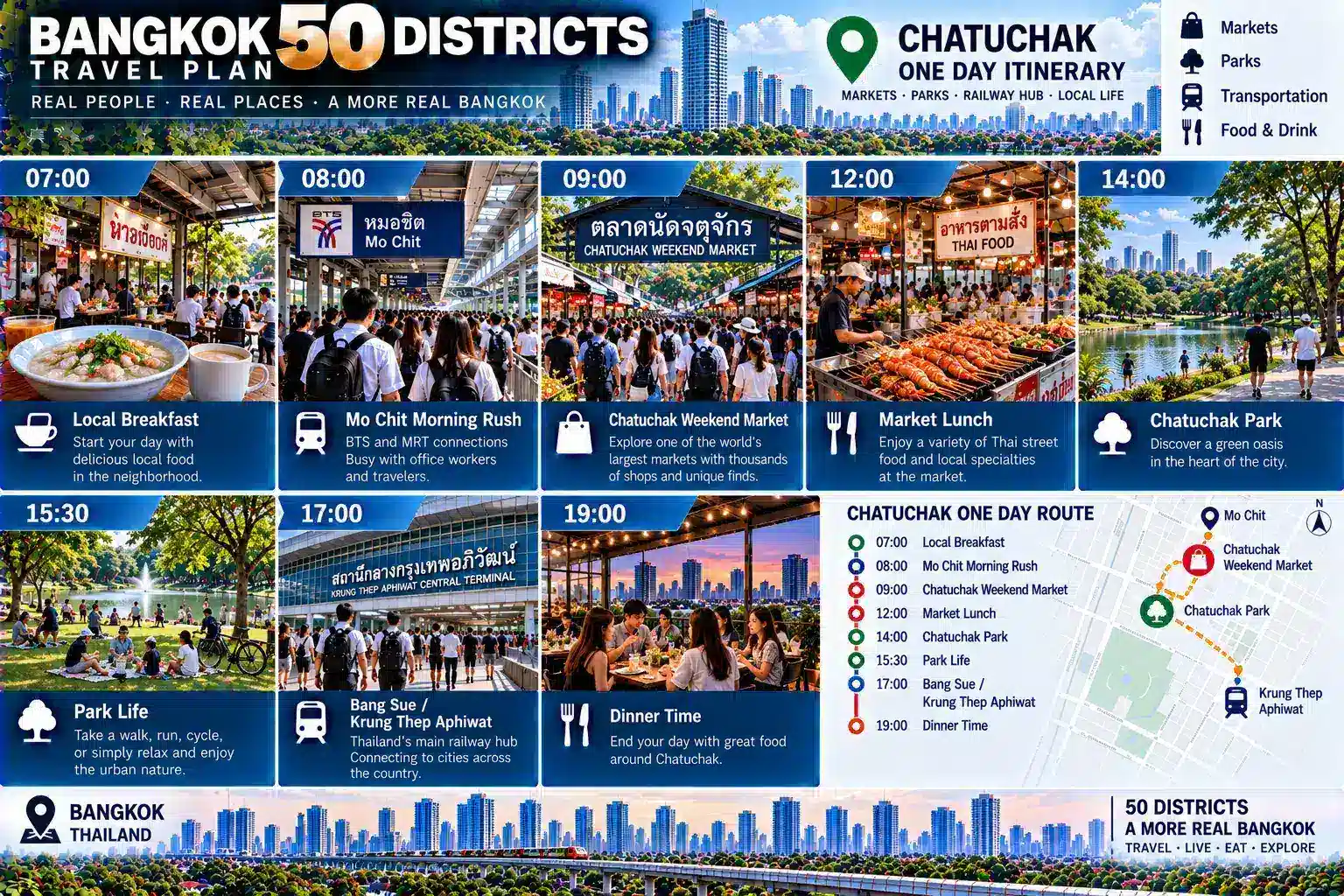
08|How to Spend One Day in Chatuchak
Chatuchak is perfect for a journey that explores:
FROM CITY SCALE TO NATIONAL SCALE
07:30|Neighborhood Breakfast
Do not rush directly into the market.
Start by observing how people who actually live here begin their day.
08:30|Mo Chit Morning Rush
Watch BTS, MRT, buses, taxis and commuters converge.
09:30|Chatuchak Weekend Market
If it is a weekend, this is when the market journey really begins.
Fashion.
Design.
Plants.
Art.
Food.
Take your time.
12:30|Market Lunch
Experience the market’s food culture directly.
14:00|Chatuchak Park
Move almost instantly from an extremely dense commercial environment into green space.
This is one of the strongest urban contrasts of the entire day.
15:30|Park & City Life
Walk.
Cycle.
Observe how families and local residents use public space.
17:00|Head Toward Bang Sue
The story now begins shifting from tourism toward transportation infrastructure.
18:00|Krung Thep Aphiwat Central Terminal
Observe the scale of the railway terminal.
Watch the passengers.
The luggage.
The trains.
Understand how Bangkok connects with the rest of the country.
19:30|Dinner
Return to the neighborhood, market area or a transport hub for dinner.
End the day.
09|What Chatuchak Really Teaches Us: How Does a City Manage Different “Scales”?
With District 25 completed, we have officially reached the halfway point of our Bangkok 50 Districts journey.
And Chatuchak is a remarkably appropriate district for this milestone.
Because here, we can see four completely different scales of urban life at the same time.
The first is:
NEIGHBORHOOD SCALE
Housing.
Schools.
Restaurants.
Cafés.
Ordinary residents.
The second is:
CITY SCALE
BTS.
MRT.
Buses.
Offices.
Large urban parks.
The third is:
NATIONAL SCALE
The central railway terminal.
Intercity trains.
Passengers arriving from or traveling to other provinces.
And the fourth is:
INTERNATIONAL SCALE
Chatuchak Weekend Market.
International tourists.
Global travelers.
Worldwide recognition.
Four different scales exist within the same urban area.
That is what makes Chatuchak truly special.
Imagine a traveler flying to Bangkok from Europe.
They take BTS to Mo Chit.
Enter Chatuchak Weekend Market.
Spend the afternoon in the park.
Then head to Krung Thep Aphiwat in the evening and board a train toward another Thai city.
Within a single day:
INTERNATIONAL → BANGKOK → NEIGHBORHOOD → NATIONAL
All four scales have been connected.
That is the real power of a major urban hub.
It does not need to have the tallest skyscrapers.
It does not need the most expensive commercial property.
Its importance comes from something else:
It allows different scales of the city to connect with one another.
The market connects Bangkok with the world.
BTS and MRT connect the metropolis.
The parks connect people with everyday urban life.
The railway connects Bangkok with the country.
And housing and local communities ensure that all of this is not merely transportation infrastructure.
It remains a real district where people actually live.
That is ultimately what District 25, Chatuchak, teaches us:
A truly mature megacity does more than move people farther—it allows neighborhoods, the metropolis, the nation and the world to connect smoothly in the same place.
That is Chatuchak.
It is a market.
It is a park.
It is a neighborhood.
It is a transportation hub.
It belongs to Bangkok residents.
And it also belongs to travelers experiencing Thailand for the first time.
And from this point onward, our Bangkok 50 Districts Travel Plan has:
OFFICIALLY REACHED THE HALFWAY MARK.
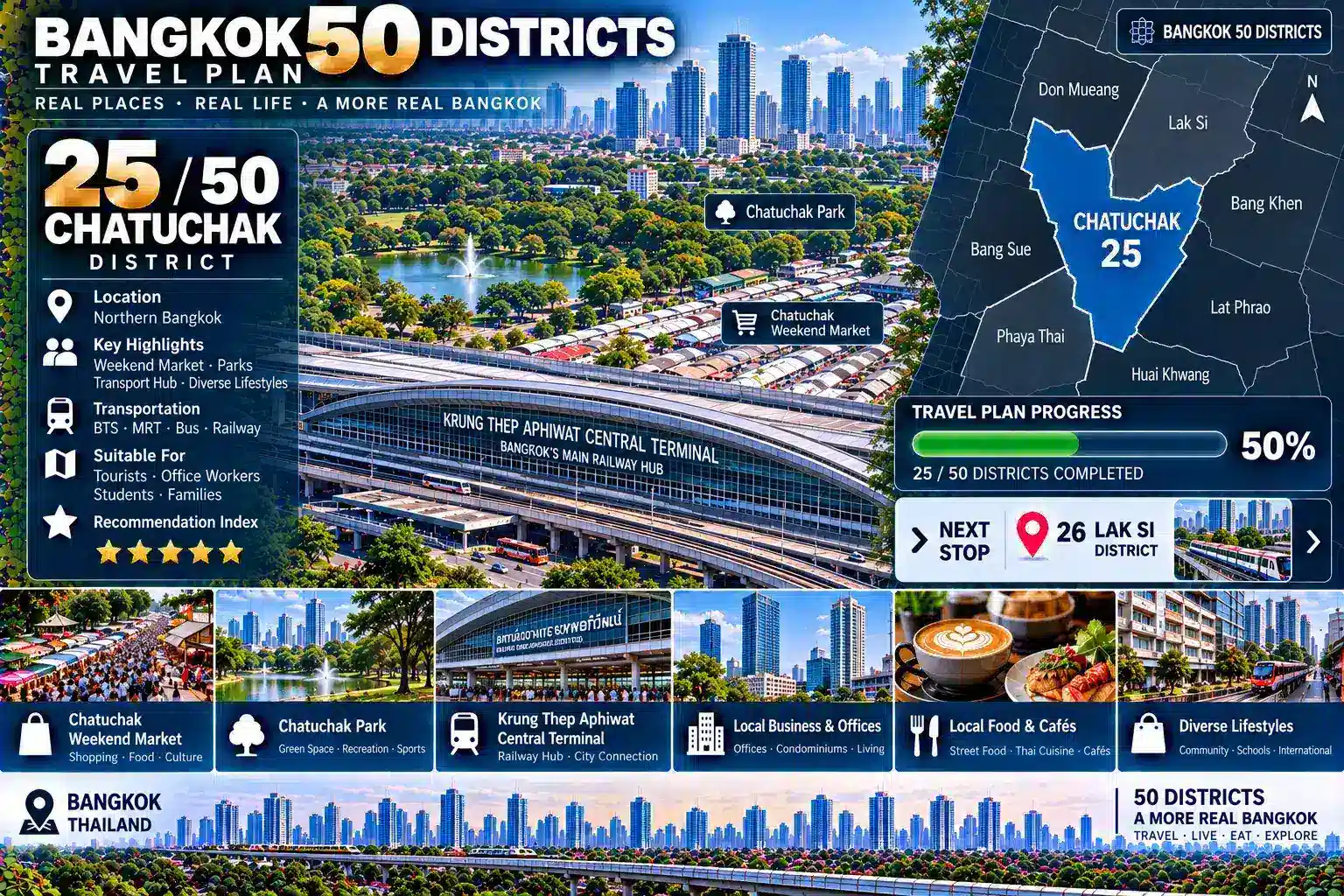
25 / 50 UNLOCKED
50% COMPLETED ✓
CHATUCHAK ✓
Keywords:
Chatuchak · Weekend Market · Mo Chit · BTS · MRT · Chatuchak Park · Urban Parks · Bang Sue · Krung Thep Aphiwat · Central Railway Terminal · Offices · Housing · Global Visitors · National Transportation
25 districts remaining.
NEXT STOP|26 / 50
LAK SI
Next, we continue north.
After leaving Chatuchak, the density of international tourists begins to decrease.
In their place, we find:
Government institutions.
Major roads.
Residential communities.
Office compounds.
Commuter rail.
Transportation toward Don Mueang.
And a much more typical version of everyday northern Bangkok.
If Chatuchak asks:
“How does Bangkok connect neighborhoods, the city, the country and the world?”
then District 26, Lak Si, asks:
“When the tourists begin to disappear, how do government institutions, housing, offices and commuter transportation work together to support a northern Bangkok built primarily for the people who actually live there?”