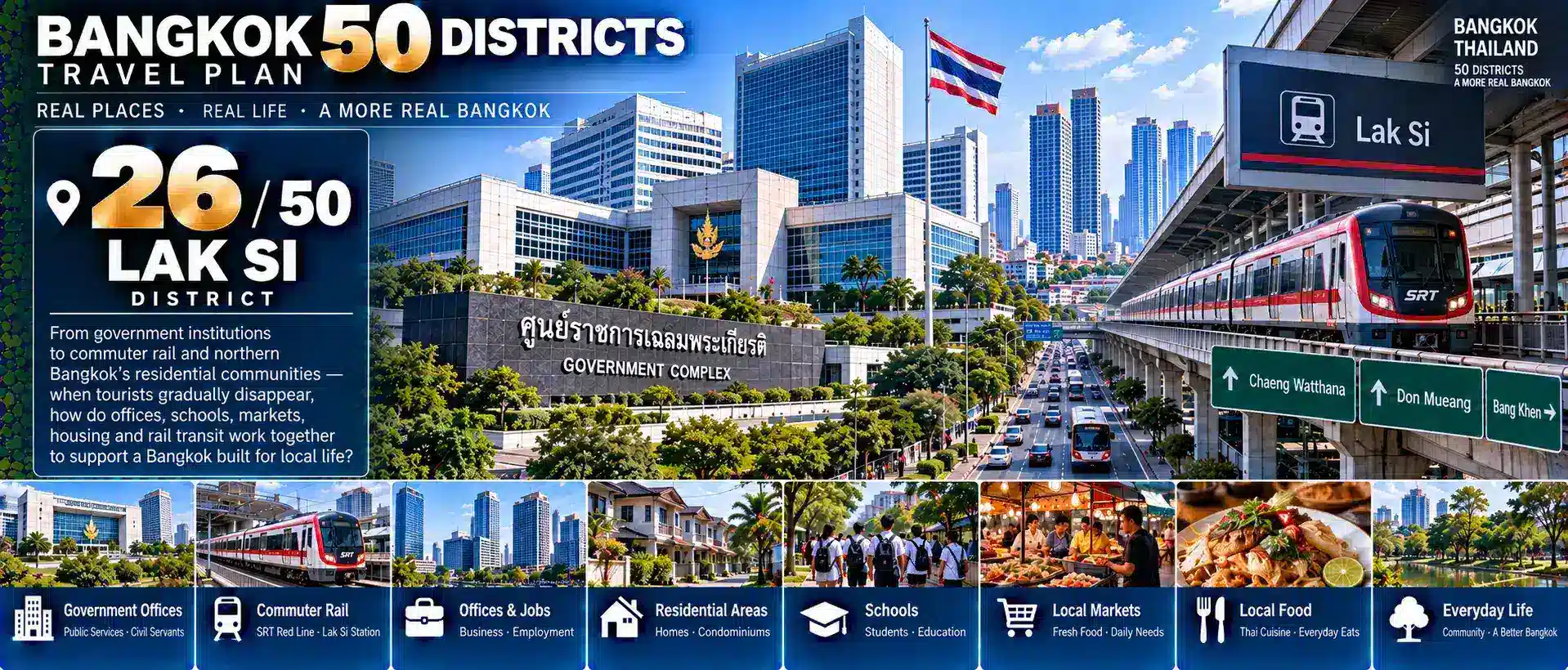
01|Where Is Lak Si?
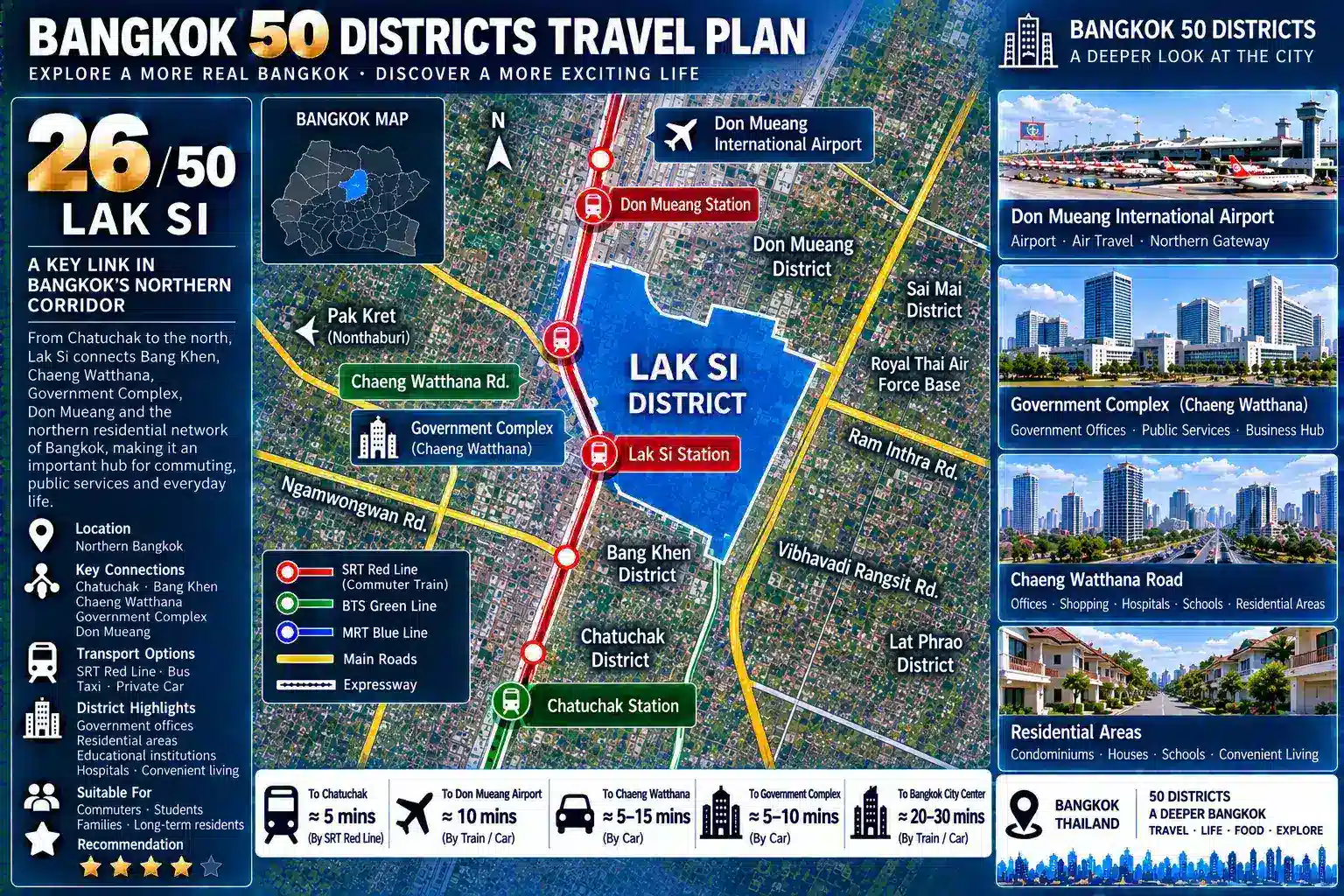
Lak Si is located in northern Bangkok.
Continue north from Chatuchak and the urban landscape gradually moves toward Bang Khen, Lak Si and Don Mueang.
One of the most important urban corridors in this area is:
CHAENG WATTHANA ROAD
Along this corridor are:
Government institutions.
Office buildings.
Commercial facilities.
Residential communities.
Schools.
Hospitals and everyday services.
At the same time, railways and major roads connect the district with:
Chatuchak.
Bang Sue.
Don Mueang.
Central Bangkok.
And areas farther north.
Lak Si may not have the commercial intensity of Siam or the global visitor traffic of Chatuchak.
But it performs an extremely important function:
It is one of the everyday operating hubs of northern Bangkok.
02|Government Complex: How Can Government Institutions Create an Urban Center?
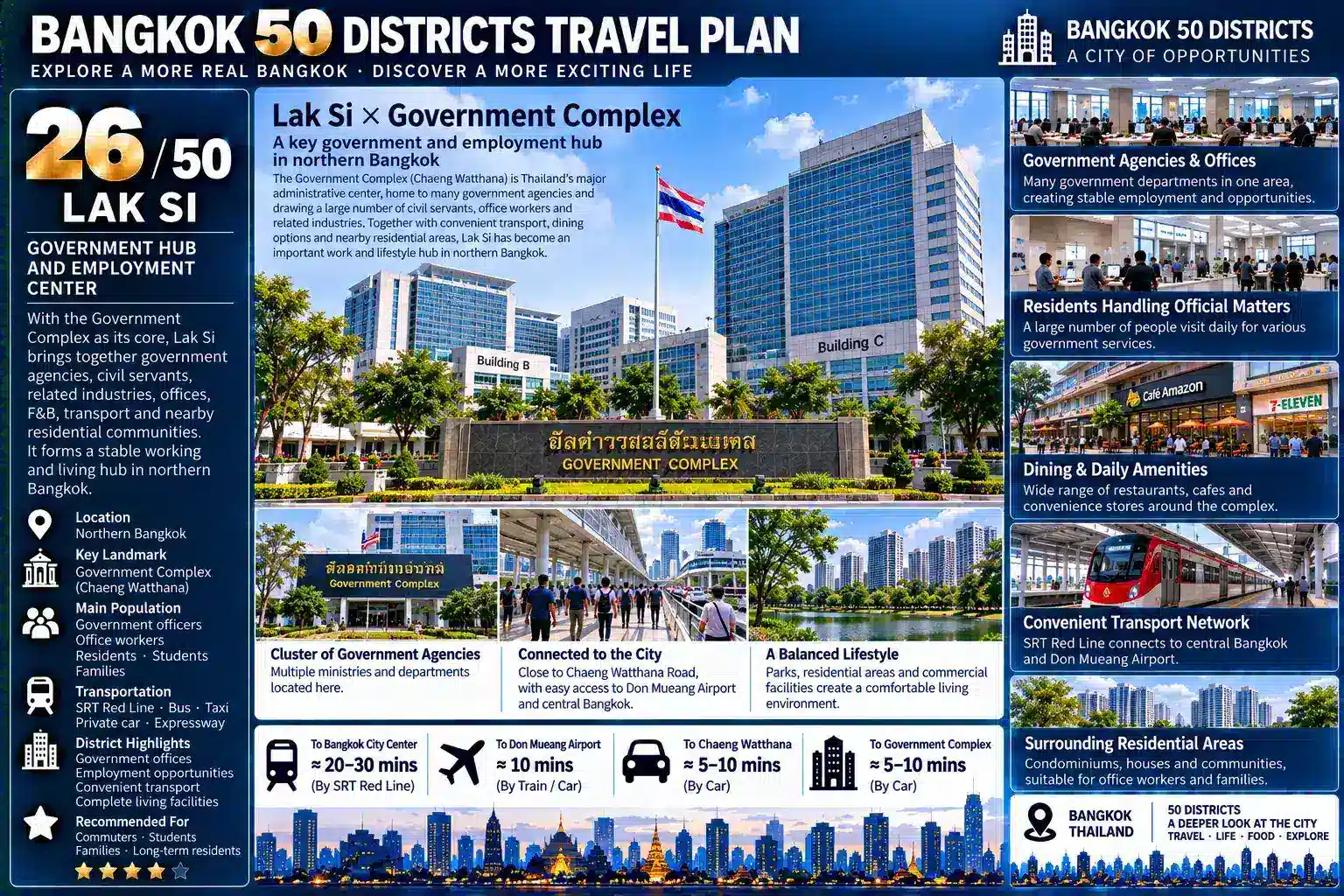
When exploring Lak Si and the Chaeng Watthana corridor, one urban function is impossible to ignore:
GOVERNMENT
Government Complex and the surrounding public institutions attract large numbers of people every day.
Civil servants.
Office workers.
Residents completing administrative procedures.
Business representatives.
Delivery and logistics workers.
Restaurant staff.
Taxi drivers.
Motorcycle taxi drivers.
The impact of a large government office district extends far beyond the office buildings themselves.
All these people need:
Breakfast.
Lunch.
Coffee.
Transportation.
Convenience stores.
Banks.
Printing and document services.
Accommodation.
Housing.
Government institutions therefore create a stable and highly predictable flow of people.
And unlike tourists, this population has one important characteristic:
It returns again and again.
Monday.
Tuesday.
Wednesday.
And throughout the working week.
Over time, government offices begin creating their own:
URBAN LIFESTYLE ECOSYSTEM.
03|Chaeng Watthana: How Can One Road Become a Complete Urban Corridor?
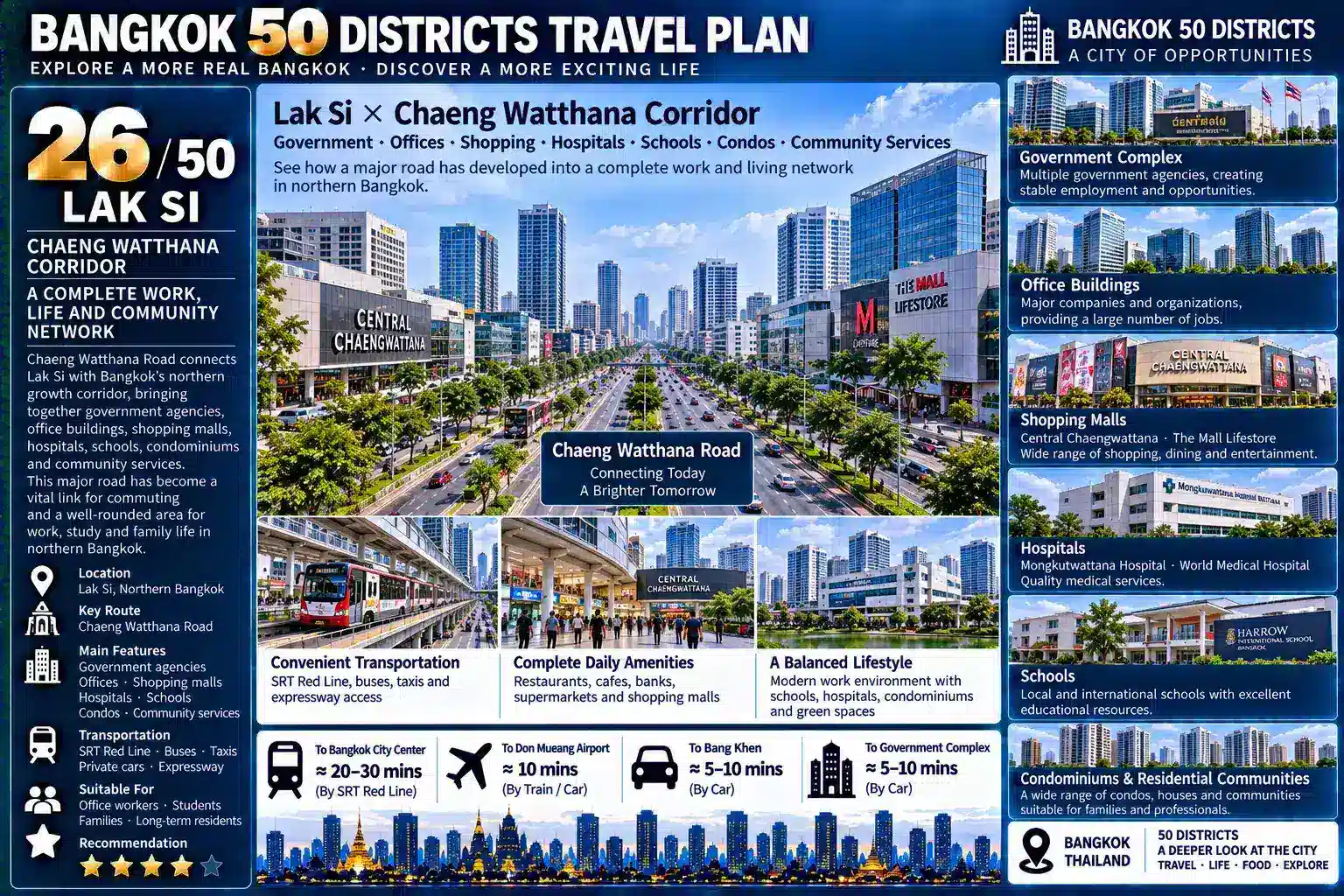
Chaeng Watthana is not a traditional tourist boulevard.
But if you want to understand the real northern Bangkok, it is extremely important.
Along this urban corridor, you can find:
Office buildings.
Government institutions.
Shopping centers.
Hospitals.
Schools.
Condominiums.
Residential communities.
Restaurants.
Convenience stores.
Everyday neighborhood services.
Most of them were not created primarily for tourists.
They exist to serve:
the people who live and work here every day.
This is also a very typical pattern of Bangkok’s urban development.
First comes a major road.
The road creates mobility.
Mobility attracts offices and housing.
As the population grows:
Restaurants appear.
Retail follows.
Schools develop.
Healthcare expands.
More condominiums are built.
Eventually, what began as simply a “road” becomes:
A COMPLETE URBAN LIFESTYLE CORRIDOR.
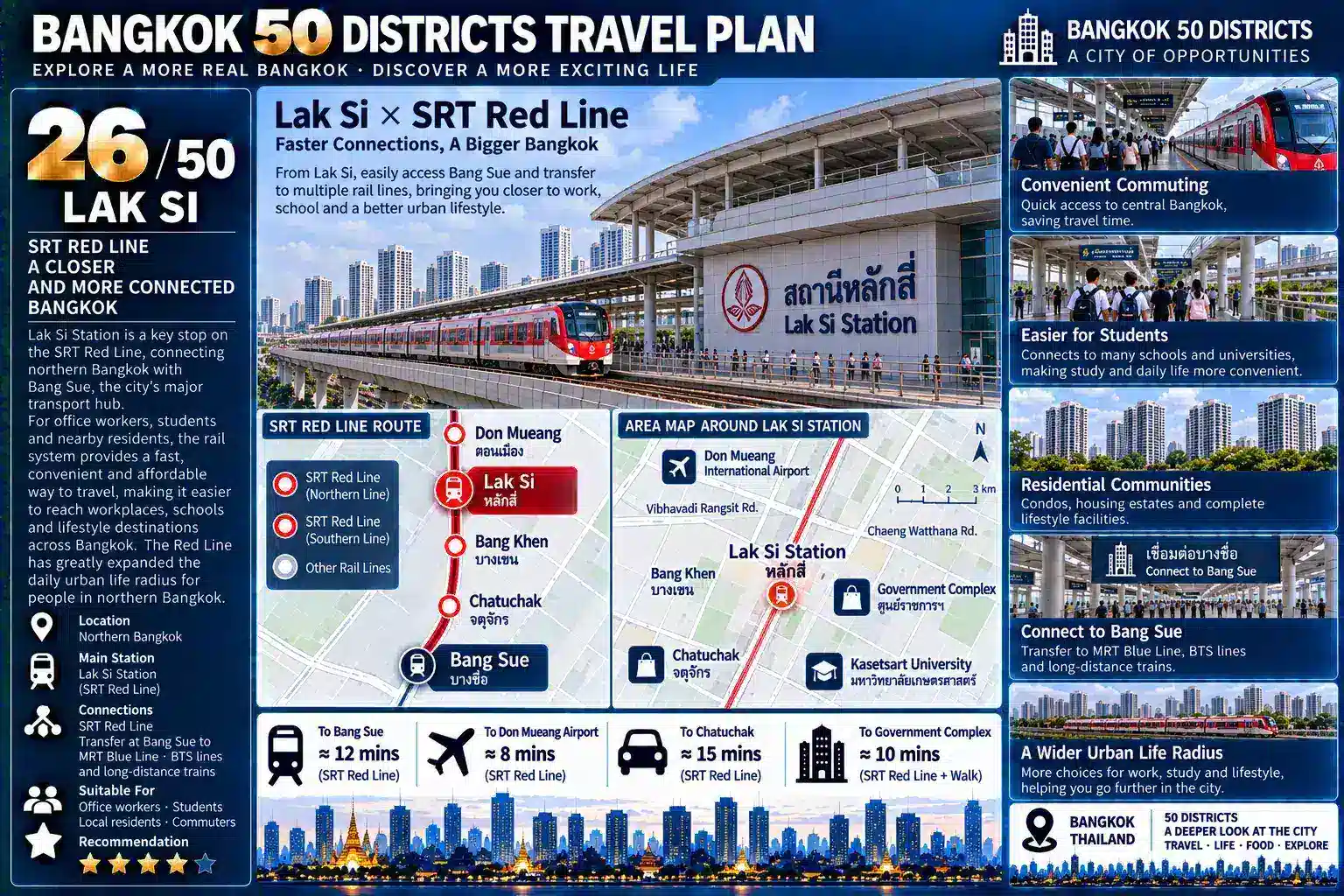
04|SRT Red Line: Why Can Commuter Rail Transform Northern Bangkok?
For people living in central Bangkok, BTS and MRT are usually the most familiar forms of rail transportation.
But as we travel farther north, another type of rail system becomes increasingly important:
COMMUTER RAIL
The SRT Red Line strengthens the connection between northern residential areas and the wider Bang Sue transport network.
Lak Si Station is therefore more than just a station.
It represents a different urban logic:
You can live farther away and still remain connected to the city.
In the past, the farther a home was from central Bangkok, the more difficult and expensive daily commuting could become.
Rail transit changes that relationship.
Residential areas can spread farther outward.
Employment opportunities become accessible across a larger area.
People do not necessarily have to live near Siam, Asok or Phaya Thai.
They can live in northern Bangkok.
Take rail transportation to work or school.
Then return to their own community in the evening.
That is the deeper urban significance of commuter rail:
It expands the geographic area in which everyday city life is possible.
05|Residential Communities: Why Does Lak Si Feel Closer to the Everyday Life of Bangkok Families?
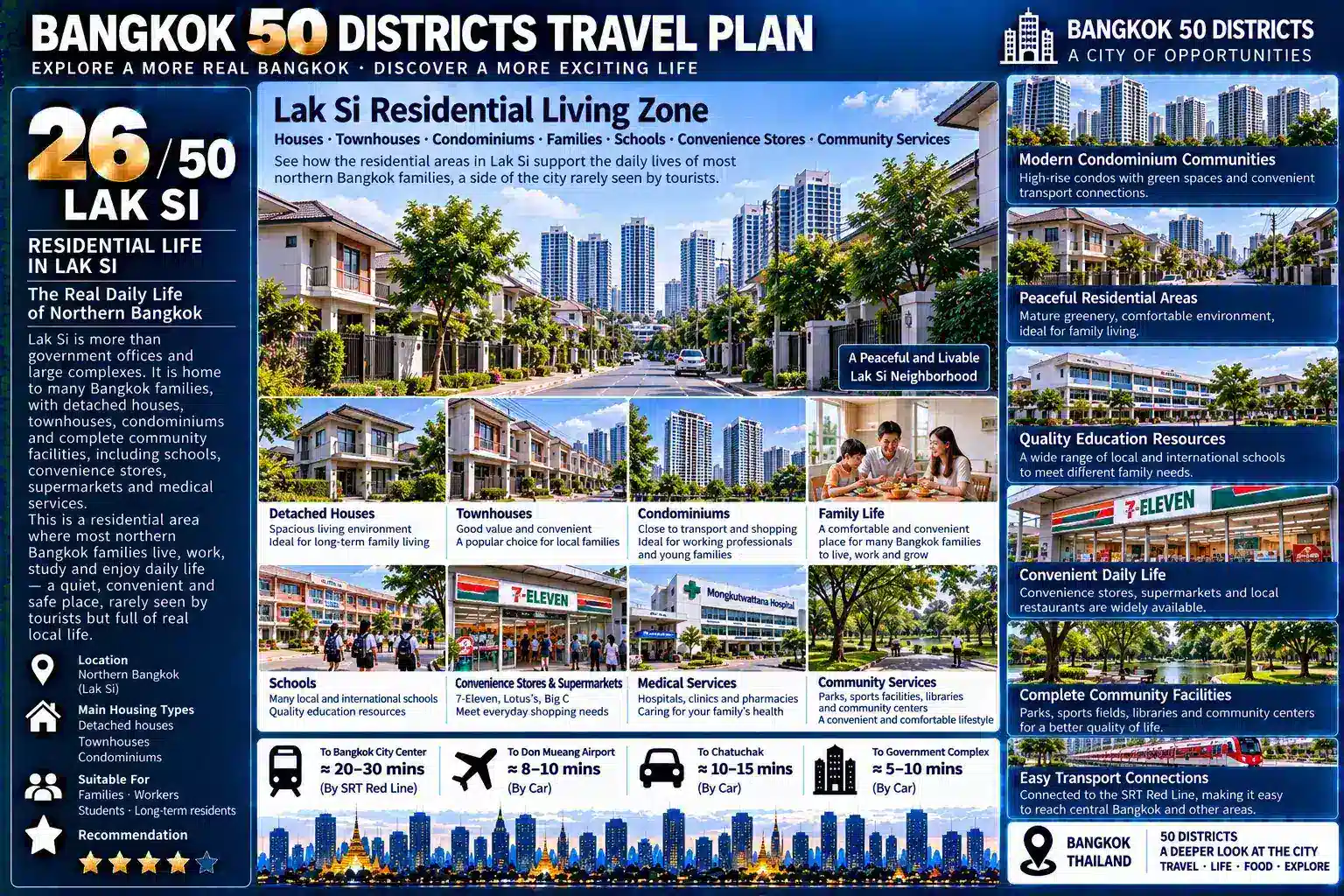
Leave the major roads and government institutions behind and enter Lak Si’s residential areas.
The city becomes quieter.
Residential sois.
Detached houses.
Townhouses.
Condominiums.
Schools.
Small restaurants.
Convenience stores.
Neighborhood markets.
Motorcycles.
These elements look very different from the Bangkok imagined by most tourists.
There are no mega malls.
No Grand Palace.
No neon tourist market.
No crowds lining up for photographs.
And yet, this may actually be much closer to:
HOW MANY BANGKOK FAMILIES REALLY LIVE.
Take the children to school in the morning.
Go to work.
Buy groceries in the afternoon.
Return home in the evening.
Eat somewhere near the neighborhood.
Go to a shopping center for household supplies on the weekend.
These are the routines that are repeated millions of times across a city.
Tourist attractions tell us:
What Bangkok has to see.
Residential neighborhoods tell us:
HOW BANGKOK LIVES.
06|Neighborhood Markets: Why Does Buying Food Near Home Still Matter?
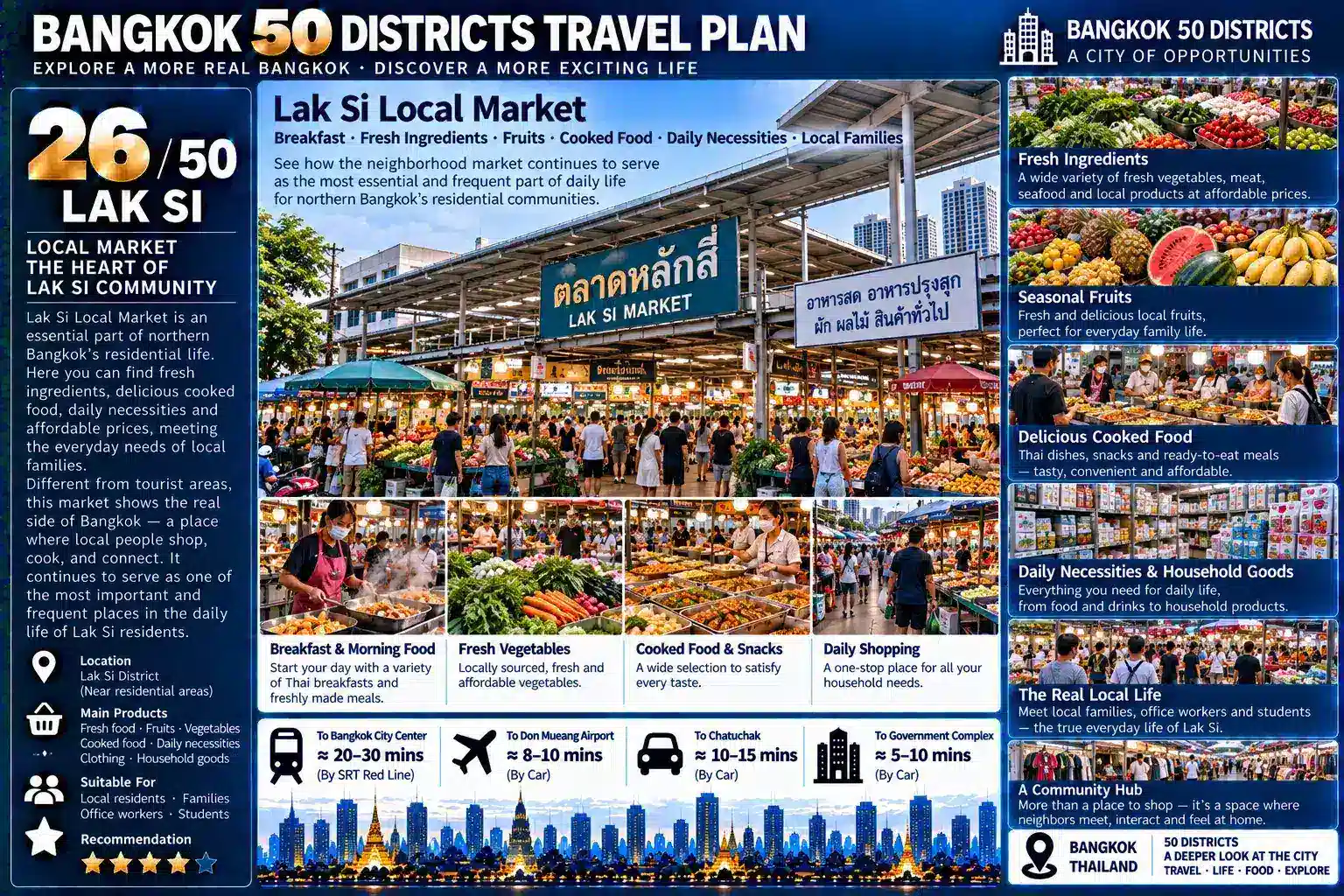
Even as modern shopping malls, supermarkets and convenience stores become more common, neighborhood markets remain an important part of everyday Bangkok life.
The reasons are simple.
They are close to home.
Prices are accessible.
Ingredients are fresh.
You can buy small quantities.
You can buy ready-to-eat food.
You get to know the vendors.
And you can return every day.
In the morning:
Breakfast stalls begin operating.
During the day:
Vegetables, fruit, meat and household necessities dominate.
In the evening:
Prepared food appears and the after-work crowd grows.
A market is therefore more than a place for buying and selling.
It also functions as:
A COMMUNITY INFORMATION EXCHANGE.
Neighbors meet.
Vendors recognize regular customers.
Families repeat the same shopping routines.
And urban relationships gradually form in these very ordinary places.
07|What to Eat in Lak Si? Not “Instagram Food,” but Food You Can Eat Every Day
Lak Si’s food culture is very different from Ari or Pratunam.
Restaurants here do not all need to be photogenic.
What matters more is:
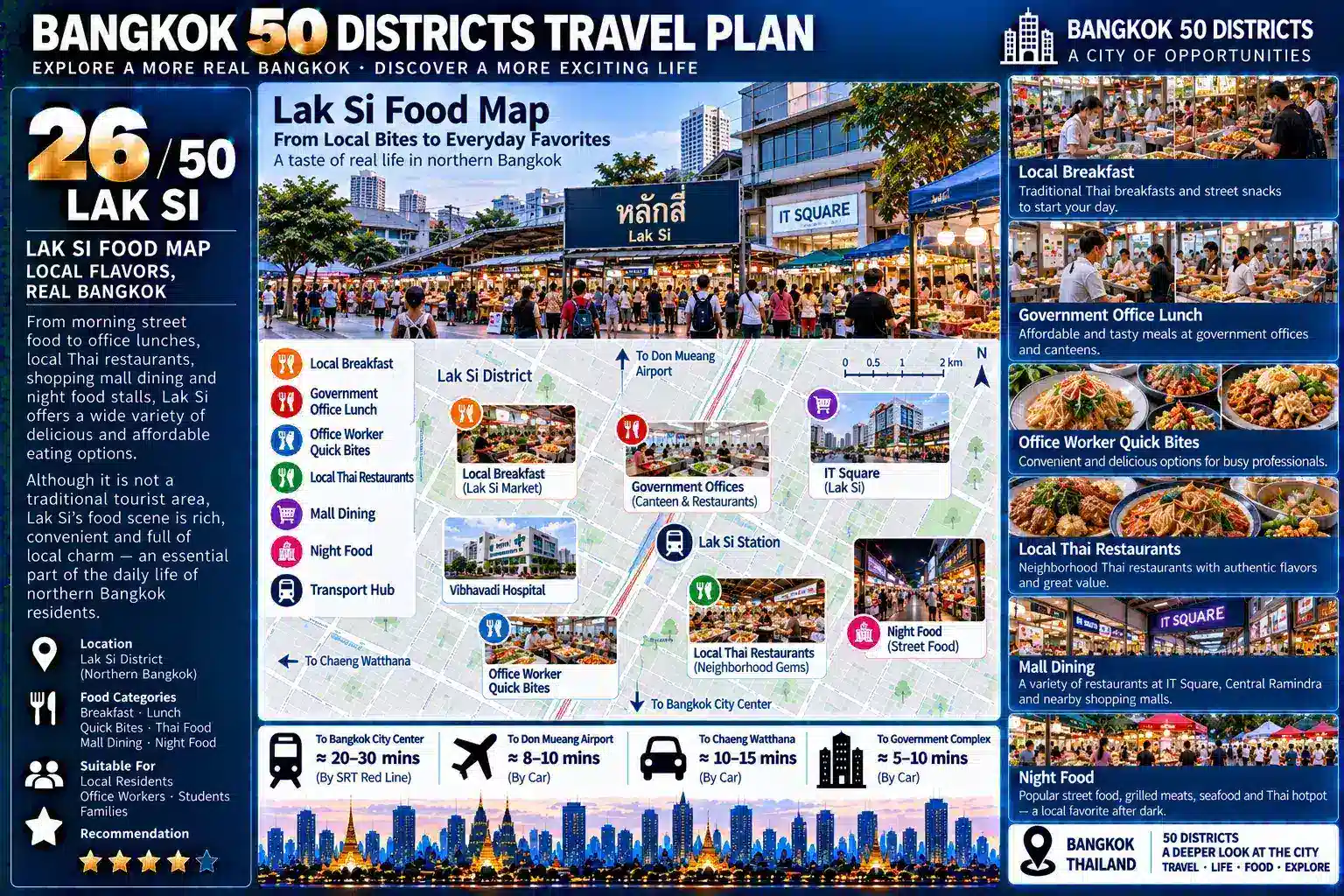
AFFORDABLE, CONVENIENT FOOD FOR EVERYDAY LIFE.
① Neighborhood Breakfast
Rice porridge.
Noodles.
Chicken rice.
Pa thong ko.
Coffee.
② Government-Worker Lunches
Fast.
Plenty of choices.
Reasonably priced.
③ Office-Worker Meals
Rice dishes.
Thai fast food.
Noodles.
Simple meals.
④ Neighborhood Thai Restaurants
An important part of everyday family dining.
⑤ Shopping-Center Dining
More standardized and modern choices.
⑥ Evening Neighborhood Food
Grilled food.
Isan cuisine.
Hot pot.
Small Thai restaurants.
The real character of Lak Si’s food scene is not:
“Which restaurant must I visit?”
It is:
AN ENTIRE EVERYDAY FOOD SYSTEM BUILT TO SERVE LOCAL RESIDENTS.
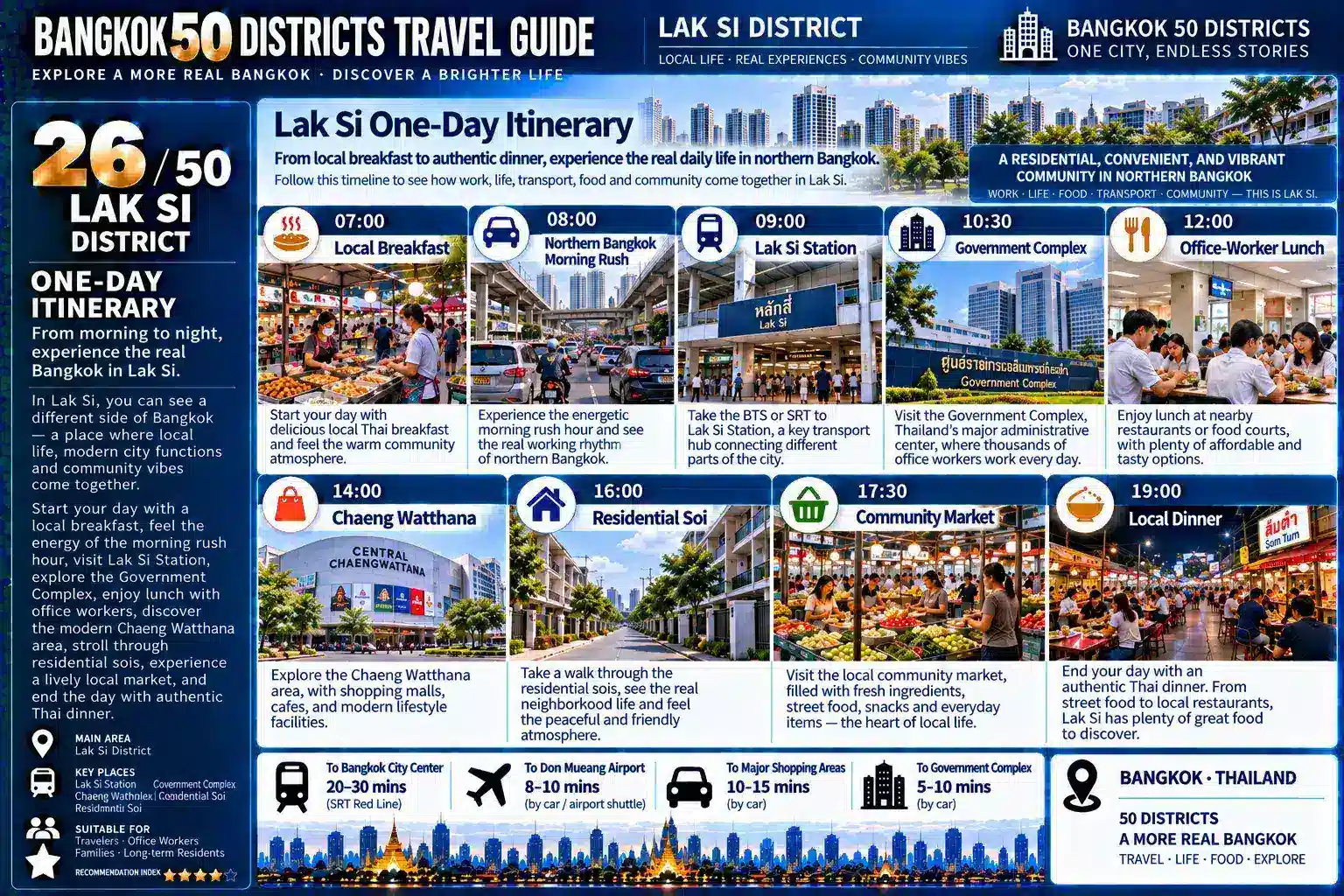
08|How to Spend One Day in Lak Si
Do not explore this district like a conventional tourist destination.
The best approach is to:
EXPERIENCE AN ORDINARY WORKDAY IN NORTHERN BANGKOK.
07:00|Neighborhood Breakfast
Have an ordinary breakfast near a residential community.
08:00|Morning Rush
Observe how buses, cars, motorcycles and rail transit move residents toward their workplaces.
09:00|Lak Si Station
Experience the SRT Red Line and northern Bangkok’s commuter network.
10:30|Government Complex
Observe the real weekday rhythm of a major government office district.
12:00|Office-Worker Lunch
Do not search for an Instagram-famous restaurant.
Follow the office workers.
14:00|Chaeng Watthana
Observe the mixture of offices, commerce, healthcare and housing along the road.
16:00|Residential Communities
Enter the sois.
See the Bangkok that tourists rarely experience.
17:30|Neighborhood Market
This is one of the most atmospheric times of the day.
Workers begin returning home.
Families start buying food for dinner.
19:00|Local Dinner
Finish the day with a meal designed for local residents rather than visitors.
09|What Makes Lak Si Worth Seeing Is the Bangkok That Remains “After the Tourists Are Gone”
Many people begin discovering Bangkok through places such as:
Grand Palace.
Wat Arun.
Siam.
ICONSIAM.
Asok.
Chatuchak.
All of these places are part of Bangkok.
But they are not the whole city.
When we reach District 26, Lak Si, an important question emerges:
IF WE REMOVE ALL THE TOURISTS, WHAT IS LEFT OF BANGKOK?
The answer is:
A lot.
Breakfast stalls opening at six in the morning.
Roads becoming congested at seven.
Office workers rushing to transportation at eight.
Parents taking children to school.
Civil servants entering government offices.
Employees lining up for lunch.
People buying groceries in the afternoon.
Students leaving school.
Motorcycles returning home in the evening.
Families sitting together in neighborhood restaurants at night.
Almost none of these things will become the main scene in a tourism advertisement.
Yet these are the things that happen most often in a real city.
A tourism city has two versions.
One is:
THE CITY VISITORS SEE.
The other is:
THE CITY RESIDENTS ACTUALLY USE.
What makes Lak Si worth exploring is precisely that second version.
There may not be a spectacular landmark demanding a photograph.
But here you can see:
How government functions within the city.
How transportation supports employment.
How housing develops around jobs.
How markets support families.
How schools create daily commuting patterns.
How restaurants survive on office populations.
And how rail transportation connects all these systems together.
District 26 therefore teaches us something important:
THE MOST IMPORTANT PARTS OF A CITY ARE NOT ALWAYS THE PLACES WITH THE MOST TOURISTS.
Sometimes the most ordinary districts explain something much deeper:
WHY THE CITY CAN KEEP FUNCTIONING EVERY SINGLE DAY.
That is Lak Si.
Not a tourist center.
Not a mega commercial center.
But a Bangkok that genuinely belongs to:
Residents.
Families.
Students.
Civil servants.
Office workers.
And the people who live their everyday lives here.
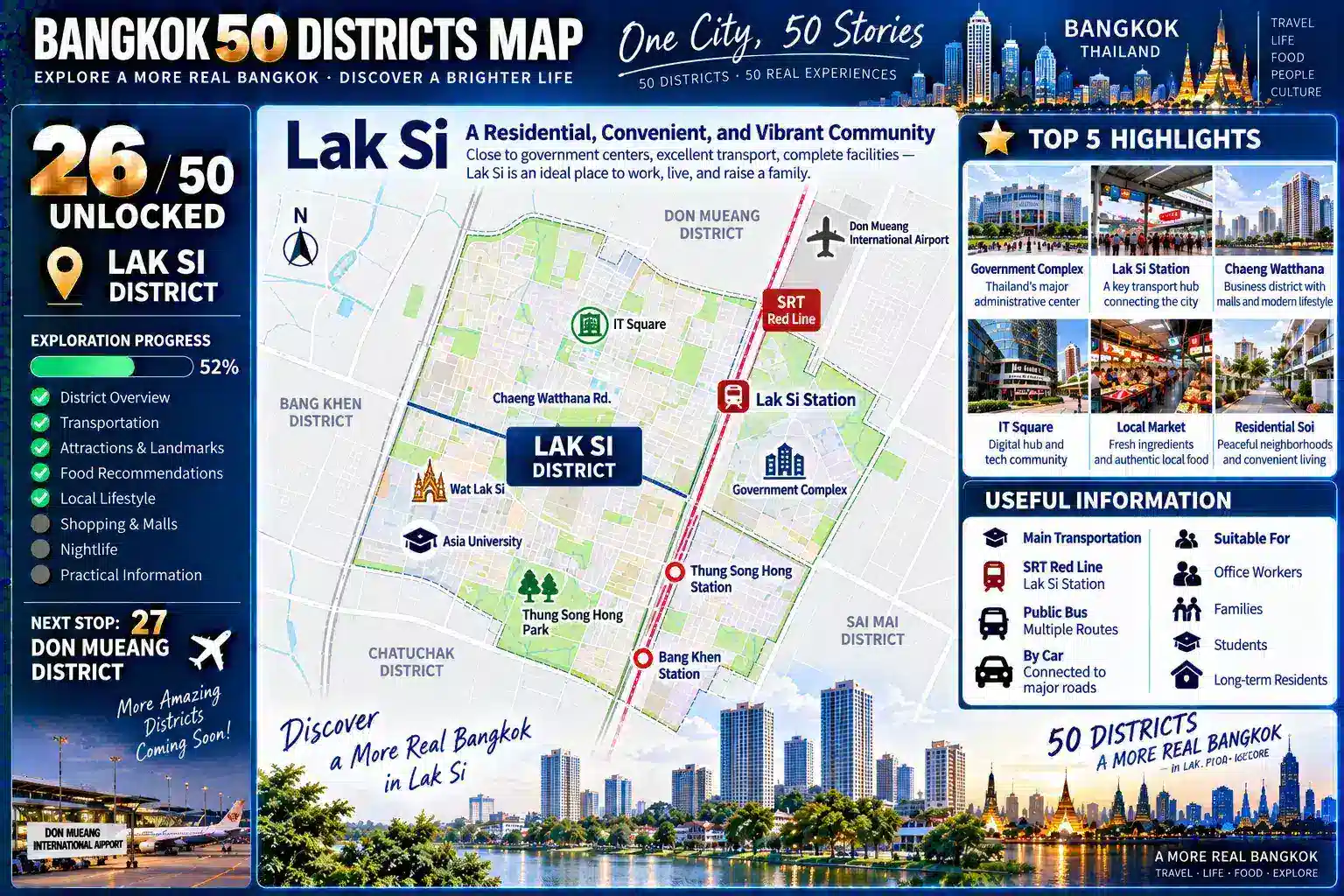
26 / 50 UNLOCKED
LAK SI ✓
SERIES PROGRESS|52%
Keywords:
Lak Si · Chaeng Watthana · Government Complex · SRT Red Line · Lak Si Station · Government Institutions · Commuting · Residential Communities · Families · Schools · Neighborhood Markets · Local Life · Northern Bangkok
24 districts remaining.
NEXT STOP|27 / 50
DON MUEANG
As we continue north, one enormous piece of infrastructure begins to reshape the entire urban landscape:
DON MUEANG INTERNATIONAL AIRPORT
Aircraft.
Airport employees.
Passengers.
Hotels.
Logistics.
Railways.
Residential communities.
Military facilities.
Airport-related businesses.
All of these completely different functions overlap within the same district.
If Lak Si showed us:
“How ordinary Bangkok continues functioning when tourists are no longer the main characters,”
then District 27, Don Mueang, asks:
“When an international airport is embedded directly inside a residential district, how do aircraft, passengers, airport employment, railways, logistics and local families coexist within the same urban space?”