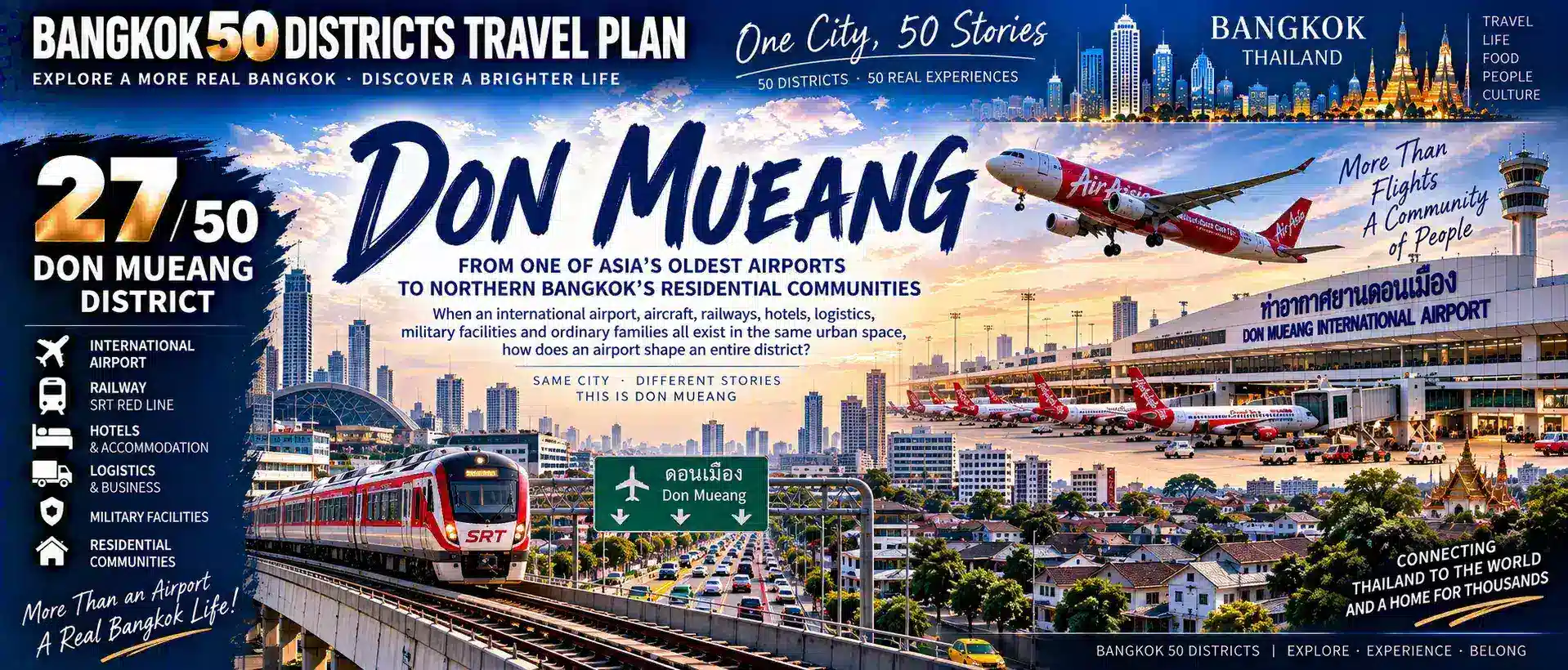
01|Where Is Don Mueang?
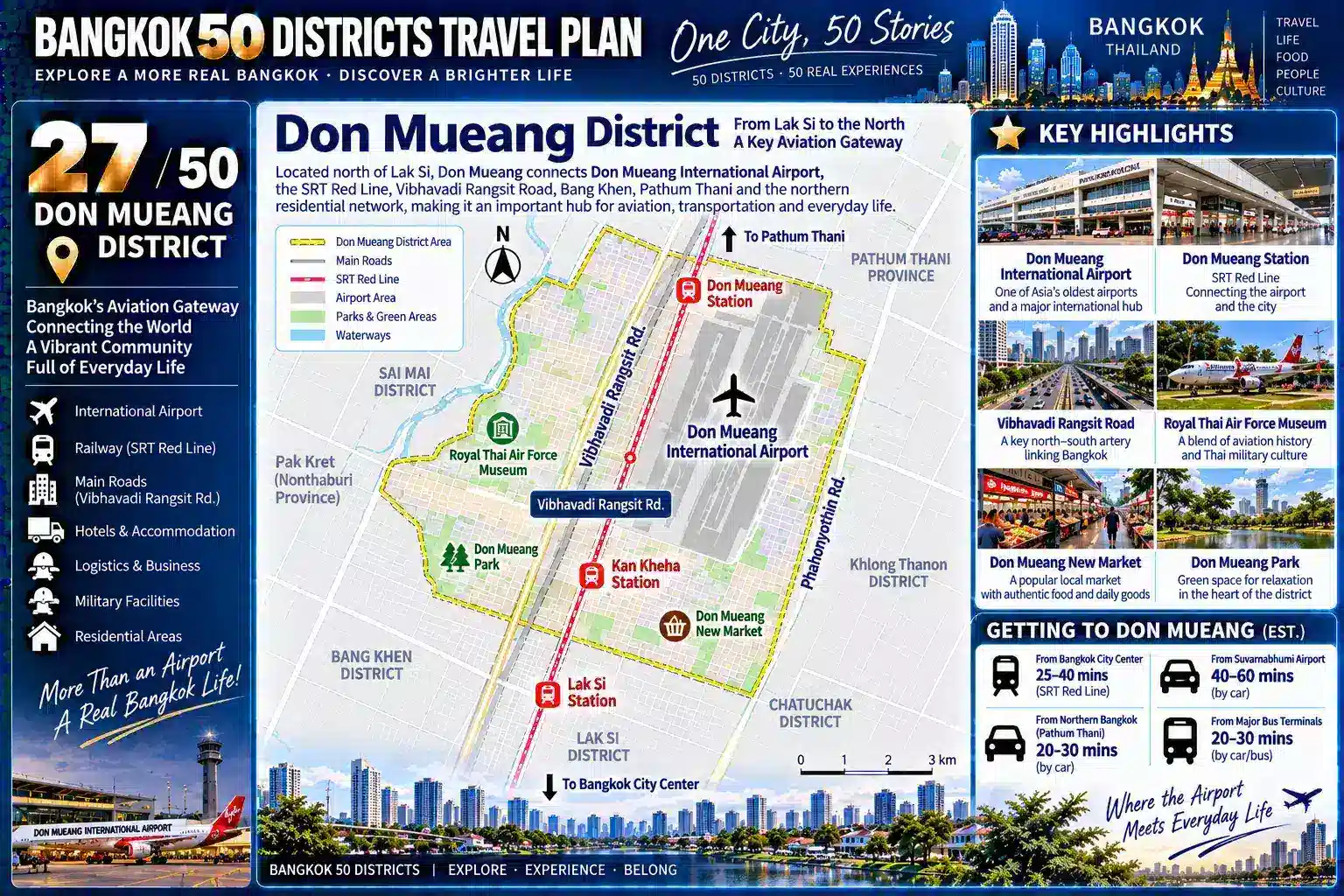
Don Mueang is located in northern Bangkok.
To the south, it connects with Lak Si, Bang Khen and the more central parts of Bangkok.
Continue north and the urban landscape gradually approaches the expanding metropolitan corridor between Bangkok and Pathum Thani.
The district’s most important landmark is unquestionably:
DON MUEANG INTERNATIONAL AIRPORT
The airport has a major influence on the structure of the entire district.
Railways run alongside the airport area.
Vibhavadi Rangsit Road carries enormous volumes of north–south traffic.
Hotels cluster around the terminals.
Taxis, buses and airport transportation constantly converge here.
Residential communities occupy the spaces between these major pieces of infrastructure.
Don Mueang therefore is not simply:
“an airport beside the city.”
A better way to understand it is:
THE AIRPORT ITSELF IS PART OF THE CITY.
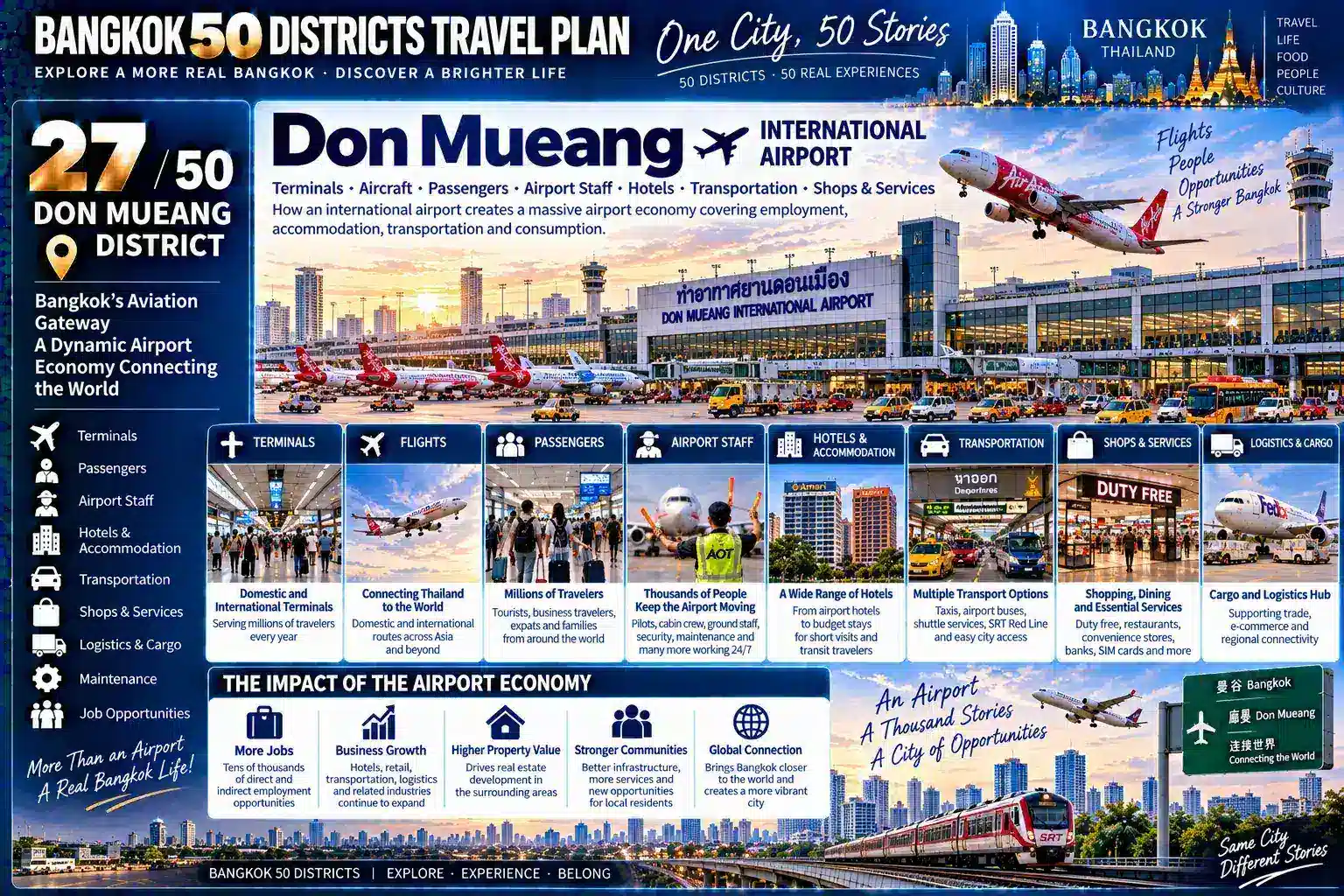
02|Don Mueang Airport: How Can One Airport Transform an Entire District?
The most powerful urban force in Don Mueang is:
THE AIRPORT
An airport brings much more than passengers.
It creates an entire employment ecosystem:
Pilots.
Cabin crew.
Ground staff.
Security personnel.
Cleaners.
Maintenance teams.
Catering workers.
Airline employees.
Taxi drivers.
Hotel staff.
Logistics workers.
Retail employees.
Every day, the airport generates enormous flows of people.
And all these people need:
Housing.
Food.
Shopping.
Transportation.
Accommodation.
Convenience stores.
Laundry.
Repairs.
Healthcare.
Over time, the area surrounding the airport develops into a huge:
AIRPORT ECONOMY
The airport is no longer simply a terminal building and a set of runways.
It begins to shape the entire district.
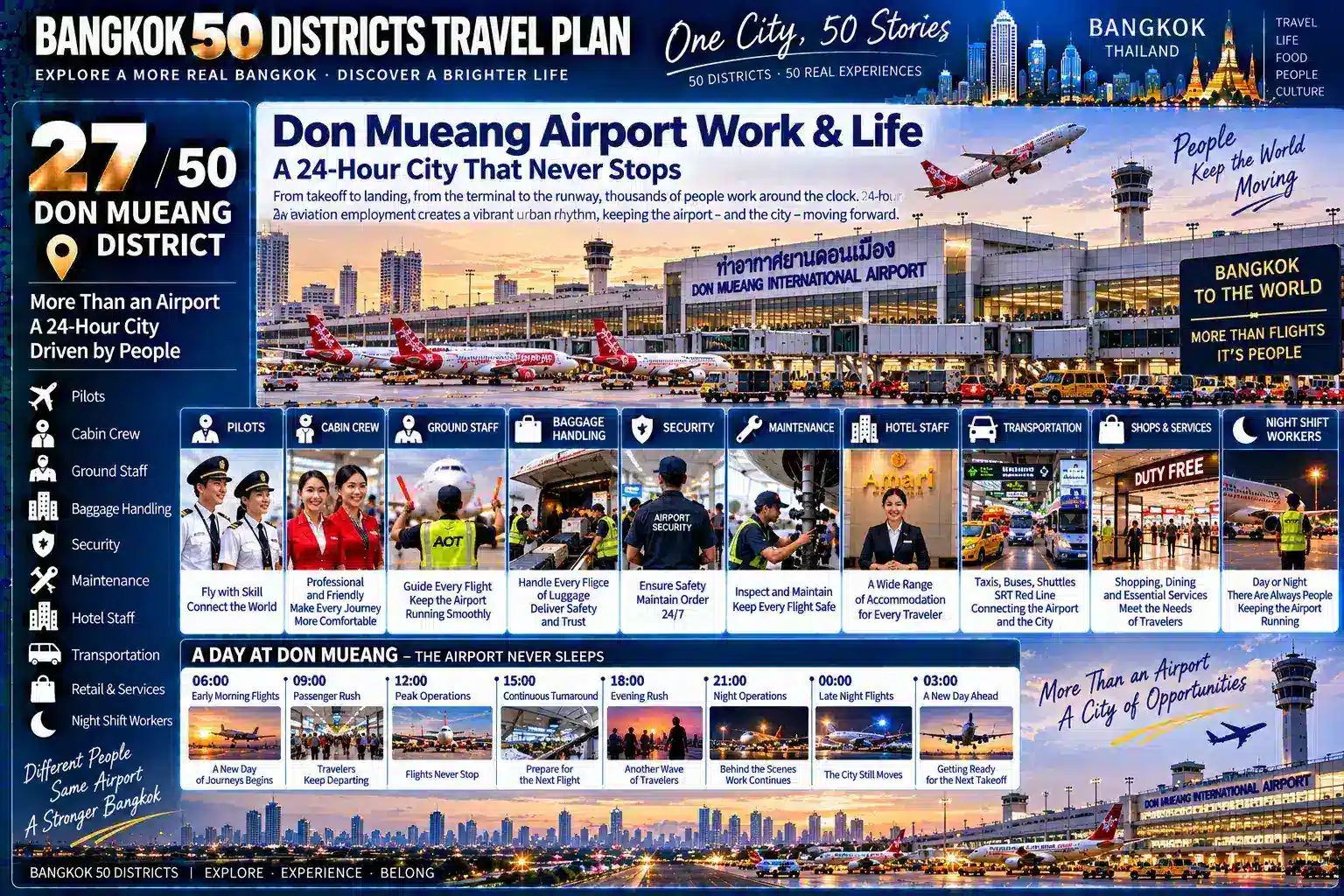
03|Airport Workers: Who Keeps an Airport Running 24 Hours a Day?
When travelers see an airport, they usually notice:
Check-in counters.
Security.
Boarding gates.
Aircraft.
But what actually keeps an airport functioning is a huge workforce that passengers often barely notice.
After an aircraft lands:
Someone guides it.
Someone unloads the luggage.
Someone inspects the aircraft.
Someone cleans the cabin.
Someone loads catering supplies.
Someone maintains the equipment.
Someone handles passenger problems.
Someone manages security.
An airport is therefore a very unusual kind of:
24-HOUR WORKING CITY
Morning shifts.
Evening shifts.
Night shifts.
Different teams continuously replace one another.
This directly changes the rhythm of life in the surrounding district.
When many other Bangkok neighborhoods are preparing to sleep, people here are still:
Finishing work.
Starting work.
Eating.
Commuting.
Checking into hotels.
Don Mueang therefore operates on a different urban clock.
HERE, THE CITY’S CLOCK MOVES WITH THE FLIGHT SCHEDULE.
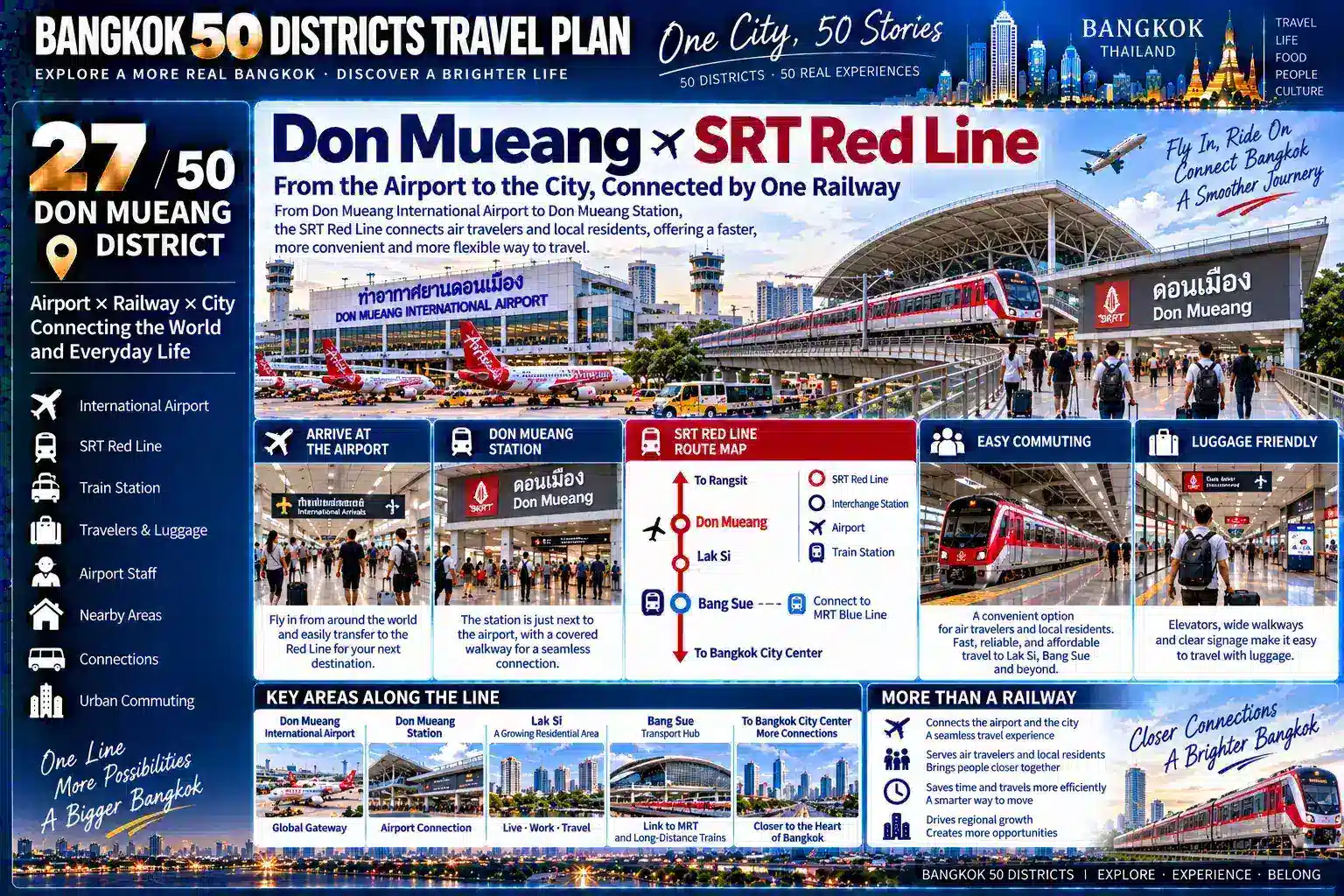
04|SRT Red Line × Railway: Why Does an Airport Need Rail?
One of the biggest transportation challenges for any airport is:
HOW DO YOU MOVE LARGE NUMBERS OF PASSENGERS INTO THE CITY?
If everyone depends on:
Taxis.
Private cars.
Buses.
Road congestion becomes a major problem.
Rail therefore becomes increasingly important.
Don Mueang Station and the SRT Red Line provide another transportation option for both the airport and northern Bangkok.
Travel south and the line connects toward:
Lak Si.
Bang Sue.
And Bangkok’s wider rail network.
For local residents, this railway is not merely:
“airport transportation.”
It also serves:
Office workers.
Students.
Airport employees.
Everyday commuters.
The deeper value of the railway is therefore:
THE SAME RAIL SYSTEM SERVES BOTH TRAVELERS AND RESIDENTS.
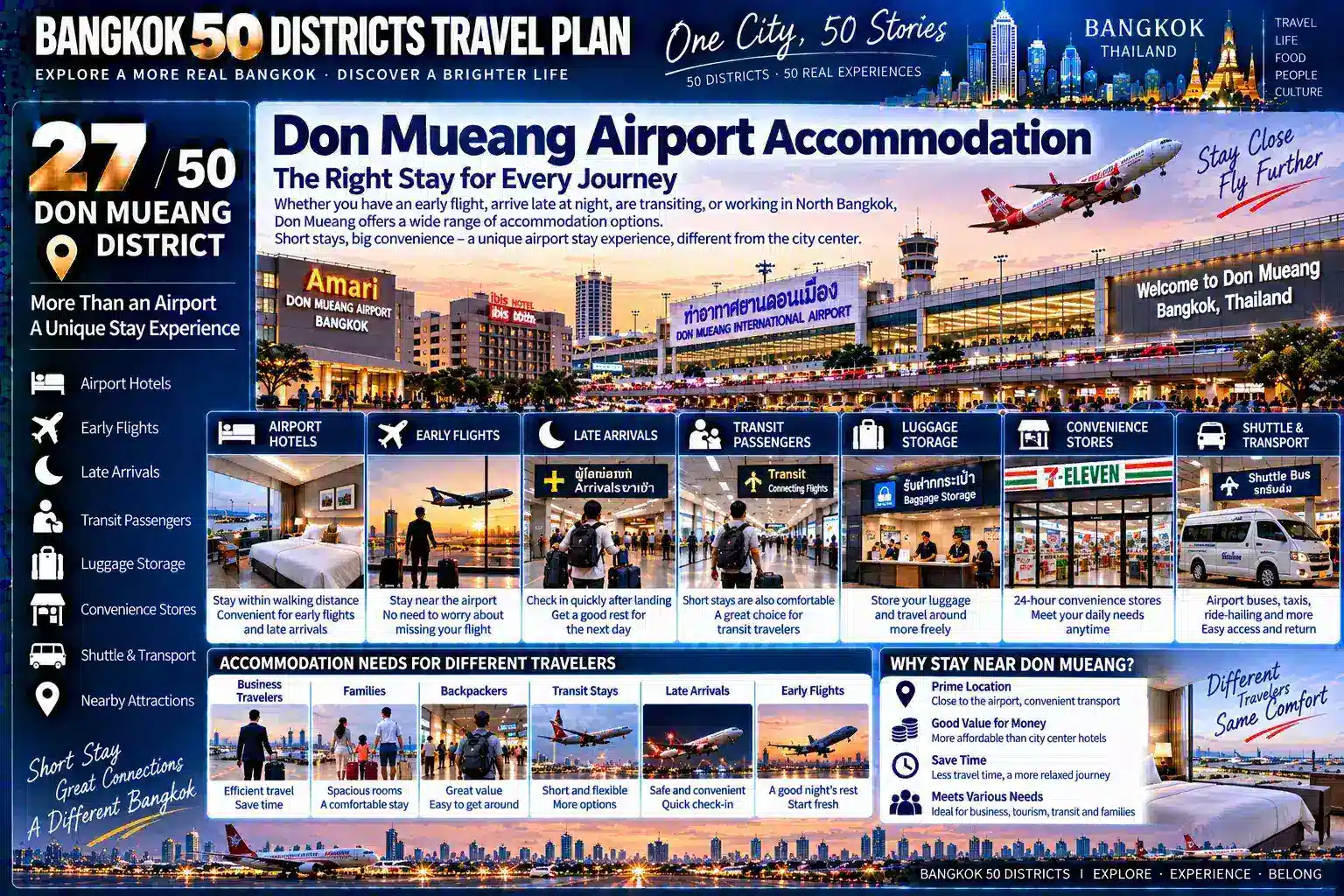
05|Airport Hotels × Short Stays: Why Does an Airport Need Its Own Accommodation Ecosystem?
Hotels around an airport operate differently from hotels in central Bangkok.
Many guests are not staying here because they want to explore the neighborhood.
They are here because they need to:
Catch an early flight.
Wait for a connection.
Arrive late at night.
Deal with a delayed flight.
Continue traveling the next morning.
For airport accommodation, the most important word is often not:
Views.
Luxury.
Instagram.
It is:
CONVENIENCE
Close to the airport.
24-hour reception.
Luggage storage.
Easy taxi access.
Convenience stores and restaurants nearby.
This creates a very particular accommodation economy around the airport.
A traveler may stay for only:
Six hours.
Ten hours.
One night.
Then leave again.
These hotels therefore serve:
PEOPLE IN MOTION.
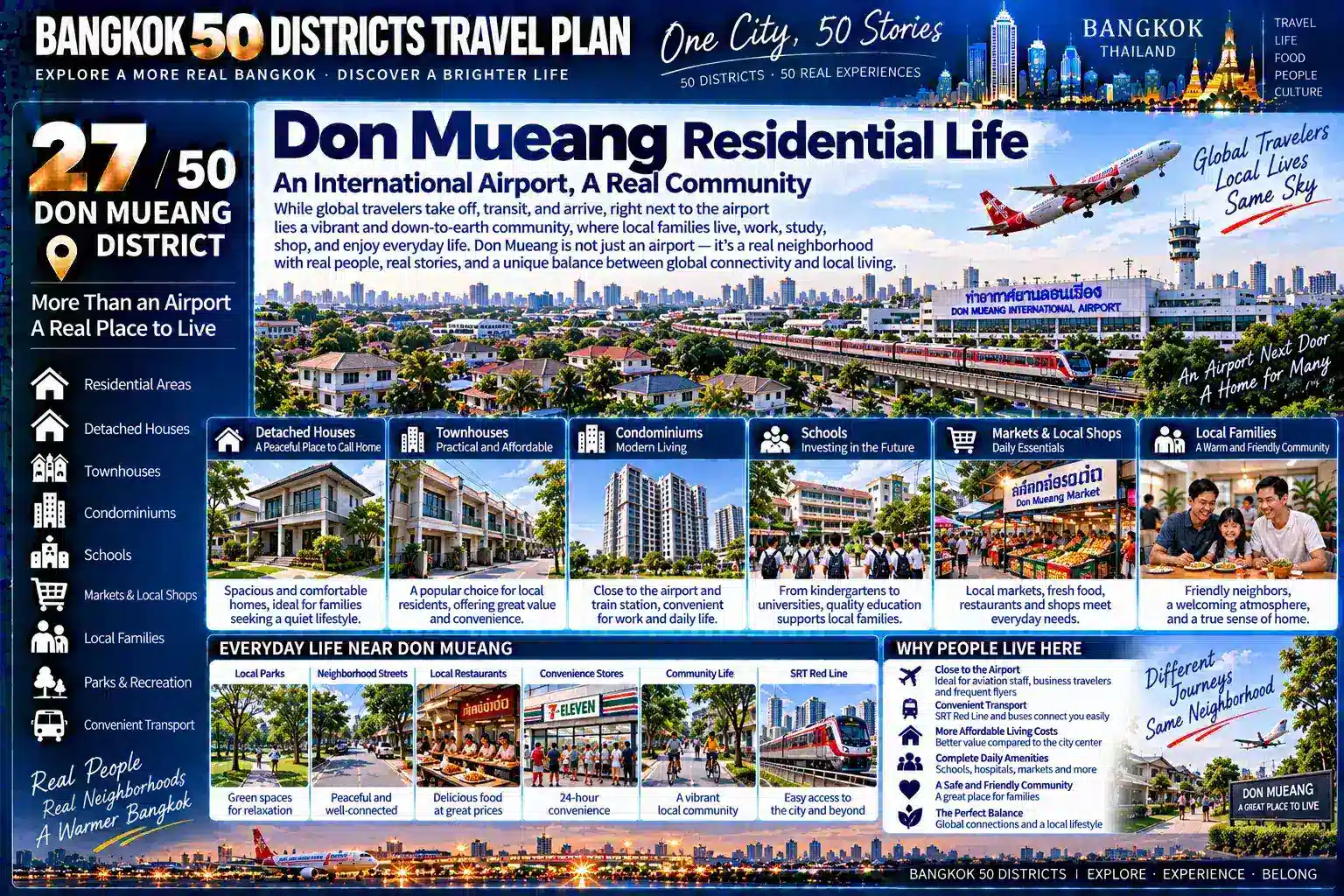
06|Residential Communities: What Is It Like to Live Beside an Airport?
Leave the terminals and major roads behind, and Don Mueang reveals a completely different side.
Residential sois.
Detached houses.
Townhouses.
Condominiums.
Schools.
Temples.
Markets.
Convenience stores.
Family restaurants.
Aircraft passing overhead occasionally remind you:
The airport is nearby.
But for long-term residents, that does not mean every day feels like travel.
They still need to do the most ordinary things:
Take children to school.
Go to work.
Buy groceries.
Eat.
Return home.
The airport represents global movement.
The residential neighborhoods represent:
STABILITY
These two seemingly opposite urban conditions exist immediately beside each other in Don Mueang.
On one side:
People constantly leaving.
On the other:
People who stay.
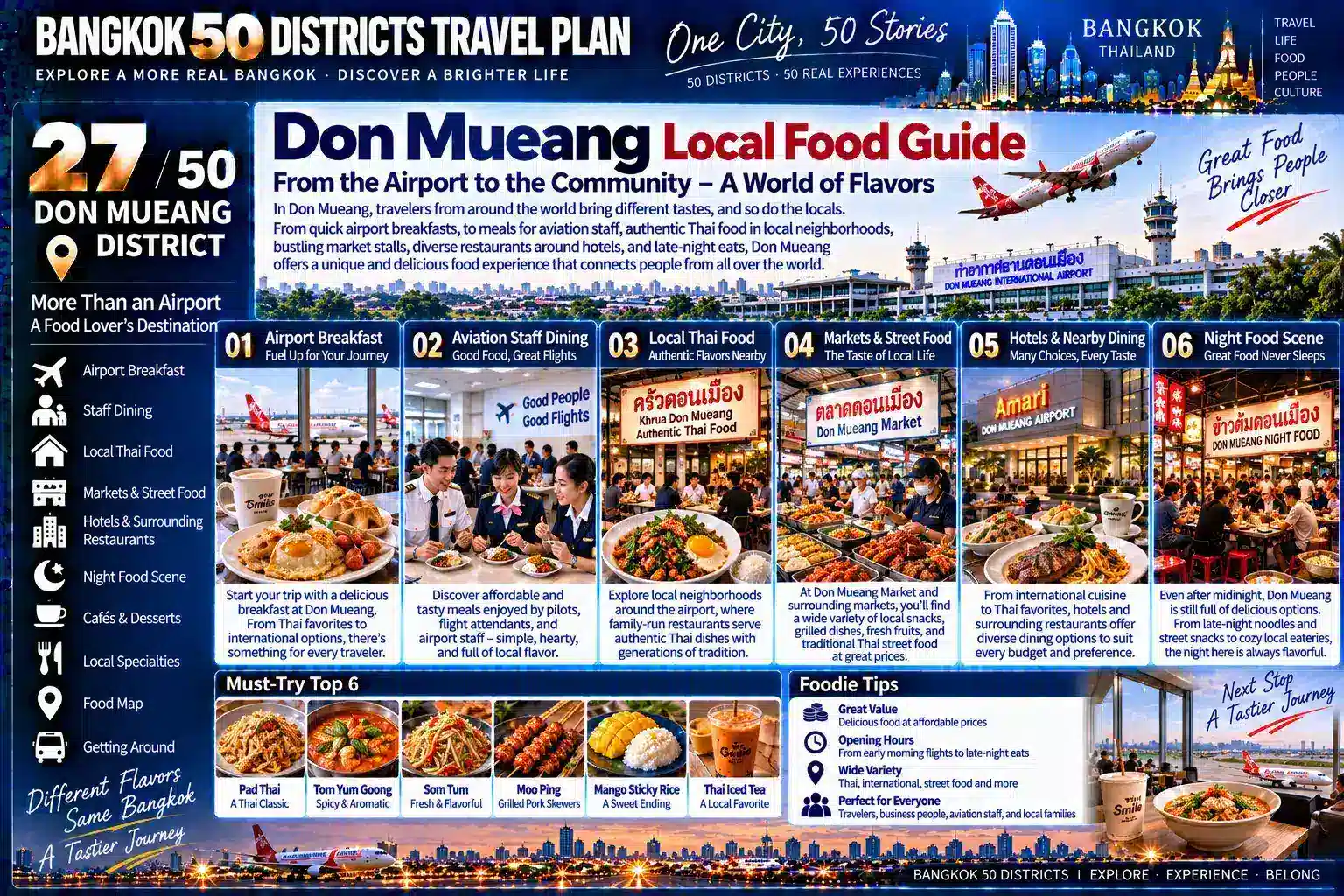
07|What to Eat in Don Mueang? Airport Food and Neighborhood Food Are Two Different Worlds
Food in Don Mueang is also divided into two distinct systems by the airport.
① Airport Breakfast
Designed for early-flight passengers.
Fast.
Convenient.
Time matters more than variety.
② Food for Aviation Workers
Affordable.
Quick.
Suitable for shift workers.
③ Neighborhood Thai Food
The everyday meals of local residents.
Rice dishes.
Noodles.
Chicken rice.
Thai stir-fries.
④ Market Ready-to-Eat Food
Easy to take home.
Affordable.
Plenty of choices.
⑤ Hotel-Area Dining
Serving late-night arrivals and short-stay travelers.
⑥ Local Night Food
Grilled food.
Isan cuisine.
Hot pot.
Small night markets.
This makes Don Mueang’s food map particularly interesting:
ONE SIDE FEEDS PEOPLE WHO ARE ABOUT TO LEAVE; THE OTHER FEEDS PEOPLE WHO LIVE HERE EVERY DAY.
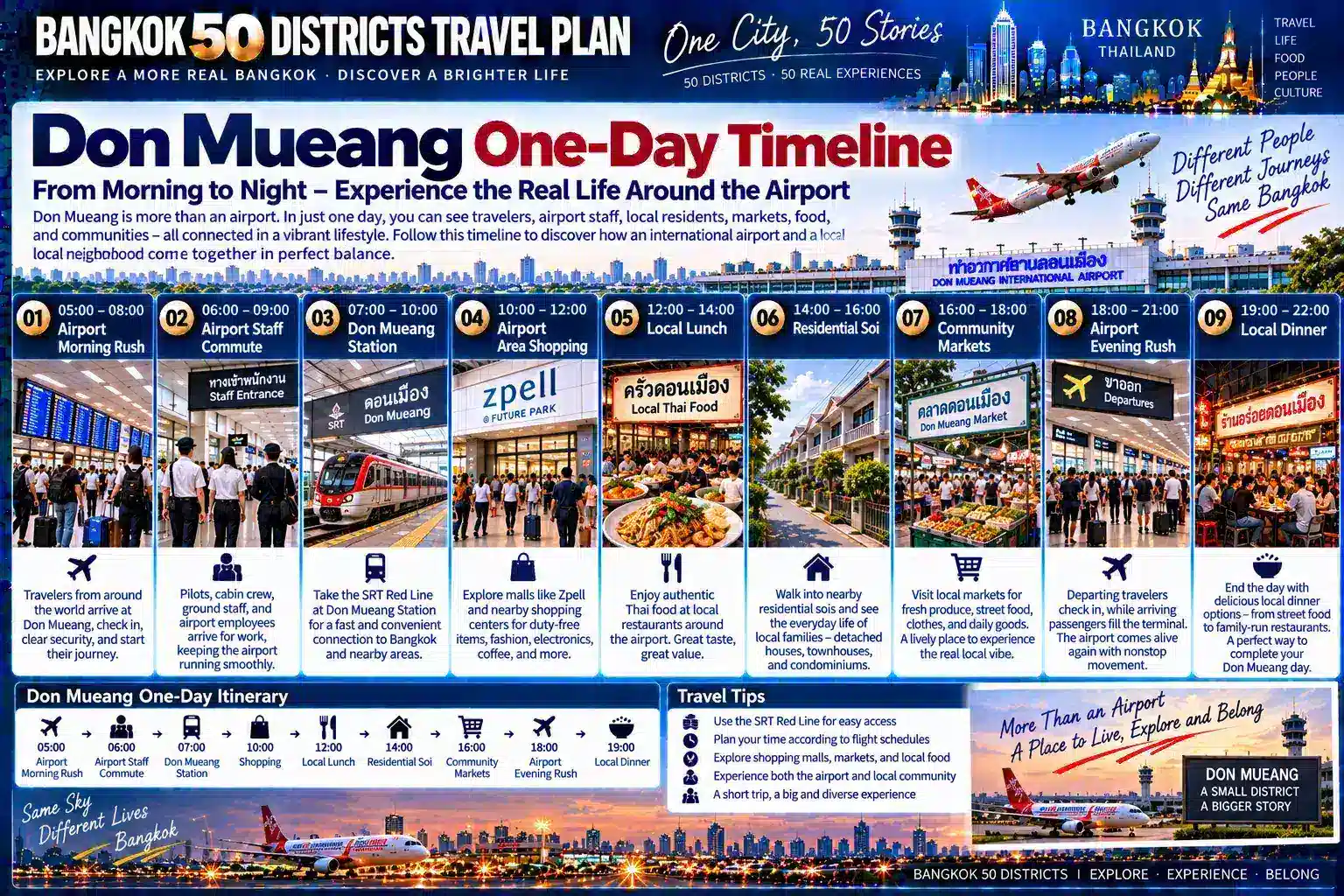
08|How to Spend One Day in Don Mueang
This district is best explored by observing:
HOW AIRPORT LIFE AND COMMUNITY LIFE SWITCH BACK AND FORTH THROUGHOUT THE SAME DAY.
06:30|Airport Morning Rush
Early flights begin to concentrate.
Observe luggage, taxis and passengers.
08:00|Airport-Worker Commute
Travelers are departing.
Another group of people is arriving here to work.
09:30|Don Mueang Station
See how rail transportation connects with the airport.
11:00|Airport-Area Businesses
Hotels.
Convenience stores.
Restaurants.
Transportation services.
12:30|Local Lunch
Leave the terminal area.
Eat somewhere used by local residents.
14:00|Residential Soi
See the real Bangkok communities beside the airport runways.
16:00|Community Market
Residents begin shopping.
Students begin returning from school.
18:00|Airport Evening Rush
Return to the airport area.
Observe another major wave of passenger movement.
19:30|Local Dinner
Finish the day with a neighborhood Thai meal.
09|What Makes Don Mueang Special Is the Coexistence of “Movement” and “Stability”
What does an airport represent?
Departure.
Arrival.
Connections.
Travel.
Migration.
Speed.
It is one of the fastest-moving population environments in any city.
But move only a short distance away from the terminal and you find:
Homes.
Schools.
Markets.
Temples.
Families.
Daily routines repeated again and again.
This is the most important urban relationship to understand in Don Mueang:
MOVEMENT × STABILITY
One person may be arriving in Thailand for the first time today.
Another family may have lived here for decades.
A traveler lands before dawn.
An airport employee finishes a night shift.
A student leaves for school in the morning.
A market vendor prepares dinner in the afternoon.
They may never know one another.
But they all use the same city.
The airport therefore should not be understood simply as:
“transportation infrastructure outside the city.”
In Don Mueang, the airport itself is urban life.
It creates employment.
It creates commerce.
It creates hotels.
It creates transportation.
It creates logistics.
And at the same time, it must continuously coexist with long-established residential communities.
This reveals something important about Bangkok’s urban development:
LARGE INFRASTRUCTURE DOES NOT REPLACE EVERYDAY LIFE — EVENTUALLY, IT MUST LEARN TO COEXIST WITH IT.
Aircraft take off every day.
Passengers constantly change.
But the communities beside the airport will still wake up tomorrow and:
Open breakfast stalls.
Take children to school.
Go to work.
Buy groceries.
Return home.
That is what makes Don Mueang so fascinating.
One side connects Bangkok with the world.
The other simply continues living.
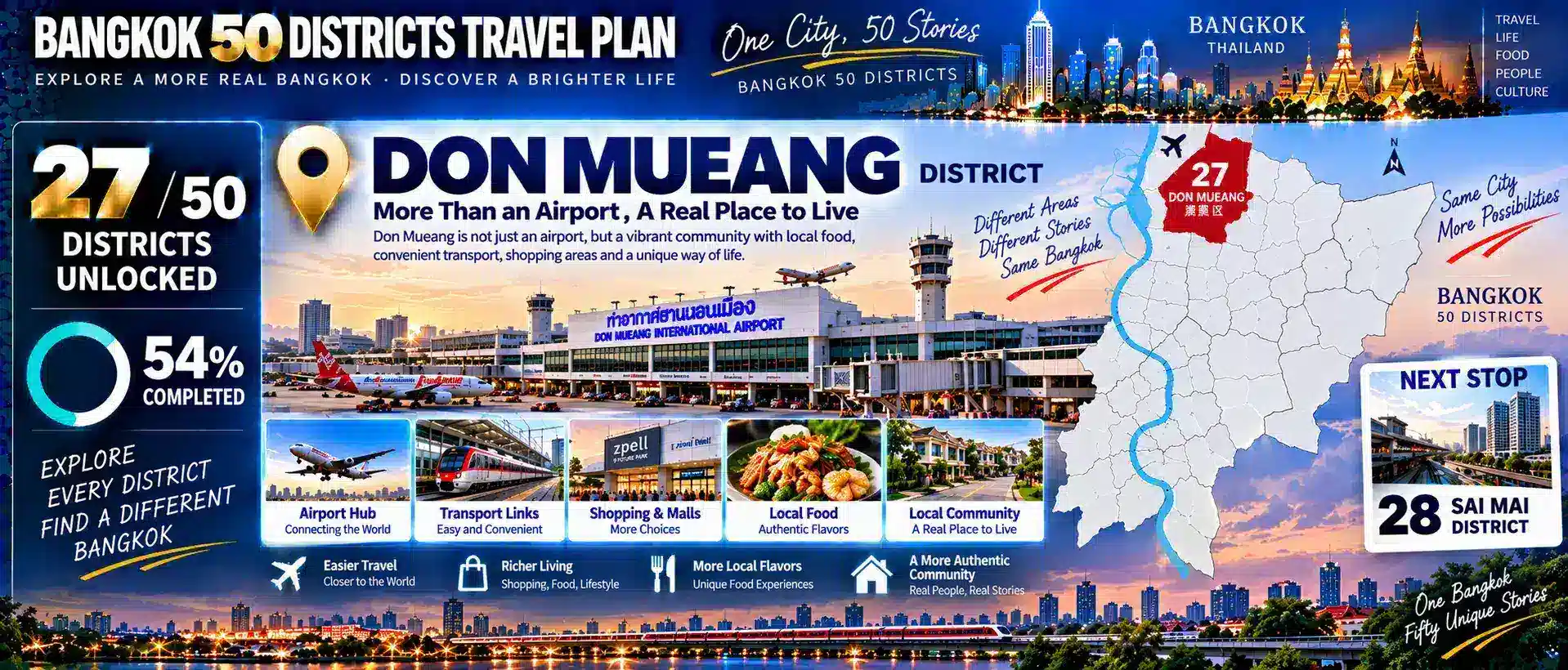
27 / 50 UNLOCKED
DON MUEANG ✓
SERIES PROGRESS|54%
Keywords:
Don Mueang · International Airport · Aviation · SRT Red Line · Airport Workers · Hotels · Logistics · Residential Communities · Local Markets · Airport Economy · Northern Bangkok
23 districts remaining.