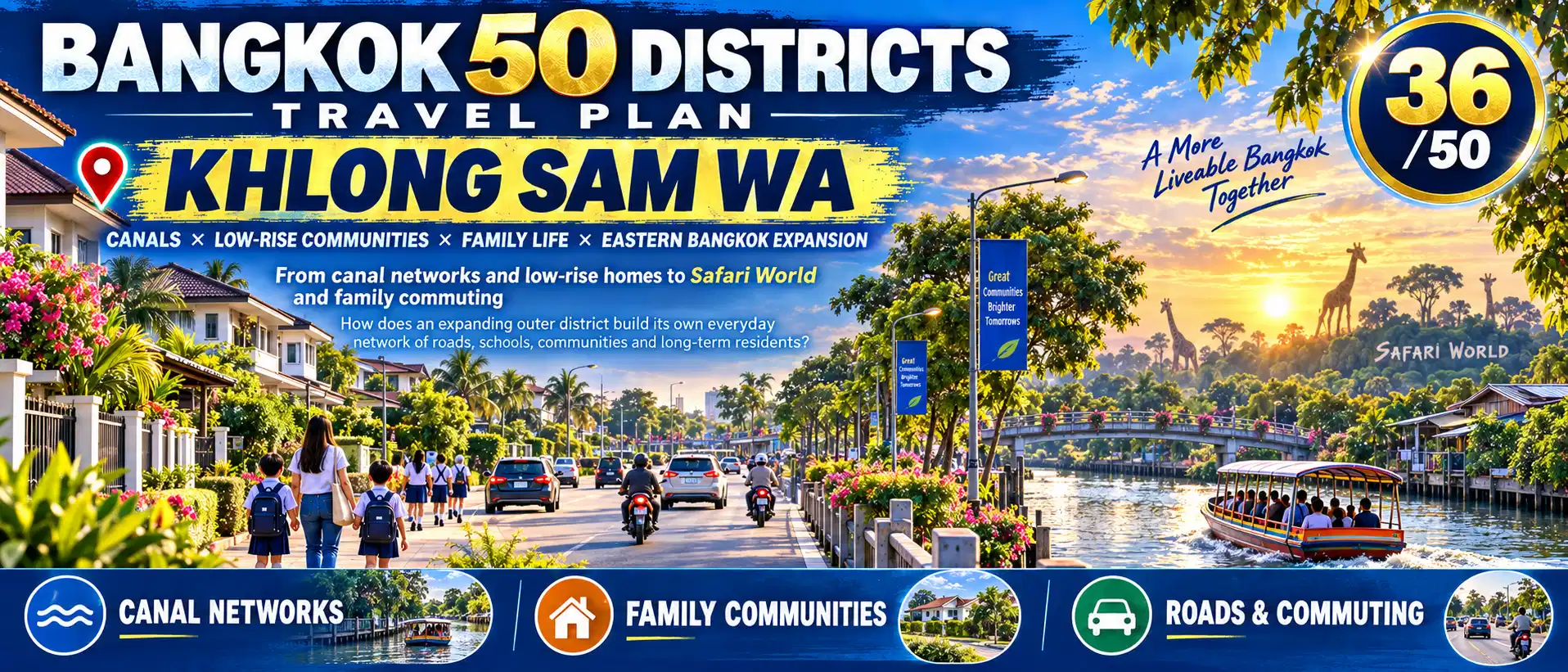
Leaving behind Min Buri’s old markets, canal life and transport hub, we now move further north into a larger, more dispersed part of eastern Bangkok—one shaped by everyday residential life.
There are no dense CBD skylines here.
No single commercial district that can explain the whole area.
No one landmark that defines the neighborhood.
Instead, Khlong Sam Wa offers another, equally real version of Bangkok:
Canals.
Low-rise homes.
Family communities.
Schools.
Markets.
Main roads.
Motorbikes.
Private cars.
Weekend family destinations.
And a growing residential population spreading farther east and northeast.
Welcome to Stop 36:
KHLONG SAM WA
If Min Buri asked:
“How can an old town remain a local living center between markets, roads and new rail transit?”
Then Khlong Sam Wa asks:
“As Bangkok continues to expand outward, how do canals, low-rise family communities and commuting roads make room for new residents?”
01|Where Is Khlong Sam Wa?
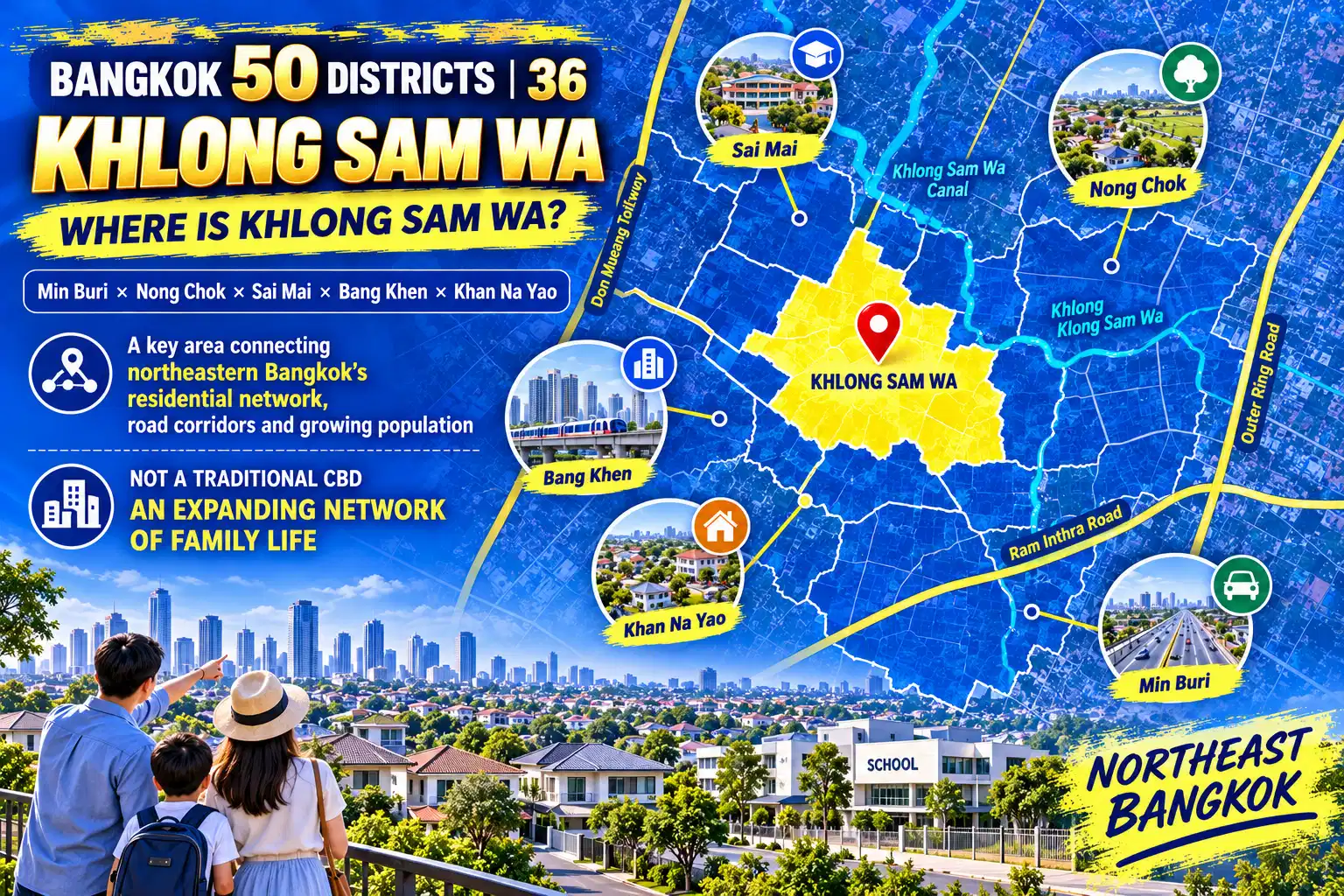
Khlong Sam Wa is located in northeastern Bangkok.
It connects with Min Buri, Nong Chok, Sai Mai, Bang Khen, Khan Na Yao and the wider residential network of eastern Bangkok.
From the perspective of Bangkok’s traditional CBD, it may seem far away.
But from the perspective of long-term residents, family life and urban expansion, it is far from unimportant.
For more and more people, Bangkok does not happen in Siam, Silom or Sukhumvit every day.
It happens between:
Home.
School.
The market.
A local clinic.
A convenience store.
The main road.
A shopping mall.
A weekend destination.
And the route to work.
Khlong Sam Wa does not have one concentrated urban core.
It is better understood as a broad and expanding network of daily life.
Housing estates grow along major roads.
Small businesses appear where population grows.
Schools, markets, clinics and restaurants are distributed across different neighborhoods.
Canals remain part of the landscape beneath this expanding city.
Its importance is not simply about distance from the center.
It is about its role in accommodating Bangkok’s continuing residential growth toward the east and northeast.
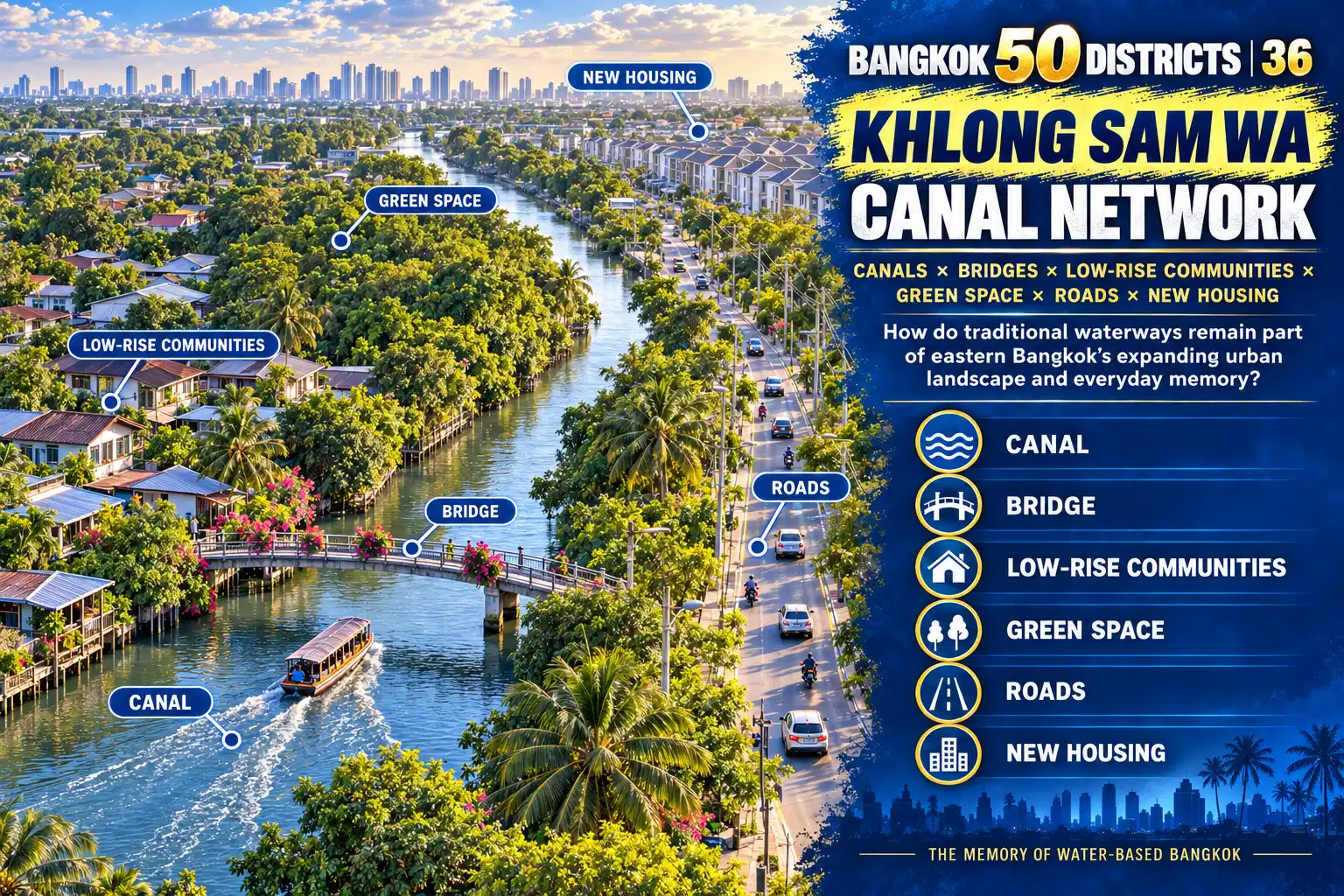
02|Canal Networks: Why Does This Area Still Carry the Memory of Water-Based Bangkok?
The word “Khlong” means canal in Thai.
In Khlong Sam Wa, canals are not simply scenic waterways turned into tourist attractions.
They are part of the district’s deeper urban structure.
Before elevated rail lines, expressways and high-rise towers defined modern Bangkok, waterways helped organize:
Agriculture.
Settlements.
Transport.
Markets.
Temples.
And connections between communities.
Over time, more roads were built.
Housing estates expanded.
Cars became the dominant form of mobility.
But the canals did not disappear.
They still pass through communities.
They still connect water, green space, low-rise homes and traces of older ways of life.
They remind us that Bangkok was not created from a blank slate as a modern metropolis.
It developed through layers:
Rivers.
Canals.
Farmland.
Roads.
New housing.
And continuously expanding communities.
In Khlong Sam Wa, these layers remain especially visible.
On one side are new residential developments moving farther outward.
On the other are waterways, open land, trees and a lower-density rhythm of life.
The city has not completely erased the earlier landscape.
It has continued to grow on top of it.
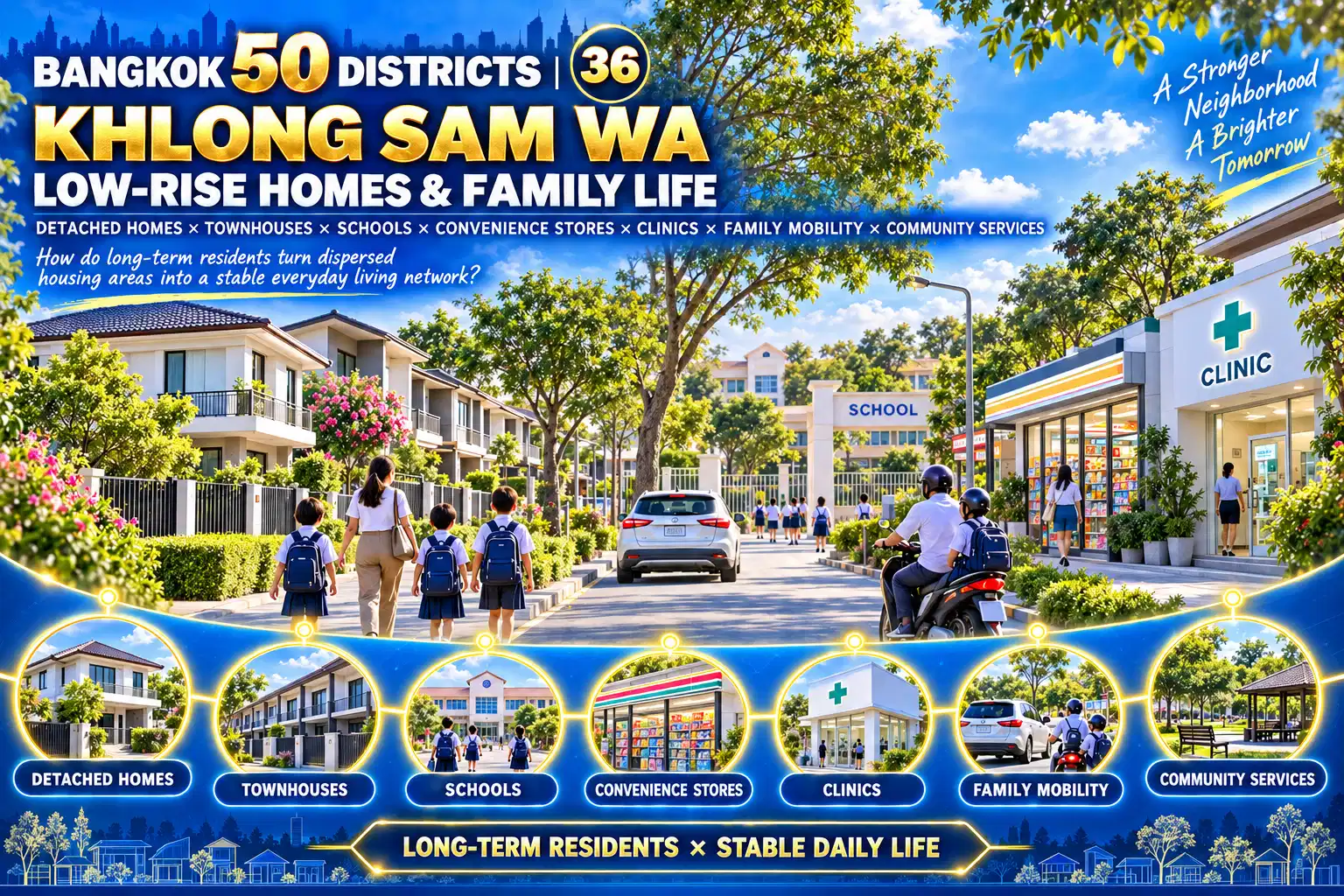
03|Low-Rise Housing and Family Life: Why Is the City So Spread Out Here?
Unlike condo life in central Bangkok, Khlong Sam Wa is more often defined by:
Detached houses.
Townhouses.
Low-rise apartments.
Village-style housing estates.
Gated communities.
Family-run shops.
And everyday businesses along main roads.
The rhythm of life here is usually organized around families rather than tourists.
Morning means:
Taking children to school.
Buying breakfast.
Riding a motorbike to the main road.
Driving into traffic.
Starting the workday.
During the day, people move between:
Work.
Markets.
Local services.
School pickups.
And household errands.
By evening, life returns to:
Family dinners.
Convenience stores.
Street food.
Neighborhood activity.
And small businesses staying open for residents.
Low density does not mean the absence of city life.
It means that daily services are not concentrated around one giant mall or one rail station.
They are distributed across multiple communities.
Each residential area needs its own:
Restaurants.
Laundry shops.
Pharmacies.
Coffee shops.
Convenience stores.
Tutoring centers.
Clinics.
Schools.
As long-term residents increase, these services continue to grow.
That is one of Khlong Sam Wa’s most important urban strengths.
It does not depend on one spectacular landmark.
It is sustained by the everyday needs of many ordinary families.
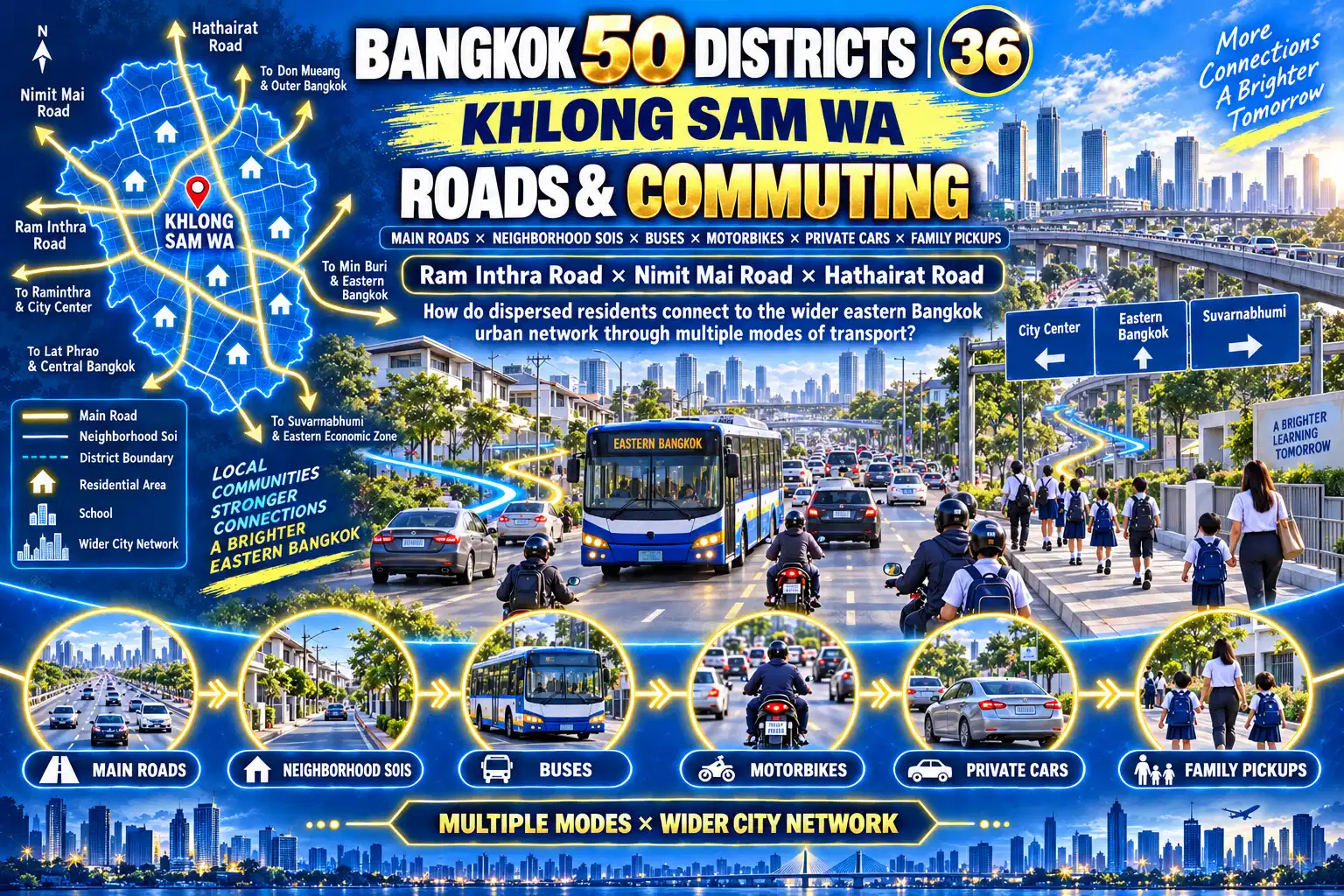
04|Roads and Commuting: How Does Daily Mobility Work in Eastern Bangkok?
In a district with a large area and dispersed housing, roads are essential.
Ram Inthra Road, Nimit Mai Road, Hathairat Road and countless neighborhood sois help carry daily population movement.
During the morning rush, people leave different housing communities at the same time.
Some drive.
Some ride motorbikes.
Some take buses.
Some use taxis.
Some first reach a main road, then connect to the wider city.
This is the real commuting pattern of many family districts in eastern Bangkok:
Not one transport mode.
But several modes connected together.
From home to the main road, a motorbike may be the fastest option.
From the main road to a school, market or workplace, people may use a bus, car or taxi.
For longer trips, rail lines and larger transport hubs become part of the journey.
To understand Khlong Sam Wa, it is not enough to look at a single main road on a map.
You also need to notice the smaller streets that connect residential areas with the wider network.
They shape:
How children get to school.
How older residents reach the market.
How workers commute.
And how families access malls, hospitals and weekend destinations.
Roads are not simply infrastructure.
They are one of the district’s most visible daily urban spaces.
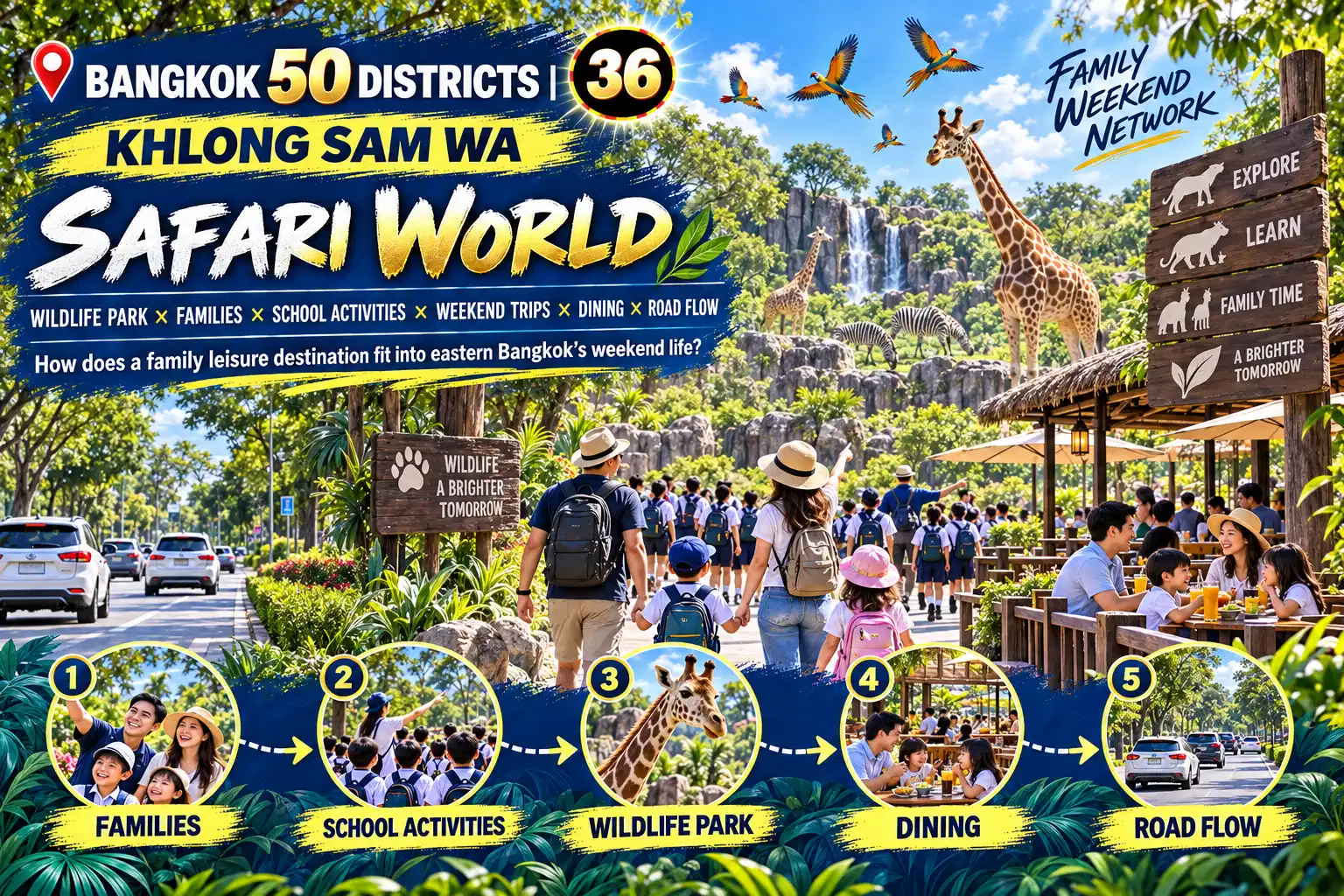
05|Safari World: How Can a Family Destination Shape Weekend City Life?
One of the places most recognized by visitors outside the district is:
SAFARI WORLD
For first-time visitors, it may feel like a theme park or a family day-trip destination.
But from an urban perspective, its role is larger than entertainment alone.
It represents a very typical kind of weekend life in eastern Bangkok.
Families do not always need to travel into the traditional city center.
They do not always need to spend the weekend in the busiest commercial districts.
They can drive here.
Bring children to see animals.
Join school activities.
Meet relatives.
Spend a day together.
Then eat nearby, shop or return home.
Large family destinations like this redistribute leisure activity across the city.
They reduce the idea that all weekend crowds must flow toward Siam.
They also give a road-oriented residential district its own recreational attraction.
Most importantly, Safari World does not replace local life.
It becomes part of it.
On weekdays, the surrounding area still runs on schools, families, markets, roads and neighborhood businesses.
At weekends, visitor flows increase.
Together, these create two different rhythms of Khlong Sam Wa:
Everyday residential life.
And family-oriented weekend activity.
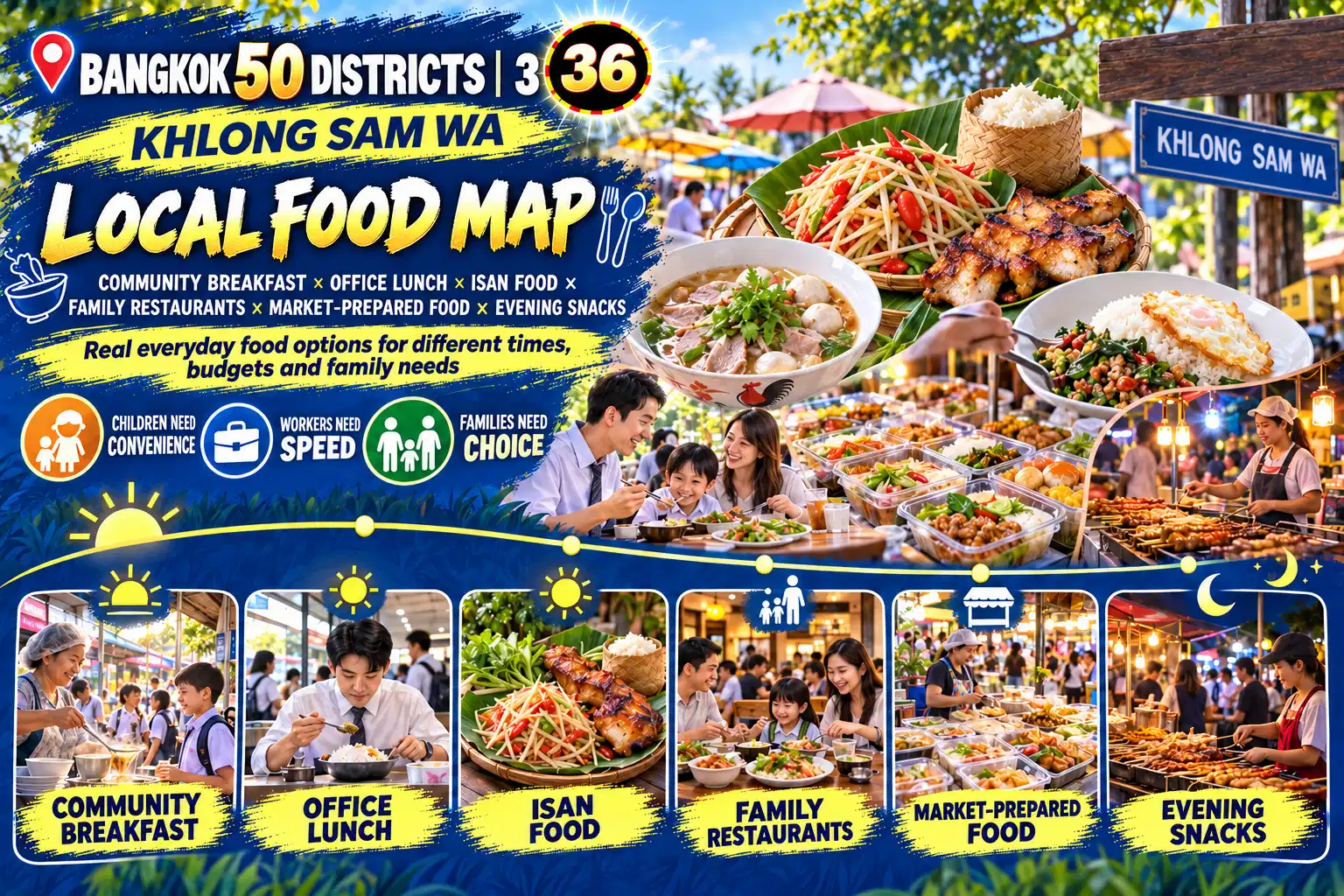
06|What to Eat in Khlong Sam Wa?
Food in Khlong Sam Wa is not necessarily concentrated in one famous night market.
It is a practical daily system distributed wherever residents live.
① Community Breakfast
Rice porridge.
Chicken rice.
Grilled pork skewers.
Thai noodles.
Soy milk.
Coffee.
② Office-Worker Lunch
Rice dishes.
Freshly cooked Thai meals.
Noodles.
Quick local lunches.
Small casual restaurants.
③ Isan Food and Street Restaurants
Grilled chicken.
Som tam.
Grilled meat.
Sticky rice.
Spicy northeastern Thai dishes.
④ Family Restaurants
Good for sharing.
Reasonable prices.
Easy parking.
Large portions.
⑤ Market-Prepared Food
Easy to take home.
Quick solutions for dinner.
Ideal for busy households.
⑥ Evening Snacks
Grilled food.
Fried snacks.
Desserts.
Drinks.
Street stalls.
The most important thing here is not a single viral restaurant.
It is the fact that different families, different budgets and different schedules can all find food nearby.
Children need something easy after school.
Workers need something reliable after work.
Families need convenient options for dinner or weekend meals.
Food becomes one of the most direct ways to understand how a community lives.
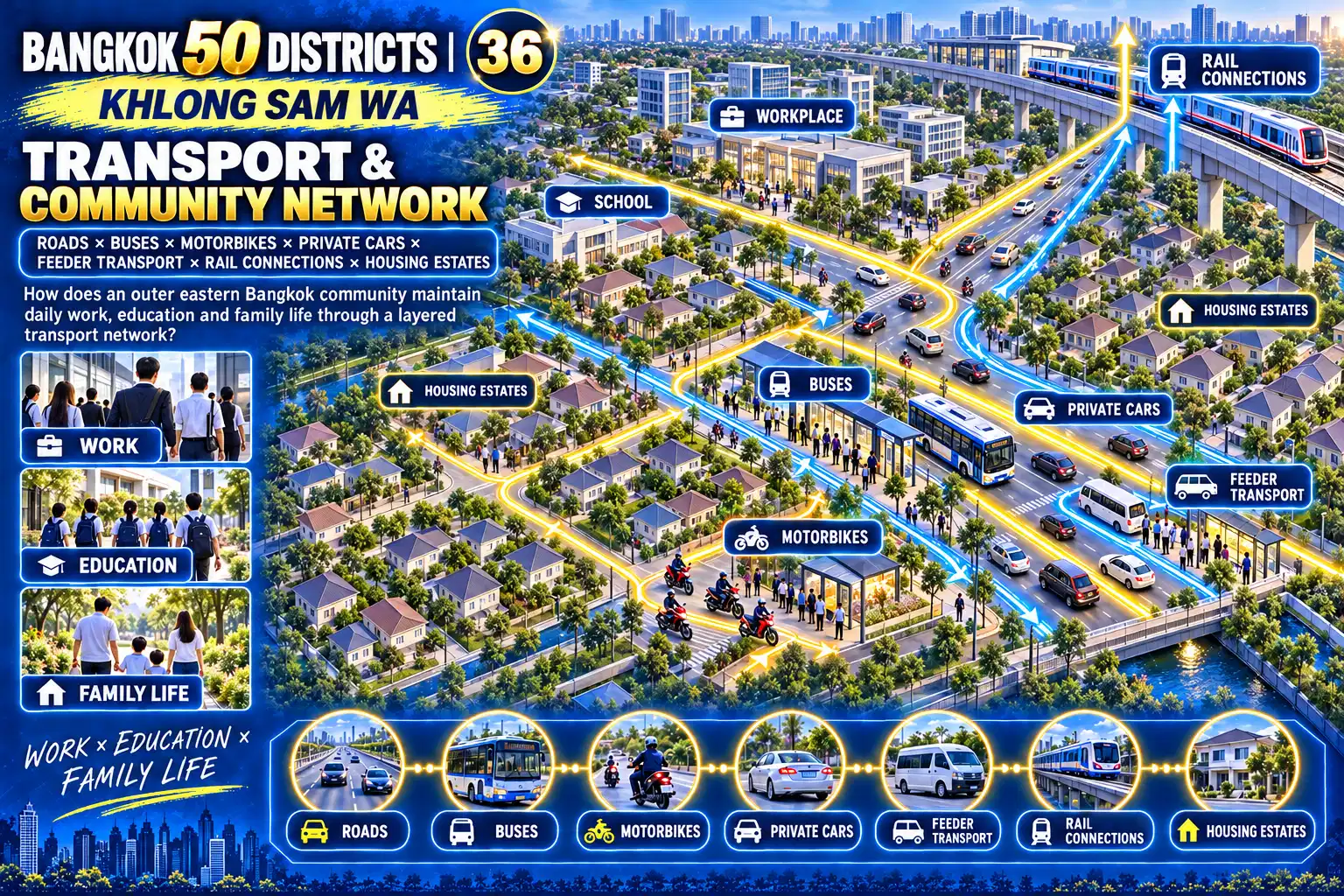
07|When Rail Does Not Reach Every Part of Daily Life: How Does the Transport Network Fill the Gap?
In central Bangkok, it is easy to think of rail transit as the foundation of urban life.
In Khlong Sam Wa, reality is more layered.
Residents still depend heavily on:
Roads.
Private cars.
Buses.
Motorbikes.
Taxis.
Local connections.
And feeder transport.
Rail transit is part of the larger city network—but not always the first step from home.
For many people, commuting does not begin with walking straight to a station.
It begins with:
Leaving the housing estate.
Reaching a main road.
Taking a bus, motorbike or taxi.
Then connecting to rail, a shopping area or a workplace.
This shows that urban convenience is not determined only by whether a station exists nearby.
It also depends on:
Road connections.
Usable bus routes.
Accessible local services.
And whether schools, markets and healthcare can be reached close to home.
For Khlong Sam Wa, transport matters because it links dispersed pieces of daily life together.
It allows residents on Bangkok’s outer edge to continue using the wider city.
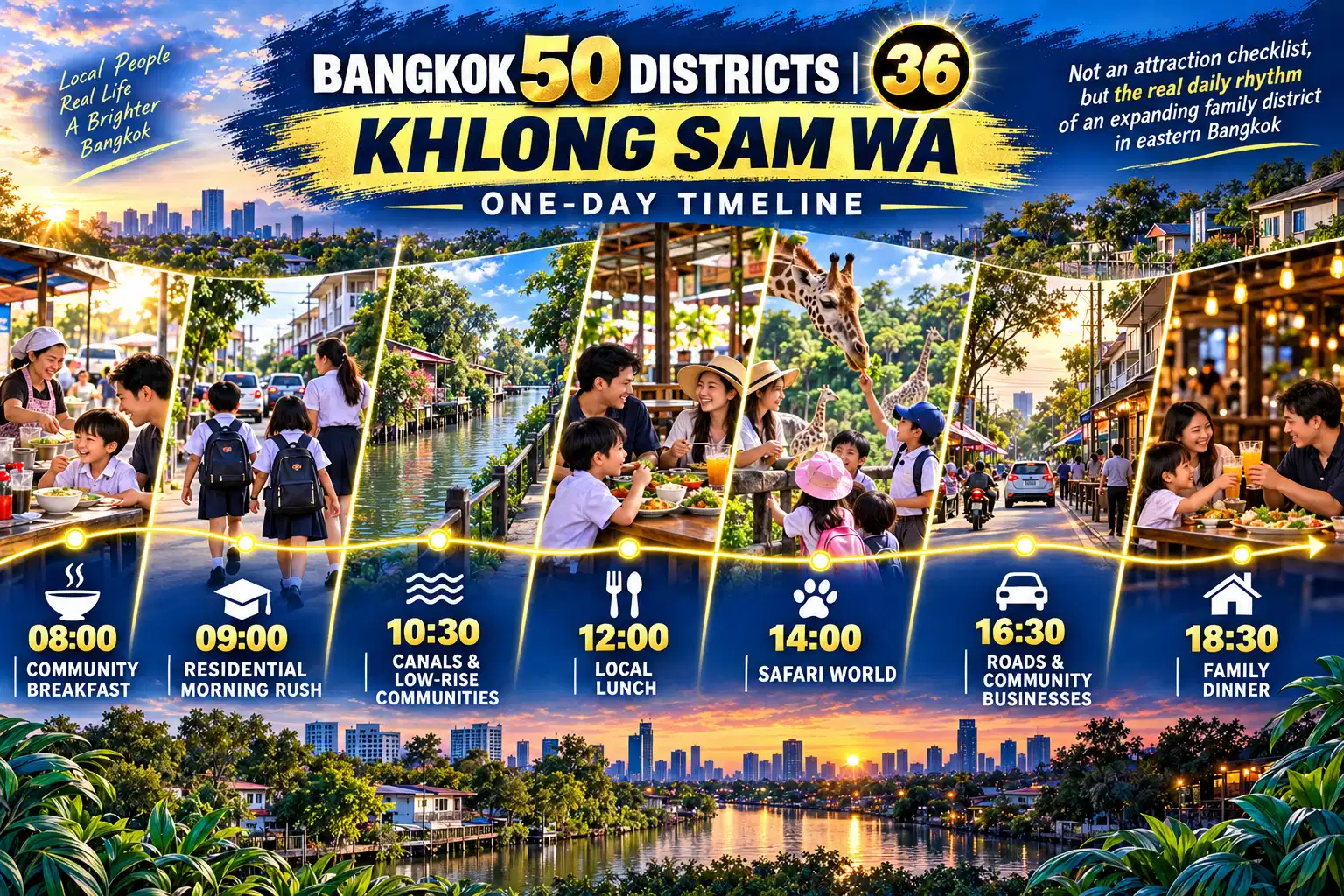
08|How to Spend One Day in Khlong Sam Wa?
This district is not best understood through a checklist of famous attractions.
It is better explored as a route through eastern Bangkok’s everyday family life.
08:00|Community Breakfast
Start at a small breakfast shop, roadside stall or local market near a residential area.
09:00|Roads and Morning Rush
Watch school runs, commuting, buses, motorbikes and private cars moving through the district together.
10:30|Canals and Low-Rise Communities
Observe how waterways, bridges, trees and new housing estates coexist.
12:00|Local Lunch
Choose a community restaurant and experience the stable lunchtime rhythm of a family district.
14:00|Safari World or a Nearby Family Destination
See how weekend entertainment becomes part of eastern Bangkok life.
16:30|Main Roads and Community Businesses
Notice the convenience stores, local shops and everyday services that grow around residential population.
18:30|Community Dinner
End the day with market-prepared food, Isan dishes or a casual family restaurant.
This is not an attraction checklist.
It is a real route through the daily rhythm of an expanding family district in eastern Bangkok.
09|Why Does Khlong Sam Wa Matter for Understanding Bangkok’s Future?
When people imagine Bangkok, they often think first of:
Skyscrapers.
Rail transit.
Mega malls.
CBD districts.
International hotels.
Tourist areas.
But Khlong Sam Wa reveals another urban reality—one that is growing at a much larger scale.
As the city’s population continues to expand, new living spaces will not appear only in high-rise central districts.
They will also appear farther out:
Along roads.
Around housing estates.
Near schools.
Around markets.
Through family services.
And across neighborhood businesses.
Here, the city is not growing upward through tower after tower.
It is growing outward through interconnected networks of daily life.
Canals preserve the older landscape.
Roads enable new movement.
Housing accommodates long-term residents.
Schools and markets stabilize communities.
Weekend destinations create family activity.
And the wider transport network keeps the district connected to Bangkok as a whole.
Khlong Sam Wa is not an undeveloped edge of the city.
It is an urban lifestyle model still taking shape.
It shows that city centers do not come in only one form.
Some centers are defined by skyscrapers and rail stations.
Some are defined by malls and office towers.
Others are made from homes, schools, markets, roads, canals and family life.
By District 36, we are no longer simply looking at administrative boundaries.
We are watching Bangkok expand its radius of daily life.
From one central core outward.
Then into multiple urban networks—with different densities, rhythms and functions.
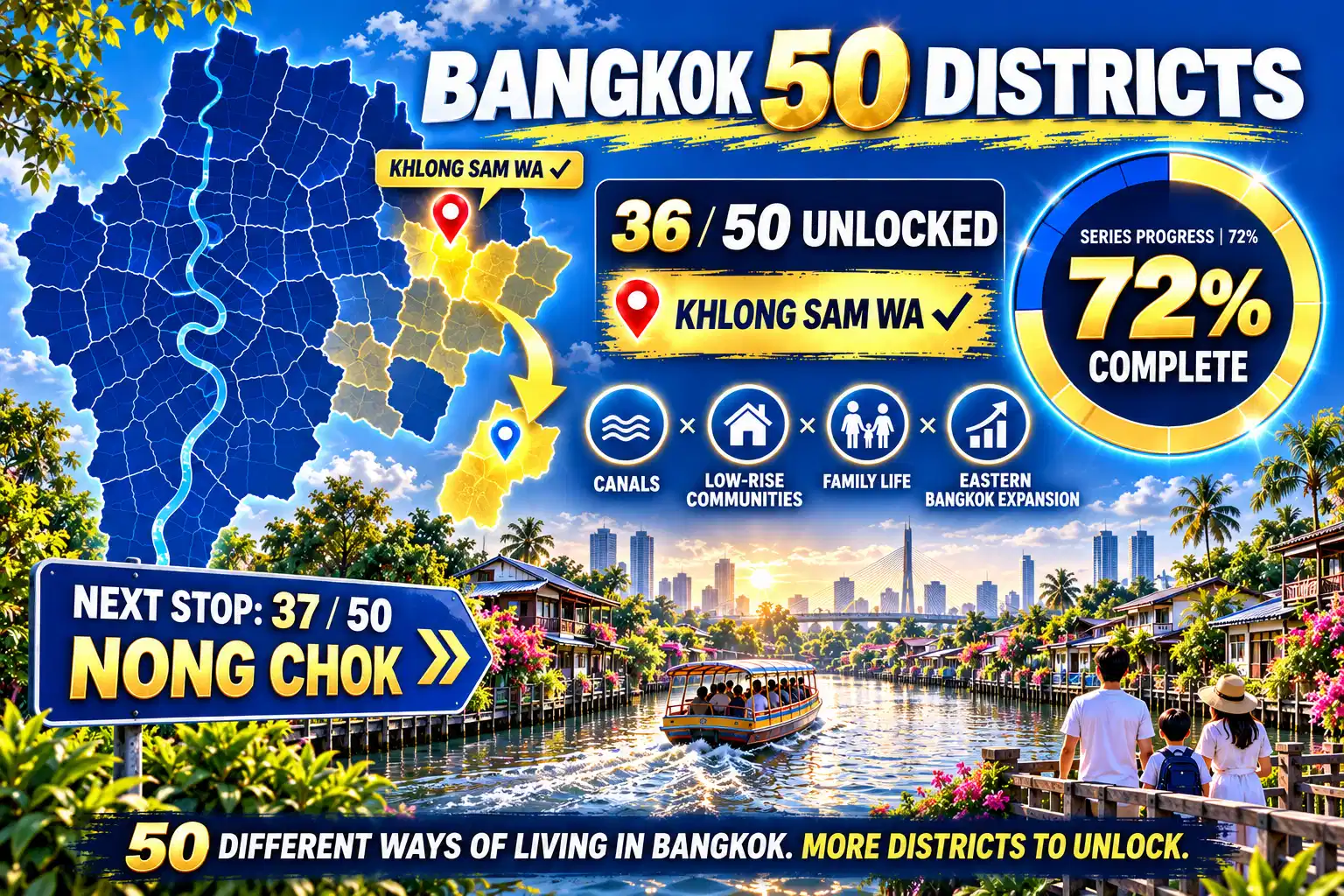
36 / 50 UNLOCKED
KHLONG SAM WA ✓
SERIES PROGRESS|72%
Keywords:
Khlong Sam Wa · Canals · Low-Rise Communities · Family Life · Safari World · Roads · Local Markets · Local Food · Eastern Bangkok · Urban Expansion
There are 14 districts remaining in the Bangkok 50 Districts Travel Plan.
Next Stop|**37 / 50**
NONG CHOK