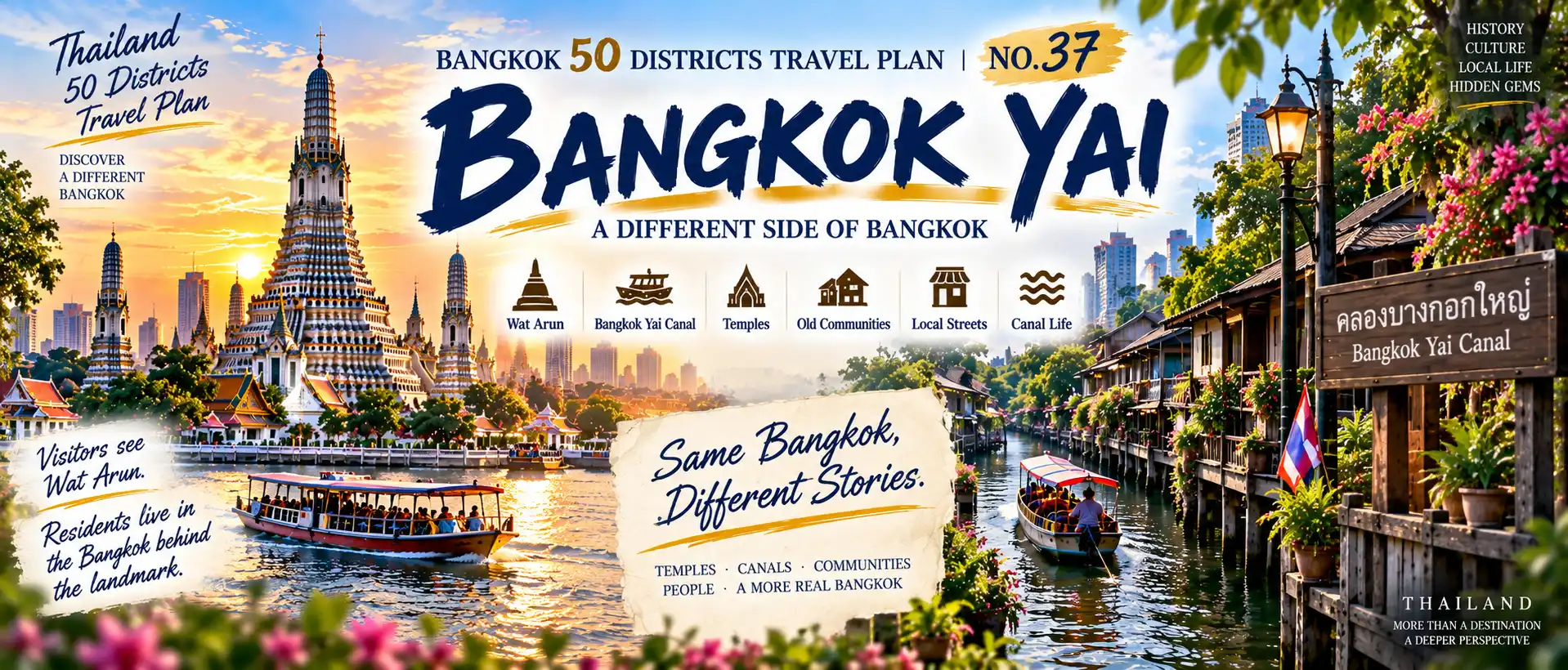
For many visitors,
the name Bangkok Yai may not sound immediately familiar.
But almost everyone recognizes one of its most famous symbols:
Wat Arun
Standing on the western bank of the Chao Phraya River,
Wat Arun has become one of Bangkok’s most iconic landmarks.
Boats pass by.
Cameras point toward its towering prang.
Sunset reflects across the river.
But if you continue beyond the temple,
into the streets and canals behind it,
another Bangkok begins to appear.
Canals.
Old homes.
Temples.
Schools.
Markets.
Small shops.
Local residents.
This is the Bangkok that exists behind the landmark.
01|Entering Bangkok Yai from Central Bangkok
Start in central Bangkok
and head toward the Chao Phraya River.
Cross the river
and enter the western bank.
Wat Arun.
Bangkok Yai.
Bangkok Yai Canal.
Old communities.
Within a short distance,
the journey changes from one of Bangkok’s most famous landmarks
to a much quieter world of neighborhood life.
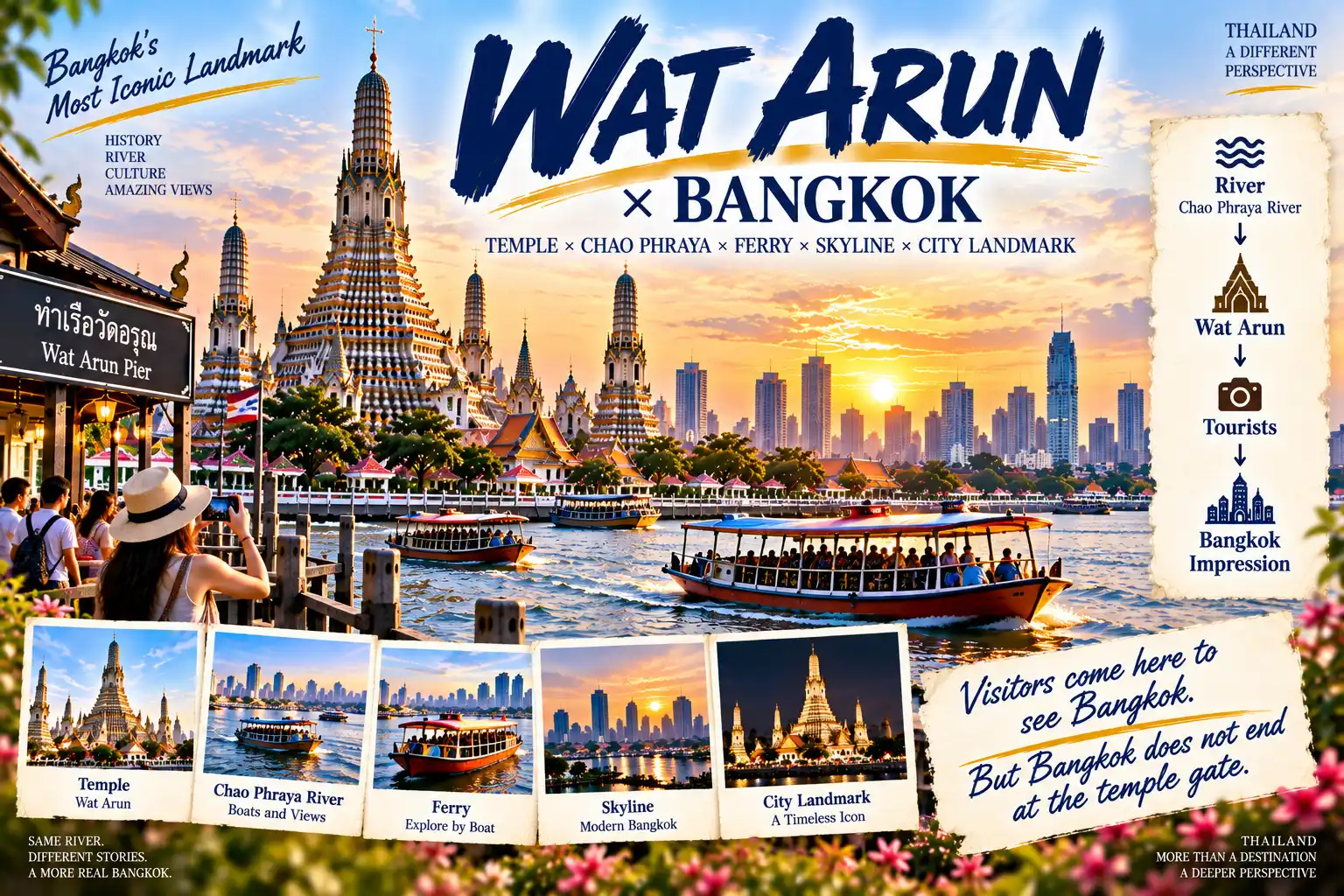
BANGKOK CENTER
↓
CHAO PHRAYA RIVER
↓
WAT ARUN
↓
BANGKOK YAI
↓
CANAL COMMUNITY
CITY CENTER × RIVER × LANDMARK × CANAL × COMMUNITY
**From one of Bangkok’s most familiar landmarks,
step into a west-bank world few visitors see.**
02|Wat Arun: The Bangkok Yai Everyone Knows
Wat Arun is one of Bangkok’s most recognizable landmarks.
Its towering central prang.
The Chao Phraya River.
Ferries.
Temple rooftops.
Sunset.
Together,
these scenes shape the way many people first imagine Bangkok.
But Wat Arun is not an isolated attraction.
It is part of a much larger urban community.
Beyond the temple,
the everyday Bangkok Yai continues.
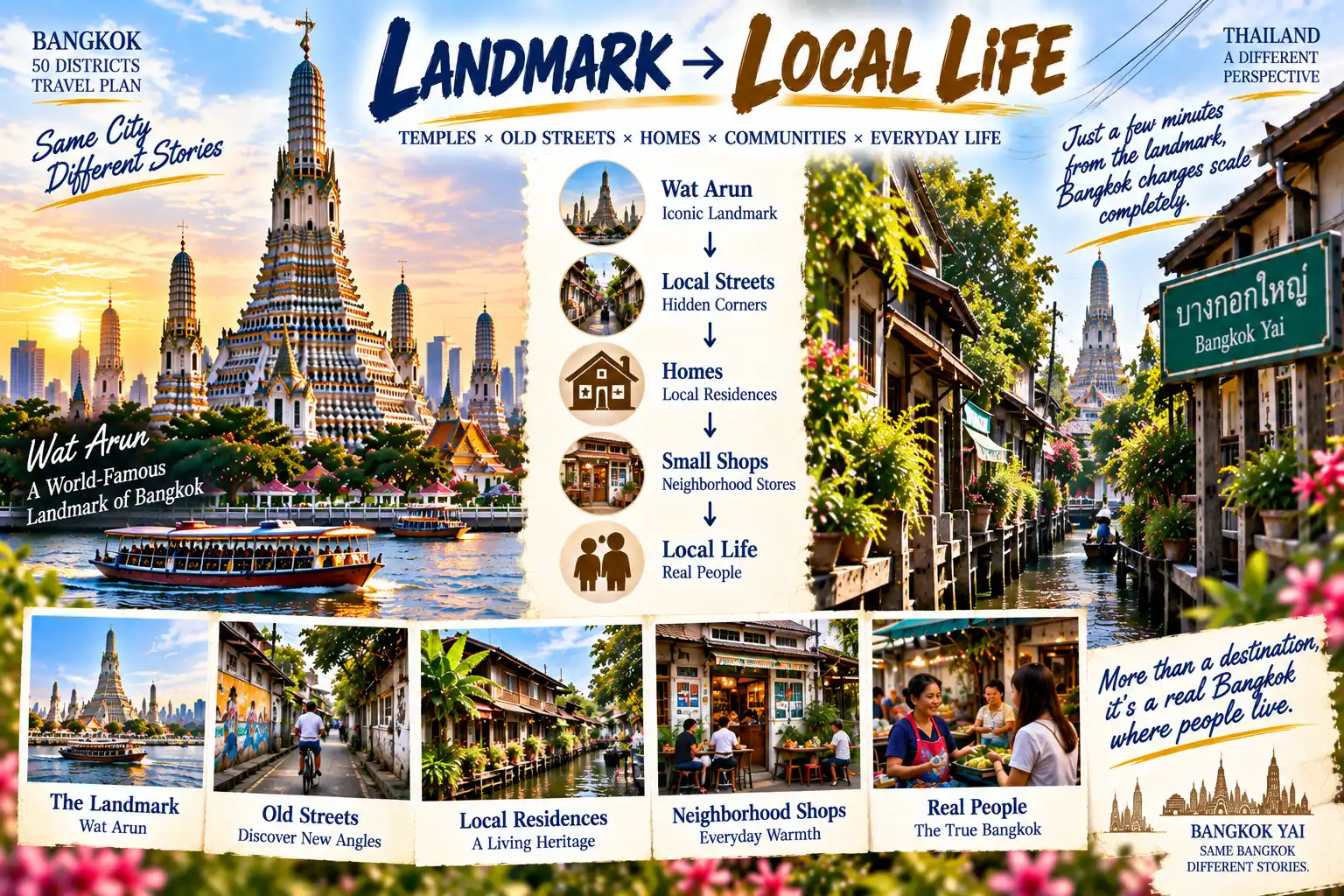
WAT ARUN × BANGKOK
TEMPLE × CHAO PHRAYA × FERRY × SKYLINE × CITY LANDMARK
**Visitors come here to see Bangkok.
But Bangkok does not end at the temple gate.**
03|From Landmark to Local Life
Leave the main tourist route,
and the scale of Bangkok Yai quickly changes.
Tourists.
↓
Residents.
Main roads.
↓
Small lanes.
City landmark.
↓
Community life.
Wat Arun may still rise above the neighborhood in the distance,
but the streets around you become filled with:
Homes.
Small shops.
Schools.
Motorbikes.
Street food.
This is where Bangkok Yai truly begins to unfold.
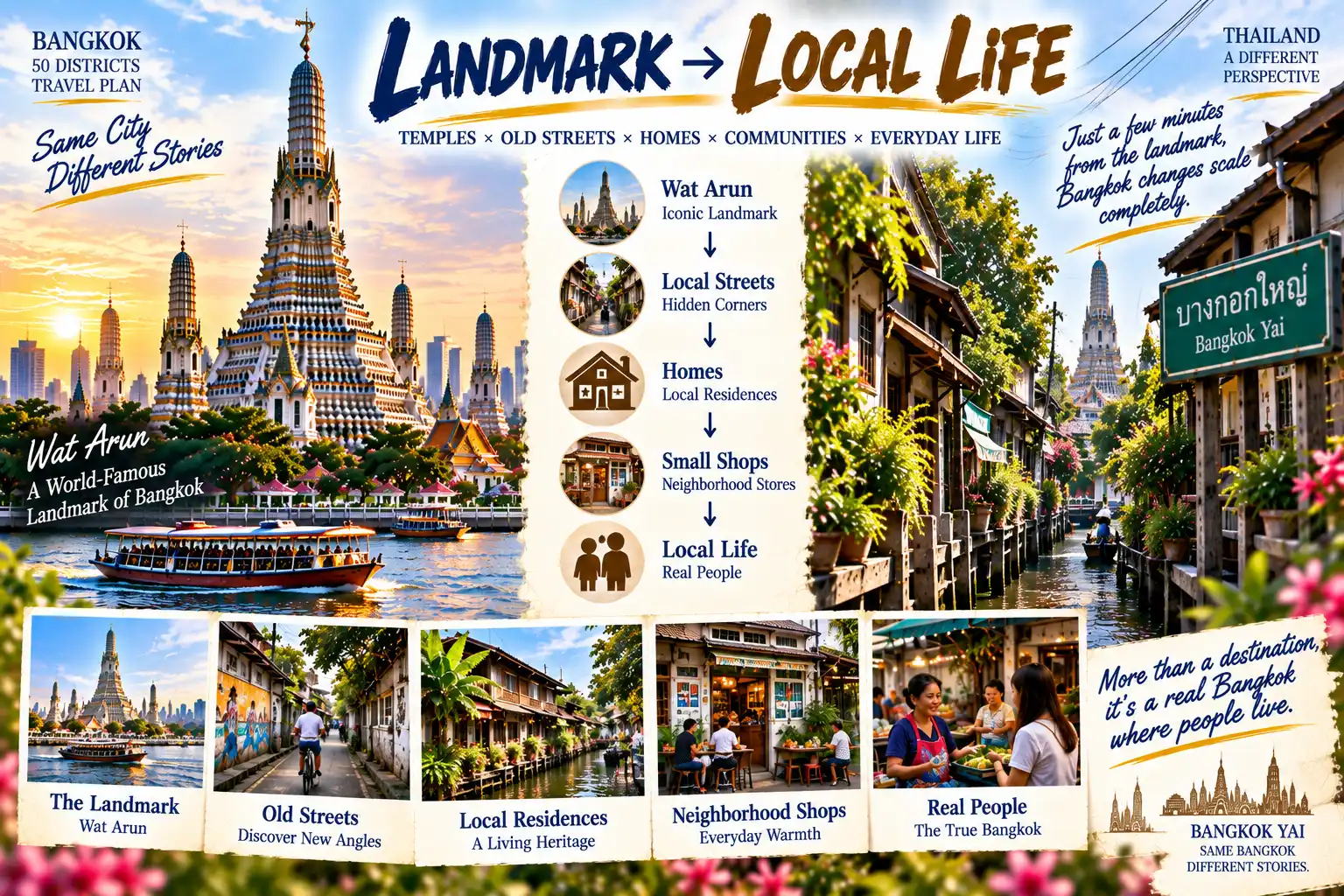
LANDMARK → LOCAL LIFE
WAT ARUN
↓
LOCAL STREETS
↓
HOMES
↓
SMALL SHOPS
↓
DAILY LIFE
**Just minutes from the landmark,
Bangkok changes scale completely.**
04|Bangkok Yai Canal
To understand this district,
you cannot ignore Bangkok Yai Canal.
Before roads became Bangkok’s main transportation network,
rivers and canals played essential roles in the city.
Transport.
Trade.
Markets.
Homes.
Temples.
Communities.
Much of urban life developed along waterways.
Today,
the canals no longer perform all the functions they once did.
But the structure of the city still carries traces of Bangkok’s water-based past.
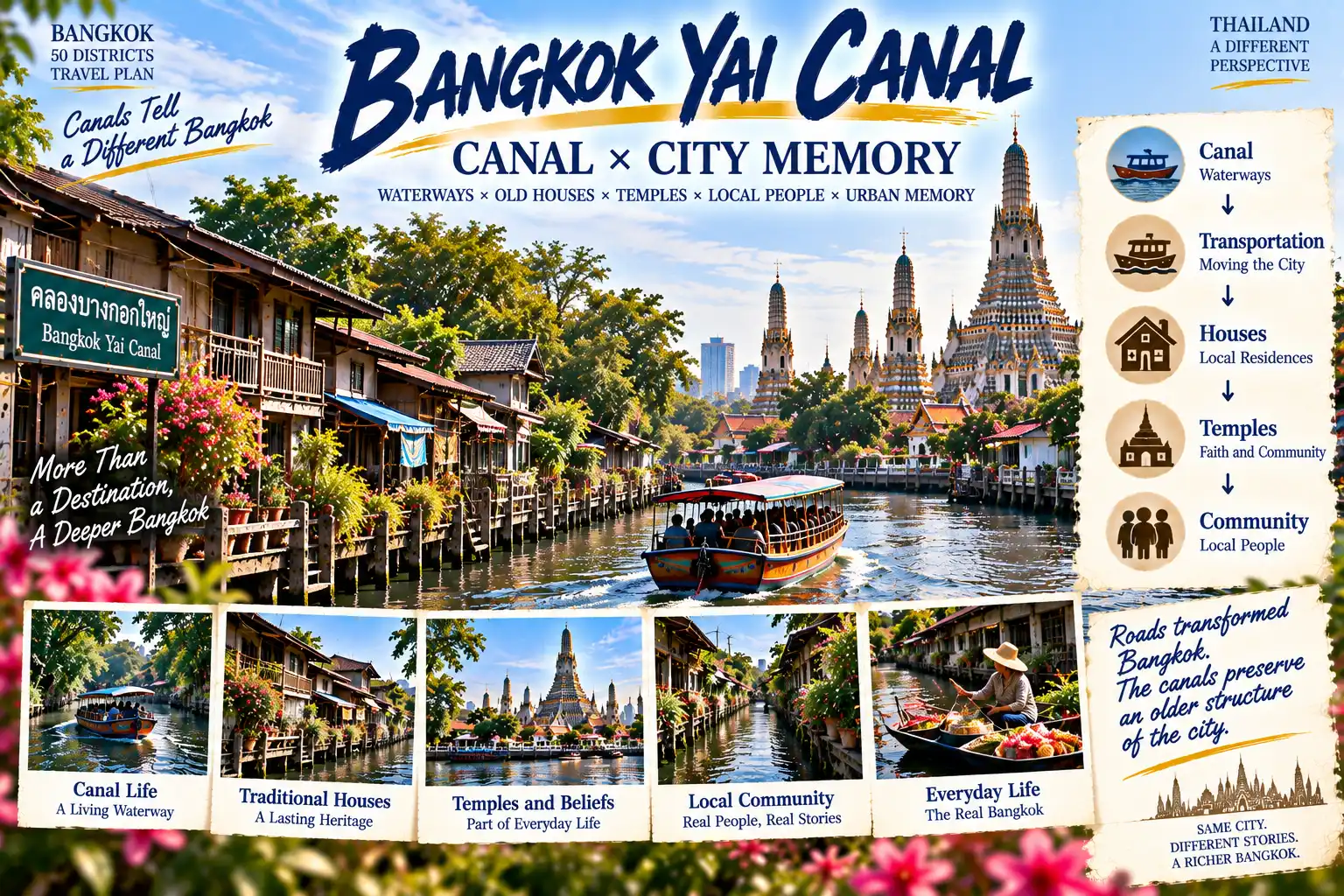
CANAL × CITY MEMORY
CANAL
↓
TRANSPORT
↓
HOMES
↓
TEMPLES
↓
COMMUNITY
**Roads transformed Bangkok.
The canals preserve an older structure of the city.**
05|Why Did Temples Become Community Centers?
In Bangkok Yai,
temples are not isolated tourist attractions.
Traditionally,
they have been closely connected with community life.
Faith.
Education.
Festivals.
Residents.
Piers.
Markets.
These different functions often existed within the same neighborhood network.
So to truly understand Bangkok Yai,
do not look only at temple architecture.
Look at how people live around the temples.
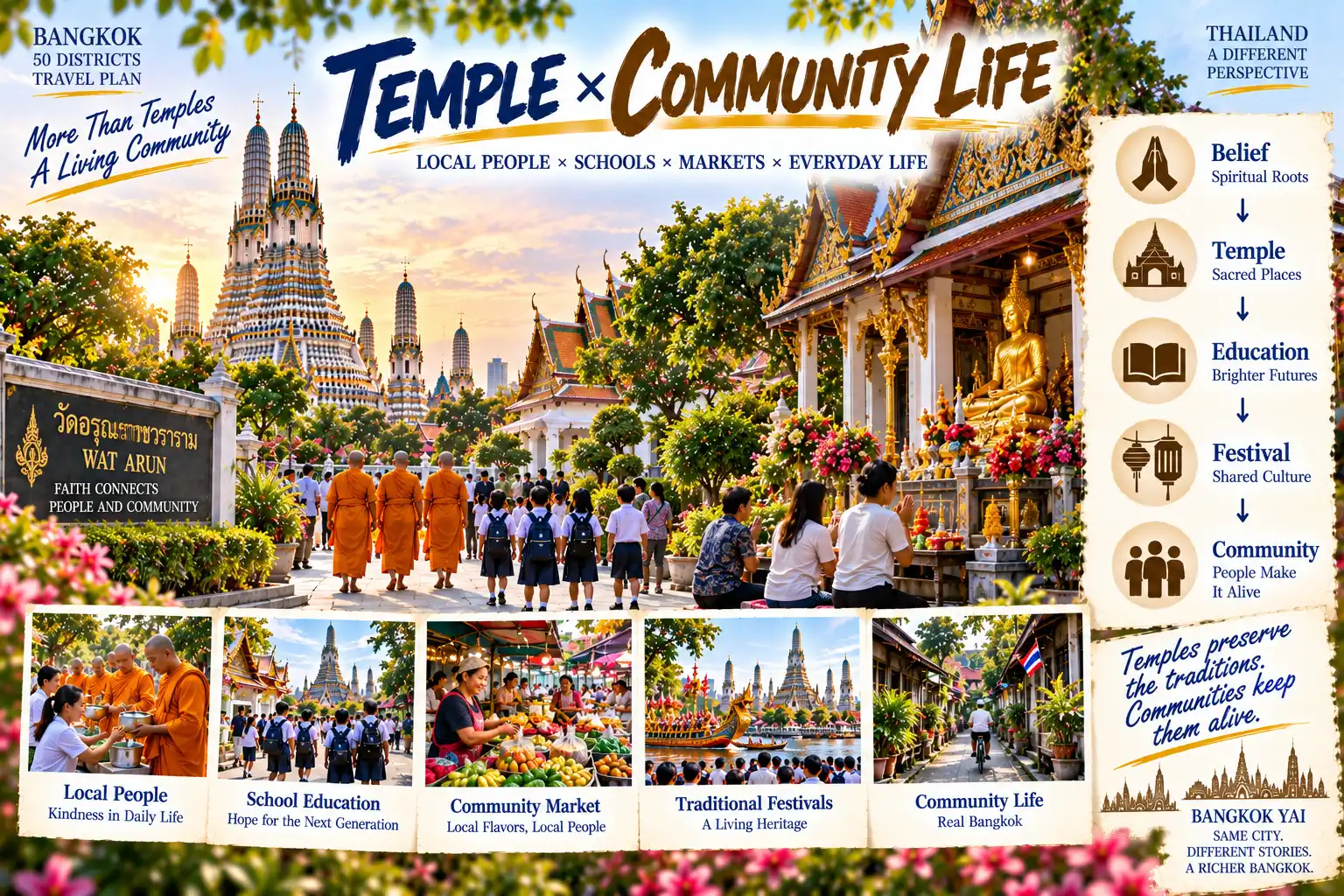
TEMPLE × COMMUNITY LIFE
FAITH
↓
TEMPLE
↓
EDUCATION
↓
FESTIVALS
↓
COMMUNITY
RESIDENTS × SCHOOLS × MARKETS × DAILY LIFE
**Temples preserve tradition.
Communities keep tradition alive.**
06|Everyday Life in Bangkok Yai
By midday,
the everyday Bangkok Yai begins to appear clearly in the streets.
Local markets become busy.
Street restaurants prepare lunch.
Students pass small shops after school.
Residents buy groceries.
Motorbikes move through narrow lanes.
Visitors may stay for only a few hours.
But for local residents,
this is simply where everyday life happens.
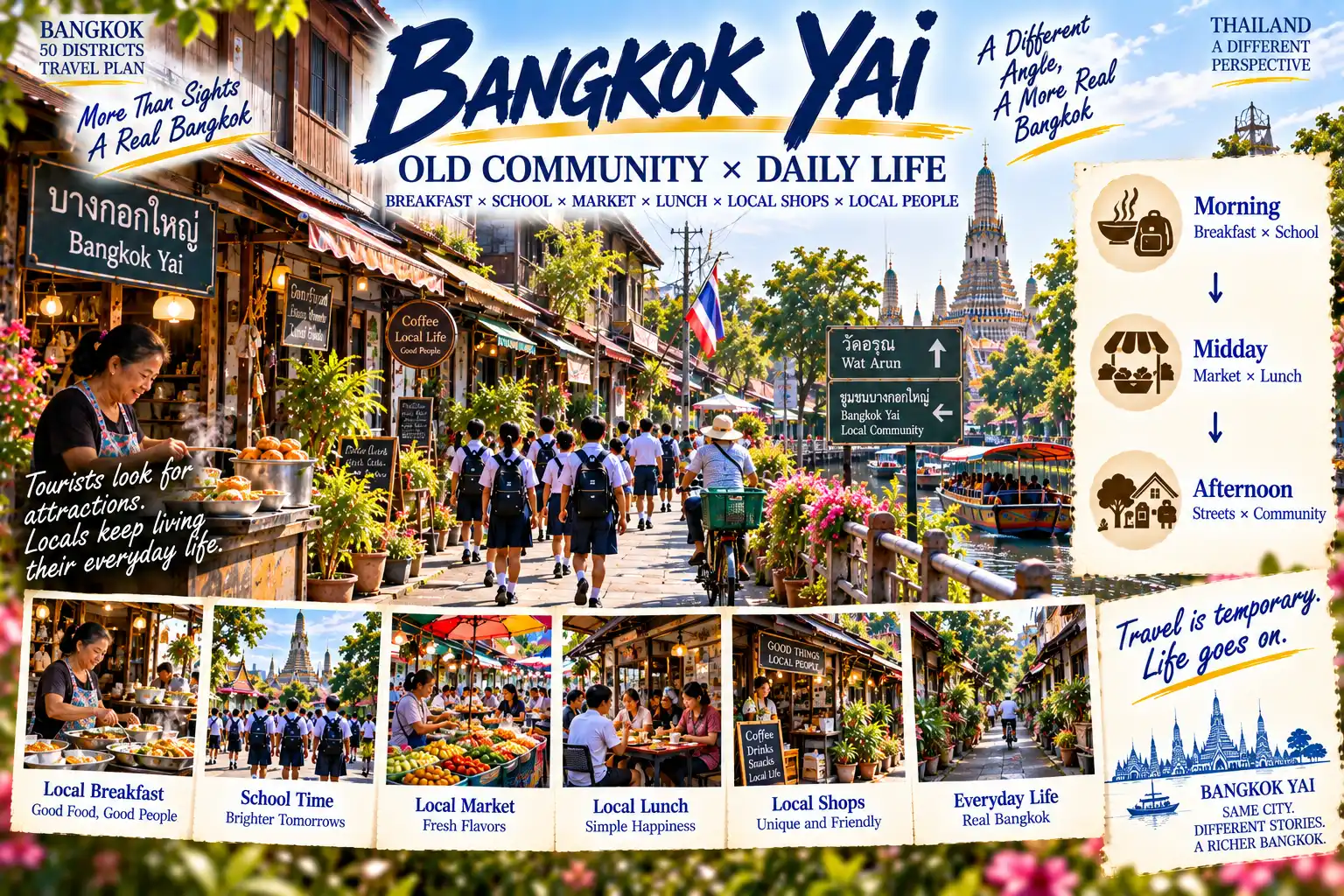
OLD COMMUNITY × DAILY LIFE
BREAKFAST × SCHOOL × MARKET × LUNCH × SMALL SHOPS × RESIDENTS
MORNING|BREAKFAST × SCHOOL
↓
NOON|MARKET × LUNCH
↓
AFTERNOON|LOCAL STREETS × COMMUNITY
**Visitors look for attractions.
Residents continue their everyday lives.**
07|Tourist Bangkok VS Local Bangkok
Bangkok Yai is a perfect place to observe two different views of the same city:
The Bangkok visitors see,
and the Bangkok residents live in.
On one side:
Wat Arun.
The Chao Phraya River.
Ferries.
Iconic photographs.
On the other:
Canals.
Homes.
Markets.
Schools.
Community streets.
They are not competing versions of Bangkok.
They are both part of the same city.
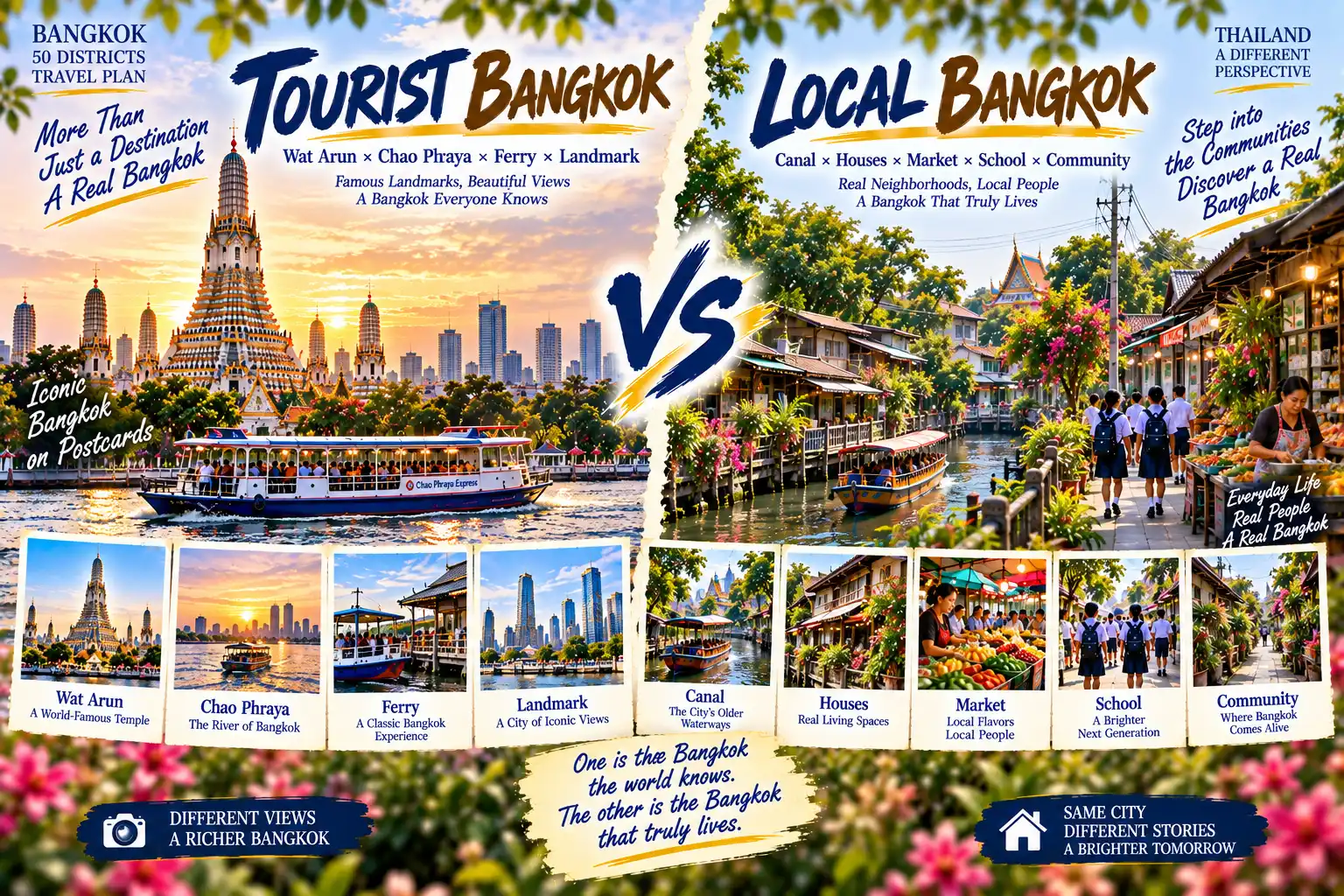
TOURIST × LOCAL
TOURIST
WAT ARUN × CHAO PHRAYA × FERRY × LANDMARK
VS
LOCAL
CANALS × HOMES × MARKETS × SCHOOLS × COMMUNITY
**One side is the Bangkok the world recognizes.
The other is where Bangkok actually lives.**
08|A One-Day Bangkok Yai Travel Plan
For a first visit,
think of the day as:
“From a world-famous landmark into a real west-bank community.”
09:00|Depart Central Bangkok
Head toward the Chao Phraya River.
09:30|Cross the Chao Phraya
Travel from the east bank to the west bank.
10:00|Wat Arun
Begin with one of Bangkok’s most iconic landmarks.
11:30|Temple Area × Old Streets
Move away from the main tourist route.
12:30|Local Lunch
Eat inside the neighborhood.
14:00|Bangkok Yai Canal
Discover the urban structure left behind by Bangkok’s waterways.
15:30|Market × Old Community
Experience everyday neighborhood life.
17:00|Canals × Local Streets
Slowly make your way back toward the river.
18:00|Chao Phraya × Sunset
Watch the sunset from Bangkok’s western bank.
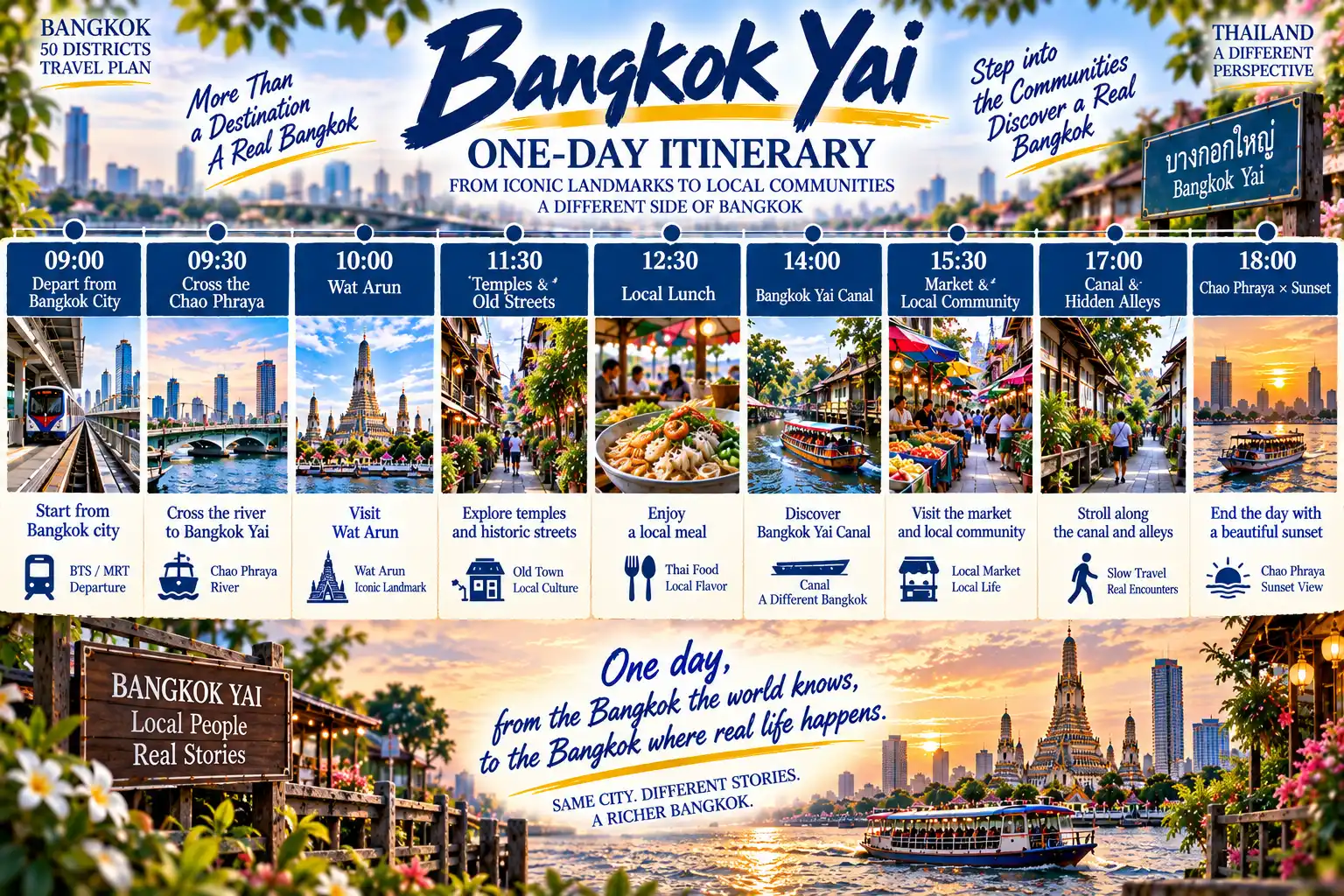
09:00|DEPART CENTRAL BANGKOK
09:30|CROSS THE CHAO PHRAYA
10:00|WAT ARUN
11:30|TEMPLE AREA × OLD STREETS
12:30|LOCAL LUNCH
14:00|BANGKOK YAI CANAL
15:30|MARKET × OLD COMMUNITY
17:00|CANALS × LOCAL STREETS
18:00|CHAO PHRAYA × SUNSET
**One day,
from the Bangkok the world recognizes to the Bangkok where people actually live.**
09|Why Is Bangkok Yai Worth This Stop?
Because Bangkok Yai reminds us of something important:
A city cannot be understood through landmarks alone.
Wat Arun matters.
It represents history.
Architecture.
Religion.
And one of Bangkok’s most recognizable city images.
But continue beyond the landmark,
and you discover that:
The canals remain.
Old communities remain.
Markets remain.
Schools remain.
Residents still move through these streets every day.
The real Bangkok Yai is not simply about asking:
“What else is there beyond Wat Arun?”
Instead,
it shows us that:
**Landmarks and everyday life have always been part of the same Bangkok.**
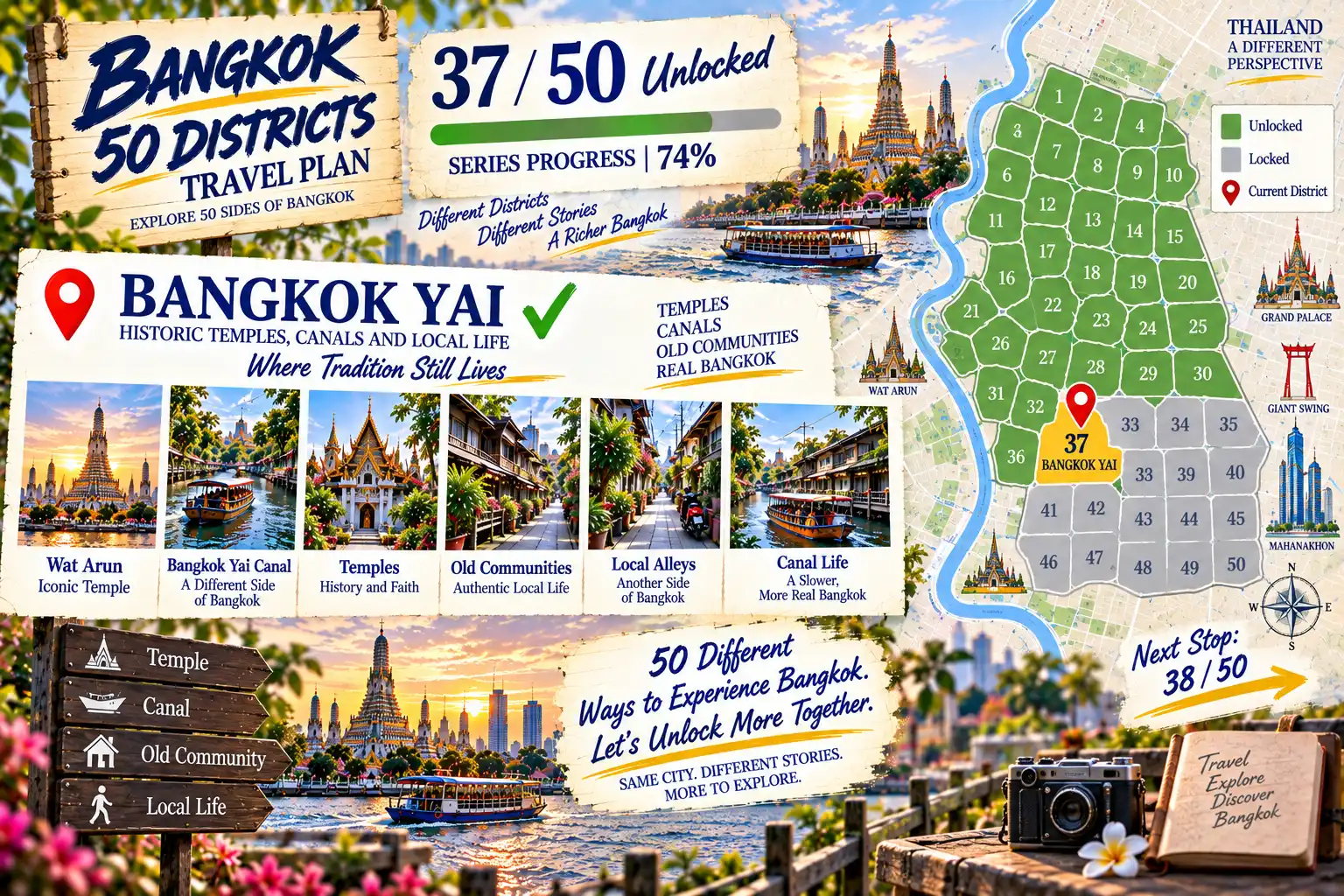
BANGKOK 50 DISTRICTS TRAVEL PROJECT
**37 / 50 UNLOCKED**
BANGKOK YAI ✓
SERIES PROGRESS|74%
WAT ARUN × BANGKOK YAI CANAL × TEMPLES × OLD COMMUNITIES × LOCAL STREETS × CANAL LIFE
NEXT STOP: 38 / 50
**50 districts.
50 different ways of life.
Keep exploring Bangkok.**