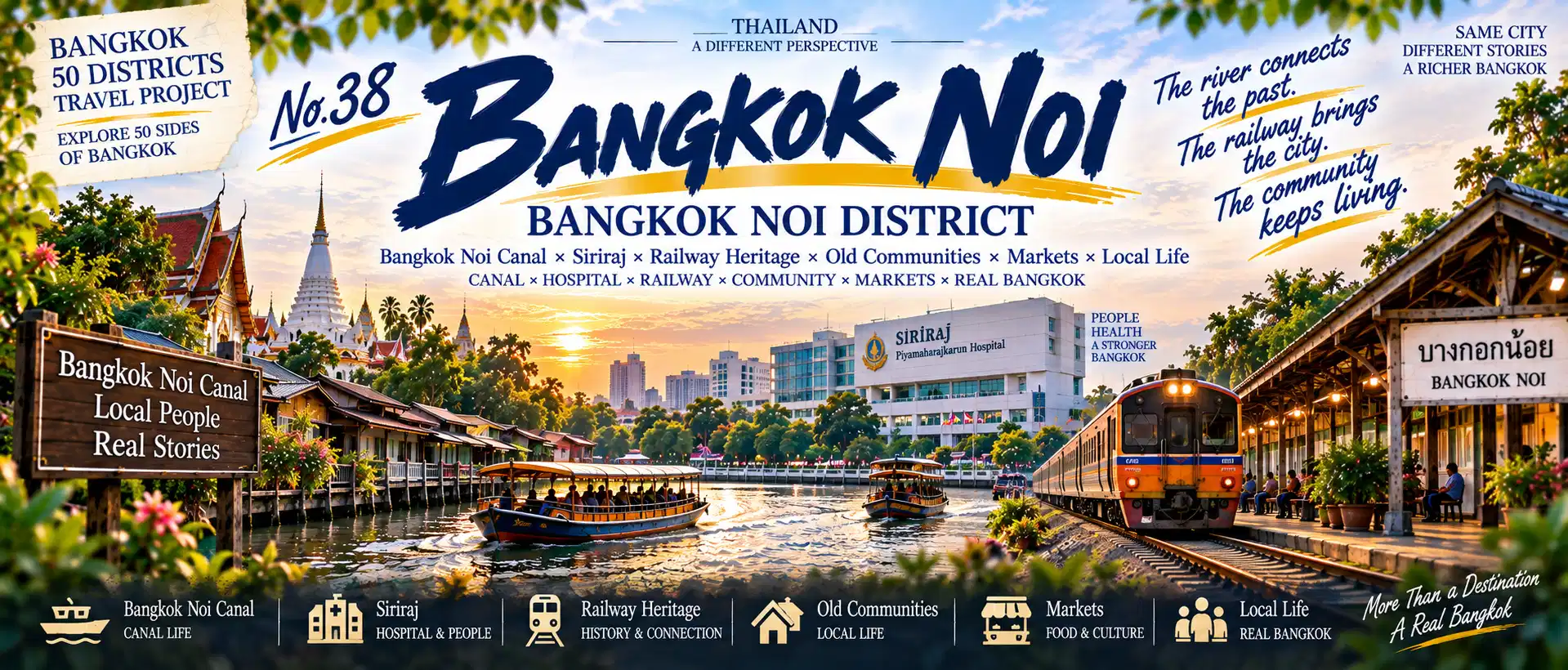
If Wat Arun is the landmark most associated with Bangkok Yai,
then in Bangkok Noi,
the story begins to change.
There is no single landmark that represents the entire district.
Instead, Bangkok Noi has been shaped by many different parts of city life:
Bangkok Noi Canal.
The Chao Phraya River.
Siriraj.
Railways.
Markets.
Temples.
Old communities.
And the streets local residents use every day.
Unlike central Bangkok,
this district is not defined by skyscrapers and major commercial centers.
It feels more like an old map of urban life,
where waterways, railways, roads and communities
have gradually formed different layers of the city.
This is:
Bangkok Noi
01|Continuing North into Bangkok Noi
Continue north from Bangkok Yai,
and the city gradually enters Bangkok Noi.
Wat Arun.
↓
Bangkok Yai.
↓
Bangkok Noi Canal.
↓
Siriraj.
↓
Bangkok Noi.
This time,
the journey is no longer centered around one famous landmark.
Instead,
it becomes a story about how waterways, roads, railways and communities
work together to shape a city.
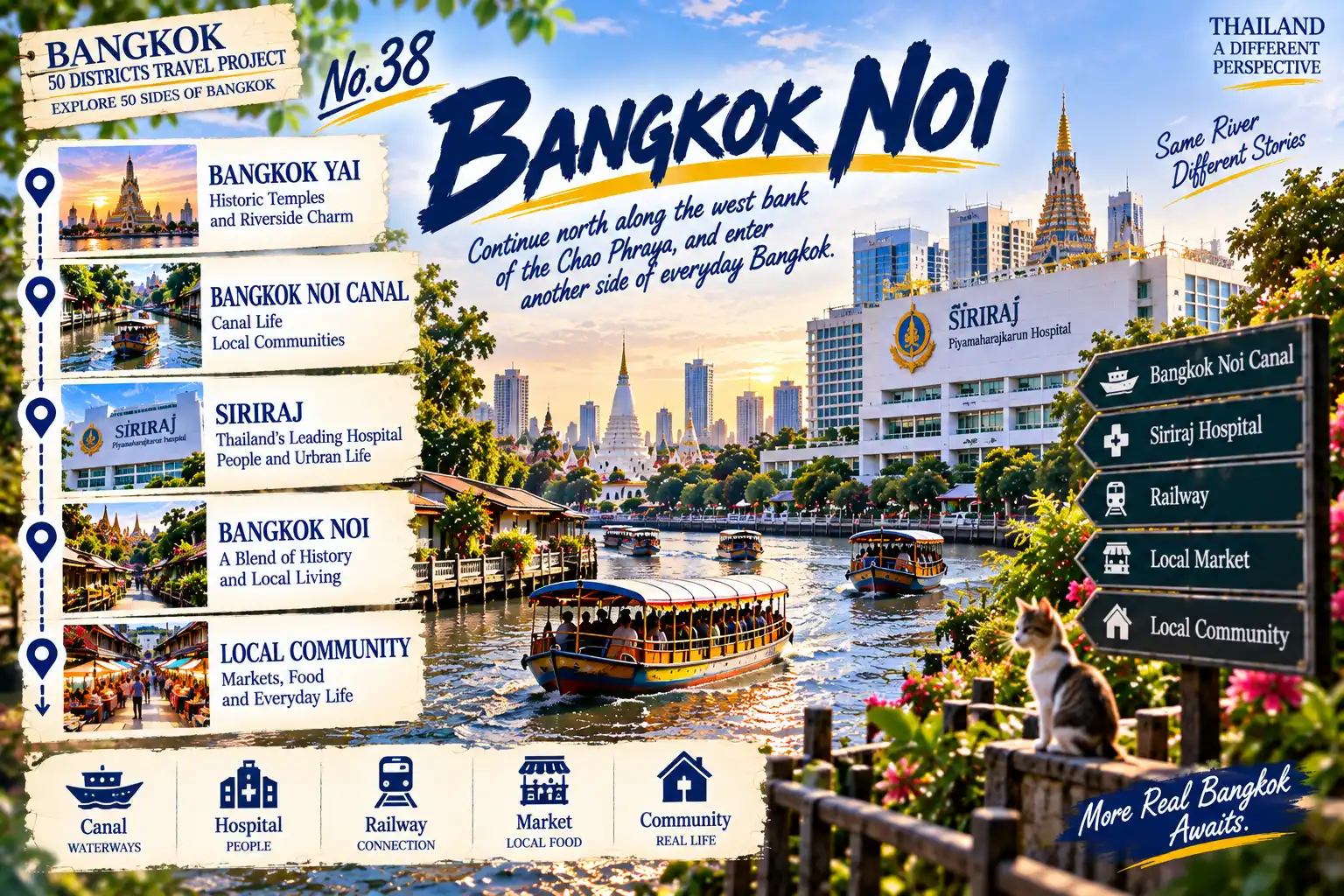
BANGKOK YAI
↓
BANGKOK NOI CANAL
↓
SIRIRAJ
↓
BANGKOK NOI
↓
LOCAL COMMUNITY
CANAL × HOSPITAL × RAILWAY × MARKET × COMMUNITY
**Continue north along the west bank of the Chao Phraya,
and enter another side of everyday Bangkok.**
02|Bangkok Noi Canal: A City That Began with Water
Before modern roads,
much of everyday life in Bangkok Noi depended on water.
Canals provided transportation.
Boats carried goods.
Homes were built along waterways.
Temples stood near piers.
Markets developed around transportation routes.
Water was not simply part of the scenery.
It was once part of the city’s essential infrastructure.
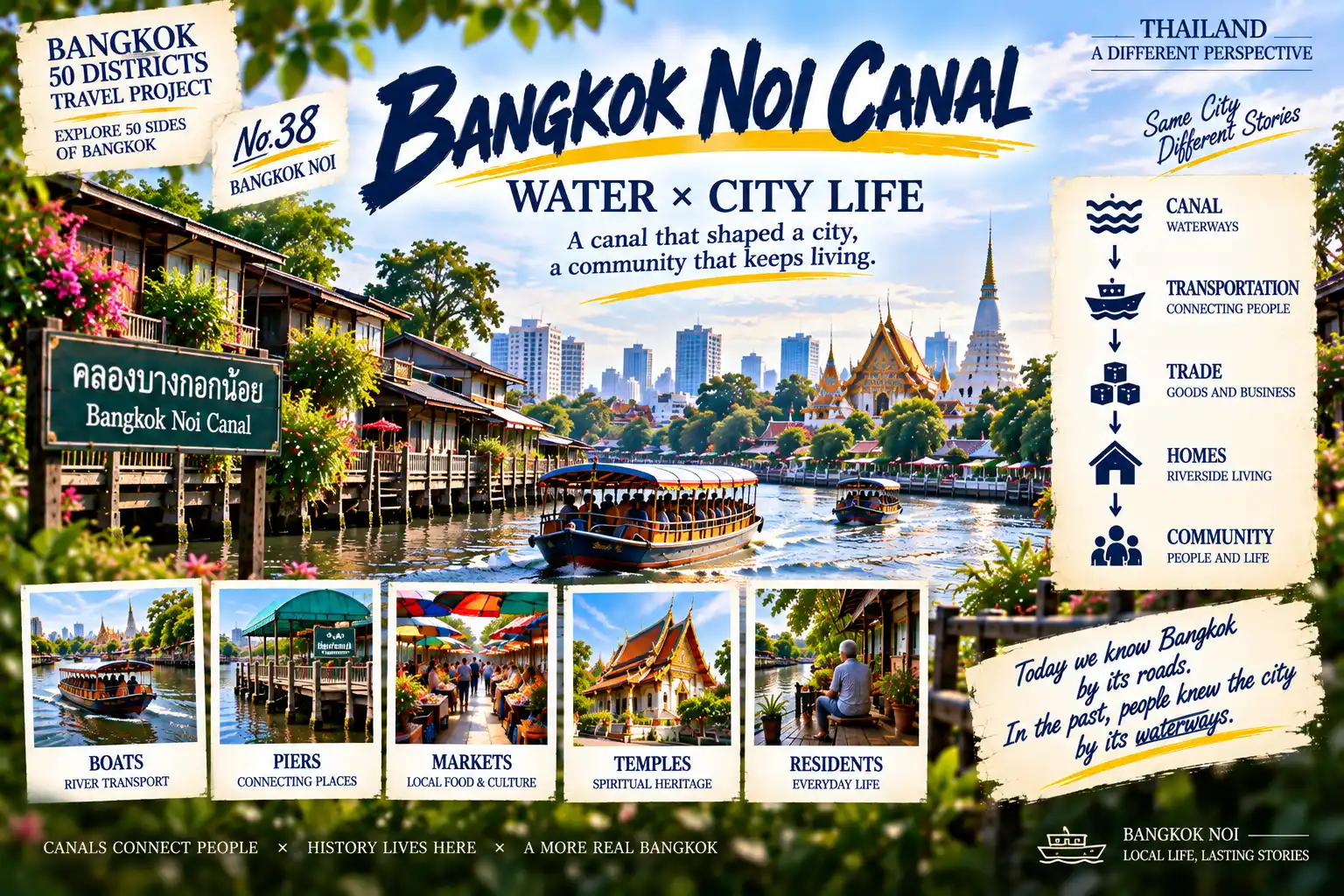
WATER × CITY LIFE
CANAL
↓
TRANSPORT
↓
TRADE
↓
HOMES
↓
COMMUNITY
BOATS × PIERS × MARKETS × TEMPLES × RESIDENTS
**Today, we understand Bangkok through its roads.
In the past, people understood the city through its waterways.**
03|After the Waterways Came the Railway
As Bangkok continued to modernize,
the way people moved around the city began to change.
Waterways remained,
but railways introduced a new form of connection.
Stations.
Goods.
Passengers.
Connections between Bangkok and more distant places.
Bangkok Noi therefore carries not only the memory of a water-based city,
but also traces of Bangkok’s railway development.
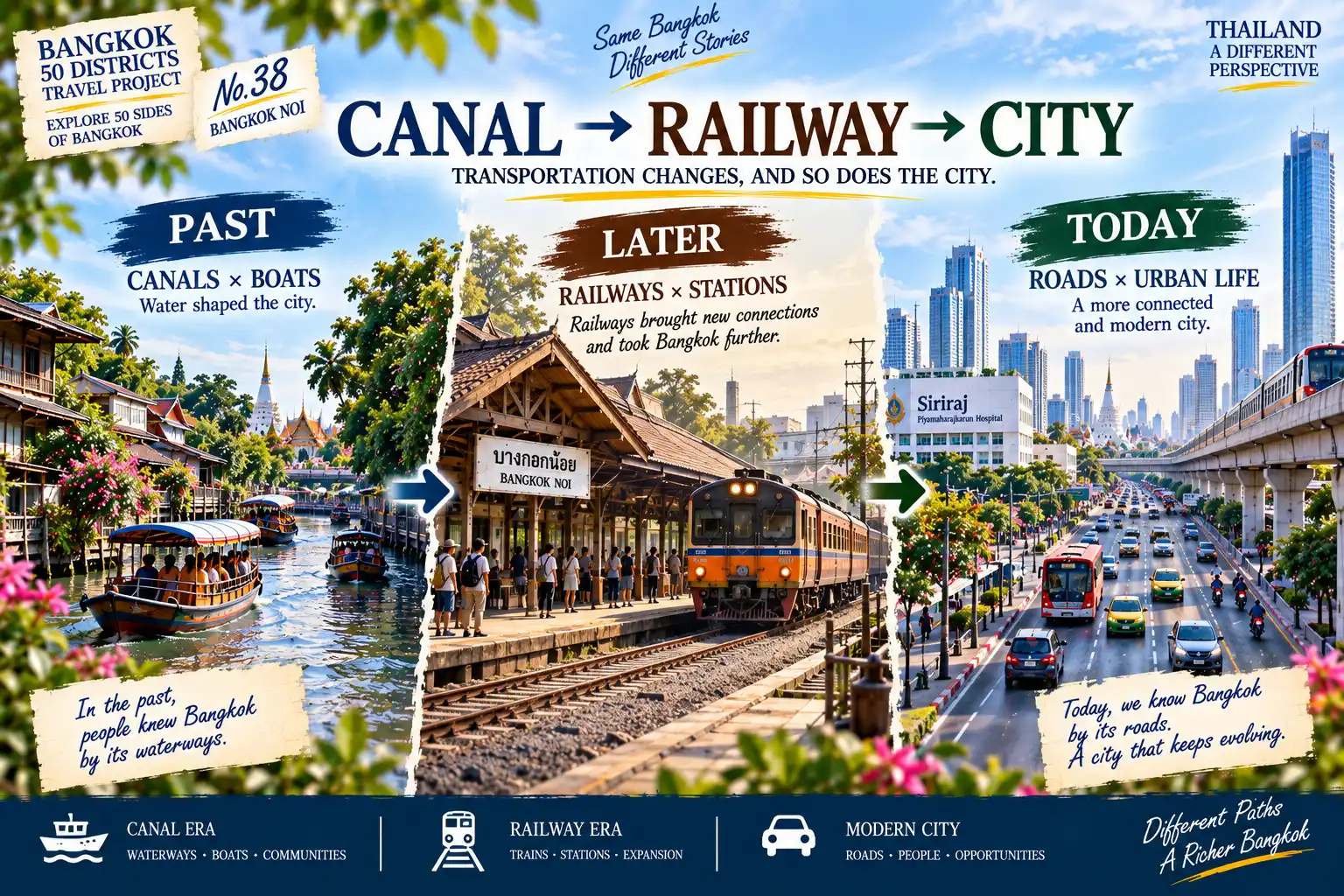
CANAL → RAILWAY → CITY
PAST|CANALS × BOATS
↓
LATER|RAILWAYS × STATIONS
↓
TODAY|ROADS × CITY LIFE
**Transportation keeps changing.
The city changes with it.**
04|Thonburi Railway and the Memory of the City
For Bangkok Noi,
the railway was more than a means of transportation.
It also changed urban space.
People gathered around stations.
Businesses followed transportation routes.
Residential areas gradually expanded.
Railways connected the city
with places farther away.
Today,
Bangkok has entered the era of BTS, MRT and expressways.
But the old railway still records another stage of the city’s modernization.
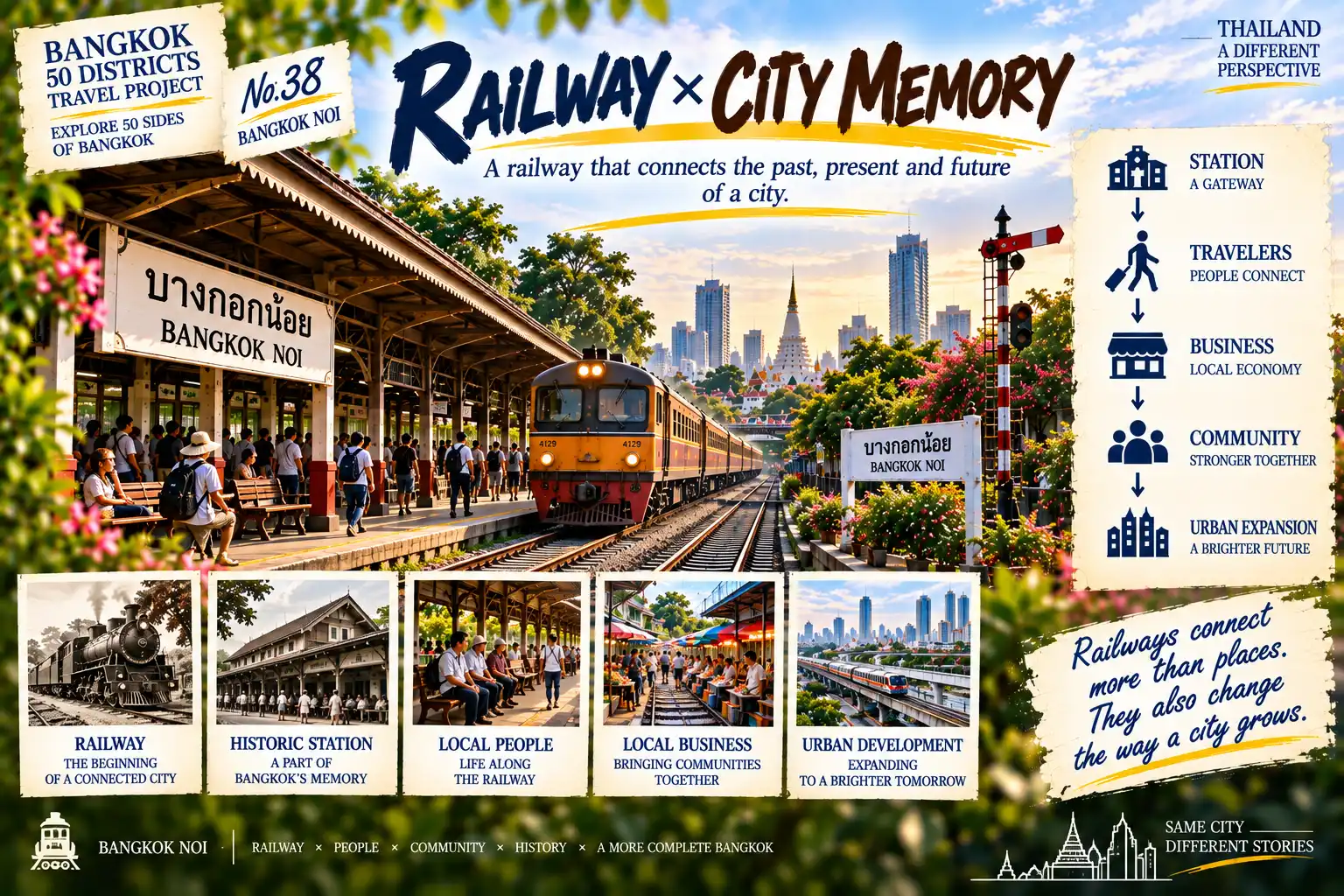
RAILWAY × CITY MEMORY
STATION
↓
PASSENGERS
↓
COMMERCE
↓
COMMUNITY
↓
URBAN EXPANSION
RAILWAY × OLD STATION × RESIDENTS × URBAN DEVELOPMENT
**Railways connected more than places.
They also changed the direction in which the city grew.**
05|Siriraj: Another Side of Everyday Bangkok Noi
Bangkok Noi also plays another important role in the city:
Healthcare.
The Siriraj area sees large numbers of people moving through it every day.
Doctors.
Nurses.
Students.
Patients.
Families.
Workers.
Food vendors.
Transportation.
This makes Bangkok Noi very different from an area designed mainly around tourism.
This is not an urban space that operates for visitors.
It performs essential functions for the city itself.
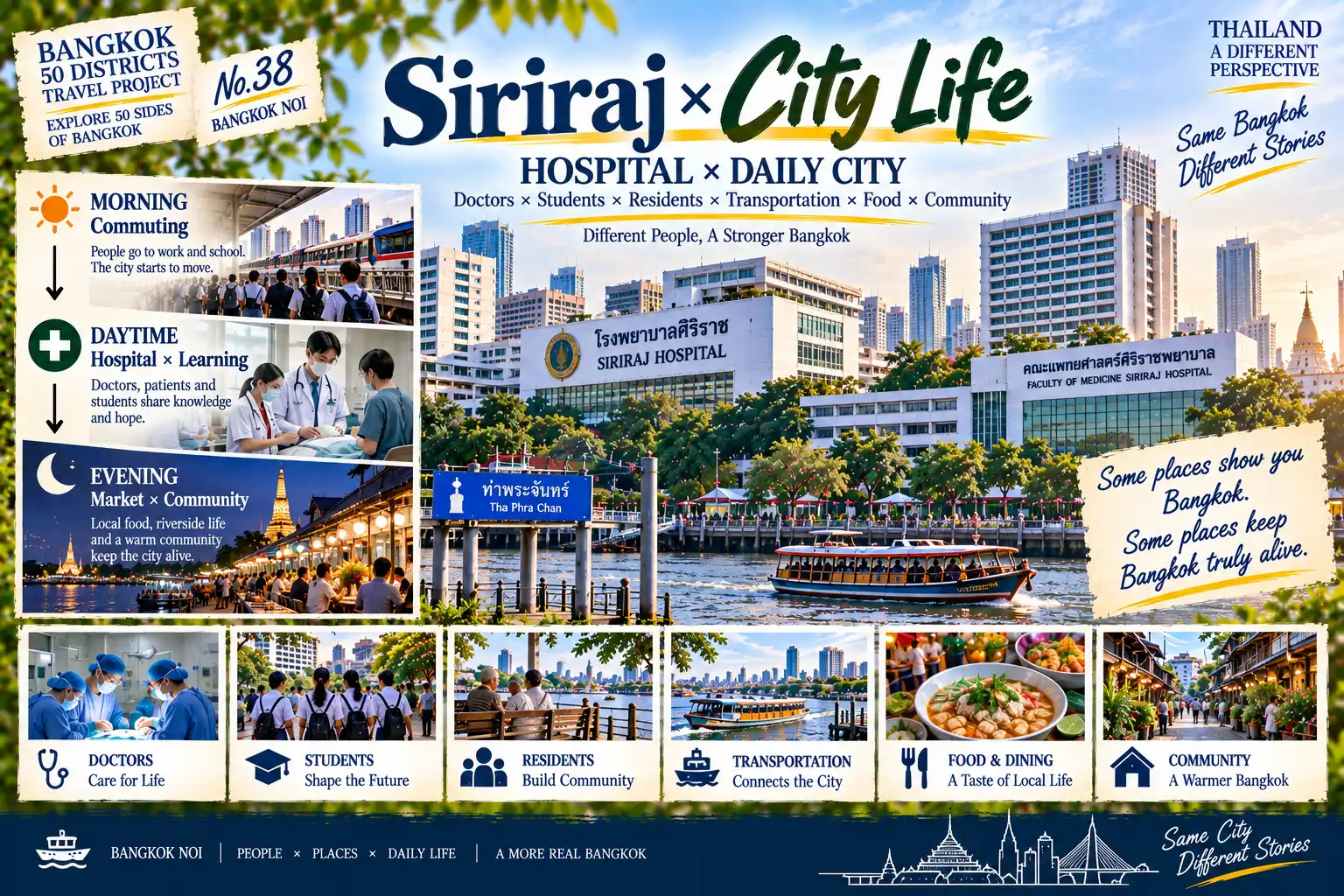
HOSPITAL × DAILY CITY
DOCTORS × STUDENTS × RESIDENTS × TRANSPORT × FOOD × COMMUNITY
MORNING|COMMUTE
↓
DAY|HOSPITAL × EDUCATION
↓
EVENING|MARKET × COMMUNITY
**Some places showcase Bangkok.
Other places keep Bangkok running.**
06|Bangkok Noi Local Market
Leave the main roads
and enter the neighborhood,
and the market once again becomes a center of everyday life.
Breakfast.
Fruit.
Prepared food.
Vegetables.
Small shops.
Residents.
Students.
Workers.
These markets do not need to become “tourist attractions.”
They are already part of daily life.
LOCAL MARKET × EVERYDAY LIFE
BREAKFAST × FRUIT × COOKED FOOD × SMALL SHOPS × RESIDENTS × STUDENTS
MORNING|BREAKFAST × COMMUTE
↓
NOON|MARKET × LUNCH
↓
AFTERNOON|SHOPPING × COMMUNITY
**Visitors look for something unique.
Residents look for what they need every day.**
07|Waterway Bangkok VS Railway Bangkok
One of the most interesting things about Bangkok Noi
is that two different eras of urban transportation can still be seen together.
On one side:
Canals.
Small boats.
Piers.
Waterfront communities.
On the other:
Railways.
Stations.
Roads.
The modern city.
The waterways have not completely disappeared.
The railway has not completely become history.
Different transportation eras
still overlap within the same district.
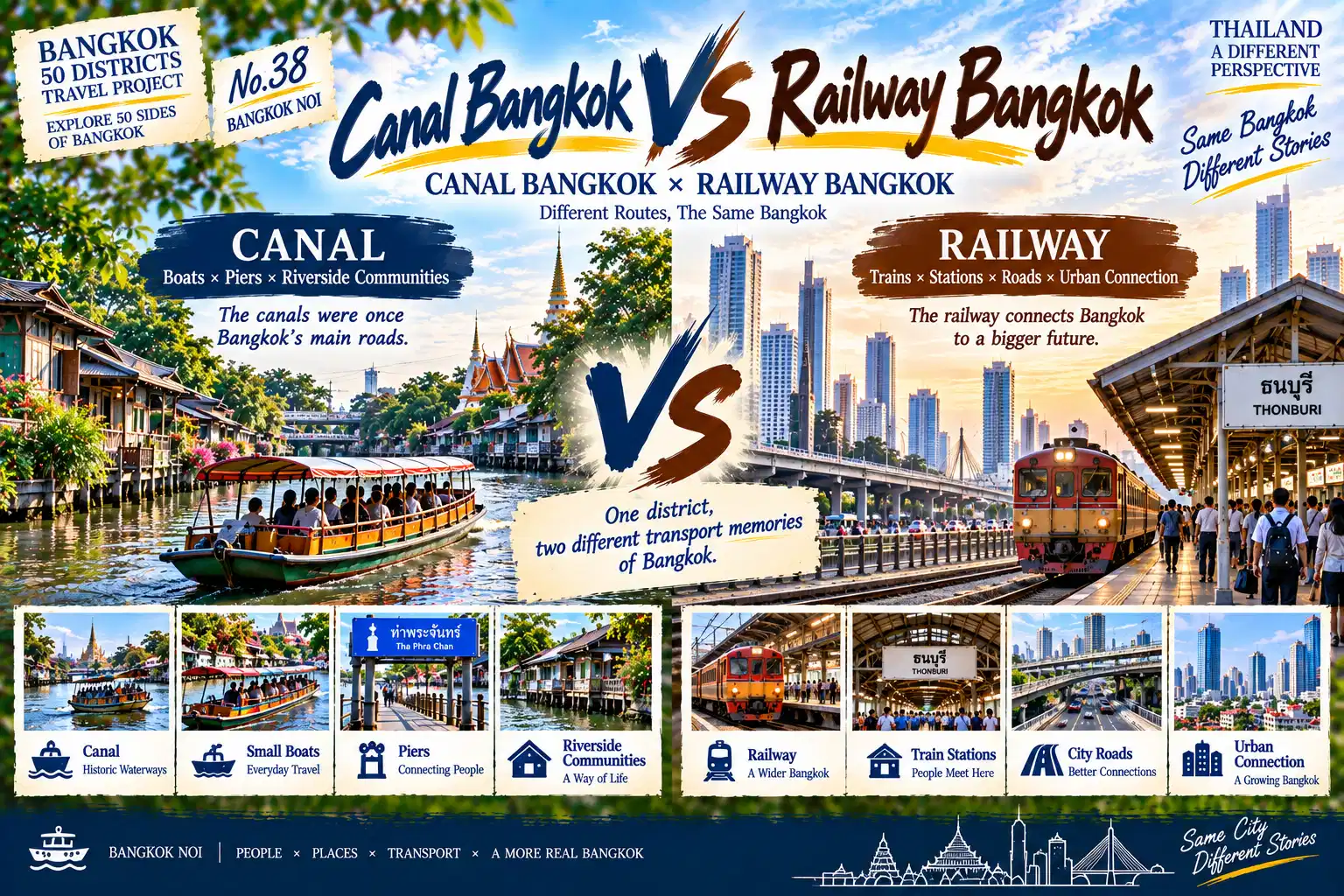
WATER × RAIL
CANAL
CANALS × BOATS × PIERS × WATERFRONT COMMUNITIES
VS
RAILWAY
RAILWAYS × STATIONS × ROADS × URBAN CONNECTIONS
**One district,
preserving two different transportation memories of Bangkok.**
08|A One-Day Bangkok Noi Travel Plan
For a first visit,
think of the day as:
“From canals to railways, then into everyday west-bank life.”
09:00|Depart Central Bangkok
Head toward the western bank of the Chao Phraya.
09:30|Cross the Chao Phraya
Enter Bangkok’s west bank.
10:00|Siriraj
Observe the rhythm of everyday city life.
11:30|Bangkok Noi Canal
Discover the urban structure left by the waterway era.
12:30|Local Lunch
Eat inside the neighborhood.
14:00|Railway × City Memory
Explore Bangkok Noi’s railway story.
15:30|Local Market
See how residents shop and live every day.
17:00|Old Community × Local Streets
Slow down and explore a quieter Bangkok Noi.
18:00|Chao Phraya × Sunset
Return to the river to end the day.
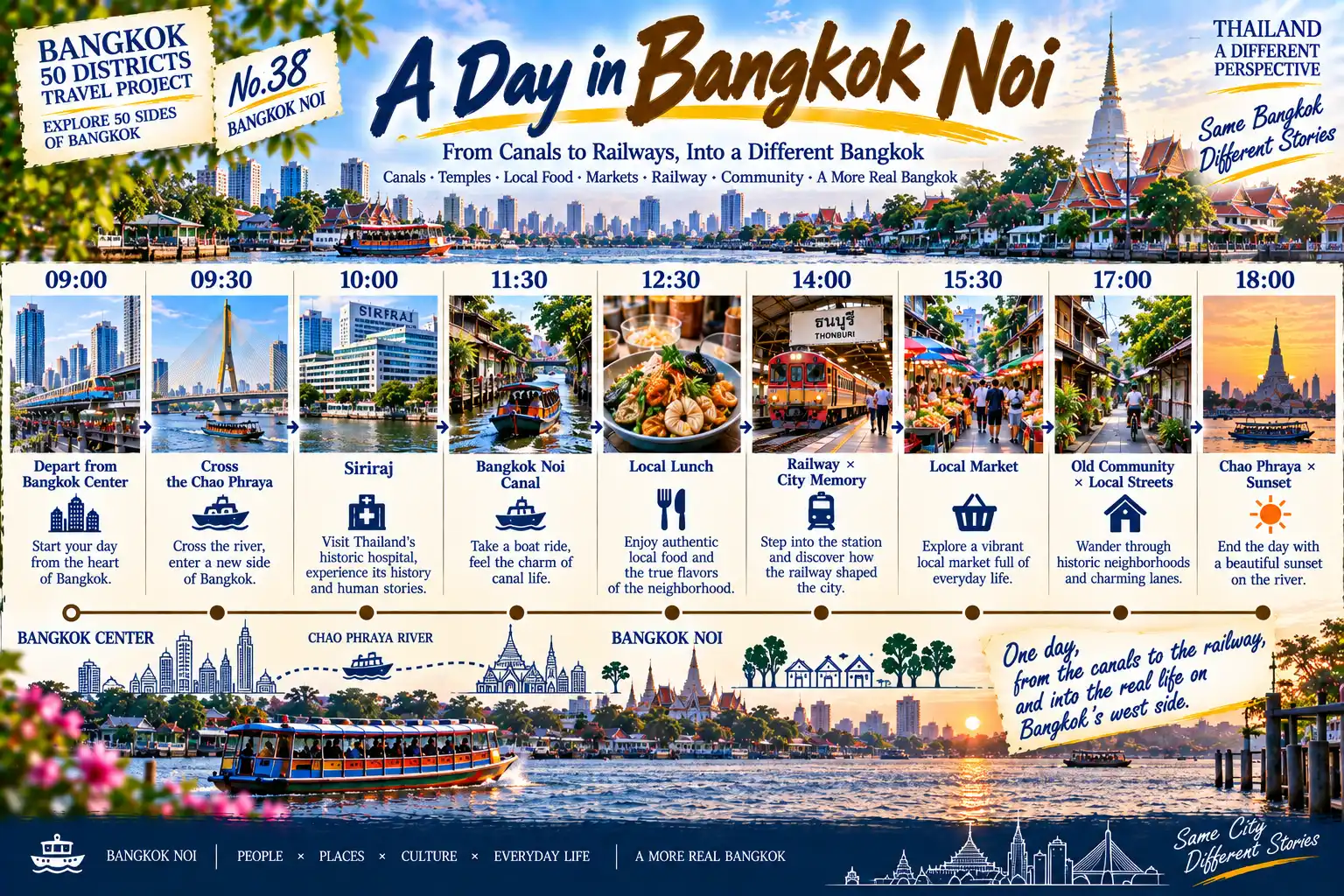
09:00|DEPART CENTRAL BANGKOK
09:30|CROSS THE CHAO PHRAYA
10:00|SIRIRAJ
11:30|BANGKOK NOI CANAL
12:30|LOCAL LUNCH
14:00|RAILWAY × CITY MEMORY
15:30|LOCAL MARKET
17:00|OLD COMMUNITY × LOCAL STREETS
18:00|CHAO PHRAYA × SUNSET
**One day,
from canals to railways,
then into the everyday life of Bangkok’s west bank.**
09|Why Is Bangkok Noi Worth This Stop?
Because Bangkok Noi shows us that
a city is never shaped by only one form of transportation,
one landmark,
or one period of history.
Waterways created one layer of the city.
Railways brought new connections.
The hospital created another major flow of people.
Markets continue to serve everyday life.
Roads continue to reshape neighborhoods.
And local residents
connect all these different layers of the city.
So the most interesting thing about Bangkok Noi
is not one “must-see attraction.”
It is the chance to understand:
**How a city slowly became what it is today through waterways, railways and everyday life.**
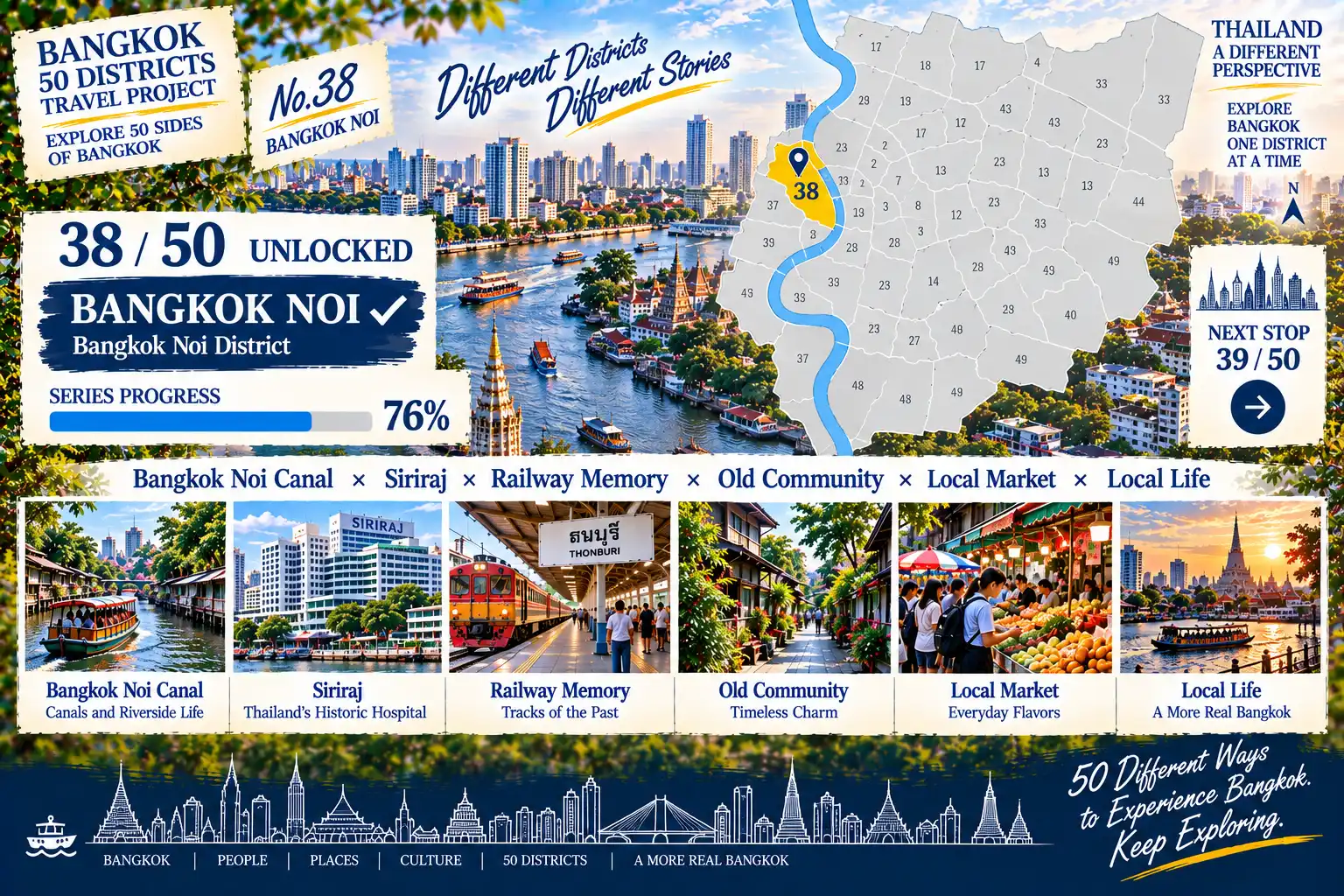
BANGKOK 50 DISTRICTS TRAVEL PROJECT
**38 / 50 UNLOCKED**
BANGKOK NOI ✓
SERIES PROGRESS|76%
BANGKOK NOI CANAL × SIRIRAJ × RAILWAY HERITAGE × OLD COMMUNITIES × MARKETS × LOCAL LIFE
NEXT STOP: 39 / 50
**50 districts.
50 different ways of life.
Keep exploring Bangkok.**